
Happy Sunday, bibliophiles, and happy near year!
First post and the first Sunday Songs of 2025! No pressure. This week: new verses on new songs, new(ish) takes on old(er) songs, and…oh, god, Eric, please put your shirt back on—
Enjoy this week’s songs!
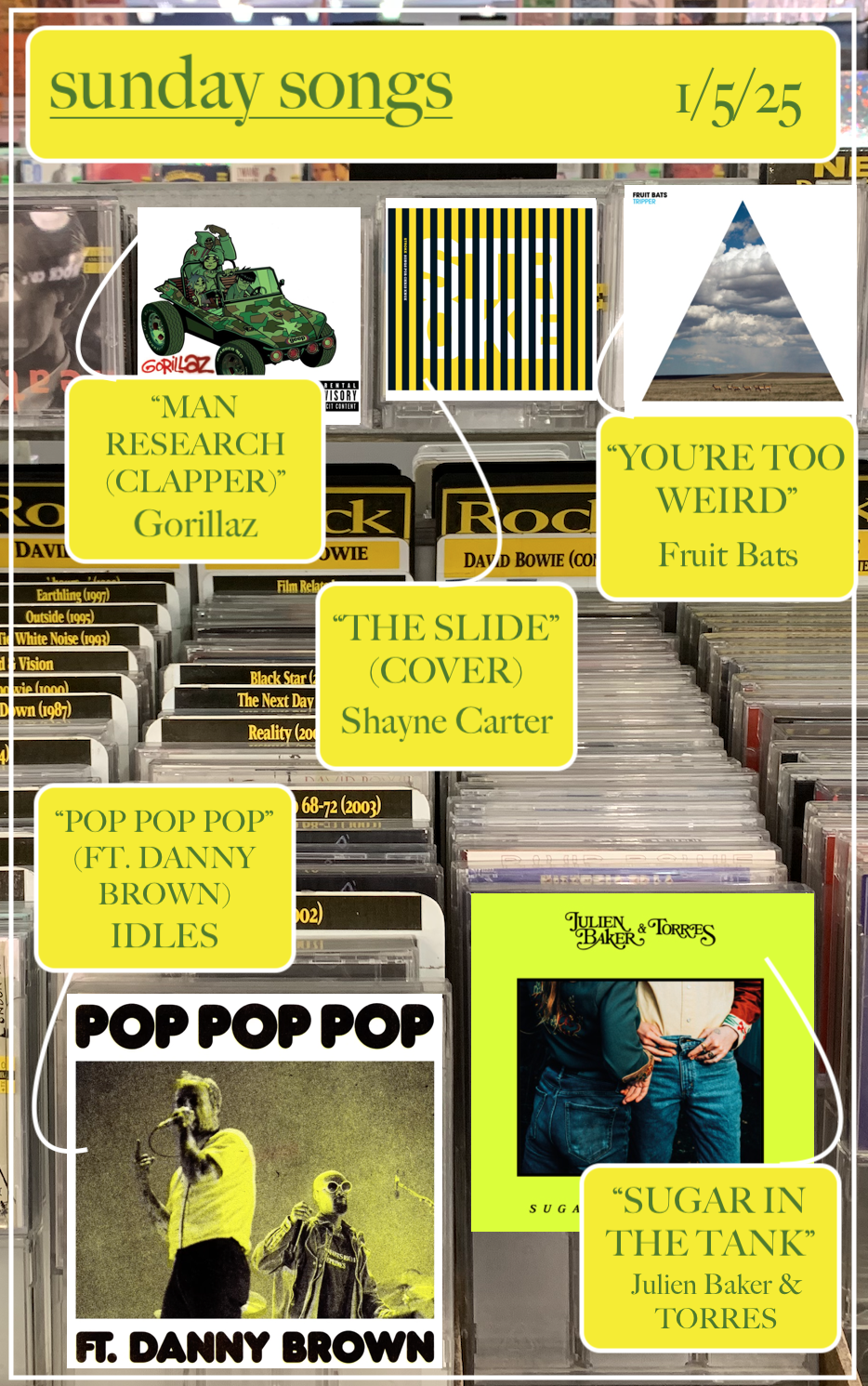
SUNDAY SONGS: 1/5/25
“POP POP POP (feat. Danny Brown)” – IDLES
Dread it…run from it…TANGK always arrives. One of the best albums of 2024, hands down. I already talked about “POP POP POP” back in March, but at the end of the year, IDLES added one more flourish to an already excellent track—a guest feature by Danny Brown. Of course, I say that knowing next to nothing about Danny Brown up until this point, but the spin he and IDLES put on one of the most prominent highlights of TANGK is an interesting one—and catchy, too. In places, the beat has been treated like an accordion, stretched out in some areas and compressed in others—the final, spoken-word monologue has been sped up, while the first five seconds are jumpstarted, recreating the static of plugging a guitar amp in. Meanwhile, Brown’s guest verse hurtles at breakneck speed; For me, there are some lines that come across rather corny (“On the surface/Looks like a circus/All these clowns around, pull the curtain”). However, at the very end, Brown’s lyrics align with the ethos of “POP POP POP” in the first place: an assertion of purpose, that purpose being staying true to yourself, spreading love, and being a source of protection for others. The final line sums it up nicely: “Took a couple wrong turns/Don’t know right from left/But found my way to the home that I strayed/And now I say everything is okay.” Can “POP POP POP” ever be improved? I highly doubt it, but I also doubt that this was meant to be an improvement—it’s more the kicking around with a preexisting idea with other collaborators, and in that experimentation, it creates an exciting take on one of the 2024’s best songs.
…AND A BOOK TO GO WITH IT:
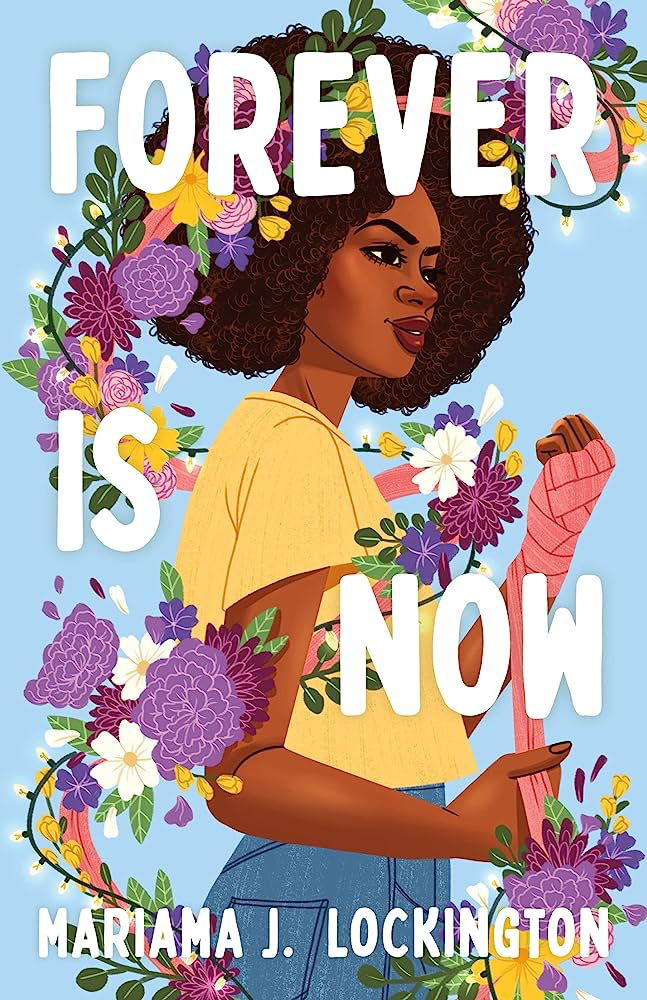
Forever Is Now – Mariama J. Lockington – “Searching for something you cannot hide/Looked in the wrong place, but should search inside/Relied on things that just let me down
But now I see what its really ’bout…”
“Sugar in the Tank” – Julien Baker & TORRES
Personally, I’ve never quite gotten on board with the queer cowboy aesthetic, but I can respect how queer people have been taking it back. In the first place, I think any kind of cowboy mythos attracts the kind of people who want to forge their own trails and make their own way without the constraints of society, a Venn diagram that seems to attract, strangely enough, both conservative people wanting to go back to “traditional values” and queer people who see an out from heteronormative culture. Growing up in the mountains, my association with much of it came from the former, even in our fairly liberal town (I say fairly liberal because there was the odd confederate flag or “if you’re reading this, you’re in range” sign on someone’s house). But I don’t mind seeing a bedazzled cowboy hat or a boygenius photoshoot out in the desert every now and then. Evidently, I’m too much of a city slicker.
The reclamation of country by queer people has gone in much the same way, and I’ve never been one for country in the first place (same association as above), but what I will give a try 8 or 9 times out of 10 is anything that Julien Baker is involved in. Now here’s an example of queer cowboy/country reclamation done right: nothing better than two lesbians making a song with a title referring to slang for an effeminate man and turning it into something positive and sensual. Musically, there’s twang aplenty, but at least for me, Baker’s talent screams at you like a neon sign—she’s whipped out the banjo once more, and it contrasts with the hazy overdrive that TORRES has applied to her excellent guitar work. The boygenius fan is me is more partial to how Baker’s harmonies fit with Phoebe Bridgers and Lucy Dacus, but it’s clear that she’s well-matched with TORRES, musically and vocally. I’m not 100% on board with the more country direction—it’s more on the alt-country side, but very much country-sounding—but I’ll give it a chance for Baker.
…AND A BOOK TO GO WITH IT:

Road to Ruin – Hana Lee – will something close to post-apocalyptic, biker cowboys suffice?
“Man Research (Clapper)” – Gorillaz
I remembered this track after getting into “Bill Murray” a few weeks ago; as wonderful an album as Gorillaz is, I often find myself forgetting about some of the songs sandwiched in the middle; this one has the job of following up “Clint Eastwood,” and with how many tidal waves that classic made in the early 2000’s, any track following that up, like “Bill Murray” and “Feel Good, Inc.,” has an exceedingly hard act to follow. But in much the same way as “Bill Murray” brings down the tempo but keeps the creativity, “Man Research (Clapper)” provides a bridge between some of the more energetic heavy-hitters—“Punk” comes up right after it. Buoyed by a sample from Raymond Scott’s instrumental piece “In The Hall of the Mountain Queen” (delightful, honestly—feels like the title screen music for an ’80s video game and not in a cheesy way), it’s dominated by the rasping repetitions of Damon Albarn pushing his higher vocals to their limits—maybe there’s the excuse for why I forgot about it. A good portion is just him going “yeah yeah yeah yeah yeah yeah,” but that’s the mark of a great musician—sure, he’s just going “yeah yeah yeah” in front of a sample and some record scratches, but I eat it up every time. There’s a smooth cohesion to his craft that makes every separate element seem as though this song is their final form, their ultimate destiny to be brought together.
…AND A BOOK TO GO WITH IT:
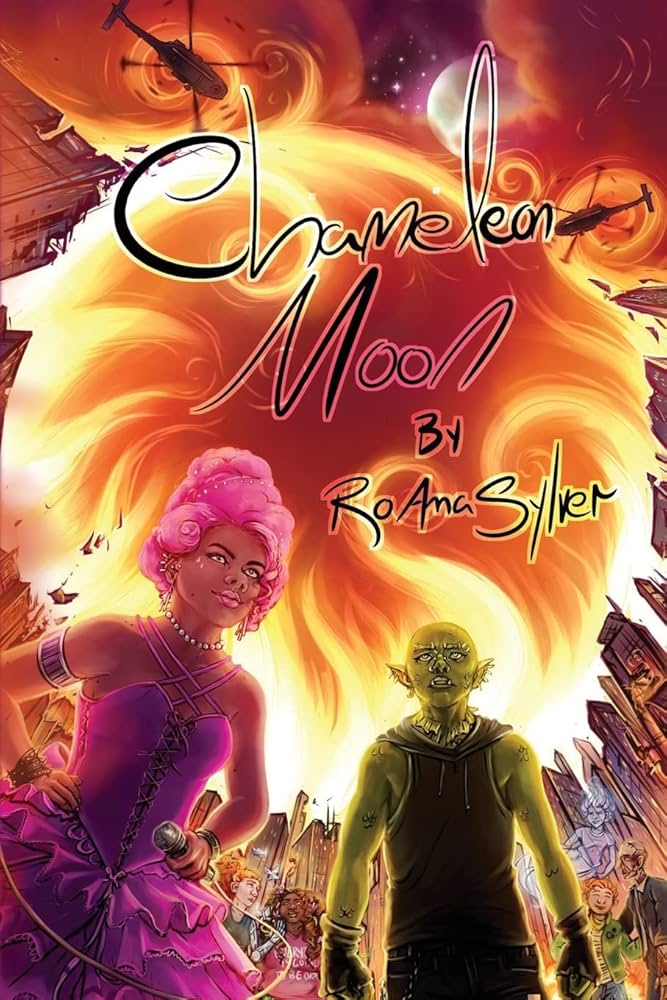
Chameleon Moon – RoAnna Sylver – I picked this one more for the atmosphere than the lyrics—a similar kind of hazy and raspy energy, but with an undercurrent of vitality.
“The Slide” (Tall Dwarfs cover) – Shayne Carter
Some covers prove that the singer understands some part of the song more than the original creators. Not to front on Chris Knox, incredibly talented and oddball songwriters as he is, but Shayne Carter’s cover gets to the heart of what Knox and co. were going for as far as the tone and the emotion of the lyrics.
Tall Dwarfs aren’t going to be anything but jangly, and their original version of “The Slide” is no exception. It’s got a psychedelic, ’60s sway to it, faintly sunny…and then you get to the lyrics. And then you get the whiplash from hearing those upbeat guitars against the lyrics: “The doctors should kill/She’s terminally ill.” I’m sorry, WHAT? I’m not saying that songs can’t have lyrics that don’t match the mood of their music, but in this case, Shayne Carter’s interpretation does the song more justice. In contrast to Knox’s upbeat instrumentals, Carter employs solemn pianos, muted strums of an acoustic guitar, and an electronic drone that begins to circle around you at the 1:58 mark as you listen like vultures circling carrion. The acoustics sound like they were recorded at 3 a.m. in an abandoned gym with walls covered in mold. That atmosphere captures how disturbing the lyrics are—sparsely told, it recounts the experience of an 80-year-old, terminally ill woman wasting away in an institution. That cold, chilling echo gives the song a much more tangible setting and emotional depth; the spareness of it all makes the setting so much more unforgivable, with its featureless walls and constant chill in the air. That Radiohead-like, droning dread comes about as close as I would imagine to capturing that imprisoned, monotonous feeling of your mind slip away and being powerless to do anything about it, all the while surrounded by nurses who barely want to be there. It’s a tragedy of a song—it was written in the 1990’s, and while I’m sure conditions have somewhat improved for patients, these situations are a reality for so many people, whether or not they have control of their minds. The pen that Chris Knox and co. put to paper was a respectful and sympathetic one, but Shayne Carter deserves so much praise for how much his musical interpretation brought out the original sentiment—and made it even more emotional.
Sadly, it’s a story that partially came true for Chris Knox; he suffered a stroke in 2009, and has had a limited vocabulary ever since. He’s made a handful of public appearances and performances in the last decade or so, but he’s largely off the radar these days. However, “The Slide,” alongside many more of his covers from both his solo work and of Tall Dwarfs, were compiled on Stroke: Songs for Chris Knox in order to initially help his family pay the medical bills. I hoped that he hadn’t accidentally predicted his own fate with “The Slide,” but it seems that his family has been going to great lengths to make sure he’s taken care of. Even amidst the horrors he described, there are bright spots worth celebrating—namely, the love of family and friends during unpredictable situations such as his.
…AND A BOOK TO GO WITH IT:
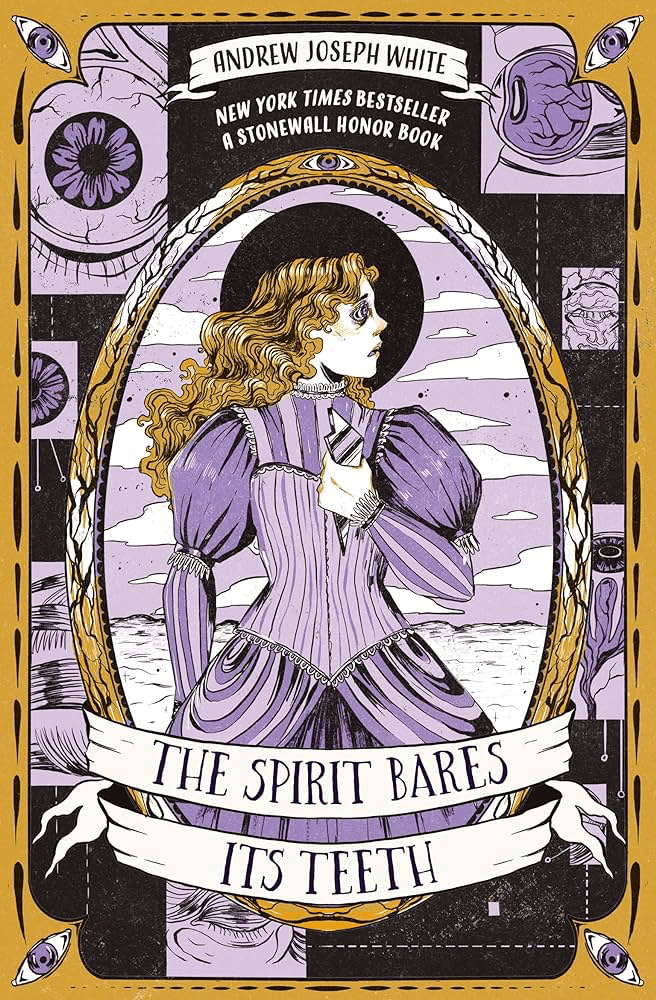
The Spirit Bares Its Teeth – Andrew Joseph White – the institutions in this novel are different than the one in the song, but it’s just as oppressive—and deeply haunting and eerie.
“You’re Too Weird” – Fruit Bats
…okay! Going into this, I didn’t expect to be that well-acquainted with Eric Johnson’s chest hair while he stared longingly into my eyes, but here we are? 😀 Don’t think I needed all that…thank you Eric, very cool
Either way, it’s all part of the ’80s-parodying cheese of the music video, complete with mullets, long pearl necklaces, everyone’s hair being artfully blown by an invisible fan, and even a keytar. The best part is that every single band member is fully leaning into the cheese, with every band member hamming it up whenever the camera is on them. If I can erase the strategic view of said chest hair via Johnson’s unbuttoned shirt, “You’re Too Weird” is a great little indie track; Johnson has one of the more distinctive voices in indie music that I can think of, and he takes it to some of its extremes, hitting higher notes than I’d expect even from him. Like the ’80s music and videos that “You’re Too Weird” takes cues from, it’s an endlessly catchy love song, peppered by a tasteful guitar solo and tambourine here and there. I’ll have to bring this back once the weather gets warmer—it’s the perfect song for staring out the car window on a summer evening.
…AND A BOOK TO GO WITH IT:
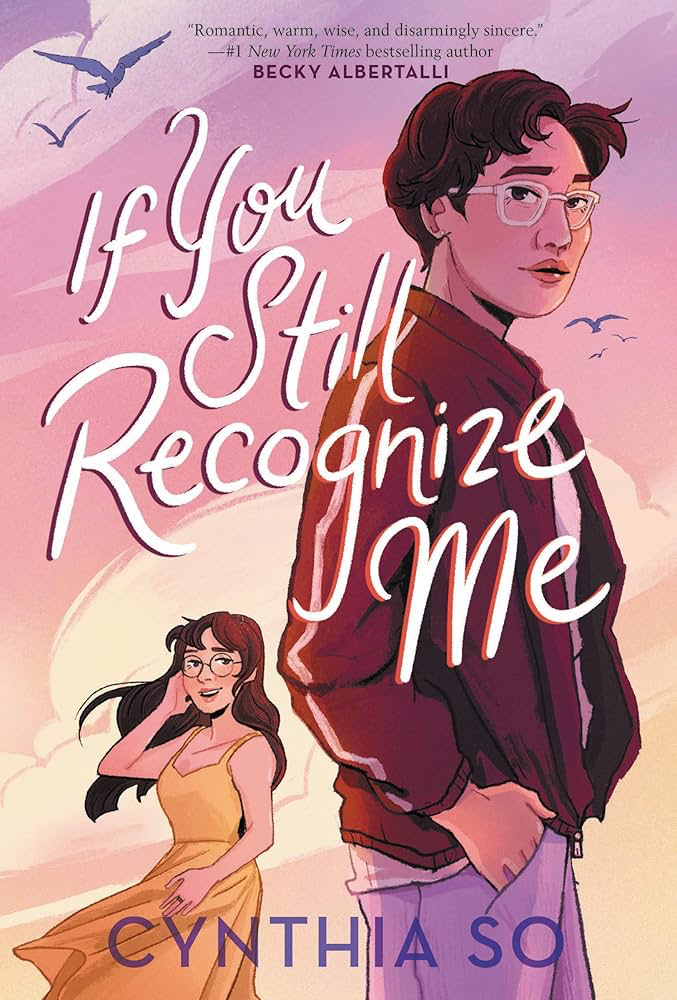
If You Still Recognize Me – Cynthia So – “They say that I’m not supposed to be in love with you/They say that you’re too weird for me/And you’ll leave eventually/But then I’m the only one who ever believed in you…”
Since this post consists entirely of songs, consider all of them to be today’s song.
That’s it for the first Sunday Songs of the year! Have a wonderful rest of your day, and take care of yourselves!


 The Bookish Mutant