

Happy Sunday, bibliophiles! I hope this week has treated you well.
This week: even if Wilco wasn’t ever-present in The Bear, we’d have to physically restrain Jeff Tweedy just to stop him constantly cooking in that kitchen. Plus: lots of top tier album intros and some lyrics I probably should’ve reconsidered playing in the presence of my guitar teacher.
Enjoy this week’s songs!
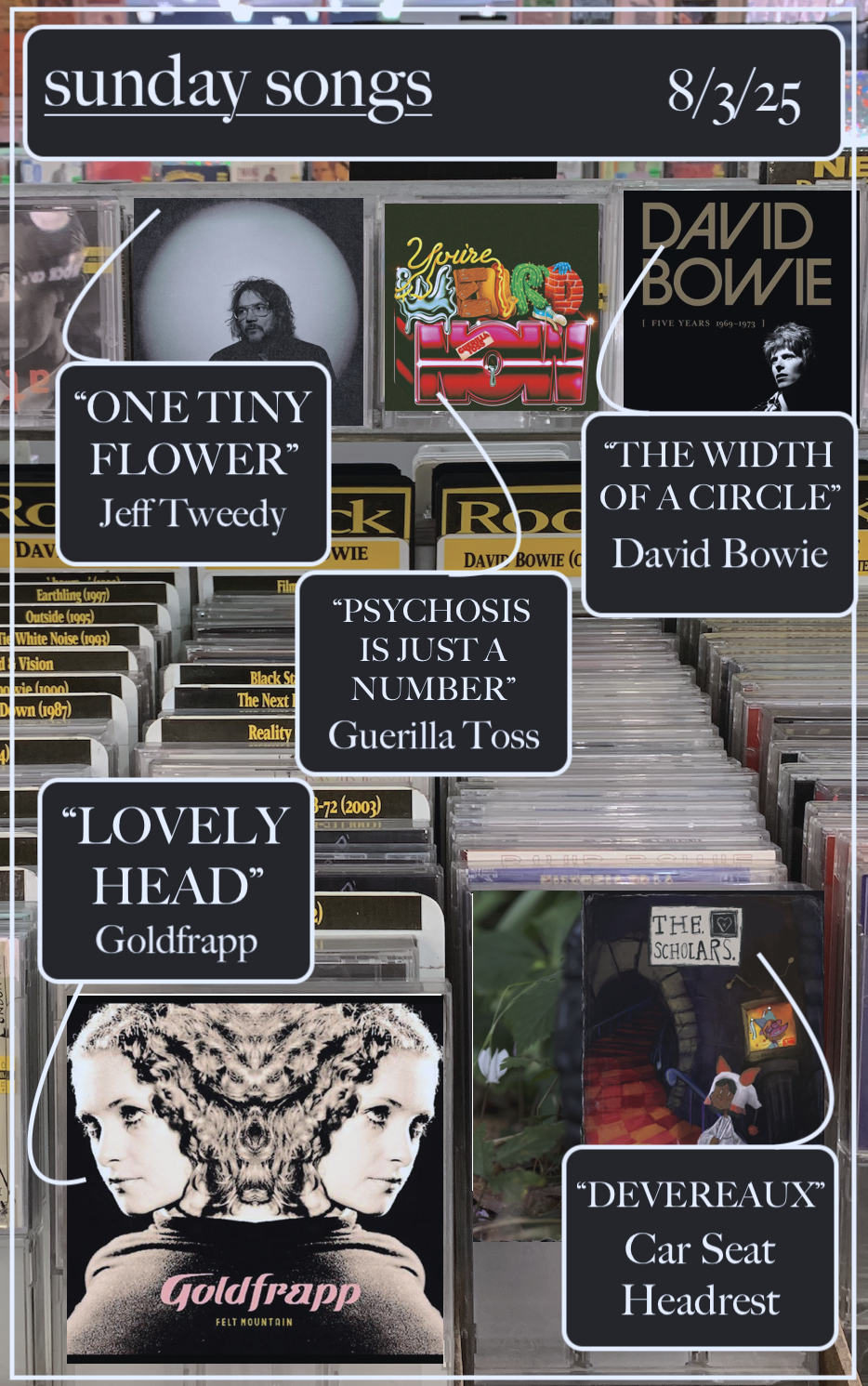
SUNDAY SONGS: 8/3/25
Both Alison Goldfrapp and Will Gregory had been musically active before they joined forces, but even then, to come right out the gate with a single like this is so impressive for a band just getting its start. “Lovely Head” was the first single that Goldfrapp ever released and eventually became the opening track for their debut album, Felt Mountain. The U.S. didn’t seem to see the wave of popularity it eventually gained, but in the U.K., it was used liberally in film, TV, and commercials in the early 2000’s. But if there was ever a song that was meant for all of those things, it’s this one. Everything about it is cinematic, from the Ennio Morricone-like whistling intro to the soaring, theremin-like melodies, which wasn’t actually a theremin at all—just Alison Goldfrapp’s voice filtered through a synthesizer. It’s just so deliciously eerie, cool and distant, with lyrics that seem romantic only from the furthest distance, but disaffected and almost scientific once you examine them more closely. “Frankenstein would want your mind/Your lovely head” is probably only romantic for…y’know, a serial killer, or something, but it’s the precise effect that I think the song is going for—a love song penned by a cold-blooded killer.
…AND A BOOK TO GO WITH IT:
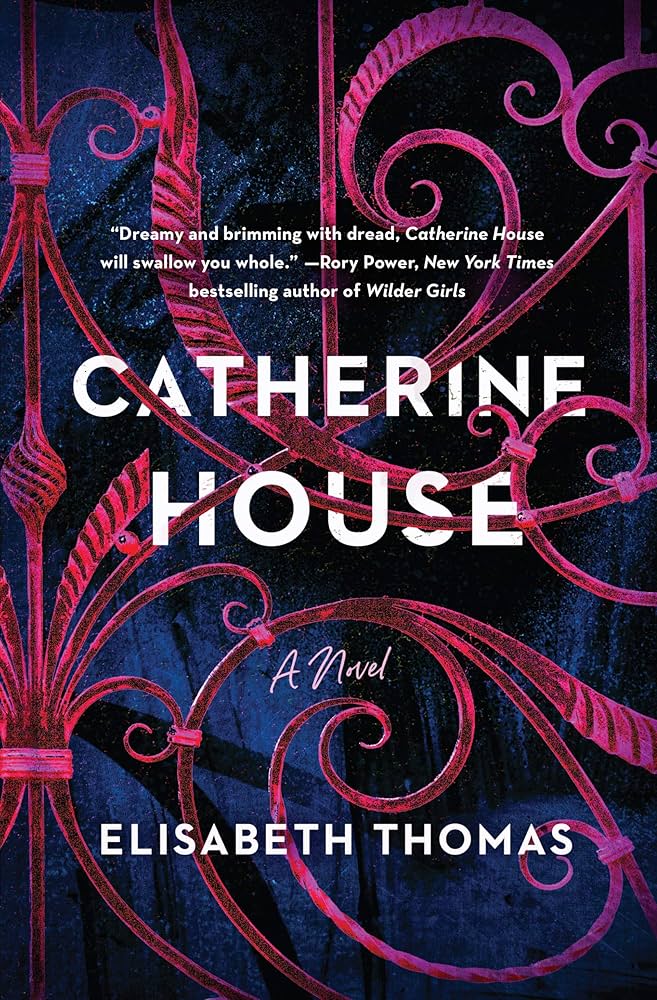
Catherine House – Elisabeth Thomas – an eerie atmosphere, eerie interactions with eerie people, all in an eerie, secretive college.
“Devereaux” – Car Seat Headrest
I promise I’ll shut up about Car Seat Headrest for a few more months after this week. Well…I can’t make any promises.
Though I never got around to writing an album review for The Scholars (or any other of the amazing albums that have come out this year…oops. Phonetics On & On is the only album to come out in 2025, folks! Rejoice!), I feel like it’d be a crime for me to not talk about “Devereaux” at some point. After the back-to-back slew of excellent singles, “Devereaux,” along with “Equals,” is the song I’ve come back to the most from The Scholars. It’s what duped me into thinking that the album was going to be a re-hash of Teens of Denial, but even though it calls back to the song, the rest of the album proved me dead wrong…though I wouldn’t complain about Teens of Denial 2: Electric Boogaloo. Despite being from the perspective of one of Will Toledo’s many characters, a crocodile named Devereaux, the themes of living under the roof of religious bigotry and longing for escape could’ve been plucked straight out of his early discography. Anthemic and pleading, I see it becoming a future crowd-pleaser at shows—the kind I’d see the fans emphatically jumping up and down to. Hell, I saw them doing that on this tour, and it was only the second song in the setlist. Toledo’s soaring vocals meld the yearning, melancholic lyrics into a cry of longing: “I wasn’t born to be this, I was born to fight dragons/With a cowl on my face/With an auspicious birthday.” If there was ever a more air-punch worthy song, chock-full of lyrics meant to be yelled into the spacious walls of a sturdy venue, or simply into the darkness of a firefly-tinged summer night, “Devereaux” is it.
…AND A BOOK TO GO WITH IT:
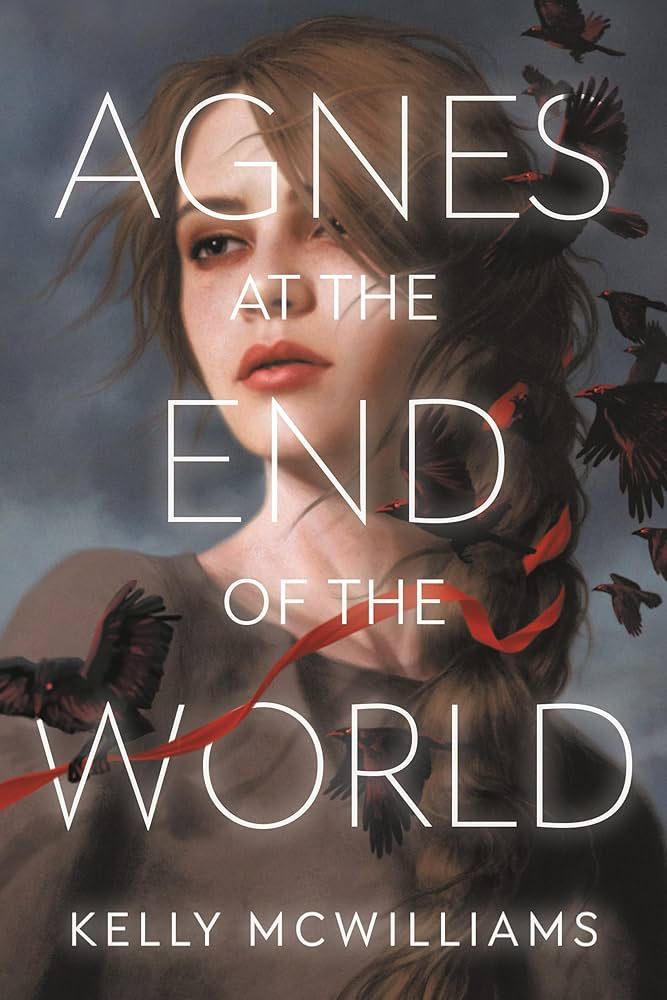
Agnes at the End of the World – Kelly McWilliams – “In the land beyond me and you/A bunch of kids who don’t know what to do/We all wait in the silence to hear…”
“One Tiny Flower” – Jeff Tweedy
BREAKING: water is wet, the sky is blue (sky blue sky, even? [gets dragged offstage by a comically large cane]), and Jeff Tweedy cannot stop cooking. Seriously! Even within a band, how is it possible that in the last five years, this man has put out one solo album, two albums (one of which is a double album) and an EP with Wilco, three reissues of past albums, and now a triple album out this September? It’s been a while since I’ve read Tweedy’s book, How to Write One Song, but if that kind of insane output—not only prolific, but consistently good to boot—doesn’t convince you that he can, in fact, teach you how to write one song, then I don’t know what will.
I had a feeling why he continues to be so prolific. In my experience, creativity blossoms most when you’ve got something impelling it: not necessarily spite, anger, or negative emotion, but any kind of passion that pushes you to put something new out into the world. Give yourself into it too much, you lose the outside world, and you lose the reality that must be grounded to; lose sight of it, and you forget that everything pushing against you in the world, positive and negative, can be a source to revive that creativity. Tweedy put it this way in a statement about the album: “When you choose to do creative things, you align yourself with something that other people call God…and when you align yourself with creation, you inherently take a side against destruction. You’re on the side of creation. And that does a lot to quell the impulse to destroy. Creativity eats darkness.” Tweedy saw the veritable tsunami of strife, fascism, genocide, and all the other ills plaguing the world, and put up arms against it by means of art. For me, and for so many people who feel helpless, it’s all we can do. My mom shared this wonderful Ted Talk by Amie McNee about how making any kind of art, political or not, is an act of resistance in this hellscape just by virtue of the fact that you’re putting your time and attention into creativity and not giving money to corporations by endlessly scrolling on social media or participating in other capitalist activities. It comes to mind when I think about the upcoming Twilight Override: now that’s an act of resistance. 30 songs! That monstrous length is also intentional to Tweedy: “Whatever it is out there (or in there) squeezing this ennui into my day, it’s fucking overwhelming. It’s difficult to ignore. Twilight Override is my effort to overwhelm it right back. Here are the songs and sounds and voices and guitars and words that are an effort to let go of some of the heaviness and up the wattage on my own light. My effort to engulf this encroaching nighttime (nightmare) of the soul.” 30 songs is hard to keep consistency with, but nevertheless, I welcome Jeff Tweedy as the musical champion of (twi)light in the overwhelming darkness.
Out of the four singles that have been released so far, “One Tiny Flower” seems most like Tweedy’s mission statement with Twilight Override. It’s not his most lyrically complex song, but it evokes the most classic imagery of resistance and resilience possible: a tiny flower sprouting out from the concrete. It’s an ember of joy, a labor of intensive hard work to make the roots hold onto concrete, and a fuck you to whoever poured the concrete over the space where they didn’t want more plants to grow. Even without the rest of Wilco, “One Tiny Flower” reeks of Cousin, shifting from understated, softly sung acoustic melodies to a jingling, entropic dissolution before straightening itself back up again. The other three songs veer between different sides of Tweedy’s range, but if there are any more songs like this one, then I’ll be satisfied with Twilight Override.
…AND A BOOK TO GO WITH IT:
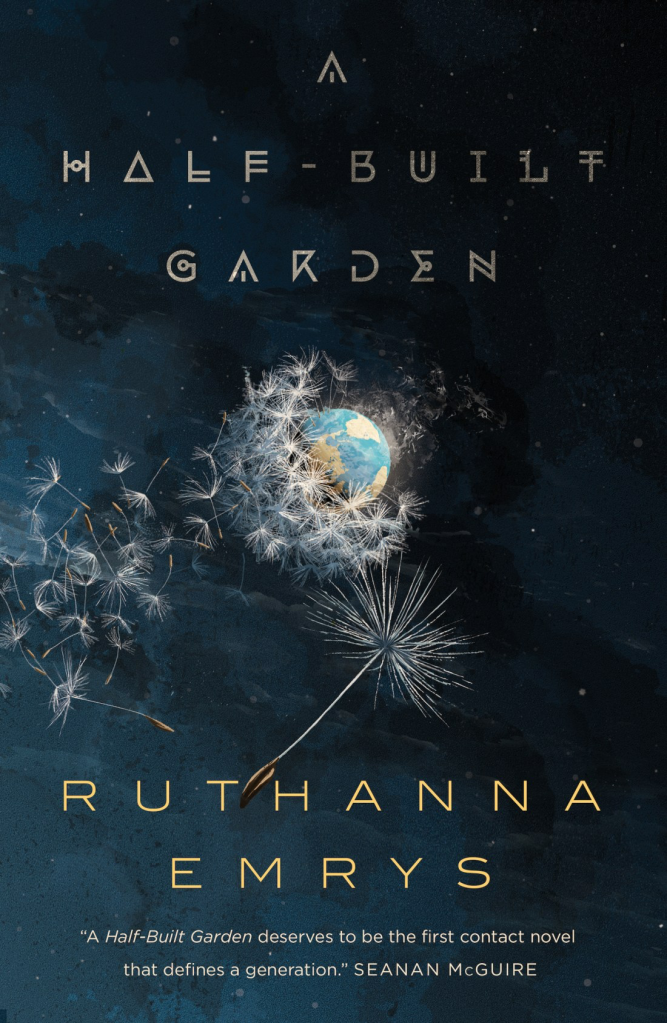
A Half-Built Garden – Ruthanna Emrys – a quiet, hopeful tale of climate change and first contact.
“Psychosis is Just a Number” – Guerilla Toss
I’m surprised that I’ve never talked about Guerilla Toss on any of these posts, but I think it’s mainly because my main heyday listening to them ended right around the time when I started making these graphics, several months after their last album, Famously Alive, came out. I don’t tend to habitually revisit them, minus most of the tracks from Twisted Crystal (see: “Come Up With Me,” which I swear needs to be the theme song for a quirky Cartoon Network show with a plucky girl protagonist on a bicycle exploring a magical realm). But even though I’d never place them among my most-listened to bands, I’m always happy to hear something new from them. You’re Weird Now comes out this October, but the truth is, Guerilla Toss have been weird all along—and that’s what makes them special. They’re doing nothing but their own thing, pasting together surreal lyrics with electronic and rock beats frankensteined together. “Psychosis Is Just a Number” mashes together thrumming bass and a surprisingly smooth brass section—I’d never think to compare Oingo Boingo and Guerilla Toss musically, but the madcap, off-the-walls excitement of this track is so wonderfully reminiscent of them. They throw everything at you (the chorus is borderline overstimulating if you listen to it over and over) but that’s just how their unfiltered, raw excitement and creativity shines through.
…AND A BOOK TO GO WITH IT:
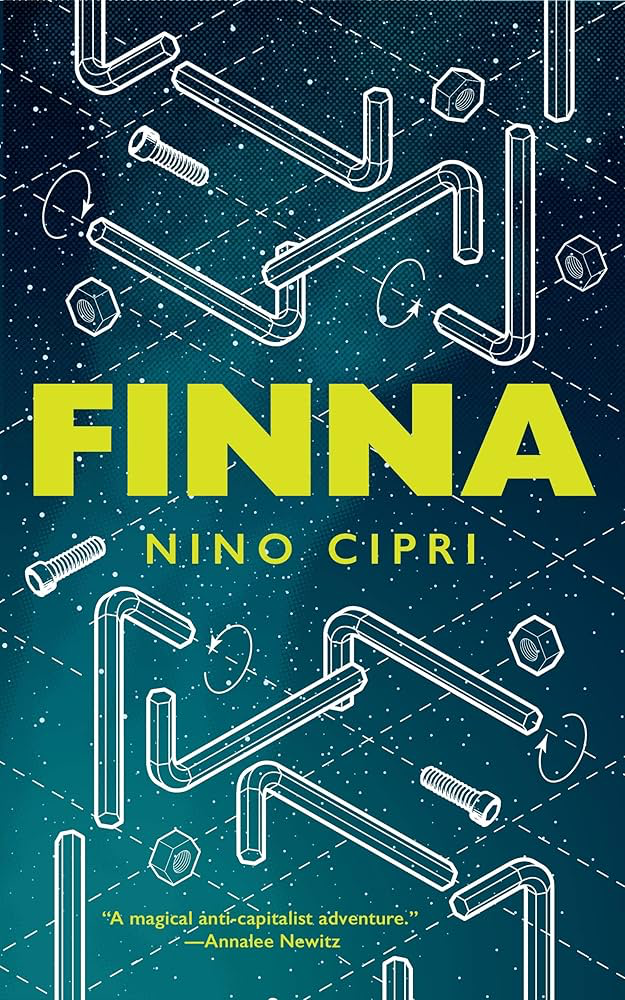
Finna – Nino Cipri – this is a highly specific situation, but strangely, Guerilla Toss seems like the ideal soundtrack to being trapped in an interdimensional, legally distinct IKEA full of monstrous furniture.
“The Width of a Circle” – David Bowie
I’ve loved “The Width of a Circle” for at least a few years, and I’ve been interested in learning how to play it on guitar. Unfortunately, though it has been a wonderful experience, I made a…uh, slight oversight, and didn’t realize how painfully awkward it would be to be in my guitar lesson and have my guitar teacher go through the whole “He swallowed his pride and puckered his lips/And showed me the leather bound ’round his hips” bit. Whoops.
As you probably gathered, “The Width of a Circle” is about as freaky as they come. Though the actual subject is somewhat ambiguous, it’s about Bowie encountering either God or Satan…and proceeding to have the most earth-shattering gay sex with him. (I’m more inclined to the Satan interpretation, as the figure fools the Bowie character into thinking he’s a humble, young God, then opens up the pits of Hell.) Even though The Man Who Sold the World didn’t get a ton of attention when it came out, it’s impressive that this got through any kind of censors and was released all the way back in 1970—just as impressive as the fact that Bowie was slaying in that dress on the front cover of the album. It’s honestly one of the queerest songs in his catalogue to me, and this was even before he made a whole album about a queer alien. The Man Who Sold the World didn’t gain much notoriety until Bowie’s career started picking up in earnest, but in retrospect, it’s the album where his storytelling really took a turn for the truly artful. Though the sound isn’t as cohesive, you can see the leap he took into going more daring places with his songwriting. “The Width of a Circle” truly is an epic in every sense of the word; originally two separate songs, it was tied together by the connective tissue of Mick Ronson’s jamming, expanding it into an eight minute long behemoth of a tale. The theatricality that would come to dominate Bowie’s work in only a few years blossoms here as he takes a journey through innocence and into shock and revelation. Even if it came to my disadvantage in that guitar lesson, this is the first time in Bowie’s career where his imagery takes on the quality of being so startlingly evocative—he’s a master of weaving worlds through song, and whether or not he’s selling them, each song is a Faberge egg of allusions and stunning songcraft.
…AND A BOOK TO GO WITH IT:

The Familiar – Leigh Bardugo – “And I cried for all the others until the day was nearly through/For I realized that God’s a young man too…”
Since this post consists entirely of songs, consider all of them to be today’s song.
That’s it for this week’s Book Review Tuesday! Have a wonderful rest of your day, and take care of yourselves!


 The Bookish Mutant