

Happy Sunday, bibliophiles! I hope this week has treated you well.
Don’t let the black color scheme full you—we’ve got a mostly joyful bunch, and if not joyful, at least upbeat. This week: what happened when I listened to Apple Music’s “Love” station on a whim, things that are wholly good and pure, and reflecting on the things that made middle school survivable.
Enjoy this week’s songs!
SUNDAY SONGS: 3/10/24

“After Hours” – The Velvet Underground
The story of “After Hours” famously goes that Lou Reed wrote this song, but knew it was too pure and innocent for him to possibly sing, so he enlisted Mo Tucker, the Velvet Underground’s drummer, for the task. As much as I love Lou Reed, he did the world a great service by not singing this song—in his hands, there’s no doubt that it would’ve felt like some kind of melancholic “Perfect Day” prequel, but at least he was self-aware enough to realize it. And there’s nobody more fit to sing it than Tucker. Her voice is beautiful, but it’s the voice of someone who rarely sings, if at all, and sings softly when she does. But that’s exactly the kind of voice that “After Hours” calls for. It’s a bashful, rosy-cheeked song, the kind that shyly peers out from behind the curtain to watch the bustling city below. There’s an embarrassment to it, but not the kind that makes you wince—it’s a diary confession written as the last threads of light are fading from the sky, the last pure thoughts filtering out of your brain. It’s so simple, and yet that’s why it digs at such a unique place in my heart—it’s not quite universal, but it’s just the kind of special to nestle up against me like a drowsy cat. There’s practically no end to the influence that The Velvet Underground has had on rock music, but I feel like “After Hours” is overlooked in that aspect—without it, where would the glorious pantheon of wistful women and their acoustic guitars come from?
Bonus: because somewhere down the line we collectively recognized that this song is best performed by female drummers, here’s a performance by Meg White of the White Stripes:
…AND A BOOK TO GO WITH IT:

Heartstopper – Alice Oseman – another pure, sweet morsel of tenderness.
It’s happening. IT’S HAPPENING. IT’S HAPPENING!!!
All Born Screaming? Uh, yeah, I sure am. The squeal I let out at 7 A.M. when my mom shared this new single could probably be heard through my whole dorm. I’m just glad that my RA didn’t catch on. After a solid month of teasing, first with the ceremonial removal of the Daddy’s Home blonde wig, then with throwbacks to her performance of “Lithium” with the surviving members of Nirvana at the Rock and Roll Hall of Fame (to the people saying “oH, shE’s sO oFf-KeY” about this one: did you all just forget how Kurt Cobain sang, or what?) and her performance of “Krokodil” at Coachella in 2012, we finally have the St. Vincent rock album that we’ve always wanted. I’ve gone past the point of trying not to hype myself up for this one—somehow I feel like it’s not gonna be another MASSEDUCTION incident, because everything about this album— the aesthetic around it, and its collaborators (Dave Grohl on drums in this track, and Cate LeBon featuring on another)—feels like it’s going to rock. Annie Clark always seems to have a clever, cheeky album title up her sleeve, but All Born Screaming has to be one of the harder ones. And the album art…well, yeah. Let’s get the elephant out of the room—it’s great album art, but the timing was…not good, as it came just days after Aaron Bushnell self-immolated to call attention to the ongoing Palestinian genocide. (Rest in power. Chip in where you can.) But at the same time, there’s no way that Clark or her team could have predicted that kind of thing. I really don’t feel like she’s at fault here—it’s bad timing, sure, but none of us can be expected to foresee everything in the news.
Back to the song…I need to be stopped. Somebody needs to hold me back…or, at any rate, somebody should’ve held me back on the Thursday morning when “Broken Man” came out, because I listened to nothing but that song from approximately 7-11 A.M, and I had to go about three days before I could listen to it again. I’ve learned nothing. But now that I’ve ridden the initial high, I’m reveling in the new direction that St. Vincent has started to go towards with All Born Screaming. Most of the comparisons I’ve seen wind up somewhere in the neighborhood of Nine Inch Nails, P.J. Harvey, and Rage Against the Machine, and I can see all of those, especially with the former two—the industrial grind of Trent Reznor and the feral, growling vocals of P.J. Harvey are wound all over this track. Like the album art, it’s painted in the colors of ashes, still hot to the touch and rough between your fingertips. Clark has toed this line more often than not (see “Krokodil”), but we’ve gotten an album where she’s fully embraced her heavier side—one that she’s always had the capacity for, but somehow bottled up before throwing herself into All Born Screaming, the first album that she produced herself. It oscillates smoothly between hectic, metronome-ticking pop, uncomfortably sung from inside of a steel crate as she taunts the listener with her head peering out of the lid. It feels like a callback to the frenetic, pent-up energy of her self-titled record [slides Anthony Fantano glasses up the bridge of my nose], but with even more fury—every other lyric feels like a spit-laden taunt: “Who the hell do you think I am?/Like you’ve never seen a broken man?” With each verse that goes by, every word is spat with more intention, more vitriol, swerving between her silky, whisper-vocals to a full-on, sweat-drenched growl as the song closes. And this song’s breakdown is one of the most exciting of her songs in recent years; crashing in with Dave Grohl’s legendary drumming, you can’t describe this song with anything other than “fiery”: it’s a primal scream of a song, burning, biting fervor engulfed in flames. And I can’t help but get excited about the choreography in the music video—as flames dance across her neat, white button-up and slicked-back ponytail, her arms play a game of “the floor is lava” with her torso, jerkily twisting to avoid some point of contact. An eagle-eyed YouTube commenter compared it to her choreography for “Rattlesnake,” and…oh god, now I’m way too excited. Daddy’s Home is the best of her more recent work, if we’re going post-self-titled [slides glasses up even further] but…don’t do it. Don’t give me hope.
…AND A BOOK TO GO WITH IT:

Gearbreakers – Zoe Hana Mikuta – industrial landscapes abound and all-around badassery to spare.
“Red’s Ok” (from Hellboy II: The Golden Army) – Danny Elfman
Fast-forward to 8:20 for “Red’s Ok.”
Hi. Gonna try and be calm about this one. As calm as I can be when I feel the raw, untamed power of my middle school Hellboy hyperfixation coursing through my veins. The deluxe edition of the Hellboy II soundtrack showing up on my Apple Music suggestions on an unsuspecting Sunday morning was certainly a kick in the pants that sent me hurtling back to 2017 at alarming speeds, and I have yet to reach terminal velocity.
I don’t know what prompted the release—last year would’ve been fine, given that Hellboy II turned 15 that July. Who knows. Just up and popped out of nowhere. But man, I am so glad that it did. Having this expanded edition just goes to show how many gaps were left out of the original soundtrack, even if many of them (including this song) are under a minute long. I’m convinced that there was some kind of rush in putting together the original soundtrack, since now we know that the random tidbits that didn’t seem to come from anywhere that were tacked onto the end of “Finale” were, in fact, two alternate versions of songs that were almost used in the troll market scene. Again: who knows how that happened. But now, the score feels as whole as ever—those short-and-sweet tidbits fill in the crucial gaps, the silly, almost jazzy flourishes to plump up some moments of witty banter (of which there are many), fleshed out a soundtrack that’s cemented itself in the nostalgia catalogue of my mind. “Red’s Ok,” in particular, is the wonderful variation on the tasteful electric guitar motif, shown just as we see Hellboy emerging from the wreckage of a car he’s just landed on top of, wielding the Good Samaritan in the film’s most honest-to-god movie poster moment. And we get the full, 7-minute long cut of “Where Fairies Dwell.” I was born in the right generation. Born too late to see the rockstars I like, born too early to explore space…but born just in time to be able to listen to “Fuck-Used”. Bless.
My good feelings towards Elfman himself have started to fade after the allegations that came out last year, and this doesn’t change that, but I can’t deny the talent that went into this soundtrack, as well as the countless others he’s crafted over the years. Admittedly, his work has become so entangled in my life that, even though I’m all for theoretically separating the art from the artist, the truth is often far more complicated than putting the allegations in one box and their art in the other. I don’t necessarily know if it’s a personal flaw that I can’t detach from people that easily (lord knows I haven’t been able to listen to Arcade Fire as often as I used to without feeling a little moral revulsion). It’s not like J.K. Rowling’s transphobia and other prejudices manifested out of thin air directly after she wrote Harry Potter. And yet, I’d be the world’s worst liar if I denied how dear this film is to me. 13-year-old me saw this and saw an image of found family, of freaks who banded together in a world that was bent on destroying them, of freaks showing affection and forgiveness towards the world and each other, and it stuck. It did something to me. It showed me a possibility of a future that I could live out. At least it’s just the soundtrack in this case, and not the film itself. That’s all safe. I don’t even want to entertain the notion of Guillermo del Toro having any metaphorical skeletons in his closet, because given what the guy’s house looks like, he definitely has some plastic ones lying around. But it seems like he’s the type to keep it to that.
So I’ll be excited for the middle schooler in me. When this came out, I painted my nails and listened to this as they dried, remembering that there was a part of me back then that should be cherished—the one that didn’t care what anybody thought, and the one that watched this movie at least once a month.
…AND A BOOK TO GO WITH IT:

Hellboy II: The Art of the Movie – Guillermo del Toro – yeah, this was the obvious pick, but what else was I gonna do? Put in the movie novelization? Imagine swapping out “Dr. Manning, suck my ectoplasmic schwanzstucker” for “Manning, you’re a jerk.” Unconscionable.
It’s been almost a month since TANGK was released, and I find myself drawn to it over and over again, simply because it’s so IDLES in a way that I haven’t seen from them. Like I said when I talked about “A Gospel” back when the album was released, it’s a beast that’s half old and half new, but brimming with the same ethos of kindness with a hard-edged sound. While “A Gospel” and “Grace” were the album’s pinnacles of vulnerability, “POP POP POP” just seems like the place where Nigel Godrich went nuts—it feels like IDLES trying to make a Radiohead song, but never once does it feel like a blatant imitation. It has an angular, jerky smoothness to it, with the combination of synths that buzz like a hive of insects with Joe Talbot’s voice—the lyrics aren’t screamed like he tends to do, but with a dry, disaffected drawl that signals irony, but knowing IDLES, it’s a sign of bare sincerity just as any other bellow he lets out. On the inside, the lyrics are similar to most of the material on this album—a shield of kindness against a wave of hatred: “Strong like bull/Vulnerable (vulnerable)/Keep my people up/That’s my tool.”
But there’s something resolute about the way that “POP POP POP” is delivered—it’s almost like he’s drawing not from a place of repeating himself, but convincing himself of his mission. I’ve seen a fair amount of people in internet music circles roll their eyes at IDLES for acting like their lyrics are more radical than they are, which…I halfway understand. A lot of their subject matter in their music isn’t exactly new in terms of political fodder to spin into music. But is there really anything new, political or otherwise, that you can write a song about? I find myself thinking of Audre Lorde and her essay “Poetry is Not a Luxury,” where she states that “…there are no new ideas. There are only new ways of making them felt, of examining what our ideas really mean on Sunday morning at 7 AM…[while] making war, giving birth.” I get why people are put off by IDLES seemingly acting like their ideas are new (I’ve never gotten that impression, but that’s just me), but personally, that was never what was radical about them—it’s their approach to kindness. It’s unclear whether this is the exact criticism that may have spawned “POP POP POP,” but the final verse, chanted like a prayer as the hive of synths descends into a buzzy, Kid-A maelstrom, feels like Talbot convincing himself of the message that he and the band have always pioneered: “Imposter, imposter, living in my head/Am I the spider in your bed?/A dead canary and a thief for a king/A cheerleader valiant/But I will sing about love, love…” And as his voice gets overlaid, the final chant that rings out is the tagline for the later track “Grace” and this album’s tour: “love is the fing.” It feels like reassurance in a sea of self-doubt, a reminder of a message to be held dear, a mission statement lost in the mist but found again when it came time to look back and remember why they created it in the first place. And as with the ending of this song, what persists is four essential words: “love is the fing.” You look back into all of the mess that your creativity has taken you, and what you find at the center is the love that motivated you to create in the first place.
…AND A BOOK TO GO WITH IT:

Kindling – Traci Chee – I just reviewed this one, so it’s pretty fresh in my mind, but the last, more distorted lyrics made me think of these characters and their struggles to grow out of their trauma and persist—”Imposter, imposter, living in my head/Am I the spider in your bed?/A dead canary and a thief for a king/A cheerleader valiant/But I will sing about love, love…”
The other day, I decided to listen to Apple Music’s Love station on a whim—I was drawing before bed, and I wanted something new to listen to. It ended up having mostly hits, some misses (one of the hits was “After Hours,” but I’m honestly concerned about the fact that there was…an Elliott Smith song on there? Not the weirdest Apple Music pick, but I don’t know if that screams “love”…), but it was the reason that I stumbled upon this song, which I am so grateful for. Scratch that—I’m grateful, but more than anything, I’m more surprised than anything that I’d never heard of her before then, given the company that she kept: she was first discovered by James Brown, and later collaborated with everybody from The Rolling Stones to Pink Floyd (she contributed backing vocals to Dark Side of the Moon, my god…). With all that, a musical based on her life, and a number one hit, you’d think we would be hearing more about her, but alas, nope. Whether or not that’s just another testament to how history treats Black women or the fact that she stepped away from the mainstream music industry after the ’70s is up in the air, but either way, I’m glad the Love station brought me to her.
I’ve always had a soft spot for that late ’50s-early ’60s soul. As much as I laud other artists for having intricately crafted lyrics, sometimes, it’s simplicity that wins out—and that was exactly what labels like Motown were the best at producing. Artists like The Temptations, the Ronettes, and others feel like they’ve distilled love—one of the most complex human emotions—down to its barest essentials. Every song becomes something so tender and universal that it feels like a warm blanket for the soul. Along with the rich vocals that often came with it, and you’ve got one of my favorite musical soft spots—I’ll take shreddy guitars any day, but sometimes, all I need is some wholesome love. That’s exactly how “Just One Look” feels—brimming with warmth, and the perfect tempo for slow-dancing in the kitchen. Only seconds into the song, and you can hear exactly why Troy’s fans gave her the nickname “Mama Soul”—soulful is the only adequate word to describe her rich, soaring voice. Combined with the air light touch on the piano keys, and I’ve got another comfort song in my collection—there’s something to be said for simplicity.
…AND A BOOK TO GO WITH IT:
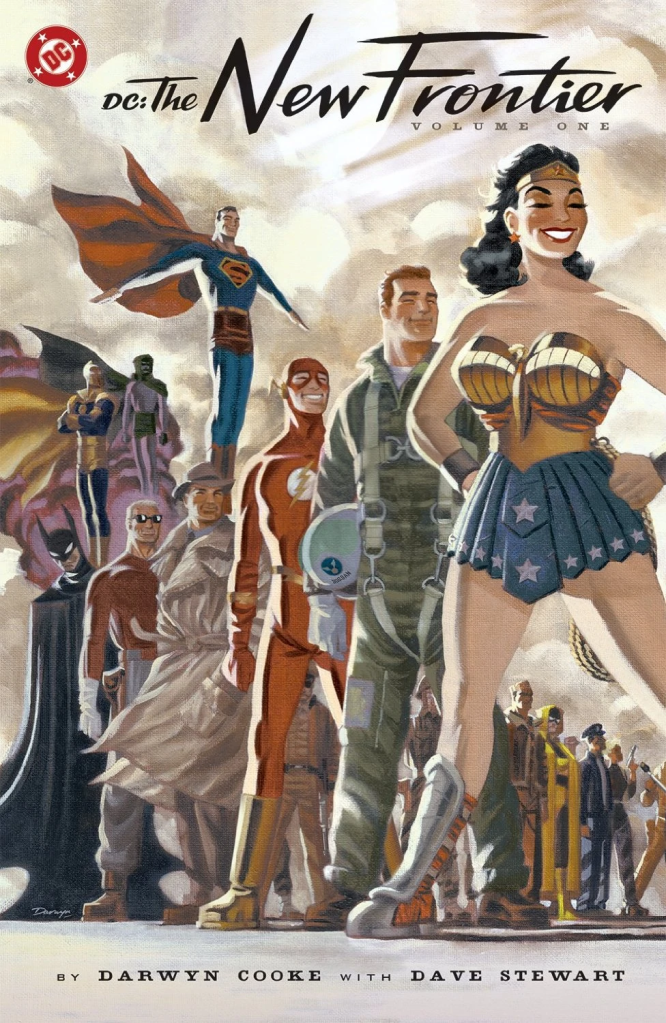
DC: The New Frontier, vol. 1 – Darwyn Cooke – the lyrics for this song are so universal that they could cover any kind of romance, so instead, I went for the time period; the late ’50s-early ’60s setting of The New Frontier is settled right in the same era.
Since this post consists entirely of songs, consider all of them to be today’s song.
That’s it for this week’s Sunday Songs! Have a wonderful rest of your day, and take care of yourselves!



 The Bookish Mutant