Posted in Sunday Songs

Sunday Songs: 11/30/25

Happy Sunday, bibliophiles! I hope this week has treated you well.

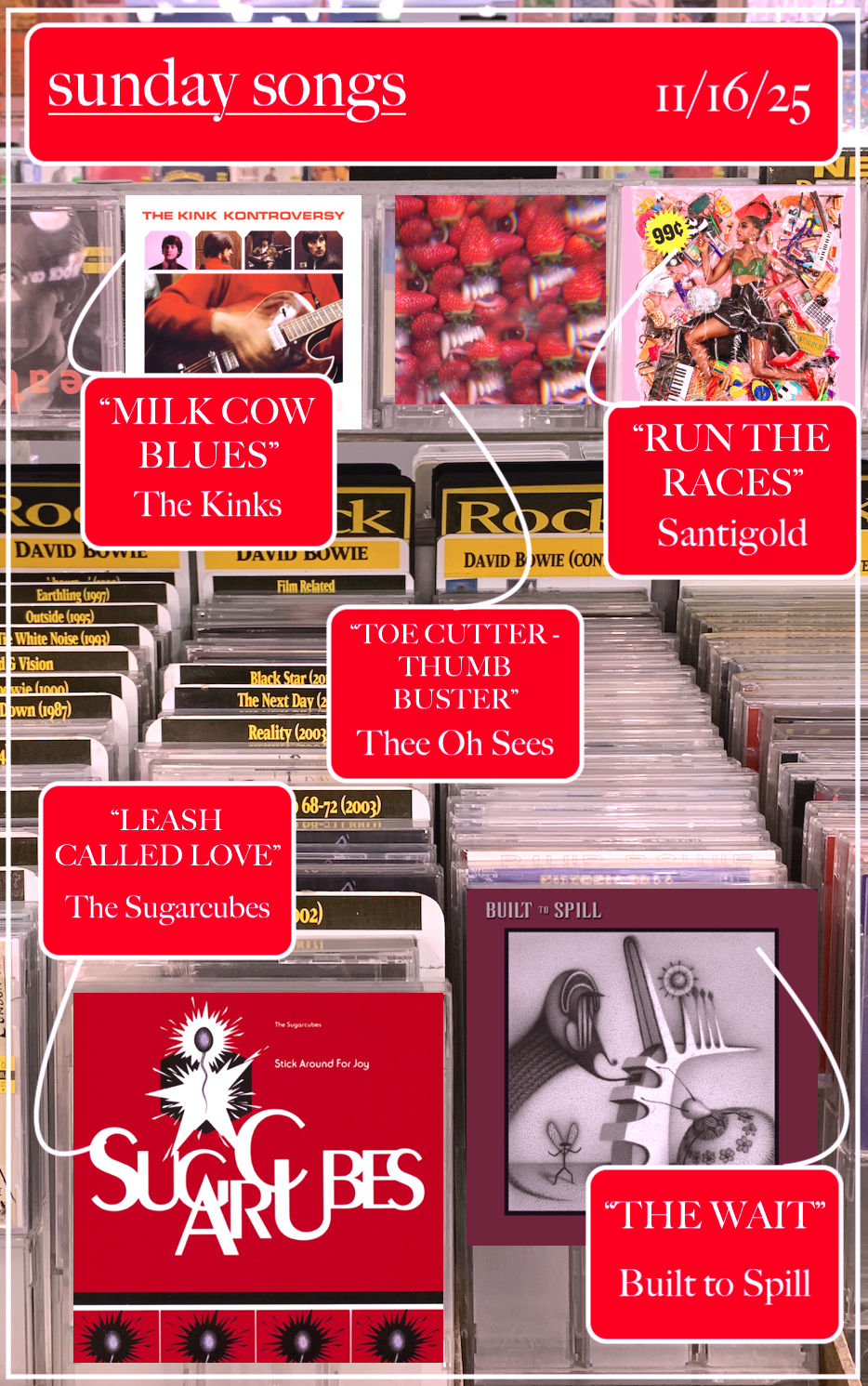
I’ve got at least one more post here before I inevitably have to crawl back into the finals burrow. Since I’ve been out of the office lately, here are my graphics from the past few weeks:
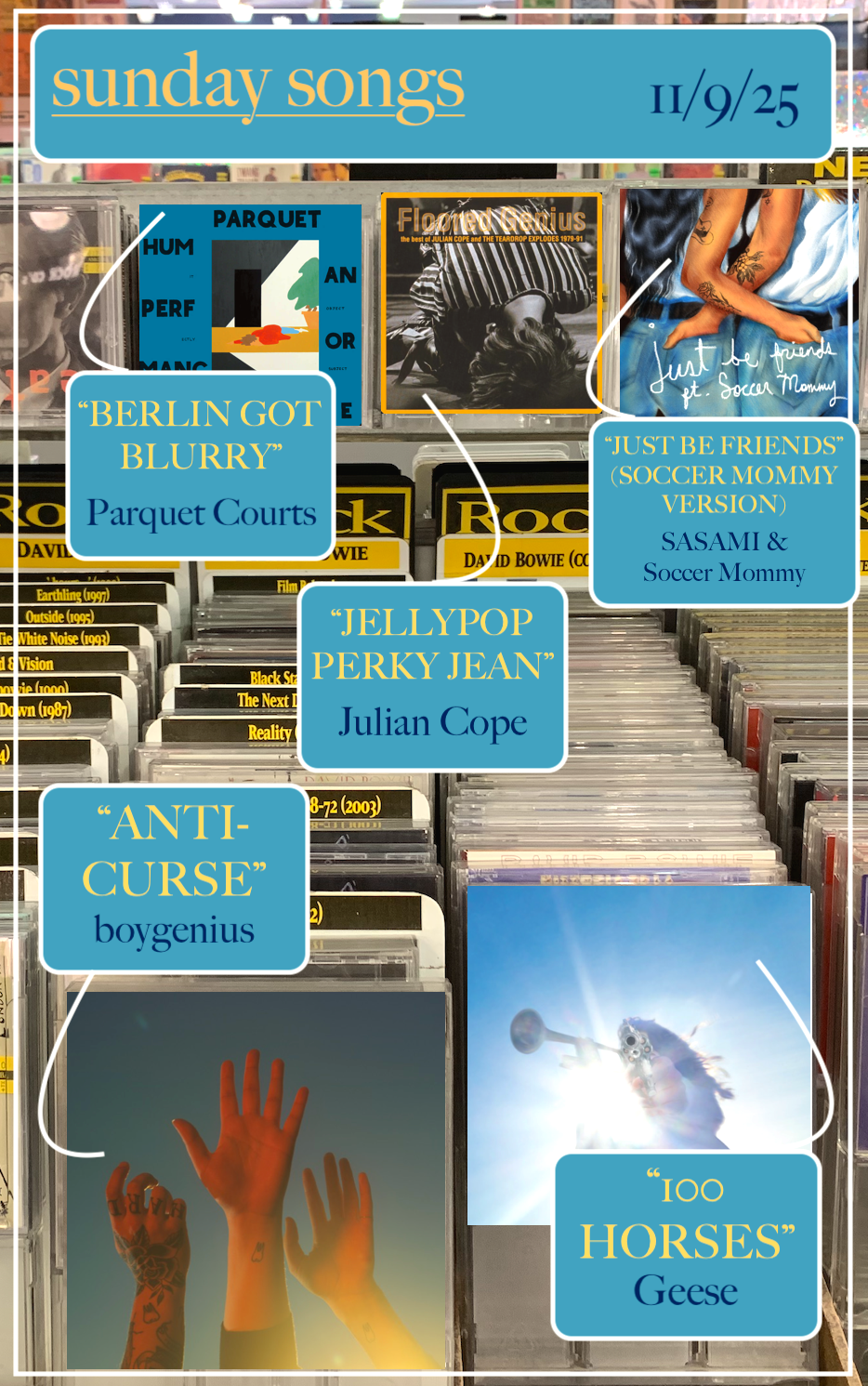
11/9/25:

11/16/25:

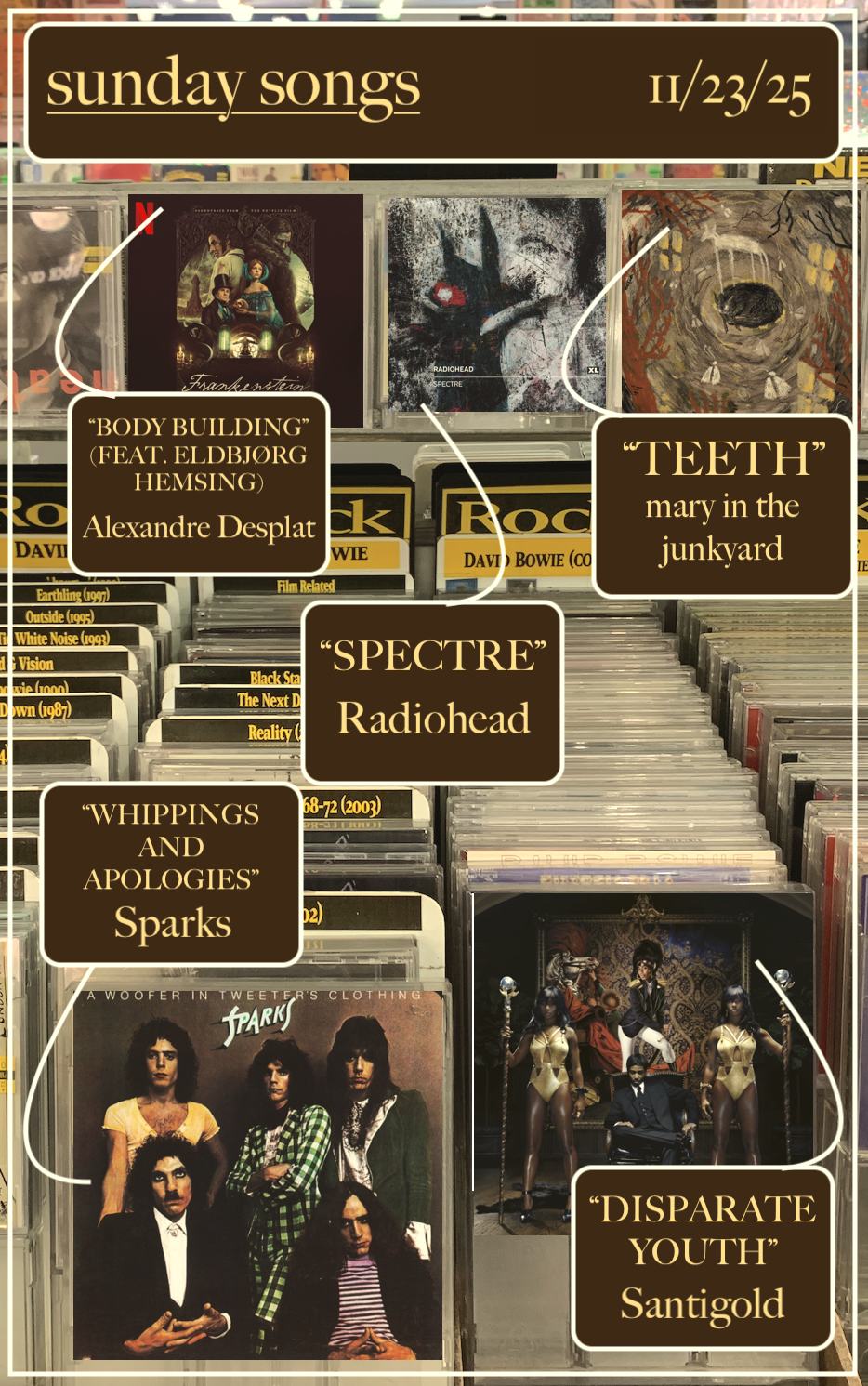
11/23/25:

This week: What half of Britpop’s Big Four frontmen are up to these days, peak goth drama, and I finally find out why Joe Talbot was hiding out in that Gorillaz exhibit like Where’s Waldo.

Enjoy this week’s songs!
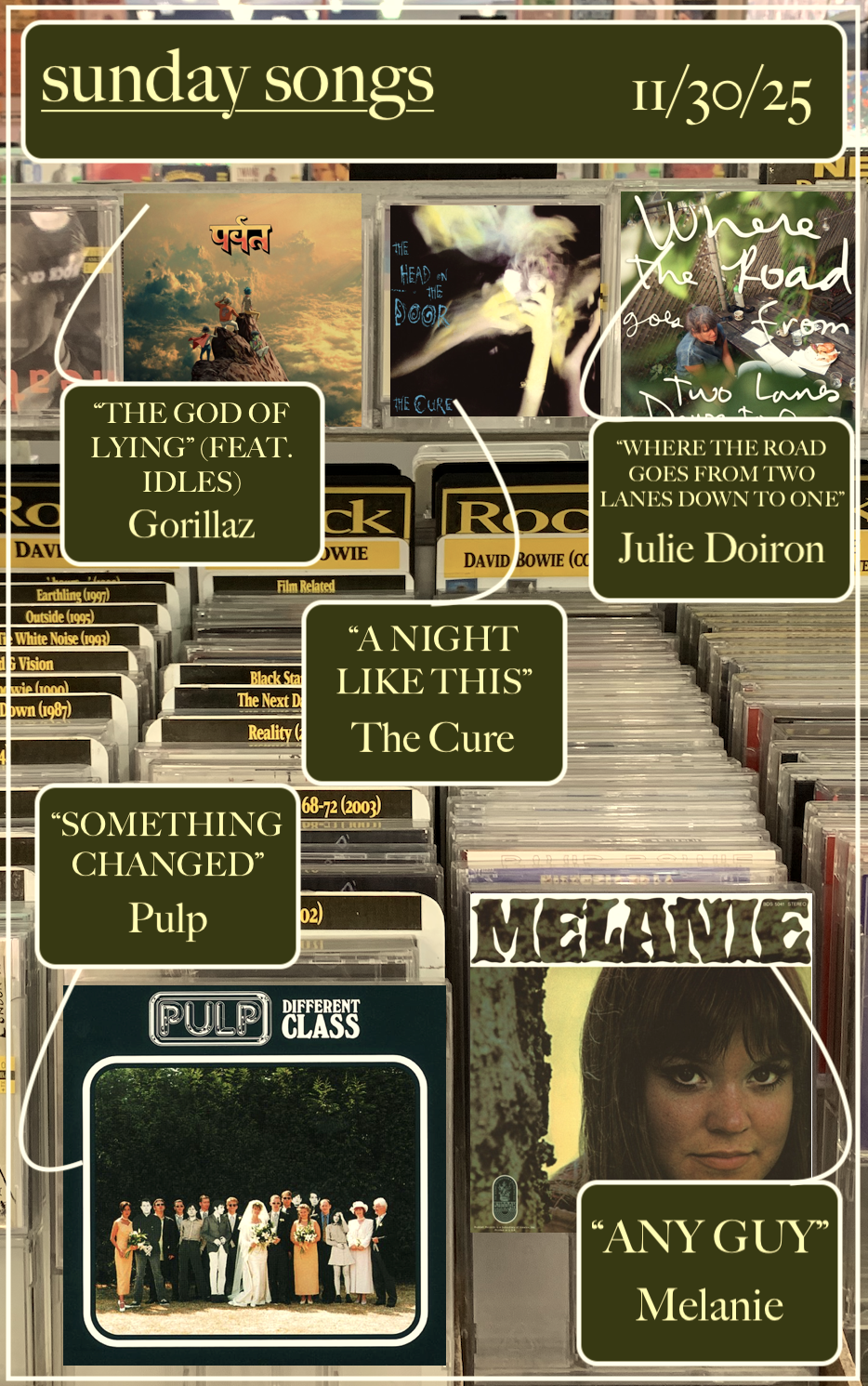
SUNDAY SONGS: 11/30/25

“Something Changed” – Pulp

Pulp recently put on an absolutely showstopping performance at NPR’s Tiny Desk Concert. I still have only a handful of Pulp songs that I really know, but even as a budding fan that initially knew only 1/4 songs in their setlist (that one being “This Is Hardcore,” yet another shoutout to my amazing dad for showing me that one!), their performance was an absolute joy. Even in the confines of said Tiny Desk, Jarvis Cocker has the most enigmatic, fluid stage presence that defies being simply Britpop and has transformed into a timeless charm. And now I have three more Pulp songs on my rotation!

“Something Changed” hooked me more than the rest, and it reminded me that I really just need to get over myself and listen to Different Class already. Themes of social and sexual frustration aside (see: “Live Bed Show”), Pulp seemed to have an uncanny ability to create such pure, resonant anthems without making them cloying or insincere. I never got around to talking about “Disco 2000” last year, but that song feels like the platonic ideal of a pure, passionate love song—it’s a small wonder that nobody’s used it in the end credits of a rom-com yet. (Maybe that’s for the best? It’d need a really good rom-com.) “Something Changed” has that same quality in softer shades, with Cocker crooning about the nature of chance against a backdrop of swelling, sunlit strings: “Do you believe there’s someone up above/And does he have a timetable directing acts of love?” For someone with a sense of humor as sardonic and often cynical as Cocker, it’s a display of sincerity that feels anything but inauthentic—you can tell that, to some degree, there’s a genuine feeling of being wonderstruck by the chances that led him to this point in time—and this whirlwind romance.

“Something Changed” starts at 8:05. While you’re here, though, the 7+ minute rendition of “This Is Hardcore” stopped me dead in my tracks. One of the best Tiny Desk Concerts this year, for sure.

…AND A BOOK TO GO WITH IT:
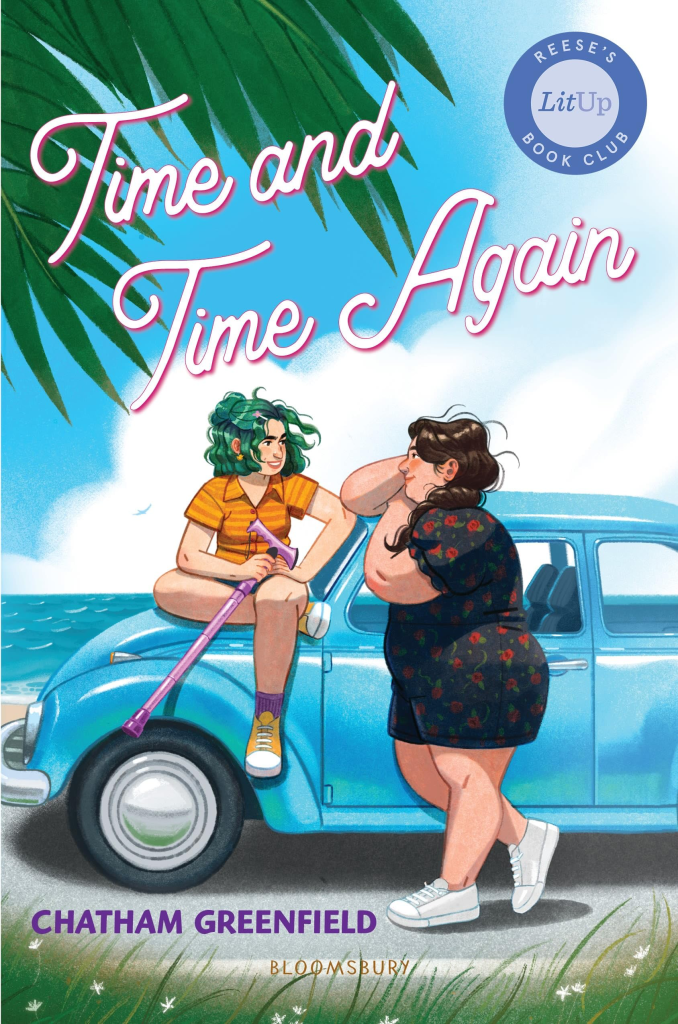
Time and Time Again – Chatham Greenfield“Oh, I could have stayed at home and gone to bed/I could have gone to see a film instead/You might have changed your mind and seen your friend/Life could have been very different but then/Something changed…”

“Any Guy” – Melanie

I never find Melanie songs organically, I just leech them off of TV shows about once a year (see: “Look What They’ve Done to My Song, Ma” thanks to We Are Lady Parts). This one in particular came from the season 1 finale of Bad Sisters, and without spoiling anything, it rang out as a bitterly triumphant anthem for the culmination of a season’s worth of work to try and eliminate a man equivalent to Satan incarnate from the face of the earth. Season 1 has been out for a few years, but I’ll still refrain from spoilers.

But some needle drops get better and better the more that you think about them. Melanie fit along with the musical feel of Bad Sisters, primarily featuring needle drops from great women-fronted bands and musicians (Bikini Kill, Nancy Sinatra, Wet Leg, and of course, the theme song and score composed by the iconic PJ Harvey). Many of them feel more atmospheric other than a handful of very purposeful ones, but “Any Guy” relates so much to the character of Grace to me. A lot of Melanie’s earlier fame centered around how childish she looked—this was pre-“Brand New Key” and people derailing childhood innocence into Freudian nonsense, but there was a clear correlation between what people saw as an unassuming young woman and the talent that resided inside of her. That image remains after her death, but for me, Melanie’s her best when she lets loose—think of the righteous fury at the end of “Look What They’ve Done to My Song, Ma!” That final belt at the end! Reckoning! “Any Guy” has that same explosive moment at the end; beneath the veneer of placid strings, Melanie stews about getting involved with a two-timing guy and feeling disposable, until her waver breaks into an impassioned howl of “Is she as pretty as me, huh?” Nothing’s better than when Melanie snaps and lets the full force of her voice free, and what better song to soundtrack a similarly unassuming, underestimated woman finally breaking free. Even when she’s singing of breaking away, there’s a waver in her voice, and that’s more Grace than anything—and there’s no shame in having a waver in your voice when you’ve finally mustered the courage to speak your mind.

…AND A BOOK TO GO WITH IT:
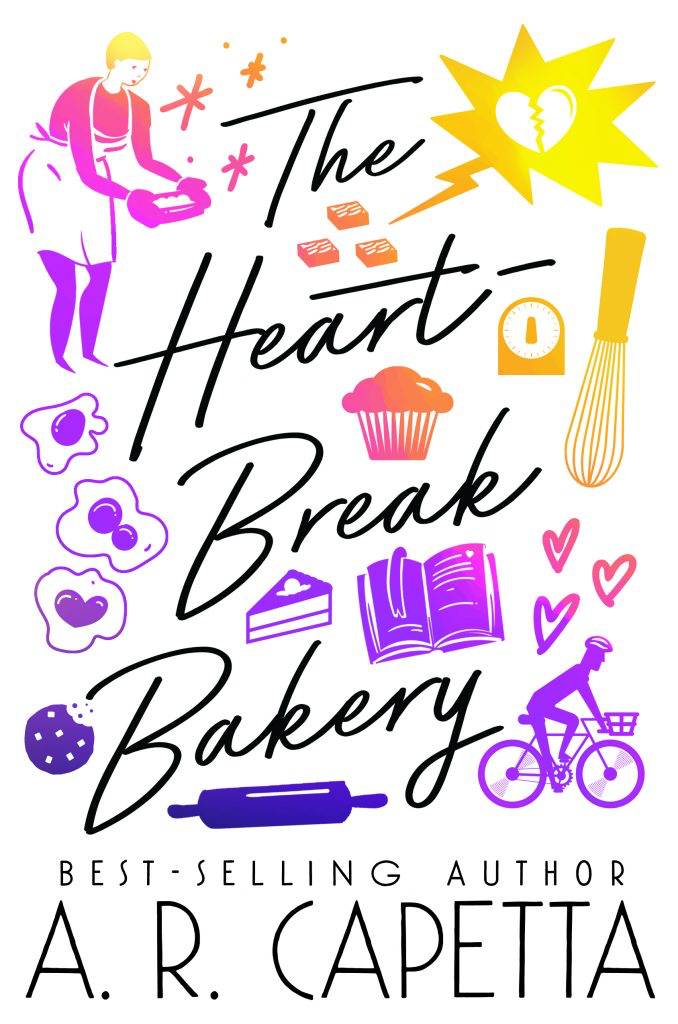
The Heartbreak Bakery – A.R. Capettabreakups, miscommunication, and one very fateful batch of magic brownies…

“The God of Lying” (feat. IDLES) – Gorillaz

Guess who’s getting tickets to L.A. the minute that they announce when the House of Kong exhibit is coming?? Prepare for me to be INSUFFERABLE and IN CALIFORNIA

Back when they did the story on the London House of Kong exhibit over the summer, they showed the collage on the wall of all of Gorillaz’s collaborators over the years. There were tons of familiar faces: De La Soul, Yasiin Bey, Shaun Ryder, St. Vincent, et cetera…but I swore that I could see Joe Talbot peeking out from between the faces. And it got me thinking…had I missed something? Mind you, this was before The Mountain was announced, so I had no idea what was a head. But now that it’s here, I’m so excited for this pairing! As is the ritual with most modern Gorillaz rollouts, the singles are hit or miss. “The Happy Dictator” was loads of fun, but “The Manifesto” is somehow two different songs, and none of them are particularly good. And here we see the post-Humanz Gorillaz “where’s Damon?” problem—it’s all the collaborators and barely him.

Thankfully, “The God of Lying” fixed this issue swiftly, with Albarn trading off verses with Joe Talbot of IDLES. Gorillaz have been mining the state of dystopian discontent that we’re in for quite some time now, but if there’s anyone more fit for an antidote, it’s Talbot. As he coolly assesses the sorry state of the world (“Are you deafened by the headlines?/Or does your head not hear at all?/Are you pacified by passion/Are you armed to the teeth?”), Albarn’s distorted voice professes that we’ve all reached for some comfort beyond the bad news, but that it’s so overwhelming that we can’t even comprehend that hope is still possible; we’re actively “running to the exit” because we somehow fear the notion of hope existing even while trapped in an endless cycle of doomscrolling and horrific news. Albarn said this to BBC Radio 1: “I suppose I’ve kind of got in my head what happened a few days ago with Mamdani in New York. And one of the things he said that really kind of stuck out for me is that ‘Hope is alive’. And in this track, Joe and I are kind of we’ve been chased by hope. And I thought, Oh, that’s nice.” First off, since I was hunkered down doing homework when it happened…THAT’S MY MAYOR! (I’ve been to NYC a grand total of one time in my life…anyways.) Second, what a poetic assessment—we haven’t just abandoned hope, we’re being pushed away from it, pacifying the weight of carrying every bad thing in the world with fleeting pleasures and addiction. It’s a poignant statement for both Albarn and IDLES, enduring proof that love remains to be the fing.

…AND A BOOK TO GO WITH IT:
No Gods, No Monsters – Caldwell Turnbull“Are you pacified by passion?/Are you armed to the teeth?/Are you bubbling at the surface of what’s cooking underneath?/Are you dying for an answer for what they call good grief?”

“A Night Like This” – The Cure

Another album that I need to listen to: The Head on the Door, apparently! As the result of being brought up by gothy parents who went to high school in the ’80s, I’ve practically listened to the whole thing. The same can be said for a fair amount of their albums. (From The Head on the Door in particular, I have a specific memory of my parents showing me the “Close to Me” video and thinking that the puppets were really funny.)

How perfect it was that I remembered “A Night Like This” right after Halloween. Frankly, every season is The Cure season if you can get with the drama 24/7, but you can’t deny that it’s the ideal fall or winter soundtrack. This track in particular represents the peak of what I love about The Cure—oh my god, the drama. I mean that without any irony, because there’s such an art to throwing yourself into it fully without looking insincere. You have to make a bit of a fool of yourself to sell it, but Robert Smith never looked the part to me—it was so intentional, and so clearly from a place of love. Lyrically, that’s what sells the glut of the song for me, but musically, what pulled it back from my memory was that guitar tone—so incredibly rich and full, and yet cavernous in a way that it couldn’t be considered goth without. It’s the closest I feel a guitar can sound to a cello without Jonny Greenwooding it with an actual cello—there’s a depth to the sound that feels like it could only come from an instrument with a hollow body. It’s all an undeniable spectacle of romantic (capital R Romantic and the usual sense) passion.

…AND A BOOK TO GO WITH IT:
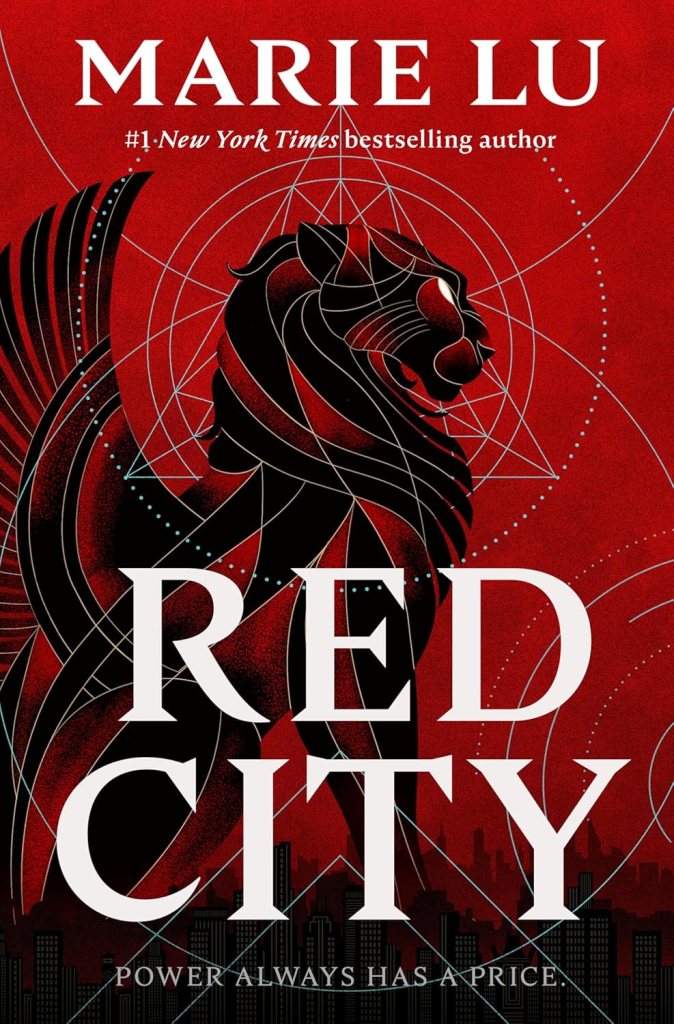
Red City – Marie Lu“It goes dark, it goes darker still/Please stay/But I watch you like I’m made of stone/As you walk away…”

“Where the Road Goes Down from Two Lanes to One” – Julie Doiron, Michael Feuerstack, Land of Talk, & Dany Placard

I just put Julie Doiron on the graphic since she’s the main artist on this song, but I wanted to credit the rest here. I just don’t think I could fit everybody else in the tiny text in that tiny little rectangle, and I’m not about to give anybody eyestrain.

I found out about this soothing song through Black Belt Eagle Scout, who played several shows with Julie Doiron earlier this month. (Happy to see that they’re well enough to play music again!!) Either way, I was immediately charmed by the nostalgic calmness of this song; it’s a six-minute, lazy stroll down memory lane, buoyed by a series of multilayered harmonies. As Doiron strings together a series of vignettes about crushes on boys and late-night driving, she gives them the feeling of blurry, sun-bleached photos with the edges curled up from wear. Towards the end, as all four of their voices fall artfully out of sync, repeating “Can you say it how I remember/Will you say it how I remember/Can you sing it how I remember/Will you sing it how I remember?”, it brings into sound the feeling of memories tangling together in your mind, timelines hazy and blurred, but just as pleasant as they were in the moment.

…AND A BOOK TO GO WITH IT:
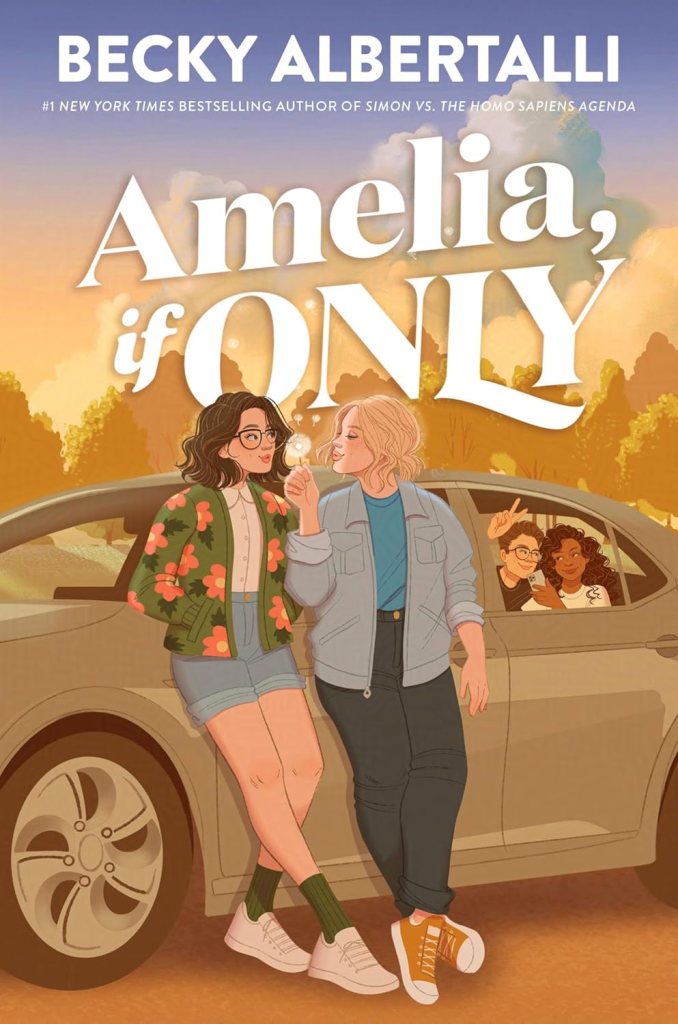
Amelia, If Only – Becky Albertalli“Get in the van, we’re late for a show/Still got four more hours to go/Road maps, glovebox, no phone/I need to pull over, I wanna call home…”

Since this post consists entirely of songs, consider all of them to be today’s song.

That’s it for this week’s Sunday Songs! Have a wonderful rest of your day, and take care of yourselves!

Posted in Sunday Songs

Sunday Songs: 5/18/25

Happy Sunday, bibliophiles! I hope this week has treated you well.

This week: do

you

SEEEEEEEEEEEEEEEEEEEE

THAT I’M SCARED

AND I’M LONELÆEEEEEEEEEEE

Enjoy this week’s songs!

SUNDAY SONGS: 5/18/25

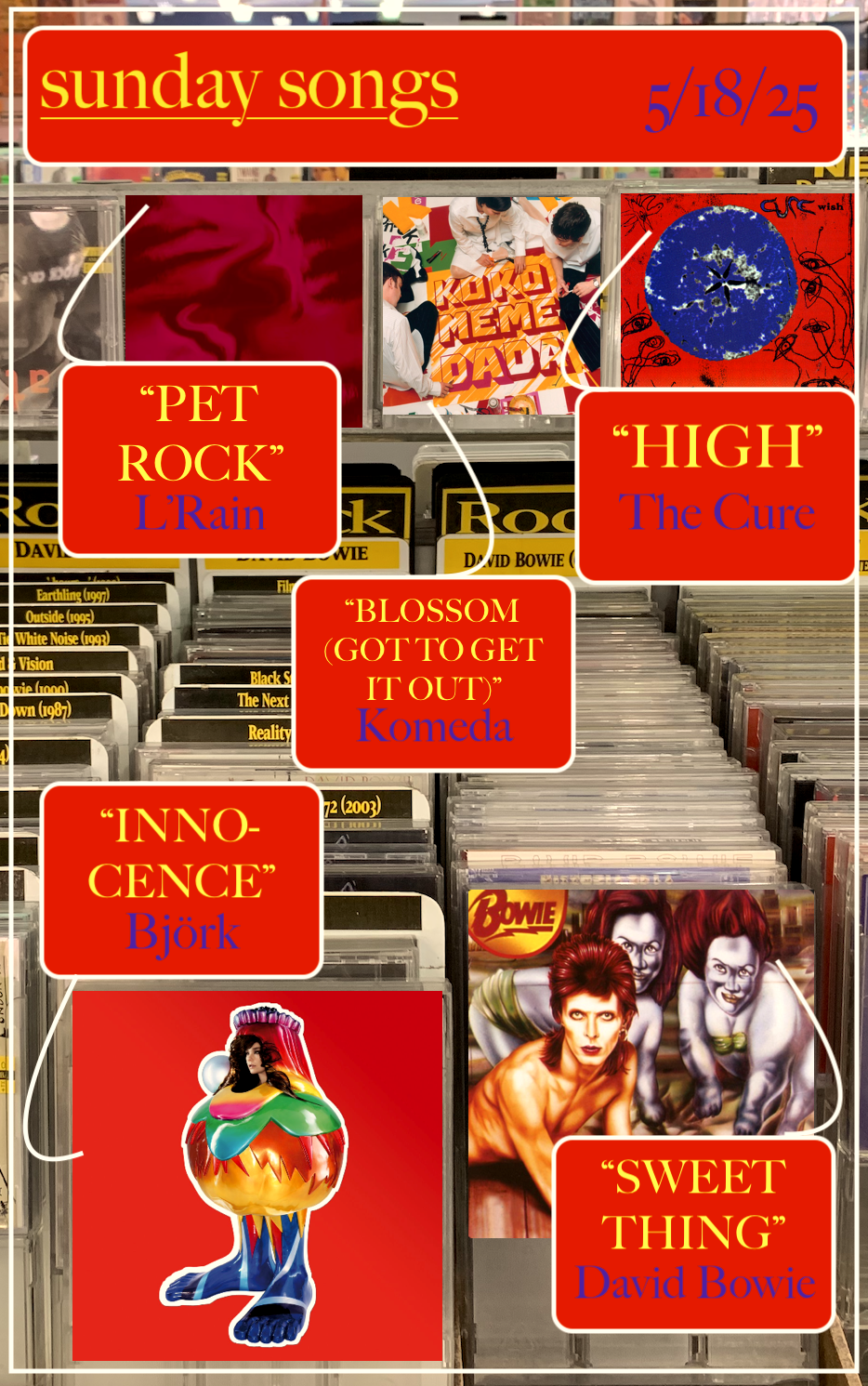
“Innocence” – Björk

Saying that a certain Björk album feels bolder or more in-your-face than others feels redundant because most of them trend towards that direction. According to Sonic Symbolism, Volta was about being upfront, brightly-colored, and loud—in her personality, in her life, and in her political views (see: “Declare Independence”). Volta’s still in the weeds as far as my album bucket list goes, but I love the distinct flavor of it—flat neons and confidence. “Innocence” is a whole feast for me to pick apart in terms of sound. It stomps all over the place, leaving an asymmetrical trail in its wake, angular and herky jerky, but never more sure of itself. It’s the kind of song that makes me think that Björk’s suit on the album cover (designed by Bernard Willem) is about to turn into some kind of mech suit with flag-shooting cannons for hands. This is one of the songs on Volta that was produced by Timbaland, giving it a chrome-like sheen that could almost be pop, but could never deny the inherent weirdness that is Björk. At the beginning, the synths speed up as though winding up for a punch. The angular rhythm is an ouroboros, constantly made and remade again against Björk’s smoother vocals. There’s even a bit at 2:13 that I swear sounds like the Severance elevator noise. Every listen brings something new to the table—there’s all manner of Easter eggs lying around.

Lyrically, I can’t help but think of Debut. “Innocence” is a reckoning with the fearlessness of youth: “When I once was untouchable/Innocence roared, still amazes/When I once was innocent/It is still here, but in different places.” It’s hard not to think of the 1992 Björk that sang of “go[ing] down to the harbor/and jump[ing] between the boats” and ecstatically declaring that there was more to life than this. But the kind of confidence that she maintains at the time of “Innocence” is balancing that excitable youth with the fears that came as she matured: speaking to The Sun, she called the song “A handshake with fear.” For her, fear makes fearlessness even more tantalizing—now that she’s known the grips of it, she appreciates it even more. Even so, it’s still an extreme, but so is fear: “Fear of losing energy is draining/It locks up your chest, shuts down the heart/Miserly and stingy/Let’s open up: share!” Man. Did I need to hear that…for the millionth time. I feel like I’m the reverse, somehow. Of course, I’m not nearly at her maturity level, but I’ve been cautious my whole life. Still am. Fearlessness is freeing, and I only find that I can appreciate it when I have those fears right in front of me: I can see them, acknowledge them, and throw them to the wind, if only for a moment.

BONUS: The video above isn’t the official music video, but the 1st place winner of a fan contest that Björk held to make a music video, created by Fred & Annabelle. Here is the 2nd place winner for the video contest, made by Roland Matusek (Björk Kart?)

…as well as Björk talking about the inspiration behind the animation contest:

…AND A BOOK TO GO WITH IT:

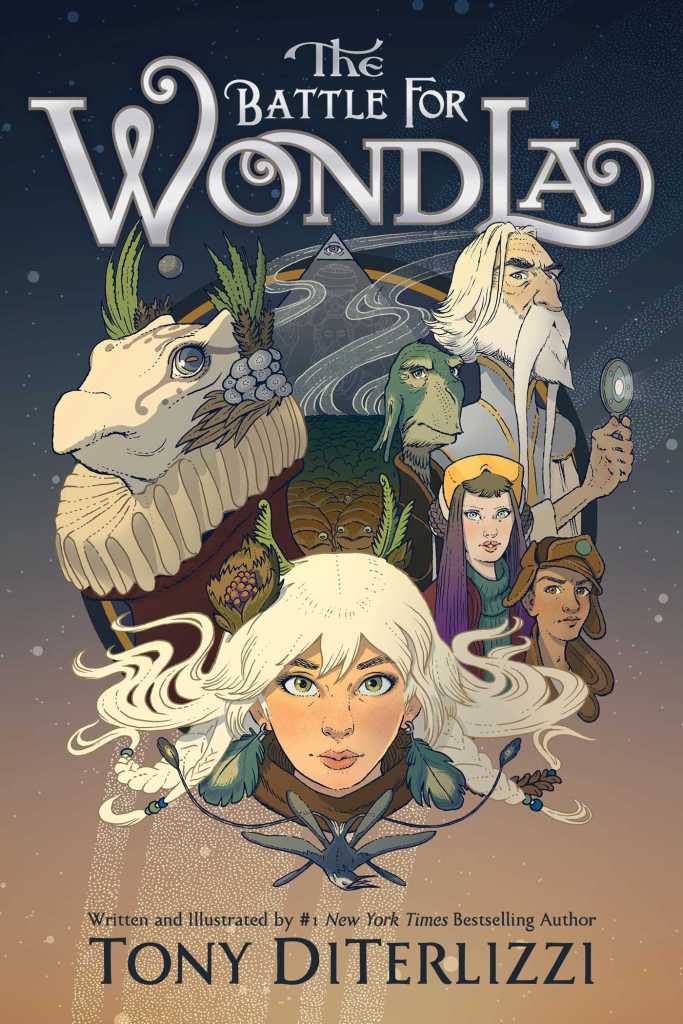
The Battle for WondLa (The Search for WondLa, #3) – Tony DiTerlizzi“When I once was fearless/Innocence roared, still amazes/Untouchable innocence/It is still here, but in different places…”

“Sweet Thing” – David Bowie

It’s been about a year since I finally listen to all of Diamond Dogs in full, and I’m still blown away by how much David Bowie’s storytelling had developed. Throughout his life, Bowie accumulated an extensive library, often bringing books along with him to read on tour. (If you’re interested, John O’Connell compiled a list of some of the books that impacted him the most in Bowie’s Bookshelf. It’s a great read.) The more I think about it, the more I realize that Bowie approached songwriting like an author—whether or not there was a linear narrative, like the story of Hunger City in Diamond Dogs, he had not just melody in mind, but the exact emotion to wring out of which characters and when, and which motifs and allusions to scatter throughout. Obviously, these elements can exist outside of the realm of literature, but it’s so distinct from any given Bowie lyric, much less “Sweet Thing,” that he was a literary-minded man. No wonder I connected with him instantly.

In terms of Diamond Dogs’ tracklist, often with songs that are directly chain-linked to the others, I’m partial to “Future Legend/Diamond Dogs” (my favorite album opening of all time…nothing will ever go harder than that), but “Sweet thing” is the emotional core of Bowie’s narrative, without a doubt. Take a look at the first verse: “It’s safe in the city/To love in a doorway/To wrangle some screams from the dawn/And isn’t it me, putting pain in a stranger?/Like a portrait in flesh, who trails on a leash?” MAN. Glam rock had roots in theatre and the dramatic from the start, but this is one excerpt from Diamond Dogs that would have felt right at home on stage. As one of the entries in Bowie’s failed 1984 musical adaptation, it’s a loose twist on the ill-fated romance between Winston and Julia in Orwell’s novel; Bowie had to make some changes after the musical was dead in the water, rendering the characters nameless and the woman, seemingly, into a prostitute. Under the watchful eye of the “knowing one,” a kind of panopticon surveillance a la Big Brother, the narrator and the prostitute share painful, ill-fated, but fleeting love: “I’m in your way/And I’ll steal every moment/If this trade is a curse, then I’ll bless you/And turn to the crossroads…” With the imagery aplenty of doors and doorways, it’s an affair steeped in transition, an air of impermanence and separation present in every bittersweet moment. Bowie sells it all with one of the album’s most heart-wrenching moments: he draws out “Will you see/That I’m scared and I’m lonely?” with a stabbed, bleeding heart, hand outstretched, with full on musical theater drama. Yet never once does it feel false—Bowie can’t help but let some sincerity slip through the metric ton of personas and fiction. Alan Parker’s guitar soars in true glam-rock fashion, and somehow, the saxophones never feel out of place; Bowie’s world is all brass, rust, and forbidden love—a world fully realized that burst from the shell of Orwell to become a myth all its own.

BONUS: for the full experience, here’s the full story, told in a joining of “Sweet Thing,” “Candidate,” and “Sweet Thing (Reprise)”:

…AND A BOOK TO GO WITH IT:

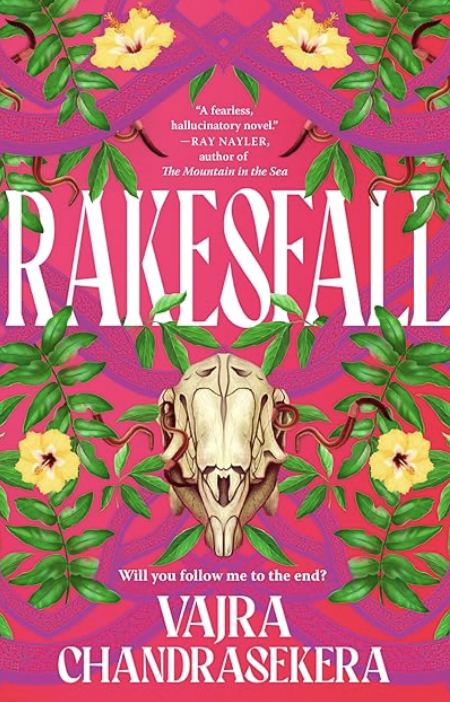
Rakesfall – Vajra Chandrasekerathe 1984 pairing has run its course at this point, so here’s a story of epic-like love spanning across space and time.


“Pet Rock” – L’Rain

Another amazing find from my dad, “Pet Rock” thrives on being propped up. The music video shows a variety of pet rocks being set up and placed around a miniature dollhouse fitted with all manner of retro furniture, tiny instruments, and mini versions of L’Rain’s album I Killed Your Dog. (Now that’s a title for you…what’d you have to do that for??) The music thrums with distortion, barely contained chaos with a bubbly, Crumb-like atmosphere, faintly on the verge of psychedelic collapse. Taja Cheek’s vocals, like Lila Ramani, flicker in and out of clarity—the only time a finger pokes through the haze is when the guitar, before the instrumentals start unraveling, almost tricks you into thinking that there’s a light at the end of the tunnel. Like the dollhouse, “Pet Rock” has the feeling of a neon-colored haunted house (new Meow Wolf concept?)—everything appears structurally sound, but there’s all sorts of weirdness drifting just out of earshot.

The lyrics take a similar turn: after speaking of being propped up like said rock “Why would you go without me?/And make me something else?”), the lyrics go from a faint dread to something outright sinister: “Like a dead girl with shades on/Propped up by captors/I’m fine/I’ve got no one to talk to.” HUH?? Cheek told Alternative Press that the story was inspired by “an old story I’d been told about a woman who was riding the train but looked strange, and the reader eventually figures out that she’s dead, with glasses on, being propped up by the people that seem to have harmed her.” There’s a solid manipulation metaphor for you—rock or human, you’re not alive, just a nice little dolly to be moved around the dollhouse in whatever way suits you.

It’s just a rock! Or not quite, this time? Rocco takes a stand?

…AND A BOOK TO GO WITH IT:

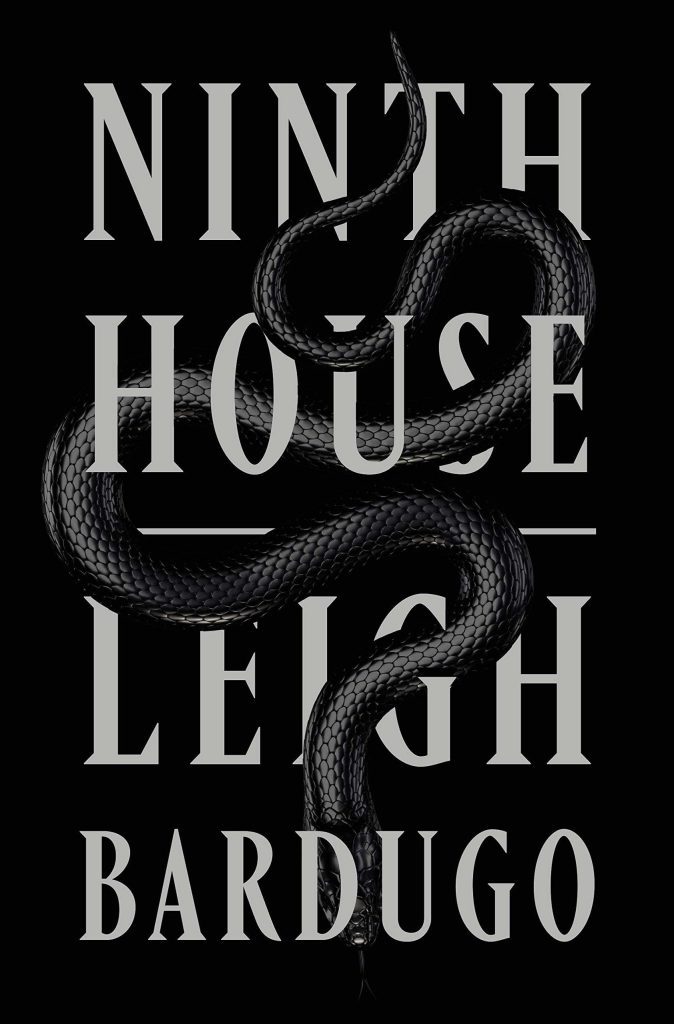
Ninth House – Leigh Bardugo“Like a dead girl with shades on/Propped up by captors/I’m fine/I’ve got no one to talk to/It’s all my fault, I know…”

“Blossom (Got To Get it Out)” – Komeda

I seem to gain a tolerance for more uptight songs once I get older, but in retrospect, “Blossom” gets less uptight the more I listen to it. Sure, it’s about as high-strung as The Feelies, but it’s got this ’60s girl group feel to it that makes it inherently more playful. Komeda seems to fall into a kind of indie, ’90s niche taking their cues from the bubblegum pop from the ’60s (see also: The Rondelles); it’s jangly as all get-out, and features an almost Fred Schneider-esque chorus of spelling out “B-L-O-S-S-O-M” like a cheerleader’s chant. I’d argue that Komeda’s voices aren’t quite as enthusiastic as their forebears (and the instrumentals), but it’s got that vibrant, candy-colored spirit of the ’60s with a distinctly ’90s production—it’s much more fun now that I’ve revisited it.

What makes this song infinitely better for me is the fact that, under the title “B.L.O.S.S.O.M.,” this song was on Heroes and Villains, an album of songs inspired by The Powerpuff Girls, alongside The Apples in Stereo, Devo, Dressy Bessy, and Frank Black…what a time to be alive. This version is re-recorded, sped-up, and drum-machine-ified, and doesn’t resemble a whole lot about the original. The more electronic version isn’t jangly at all, but the very early 2000’s, rapid-fire instrumentals mesh with the 2d, supersonic speed of the Powerpuff Girls. I’m partial to the original, but at least you’ve got this absolute banger from The Apples in Stereo, right?

…AND A BOOK TO GO WITH IT:

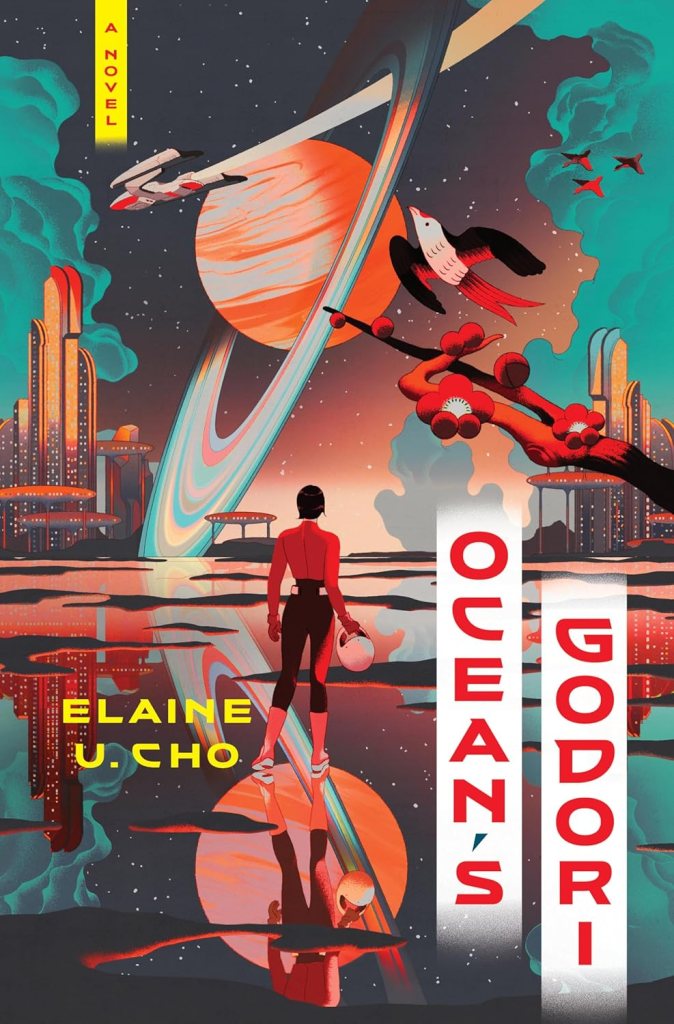
Ocean’s Godori – Elaine U. Chovibrant, fast-paced, and with the kind of spaceships I can imagine blasting Komeda through their speakers.

“High” – The Cure

I wasn’t here to witness it, but it must’ve been such a jarring shift in the ’90s when the Cure became more embraced by the mainstream. My parents talk about how maddening it was to have their special, alternative music be ignored or made fun of in the ’80s and then all the normies started singing along to “Friday I’m In Love.” Jeez. The Cure could always make an incredible pop song, but it never ceases to baffle me that they went from being relatively underground to selling out arenas in such a short period of time. Now that rock is less adjacent to the mainstream these days, I can’t say I’ve had an experience that mirrors it. The only thing I can think of is all of the members of boygenius getting huge, but they aren’t nearly as weird as the Cure were. The eternal battle: wanting people to appreciate your weird music, but wanting to gatekeep it at the same time…

I can’t fully grasp the kind of frustration my infinitely-cooler-than-me in their ’20s parents had when Wish came out back in 1992. I fully adore “Friday I’m In Love,” even though I can recognize that it’s leagues less weird than the more creative parts of their catalogue. But if the fact that I remember “High” to this day must prove that they weren’t all that resentful. “High” was a mainstay throughout my childhood in many a car trip—I distinctly remember mishearing “licky as trips” as “licky as chips” (those damn Brits) and Robert Smith meowing (can you really have a Cure song without it?). I’m charmed to this day about the way Smith makes adjectives into nouns with each lyric—”sky as a kite” or “kitten as a cat” makes perfect sense in his lingo. What strikes me now is that The Cure, even at their darkest, always kept true to having emotion at their core. They were dramatic and goth, but they were always in touch with whatever was at heart, and painted it in every complicated color. “High,” like “Friday I’m In Love,” is proof that they can be just as sugary and playful as they can be brooding and raw, but to an extent, all of it feels true to them. Like the subject, who’s “happy as a girl/limbs in a whirl,” “High” is The Cure in a dreamy, lovelorn state, adrift in the clouds in the throes of ecstatic love. It’s not their most emotional love song, but it’s got a similar purity as “The Perfect Girl” or “Just Like Heaven”—”High” feels like a spiritual successor of that emotion, even if it’s not fully on the level of the latter two to me. To this day, this track remains as warm as sand between my toes or afternoon sunlight heating up the glass of the back seat of a car.

…AND A BOOK TO GO WITH IT:

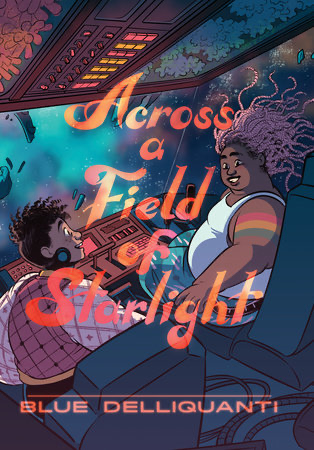
Across a Field of Starlight – Blue Delliquanti“And when I see you take the same sweet steps/You used to take, I say/’I’ll keep on holding you in my arms so tight/I’ll never let you slip away…'”

Since this post consists entirely of songs, consider all of them to be today’s song.

That’s it for this week’s Sunday Songs! Have a wonderful rest of your day, and take care of yourselves!
Posted in Sunday Songs

Sunday Songs – 11/5/23

Happy Sunday, bibliophiles! I hope this week has treated you well.

Did somebody order a monthly blue period double-dipped with Peter Gabriel? Because you guys are not gonna believe what showed up on my doorstep this morning…

Enjoy this week’s songs!

SUNDAY SONGS: 11/5/23

“The Tower That Ate People” – Peter Gabriel

COME AND GET IT! TWO FOR ONE PETER GABRIEL DEAL! TWO FOR THE PRICE OF ONE!

If there’s a vaguely overarching theme for this week’s songs that I can throw together, it’s that Peter Gabriel gets so much weirder than people give him credit for. I suppose that’s the curse of any musician whose earlier hits get the spotlight while the later, more experimental parts of their career go on the wayside in terms of engagement, but are as full of life and creativity as anything else they’ve produced (see also: David Bowie, Kate Bush). To be fair, we’re so used to aging artists that continue to pump out more of the same in hopes of keeping the fire of fame going (say, what’s going on with The Rolling Stones lately?), but equating aging to a decline in musical artistry is shallow either way. Again: I just saw Peter Gabriel a few weeks back, and here he is at 73 delivering some of the most spectacular performances—both visual and musical—that I’ve seen from any musician on stage.

The album, 2000’s OVO, is technically his soundtrack work, and was conceived for a multimedia show that ran in the Millennium Dome for 999 shows in that same year. Gabriel’s work on it interfered with his next album, the criminally underrated Up, which ended up coming out in 2002, a year after it was set to be released. The through lines between the two are clear; “The Tower That Ate People” (good god, what a title) has an industrial, almost Massive Attack-like crawl to it, propelled by a looped guitar riff. Gabriel’s voice comes out as a shrouded growl, making it all the more convincing when he opens the song with “There’s a bump in the basement/there’s a knocking on the wall.” The electronic grinding as he sings of “the pumping of the pistons” makes the music swell. It’s a clanging machine, but it never loses an ounce of that cinematic, Peter Gabriel touch—especially not the prolonged silence after he declares “We’re building up/Until we touch the sky,” letting everything fade to lumbering, echoing footsteps. I can only imagine what the stage show was like. I’m jealous that I wasn’t one of the lucky few who got to see this live on the i/o tour, because can you imagine the feeling of this reverberating straight through your ribs?

“We Looked Like Giants” (Death Cab for Cutie cover) – Car Seat Headrest

THEY’RE BACK!! THEY’RE BACK!!!! So what if it’s a cover—it’s a perfect fit.

Even without as much Death Cab for Cutie knowledge (much less about the album that they’re commemorating—before this, all I knew was the title track. Owie.), it’s easy to see that pairing them with Car Seat Headrest was a fit as perfect as puzzle pieces sliding together. Despite “We Looked Like Giants” being a cover, it feels like the whole song is harkening back to the Teens of Denial glory days, with its crashing guitar breakdowns and angst so dense you could squeeze it out of a dish towel. The lyrics feel even more like it was made for them—”When every Thursday/I’d brave the mountain passes/And you’d skip your early classes/And we learned how our bodies worked.” Certainly makes…every single song from Twin Fantasy make more sense. Even without the slam of an intro that the original version boasts, the tension and momentum that Will Toledo and company bring to this song fills it with the nervous energy that has defined the band for so long—it’s a song teetering on its tiptoes, balancing out both arms as it contemplates the edge. Toledo’s signature, honeyed wail takes the song to dizzying heights, making the collision course back to Earth as the final seconds plunge into silence all the more riveting. I always get all sappy about Teens of Denial and all of the memories of listening to it the summer before I started high school, and this song brings all of the good parts of that back—slip this before “Fill In the Blank,” and I wouldn’t even blink. Leave it to Car Seat Headrest to toe the line between an unchanged cover and one that makes the cover all their own.

“The Family and the Fishing Net” – Peter Gabriel

I’ve done it. I’ve finally surmounted the task of going through all of Peter Gabriel’s albums (minus his soundtrack work). Peter Gabriel summer has come to an end. Peter Gabriel 4: Security was the last one for entirely arbitrary reasons, but it’s fantastic—and a lot creepier than most people give it credit for.

Take this song. Immediately, it sonically calls back to “Intruder,” with its ominously creeping instrumentals, off-kilter chanting and an unsettling chorus of flutes that open the song. Slowly, you start to process the lyrics, and the chill starts creeping down your spine. “Icing on the warm flesh cake?” Yep. Mom, come pick me up, I’m scared. But if you take just a quick look through, you can see the true genius of this song—I was super curious about the meaning, and I was floored by the concept behind it.

“Vows of sacrifice (vows of sacrifice)/Headless chickens (headless chickens)/Dance in circles (dance in circles)”. It sounds like the makings of a cult. But Peter Gabriel specifically created “The Family and the Fishing Net” as a wedding song. Vows of sacrifice? For richer, for poorer, in sickness and in health. Headless chickens? Could just as well be serving a roast dinner at the ceremony. Dance in circles? We’ve all done that at a wedding or two, haven’t we? That’s where the lyrical genius comes in—it’s not just that he’s subverting Western wedding imagery and making it sound like a cult ritual, there’s a level of exoticization that he brings to it that makes it clever in a conscious way that lines up with his worldly sensibilities. It feels like a response to every song that’s ever demonized and exoticized ordinary (and often sacred) rituals of indigenous people around the world. And given that much of this album has that worldly ethos (see also: “San Jacinto,” “Wallflower”), it’s a perfect addition. As much as I tend to rag on old white guys, Peter Gabriel should be one of the paragon examples in writing songs—and any kind of writing—outside our worldviews, just for the simple fact that he cares to listen about people’s lived experiences. It’s not just writing about some strange, foreign goings-on that he witnessed in his travels—Gabriel took the time to make sure that he understood and uplifted the people and cultures that he encountered. That’s what makes this song feel so important—he recognized the detriment in writing songs from an ignorant distance, and used that aspect of the history of Western music to create one of the creepiest—and most clever—songs in his catalogue.

Also, to the anonymous YouTube commenter who said that she wanted to have this play when she walked down the aisle: I salute you. I’d pay to see that.

“She Plays Bass” – beabadoobee

So it turns out that the she who plays bass is beabadoobee’s actual bassist, and…yeah. They’re aren’t romantically involved, but that still has to be bizarre to be playing bass on a song about yourself. At least all parties seem to be okay with it? Knock on wood that beabadoobee’s backing band doesn’t get into any kind of Fleetwood Mac funny business.

That aside, here’s another entry into my thesis that beabadoobee makes the perfect music for teen rom-coms. From her 90’s-inspired Space Cadet EP (hmm, wonder why there’s a song called “I Wish I Was Stephen Malkmus”…), it’s an ode to yearning, longing, and bright, shiny guitars. Bea Kristi described the song as “a Cure rip-off,” a description that she admitted to Robert Smith himself when they met at the BRIT awards back in 2020. Either way you want to describe it, there’s no denying the brightness of it—despite the black and white cover of the single, “She Plays Bass” is rife with neon colors and cartoon stars. I halfway get the Cure bit—definitely more like “Friday I’m in Love” or “Let’s Go to Bed” than their other music—but what I do get is delightfully guitar-driven indie longing, sparkling and starry-eyed. If “Glue Song” plays in the end-credits of said rom-com, maybe this plays as the intimidatingly cool love interest is introduced. Just a thought.

“Black Hole” – boygenius

What? You thought I was gonna shut up about the rest after talking about “Powers”? You fools…

“Black Hole” is an easy song to have on loop—it’s part of the 3/4 of this EP where every song is freakishly hypnotic, but they’re all around two and a half minutes long, so they just suck you down with them forever, like water sucked down the sink drain. Or…maybe, something else? Mayhaps…a black hole? But the black hole in this song is a more recent revelation—”You can see the stars, the ones/The headlines said this morning were being spat out/By what we thought was just/Destroying everything for good.” The black hole in question is a fascinating one: caught by the Hubble telescope in early April of this year, NASA observed that this supermassive black hole was leaving a trail of stars in its destructive wake that stretched over 200,000 light years long. It’s the perfect, beautiful moment to write a song about. Hopefully this bodes well for me because I’m taking an astronomy class next year: I’ve always struggled with astronomy in school previously, but it makes me tear up that we live in a universe that we will never fully know everything about. That there will always be new things to discover about the vastness of space and the world around us and beyond us until the day I die.

Back to the song: it’s poetry. More specifically, it’s two separate poems. Julien Baker takes the reins in the first poem, with her musings about looking at the stars. The gently clattering electronic instrumentals sound appropriately starry, with the hum of synths leading into Baker’s voice, then transitioning into a tinny, ascending scale on a keyboard just before everything shifts. This is the second poem. It feels like the camera has whipped around as the drums and synths intensify, panning around to Lucy Dacus as Phoebe Bridgers lingers just out of the frame, opaque camera shots flickering at high speed over them as the camera zooms in on their faces. Hearing Dacus take the high notes and Bridgers taking the low, the opposite of their normal range, is an odd treat—it makes Bridgers’ voice seem like a ghost, barely there unless you really pay attention, while Dacus acts as the piercing lighthouse beacon cutting through the fog. All of their lines are enchantingly neat, spaced apart like they’re all collected in separate bins. Apart from the initial confusion (and fleeting clunkiness) of the first two lines (“White teeth/black light/White tee/brown eyes”—”teeth” and “tee” sound way too similar, especially when preceded by the same adjective), I’ve been eating up the emotionally-charged precision of it all. As each line is cut off the chopping block, the drum machine thrums on, just as meticulous as the delivery of each lyric. And I am nothing if not a sucker for songs on an album (or an EP, in this case) that transition into the other as though they’re the same song. Especially with this and “Afraid of Heights” being so short, it feels all the more like a single song. Pure artistry.

Since this post consists entirely of songs, consider all of them to be today’s song.

That’s it for this week’s Sunday Songs! Have a wonderful rest of your day, and take care of yourselves!
Posted in Uncategorized

Sunday Songs: 7/9/23

Happy Sunday, bibliophiles! I hope this week has treated you well.

Today marks almost a year since I’ve been making these Sunday Songs graphics, and about six months since I’ve started writing about them on here. But if there’s on thing I’ve learned in this year of collaging album covers on Previews, it’s this: all roads lead back to David Bowie.

Enjoy this week’s songs!

SUNDAY SONGS: 7/9/23

“Quicksand” (demo) – David Bowie

Lordy. This song gets me in whichever form it manifests—the original, untouchable album version, the live performance with the Cure’s Robert Smith for Bowie’s 50th Birthday Bash…everything. Since when did I wake up in the onion cutting plant, and where’s the door?

“Quicksand” has been an immensely special song to me, from the time I was young and my dad still had to speedily turn the car volume down in time for little me to miss the word “bullshit.” Even back when I didn’t even have the capacity to understand anything about what an ego is or the fact that it was capable of death (“knowledge comes with death’s release,” cue the “aah-aah-aah-aah” that always scoops my tender heart out of my ribcage), this song felt like the encircling warmth of a cosmic pair of arms, infinite in their reach and love, rocking me to sleep like a baby. The iconic lyric “I’m not a prophet or a stone-age man, just a mortal with the potential of a superman” has been my life’s mantra ever since I comprehended it. Learning it on guitar made me love the song down to its molecular structure—chances are, if you can rattle off any old chord off the top of your head, it’s in there somewhere. Even the painful, finger-twisting ones—especially the finger twisting ones. And yet David Bowie makes them all sound like they were all destined to be played together since the dawn of time—all of them. It’s the kind of song that was fully-formed from the very start, as Athena splitting out of the skull of Zeus, armed with a ragtag, motley crew of guitar chords. It feels like listening to the heartbeat of the cosmos itself.

So it’s so strange to think that it wasn’t always quite as fully-formed as I thought—in parts, at least. With the release of Divine Symmetry (a line fittingly taken from this song), a boxed set containing Hunky Dory in its entirety, plus the demos and live performances that eventually fused to form my favorite album of all time. Among them was this—a raw, stripped-down version of one of my favorite songs of all time. “Quicksand” was always destined for the epic grandeur of the album version, but there’s a different brand of poignant tenderness to this demo. With only David Bowie’s voice and the heartbeat-thrum of his acoustic guitar, you can hear the subtle differences—lyrics swapping places, Bowie straining to reach the high notes in the higher key he originally plays this song in. There’s an urgency to every strum, as though he knew this song had to see the light of day, but he had to put his heart into it, whichever way it came out. And that’s the power of this song: Bowie never took the easy way out. Every version is in tune with the resonant hum of the universe.

“Gone Daddy Gone” – Violent Femmes

Never in my life would I have anticipated liking a xylophone solo this much. The words “xylophone” and “solo” make sense separately, but you rarely ever hear them together, right? And yet, against all odds, it’s so good. Imagine being at a Violent Femmes concert and the crowd going wild over a xylophone solo. That’s the dream.

A lot of what I’ve heard of the Violent Femmes works against all odds, from the infamous story of how the cover of their debut, self-titled album came to be to everything about their unique, abrasive sound. All you’ve got here is some guitar, bass, and a drum set that was originally part washbasin (plus said xylophone). The nicest you can necessarily say about the vocals is that they’re abrasive. It really is the essence of D.I.Y.—separately, there’s no way that it should work together and sound good, and yet it does. We all know “Blister in the Sun” nowadays, right? Whatever formula that Gordon Gano and company worked out in the early 80’s with this album, when everybody started turning to synths and capitalism, they nailed it. Every song I’ve heard off of this album feels timeless, but “Gone Daddy Gone” feels like it could’ve come from anywhere—a tiny, under-underground garage in the 70’s, somebody sick of all of said synths and capitalism in the 90’s—there’s something so ubiquitous about this song, from its frustrated, high school lyrics that Gano delivers with a sinister sneer, to the unexpected patchwork of sound. And of course, whoever’s idea it was to add a xylophone solo to this song deserves an award.

“Baby’s On Fire” – Brian Eno

I’ve been overdue to talk about Here Come the Warm Jets and Brian Eno for a few weeks, but I am nothing if not pointlessly devoted to trying to create a nice color scheme. But yes, I finally got around to listening to it after putting it off for several months (blame it on the whiteboard…oh, I still need to post those, don’t I?), and I’m a fan! Even though nothing rivaled “Cindy Tells Me” (which is, for me, a hard thing to achieve—my absolute favorite Brian Eno song, now that I think about it), there wasn’t a single song I didn’t like. I’m a sucker for any album where each track bleeds into the next, giving the illusion of a continuous, long song—almost a symphony: some of my favorites albums do it, or at least do it partway (see: Hunky Dory, OK Computer), and in the case of Here Come the Warm Jets, it added a cohesive layer to an already meticulously weird album. There’s Brian Eno doing weird voices, there’s guitar freakouts, and there’s uptight-but-glam 70’s weirdness all over the place. It’s an album.

“Baby’s On Fire” stood out immediately—I remember hearing the name somewhere and looking it up a few years before I listened to this album in full, but I’d all but forgotten about it until a few weeks ago. It has a deliciously creeping, building feeling to it—with every thrumming piano chord and drumbeat, it feels like something is sneaking up on you, casting a long, thin shadow over your body before coming in to pounce. And pounce it does, with an extended, purely 70’s guitar freakout that, if you break the separate parts of it, easily takes up half to 2/3 of the song—as it absolutely should. It’s fantastic. I find myself vibrating in my seat every time I listen to it; Robert Fripp’s frenetic playing sounds like the auditory version of fabric being torn apart, all at once ragged and full of hypnotic color. Add that to Brian Eno’s distinctly nasally, theatrical vocals, and you’ve got something that feels like the shadow of a hand on the wall—a hand with long, glossy acrylics on the nails, the kind that look like claws. I suppose that’s what ‘s tearing through the fabric, but I doubt that would be very conducive to the kind of guitar insanity on this song. In this house, we love and cherish 70’s guitars.

“Tin Man” – feeble little horse

I swear that my motive for downloading this song wasn’t just to create a playlist consisting of songs that have the same names as other songs. It’s twins with “Tin Man” by Shakey Graves, if you were interested. I named the playlist “Attack of the Clones.” Execute Order 66.

I’m very new to feeble little horse, but “off-kilter” was the one (hyphenated) word that immediately came to mind when I first listened to “Tin Man.” Every note just seems slightly tweaked from the next—almost pleasant sounding, but just enough to make you furrow your brow. Lydia Slocum’s dry, droll drawl creeps over the withered vines of notes, just as creaky and rusty as the the famous Tin Man himself before he got some oil in his joints. But unlike the Tin Man, this song doesn’t need any oiling or polishing; like the Violent Femmes, it exists in its own, uniquely abrasive space, not existing to please, but baring its prickly porcupine quills proudly. Like Lisa Germano, Sparklehorse, and others before them, feeble little horse is content to make their songs look and feel like a collection of rusty spare and found parts. But where the former two is the dread you feel upon finding said spare parts, “Tin Man” is the sudden prick of stepping on something sharp sticking out of the pile. It’s almost like Sid’s cobbled-together, mutant toys in Toy Story—despite all of its parts from other toys, it crawls along the carpet just fine. And maybe it’s an insult to compare this great song to that baby doll-spider monstrosity, but given the aesthetic of the music video, I don’t think Lydia Slocum and company would be too insulted.

“Sun’s a Star” – Wilco

I didn’t intend for this one to end on such a somber note, I promise. Just the way I thought the album covers went together. But I came upon this song on accident—as dear to my heart as Wilco is, I haven’t listened to Being There all the way, despite the claims of an unknown employee at Amoeba Records in San Francisco that it was “the best Wilco album.” BOOOOOO. DUDE. Not to rag on a complete stranger several states away that has no idea that I exist, but respectfully…Yankee Hotel Foxtrot exists? Summerteeth? My guy??

But I’m not here to rag on Being There, either. It’s the same record that gave us “Misunderstood,” after all, and proof that screaming like a death metal frontman is just one of the great Jeff Tweedy’s many talents. Every member of Wilco is proof that they’re really a jack-of-all-trades band; they’re primarily known for generally being on the stranger side of alt-country, but they can do it all, from Nels Cline’s famous, spidery guitar solo on “Impossible Germany” to the pseudo-Thom Yorke surprise of “Art of Almost.” The thing is, loving songs like those almost makes me forget that they’re just as apt at creating gently melancholy folk numbers: “Red-Eyed and Blue,” anyone? And as with every Wilco song that I can think of, Jeff Tweedy’s sharp, ever-clever songwriting is the clear star (no pun intended) on “Sun’s a Star.” What’s more Tweedy than taking a look at one’s own folky breakup tune and declaring “and there’s this song/in a minor key/hey, how could it be/such a cloudless tune?” I’m nothing if not a sucker for a sad, acoustic song, and leave it to Jeff Tweedy to scratch that itch. And there’s nobody else that could translate walking away into a single contraction—somehow, the name “Sun’s a Star” feels like an apathetic shrug of the shoulders. You’re not as special as I thought you were. Oh well. Sun’s a star.

Since this post consists entirely of songs, consider all of them to be today’s song.

That’s it for this week’s Sunday Songs! Have a wonderful rest of your day, and take care of yourselves!
Posted in Music, Sunday Songs

Sunday Songs: 1/29/23

Happy Sunday, bibliophiles! I hope this week has treated you well.

We’re reaching the end of the month now, and it’s shaping up to be another great year for music already! Also, we’re not even a month into this year and I’m already on another relentless Super Furry Animals kick, so…do with that what you will. It’s fine. Bring on the (Welsh) Britpop craziness.

Enjoy this week’s songs!

SUNDAY SONGS: 1/29/23

“$20” – boygenius

Just to check in…gays, are we all okay after this? Are you okay? Are you sure? Take a deep breath.

Breathe in…

…breathe out. This is really happening. Finally.

the glorious Rolling Stone cover, an homage to an older cover featuring Nirvana
PINS PINS PINS!!

To the elation of the girls and the gays (and to the dismay of a bunch of butthurt boomers in the comments of Rolling Stone’s instagram account, apparently), boygenius are back, and they’re already coming out swinging with three fantastic singles. Although all three showcase the joint talents of Julien Baker, Phoebe Bridgers, and Lucy Dacus, “$20” is the true powerhouse of the trio. Baker’s vocals, from most of her solo work, tend to be restrained at worst, but she lets loose on this single, filled with punchy guitars and equally punchy lyrics. It never slows down, feeling more like riding a wave, thinking that you’re safe in the current, and then getting hit with a powerful mouthful of saltwater with what may be the best Phoebe Bridgers scream yet. More than ever, the harmonies of Baker, Bridgers, and Dacus fit each other like chiseled puzzle pieces, as though they were always destined to work together in near-perfect unison. Needless to say, I doubt I’ll come down from the boygenius high for a while here. I KNOW YOU’VE GOT $20.

“Ice Hockey Hair” – Super Furry Animals

If you described the bare elements of “Ice Hockey Hair” to me—nearly 7 minutes long, heavy on autotune, a minute-long outro with almost nothing but random beep-boops strung together—I doubt I’d be immediately sold. But that’s the magic of Super Furry Animals; they can take any number of weird, outlandish elements and string them into something that’s not only cohesive, but an instant earworm at that. Laden with heavy guitars and drums and backed by a consistent fuzz and an effortless vocal harmony, “Ice Hockey Hair” never makes me lose interest through all 7 minutes, going above just keeping a steady pace and making for the perfect, prolonged Britpop song. I barely ever like autotune, but what sells me about the way that Super Furry Animals use it is that they just embrace the weirdness of it—it’s not to make their voices sound better, it’s just to make it sound weirder, to make it blend into all the screeching static and beeping faintly humming in the background. They’re masters of making their voices into instruments, and not just that, but making them into something just as weird as what’s going on in the rest of the song.

“Laughing With A Mouth Of Blood” – St. Vincent

Added bonus: the gloriously awkward Portlandia music video (“I could stick around for another song if you guys want” “no ❤️”)

Along with Super Furry Animals, I’ve stumbled into another St. Vincent kick as of late, and although I’ve always loved her work, I’m reminded of how rarely she misses (we don’t talk about MASSEDUCTION) in any aspect of her artistry. Actor is only her second album, and already, she’s showcasing her clear virtuosity—lyrically and musically. Even before her rightfully famous electric guitar shredding became an essential part of her music, Annie Clark’s complex, acoustic guitar pickings create an atmosphere that always feels alive, and with the added brass and driving drums, “Laughing With A Mouth of Blood” is a poignant landscape of a song that you can’t help but lose yourself in. St. Vincent’s music never loses its quality with the passage of time, and every listen feels like the wonder and joy of listening to it for the first time.

“Burning Airlines Give You So Much More” – Brian Eno

I was so used to seeing the album cover of Taking Tiger Mountain By Strategy (now that’s a title) from really far away, so…am I the only one who thought that Brian Eno was wearing a beret, and it wasn’t just his hand patting him on the head? Is the hand about to give him the Gary Oldman cheek stroke, or is it just to cover up the pseudo-Riff Raff haircut?

…okay, I really shouldn’t be roasting the guy. He’s just doing his wonderful art-pop thing, and I love him for it. So much. Songs like “Cindy Tells Me” have further convinced me that I should listen to more Brian Eno, and this one I like almost as much (though it’s hard, considering how long I had the former on repeat back in October). For a song loosely written about one of the deadliest plane crashes of all time, it’s strangely laid-back, meandering along with bright, jangly guitars and synths in the similar tone. It’s a song to gently sway your head to, one to revel in the multi-layered composition of it as the guitars slowly climb up and down the scale. Brian Eno’s just doing his Brian Eno thing, and I’m so glad he’s doing it.

“Purple Haze” (Jimi Hendrix cover) – The Cure

It’s hard to take a cover and put a spin on it that feels completely new—especially if it’s Jimi Hendrix that you’re covering. But Robert Smith and company make it look easy, putting their signature goth touch on a rock n’ roll classic. Smith pulls the meaning of “haze” to an entirely different direction, layering the song with an eerie, synth-laden atmosphere and distorted vocals. It really does give the song the feel of a haze, like some kind of cloud or curtain that you’re walking through to try and find the heart of the song.Different pieces of instrumentation fade in and out, as though you’re losing consciousness. The guitars are understated, but I think it’s rightfully so—you really can’t touch Jimi Hendrix in that regard, for one, but it’s the fog of distortion and synths that make this cover so memorable. It’s a cover that wouldn’t be out of place at some kind of shady Halloween party (as most of the Cure fits anyway), a musical fog machine that transports you to another realm where you can’t seem to differentiate which way is up or down.

Since this post is all songs, consider this post to be today’s song.

That’s it for this week’s Sunday Songs! Have a wonderful rest of your day, and take care of yourselves!