Posted in Book Review Tuesday

Book Review Tuesday (11/7/23) – The Deep Sky

Happy Tuesday, bibliophiles!

The Deepy Sky came out this July, and I’ve been seeing a ton of buzz about it around the blogosphere since. I’m always in for a sci-fi thriller, and this one delivered in that aspect, as well as the wonderful mixed-race rep!

Enjoy this week’s review!
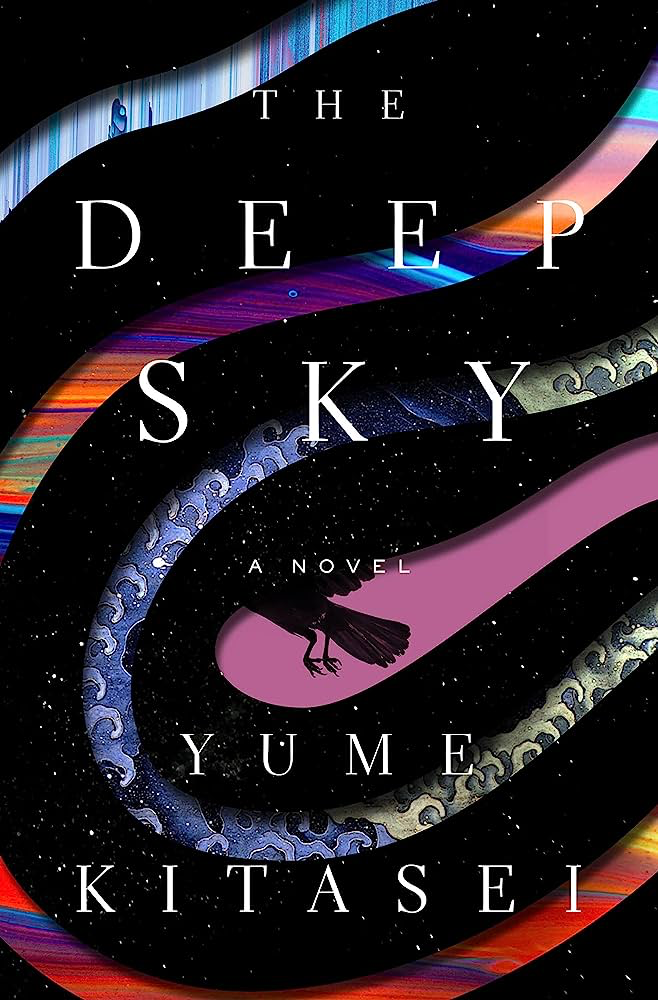
The Deep Sky – Yume Kitasei

Asuka has been chosen as a representative on a mission to deep space, where she will help give birth the next generation of Earth’s children. But she has been chosen to represent Japan—a country she barely knows, as a half-Japanese, half-Latina girl raised in the United States. Feeling like an imposter to an unfamiliar country, she accepts her duty and joins the crew of the Phoenix. But a deadly explosion onboard the ship leaves her the only surviving witness. With all eyes on her once more, Asuka must get to the bottom of the explosion before the perpetrator strikes again.

TW/CW: racism, terrorism, miscarriage/fertility themes, death of a child

“Literary” sci-fi rarely does it for me; most of what I’ve read barely scrapes past the 3.5 star rating for me, at best. Often, what happens is that the sci-fi element gets significantly watered down for the sake of marketability, drama, and a place in a celebrity’s book club (see: Sea of Tranquility, In the Quick). But The Deep Sky had the chops to make itself unique—and incredibly poignant.

The sci-fi plot of The Deep Sky is pretty standard as far as story elements go, but Kitasei’s approach to it made it feel fresh. It’s the setup for a myriad of sci-fi thrillers: you’ve got a large crew voyaging through the depths of space, only for a tragic accident to leave everyone onboard in suspicion, with no way to get back to Earth. It’s not necessarily a new approach plot-wise that keeps it going—it’s the emotional core that Kitasei brings to it. You’re really able to see deeply into Asuka’s head, deeper than a lot of authors dare to go with these kinds of stories; it’s a great way to increase the stakes without having to complicate the mystery of the story.

Also, LET’S HEAR IT FOR MIXED-RACE REPRESENTATION!! I’ve been on a roll with books with amazing mixed-race characters and stories lately (see also: Leslie Marmon Silko’s Ceremony—a very different book, but no less poignant), and as a mixed-race person, I’m so glad that narratives like these exist. Kitasei’s depiction of the imposter syndrome that Asuka faces about her identity is twofold—not only is there the level of it that comes with her being of Japanese and Mexican descent in the U.S., but also in the fact that she has to represent Japan—a country that she’s barely been to—in this mission. It really did make me feel so, so seen. Kitasei’s portrayal of having these intersecting identities and them coming at odds with how others want to box you in was deeply moving and authentic, and I cannot thank her enough for that.

Back to the subject of literary sci-fi. A lot of these types of novels that I’ve read deal with intersecting, nonlinear timelines, which may or may not have to do with actual time travel (case dependent). For the most part, it worked incredibly in Kitasei’s favor—even outside what we can consider the “main” plot, the pieces that we get of Asuka’s life before the deep space mission were almost more intriguing than the actual murder mystery in space. Kitasei’s character work is incredibly detailed and nuanced, and having most of this novel be driven by character and family was a choice that made me enjoy it that much more. These types of sci-fi thrillers normally lend themselves to very distant characters, and minimal character work by proxy (outside of “trust no one”), so this was a breath of fresh air in that sense.

That being said, the nonlinear timeline was also what brought part of the novel down for me. There’s much more emphasis placed on the time before the mission than the actual mission, making the murder mystery plot feel like an afterthought. The way that these timelines were spaced out meant that we went long stretches without checking in on what’s supposed to be the novel’s inciting incident, which made the stakes feel much lower than they were meant to be. The tension got appropriately amped towards the end, but other than that, there really wasn’t as much thriller as I was expecting going in. Maybe this is just a matter of how The Deep Sky was marketed, but I did wish we got a little more of the “main” plot.

All in all, a rare gem of a literary sci-fi novel where every page brimmed with emotion and suspicion. 4 stars!

The Deep Sky is a standalone; it is also Yume Kitasei’s debut novel.

Today’s song:

listened to my first Arlo Parks album, and I’m a fan!! this was my favorite, for sure

That’s it for this week’s Book Review Tuesday! Have a wonderful rest of your day, and take care of yourselves!

Posted in Book Review Tuesday

Book Review Tuesday (8/8/23) – Machinehood

Happy Tuesday, bibliophiles!

After I read Meru back in June, I immediately went through the rest of S.B. Divya’s full-length books and put them on my TBR. Even though sci-fi is my favorite genre, I don’t readily jump for sci-fi thrillers quite as often, but after loving Meru, I was willing to give this one a chance. And while it wasn’t without its flaws, Machinehood was an incredibly detailed and twisty novel!

Enjoy this week’s review!

Machinehood – S.B. Divya

2095. In Welga Ramirez’s world, humans and machines work in an uneasy symbiosis. Artificial intelligence has become so advanced that humans must take all manner of pills, not only for them to keep from getting sick, but to be strong enough to compete with the machine labor force. Welga has intentions to retire from being a bodyguard. But after a client is killed in front of her and a hybrid human-machine terrorist group called the Machinehood is to blame, she must track down her killer—and the members of the Machinehood that have threatened to attack every major pill funder until production comes to a standstill.

TW/CW: violence, murder, racism, substance abuse, abortion/forced pregnancy, miscarriage

You ever finish a book that’s so detailed in its worldbuilding that not only can you imagine all of the described conventions and their ramifications, but the massive google doc that was probably behind it all? That’s how Machinehood felt to me—aside from the one other S.B. Divya book that I’ve read so far, Machinehood was one of the most thoughtfully-crafted books I’ve read in a long time.

At its best moments, Machinehood felt like a good Christopher Nolan movie. There was no shortage of suspense, and while it was difficult to keep up with at times, it was always an enjoyable read. I don’t gravitate towards sci-fi thrillers as much, even though sci-fi is my favorite genre, but this novel reminded me of what the really well-written ones are capable of doing; the suspense kept me guessing, the tension hardly ever let up, and there were twists aplenty to satisfy any sci-fi reader’s appetite. And of course, nothing makes a thriller like a main character about to retire, and then has to do that One Last Mission™️. When it’s not a part of a huge franchise, it works for me.

Machinehood is S.B. Divya’s first novel, and even then, it’s easy to see the threads from where they eventually branched off to Meru. The most prominent of those was, by a long shot, the worldbuilding. Like Meru, the dystopian, AI-dominated world of Machinehood is painstakingly detailed, down to the most minute consequence of any given sociopolitical ramification. I wouldn’t be surprised if Divya had some kind of Pepe Silvia-style conspiracy cork board to keep track of all the possibilities of this world that they created. There truly was no stone left unturned, and for the most part, it was a positive experience—between the moments of suspense, it was fascinating to see these possibilities unfold. From the myriad of pills that keep humans competing with the AI labor force to the ways that genetic and physical modification advanced, there was nothing that Divya didn’t think of, and that created one of the most fleshed-out sci-fi worlds that I’ve read recently.

Unfortunately, the downside of all of that excellent worldbuilding was its delivery. Having read Meru first, it’s easy to see how Divya improved on this delivery from Machinehood to there. Meru deftly toed the line between explaining its complex worldbuilding and dumping it all in one sitting. Machinehood, on the other hand, could have used some work in that department. As much as I enjoyed how richly layered the worldbuilding was, Divya had a frequent tendency to ramble on about said worldbuilding; even with all of the suspenseful plot points falling into place, this novel took frequent breaks to explain why [x] was a result of [y] and [z], which took away from the tension built up during the parts where the actual plot occurred. It’s a pitfall that I can almost excuse, given that a) Divya’s worldbuilding is obviously top-tier, and b) this was their debut novel, but it definitely took away from some of my enjoyment of the book as a whole. This novel probably would’ve gotten the full 4 stars from me if not for all of this.

All in all, a twisty and suspenseful debut with extensive worldbuilding that sometimes suffered from just as extensive rambling. 3.75 stars, rounded up to 4!

Machinehood is a standalone, and S.B. Divya’s first novel. Divya is also the author of the Alloy Era series (Meru, Loka, and an untitled third book) and Runtime, and has contributed to many short story collections.

Today’s song:

been listening to this song a bunch again, we’re levitating over here

That’s it for this week’s Book Review Tuesday! Have a wonderful rest of your day, and take care of yourselves!

Posted in Book Review Tuesday

Book Review Tuesday (11/30/21) – Six Wakes

Happy Tuesday, bibliophiles!

Six Wakes is one of those books that’s been on the first shelf of my Goodreads TBR since the dawn of time. (Read: early 2017) I forget exactly when I fished it back out of the depths, but the premise looked interesting, so I figured I’d put it on hold at the library. Sadly, Six Wakes befell the same fate as most of the books that sit and wither in my TBR for too long: it didn’t live up to my expectations—average as they were—and ended up just being mediocre.

Enjoy this week’s review!

Six Wakes by Mur Lafferty

Six Wakes – Mur Lafferty

The spaceship Dormire is home to six clones. Each of them were convicted of crimes in their past lives, and by steering the Dormire to a new planet, they will be pardoned of all their past misdeeds. But when they wake up to find the corpses of their previous clones strewn around the spaceship, all six suspect foul play. But with their memories wiped and the Dormire’s AI malfunctioning, will they be able to find the perpetrator of the crime before they strike again?

Deshi Basara | 4orror: In space no one can hear you scream. ...

TW/CW: murder, blood, gore, poisoning, descriptions of death/corpses

From the premise of Six Wakes, I expected a sci-fi thriller. The sci-fi box was ticked off, without question, but the further I progressed in the novel, I was more convinced that all I was reading was 50% fictional cloning history, 48% backstory, and 2% plot.

I’ll give Six Wakes one thing, though; the worldbuilding, at its best, was incredibly thorough and well thought-out. Mur Lafferty clearly spent so much time on creating a rich, century-spanning history of cloning and its ethics, as well as the effects it had on world governments and the criminal underworld. It’s the kind of worldbuilding that made me think, “wow, I doubt I could ever have the patience to create something that detailed.” It was fantastic, really. However, it ended up being a bit of a curse to the rest of the book.

This worldbuilding, extensive and detailed as it was, ended up being delivered in such long chunks that I found myself forgetting what the novel was supposed to be about in the first place. There was so much content shoved in that it distracted from the plot as a whole, leaving it suspended in time for so long that I had to go back and re-read just to remember where we left off before the clone rambling started.

Along with the blessing/curse of the worldbuilding, the other 48% (excluding the plot) that bogged down Six Wakes was the excessive backstory. I may not be a frequent mystery reader, but I’ve read enough to know that the whole point of figuring out the mystery is to very slowly realize key details of the characters. And yet, Six Wakes went and did the EXACT opposite. Almost half of the book consisted of multi-chapter sections of backstories for the characters. Not only were they the most inorganic way possible to learn about the characters, they dragged away from what was supposed to be the main plot, and contributed to my lack of enjoyment for the book.

Even with all that backstories, none of the characters really had much of a personality. At all. We got their stories, sure, but save for maybe Hiro (whose personality seemed to be solely for comic relief), I got no sense for what made any of them tick, or what any of them were like as people. I will say in Lafferty’s favor that at least the cast was diverse—two of the main characters were Latinx (Mexican and Cuban-American) and one character was Japanese, so that was a plus.

All of those lacking plot aspects ultimately numbed me to what could have been an inventive and chilling mystery. By the time I’d trudged through all of the backstory and clone history, the plot twists made me feel nothing. And I still don’t have a clear picture of how the book was even resolved. Maybe that’s because by then, I was just skimming, but it still felt so weak and lacking as a whole.

All in all, a sci-fi thriller that had the potential for greatness but got bogged down by excessive backstory and info-dumping. 2 stars.

space aesthetic gifs | WiffleGif

Six Wakes is a standalone, but Mur Lafferty is also the author of the Afterlife series (Heaven, Hell, Earth, Wasteland, War, and Stones), the Shambling Guides series (The Shambling Guide to New York City and The Ghost Train to New Orleans), the novelization of Solo: A Star Wars Story, and several novels.

Today’s song:

That’s it for this week’s Book Review Tuesday! Have a wonderful rest of your day, and take care of yourselves!

Posted in Book Review Tuesday

Book Review Tuesday (8/10/21) – The Darkness Outside Us

Happy Tuesday, bibliophiles!

Last week, before my trip, I trawled the Kindle library for books to read to tide me over until I could get to the books I bought. I’d had it on hold at the library for a bit, but I realized that it was available on the ebook library, so I checked it out immediately. I was initially excited for it, but I had no idea what I was truly in for; The Darkness Outside Us is more than just a thriller or a sci-fi romance – it’s a heartrending and harrowing exploration of love and grief on a cosmic scale.

Enjoy this week’s review!

The Darkness Outside Us by Eliot Schrefer

The Darkness Outside Us – Eliot Schrefer

After waking up from a strange, deep sleep, Ambrose finds himself on a spaceship with a critical mission – rescuing his older sister, Minerva, who is trapped on a base on Titan. His ship, the Coordinated Endeavor, holds infinite mysteries – it has the voice of his mother, robots with minds of their own, and secrets hidden in every corner. But the most enigmatic of all is Kodiak, his isolated shipmate from a rival country on Earth. Kodiak is bent on keeping distance between them, but when the mission’s true nature becomes clearer, their only choice is to work together.

Quiz: Ripley, Our Lady of Survival | Bookmans Entertainment Exchange

TW/CW: grief, loss of loved ones, violence, descriptions of illness, death

What can I say other than the fact that I’m truly in awe of this book?

The Darkness Outside Us started out like any other sci-fi thriller. We find Ambrose waking up and slowly realizing his surroundings, and figuring out that things about the Coordinated Endeavor are not what they seem. We witness his developing romance with Kodiak, and all the puzzle pieces seem to come together.

But trust me. Once you hit the halfway mark of the book, you may think you’ve predicted all the plots twists (I thought I did…), BUT YOU WON’T. Just as quickly as everything seems to go disastrously wrong, the real plot starts to come together. I don’t want to spoil anything for this novel, but it’s hard to say anything about what happens next without revealing the last half of the plot, but I’ll try my best. It’s better if you go in blind about this one.

For the first half of the book, I thought that I’d give it a 3-3.5 star rating; the characters were decent, the queer enemies-to-lovers romance was well-done, and the mounting tension was well-written. But the further I got on, the surer I became of my 5-star rating. The Darkness Outside Us is far more than what it was marketed as; yes, there’s romance, and yes, there’s a mystery to be solved in ✨space✨, but there is truly so much more than meets the eye. It’s not every day that I truly feel like a novel is a work of art, but this one was. It’s a testament to life itself, appreciating every minute of it while you still can, and the power of love that binds us and shapes us.

We don’t get enough sci-fi/fantasy novels that delve into these core human emotions quite like The Darkness Outside Us did. And if I’m being honest, I think sci-fi can sometimes be an even better vehicle to explore these kinds of themes. With the dizzyingly cosmic scale that this novel takes place over, there’s a unique opportunity to show the transcendental power that love can span over many years. There’s a bleakness to everything, and most of the last half was heartbreaking to read, what with all the grains of hope that were spread throughout being overturned and crushed in seconds, but Schrefer leaves us with a hopeful ending that nearly brought me to tears.

I’ve said several times that part of what makes a good sci-fi is that it makes you think. The Darkness Outside Us fits the bill in every sense of the word. I had…well [ahem] several existential crises over the course of the last half, but in all seriousness, this novel is deeply introspective and philosophical. It’s all about reckoning with our past choices and the choices of others, of breaking free of cycles that have controlled you for millennia (literally), and the enduring power of love and the complicated nature of relationships. I ended up staying up a *little bit later* than I intended to because I just HAD to see what happened, but all that time, I had the space to ruminate about life. Needless to say, this one had me staring at the ceiling and pondering the meaning of life until I fell asleep, despite my attempts to distract myself.

In short, I don’t use the word “masterpiece” lightly, but The Darkness Outside Us truly is one. It’s an ode to love to light the way in the darkness and a musing on the nature of love, relationships, grief, and choices. It’s haunting, heartbreaking, and nothing short of immense in its scale, and will surely leave you thinking about all manner of things after reading it. It’s the book equivalent of Spiritualized’s “Ladies And Gentlemen We Are Floating in Space” – “I will love you ’till I die/And I will love you all the time/So please put your sweet hand in mine/We’ll float in space and drift in time.” Books like this don’t come around often, so pick this one up. You won’t regret it. 5 stars!

cyber-black | Cyberpunk, Cyberpunk anime, Cyberpunk art

The Darkness Outside Us is a standalone, but Eliot Schrefer is also the author of the Ape Quarter (Endangered, Threatened, Rescued, and Orphaned), The School for Dangerous Girls, The Deadly Sister, Glamorous Disasters, and many more novels for young adults and children.

Today’s song:

That’s it for this week’s Book Review Tuesday! Have a wonderful rest of your day, and take care of yourselves!