Posted in Sunday Songs

Sunday Songs: 6/1/25

Happy Sunday, bibliophiles, and more importantly, HAPPY PRIDE!! I’ll have more specifically pride-related posts coming soon, but for now: remember that no president or legislation can unmake your queerness. No one has that power over you. You are loved. You are cherished just the way you are. 🌈 I hope this week has treated you well.

This week: PLEASE NO NO NO I’M SORRY I KNOW PRETTY MUCH REPEATED THE SAME COLOR SCHEME WITHIN THE SPAN OF TWO WEEKS I’M SORRY PLEEEEEASE…does it help that I’ve double-dipped on St. Vincent for pride?

Enjoy this week’s songs!

SUNDAY SONGS: 6/1/25

“Shoot Doris Day” – Super Furry Animals

Three years after listening to it, I’d still put Rings Around the World as one of my favorite albums of all time. Still around #9, though I think things have shifted slightly in my lineup. I can’t make any promises, but I might revisit this post one of these days. Back then, I described the sound of the album as fully-formed, “like Athena bursting out of the skull of Zeus.” Admittedly, I do go crazy with the flowery language, but for once, I actually stand by it. Rings Around the World is one of those albums that makes you think it just sprung out of nowhere. It’s a living, breathing being of an album, so cohesive yet so readily embracing of every possibility. Like turning a Doobie Brothers-like melody into full on EDM in the course of seven minutes. Super Furry Animals are seriously something special. Just when you’ve thought they’ve got a pattern going, Gruff Rhys and company pop out new twists like whack-a-moles, ready with another kick to the senses.

“Shoot Doris Day” is one of those tracks, and no, Gruff Rhys isn’t out for blood (though Doris Day was alive and well when Rings Around the World came out)—it’s the camera form of shooting, thankfully. And like the high-drama cinema that inspired some of the lyrics (Rhys said he simply added them in to match the cinematic nature of the intro), the intro speeds out of nowhere, bursting into a swell of strings and clattering pianos, yet it fades away to acoustic guitars in mere seconds. The best quality of Super Furry Animals, to me, is their uncanny ability to keep their listeners on their toes. “Shoot Doris Day” is a song that repeatedly gives the listener a false sense of security, then pulls the rug out from them several times over. Rugs upon rugs upon rugs…until the disparate elements are reunited at the 2:07 mark, a swirl that meshes naturally as the song finally allows you to let your guard down, in time for an anthemic sway with equally anthemic lyrics: “I’ve some feelings that I can’t get through/I’ll just binge on crack and tiramisu.”

…as one does.

…AND A BOOK TO GO WITH IT:

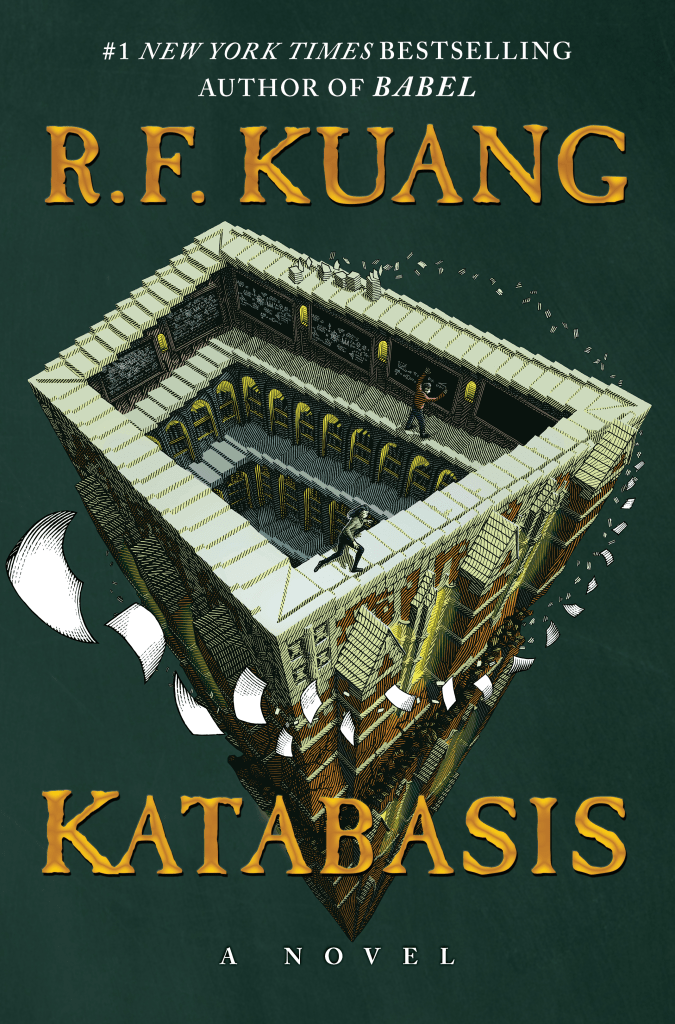
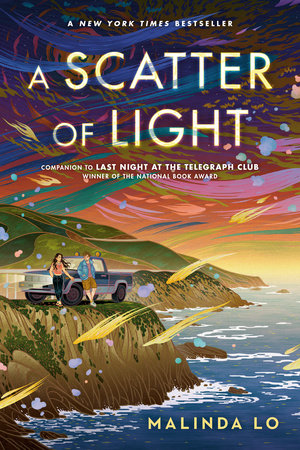
Light Years from Home – Mike Chena book with two distinctly different genres that clash in surprising ways.

“Cissus” – David Byrne & St. Vincent

Another St. Vincent song that she…did not play live when I saw her, and probably won’t again unless she teams up with David Byrne again. Five years after Love this Giant soundtracked the early days of lockdown, I discovered Brass Tactics, an EP of remixes and live performances from the tour, as well as this outtake. With the same brassy march, David Byrne and Annie Clark take their keen teamwork to an unassuming image. I fully thought that, given the imagery of the album, there would be some strange turmoil at the heart of the song. But no, the cissus in question is a kind of vine, and one that Byrne and Clark chronicle as it grows and crawls over a stone wall. Their lyrics have the feel of Victorian poetry as they describe its journey: “Cissus, you keeper of the shadows/Scaling my stone, terrace aswarm in summer.” In their shared language, the gradual crawling and blooming of the cissus vine becomes a kind of heroic march worthy of a flag-bearing procession. And it absolutely is—there’s nothing I like more than when artists turn something as mundane as vines crawling up a wall into a brass-helmed display of utmost grandeur.

…AND A BOOK TO GO WITH IT:

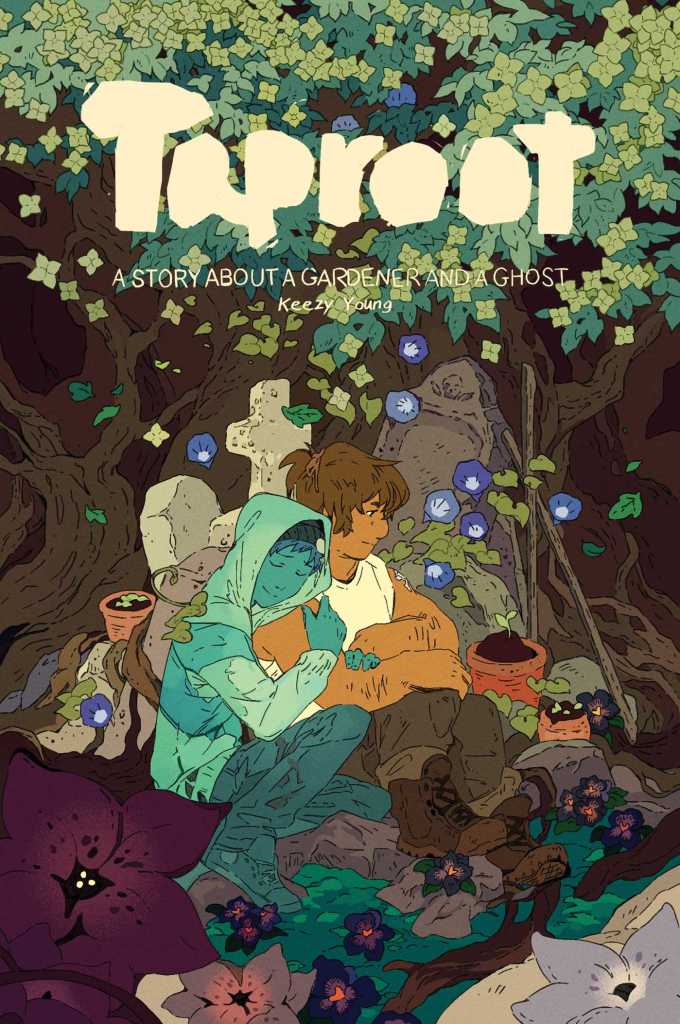
Taproot – Keezy Youngas the subtitle says, this graphic novel is “a story of a gardener and a ghost,” and there are vines aplenty.

“For the Cold Country” – Black Country, New Road

I’ve had a surprisingly good streak of opening bands at concerts this year. Now joining the ranks of Hana Vu (for Soccer Mommy) and Tyler Ballgame (for Shakey Graves) are Black Country, New Road. They’d been floating on the edge of my periphery from years of pretentious music memes on my instagram explore page, but I never showed an interest in them. I was at least intrigued when they came onstage…with a lute, a saxophone, a keyboard tuned to sound like a harpsichord, and enough recorders to imitate a 5th grade recital. I fully thought that there was about to be some Arcade Fire funny business afoot, but boy, was I wrong. Mostly. I could not get on board with the recorders. But I can’t deny that Black Country, New Road are a talented bunch. At worst, they veer towards the proggy, “Dibbles the Dormouse Has Lost His Lucky Handkerchief (Movements I-IV)” for me, but at their best, they’re a truly inventive, adventurous group of musicians.

A comparison that sprung to mind after hearing all of the harpsichord tomfoolery was, of all bands, XTC. Sonically they’re fairly different, but Black Country, New Road take the same approach of modernizing a distinctly British, pastoral flavor into their music. Modern subjects rub shoulders with medieval ones, and it all has the misty feeling of drifting over the English countryside in the melting stages of late winter. Forever Howlong, has its ups and downs (one down namely being the recorder ensemble on the title track), but “For the Cold Country,” both live and in the studio, feels like the summation of the best of the band. Beginning with an “Abbey”-like chorus of vocalists Georgia Ellery, Tyler Hyde, and May Kershaw, the track meanders as it tells the acoustic, fog-touched tale of a wandering knight laying down his arms and wandering across the countryside. As the track progresses, it becomes a more orchestral march, the vocals galloping like the patter of horse hooves. But what made “For the Cold Country” my favorite of their songs is the cinematic sweep that comes in at the 2/3rds mark—as the knight confronts the ghost of his past self among frigid waters. The acoustic guitar creeps back in, only to give way to an explosive swell of instrumentals that seem to shake the dirt beneath the foundation that the song built, accompanying an unexpected storm and flashes of lightning. Live, it really felt like something had possessed the audience, all bathed in warm light as all of the instruments howled, but what pulls it all together is the feeling of being on a journey—pretentious as it is, I can’t deny the chills when it was all over, feeling as though I’d just been on a trek through freezing rain and snow. Forever Howlong is a solid album if you’d like to give it a go—again, even if it’s not fully for me, it’s a delightfully inventive and fun entry into 2025’s musical history.

…AND A BOOK TO GO WITH IT:

Godkiller – Hannah Kanerall of the characters in Godkiller certainly join up in a similar arc to this song, but I thought particularly of Elo, a knight who gives up his former mantle.

“Every Little Thing She Does is Magic” – The Police

I’m struggling to write anything terribly flowery or excessively pick apart the lyrics, because some songs just defy analysis. It’s not that “Every Little Thing She Does Is Magic” is some overcomplicated epic—it’s the exact opposite, and yet it’s just a perfect song. It’s a hit that deserved every minute of airplay it got in the ’80s and in my dad’s car when I was a little kid. As with what I’ve heard of…well, every Police song back in the day, this song went through more lives than your average cat, and the studio probably looked like one of those cartoon fights where there’s a squiggly ball of dust with several hands sticking out (and Stewart Copeland’s drumsticks) when they were recording it. Yet what came out is, fully acknowledging the cliche, absolutely magic. Some songs just instantly capture a kind of unbridled joy and innocence, and you can’t help but be taken along for the ride, no matter what state you’re in. Everything about it is so bright—the tone of the steel drums in the chorus, Sting’s ecstatic vocals, Copeland’s pattering drumming, the guitar tone…I’m not even a Police superfan, but I might go so far as to say that this is one of the more pure love songs of the ’80s. The lyrics are so timelessly starry-eyed—it never feels cloyingly sweet, but how can “Do I have to tell the story/Of a thousand rainy days since we first met?/It’s a big enough umbrella/But it’s always me that ends up getting wet” not charm you? It’s given me a warm, fuzzy feeling since childhood, and time has never dulled that magic.

…AND A BOOK TO GO WITH IT:

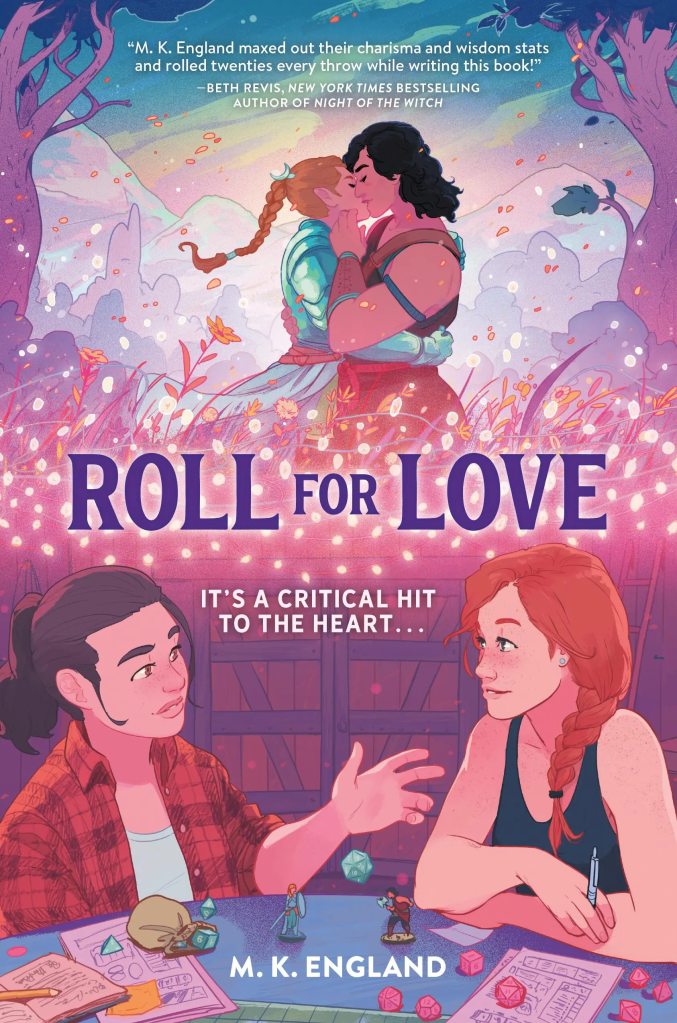
Roll for Love – M.K. Englanda pure, sweet love story with both romantic and fictional magic (in the form of DnD).

“Sugarboy” – St. Vincent

Two weeks of these posts since I actually saw St. Vincent, and now I actually have a song that she played to show for it.

I kind of hated MASSEDUCTION when it came out. To this day, I’m still firm in the belief that it’s St. Vincent’s worst album. Half the fandom might want to put my head on a pike for that, but for a singer with an established trend of matching albums to personas, there wasn’t much that was her about the album. The more I think about it, I can’t help but correlate that with the alienation and lack of personhood she felt at the time, what with being in a multitude of ill-fated relationships, namely with Cara Delevigne, the latter of whom caused British paparazzi to scout out the Clark family home in Texas to find out who she was and why she was dating a famous model. That disregard for her privacy and mental health resulted in an album that musically feels like it lacks a self. Peel back the latex and heels, and Annie Clark was hardly there—she was a shell of herself, clearly. Don’t get me wrong—there are some tracks on MASSEDUCTION that I frequently revisit to this day (see: “Hang On Me,” “Pills”) and even though 14-year-old me thought that this album was the letdown of the century, I still have a fair deal of nostalgia attached to the songs I liked.

“Sugarboy” was not one of those songs. For a while, I vaguely remembered it as one of the worst of the bunch, and it faded into mental obscurity. However, seeing it live has completely reoriented the song for me. Even though the MASSEDUCTION era was in the dust for both times I saw it live, “Sugarboy” transcended the ’70s setpieces of Daddy’s Home and was practically made for the rabid anger and fear of All Born Screaming. On the former, the backup singers lifted the lights off of the set pieces and waved them around like giant glowsticks as the song devolved into chaos. This tour didn’t see as many theatrics, but it was one of the most energetic songs of the setlist, which, given All Born Screaming, is really saying something. Upon reflection, this might be one of the best songs on MASSEDUCTION. The narrative of the album clearly has a through line, starting with a flicker of hopeful romance (“Hang On Me”), then immediately going into debauchery, drugs, sex, and materialism (“Masseduction“-“Los Ageless”), and then into the drawn-out crash and burn that ends with the harrowing “Smoking Section.” As the climax of the overindulgence, “Sugarboy” embodies the whirlwind of all of it, a kind of manic chaos as she both uses others and is in turn, used herself. The breakneck pace of the music, along with the shrieking, autotuned chorus behind her, feels like a fast-forwarded shot through a trashed ballroom—everything is in disarray, and the red smeared on people’s faces makes it impossible to tell blood from lipstick. The desperate cries of “I am a lot like you!/I am alone like you!” in the chorus are needles through the mindlessness, cries for help amidst the all-consuming sea of overindulgence. Even the studio version feels like being dragged along at inhuman speeds, ricocheting off the walls as the synths thrum through your ribcage. Like the lyrics say, she’s “hangin’ on from the balcony” (a reference to show antics that she frequently used to do), but her fingers are barely holding on from the adrenaline.

…AND A BOOK TO GO WITH IT:

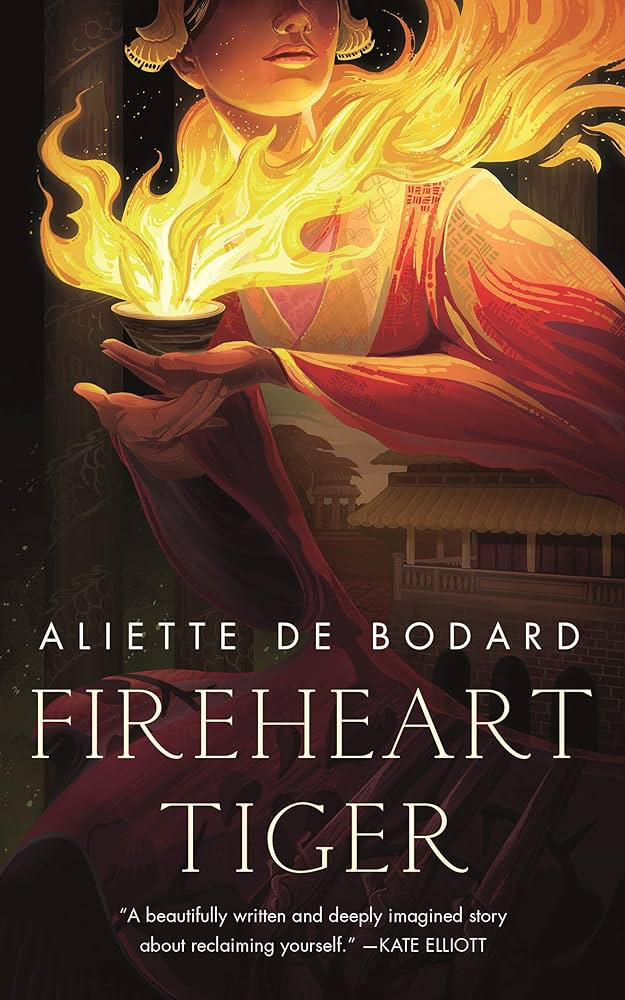
Fireheart Tiger – Aliette de Bodard“Oh, here I go/A casualty/Hangin’ on from the balcony/Oh, here I go/Makin’ a scene/Oh here I am, your pain machine…”

Since this post consists entirely of songs, consider all of them to be today’s song.

That’s it for this week’s Sunday Songs! Have a wonderful rest of your day, and take care of yourselves!

Posted in Sunday Songs

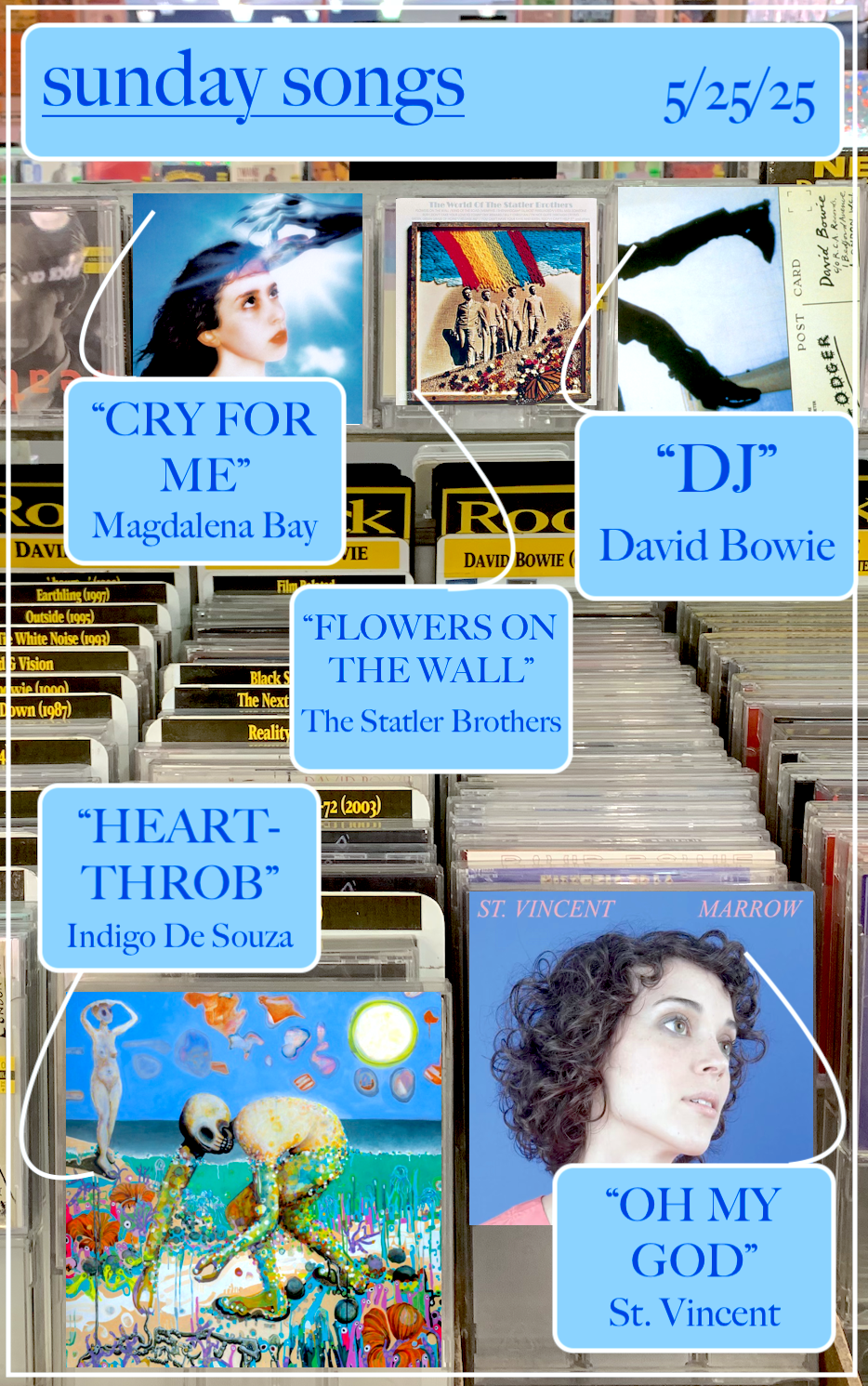
Sunday Songs: 5/25/25

Happy Sunday, bibliophiles! I hope this week has treated you well.

This week: it’s all a trick question. I saw St. Vincent last week, but did she play the song I’m writing about this week? No. Did she play the David Bowie song I’m writing about this week, though?

…yup.

Enjoy this week’s songs!

SUNDAY SONGS: 5/25/25

“Heartthrob” – Indigo De Souza

Two years on the heels of All of This Will End (I say that like I’ve listened to it…I’ve listened to about half? Good stuff, though), Indigo De Souza is back with a new album out this summer, Precipice. I don’t know if I’m committed enough to listen immediately (I might go for Any Shape You Take first). To be honest, after briefly hearing whatever the hell that disastrous, autotuned misfire that was WHOLESOME EVIL FANTASY, I was hesitant to see what De Souza had done next. Thankfully, it was far from that. The album cover’s gorgeous, too—the naked skull creature is having its beach episode!

As cheesy as the music video is, “Heartthrob” seems for all the world to be a moment of healing for De Souza, and I’m so happy for her. The chorus of “I really put my back into it” describes the throttle of this track, a more pop-rock offering with trembling vocals but no shortage of determination. The pre-chorus describing De Souza’s experiences of abuse are jarring against the otherwise sunny, bubbly feel of the track, and yet that’s the point; De Souza said that they wrote the song about “process[ing] something that is often hard to talk about—the harmful ways I’ve been taken advantage of in my physical memory. ‘Heartthrob’ is about harnessing anger, and turning it into something powerful and embodied. It’s about taking back my body and my experience. It’s a big fuck you to the abusers of the world.” That passion radiates through every inch of the track through wavering warble and cheerleader-like shout, which De Souza delivers in equal measure. More than anything, “Heartthrob” feels like a release, an outpouring of joy, anger, and passion, a bubbling bottle uncorked. I can’t help but love the rallying cry of “I really put my back into it”—maybe it’s not my favorite song in the world, but for all of the unoriginality plaguing our landscape, it’s refreshing to see people like them pouring it all into their art.

…AND A BOOK TO GO WITH IT:

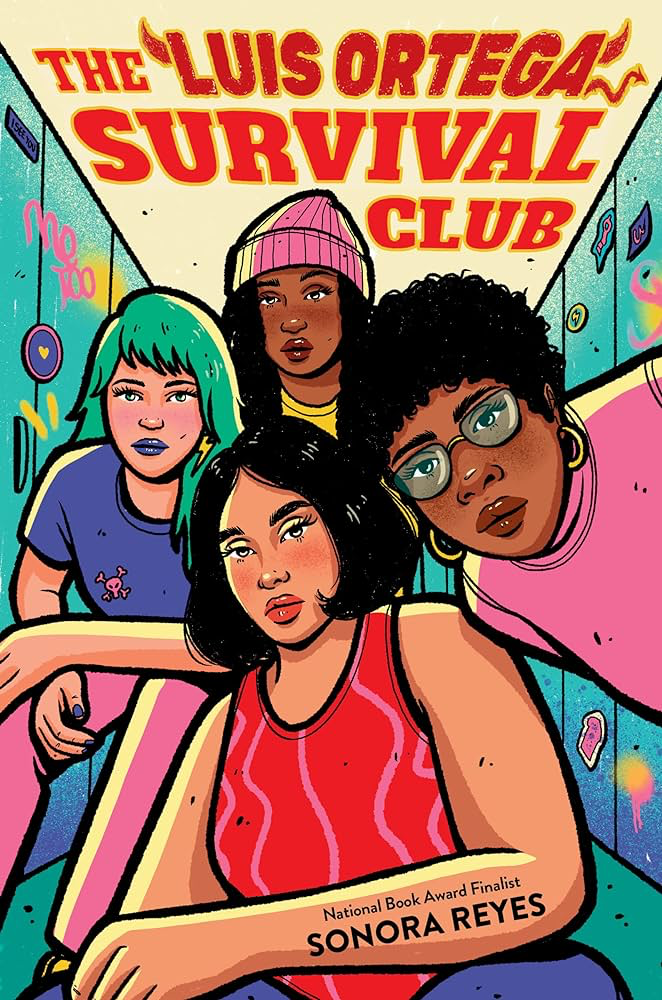
The Luis Ortega Survival Club – Sonora ReyesA story of feminist resistance and reclaiming your body and identity in the face of abuse.

“Oh My God” – St. Vincent

I had the absolute privilege of seeing St. Vincent for a second time last week. I know I’m obsessed, but it was seriously breathtaking—the setlist was incredible, her stage presence was so captivating, and her guitar playing always knocks me off my feet. I was right near the third row, and I nearly had a heart attack when she started crowdsurfing during “New York”…never thought I’d find myself getting choked up by that song (it’s nowhere near my favorite), but to be so close to her and in the presence of so much love and togetherness began to heal a part of me, if only for a night. Sure, the loungy rendition of “Candy Darling” she did at the end was a bit of a misfire, but if that was the worst part of the night, then it was a concert I’ll never forget.

So without further ado, here’s a song that…she didn’t play, and I suspect that she probably won’t revive unless she willingly goes into her deep cuts. A bonus track from Actor that was also released along with the “Marrow” single (which she did play that night and absolutely annihilated), its deceptively quiet intro hides a suppressed, roiling storm. Like much of Actor, it hides dread and unpleasantness beneath a veneer of delicate woodwinds and finger-picking, but conceals a spreading rot beneath it. The dread veers into focus with Annie Clark’s chorus of “‘Cause when the drink goes in/The devil comes out” after detailing all of the dishes gone without washing and the bathwater gone cold while she’s still in it. A faintly “Via Chicago”-like drum fill patters as the chorus grows in intensity, a chanting of “Oh my god” that never loses its delicacy but turns more from an indifferent remark to a quietly horrified exclamation, as though she sees the landscape of dying houseplants and unmade beds before her. Given that this was a bonus track, it seems that even then, this was a time that Clark wasn’t keen on returning to, but I do find some comfort in the fact that presumably, given that there’s around 16 years behind it, this is something that Clark has deliberately put in the past; MASSEDUCTION saw her dealing with substance abuse and other issues more upfront, but even that’s an era that seems behind her, even if All Born Screaming found her in a darker but seemingly different headspace. I’m glad that she was able to exorcise “Oh My God”—sometimes, you have to extricate those things from your life, but hiding the track in plain sight seems a strategic way to not return to a time you’re not keen on revisiting.

…AND A BOOK TO GO WITH IT:

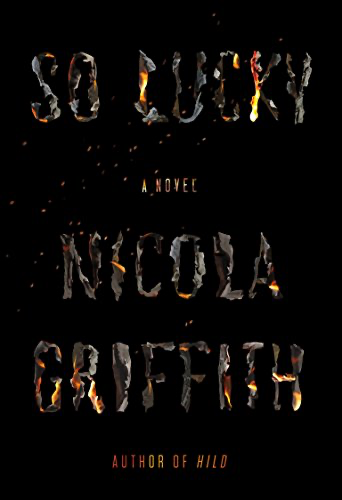
So Lucky – Nicola Griffith“Oh My God” matches the dread of the protagonist, Mara, picking the pieces of her life after losing everything, as well as the lingering feeling that her life is in danger—from herself and from outside forces.

“Cry for Me” – Magdalena Bay

Everything I’ve heard about Imaginal Disk has been nothing short of worship: album of the year (2024), modern classic, cult classic…the list goes on. Imaginal Disk feels inherently tied to hype for me, even though I’ve only heard this song. Again, outsider perspective, Magdalena Bay just seemed to spring up out of nowhere. Before this, I’d only heard a handful of reviews several years ago, a remix they did of Soccer Mommy’s “Shotgun” (not a huge fan, honestly) and this interview they did with Stereogum ahead of Imaginal Disk talking about how much they love the weird CGI in the music video for Peter Gabriel’s “Steam” (which, honestly, so based of them. They really just said “let’s dress Peter up like Jack Nicholson’s Joker and then put his face on as many objects as possible. I don’t care if they’re ungodly cursed.” I love it so much.). There’s also a concept and a narrative I’m missing here—something about a person rejecting some sort of disk put into their head by aliens?—but I’ll do my best.

I was floundering for comparisons for “Cry for Me” at first, but then it hit me. Imagine if the Cardigans had access to 21st century technology in the ’90s, and then imagine them taking that and making some kind of weird disco. They’ve got their uber-’70s violin piano flourishes and bass lines paired with the most modern-sounding, cinematic synths. What’s cooked up is bizarrely good—the at first disparate contrast of Mica Tennenbaum’s air-light voice and the oily chrome of the synths makes for something that works together in surprising harmony. The disco bit sometimes veers into too much for me, but I can’t deny how deliciously catchy “Cry for Me” is—the song’s title is uttered like a seductive plea to cross into a world where everything is glittering and perfect, but once you bite into the fruits, the venom starts pumping through your veins. The crunching, bubbling shift in synths at the 2:00 mark make you feel like you’ve turned a corner on some kind of theme park ride—into what, you’re not sure. For the rowers keep on rowing, and they’re certainly not showing any signs that they are slowing…

BONUS: who the fuck let a keytar in the—oh, okay. Just this once. I’ll allow it. Maaaaaaybe. Magdalena Bay recently covered “Ashes to Ashes” on Triple J, and even though it’s up there with my favorite Bowie tracks, they clearly get how weird of a song it is:

…AND A BOOK TO GO WITH IT:

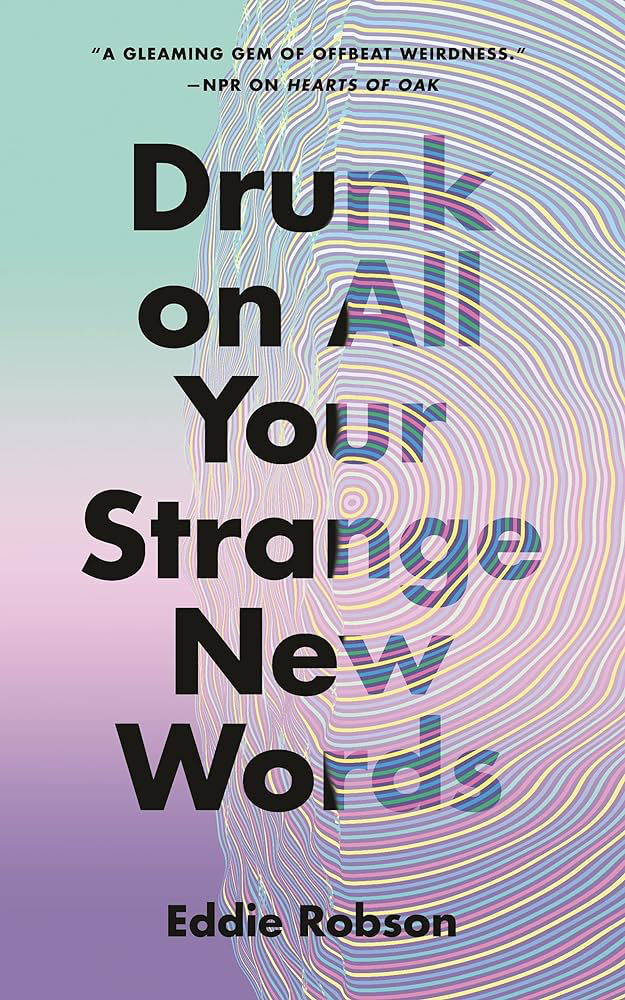
Drunk on All Your Strange New Words – Eddie Robsonagain, I’m not entirely clear on the concept, but if you want alien revelations with unintended side effects, look no further…

“Flowers on the Wall” – The Statler Brothers

Sometimes you remember certain songs at times that are too perfect for words.

“Last night, I dressed in tails pretending I was on the town/As long as I can dream, it’s hard to slow this swinger down/So please don’t give a thought to me, I’m really doing fine/You can always find me here and having quite a time…”

Depression, self-isolation, and making up scenarios transcends time, but getting this song absolutely hooked in my head while I was about a month into lockdown had to be divine intervention. Or something. Minus the more ’60s language, this could’ve been the contents of a long-distance FaceTime call right smack in the middle of 2020. I have a specific memory, give or take five years to the day (I’m just glad I can put some distance from it) of hearing nothing but this song in my head while I was supposed to be recalling something or other about U.S. History for the APUSH exam…a single essay question that I did on my laptop in my bedroom. (Don’t worry, I got a 4. I wasn’t really in dire straits.) Yes, feelings aren’t inherently attached to history, but “Flowers On the Wall” bottled something so succinctly and charmingly. Once it invited itself into my shuffle after years of not thinking about it, that feeling never went away—in a good way. Despite being so pandemic-feeling it never got sullied by it. I’ve never been one for this almost hokier country sound, but it fits the kind of exaggerated state that the narrator’s in—it’s exactly how I’d expect the inner voice of someone who spends their days playing solitaire and dressing up in a tux, never once leaving the house. It’s the catchiest song about extensively denying that you need to touch grass. Truly timeless.

…AND A BOOK TO GO WITH IT:

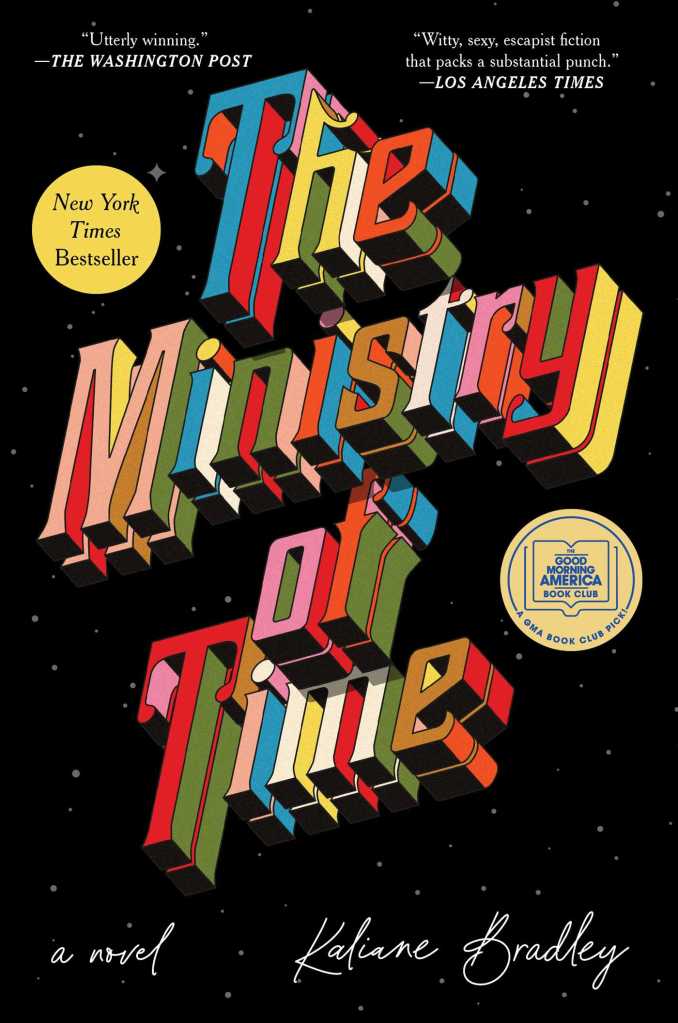
The Ministry of Time – Kailene Bradleywhat else is there to do when you’re [checks notes] a time-displaced polar explorer from the 1840’s who really shouldn’t leave the (21st century) house?

“DJ” – David Bowie

Diversity win! Bowie is breaking his and her heart!

“DJ” has been on the brain because, back to St. Vincent, they played this song not once but twice before she came onstage. Taste, especially from someone who has said that there’s no one she’d put above Bowie.

From Lodger, “DJ” retains some of the theatricality of his glam days, but well past the Ziggy Stardust days. He’s long shed that persona, as well as the abysmal leanings and drugs of the Thin White Duke, closing out the Berlin Trilogy with a slicker flourish that led into the ’80s (see: “Boys Keep Swinging”). It’s got a critical, sardonic eye that he retained from his earlier ’70s songwriting, magnifying the role of a DJ who becomes so swallowed in his career that he becomes it: “I am the DJ/I am what I play/I’ve got believers/Believing me.” According to Bowie, it was his take on the disco culture that had overtaken the ’70s: speaking to Melody Maker, he said, “The DJ is the one who is having ulcers now, not the executives, because if you do the unthinkable thing of putting a record on in a disco not in time, that’s it. If you have thirty seconds silence, your whole career is over.” Yet it’s so easy to see the through line back to himself—persona or not, you don’t have to chip away at much to find the one true Bowie within.

Even if “DJ” didn’t also spell out David Jones’ initials, this fear of becoming inextricable from his music and celebrity was a constant fear of his in the 1970s. 1979 saw Bowie recovering from his devastating cocaine addiction, and that almost-separation from it makes “DJ” feel like a less fatalistic version of “Cracked Actor,” in which he saw his future self as a washed-out, middle-aged actor relying on his past fame to pay the bills.”DJ” sees him inching away from “Forget that I’m 50/’Cause I just got paid” territory, but no less critical—and almost fearful—of being on the precipice of losing his career thanks to one less hit and being seen only as a vessel for the music. In the music video, he’s passed around by fans in the middle of the street; some hug him and seem to make genuine conversation, while others simply try to give him a kiss on the cheek (BRO?? not to get all gen z with it, but did he WANT that??). It’s all at once tenderly human and a little eery watching him weave through the crowd, some seeing a human, others seeing a celebrity. No matter the disaffected sarcasm in his words and lyricism, Bowie’s always there.

As for the music video…I don’t think there’s really any bad Bowie videos I can think of, and even the really bad ones are at least hilarious. But this one seems to fall on the wayside, and I don’t see why! The way that Bowie drapes himself down the blue shutters, the demolishing of the DJ equipment, the proto-Trait pink boiler suit/gas mask combination…he could work anything. Well…okay, definitely not this. Almost anything.

…AND A BOOK TO GO WITH IT:

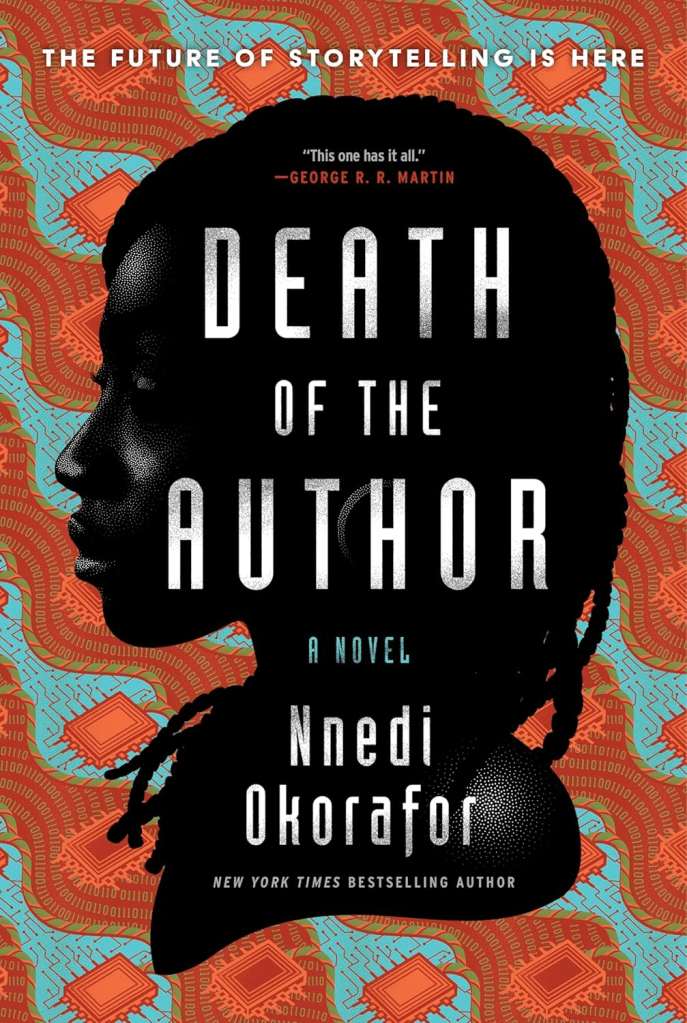
Death of the Author – Nnedi Okoraforanother work about the line between the author, their work, and how the two are interconnected, no matter the perceived separations (and the complications that arise from it).

Since this post consists entirely of songs, consider all of them to be today’s song.

That’s it for this week’s Sunday Songs! Have a wonderful rest of your day, and take care of yourselves!

Posted in Sunday Songs

Sunday Songs: 4/20/25

Happy Sunday, bibliophiles, and happy Easter for those celebrating! 🐣 I hope this week has treated you well.

This week: stories from concerts, songs I heard before concerts, and songs that enticed me because of a cat on the album cover.

Enjoy this week’s songs!

SUNDAY SONGS: 4/20/25

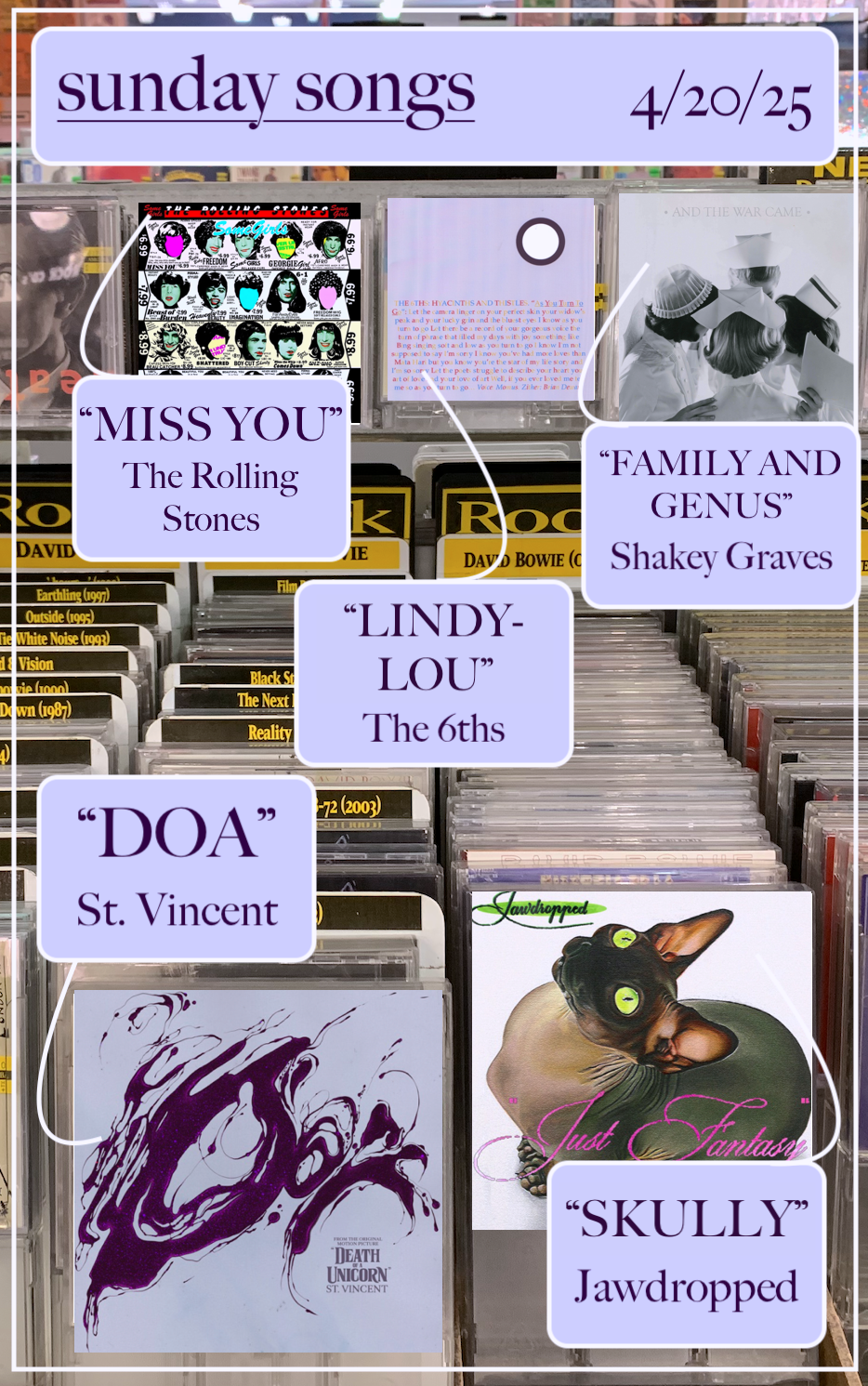
“DOA” – St. Vincent

I’ve got a confession to make. As die-hard of a St. Vincent fan as I am, it took me some time to warm up to this song. I never hated it, but it wasn’t an instant favorite. I haven’t seen Death of a Unicorn yet (though the trailer intrigued me…), but something that always bothers me about songs made for movies and TV is when they obliquely reference either the plot points of the movie or how the characters are feeling. Hot take, but it’s part of why I didn’t care for the original soundtrack of Arcane—it basically did that for most of the character’s conflicts and arcs. (That, and it’s a matter of my music taste. Don’t let that deter you from watching Arcane though, it’s a breathtaking show! Having Im*gine Dr*gons do the theme song was just the worst possible decision they could’ve made. Just skip the intro.) You can make a song subtly extrapolating on a movie’s themes and have it fit naturally! (See: “Strange Love,” “Sticks & Stones”) Hell, she’s done it before with the original songs for her concert-film-turned-thriller The Nowhere Inn! Granted, I haven’t seen the movie, but opening the song with “Right as I had stopped believing in miracles/In comes a unicorn right in front of me” is…right there. So is the unicorn, I guess.

From then on out, “DOA” easily saves itself. It’s an absolute ’80s freakout from start to finish. The synths are so dense and bubbly that St. Vincent’s voice easily drowns in them—it’s like they’re the main vocal, and that kind of chaos, especially towards the latter half, is what makes the song so rich. “DOA” leads me to believe that somewhere, there’s a better, kinder alternate universe where MASSEDUCTION sounded more like this. It strikes the balance that album never got, with lightning-quick synth palpitations duel with Annie Clark’s classic, punchy guitar breakdowns. Piercing yelps cut through the dense, purple fog shrouding the song—again, I haven’t seen Death of a Unicorn, but it certainly brings to mind what I might feel if I was being pursued through the woods by a dubiously carnivorous unicorn. Given the film’s purported balance of campy concepts and dark execution, “DOA” is the perfect merging of the two aesthetics.

…AND A BOOK TO GO WITH IT:

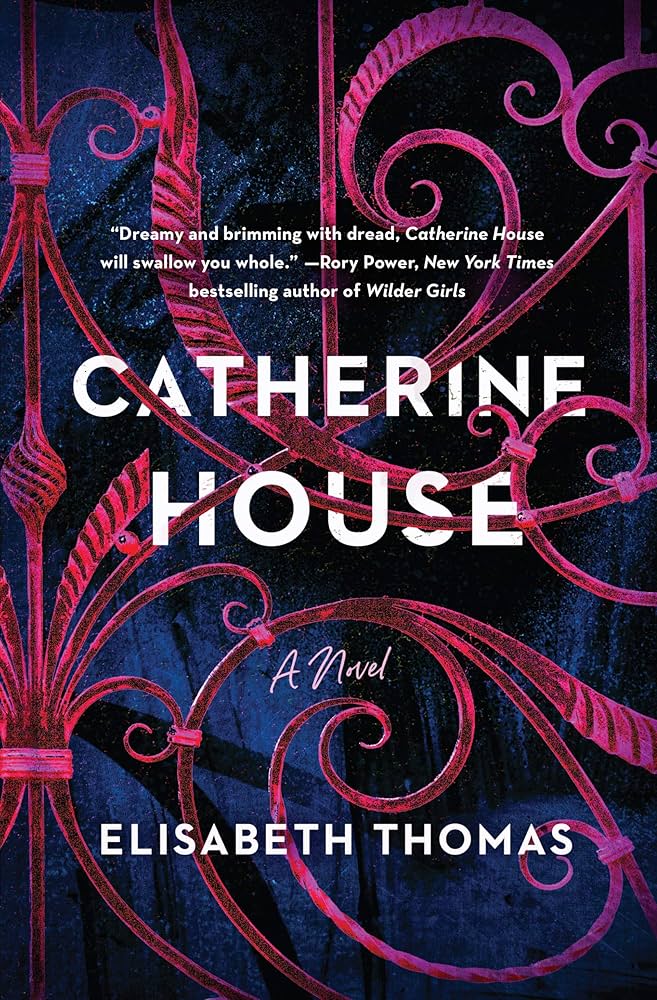
Catherine House – Elisabeth Thomasa similarly out-of-time feel, as well as dabbling with strange, magical substances.

“Skully” – Jawdropped

No way, I’d never listen to a band just because I saw a picture of them where one member had a Ladies and Gentlemen We Are Floating in Space shirt. Me? Nah, never. I’m a woman of taste…it was the album cover and the shirt that convinced me to at least listen.

I heard of Jawdropped by way of Stereogum; they reviewed the first singles off of their forthcoming debut (!!) EP, Just Fantasy, and I figured I might as well give it a go. Thankfully, they’ve got more to them than just a cute sphinx on their album cover and one guy with a Spiritualized shirt! I keep coming back to “Skully,” the opening track, which is about as propulsive as an opening track can get. It’s truly one of those songs where they’ve mastered how to make guitars cascade down like an avalanche on the first go, which is something not every band can say for themselves—especially not on a debut EP. Between the instrumental chaos of the chorus, they ease the verse into calm, a beast of burden tugged out of a sprint, in order to let the harmonies of Roman Zangari and Kyra Morling take the spotlight. But it’s that colossal cascade that makes “Skully” so excited; they don’t strike me as particularly similar to Spiritualized (this may be a bit too loud for shoegaze), but Jawdropped has a similar quality of encasing the listener in a fizzling, crackling bubble of sound. For all of 2:48, you’re cocooned on a moment’s notice—and it’s a cocoon worth revisiting time after time.

…AND A BOOK TO GO WITH IT:

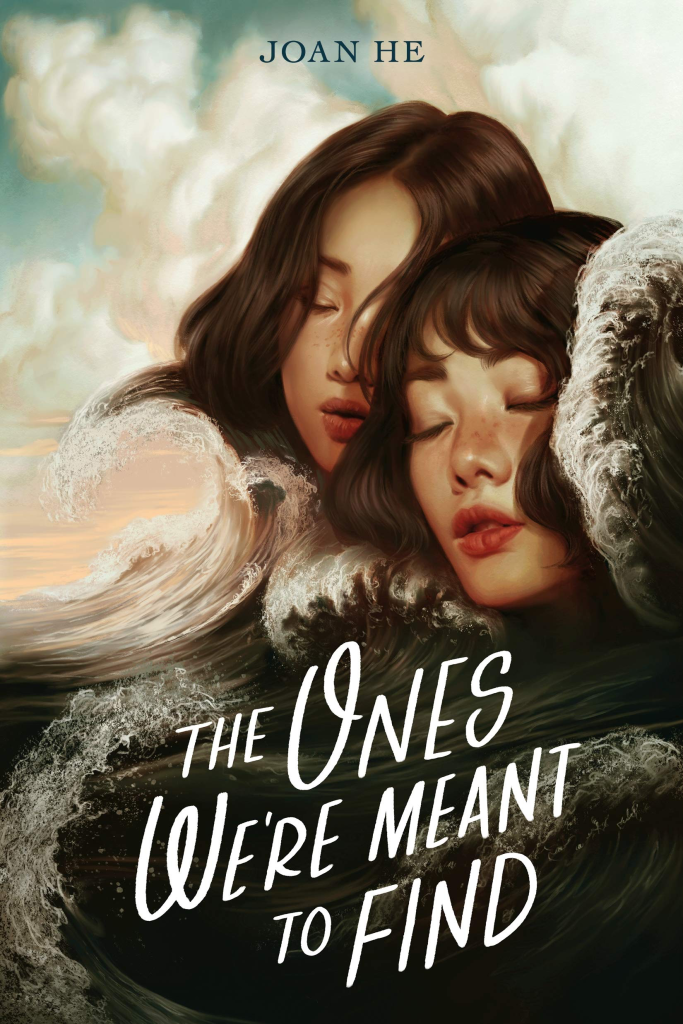
The Ones We’re Meant to Find – Joan He“I wait for you like a dog/Anxiously pacing/But you’re here when things fall apart/It’s just your nature/ We’re always stuck at the start…”

“Miss You” – The Rolling Stones

If I just put this song on in the background, I can ignore the cringy, “hip” lyric videos that The Rolling Stones started putting out after their newest album. I can’t stand that soulless, faux-graffiti/DIY aesthetic…I just can’t separate them from how painfully hard they’re trying to stay relevant to The Kids™️…

Anyways. We’ll pretend it’s 1978 and Official Lyric Videos For the Youth won’t be a thing for many decades to come. Like “Crooked Teeth,” “Miss You” was one of those songs where I’d have that opening riff (not the lyrics, this time) ping-ponging around in my head. It lingered in the fog of my childhood, but too far to discern anything clear. So thank you to the instagram for The Laughing Goat (and Rita) for making me remember it after however many years it was! And then, mere days afterwards, they played this song, amongst several other seventies rockers (see: “I Saw the Light”). “Miss You” was going to reach me either way. Some Girls seems to have come at the time when the Stones had cemented that sleaze was part of their brand, and subsequently became said sleaze. Despite “I guess I’m lying to myself/It’s just you and no one else,” it’s a song that lies squarely in the kind of horniness that defined them throughout the late ’60s and the ’70s. Even if he’s denying them, the way he croons the line about the “Puerto Rican girls that’s dying to meetchoo” betrays the partying and sex that later became as much a part of him as the press originally made them out to be when pinning them against the goody-two-shoes (citation needed) Beatles. There’s a Lou Reed-like drawl to the way he turns to a half-whisper as he speaks of stalking Central Park in the dead of night like some kind of werewolf, yet it couldn’t be more Jagger; the bluesy, “hoo hoo hoo-ooh hoo-ooh ooh” refrain almost becomes an abated, wolfish howl against this backdrop, roiling with angst.

…AND A BOOK TO GO WITH IT:

The Final Revival of Opal & Nev – Dawnie WaltonI try to refrain from talking about this book whenever I mention something from the ’70s, but this kind of bluesy rock fits in with the scene that it describes.

“Lindy-Lou” – The 6ths

Back to The 6ths after last week, I’m dipping my toes into Hyacinths and Thistles, Stephin Merritt’s 2000 follow-up to Wasp’s Nests, and slightly less of a tongue twister, if you say it slowly enough. (Maybe?) In contrast, there’s still some of the same synth-pop love songs, other than…the last track being nearly a half-hour long? Not sure if I know what’s going on there, and as much as I love Merritt, I’m not sure I want to know. In contrast to the ’90s indie-rock guest list, we’ve got everybody from Melanie (sadly, kind of a miss) to Gary Numan (wild pick, but great)—Merritt had his feelers out everywhere, to varying degrees of success. From the few songs I’ve sampled, “Lindy-Lou” was one of the undoubted hits, sung by Miho Hatori, one of the founding members of Cibo Matto, but best known to me as the original voice of Noodle from Gorillaz. As with Anna Domino and Mary Timony for you, she lends her tender vocals to a song gleaming with dreamy-eyed innocence. Accompanied only by keyboard, this seems to stare wistfully from a balcony as the wind toys with its hair, Amelie-style. It’s never cloying in its sweetness, but it’s so soft and intimate, the musical equivalent of a sweatered shoulder to lean on.

BONUS: somehow, I had no idea this existed beforehand, which is crazy, considering how much Car Seat Headrest has been a part of my life…back in 2013, in the car seat headrest-recording days, Will Toledo covered this song!

…AND A BOOK TO GO WITH IT:

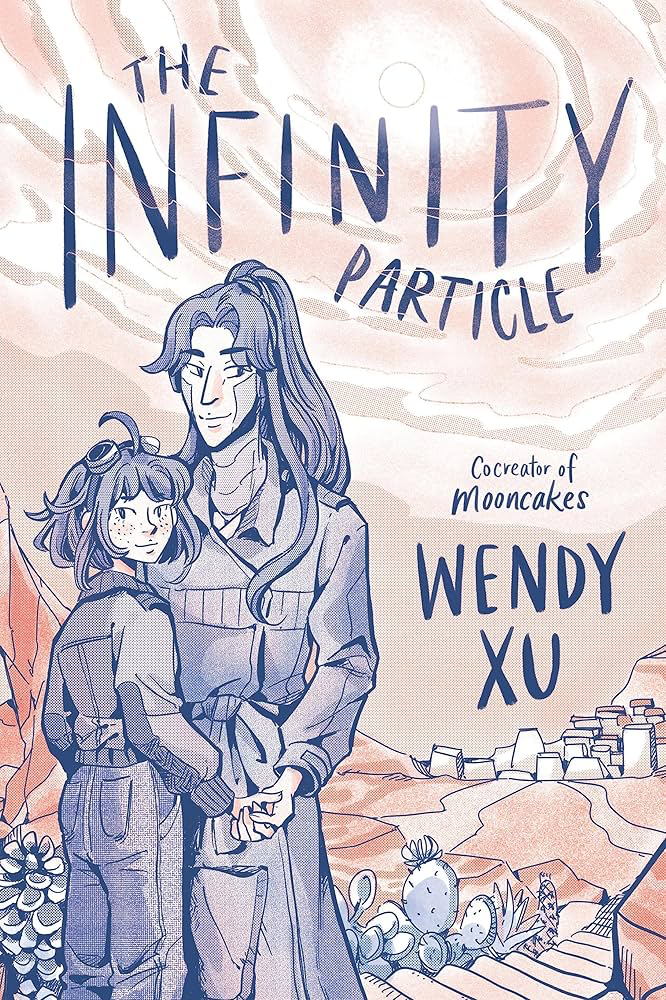
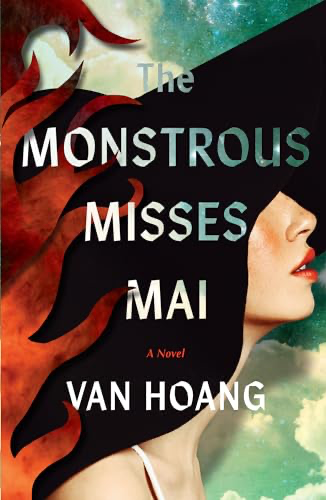
The Infinity Particle – Wendy Xuquiet, tender love between a student and a lonely android.

“Family and Genus” – Shakey Graves

I’ve now seen Shakey Graves…2.5 times. I don’t fully count the second time, as it was at a crowded festival and I had no way of seeing him, so my mom and I listened to him at a safe distance behind the wall of drunk people. I amended it this time by shouldering my way up to the front row for round 3, as Shakey Graves is touring for the tenth anniversary of And the War Came! Other than the two drunk people who tried to get me to give up my seat (one even offered me $100), this show fully made up for not being able to see him last time. Shakey Graves, seen unobstructed for the first time since 2023!

What struck me at this show in particular was how genuine he is as a songwriter. So many artists in the folk and country-adjacent genre put on this kind of persona of being a wanderer with no permanent home, forever married to the road and dismissive of being bound to any one location. Alejandro Rose-Garcia has fully leaned into this persona (see: “Built to Roam”). Yet he’s the only one I’ve seen who makes it genuine. He’s roamed his fair share, but he’s never dismissive of the journey or the people who helped him along the way. Throughout the show, he paid tribute to friends and enemies throughout his life, his wife and newborn daughter, and for “Family and Genus,” raised a toast to family and friends that make the roaming easier—and more interesting. He’s a troubadour storyteller, but he never tells a lie. I keep coming back to how genius “Family and Genus” is—even as one of his most popular songs (I’m sure the Elementary TV spot helped), the craft is so intricate and lovingly stitched—just as the relationships he penned this as an ode to. Where the studio version’s “ohs” on the chorus sound like a choir of trickster ghosts, he imbues every raw ounce of love into them, turning it into a raucous crowd-pleaser that makes you feel that family, the sinew and atoms binding us together. And his rapid-fire fingerpicking on his guitar never ceases to amaze me—the fact that Rose-Garcia has barely gotten his flowers as the masterful guitarist that he is remains a disservice to his ingenuity. Hearing the echo of hundreds of voices around me, a handful I have the treasure and pleasure of calling family (minus said obnoxious drunk people), and countless others that I’ve never seen again after that night, solidified his statement of purpose.

…AND A BOOK TO GO WITH IT:

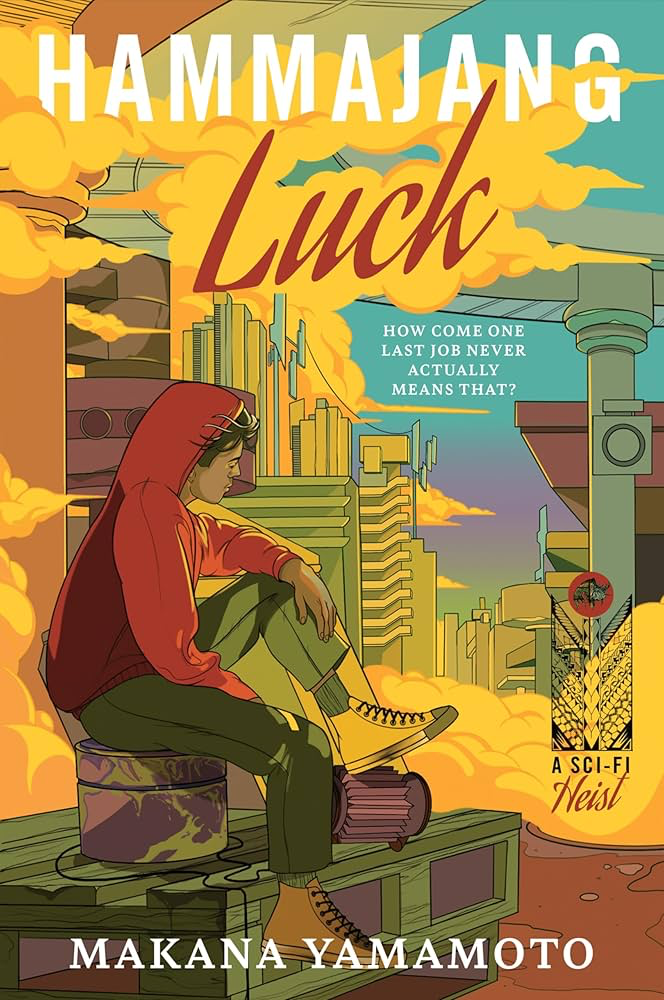
Hammajang Luck – Makana Yamamoto“If I ever wander on by/Could, could you/Flag me down and beg me to/Drop what I’m doing and sit beside you?”

Since this post consists entirely of songs, consider all of them to be today’s song.

That’s it for this week’s Sunday Songs! Have a wonderful rest of your day, and take care of yourselves!
Posted in Sunday Songs

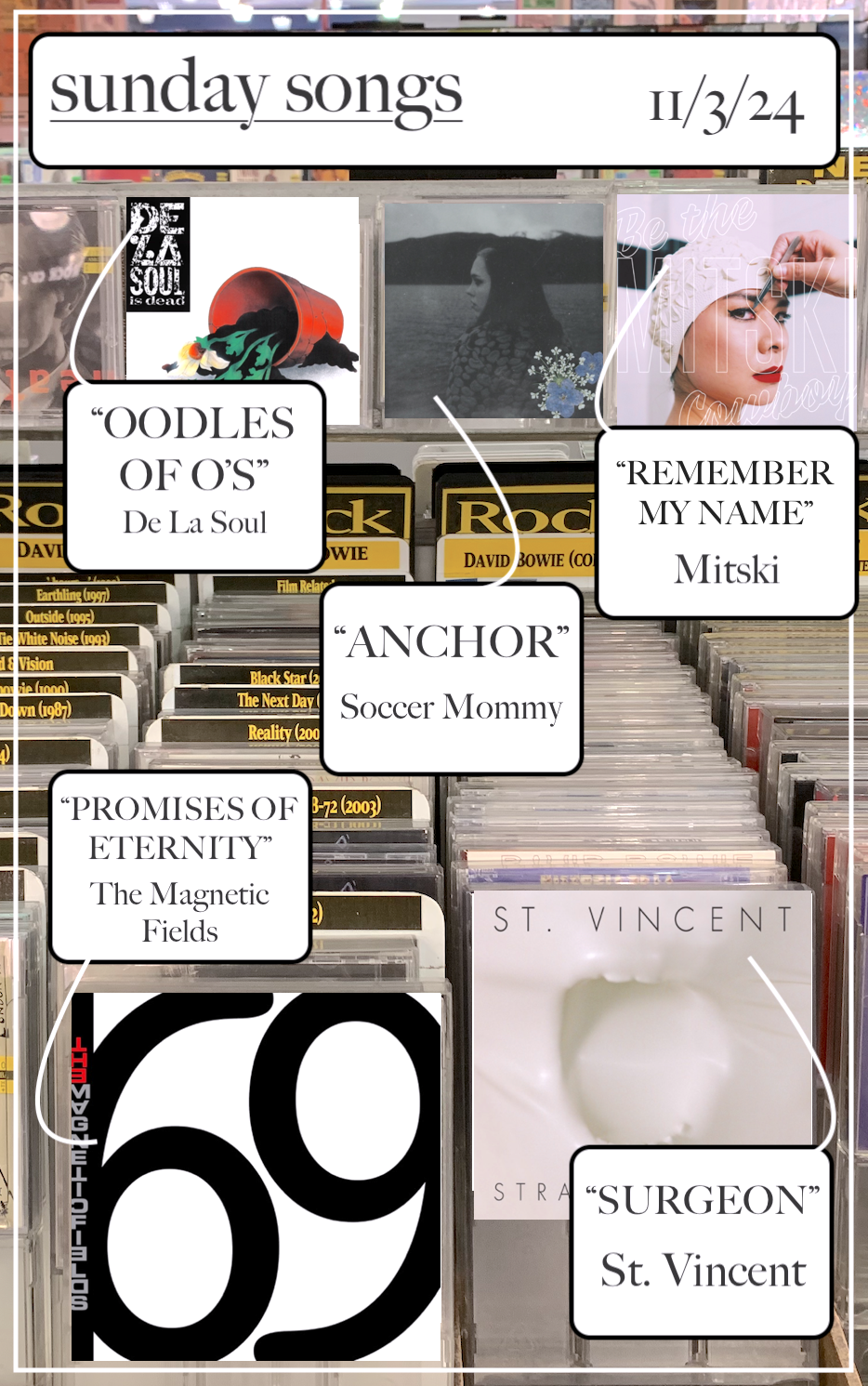
Sunday Songs: 11/3/24

Happy Sunday, bibliophiles! I hope this week has treated you well.

This week: next stop, Big Feels™️ central…totally haven’t been anxious for the past week and a half, how’d you guess?

Enjoy this week’s songs!

SUNDAY SONGS: 11/3/24

“Promises of Eternity” – The Magnetic Fields

I had the privilege of seeing The Magnetic Fields a second time last weekend; this year marks the 25th anniversary of an album that (from what I’ve heard) is not so much an album but a great balancing act of music itself: 69 Love Songs, a triple album consisting entirely of songs about love. (Make no mistake, they’re not all romantic. See: “How Fucking Romantic,” “Yeah! Oh, Yeah!” “I Think I Need a New Heart.”) I’ve yet to find the time to set aside a whole three hours and listen to the album in its entirety, but even a glimpse at around half of it over the course of my lifetime leaves me in awe of how Stephin Merritt and company pulled this off. Especially Merritt, as he wrote every single song—his songwriting never falters, but to not sputter out after 69 songs is a feat as awe-inspiring as his vocal range.

Somehow, “Promises of Eternity” slipped by my notice, but it hasn’t let me go since last weekend. Sung by Merritt on the album and by Anthony Kaczynski live, it immediately stuns. In both mediums, the synths just bowl you over—they don’t play as much as grandly announce their presence with the flourish of the same velvet curtain that the song speaks of. That chest-clutching drama defines the rest of the song—all of the lyrics detail the hypothetical collapse of the world if the narrator’s lover did not love them back: “What if no show ever happened again?/No seven, no eight and a half, no nine and no ten?” Most of Merritt’s singing has a sarcastic current to it that almost makes you question if the guy really believes in true love (though “The Book of Love” disproves that hypothesis quickly), but the way that he belts out “What if the clowns couldn’t be clowns?”, of all lines, gives you the feeling that he’s just fallen to his knees and is begging straight to your face. Apparently, the absence of clowns will signal the end? Who’s to say, really? Along with the circus imagery, the organ sound created by the synth makes “Promises of Eternity” feel like an elaborate, gilded carousel of lovesickness, with instrumentals that wouldn’t be out of place at a fairground, but lyrics fit for Romantic (in the Keats way, not the general way) poetry.

…AND A BOOK TO GO WITH IT:

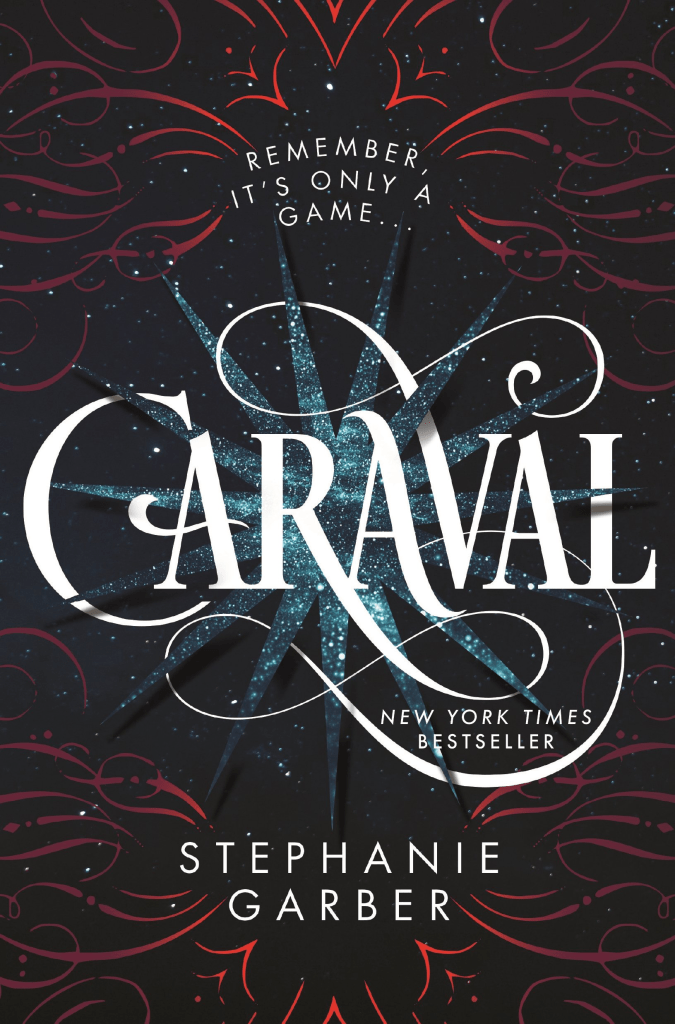
Caraval – Stephanie Garbercircus imagery aplenty, as is the levels of drama being off the charts.

“Surgeon” – St. Vincent

In the age where you can make a synth—and most any instrument, really—make almost any sound you want it to, I shouldn’t be surprised at the staggering achievements that music has made in the simple terms of what noises we can make. What sounds like “the future” feels entirely subjective when we’re talking about anything past the 2010’s—electronic music had exploded, and plus, what sounds futuristic to me might not sound futuristic to you.

My waxing poetic about St. Vincent has mostly been directed to her self-titled 2014 album, which, ostensibly fits that description for me. But with each successive listen to “Surgeon,” I’m blown away at just how much this sounds like the future. This was 2011, and aside from the percussion, most everything on this track sounds utterly alien. Watching the 4AD sessions recording that I linked above was genuinely eye opening—every few minutes, I just found myself going wait, that’s the instrument that’s making that weird noise? The synths are manipulated to the point where they could just as easily be the vocalizations of a children’s choir from another planet. Even the blink-and-you’ll-miss-it trill of a flute turns into a glitch in some kind of code. I can see the threads of Björk—especially Homogenic—throughout, yet it’s so distinctly Annie Clark. By far the most masterful of these manipulations should be obvious: Clark’s guitar solo beginning at 3:36 feels like she’s almost reached the extreme of what the instrument can sound like. It’s hardly even a solo anymore—it doesn’t just sound like a synth, it sounds like some kind of creature whose consciousness has been trapped in a computer and is howling to be freed. If you were to somehow visualize this music, I’d fully believe it if it came out fleshy and trailing with electrodes.

Oh, to spend a day in her mind…

…AND A BOOK TO GO WITH IT:

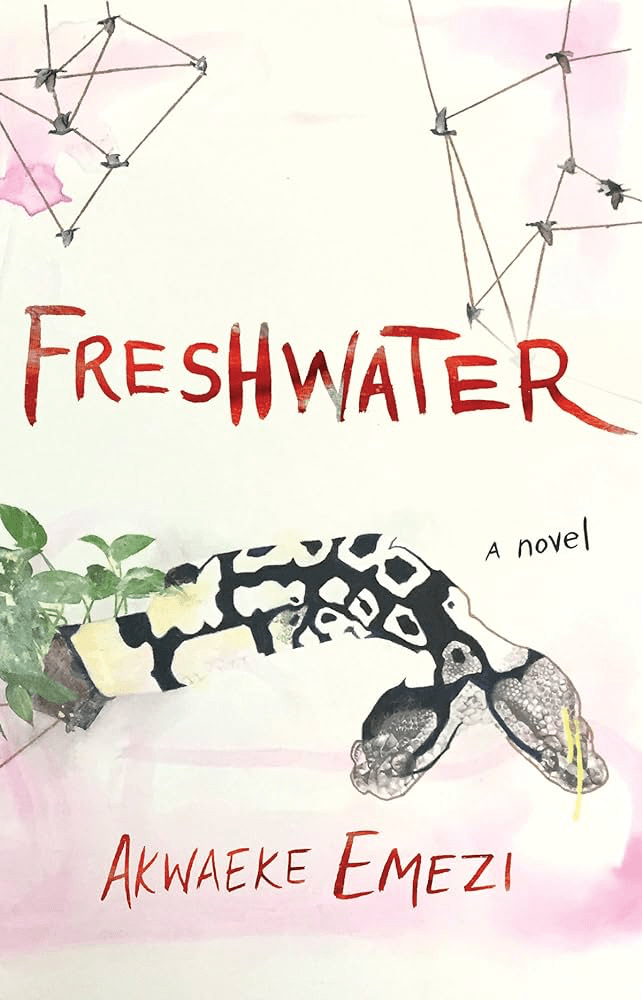
Freshwater – Akwaeke Emezistagnation, grappling with identities beyond the human, and the desire to free that identity with help of a surgeon.

“Oodles of O’s” – De La Soul

Is it possible for De La Soul to have a bad song? Well…okay, I haven’t gotten into their later catalogue, which seems to have a worse reputation (I don’t know, though, “Snoopies” is pretty fantastic), so that’s up for interpretation. But for me, De La Soul are one of those bands where almost every new song of theirs I find feels like digging up buried treasure. At least in the ’90s, their creativity seemed to come to them as easy it is for the average person to breathe. The lyrics? Deadly serious, but still full of whimsical, silly rhymes—nothing but De La Soul. The best part is that every single line ends in an o sound—quite literally oodles of o’s! The samples? That Tom Waits bassline sample is something to behold. This is my kind of hip-hop. Can’t say if their entire catalogue is perfect, but “Oodles of O’s” is. We need to bring back the word oodles. Carry on the spirit.

At the end of the day, it’s beautiful that this got the video that Dave wanted it to have, now around a year and a half after his passing. Maybe it’s not the grittiness he envisioned, but a donut shop more than makes up for it.

…AND A BOOK TO GO WITH IT:

Geekerella (Once Upon a Con, #1) – Ashley Postonadmittedly, a much fluffier take on fame, but an exploration of how it reduces you nonetheless.

“Anchor” – Soccer Mommy

With the workload I’ve been swimming through this semester, I’m not sure if I’ll get around to reviewing Evergreen, but rest assured—I LOVED it. After a few listens, Sometimes, Forever remains on top, but Evergreen is special. There’s a matured, bedroom-pop-grown-older familiarity to it, but as with every successive album, Sophie Allison always has something new to offer. Her fourth album is a cartography of grief, detailing the tangled web of loss, healing, and pining after your Stardew Valley wife, as it turns out. As with every one of her albums, it’s her introspection that shines—with every kind of grief that she experiences, it feels like a flag planted in the ground, a recognition of every hill and valley of the harrowing trek she’s been on, but recognition that it’s not the end, no matter how much of it is behind her.

In contrast to the largely acoustic (or at least traditionally guitar-driven) landscape of Evergreen, “Anchor” instantly singles itself out as the black sheep of the bunch. Though it covers some of the same ground as the rest of the album, the production doesn’t jump out at you so much as it pounces on you like some creature going after your ankles in the dead of night. I should’ve expected that Allison would retain some of the sound from Sometimes, Forever, but with how the rest of Evergreen sounded, it was a surprise—and a 100% welcome one. With synths and bells that wouldn’t sound out of place in a Chelsea Wolfe track, it has a jaggedness and fear that the rest of the album lacks. In a song about feeling so unmoored in the face of loss, it’s one of the most creative stylistic choices on Evergreen to me. In the same way that a simple object or scent or song can trigger a domino effect of memories that takes days or weeks to recover from, “Anchor” comes out of nowhere with its instrumentation. It has the static and crunch of watching yourself bolting through the woods through the lens of a trail cam, and that’s how grief can make you feel—cornered and in the dark.

…AND A BOOK TO GO WITH IT:

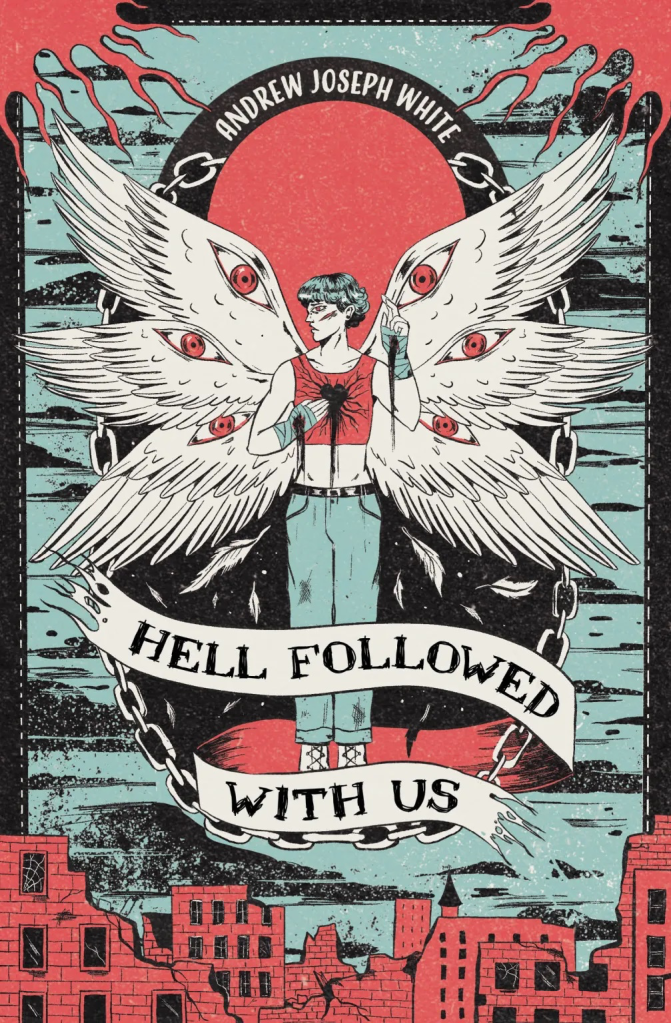
Hell Followed With Us – Andrew Joseph White“When we left the harbor/I was certain of my path/There’s no turning back/Now I long for something that/Could stop me in my tracks/An anchor to cast…”

“Remember My Name” – Mitski

Knowing that “Remember My Name” was released so close to the time that she almost quit music (back in 2019) really puts this song in perspective. Mitski’s still battling being in the spotlight, but this song presents the other side that’s been waging that war; deep down, she harbors a desire to be musically immortal, even at the steep cost: “I gave too much of my heart tonight/Can you come to where I’m staying/And make some extra love?/That I can save ’til tomorrow’s show.” With its crunching guitar riff that’s begging to be sampled and the way that the chorus consumes you in the same way that watching an approaching tornado on the horizon does, there’s so much urgency and volatility packed into just over two minutes. The best of Mitski speaks to that part of me that is so easily overcome by emotion and gives itself over to its throes—sometimes, whatever the situation, you do feel like you need something bigger than the sky. What works so well is that Mitski is dead serious—every song is an explosive, cathartic release. Of course, again, that’s probably what attracts so many parasocial weirdos to her shows, but I at least have the tact to not yell “MOMMY” at her, much less anybody else. That’s exactly the price of the fame she speaks of—she places her heart on a platter, people tear it to shreds, and the process repeats itself every day. I’m just glad that after The Land is Inhospitable and So Are We, she’s repaired that volatile relationship with music, or at least started to. Much as I love a good Mitski explosion, her best music comes when she’s healed, or at least processing it.

…AND A BOOK TO GO WITH IT:

Shadow and Bone – Leigh Bardugo“I need something bigger than the sky/Hold it in my arms and know it’s mine/Just how many stars will I need to hang around me/To finally call it Heaven?”

Since this week’s post consists entirely of songs, consider all of them to be today’s song.

That’s it for this week’s Sunday Songs! Have a wonderful rest of your day, and take care of yourselves!
Posted in Sunday Songs

Sunday Songs: 10/20/24

Happy Sunday, bibliophiles! I hope this week has treated you well.

This week: we regret to inform you that the All Born Screaming brainrot has persisted for 6 months. It may be terminal. Please stand by.

Enjoy this week’s songs!

SUNDAY SONGS: 10/20/24

“Reckless” – St. Vincent

So. Almost 6 months later, and All Born Screaming remains etched onto the folds of my brain. I already talked about how the climax of this song hit me like a train in my review of the album back in May, but rest assured that time has not dulled its potency. 2024 has been a spectacular year for album intros (see: “IDEA 01,” “Wall of Eyes,” and, I’ll preemptively say it, “Lost”), and All Born Screaming’s “Hell Is Near” rightfully claims its crown in those ranks. But “Reckless” feels like the rightful evolution of it—I’d even to as far to say that it would be stunning as a whole track. Imagine that, combined into about 8:06 of a suspenseful, cinematic build. That’s perhaps the only thing that could make the sonic lightning strike at 2:38 even more explosive. Like a well-shot film, suspense is what drives “Reckless” to its pinnacle of art—every lyric is a footstep down a pitch-black hallway, constantly wary of the faulty wiring in the ceiling that’s ready to burst. Knowing that Clark has opened every setlist for this tour with “Reckless” makes the salt in the wound that SHE DIDN’T COME TO COLORADO ON THIS TOUR even saltier. WHY HAVE YOU FORSAKEN US, ANNIE? YOU WENT TO IDAHO, FOR GOD’S SAKES!

…AND A BOOK TO GO WITH IT:

Death’s Country – R.M. Romero“If your love was an anchor/And I am lost at sea/I hear the riders calling/They’re calling for me…”

“Look What They’ve Done To My Song, Ma” – Melanie

I came here from the wonderful show We Are Lady Parts (highly recommended if you need a laugh and also want to see some Muslim punks being badass and very vulnerable on TV); it’s a fitting soundtrack for the bitter disappointment of the band at the end of the first episode of season 2 as they watch their hit song being covered by newcomers, only for said newcomers to get the bulk of the praise and applause from the crowd.

Given this song’s partial legacy of being butchered for commercial jingles (confirmation that corporate executives never listen to lyrics), there’s something predictably depressing about “Look What They’ve Done To My Song, Ma” becoming exactly what the lyrics talk about. In an slow lament that slants towards an older Broadway standard, Melanie sings of how her music has been dragged through the mud: “Look, look what they’ve done to my song/You know, they tied it up in a plastic bag/And then turned it upside down, oh Mama/Look at what they’ve done to my song.” That kind of Broadway feel is the ideal form for this song—it begs for a spotlight on a sordid character with mascara running down her cheeks as she belts her sorrow into a rapt crowd. The more I think about it, I feel like it’s one of the premier victims of the ’60s-’90s fadeout in music—why, why, why would you start turning the volume down right when she hits the most impassioned belt of the whole song? Melanie specifically wrote it about how her producer (who also happened to be her husband) would often halt her creative process in the studio, diverting her from her vision when he saw what he wanted to be a hit.

“Look What They’ve Done To My Song, Ma” has been covered a slew of times over the years, most notably by greats such as Ray Charles and Nina Simone (!!). Sometimes, with a song that covered, it’s simply a matter of fame, but it taps into what might be one of the most universal fears of anyone in the arts: trying to put yourself out there, but then getting your vision sanitized and reshaped for mass appeal. It’s always at the back of my mind. Being unreceptive towards any criticism is one thing, but I’m always afraid of what I put out there being somehow not right for what publishers want. Whatever finished products I eventually publish will have to be rigorously edited, of course, but it would kill me if there were key parts of my stories I had to dilute just so I could sell more copies. Of course, careers in the arts are often…not the most well paying, to say the least, and I almost fear having to succumb to diluting my vision just because of money more than I fear the dilution itself. Would I be able to live with myself? We’ll cross that bridge when we get to it. No, if. I’ve gotta have a little faith. If this song—released in 1970—was able to break through the constraints of producers and the music industry at large, maybe it isn’t all as bleak. Melanie did get the last laugh, from what I can tell, eventually gaining more creative control and outliving her husband. Sadly, she passed away this January, but her legacy precedes her. I’ve only been familiar with Melanie for a woefully short time, but I hope she’s resting easy.

…AND A BOOK TO GO WITH IT:

Not Here to be Liked – Michelle Quach“Look at what they’ve done to my brain/Well, they picked it like a chicken bone/And I think that I’m half insane, ma…”

“Final Fantasy” – TV on the Radio

Picture this. You open up Instagram. TV on the Radio has posted an ominous picture of their logo on their page. They’ve been on hiatus for almost a decade. When the world needed them most, TV on the Radio returned…

…just to play a few shows in New York, LA, and London.

They’re at least reissuing Desperate Youth, Bloodthirsty Babes for its 20th anniversary and we got “Final Fantasy” out of it. Hopefully the slow creep of the bass and the ominous, razor-sharp lyrics are enough to distract from the fact that we’ve been sidelined…again. I’m just telling myself that they’re cooking up something new, just so I can sleep at night. You can’t just rise from the dead like that only to play…what, nine shows in only 3 locations? Come ON.

…AND A BOOK TO GO WITH IT:

Some Desperate Glory – Emily Tesh “You’ve made a family/Now kill ’em dead/Oh it’s not me Ma/It’s what the TV said…”

“Like Humans Do” – David Byrne

When I heard this in the background of a post on Instagram earlier in the week, I got hooked through the screen—you ever just hear a 10-second snippet of a song and are immediately impelled to download it? It’s so delightfully hooky. No wonder Microsoft chose this song as one of the samples of music for their Windows XP Media Player. It’s now widely accepted as the unofficial “Windows XP Anthem”—the radio edit, that is; Microsoft used the radio edit, which cut out the following line: “I never watch TV except when I’m stoned.” (They replaced the line with “We’re eating off plates and we kiss with our tongues.”) Either way, even though I never got to experience “Like Humans Do” in that context, thank you to whoever decided that David Byrne’s music would be the flagship of Windows XP.

Byrne wrote the song as an imagined perspective of a Martian watching humans interact; the lyrics have a simplistic, domestic calm to them, placidly and warmly recounting the everyday normalities of human life that we take for granted: “For millions of years, in millions of homes/A man loved a woman, a child it was born/It learned how to hurt and it learned how to cry/Like humans do.” With its clanging, light percussion and that classically funky, Talking Heads groove, it’s a jangle that really does embody one of its more delightful lyrics: “Wiggle while you work.” You bet I was IMMEDIATELY wiggling when I first heard this song…and on every subsequent listen. And it feels exactly like the kind of song Byrne would write. It’s in that same vein of Björk’s “Human Behaviour,” but with more of a calm appreciation rather than baffled curiosity on the subject. Relating it back to Byrne’s autism diagnosis later in life doesn’t explain everything, but as with Björk, who said that she “may be semi-autistic” in an interview in 2011, it does make sense for Father Autism himself to take on this kind of subject matter. Of course, you can zoom this lens out to apply this observational mentality to anyone on the fringes of normality, but it does feel like a role I’ve embodied as a neurodivergent person myself. You watch others to learn how to act, and sometimes, you feel like you’re another species collecting enough information to try and blend in. Of course, the freedom comes when you realize that there’s no point in blending in, but for me, at least, there was never a shunning of neurotypical behavior—simply a realization that I would never fully be able to imitate it, and I’d found enough people who understood and words to explain why I am the way I am. “Like Humans Do” feels like the calm epiphany of discovering difference once neurodivergent acceptance becomes reality.

…AND A BOOK TO GO WITH IT:

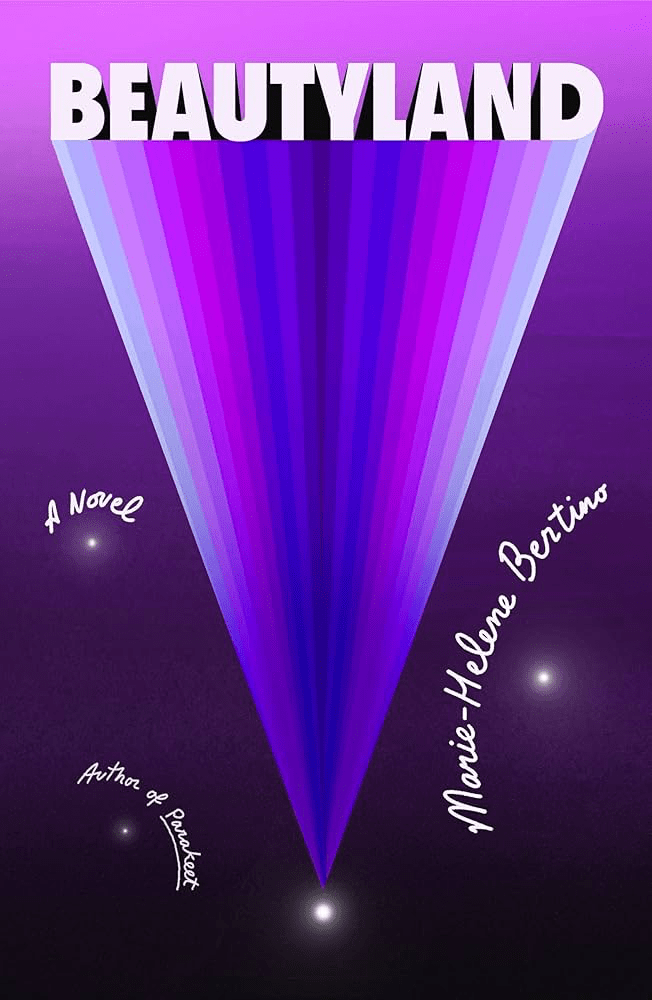
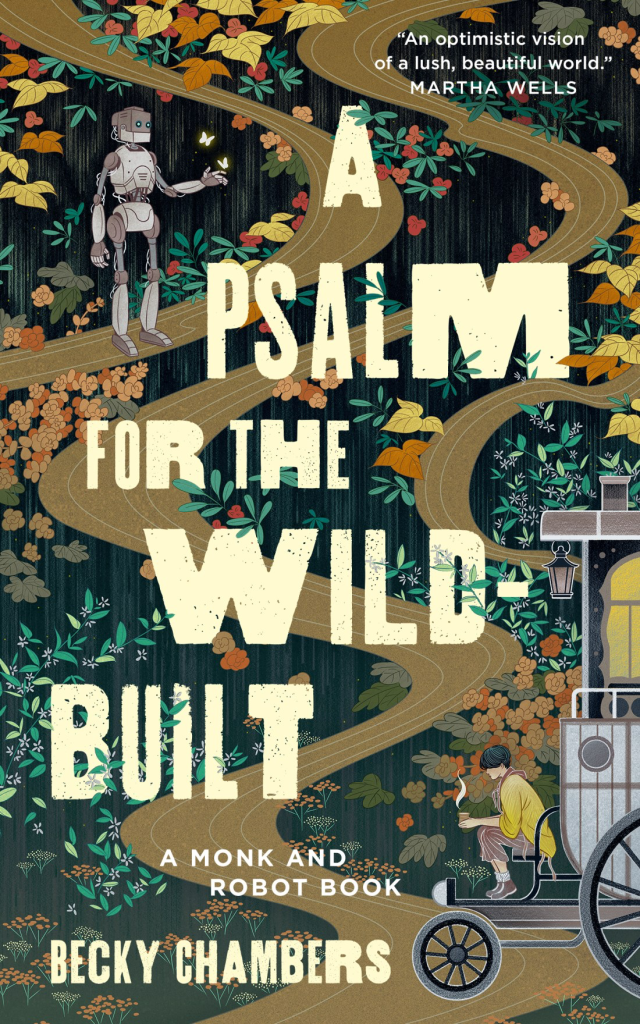
Beautyland – Marie-Helene Bertinolisten, I try not to double-dip on book pairings, especially since I paired this book with “Always Crashing in the Same Car” last week. But…the alien observing humans connection is right there!

“Breaking the Split Screen Barrier” – The Amps

Normally, I take a liking to any given Kim Deal-related song fairly quickly. But “Breaking the Split Screen Barrier” wasn’t so instantaneous for me. The beginning sounds like a series of false starts layered on top of each other. The prolonged space between each chord doesn’t just feel like a ruse: they pile up on top of each other so much that you feel like you’re being served three courses of red herrings. And I hate to say that about The Amps! I don’t think I’m that impatient of a listener, but I’m used to them getting straight to the point (see: “I Am Decided”).

After a few listens, however, you realize how much that slow build pays off. Every instrument has more crunch and crackle than a wadded-up ball of tin foil. In between the gravel and abrasion, Kim Deal murmurs her borderline surreal lyrics into a void curtained by echoing near-abrasion. Maybe I am guilty of being one of those damn gen z-ers with an attention span shorter than that of a minnow, but I think I can be patient—especially when Kim Deal is concerned. It paid off for “Breaking the Split Screen Barrier.”

…AND A BOOK TO GO WITH IT:

The Brightness Between Us (The Darkness Outside Us, #2) – Eliot Schrefer“I know you’re not sane anymore/That doesn’t mean you’re fine…”

BONUS: the great Jim Noir has a new album Jimmy’s Show 2, out on November 5th! He released a music video to accompany the lead single, “Out Of Sight,” this week:

Since this post consists entirely of songs, consider all of them to be today’s song.

That’s it for this week’s Sunday Songs! Have a wonderful rest of your day, and take care of yourselves!

Posted in Sunday Songs

Sunday Songs: 7/21/24

Happy Sunday, bibliophiles! I hope this week has treated you well.

This week: music for pretentious weirdos (me), music for animation, and music that makes me cry on the regular.

Enjoy this week’s songs!

SUNDAY SONGS: 7/21/24

“Dirt on the Bed” – Cate Le Bon

I came into Pompeii with plenty of curiosity, having finally gotten around to listening to Cate Le Bon after hearing her work producing Wilco’s latest album, Cousin, and her vocal feature on St. Vincent’s “All Born Screaming.” Vaguely remembering the buzz and air of weirdness around Pompeii, I decided to listen to it first.

Pompeii and “Dirt on the Bed” have reminded me of why a spectacular album intro can be both a blessing and a curse. If nothing surpasses the first track, then the rest of the album can never recover—or at least reach the heights of the first song. You can enjoy yourself, but never as much as you did after one song. Just one. It’s a horrible dilemma. Pompeii was fantastic from the start, but after the first four songs, nothing’s quite the same—great, but like my experience with R.E.M.’s Green, nothing tops the back-to-back splendor of the first four songs. And that splendor is set in motion by the crawling intro, “Dirt on the Bed.” As the title suggests, it has the dread of something unclean creeping into the house, like a nun on the scent of sin in a shuttered Catholic girl’s school. An off-kilter, stumbling chorus of brass blooms in moldy bursts, an airborne sickness pulsating through each thrum of the bass. Now I know exactly why St. Vincent chose to work with Le Bon—”Dirt on the Bed” is especially evidence of this, but all I could think of during Pompeii is that it felt like St. Vincent had remained lyrically and instrumentally in Actor, but slowly adorned her music with synths. They’re so similar to each other, down to their folkier, precocious indie beginnings that blossomed into full-on devotion to strangeness. This is modern art pop at some of its best, unabashedly weird and precise in every flourish. “Dirt on the Bed” makes even more sense when you see it as a product of a pandemic-produced album; it paces listlessly, putting on a smile as it tries to scrub every trace of illness and dread from a spotless house. Even as calmly as Le Bon sings each lyric, foreboding seeps through every misty horn blast.

That’s how an album intro is done. After several more listens, I’d say that nothing comes quite as close to it, but “Dirt on the Bed,” “Moderation,” “French Boys,” and “Pompeii” is SUCH an undefeated stretch of songs. Pompeii is worth a listen just for that, as is the album’s very St. Vincent closer, “Wheel.”

…AND A BOOK TO GO WITH IT:

Drunk on All Your Strange New Words – Eddie Robson“Sound doesn’t go away/In habitual silence/It reinvents the surface/Of everything you touch…”

“Poor Song” – Yeah Yeah Yeahs

…okay, I can’t possibly be normal about this because I cry a little every time I hear it. Either way, there’s an undiluted purity about this song that makes any kind of analysis feel like ten steps in the wrong direction. It’s a paramount example of how easily beauty and simplicity can intertwine, and it cuts more deeply than some songs I know with hundreds of metaphors.

It’s very nearly perfect. Karen O tends to do that.

…AND A BOOK TO GO WITH IT:

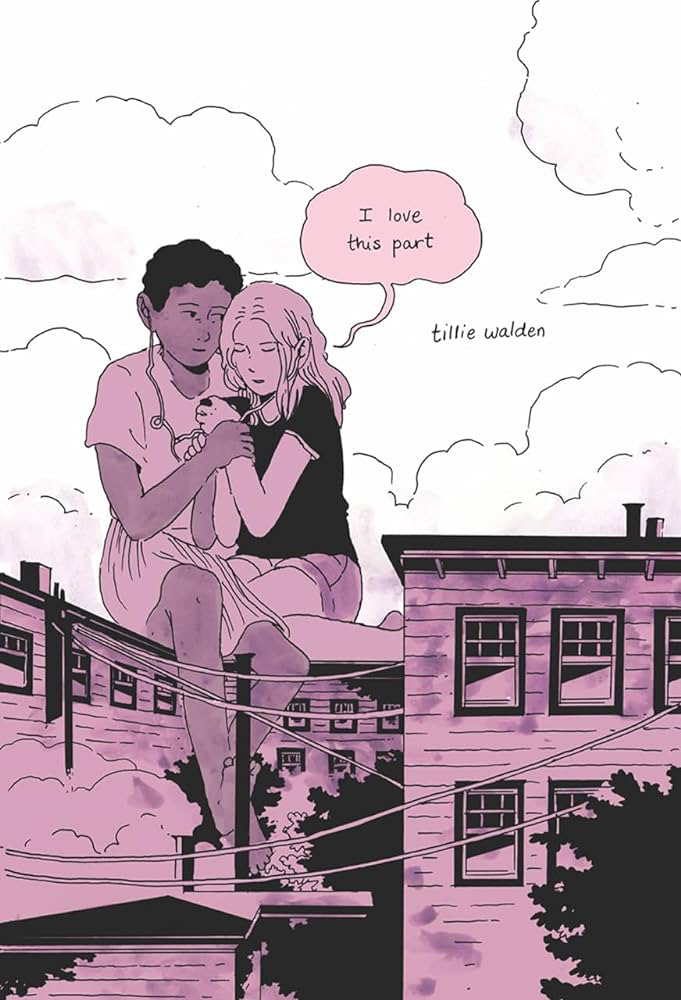
I Love This Part – Tillie Waldenquiet and gentle teenage romance.

“It’s A Wonderful Life” – Sparklehorse

One of the first times I remember hearing this song was in the car with my dad, as I come across many a good song. Looking back, since I was so young, it must have been a trip back into Sparklehorse’s catalogue shortly after Mark Linkous’ tragic passing. But as we drove home that night, the windows buffeted by snow or sleet, my dad made a wry remark about the lyrics: “he’s not feeling too good, huh?”

With every emotion comes an infinite number of ways to express it, not just confined to song. There’s the kind of songwriting that outright says that you’re sad, while others cloak it in metaphor. Neither is better than the other, but what Mark Linkous did feels like a category all its own, albeit closer to category #2. Many of the lyrics of “It’s A Wonderful Life” (if there was ever a more sarcastic title) are nonsensical, as his lyrics often are (“I wore a rooster’s blood/When it flew like doves”), but nestled between these impenetrable tidbits, the ones that do make sense land like anvils to the gut. I’ve never heard such sadness and shame articulated in the line “I’m the dog that ate your birthday cake.” Dare I say it’s one of my favorite song lyrics ever? It’s up there, just for such an unadorned, bare line to have such an instantly devastating effect; You can picture that dog, not knowing that it’s not supposed to eat human food and not processing that there’s a child sobbing at their ruined birthday, but being able to detect the shame all the same, but never know the reason why. It cowers, but it doesn’t know why it’s feeling this way. Linkous delivers it with all of that shame, clouded in the atmospheric cage of keyboards that prickle with heat lightning.

With that kind of lyricism, it came as a massive shock that this wasn’t one of his classic pieces of melancholy. In fact, Linkous wrote it as a jab at critics who panned an image of overarching depression over his catalogue: “I got fed up with people in America thinking that my music is morose and depressing and all that. That song is like a “fuck you” to journalists, or people who are not smart enough to see what it is.” And…listen, I’m a guilty party. I still think that Sparklehorse is one of the preeminent purveyors of high-quality sad bastard music, and he had enough strife in his life to justify every tear-jerking lyric. Yet this new light makes the lyrics I thought were nonsensical fall into place. Linkous describes the rest of the song as follows: “In the end, it was more about how every day, you should pick up something, no matter how minuscule or microscopic it is, and when you go to bed, you can say I was glad that I was alive to see that. That’s really what it’s about.” Wearing rooster’s blood when it flew like doves becomes a fleeting, once-in-a-lifetime capture of lightning in a bottle, and being the only one who can ride that horse th’yonder suddenly rings out as a humbly sung badge of honor. It was never sarcastic—it’s a wonderful life. I won’t ever be able to hear “I’m the dog that ate your birthday cake” without the sadness it insinuates, so maybe I’m just as much a part of the problem as the journalists he was taking a shot at, but the main takeaway for me is how versatile of a lyricist he is—if you look closely enough, he makes the absurdities of life both tragic and humbly hopeful.

Either way you absorb “It’s A Wonderful Life,” you can’t deny how otherworldly it sounds. Even years after I first heard and subsequently clung to this song, I can only name maybe one other artist who has ever come close to sounding like this—Lisa Germano, who, whether or not the two knew of each other, has a similar modus operandi of making music that sounded like rotting wood and empty doll’s heads. Lyrically and sonically, almost nobody sounds like Sparklehorse, and I suspect it’ll take a miracle for anyone to come close.

…AND A BOOK TO GO WITH IT:

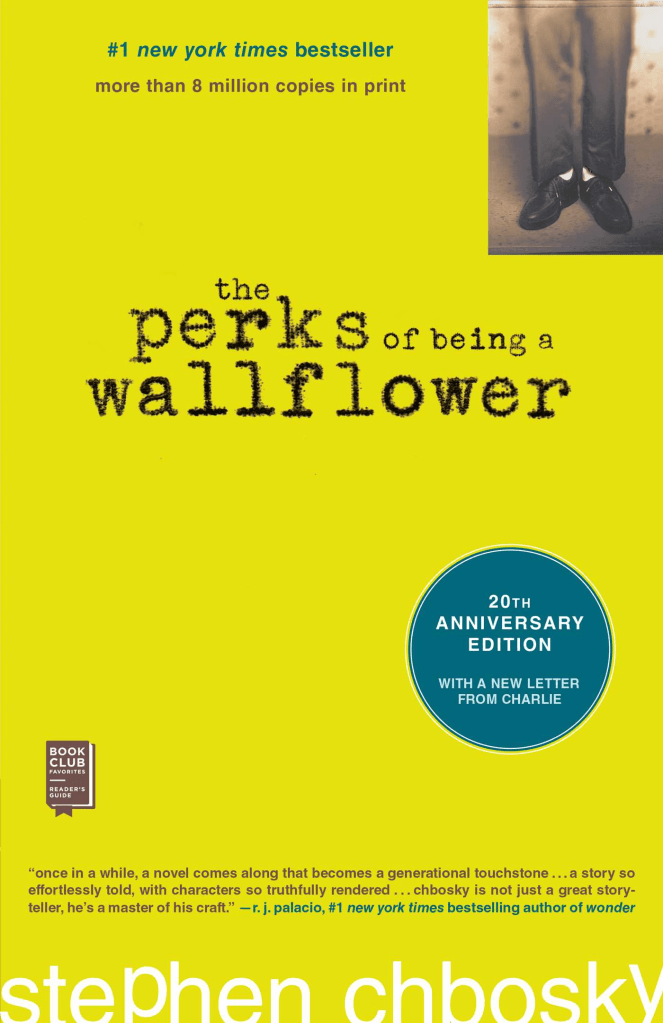
The Perks of Being a Wallflower – Stephen Chbosky Sparklehorse is no “Something,” but the crushing weight of depression and self-loathing comes across similarly.

“Girl from Germany” – Sparks

I’d heard bits and pieces of Sparks before, but like “Future Teenage Cave Artists” last week, I have Horsegirl and their episode of What’s In My Bag? to thank. Love those pretentious (affectionate) weirdos.

It seems I’ve only gotten through one strand in the massive haystack in terms of the INCREDIBLY prolific career of Sparks, which started in 1967 (under several different names) and had its most recent entry last year. Edgar Wright made a documentary about their musical exploits, and the list of artists they’ve influenced seems to span an infinite number of genres, all the way up to Horsegirl in 2023. So, having only heard two of their songs (including this one): hats off to you guys, really! Being that flagrantly weird for almost six decades is nothing short of impressive, and I can’t help but admire their musicianship in that regard.

“Girl from Germany” scratches my eternal itch for early-’70s glam rock, although it’s not all glam—it’s more glam in the sense that Brian Eno was glam at the same time, not quite like Bowie or Bolan were glam. Squeaky-clean, warm guitars as far as the eye can see and a healthy dose of theatricality cloaks this track make for a song that’s deliciously meticulous in every aspect. Russell Mael affects high-pitched vocals that wouldn’t be out of place in The Rocky Horror Picture Show while Ron Mael’s keyboard melodies glitter like light reflected off a glass of wine. And like Brian Eno, they used such a theatrical machine to touch on touchy subjects—in this case, in the climate of the early ’70s, bringing home a German girl to relatives who were mired in the horrors of World War II: “Well, the car I drive is parked outside, it’s German-made/They resent that less than the people who are German-made.” Even if every affectation is theatrical to the core, it’s still a prejudice that resurfaces today—assuming that any given person is an extension of the government and horrors of their homeland, and having to grapple with the cultural fallout of such a simple gesture of love.

…AND A BOOK TO GO WITH IT:

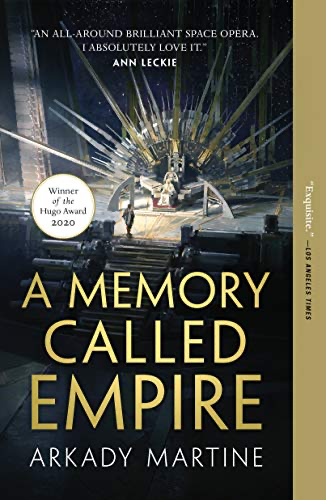
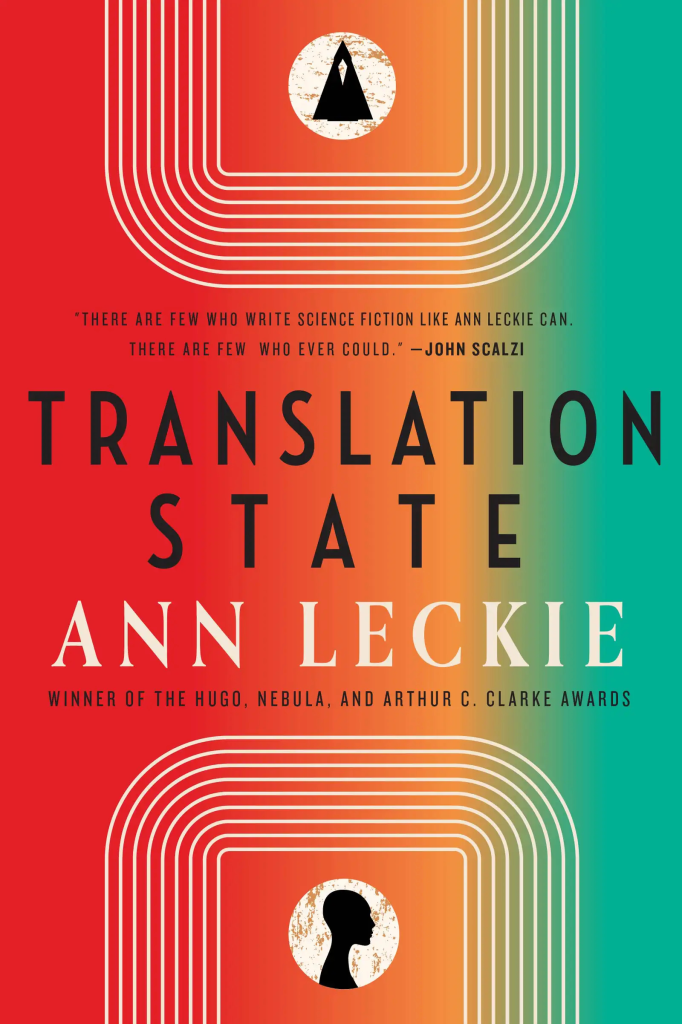
Translation State – Ann Leckie – cross-cultural confusion and characters with heart.

“Hideaway” – The Olivia Tremor Control

Having only heard one song (this one) from Black Foliage: Animation Music, I’ve already logged it into my slipshod mental list of album titles that perfectly describe the music they contain. The Olivia Tremor Control have always been masters of musical density, making soundscapes that unfold like intricate pop-up books, each layer of noise a painted paper cutout in an endless jungle. “Hideaway,” so far, is the pinnacle of that density; with each successive strain of woozy, turn-of-the-century homage to ’60s psychedelia, you’re pulled into a lush forest of plants that unfold just enough to let the tiniest slivers of light through. It’s not just the black foliage that hits the mark so fittingly—the “animation music,” as Will Cullen Hart called it, is “all the stuff floating around…To me, that’s what [animation music] is: sort-of a sound and space, personified—just flying around to greet you in a friendly way.” All at once, the xylophone chimes and trumpet blasts give “Hideaway” the feel of both the colored-pencil animations in Fantastic Planet and the bouncing characters in Schoolhouse Rock!, a papery and breathless expedition into a darkened forest of cartoonish proportions.

…AND A BOOK TO GO WITH IT:

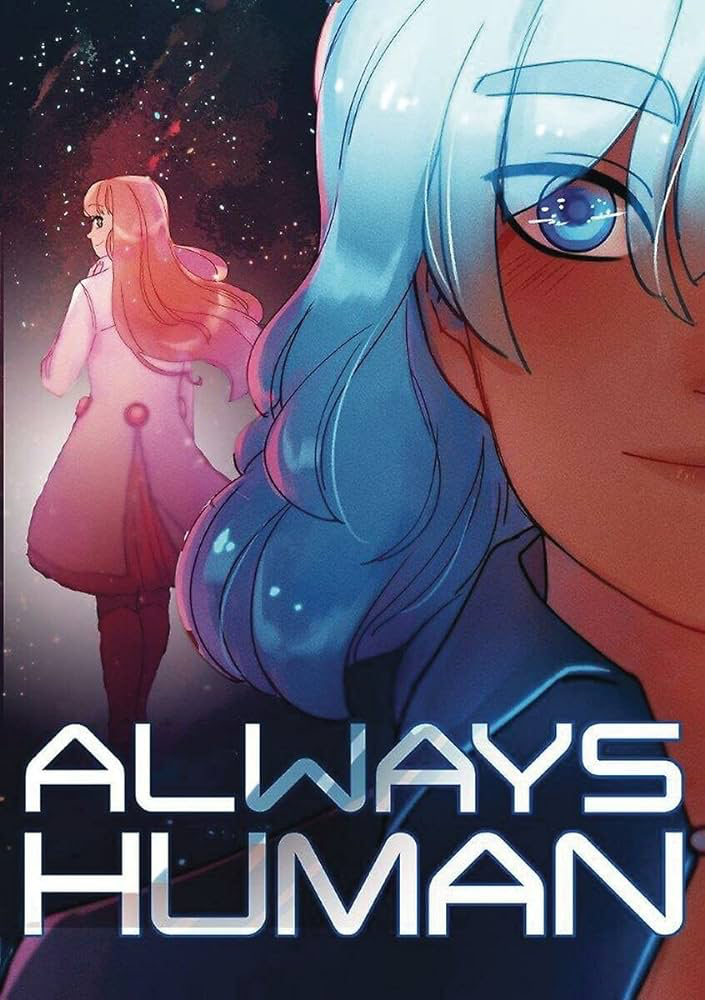
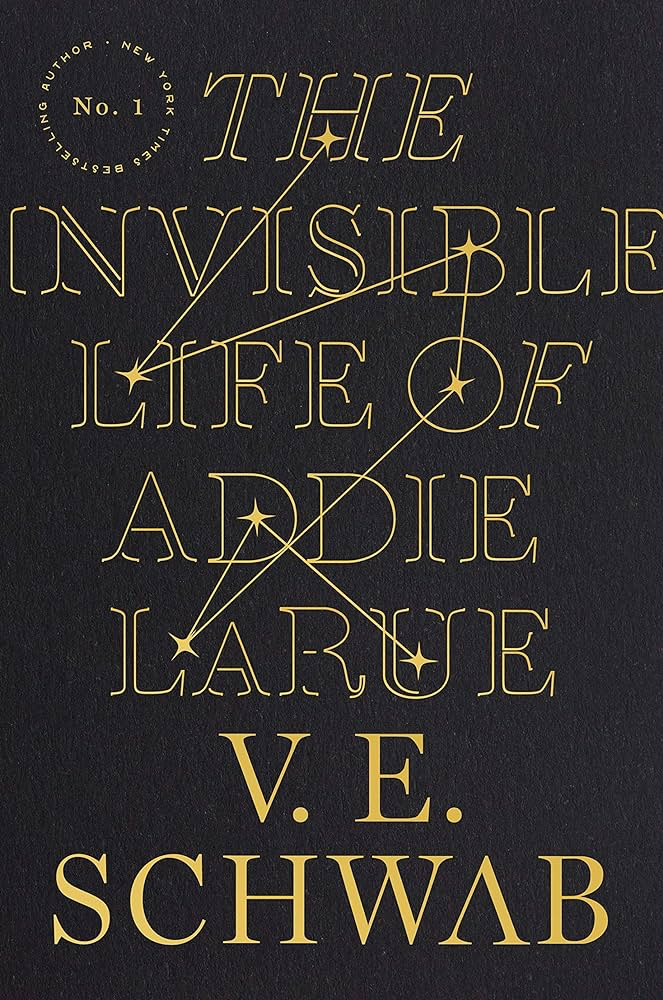
Always Human – Ari North simple, stylized art with vibrant colors—perfect for animation music.

Since this post consists entirely of songs, consider all of them to be today’s song.

That’s it for this week’s Sunday Songs! Have a wonderful rest of your day, and take care of yourselves!
Posted in Monthly Wrap-Ups

May 2024 Wrap-Up ⌨️

Happy Friday, bibliophiles!

Finally summer! Finally, more time to read…and most of what I’ve read this month has been good, I’d say.

Let’s begin, shall we?

GENERAL THOUGHTS:

Save for the first week of the month, May has been the first month where I’ve been able to relax somewhat! Finals were over and I’d moved out of my dorm before I knew it. Straight A’s and finally being free of my STEM requirements isn’t too shabby, I’d say! I’m so proud of what I’ve accomplished this year—and I’m so glad that I can have some downtime. And I’ve made good use of it so far—May has been my best month in terms of amount of books read (although the quality of…some of said books is another story), and I’ve definitely benefitted from the time spent reading! I’ve also been trying to focus more on art this summer, and consciously taking a slice out of each day to draw has been an adventure so far. I had a solid week where I had three or four blog posts all on the back burner simultaneously, so I unintentionally made a loose schedule for blogging every day as well, so I’m getting some writing in while I recover from writing two short stories and a 20,000 word novella all in one semester. I’ve also been pruning my Goodreads TBR…I’ve managed to cut it down from around 770 to around 720, so I’d say that’s been a success?

Other than that, I’ve just been cleaning things out of the dorm and bringing them back to my house, sleeping, watching Abbott Elementary (THEY FINALLY DID IT!!! THEY FINALLY LET THEM KISS!!!), Taskmaster, and Hacks (we love Jean Smart in this house), and relishing in the warm weather and the beginning of summer. I feel like every time I’m in the car with my family, I just pass the hills and feel the need to comment on how much I love that shade of green that summertime brings. But it’s so beautiful. Every single time. It never gets old. Thank you, shades of summer green.

READING AND BLOGGING:

I read 19 books this month! I’ve been oscillating between both ends of the spectrum this month, for sure—I read one of the worst books I’ve read this year, but also two of the very best. Somehow, it’s pretty evenly split as far as ratings go when I’ve lined them all up that way, but it’s been up and down all month, but on a track towards betterment midway through. I focused on AAPI books for May, and I found some fantastic books as a result from both familiar and new-to-me authors!

1 – 1.75 stars:

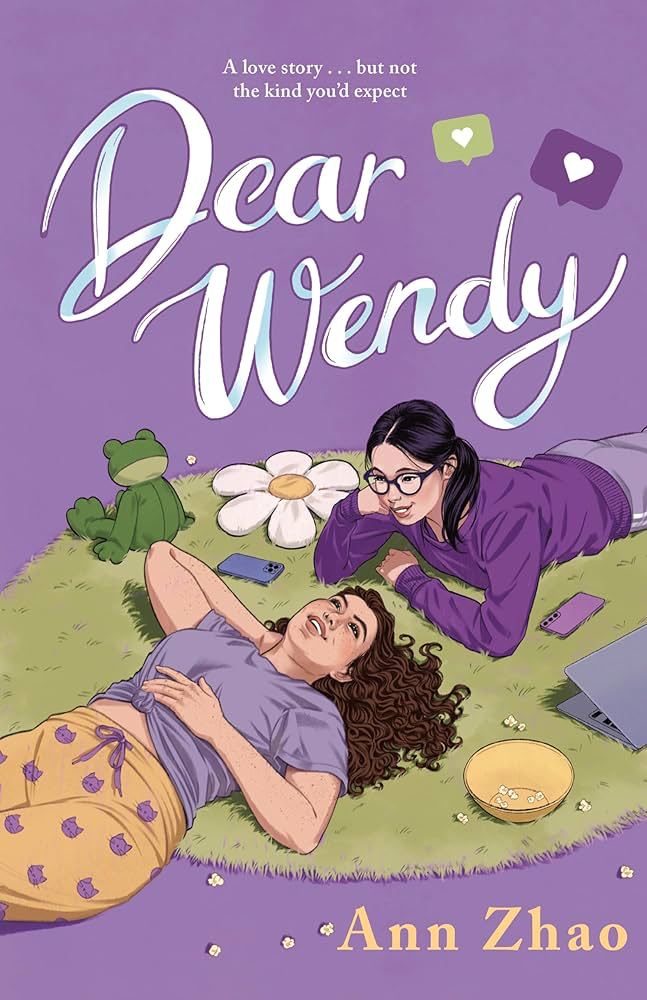
Dear Wendy

2 – 2.75 stars:

The Emperor and the Endless Palace

3 – 3.75 stars:

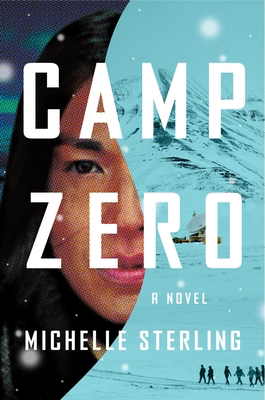
Camp Zero

4 – 4.75 stars:

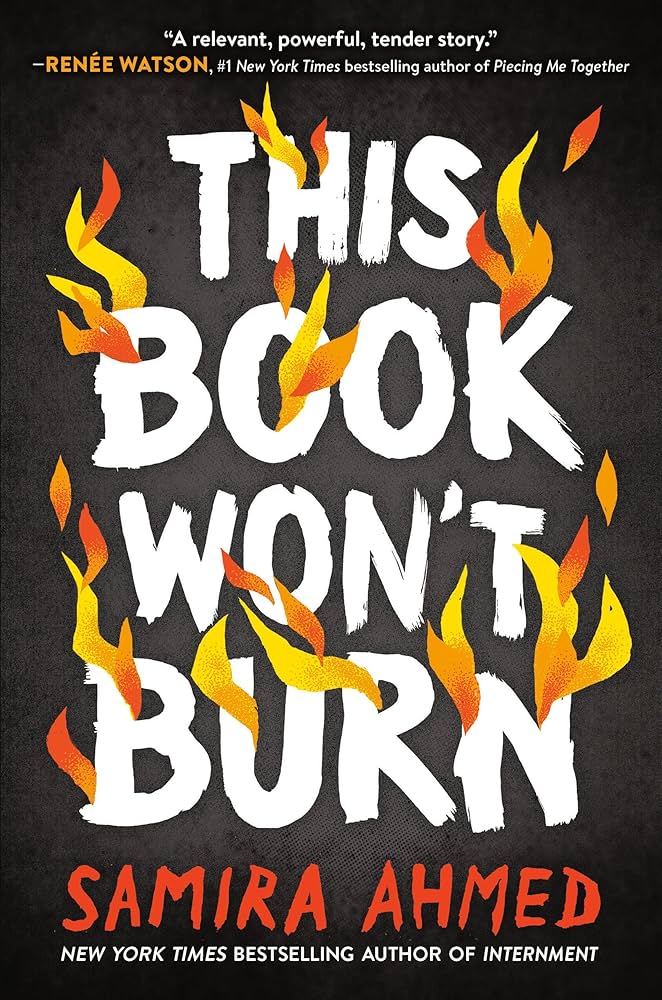
This Book Won’t Burn

5 stars:

The Travelling Cat Chronicles

FAVORITE BOOK OF THE MONTH – Squire5 stars

POSTS I’M PROUD OF:

POSTS FROM OTHER WONDERFUL PEOPLE THAT I ENJOYED:

SONGS/ALBUMS I’VE BEEN ENJOYING:

strong contender for album of the year!!!
why did I put off listening to this album for so long??
affirmations: I have listened to this song a healthy amount of times
this show was…insane?? idk if I’m built for punk shows but IDLES knocked it out of the park
lovely new album!!
got hooked on this band after seeing them open for IDLES!! fantastic stuff
such a wonderful album!!

Today’s song:

That’s it for this month in blogging! Have a wonderful rest of your day, and take care of yourselves!

Posted in Sunday Songs

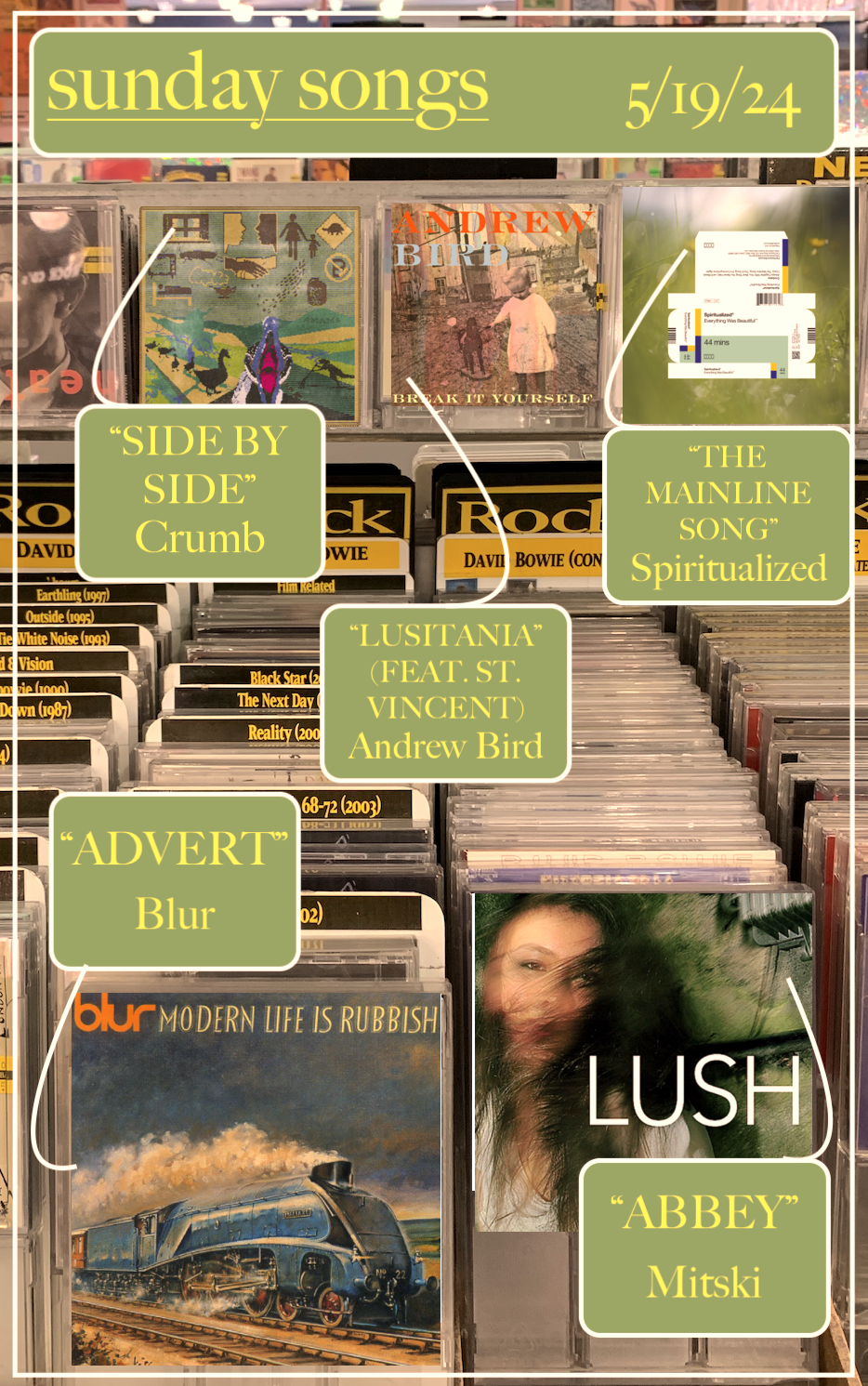
Sunday Songs: 5/19/24

Happy Sunday, bibliophiles! I hope this week has treated you well.

This week: in addition to my blue and black/white/gray periods, it’s become increasingly obvious that I also have a green period. On another note, food processors are great!

Enjoy this week’s songs!

SUNDAY SONGS: 5/19/24

“Advert” – Blur

The restraint I displayed by not blowing through Blur’s entire discography back in the last half of 2021 is restraint that I have yet to parallel, so it’s only now, almost three years after the initial Blur Breakdown, that I’ve gotten around to Modern Life is Rubbish (if there was ever a more British title). I did sort of sully it with the experience of listening to it while crawling under my bed while trying to exorcise the last of the dust bunnies from my dorm (and getting caught on the rain), but that’s all me—this is the first Blur album where they started to feel like themselves.

I’d never thought of Modern Life is Rubbish, Parklife, and The Great Escape (the final Blur album to surmount) as a trilogy until Trash Theory described it as such—from my understanding, this is what cemented their reputation as the foremost clever spectators of British life in the ’90s, peering out of every windowsill with a snappy remark about the passersby. Modern Life feels like Parklife just before it morphed into the masterpiece it would later be—all of the pieces were there, and all that was needed was to make it larger than life. The melted shoegaze of Leisure was hanging on by a thread (it’s much more evident in the special edition—see: “Peach”), and they’d shifted from staring off into the distance, bleary-eyed and exhausted, into taking out that exhaustion on whatever they saw fit. Straight off of the heels of the triumphant “For Tomorrow,” “Advert” opens with a soundbite from the commercial you’ve just heard (“Food processors are great!”) before launching into what feels like the genesis of Graham Coxon’s signature assault of pounding guitars that practically demand every crowd to jump up and down. This relentless guitar work feels like witnessing the larval stage of “Jubilee,” crashing and bouncing with unending abandon. And this kind of guitar that threatens to consume the track is perfect for the endless consumerism that “Advert” comments on—commercials everywhere, a flood of inescapable offers leeching off of the dissatisfaction of the ordinary man: “You need a holiday somewhere in the sun/With all the people who are waiting/There never seems to be one.” This consumerism leads to even more dissatisfaction, which leads to more consumerism to quell said dissatisfaction, which leads to…ah, capitalism. What could possibly go wrong?

…AND A BOOK TO GO WITH IT:

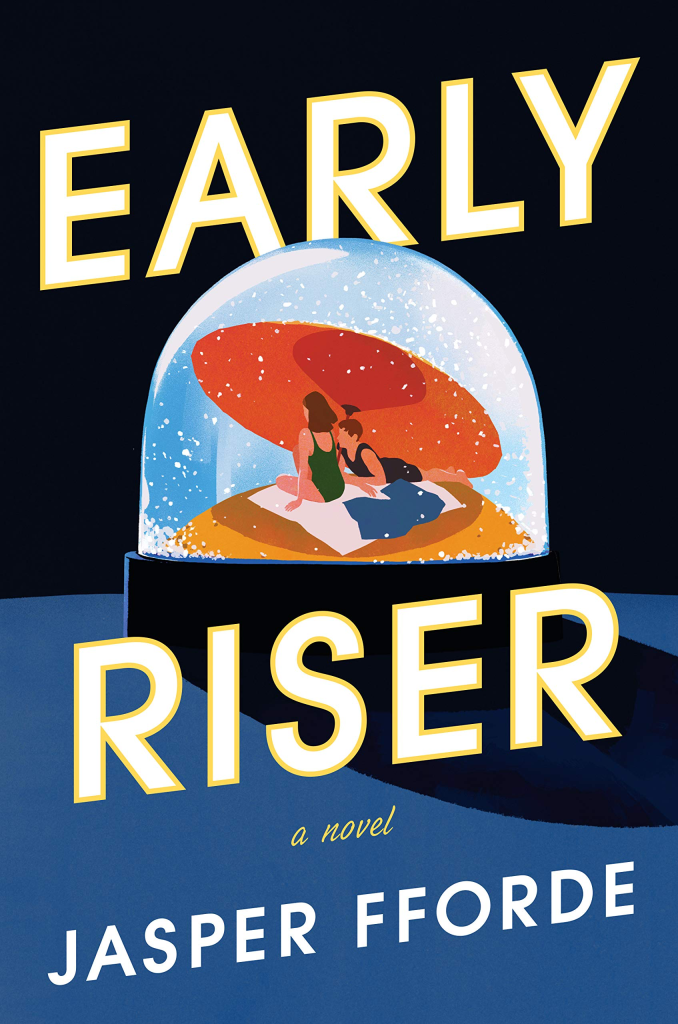
Early Riser – Jasper Ffordeconsumerism: the perfect diversion from an oppressive, unlivable winter!

“Abbey” – Mitski

LUSH, Mitski’s first album, was made for an end-of-year project when she was a junior in college; there’s an unverifiable TikTok rumor going around that she got a C on it, which, given the traction of the Mitski fandom, is just going to become an urban legend at this point. So it goes.

Either way, it’s both remarkable and understandable that she wrote all of these songs and had them produced while she was still in college. Remarkable, because just from “Abbey,” she clearly had the nascent talent for wringing emotion out like ice-cold water from a towel from a young age, and understandable, because sometimes being alone and sleepless in your dorm on the very first night of college brings out that flood of inner darkness. Leave it to TikTok to leave out the best part of the song for whatever trend it latched itself to; the slow, chanting a cappella that gained traction feels like a prayer to a void growing within your chest, a litany of acknowledgment to that which you want to reach, but cannot touch. As an instrument, Mitski’s voice, unaccompanied until halfway through the song, is a haunting, flitting machine, the slow peak and valley of a heart monitor. But once the digitized drums sweep through, it feels as though the sky has opened up. This prayer has transformed from a whisper into the confession box into a plea bellowed to the heavens. “Abbey” chronicles a search for the soul, a ravenous hunger that cannot be sated that lies just out of reach: “There is a light, I feel it in me/But only, it seems, when the dark surrounds me/There is a dream and it sleeps in me/To awake in the night, crying, ‘Set me free’/And I awake every night, crying, ‘Set me free.'” Hoowheee. God. Makes me want to travel back in time just to give her a hug, but it seems like she’s now far removed from that time in her life, emotionally: she described the version of herself that wrote the album as being “long gone,” so I can only hope that she’s been able to fill her heart, as much as the music industry has kept her from doing so.

…AND A BOOK TO GO WITH IT:

Hell Followed With Us – Andrew Joseph Whitea void within that only becomes hungrier the more it grows.

“Side By Side” – Crumb

AMAMA, which came out on the 17th, wasn’t at the top of my most anticipated albums of the year, but after only one listen, it’s cemented itself as one of the most exciting ones so far. It’s a side of Crumb that hasn’t been let loose until now, one that, instead of gently dribbling like age-old water from the precipice of a glacier, skitters around on the smallest legs, darting this way and that like a frightened millipede. The whole album feels like watching a bunch of beetles hopped up on sugar water run a race: their iridescent shells catch the light as they crawl about, scaling walls instead of the tiny racetrack and occasionally clambering over each other to get ahead. No wonder they named a whole song “The Bug”—I need the instrumentals of AMAMA just so that somebody can use them for a documentary about insects.

AMAMA‘s three openers—“From Outside A Window Sill,” this song, and “The Bug”—are its strongest links, and although the album never falters, these three shine the brightest. “Side By Side” ricochets with an energy that I never would have expected from the likes of Crumb; both the drum machine and the actual drummer are working overtime to create a scampering beat that frantically bounces like a honeybee trapped under a plastic cup. It’s a song that yearns to go, go, go, and go it does—the swirl of rapid-fire synth beats are unpredictable in their flight path, so much so that I feel a jittery, sugary rush just listening to it. For me, the most fascinating part of this change in speed for Crumb is how easily Lila Ramani’s voice adapts to the change; it’s not like I thought she couldn’t sing more quickly, but her voice only slightly seemed to change speed along with the music. Her voice is permanently trapped in a slurry of amber, unaffected by time or space—I feel like her vocals, no matter the speed, would mesh with any tempo. It retains that syrupy calm that made the rest of Crumb’s catalogue so soothing and laid-back—a quality that feels suspended in a space beyond time.

…AND A BOOK TO GO WITH IT:

A Half-Built Garden – Ruthanna Emrysskittering with life and energy (and some insectoid and arachnid aliens).

“Lusitania” (feat. St. Vincent) – Andrew Bird

It took me how long to find out that Andrew Bird had recorded a song with St. Vincent? I’m surprised that 12-year-old me didn’t find this drifting around somewhere, but to be fair, St. Vincent’s name isn’t listed on the official track.

In 2024, Andrew Bird and St. Vincent do seem like an odd couple; since 2012, Clark’s style has morphed so many times that it’s difficult to imagine her stylistically even going near Bird’s songbird-whistling, violin-dominated alternative folk. It makes sense that this was probably recorded sometime in 2011—post-Strange Mercy, but before the last dregs of Actor and Marry Me were out of her system. She’s still never been fully folk, but the intersection of the Venn diagram of her early style and Bird’s is wider than I thought it would be. With her guitar playing mostly absent, what shines in “Lusitania” is her voice; you can tell in the first half that she’s been quieted in post-production or that she’s holding back on completely dominating the track. “Lusitania” makes me miss those artsier sensibilities of 2008-2010 St. Vincent, the delicate turns of phrase and the more feathery clarion calls her voice twisted into. Just like that, I’ve got another song in my hypothetical playlist of songs where artists sing certain phrases in a way that scratches all the itches in my brain: in this case, her singing of “there’s no shame” at 2:44. Her warble seems to chain-link with Bird’s in a way that produces its own chord, something more than a harmony that feels like a tuning fork struck at my heart.

But why don’t I talk about Andrew Bird, though, since…y’know, he’s the one who made the bulk of this song, anyway? Totally unlike me to go on about St. Vincent…completely uncharacteristic. (I have not changed a bit since middle school.) The instrumentation doesn’t stand out to me on this one as much, save for the rising cymbals that nearly swallow both Bird and Clark’s voices. But it’s clearly to make way for the lyrics—a clever string of World War I metaphors, presumably about a relationship where one party suffers volley after volley of abuse, while the other doesn’t even think to recognize that their behavior is harmful: “If your loose and libel lips/Keep sinking all my ships/Then you’re the one who sank my Lusitania/But somehow it don’t register as pain at all.” As far as ship metaphors go, the Titanic has likely been used one too many times, but the Lusitania feels especially potent on several fronts. The use of such a large passenger ship (and its sinking) drives home the metaphor of weathering emotional abuse until it drowns you. What’s more effective still about the Lusitania was its eventual role in the First World War; since a significant number of its passengers were Americans, the sinking of the Lusitania by a German U-Boat was part of what pushed public opinion towards entering the war on the side of the British in 1917. Just like the boiling public outrage of the American public, the Lusitania was the straw that broke the camel’s back, an event so explosive that there could be no other option than to break away, no matter how many casualties it cost. “You laid mines along the shore” feels like the last gasp of this deeply harmful relationship, the claws that scored scars down the narrators back as they squirmed free of their bloodied grasp.

I really should have seen this collaboration coming, not because of my middle school obsession, but also because it slipped my mind that it wasn’t the first time. Here they are in 2009 performing “What Me Worry?” (15:51) and “Black Rainbow” (21:09).

…AND A BOOK TO GO WITH IT:

Fireheart Tiger – Aliette De Bodard“If your loose and libel lips/Keep sinking all my ships/Then you’re the one who sank my Lusitania/But somehow it don’t register as pain at all…”

“The Mainline Song” – Spiritualized

How I’ve never covered Spiritualized on Sunday Songs is genuinely beyond me. I did sort of discuss them when I talked about “Monster Love” last June, but that was more of a remix than anything. They’ve been in my top 5 artists of all time for at least 4 years now, but I suppose I blew through most of their catalogue before I started writing these posts. Mark my words, “Ladies And Gentlemen We Are Floating in Space” is always on in the background of everything else I’m listening to.

Everything Was Beautiful, which came out around two years ago, was some of J. Spaceman’s best work to date; at the time it came out, I remember describing it as Ladies And Gentlemen We Are Floating in Space but happy. Insane concept, I know…when was the last time you saw J. Spaceman and happiness in the same room together? Hardly ever, up until maybe 2017, right? Jesus. This poor man has to be the dictionary definition of “going through it.” Which is why the “happy Ladies And Gentlemen” hit me so deeply—all of the heroin, heartbreak, and near-death experiences have begun to fade away from his newer music, but the explosive, immersive creativity remains the same—you can really tell that these positive changes in his life have really begun to take root. And I am so glad. This man has been on the brink of death not once but twice. He doesn’t just deserve it: he needs it.

Like Ladies And Gentlemen, Everything Was Beautiful is always at the back of my mind, usually in the form of the uproariously celebratory “Always Together With You” and the nearly 10-minute long, haunting and cinematic closer “I’m Coming Home Again.” “The Mainline Song” lands on the side of euphoria, and thank god that it’s not heroin-induced this time (as much as “She Kissed Me (It Felt Like a Hit)” slaps). J. Spaceman’s immeasurable talent lies in how quickly he can not just create an atmosphere, but how he can create one that consumes so instantly. It’s not a building wave that darkens you with shadows before swallowing you whole: a more apt comparison would be falling into the core of a star, instant immersion with stardust sounds and white-hot flares roaring all around you. Every song is a universe contained in a spare amount of minutes. However, even if I did cast aside the part about there not being a build before the immersion, the buildup to “The Mainline Song” may just be its main draw. The build itself is part of the universe; J. Spaceman doesn’t even start singing until the halfway point, letting the song construct itself from fragments of stardust and train tracks as it swirls into being. It’s a song patched from the breeze of night, the kind you only find when sticking your head out of a car window, breathless and ecstatic. It’s a sprint through the streets as city lights blink like so many stars. It’s the wind parting your hair as you run to catch the bus, panting as you stumble inside with a fit of laughter. As many songs as there are about this kind of adventuring, none of them quite capture the hopeful feeling of “The Mainline Song.” No feeling necessitates J. Spaceman’s magical universe creation more—the swirl of horns, choir, and machinery bottle the feeling in all of its rapid euphoria, as blurry as the world passing by from the window of a train. Like nothing else, “The Mainline Song” captures the look you share with your friend as you reach a silent agreement to leave everything else and run. The destination isn’t what matters: it’s the breathless thrill of love.

…AND A BOOK TO GO WITH IT:

A Scatter of Light – Malinda Lowarmth, adventures in the city, and an unforgettable summer.

Since this post consists entirely of songs, consider all of them to be today’s song.

That’s it for this week’s Sunday Songs! Have a wonderful rest of your day, and take care of yourselves!
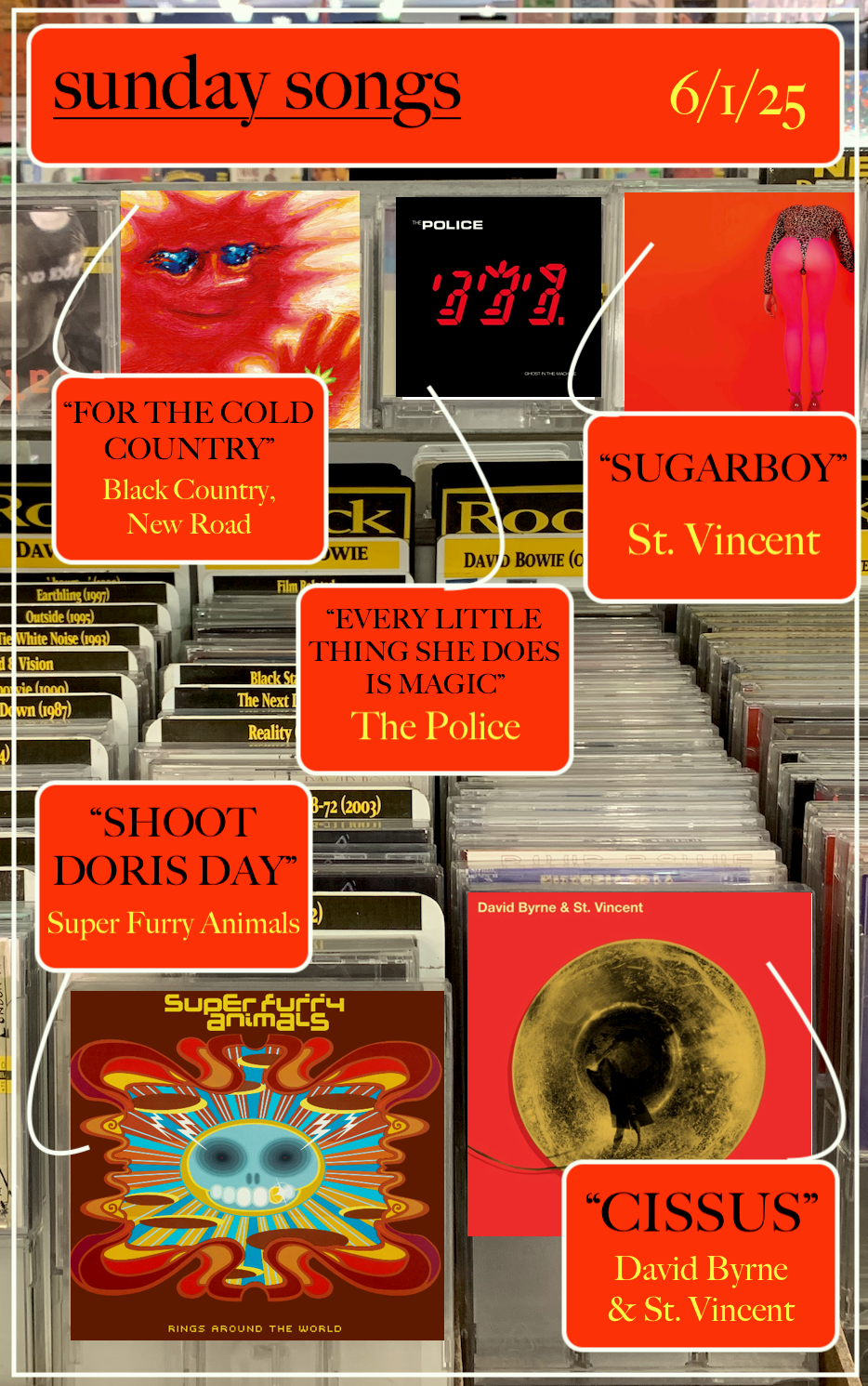
Posted in Music

All Born Screaming – album review

Happy Friday, bibliophiles!

2024 has proven to be momentous for my inner middle schooler. A new St. Vincent album, and the Apple TV+ adaptation of The Search for WondLa…exists. I may revert to my middle school self if everything else about the show is as terrible as the “reimagined” character designs. But that’s not what I’m reviewing today.

Those of you who have stuck around on this blog may remember me enthusiastically reviewing Daddy’s Home on the heels of surviving the hell that was junior year during COVID. Those who have stuck around longer still remember my middle-school rant about MASSEDUCTION. (I’d rather you…not remember the specifics of the latter, but I still count that album as her lowest point.) Her self-titled record was as much of a friend as an album can be when I was 12, struggling to reconcile being unapologetically myself and wanting the acceptance of my peers. Marry Me was the first album I ever bought with my own money, and Actor, Strange Mercy, and Love This Giant all saw me through high school. All that is to say that St. Vincent has been there for me in the best of times and the worst of times. So naturally, I did scream when I found out about All Born Screaming—not just a new album, but a supposed return to her harder sensibilities—was coming out this year. And while it wasn’t fully the rock album that was marketed—or as musically cohesive as she tends to be—All Born Screaming is, without a doubt, some of her best work in years.

As I’ve been excited about this album for months—and writing more about music than I have in past years—I’ve already reviewed 3/10 of the tracks from All Born Screaming, so I’ll link to each separate installment of Sunday Songs that I reviewed them in, so as not to sound like a feral, sobbing, broken record.

Let’s begin, shall we?

ALL BORN SCREAMING – ST. VINCENT

Release date: April 26, 2024 (Total Pleasure)

TRACK 1: “Hell Is Near” – 8/10

St. Vincent tying the aesthetic and merch in with images of marigolds is pure evil. Diabolical. Diabolical of them to pair one of my favorite artists of all time with my favorite flower…holding out until she announces a date near me until I buy that one marigold shirt, because it’s an inevitability. It’s only a matter of time.

“Hell Is Near” is an opener that creeps through the shadows on feet that you can barely see coming. With a thumping bass that thrums like a heartbeat witnessing horrors in the dark, it feels like the slithering transition between eras and personas, especially with the allusion to “The Nowhere Inn” (“Snubbed out smoke in a pack from the Nowhere Inn”). I can almost see Clark crawling out of some kind of giant shadow box as the song progresses, the heartbeat bass echoing off of every wall as her hands emerge from the darkness. I can’t help but think of the chord progression of “Prince Johnny”—this album is the most similar to the self-titled record since the record itself, and it’s clear that she’s cobbling this current aesthetic upon shadowier corners of that era, with guitar riffs that seem to interlock like strands of DNA. It’s a slow trickle of an opener, and as it dissolves into a flurry of high piano notes and fluttering synth, it leaves you guessing—where could she possibly be taking us to next?

TRACK 2: “Reckless” – 8.5/10

“Reckless” almost feels more like an opener than “Hell Is Near” does, even though the latter does a fantastic job of being an opener. After “Hell Is Near” dissolves, we return to sparse wasteland that the first track set up, but with a significantly darker tone—both speak of leaving the past behind, but “Reckless” turns “Hell Is Near”‘s willingness to move on to dwelling on it.

If there’s one thing about new music that I always live for, it’s those moments where you hear a lyric for the first time and physically have to stop in your tracks just to process how beautiful it is. Last year, I had that moment with Wilco’s stunning “Sunlight Ends”—”you dance/like the dust in the light” made all time stop around me. Jeff Tweedy just does that. And so does Annie Clark—it’s hard to think of a line on All Born Screaming more hard-hitting than this: “I’ve been mourning you since the day I met you.” Even if it precedes “Flea” and its tale of a love so predatory that it becomes parasitic, this feels like the fallout; it feels like a reconciliation, or just a realization of a feeling of destroying everything you touch, knowing that your actions will eventually drive away everyone that you will ever love. Whatever the narrator did has become so thoughtless and violent that it’s left them with nothing but “the smell of your hair on the curtains, babe,” and all that is left of them is a memory that they cling to with all that they can, knowing that what they did was enough to send them running for good. The sparkling synths that burst like faulty wiring at 2:38, around 2/3 of the way through, feel like the memory of the outburst that left them isolated, longing for something more, as Clark stares out the window like a widow remembering how her lover was slain in the war. This, unlike “Hell Is Near,” felt like a more certain sign of things to come—the wires have been cut, the dishes are shattered on the floor, and your heels are burnt and bleeding from stepping on them both.

TRACK 3: “Broken Man” – 10/10

Reviewed on 3/10—I haven’t stopped foaming at the mouth, thank you very much

TRACK 4: “Flea” – 10/10

Reviewed on 4/7—no, I still haven’t recovered from “I look at you and all I see is meat,” why do you ask?

TRACK 5: “Big Time Nothing” – 8.5/10

This is what MASSEDUCTION should have been.

All Born Screaming was what Clark called “post-plague pop,” and nothing exemplifies the “pop” aspect more than this song. Like the spandex she wore on the MASSEDUCTION tour, the skittering synths clamp the beat down enough so that it hardly even has room to squirm. There’s threads of Björk’s electronic catwalk-strutters and the obvious (to me, at least) nod to Peter Gabriel with the last utterance of “big time nothing” being cut off to a chorus of “big time”; a very fitting nod, since these two Big Times deal with the same Big Time in question: the allure—and detriment—of being under the magnifying glass of fame. Gabriel’s “Big Time” was his view on what fame turned people into—and what he feared that, as his own fame grew, he might become. (Of course he wasn’t going to, though. He’s too humble of a guy.) And even though Daddy’s Home was the first album post-MASSEDUCTION to deal with the litany of events Clark experienced, this one seems to address the scrutiny she felt under the microscope of paparazzi while she dated Cara Delevigne; she was already renowned in indie circles, but she’d never been exposed to that kind of relentless tabloid predation before, and, understandably, it’s done a number on her mental health.

Each lyric is a rapid-fire command, as though being dictated to a model while she’s spinning around for the camera: “Don’t blink, don’t wait/Don’t walk, you’re late/Don’t fall from grace, behave/Don’t trip, sashay.” Every misstep is tabloid fodder, and every move she makes is under heavy surveillance. The dead-eyed delivery of each spit lyric cements the soullessness of it all, other than an occasional vocal dip (“Don’t feel so sick”) where it turns from dead to sinister, a pseudo-coo that seems to come with a promise through red lips and an emotionless pat on the shoulder. It’s pop, but the kind of pop that’s delivered with Clark’s keen (and weary) observations on being in the celebrity spotlight—this is the natural evolution of “Los Ageless,” especially my favorite lyric from it: “girls in cages playing their guitars.” You can entertain, but you can’t move.

TRACK 6: “Violent Times” – 8.5/10

When the starts the All Born Screaming tour, she just has to transition this with “Marrow.” Or any track from Actor, come to think of it. “Violent Times” feels like a version of Actor that leans more into the boldness than the flighty, hiding-under-the-bed sensibilities. With a brass section powerful enough to flatten a forest, the dial is turned from observational pop back to the in-your-face force of “Broken Man,” but instead of the latter’s formal urges, it’s a leather jacket-clad beckoning back to a lover, sunglasses tilted down the nose and not a smear of lipstick out of place. As the brass blasts and the papery drumbeat thrums, Clark sultrily sings of the never-ending glow of kindness in the darkest hour—”I forgot people be so kind in these violent times.” Even though it’s made for Clark’s signature, birdlike dance moves, slick and smoky, it touches at some of the album’s tenderest moments. In the chaos of the modern world, it becomes more difficult day by day to remember that there’s still good left in it. But as Clark reminds us, what’s preserved from history’s great tragedies is always the innate, human quality of love: “When in the ashes of Pompeii/Lovers discovered in an embrace/For all eternity.” The subject matter and the musical atmosphere seem eons away, but in Clark’s hands, they’re all but twins, molded from the same warm clay into one of the most iconic tracks of the year.

TRACK 7: “The Power’s Out” – 9/10

Speaking of nods to other artists…

This one is the most obvious out of the many tributes to her musical inspirations, but for me, it’s the most emotional and poignant. “The Power’s Out” is, in essence, a four and a half minute long tribute to the iconic opener from David Bowie’s The Rise and Fall of Ziggy Stardust and the Spiders from Mars, “Five Years”—in my opinion, one of the greatest album openers of all time, given the artistry, fly-on-the-wall observations, and the overwhelm of emotion. The nods are practically everywhere. My brother pointed out how the drumbeat is almost identical, albeit with one beat more and significantly digitized. The parallels are everywhere:

“Came the message on the station/’The power’s out across the nation/And, Ladies and gentleman, it seems we got a problem’/The man on my screen said, just as somebody shot him.” (Clark)

“News guy wept and told us/Earth was really dying/Cried so much his face was wet/Then I knew he was not lying.” (Bowie)

“It was pouring like a movie/Every stranger looked like they knew me.” (Clark)

“And it was cold and it rained, so I felt like an actor.” (Bowie)

“And ‘Ladies and gentleman, do remember me smiling’/The queer on the train said as she jumped off the platform/And some blind folks held the police, crying/I swear to you I would not lie.” (Clark)

“A cop knelt and kissed the feet of a priest/And a queer threw up at the sight of that.” (Bowie)

I’ve got a whole Charlie Kelly conspiracy cork board laid out in my head. It’s all blatantly intentional, and it’s beautiful to me, coming from someone who has said that “there’s nobody who I would put above Bowie.” But what separates “Five Years” and “The Power’s Out” for me is the grounding. “Five Years” was the grand sweep of the beginning of his famous concept album, where Ziggy Stardust comes to Earth in its final five years to teach humanity the power of love and music before their time is expired. It’s more emotional than “The Power’s Out” for me (because, like Clark, there’s nobody I would put above Bowie…but she’s very close), but even with the barrage of anguish that Bowie pours out at the song’s climactic, chaotic flurry of an ending, you still know it’s part of something fictional. With “The Power’s Out,” there’s no pretense of total annihilation or alien saviors—it’s the horror of reality, the horror of contending with modern life. The world isn’t ending, but the disarray of the city and the fear being grown and harvested in barrels makes every day seem like a catastrophe. We’re assaulted with hate and fear from all corners of the world, now more than ever, and no one is exempt. With all of the horrific events flooding us, all we can do is try to move through it as best we can, yet still be expected to return to it and live through it all over again; all of the chaos, fear, and violence Clark describes is wrapped up in a whispery confession in the final line, as though to a partner: “That’s why I never came home.” It’s a beautiful conversation with Bowie, one that grounds its inspiration in the maelstrom of dystopian chaos that is 21st century living.

TRACK 8: “Sweetest Fruit” – 9/10

Reviewed on 4/28—good LORD, this is phenomenal

TRACK 9: “So Many Planets” – 6/10

Why does the thumbnail for this video look like I’m at a parent-teacher conference and St. Vincent’s about to pull up my math grade and tell me that my test scores have been slipping 😭

There have been various moments on this album that have made me go “huh?”—unexpected musical turns left and right. It’s an album that, if nothing else, has kept me on my toes. But this was the first on the album that was not a good “huh.” Most of the early reviews of the album called it the emotional centerpiece, so I was expecting something in line with “I Prefer Your Love,” “Live In The Dream,” or even “Slow Disco”—St. Vincent knows how to bring things down to Earth from the grandeur that she paints. But “So Many Planets” is just a jumble of confusing decisions. Here’s the thing: the lyrics are vulnerably beautiful, but the tonal dissonance between said lyrics and the music makes the aftertaste one that I don’t like all the way. It’s got this odd, synthy, bounce, and her delivery is oddly stiff and angular. Usually, Clark is one to mesh two oddly contrasting elements and make them work (see: “Violent Times”), but here, it just feels so tonally distant that it falls flat. Separately, these aspects are commendable, but they weren’t meant to be together. This is the low point of the album, without a doubt, but in the grand scheme of things, if this is the worst song, then it’s a fantastic album.

TRACK 10: “All Born Screaming” (fear. Cate Le Bon) – 7/10

All Born Screaming, as wonderful as it is, doesn’t stick the landing so well…until it does. Combined with “So Many Planets,” “All Born Screaming” is another tonally dissonant, pseudo-reggae ball of confusion that sits strangely in my mouth. It seems like the kind of thing to be paired with the kind of perky dance that Clark often did with her backup dancers on the Daddy’s Home tour, and for a song that’s meant to be the album’s closing thesis and its title track, it…doesn’t work. Most of my thoughts on this song parallel my thoughts on “So Many Planets.”

But.

About halfway through, the freakout starts. Distorted voices bubble through the wire, guitars whine and screech, and an accelerated, anxious heartbeat propels “All Born Screaming” into its final form. Joined by the cavernous voice of Cate Le Bon, Clark turns the album’s title into a clarion call, howling out to the masses: an affirmation that despite it all, we are still here. We were all born screaming, and we will continue to scream until our last breath. We are here, and we won’t go away. We went into the woods that Clark spoke of, scarred by brambles and wild animals, but in one piece, stronger for having pushed through the journey. In the background, the electronics accelerate like sleek cars down a racetrack, setting off sparks. This takes up half of “All Born Screaming”‘s nearly 7-minute length, but even if the first part had been cut away, it would still be one of the most poignant moments on the entire album. I almost get choked up at the sudden drop-off of the electronics and the shift to just the chorus of Clark and Le Bon. It gets to you. Gets you right through the ribs…I just wish the whole song got the memo.

It’s an ode to growth in all of its ugliness, knowing that whatever you have survived, you can and will survive it again.

going insane trying to choose just one photo from this photoshoot to use bc THEY’RE ALL SO GOOOOOOOOOOD

I averaged out the ratings for each track, and it came out at an 8.5! All Born Screaming, even if it does lean in a musically scatterbrained direction, is some of St. Vincent’s most vulnerable work to date. Self-produced and deeply personal, it seems to map her heart in ways that haven’t been done in her previous albums. All of that shows—it’s a bold, furious, and boundlessly creative ode to surviving—of crawling free of the darkness and finding your way home to the guiding light of love. The journey may turn you feral, but once you’re free of all of the vile parts, you’re free—to scream. And there is no one’s primal scream I’d rather hear more than that of Annie Clark.

Since this post consists entirely of songs, consider all of them to be today’s song.

That’s it for this album review! Have a wonderful rest of your day, and take care of yourselves!
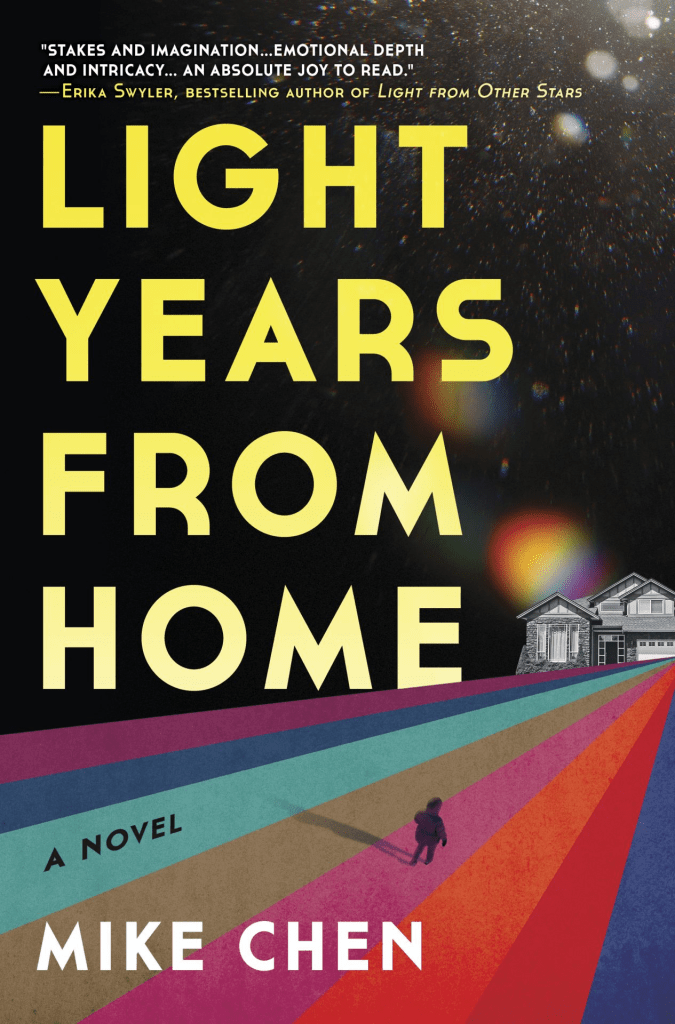
Posted in Monthly Wrap-Ups

April 2024 Wrap-Up 🌂

Happy Tuesday, bibliophiles!
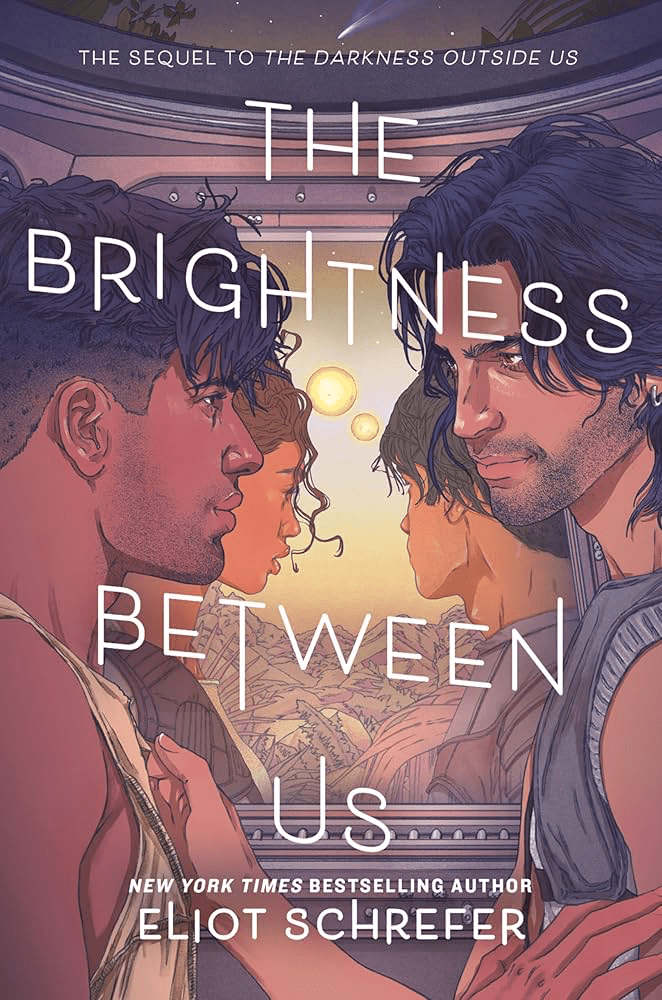
Unfortunately, I probably won’t be able to write up a book review or a Sunday Songs post this week, as I’m days away from finals. I started this post in advance, as I do with all of my wrap-ups, so that’s why I managed to put it out today. But from today on, I’ll be (mostly) radio silent for the next week or so. Wish me luck…

Let’s begin, shall we?

GENERAL THOUGHTS:

April’s been its fair share of crazy, what with job interviews, preparing for finals, and wrapping up my sophomore year of college. (How’d that happen??) It’s definitely taken a toll on my reading and blogging, but I’ve still had some free time in between. Said free time has been surprisingly fruitful this month—I finished up the 20,000 word novella that I had to write for one of my classes, and I had a solid weekend where I was able to brainstorm quite a bit for my main sci-fi trilogy. I’d still be doing said brainstorming if not for…y’know, studying for an astronomy final, but once I’m free of that, I’ll be back to making my outline even more excessively long. I’m almost there…

As I said, I had less time to read than I have in the past few months, but strangely, as far as ratings go, it’s been my most positive month. I say “strangely” because I felt like I was in a stint of good, but not great books for at least the first third of April. However, it picked up significantly, partially aided from a particularly lucky haul from Barnes & Noble with a dear friend of mine.

Other than that, I’ve just been watching The Bear, Taskmaster, and Ripley (how and why is Andrew Scott so good at being SO devious), writing when I can, and preparing for the end of the semester.

Oh, and remember how (hesitantly) excited I was about the fact that The Search for WondLa was being adapted into a TV show? We’ve just gotten the first look, and…

…not to be dramatic, but this is my villain origin story. This is my Joker arc. I’m beyond livid. They drained it. They drained it of the artistry and creativity. And the love. They made Muthr into one of those Playmobil people. Why is Otto furry and squishy? Why does Rovender have those front-facing predator eyes? Where are Eva Nine’s signature braids? Where’s the soul?

Yeah! I’m fine. They just turned my childhood into a sad, lifeless husk of a 3D animated TV show…

READING AND BLOGGING:

I read 15 books this month! Somehow, I feel like I was in a slump of good but not remarkable books for at least a third of the month, but somehow, I got through a whole month with no 2 or 1 star reads? That’s a new one for me.

3 – 3.75 stars:

A Tempest of Tea

4 – 4.75 stars:

The Tusks of Extinction

FAVORITE BOOK OF THE MONTH: Activation Degradation4.5 stars

POSTS I’M PROUD OF:

POSTS FROM OTHER WONDERFUL PEOPLE THAT I ENJOYED:

Unfortunately, I haven’t been able to blog-hop much because of finals, but here are some highlights:

SONGS/ALBUMS I’VE BEEN ENJOYING:

top 10 nerdiest club bangers
god, I missed this song…
the bowiemaxxing continues
no thoughts only all born screaming
imagine making Poor Things (2023) and failing to get across in two and a half hours what this song does in just under four minutes………couldn’t be me
xtc my beloved
as much as we praise Björk, I feel like she doesn’t get enough credit for how deeply romantic she can be…good god I feel so sappy and squishy listening to this song, it feels so good
david bowie make a song from the ’90s that isn’t criminally underrated challenge (impossible)

Today’s song:

hey, if we’re talking about keeping my inner middle schooler happy, at least this album was fantastic

That’s it for this month in blogging! Have a wonderful rest of your day, and take care of yourselves!