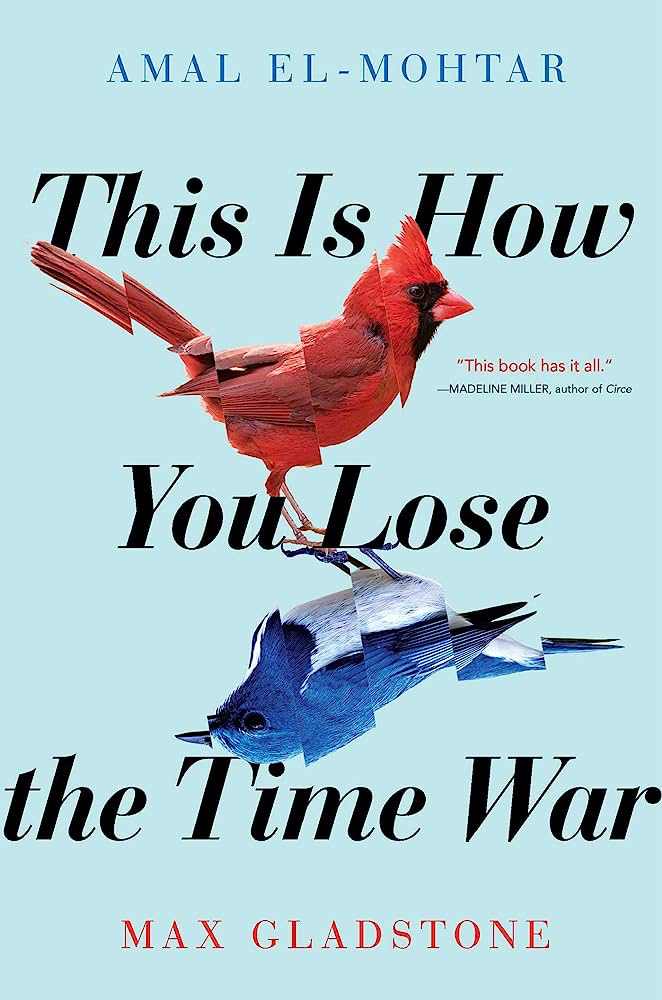
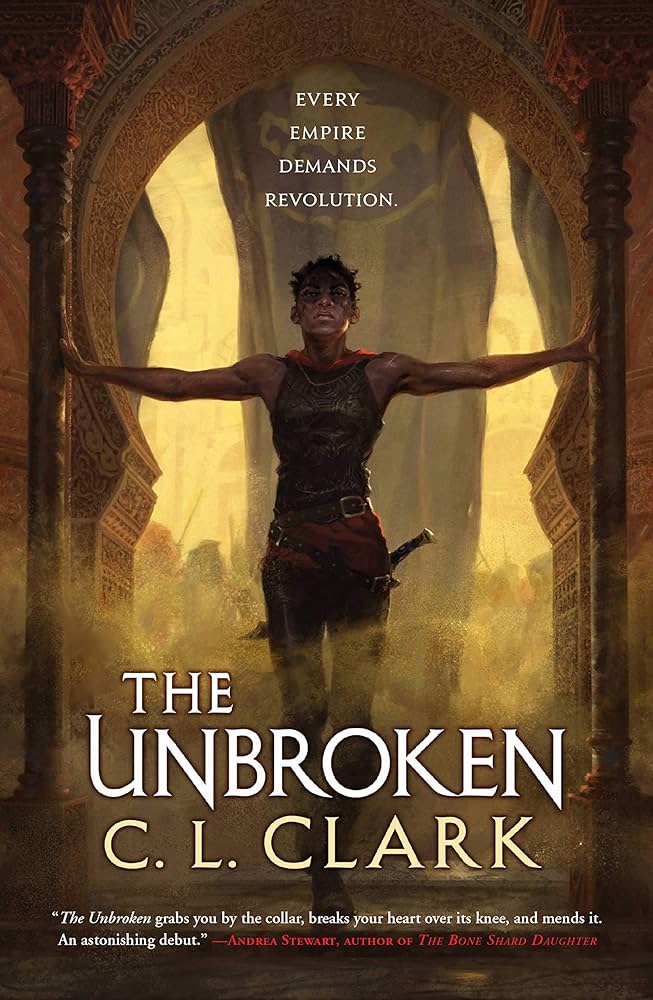
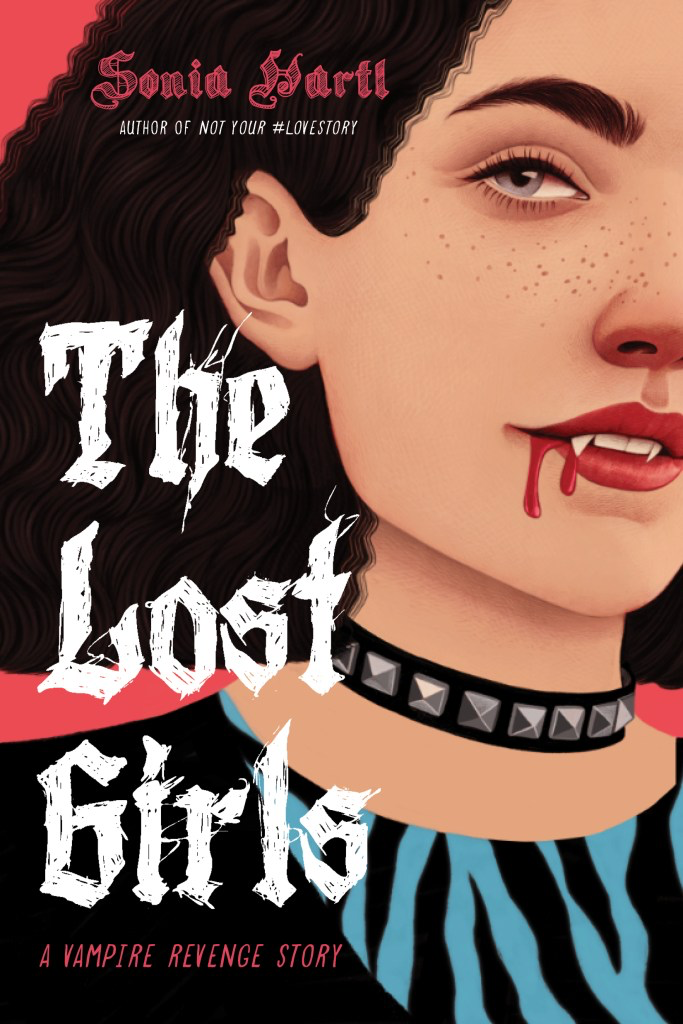
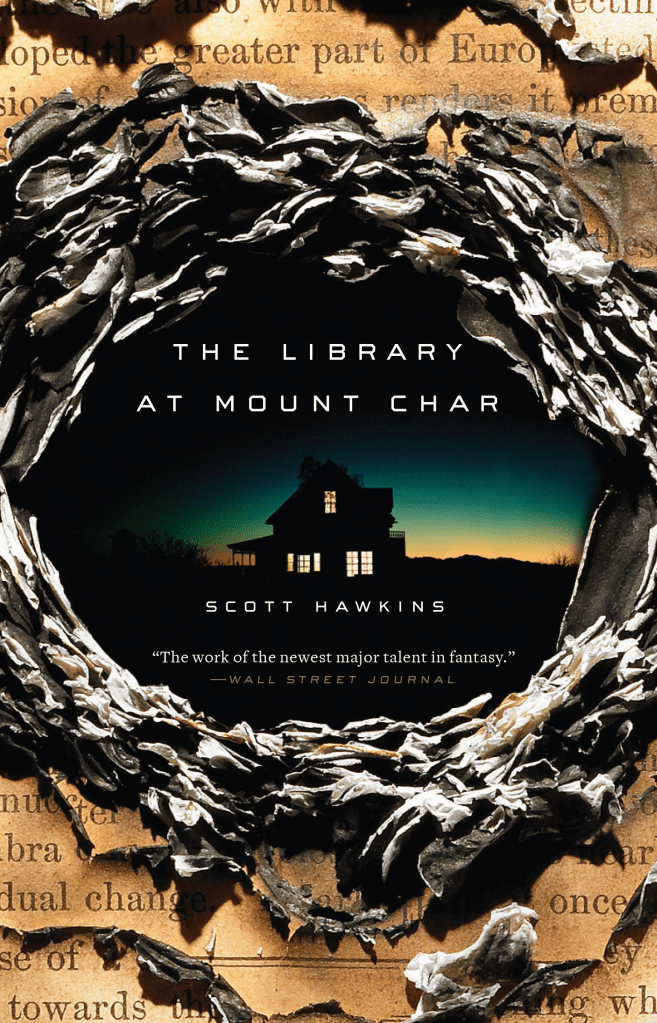
Posted in Sunday Songs

Sunday Songs: 9/29/24

Happy Sunday, bibliophiles! I hope this week has treated you well.

This week: high school throwbacks, off-kilter oddities, and a few too many people trying to explore each other’s minds than I’m comfortable with. Cool it, Charles Xavier…

Enjoy this week’s songs!

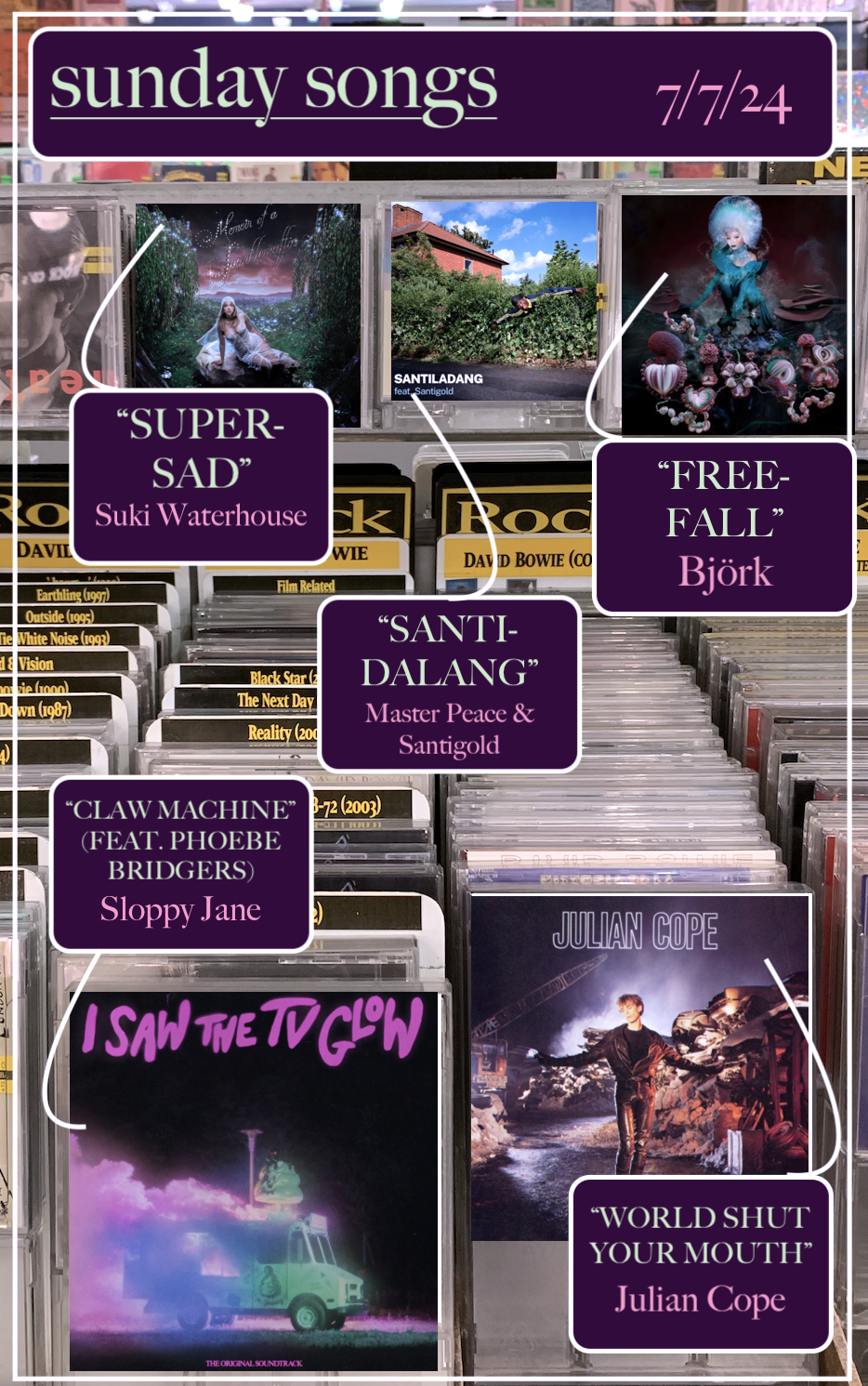
SUNDAY SONGS: 9/29/24:

“Piano Fire” (feat. P.J. Harvey) – Sparklehorse

It’s a Wonderful Life is one of those albums that took me a bafflingly long time to listen to. I know, I know, I did it to myself, but the fact that I didn’t pick it up when I was 15 and irreparably mired in Good Morning Spider astonishes me. It’s probably owed to the fact that I was also even more irreparably mired in OK Computer, which tends to overshadow things a tad bit. Looking back, maybe it was for the best that I wasn’t on an all-Sparklehorse diet at that age. I already looked pathetic scuffing my snow boots through the hall while blasting “Maria’s Little Elbows” through my earbuds between classes. I was 15, guys. It was 100% that serious, trust me.

What I can say is that I think I would have felt the same way about It’s a Wonderful Life at 15 as I do now—it’s a triumph of an album. Scattering through surreal urgency and subdued melancholy, it has every kind of Sparklehorse you’d like—along with a smattering of collaborators. It’s almost funny how different said collaborators are (take Nina Persson’s delicate backing vocals on “Gold Day” and then Tom Waits growling like a hulking ogre on “Dog Door”), but the power of Sparklehorse has always lain in the disparate elements Mark Linkous cobbles together. Like some kind of American Gepetto, he constructs all of his songs into tiny figures made of warped wood and bird bones, and what totters to life creaks with every step. They’re quaint creatures with acorns for heads and cigarettes and toothpicks for legs, but there’s no other way to love them save for exactly as they are.

Those he chooses to collaborate with feel much the same way. P.J. Harvey, of all people, was a left-field choice when I first heard about her featuring on “Piano Fire.” The only Sparklehorse song I could conceive being able to contain the kind of raw fury she exudes was “Pig,” and that had already come and gone by the time It’s a Wonderful Life came out. “Piano Fire,” however, is one of the most upbeat tracks on the album; you feel a racing urgency to it, immediately sprinting down an overcast beach the minute the first guitar chords kick in. Or maybe it’s the searing heat of airport tarmac that you’re sprinting across the minute you hear the opening line: “I got sunburnt waiting for the jets to land.” Sunburnt describes “Piano Fire” surprisingly well; it has the texture of an old photograph left out in the sun too long, all of the colors now bleached to unnatural, pale shades. Linkous almost takes a backseat on his own song, never raising his voice when he dishes out surreal vignettes of “Fiery pianos wash up on a foggy coast/Squeaky old organs have given up the ghost/Fire them up and kill the piano birds.” But that urgency is why P.J. Harvey is so perfect for this song; once the chorus kicks in, her soaring voice provides the jet fuel for this creaky old jet to careen off the runway and into a sky littered with the strangest birds you’ve ever seen.

…AND A BOOK TO GO WITH IT:
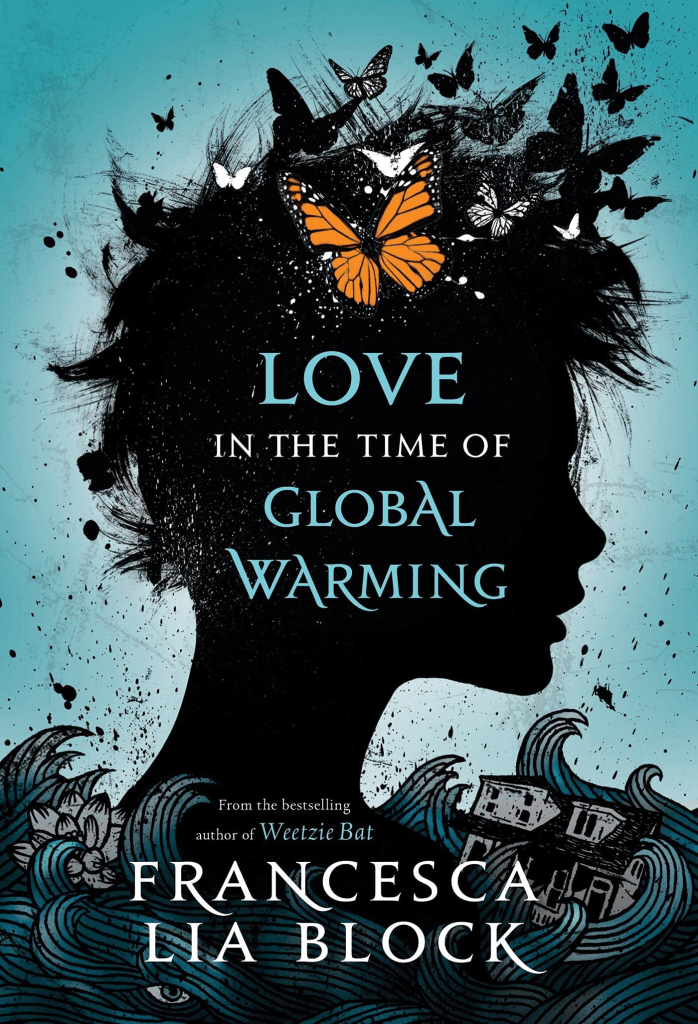
Love in the Time of Global Warming – Francesca Lia BlockBlock’s bizarre, dreamlike prose certainly fits with the surreal imagery that Linkous employs in this song—and the majority of his catalogue.

“Gigantic” – Pixies

In almost two and a half years of making these Sunday Songs graphics…this is the first time I’ve double-dipped. It was bound to happen eventually, not just because my music taste is finite, but because this song has lingered with me from a young age. I faintly remember being around five or six and hearing this song in my dad’s old car, driving in fading light down the road back to my house, and hearing the iconic chorus: “Gigantic, gigantic/Gigantic, a big big love.”

I’ve often talked about how simplicity in lyrics can convey more than the most complex songs in some cases, and if you need further proof, look no further than “Gigantic.” Most of that work is done by the immense, never-fading talent of Kim Deal, who sells every metric ounce of explosive love in this song; with every cry of “A big big love,” you get it—there’s no other words that can adequately describe the kind of secretive, all-consuming romance that swirls through every pluck of the bass. That opening bass riff is the shy, cracking open of a bedroom window when the parents are asleep, an invitation with a blushing, anticipatory smile. What follows never fails to knock me off my feet. I say “knock” and not sweep or lift me off my feet precisely because that’s what it feels like, as though the ground has opened up beneath you, and you’re falling headfirst into the unknown—contained in a kiss that consumes every cell of your body.

…AND A BOOK TO GO WITH IT:
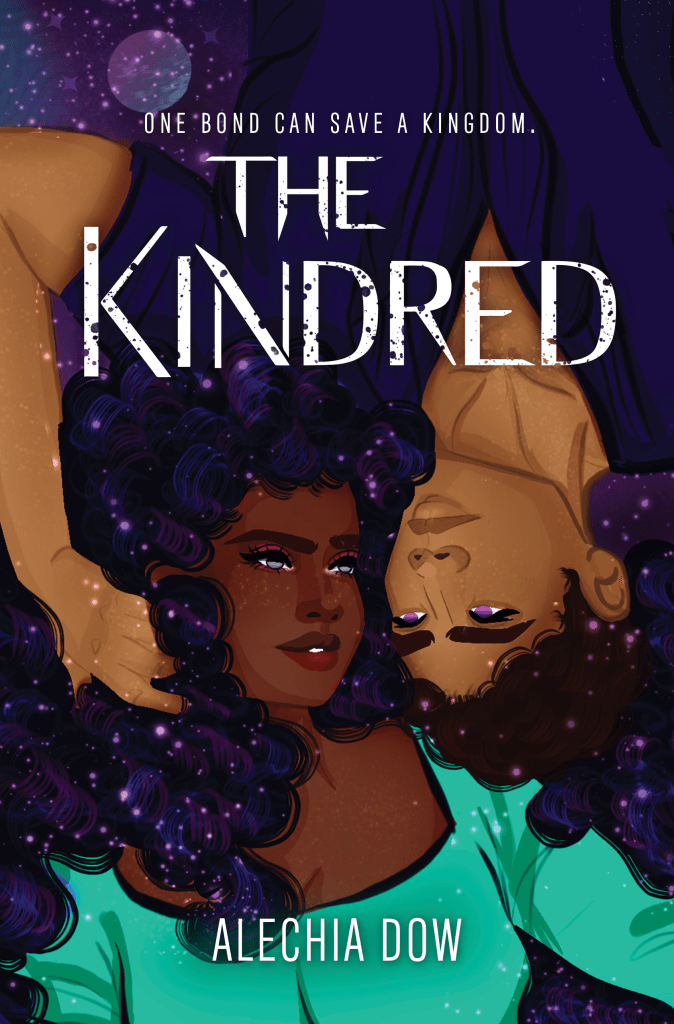
The Kindred – Alechia Dowall-consuming, explosive, and intergalactic love.

“Take Me To The River” – Al Green

I’m sure Al Green is a perfectly nice guy, but…that album cover and title is not it, man…”Al Green Explores Your Mind?” Can he…can he not?

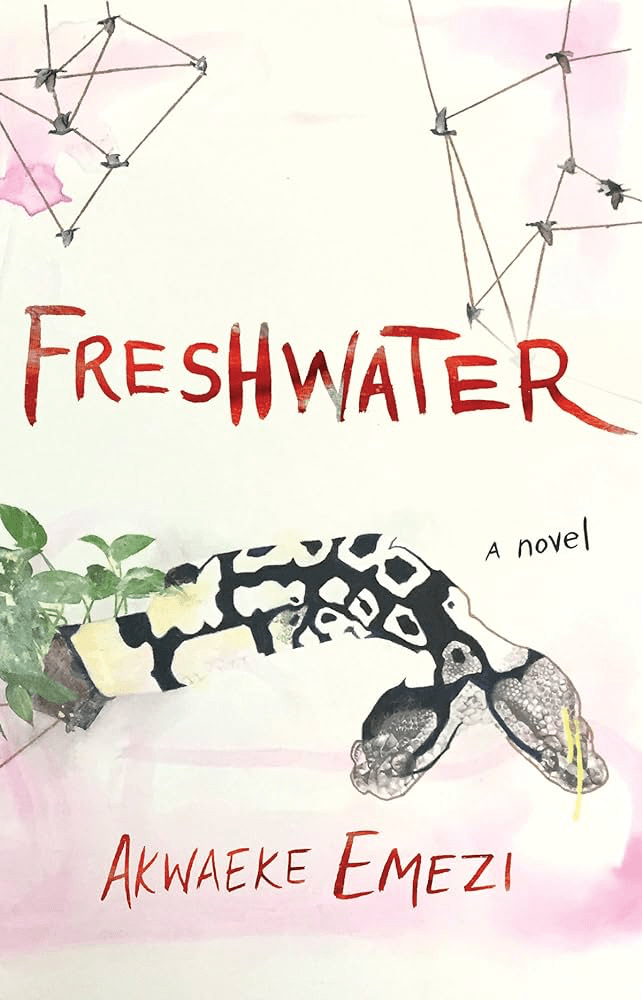
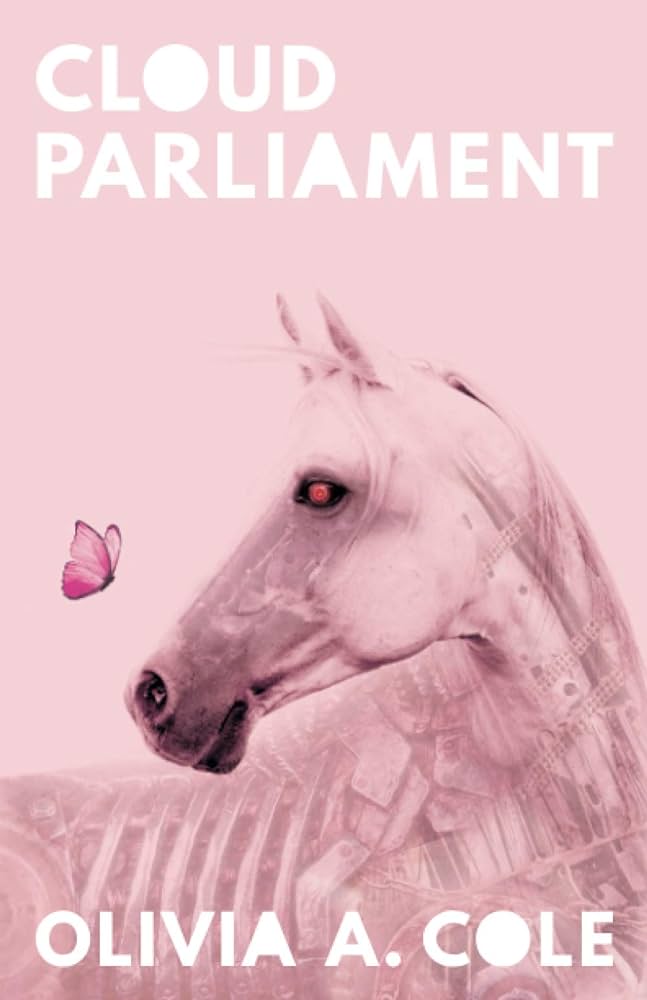
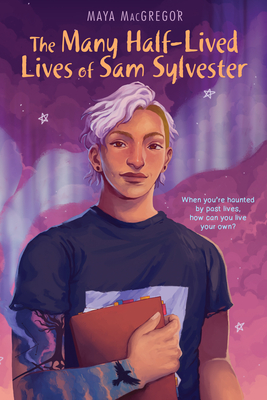
The fact that they were just naming albums anything back in the day aside…how did I not know about this song for so long? I’ve loved the Talking Heads cover for years, but somehow, it never dawned on me to look it up and discover that it was a cover. There’s something to be said for the phenomenon of white artists’ covers of songs by Black artists overshadowing the originals, but this isn’t quite the case—from the looks of it, between the amount of times that this song has been covered (most recently by Lorde for a Talking Heads tribute album, oddly enough) and the royalties from [checks notes] those animatronic wall fish, it’s cemented itself as an enduring classic of soul. I’m sure Al Green isn’t complaining about the latter though, given that he’s gotten the most royalties from the fish cover. Yet no matter the strange journey that “Take Me To The River” has taken, none of it has overshadowed how deliciously groovy it is. It’s endured for five decades in counting precisely because it wastes no time in getting straight into its slinky, infectious funk. Green’s voice flies from slick to howling in seconds and recovers in record time, all in time with the blasts of an impeccable horn section. 50 years, and you can’t not bop your head. I’m still not jazzed about Al Green exploring my mind, but I can’t deny that he worked some undeniable, immortal magic with this one.

…AND A BOOK TO GO WITH IT:

The Final Revival of Opal & Nev – Dawnie Waltonthough the musical genres differ, the atmosphere and climate of the ’70s runs through both.

“Secretarial” – A.C. Newman

I’ve had a turnaround. I’ll be honest—even though I’ve liked several New Pornographers songs since I was young, “Secretarial” has always bugged me for some reason. I never hated it, but it was always one of those songs where, over the years, I developed a reflex of just skipping it whenever it came on shuffle. I didn’t question it for a while. Many years have passed, and for once, I didn’t skip…and here we are.

A.C. Newman—and most of The New Pornographers’ catalogue, by extension—has this songwriting style that’s just so distinctive in a way that I can’t put my finger on. Even if you separated his or Neko Case’s voice from the lyrics, I could hear a line like “So come on, let the sun in/We’ve been gunning for promotion/Postering the slogans on the roadsigns.” and immediately go “yup, A.C. Newman wrote that.” What makes it so distinct has bugged me for years, and to this day, I can’t fully put my finger on it. The closest I can say is that their specific diction has an inherently off-kilter quality to it. Newman is never overly verbose, but the way he arranges words is always slightly askew. His lyrics dwell in the thin limbo between obtuse poetry and sense, situated in a place where you can decently get the metaphor he’s going for, but instinctually, you know that those syllables just don’t go together neatly. “Secretarial,” like another other Newman product, might as well be a puzzle, in that sense, but one that was put together wrong with the pieces that only look like they should fit together, but stick and slide against each other. I’ve never been great with time signatures, but this one is angular enough to match the slanted lyrics. Even if you don’t know the guy, you can’t deny that it takes some serious talent to not just think of but pull off “Lady, it’s secretarial” as a hook.

…AND A BOOK TO GO WITH IT:
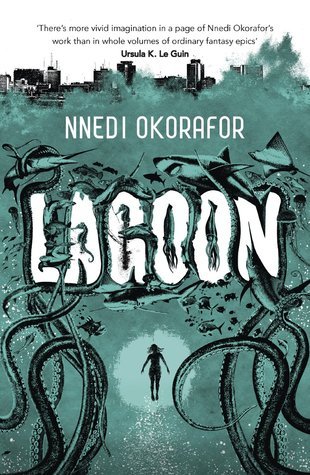
Lagoon – Nnedi OkoraforI’ve used this book more than once, but it was right there…

“One day you blew across the water/After racing through the countdown/Spewing ancient wisdom like your friend/The revelation had come and they were looking for me…”

“Henry” – Soccer Mommy

Oh, early Soccer Mommy…oh, “Henry.” This one sure soundtracked many a one-earbud-in free draw in art class my sophomore year. I think it was in the fall that I found this song as well; it carries a distinct smell of wet leaves and wood chips in the pumpkin patch. Cheesy as the title of this album, the self-released For Young Hearts, is, it’s not like it’s a lie. Here’s to many more high schoolers listening to this in art class.

It seems that “Driver” has put a pin in this tradition, but “Henry” is part of a long lineage of Soccer Mommy songs about the seduction of Bad Boys™️ (see also: “Death By Chocolate”). Of course, the natural conclusion was that the ultimate bad boy was to be conquered in “lucy,” that being…the devil himself. (God, I need to stop. I sound like a youth pastor.) But here in 2016, “Henry” chronicled the kind of guy who hung out behind the high school, smoking cigarettes in a leather jacket, and giving you a wicked smile as you passed. Sophie Allison’s younger voice, along with the plucky instrumentation (cannot get enough of that bass), makes you feel like you’re following a mischievous wood sprite through sunlit woods. Light and lovesick, it captures that heady, teenage love drug that makes every step stumble: “‘Cause Henry has a laugh like fire/And it’s spreading through the streets and burning on telephone wires/I don’t know just what it is/But he’s driving all the good girls bad with that evil smile of his.” Soccer Mommy’s had that golden, indie touch all along—”Henry” remains a classic to me.

…AND A BOOK TO GO WITH IT:
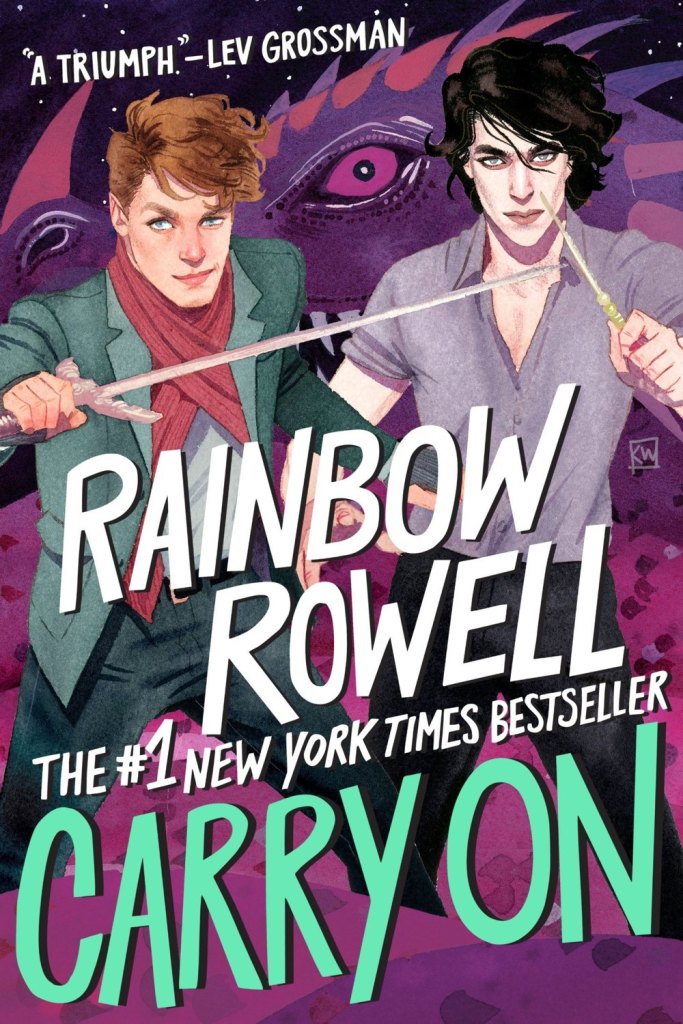
Carry On (Simon Snow, #1) – Rainbow Rowell“I don’t know/Just what it is/But he’s driving all the good girls bad with that evil smile of his…”

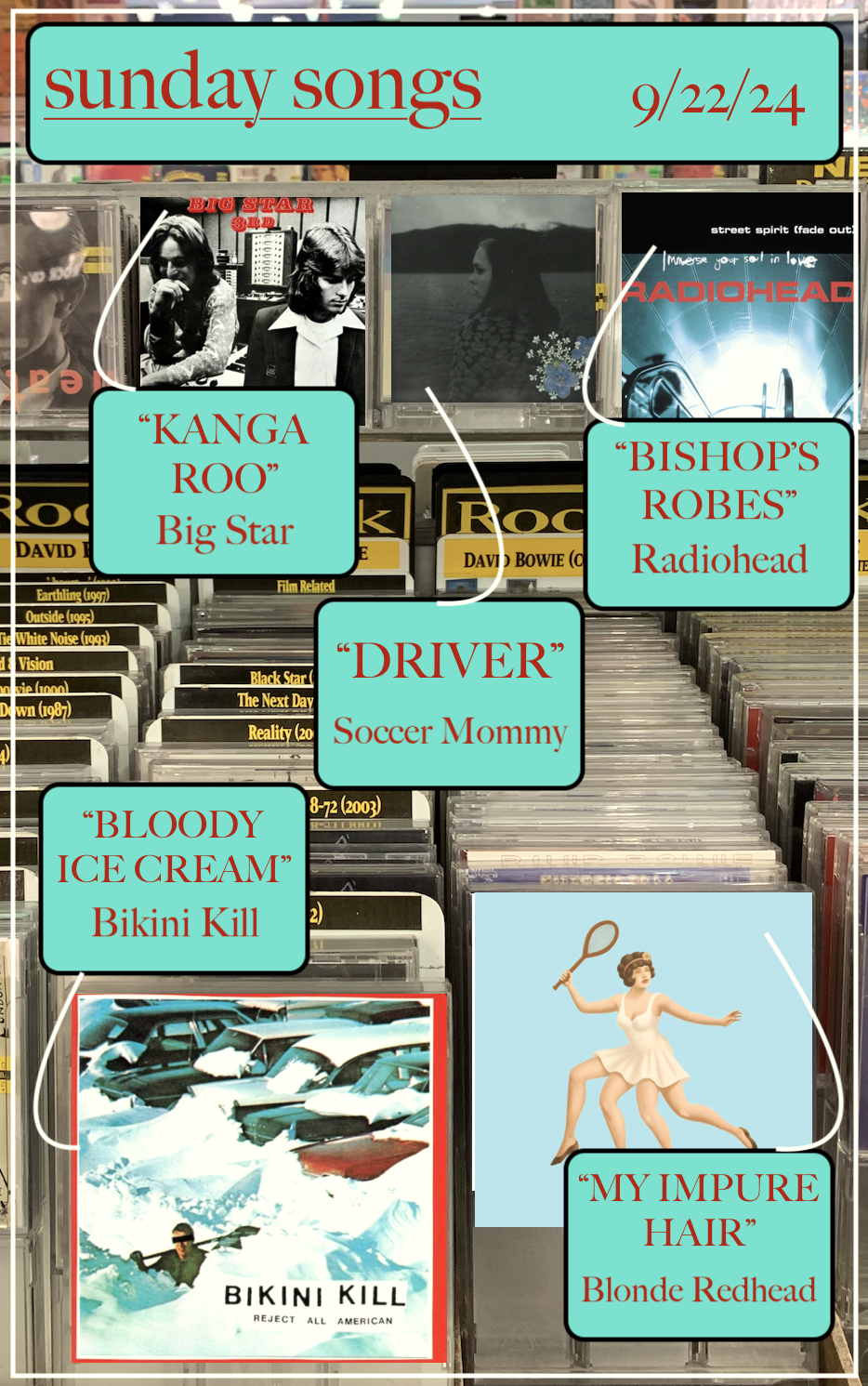
Since this song consists entirely of songs, consider all of them to be today’s song.

That’s it for this week’s Sunday Songs! Have a wonderful rest of your day, and take care of yourselves!

Posted in Sunday Songs

Sunday Songs: 9/22/24

Happy Sunday, bibliophiles! I hope this week has treated you well.

This week: I apologize in advance for every single driving mention and/or pun that I made in this post. I didn’t even notice it at a certain point…I just couldn’t…stop…

1:58-2:07

Enjoy this week’s songs!

SUNDAY SONGS: 9/22/24

“Bloody Ice Cream” – Bikini Kill

It’s been just under a month since I had the privilege of seeing Bikini Kill live, and even as someone who isn’t a hardcore fan of the band, I had SUCH a wonderful time! That’s owed in no small part to the commanding presence of Kathleen Hanna, not just in the history she carries, but in just how real she was. There she was, a pioneer of feminist punk, just onstage joking about how her bra was too tight and recounting a memory of rich girls pelting her with squirt guns before she walked into a job interview. Never at any moment was there a pretense of acting cool or punk. It was nothing but Kathleen Hanna, in all of her smudged-mascara and sequined glory. Bless Kathleen Hanna, really.

So when she introduced this song, which I was familiar with only in name, by saying that it was dedicated to “all woman writers,” you bet that I stood up and saluted her like it was the national anthem. And even as a fan on the sidelines, I’d accept “Bloody Ice Cream” as a new kind of anthem. It articulates in less than one and a half minutes what so many creators—chiefly women—are told about the profession: “The Sylvia Plath story is told/To girls who write/They want us to think/That to be a girl poet/Means you have to die.” The unspoken doctrine of your craft not being valid unless you sobbed and suffered over it permeates all kinds of media. I’ve been around so many people who think that trauma is the secret to good writing, whether it’s slapping it onto their characters or thinking that their hope in their message is invalid because it doesn’t show the bleakness of the real world. Counterpoint: ever experience happiness? Even once? Was that not in the real world?

The modern world may be far from perfect, but we have an understanding that could nurture and heal the Sylvia Plaths and Virginia Woolfs of tomorrow. And we have the recognition that there is no power greater than joy. In and outside of the writer’s world, we’re taught that to feel downtrodden is to experience the real world, competing each other for how exhausted we are, how much we have on our plates, and how sad and gloomy our projects are. Is this really what creativity is? It’s not like there’s no value in showing the darker aspects of life, but for how much it clogs the literary world, I feel like so many people have forgotten that writing—and imagination—isn’t just a contest for who can work themselves to the bone the most artfully. I write to put out the energy I want to see reflected in the world around me. And that energy is joy. The systems of oppression that surround us want to see people like us being so downtrodden that we have no energy to question them. So write. Write joy. Write what’s in your heart. Scream and dance like Kathleen Hanna. And don’t underestimate the value of kindness. They hate to see you joyous.

…AND A BOOK TO GO WITH IT:

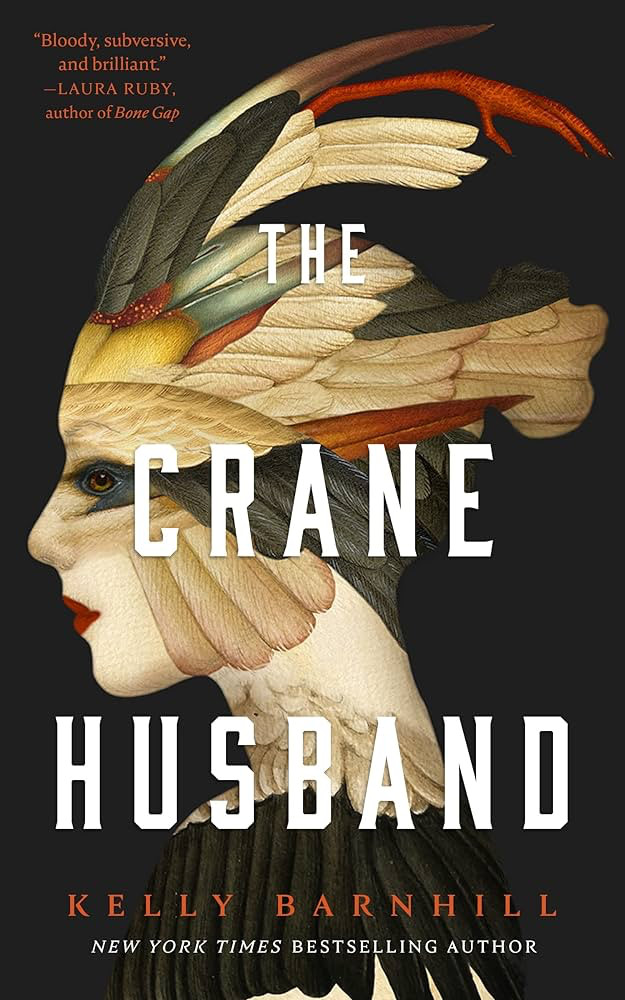
The Crane Husband – Kelly Barnhill“Who was it/That told me/All girls who write/Must suicide?”

“My Impure Hair” – Blonde Redhead

The best shoegaze sounds like you’re slipping in and out of a dream, that limbo best experienced from 1-4 in the morning when you’ve woken up from a dream, your eyes are gummy, and you’re not sure if the hazy shapes forming the walls and bed around you are part of another dream you’ve yet to wake up from. I guess that’s why it’s so easy for people to get high to this kind of music, but like…well, all things, sobriety is better suited to experiencing them. “My Impure Hair” is the closing track on 23 (I’m not even a diehard fan, but I just LOVE that album cover), and even from this tiny taste, it feels like an artfully placed closing track. It has the quality of a lullaby; every element, from the soft instrumentation to Kazu Makino’s vocals, is whispered, as though not to disturb a swaddled baby drifting off in their crib. Once you think you’ve heard a distinct sound, it bleeds into another like spilled watercolors, creating a pale wisp that floats, airless, on the passing wind.

…AND A BOOK TO GO WITH IT:

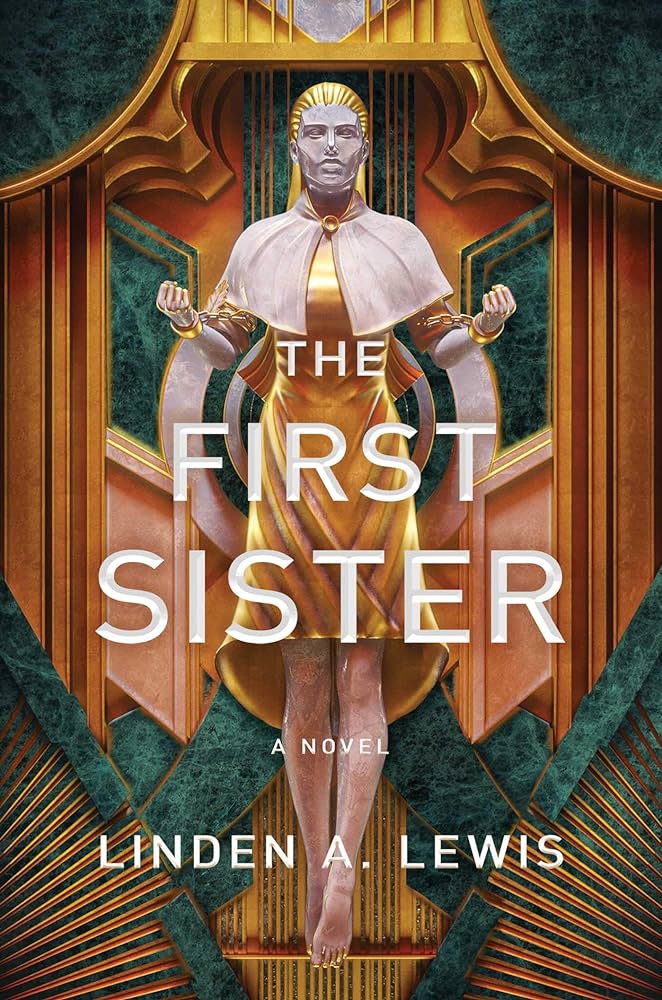
The First Sister – Linden A. Lewis“But in the end/We defend our decadence/You never wept like that/Whatever lost, I won’t forget about you…”

“Kanga Roo” – Big Star

Nothing baffles me more about “Kanga Roo” than the fact that, although it didn’t officially see the light until 1978, it was recorded sometime in 1974. I suppose there’s some ’60s psychedelic bands that got close to the sound here, but this kind of deterioration feels so modern. It doesn’t sound like 1974! It sounds like a less fuzzy Spacemen 3 or the first take of a Bends-era Radiohead b-side. One of the top comments on the official audio called it “the rough draft for Wilco’s Yankee Hotel Foxtrot, which is the most astute description I’ve ever seen ascribed to it—I don’t know how it never clicked, but suddenly, “Ashes of American Flags” makes eons more sense.

I can only imagine what hearing this in 1978 felt like—probably the musical equivalent of “mom, come pick me up, I’m scared” after expecting something more like “In The Street.” Jesus. That feeling certainly crept into me when I first heard this song, while driving home from a concert late at night, navigating a winding canyon road in near-pitch black. All of the shrill mechanical squeals sound much more menacing when you’re barely awake. “Kanga Roo” sounds like it’s actively pulling itself apart at the seams, a threadbare rag only attached to its halves by a few strands of fraying string. The drums are never on beat or consistent in volume, somebody’s banging on a cowbell for about 15 seconds, and all the electric guitars are doing is getting scratched and squealed into oblivion. It’s a bizarre experience, watching a song crumble like charcoal in a dead firepit the morning after a campfire. Yet there’s an innocence to it; Alex Chilton’s voice is the only clear sound in “Kanga Roo.” You’re hearing the instruments fighting for their lives while Chilton’s plainly singing “You was at a party/Thought you was a queen.” The iconic line that gave the song its name (“oh, I want you/Like a kangaroo”) almost makes no sense, and I’m not sure if Chilton has ever offered up an explanation, but somehow, I see it. I imagine one of those towering, buck kangaroos standing at full height, and feeling the desire to grasp someone in your arms with the strength of such a creature.

I included This Mortal Coil’s cover of “Kangaroo” in one of my past Sunday Songs that I didn’t get around to writing because I was occupied with moving and school; I have too much homework to fully go into who’s coming out victorious if we’re pitting the original against this one, but I’m at least partial to it for how sparse it feels, even with the soaring strings. It’s much more put-together than the original (not to disparage the artful chaos), but there’s something to be said for what it does with the negative space that the Big Star version drowns out. What can I say? They got me. They got me with the big feels.

…AND A BOOK TO GO WITH IT:

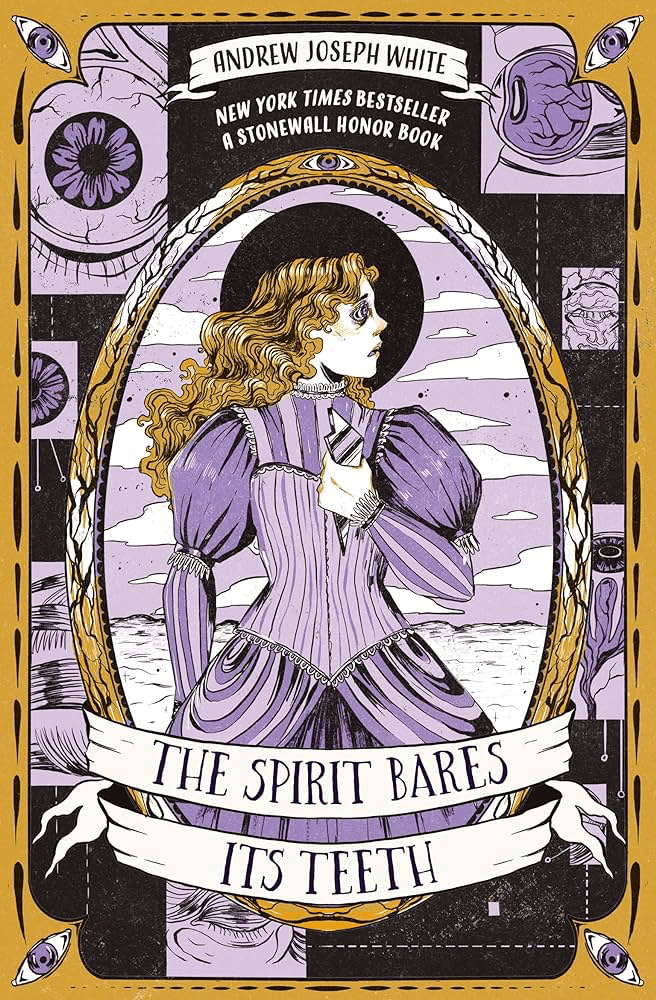
The Spirit Bares Its Teeth – Andrew Joseph Whitethe lyrics could match up with any number of books, but it’s the creaking, uneasy atmosphere that puts it squarely in this novel’s company.

“Driver” – Soccer Mommy

I’m so glad that Soccer Mommy has become a prominent enough artist that she has the means to do funny marketing campaigns, because whoever came up with the one for “Driver” had a stroke of genius. By calling a number that Sophie Allison posted, you could get a snippet of the track before it came out, followed by “how’s my driving?”-style call prompt. Maybe we are in an okay timeline.

Without a doubt, Sophie Allison has never been more sure of herself at the wheel. A departure from the expression of beauty in lingering grief that were the two lead singles, “Lost” and “M,” “Driver” presents a more lighthearted detour to the landscape of Evergreen. The backing guitars and effects have gained a grungier, grimier edge, but Allison’s sunshine puts them all in a dusty, golden light. As the guitars and drums thrum like gravel skipping across a dirt road, Allison turns her attention to the present loves of her life. You almost get the feeling that she’s slipping into the self-deprecation of her early career, but there’s nothing but affection for herself, but more in terms of her partner, who puts up with her “losing [her] concentration on every whim.” Allison presents herself as the more emotional, scatterbrained half of the couple, which her partner is playful about, but is also the one to ground her when she gets too far into her head with a reminder of “where are we going now?” She’s never completely blameless, but she’s full of nothing but love for her anchor that keeps her from veering off the path; it’s not like some of her earlier songs, like this would indicate that she’s in danger of slipping away entirely, but it’s an exercise in learning to rein yourself in—and find somebody who isn’t afraid to rest a hand on your shoulders and remind you where your feet are planted.

…AND A BOOK TO GO WITH IT:

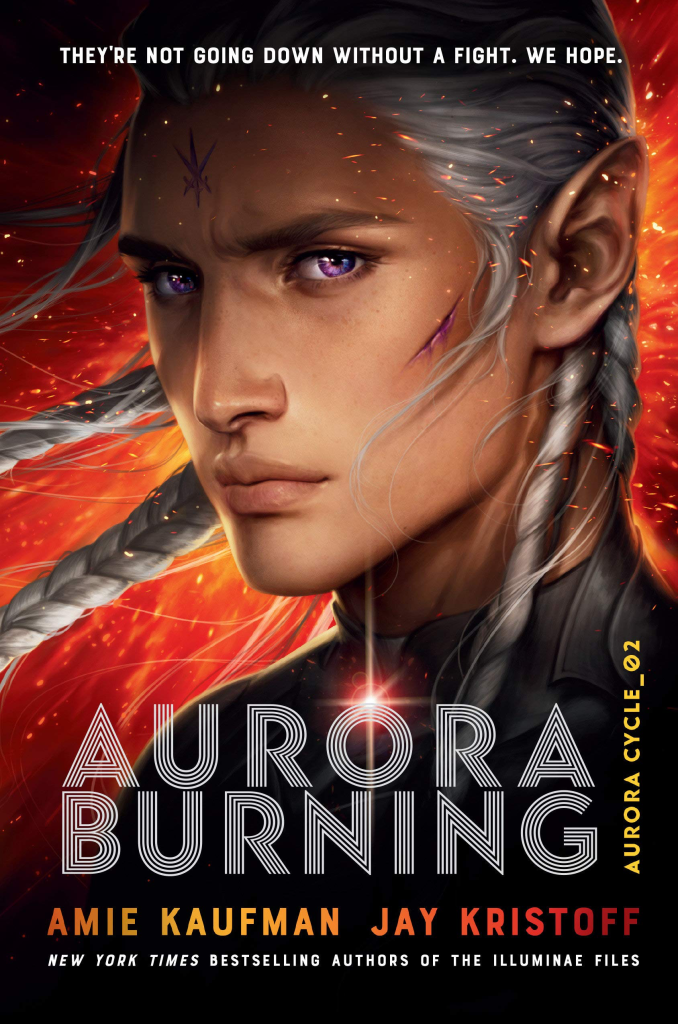
Aurora Burning (The Aurora Cycle, #2) – Amie Kaufman and Jay Kristoffnot to get all 2020 Madeline on you all, but…the Kalauri in this song…I’m gonna keel over…

“I’m a five foot four engine waiting to move/I’m a test of his patience with all that I do/‘Cause I’m hot and he stays cool, I don’t know why/But he puts up with my moods/And he makes me smile when he says/’Where are we going now?'”

“Bishop’s Robes” – Radiohead

The connection of inspiration between Radiohead and The Smiths never surprises me, but sometimes, with bands that inspire another, you find a single song that you know is the missing link in the evolutionary tree, the line of ancestry concretely delineating their music as kin. More specifically, it makes sense next to their cover of “The Headmaster Ritual,” though “Bishop’s Robes” takes a much more subdued turn.

Yorke’s raw lyricism thrives in both simplicity and complexity; he can weave any number of stories with denser, more prosey lyrics, but he knows just what kind of simple, unadorned phrases to stab you in the gut with. In this case, it’s the chorus, repeated like a shaky-voiced prayer in a dark corner: “I am not going back.” It becomes more of a reminder than a statement, as though to convince his brain that no, he’s not back in his pre-teen years under the reign of his “bastard Headmaster.” Volumes have been written about the horrors and abuse of the British education system back in the day (see: pretty much anything by Pink Floyd)—and some continuing into now, I would imagine—but what sets “Bishop’s Robes” apart is the mood. It might be more accurate to call it a lack, as the most overwhelming feeling you get from this track is not anger but numbness. There’s a resignation to it, weighing down the music, as though, even in adulthood, the experience has sapped him: Yorke doesn’t have the energy to fling insults along the lines of “spineless swines” or “belligerent ghouls” at his abusive childhood tormentors—all he can do is “bastard.” And it’s that eyebagged, forlorn crawl that sells the lasting effect it had on him. After years of unyielding discipline, I can imagine the fear of not raising your voice—a haunting presence that permeates every note of this track, constantly looking over its shoulder to guard innocent contraband that doesn’t exist.

…AND A BOOK TO GO WITH IT:

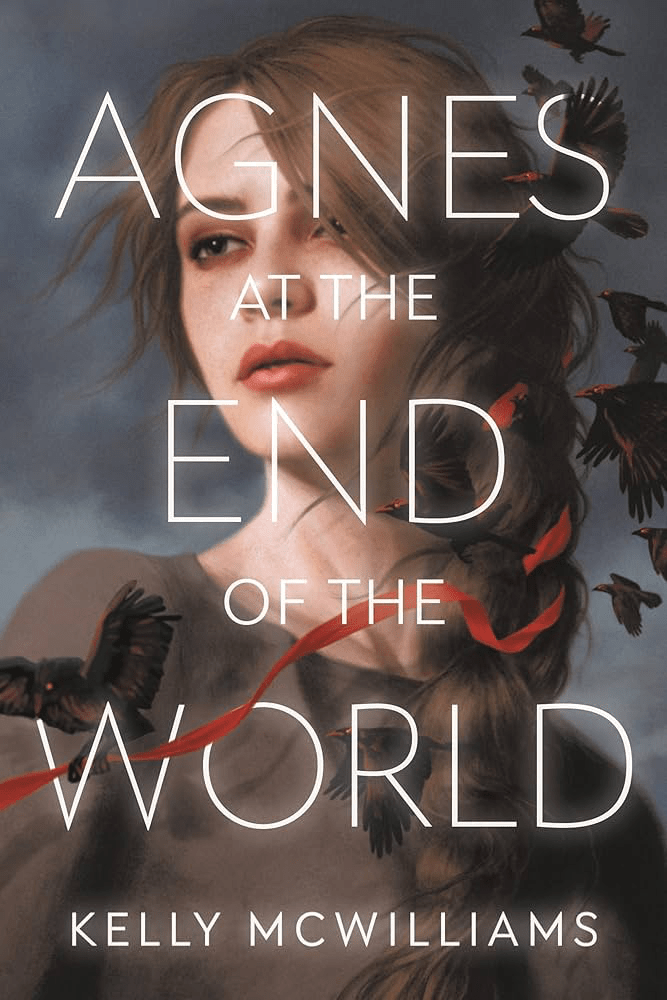
Agnes at the End of the World – Kelly McWilliamssecrecy, escape, and the horrors of a perverted version of Christianity in the hands of the wrong man.

Since this post consists entirely of songs, consider all of them to be today’s song.

That’s it for this week’s Sunday Songs! Have a wonderful rest of your day, and take care of yourselves!
Posted in Sunday Songs

Sunday Songs: 9/15/24

Happy Sunday, bibliophiles! I hope this week has treated you well.

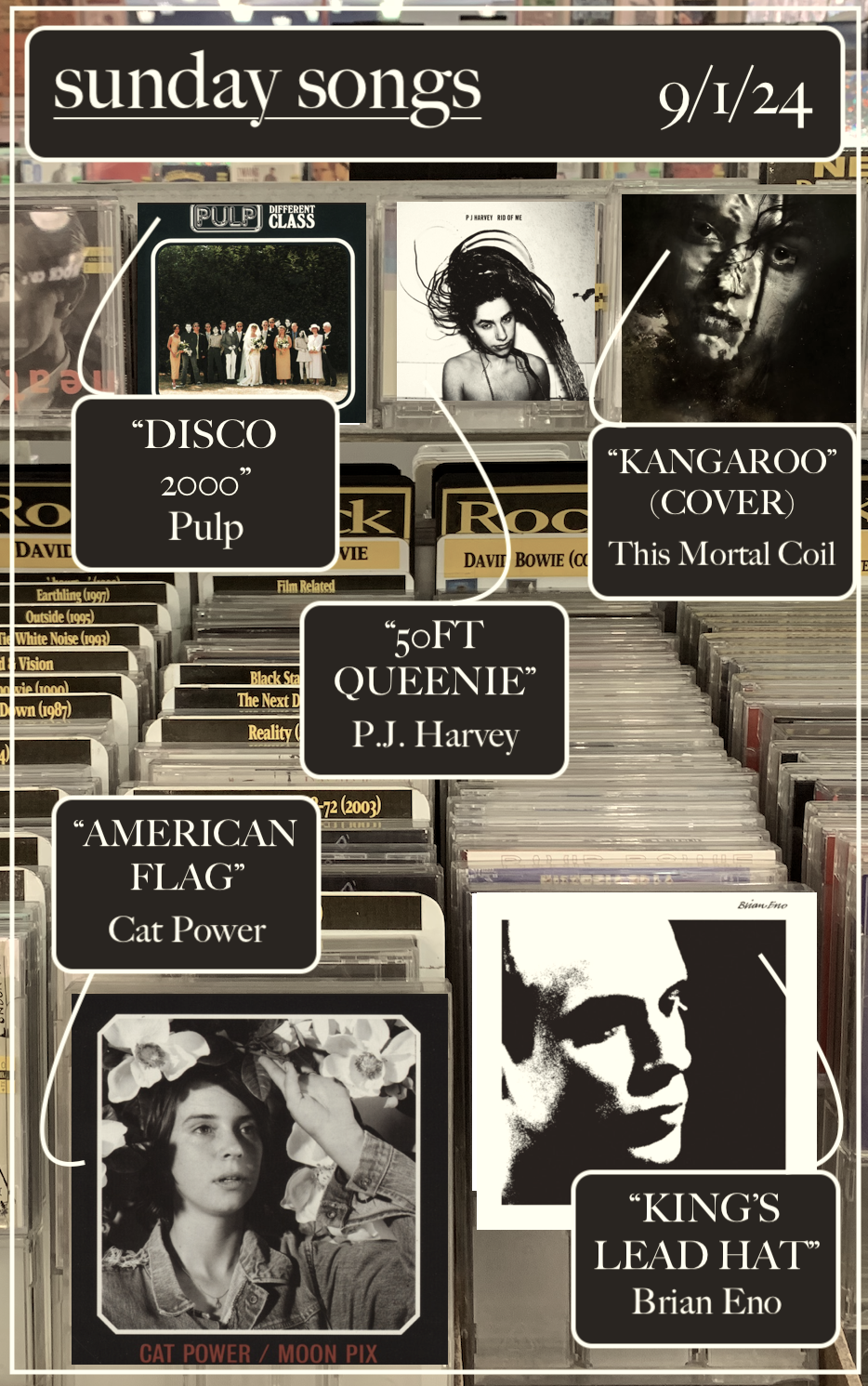
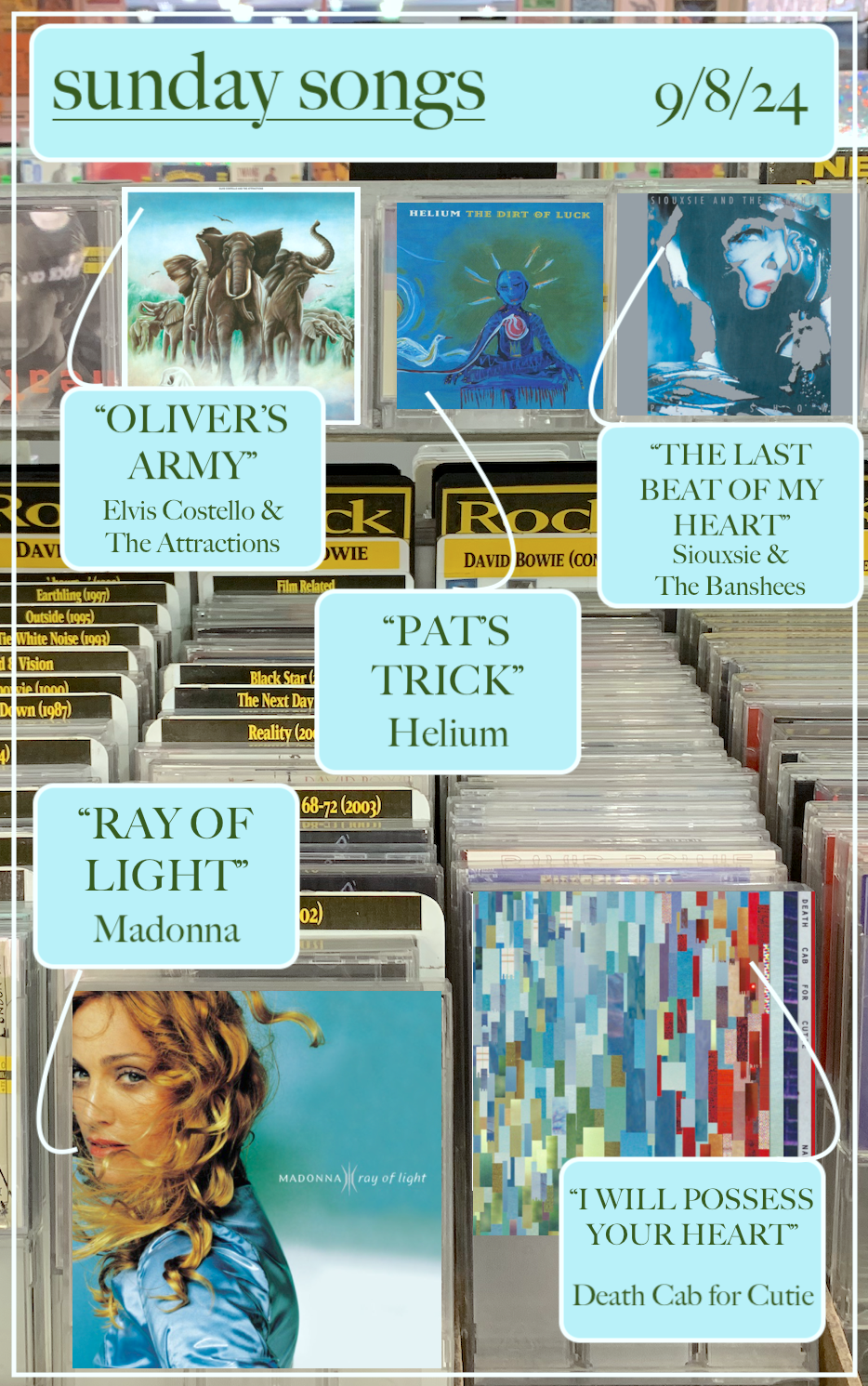
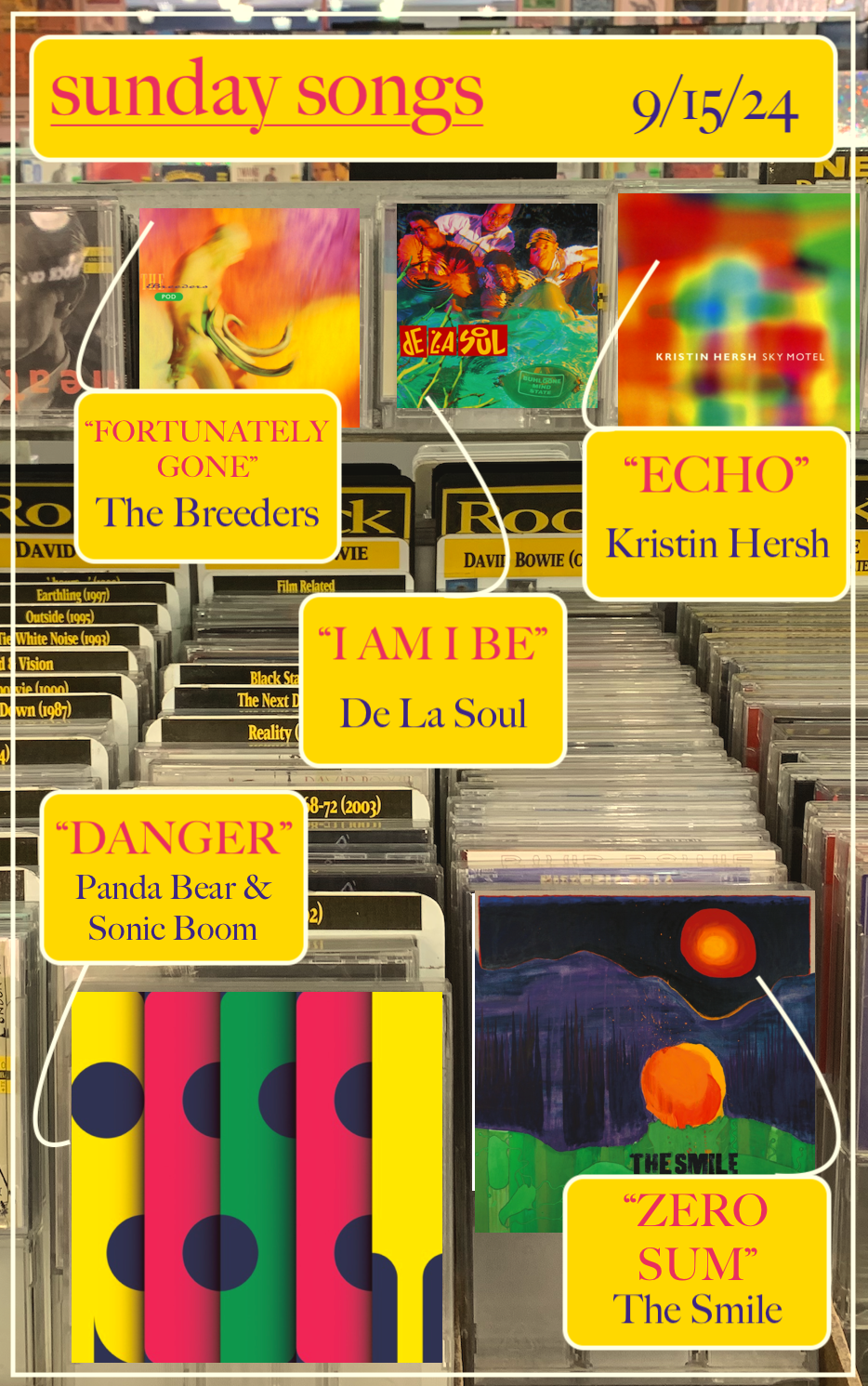
Before I get into today’s songs, I’ve also compiled my graphics for the last few weeks when things got busy. I made them (because I love making silly little graphics and giving them silly little color palettes), so, for your casual perusal, here they are:

8/18/24:

8/25/24:

9/1/24:

9/8/24:

This week: contradictions, distinctive voices, people who deserve to cover The Beatles, and…okay, the jury’s still out on whether or not what seems to be the final boss of hipster white boys can pull off mariachi, but that’s here too, I guess? I don’t know enough about mariachi to judge…

Enjoy this week’s songs!

SUNDAY SONGS: 9/15/24

“Danger” – Panda Bear & Sonic Boom

There’s something to be said for how distinctive Panda Bear (a.k.a. Noah Lennox) sounds—so much so that, having only heard a handful of his songs, when I heard that he had a hand in “Danger,” my immediate reaction was oh, that makes complete sense. What made even more sense was Sonic Boom (a.k.a. Peter Kemper); I had no idea what his deal was until my dad explained that he was one of the original members of Spacemen 3…and all of the puzzle pieces came together in complete harmony.

Someday, in some future age, I’ll bet that some scientists will come up with a way for us to be able to physically touch music. (It physically touches us, in a way, so maybe the inverse isn’t all that far away…who knows.) Whenever they come out with the playlist and the associated objects or capsules of sensation, I dearly hope that “Danger” is among the first, because it’s already a step ahead of the game; it’s so textured and layered that you can almost feel its tendrils brushing against your ear. Technology and creativity have collided to the point where these two have made a song that sounds exactly how it feels to touch one a puffer ball—y’know, the squishy balls you get at Walgreens or something with all the noodles sticking out? All manner of electronic textures were thrown in the stew pot, and the result is so elastic yet so hard-edged, so malleable yet so solid, so transparent yet so dizzyingly dense. Panda Bear’s voice, whether it’s singing or just letting out a spontaneous pigeon’s coo, collapses into neon dust motes with every note.

I’d that imagine that somebody with synesthesia (specifically chromesthesia, the variety where the person links sound to colors, shapes, and movement) would have a field day with the densely-packed prize box of auditory textures in “Danger.” Even with the cries of danger, I feel myself pulled under, drowning in a sea of spores and rubber, with every listen. Maybe that’s the danger—slipping under as your senses surrender to the prickles of this song?

As if making a whole album of, presumably, the same layered insanity (see also: “Edge of the Edge”), Panda Bear and Sonic Boom released an EP with Mariachi 2000 de Cutberto Perez consisting entirely of mariachi renditions of several tracks from Reset, including “Danger”—now reworked as “Peligro.” I’m not sure if I’m fully on board, but…those visuals should’ve been with the original track in the first place! All the colors and morphing shapes…

…AND A BOOK TO GO WITH IT:

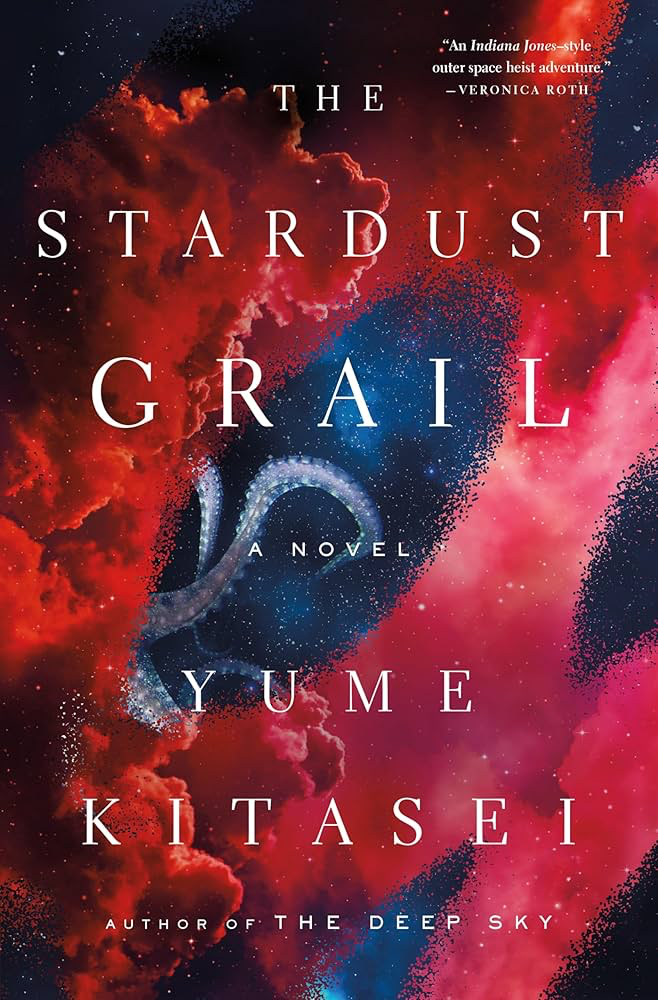
The Stardust Grail – Yume Kitasei“All that you do for me/Can’t you see what you do to me?/Gave you a pot for the tea to brew/Give me a spot for the art to grow…”

“Zero Sum” – The Smile

Here I was thinking all of my most anticipated albums of 2024 had come and gone…two Smile albums in one year? WE ARE SO BACK. THOM YORKE HAS BLESSED US!! Between this, the TV on the Radio reunion, new Soccer Mommy in a little over a month, and a Kim Deal solo album on the way…the party’s far from over! Days like the one with the trinity of TV on the Radio, Smile, and Kim Deal news make me remember how silly the people who claim that there’s “no good music anymore” truly are. That’s all on you, chuckleheads. Skill issue. Look harder. (Apply this mentality to all forms of modern media. Add water and stir. You’ll find what you’re looking for.) And sure, all of the bands I mentioned either are or have been a part of mainstays in the alternative scene, but that doesn’t negate the fact that innovative music is still being made, dammit. And if you’re looking for somebody truly new? Boom. Soccer Mommy.

I anticipated that there was going to be at least one more album from The Smile on the horizon, but it really does seem that Yorke, Skinner, and Greenwood just cannot stop their creative flow, and god, I am so grateful for it. Although their first offering, “Don’t Get Me Started,” was…weaker, though not bad by any stretch of the imagination, the official album announcement of Cutouts came with twin singles “Foreign Spies” and “Zero Sum.” The latter was the obvious standout, and not just because it’s the only fast-paced one of the bunch. The Smile and slow-paced songs are by no means a bad combination, but “Zero Sum” is just so supercharged with frenetic energy that it automatically stands out. Chances are, if you happened to inject this song in liquid form into the veins, it would probably have the effect of chugging 5 energy drinks in one sitting. It’s just so spidery, so rapid and skittering that you get eyestrain from trying to track just where the beat goes. I can already see Thom Yorke’s signature jerky, angular dance moves onstage once they slip this into the regular rotation for the tour. (You guys are doing an American tour, right? Right? Right?) Horns triumphantly blare amidst the mile-a-minute guitars and synths (now that’s some “FASTER, JONNY” for you), and Yorke, of course, has a dystopian, buzzword-filled collage of lyrics: “Thinking all the ways/The system will provide/Windows 95, Windows 95.” If there’s anybody who can get me dancing to a repetition of Windows 95, of all things, it’s these guys.

Oh, and…RADIOHEAD HAS BEEN REHEARSING, YOU SAY? I hereby apologize for my inevitable outbursts once a) Cutouts comes out, and b) whatever the hell comes out of this Radiohead Rebirth. WE ARE SO BACK!!!!!!!!!!

…AND A BOOK TO GO WITH IT:

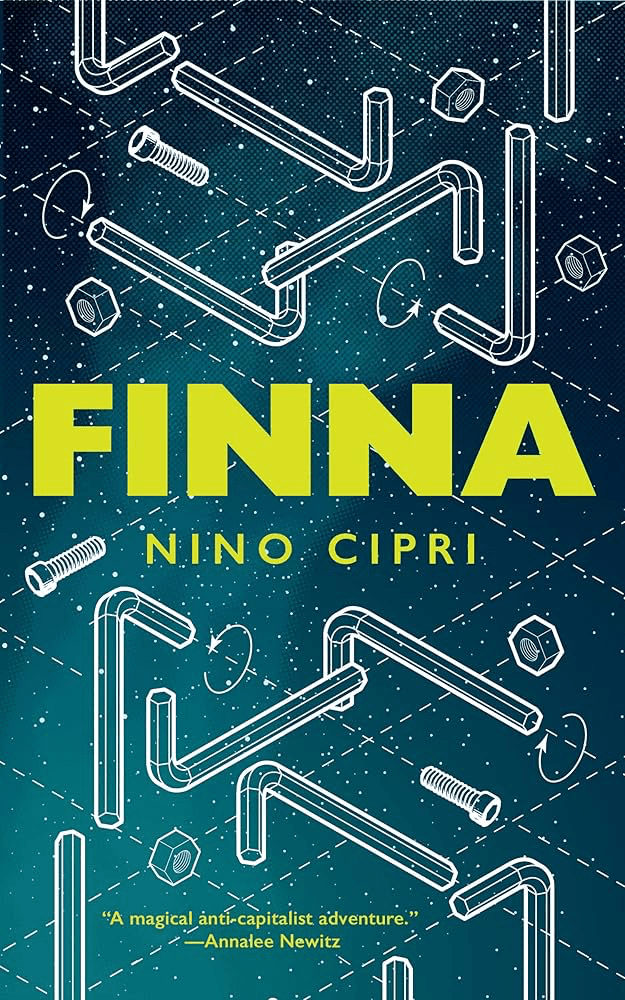
Finna – Nino Cipri“A clipped tongue, acting dumb/Somewhere in the past in a re-run/Thinking all the ways the system will provide…”

“Fortunately Gone” – The Breeders

I don’t typically associate The Breeders with any kind of whimsy. Not like they’re some kind of depression-fest or anything, but they’re not afraid to get on the heavier, crunchier side of things—listen to any track from Last Splash and you’ll know what I mean. So when I paid attention to the lyrics, it was a surprise to see how plainly and delightfully nonsensical they are; “Fortunately Gone” reveals its heart right in the opening verse: “I wait for you in heaven/On this perfect string of love/And drink your soup of magpies/In a pottery bowl.”

The more I think about it, the less surprised I should’ve been by this divergence into tenderly fantastical lyrics. I say that because Kim Deal’s voice feels molded for this purpose. No matter how much distortion you throw at her, there’s a bare-hearted openness to her voice. Her voice is the healing of a scar on your knee, always tender, but never without some semblance of hope, joy, or some manifestation that blood and bruises aren’t all there is to life. Even amidst the grit and ominous air they artfully paste over their cover of The Beatles’ “Happiness is a Warm Gun,” complete with the muted flick of a lighter brought to life, Deal whispers the title refrain with the tone of a child in an empty room watching sunlight peek through the slats of window blinds. That same hope is what buoys this tale, a story of a woman in heaven waiting for her past lover to die so that they may reunite: “Fortunately gone, I wait for you.” Kim Deal was made for the role of this lovelorn, afterlife-confined piner, and nudged into less than two minutes, every tender note lands just as the lyrics tell you so: “Sweetly as it drops upon your head/Just like it did today.”

…AND A BOOK TO GO WITH IT:

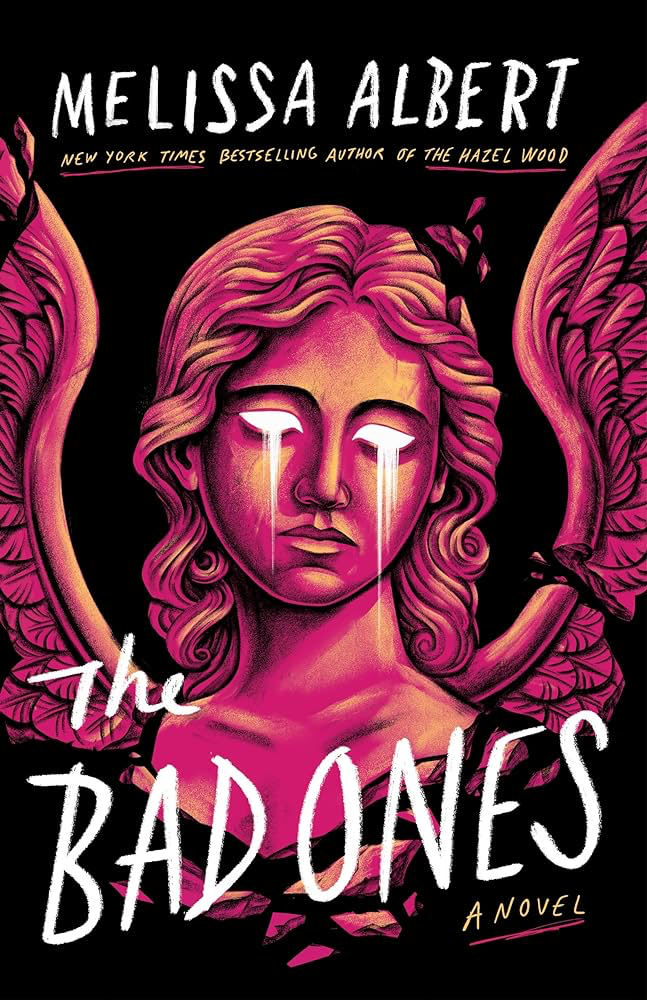
The Bad Ones – Melissa Albertreaching through the veil to find out the truth about your best friend’s death—not just in terms of what killed her.

“I Am I Be” – De La Soul

I’m inevitably getting all College™️ with this one, but can you blame me? I spent the other day talking about how this Richard III monologue displays the dissolution of the character’s sense of self. The amount of contradictions it has fits more with the next song I’m discussing (see below), but the clear-cut divisions reminded me of the title here—”I Am I Be.” It functions partly as a vehicle to add in some silly guest features and ad-libs throughout the song, starting with “I am Shortie, I be 4’11′” and devolving into silliness in the background as the song progresses (“I am Patrick, I be the biggest shrimp collector in the world,” and by the end “I am Bob, and I be really tired of doing this, guys”). After their hard left turn into cynicism of De La Soul is Dead, there’s no denying that their propensity for goofiness never faded away, however much they wanted to deny it.

But as a part of the lyrics, “I Am I Be” functions as parts of the self. After three albums, all three members of De La Soul had gotten squeezed like an empty tube of toothpaste to form an image, whether it was the flower power revival of Three Feet High and Rising or the pressure to crank out another classic post-De La Soul is Dead. From the snatches of Buhloone Mindstate that I’ve listened to, it seems like this album was the limbo outside the two—not completely happy-go-lucky again, but always willing to push the boundaries of what hip-hop could be. They were determined to not let the music industry grind them down, despite the bleak first lyrics: “I be the new generation of slaves/Here to make papes to buy a record exec rakes.” This is where, for me, the “I Am/I Be” division comes in. I’m really English majoring it up right now, but hear me out. I am represents the core of the (De La) soul, as dictated by Posdnuos (“I am Posdnuos”), whereas “I Be” is the circumstances where they find themselves (“I be the new generation of slaves…”). Neither negates the other, but together, they form a completed picture of the self. All after the latter lyric concerns Pos’s past, from collaborators abandoning him to his experience being beaten down by the music industry. But never at any point, amidst all this bleakness, does he crumble under the pressure; the end of the first verse is an assertion that no matter what life throws at him, he will pledge to stay true to himself: “If I wasn’t making song/I wouldn’t be a thug selling drugs/But a man with a plan/And if I was a rug cleaner/Betcha Pos’d have the cleanest rugs, I am.” There: bookending the last line, I am, the true self, returns. Dave’s second verse ends in a similar way: “I keep the walking on the right side/But I won’t judge the next who handles walking on the wrong/Cuz that’s how he wants to be/No difference, see I wanna be like the name of this song, I Am.” For a band that have been through the ringer (and largely emerged triumphant, though it took them decades to get there), it’s already a world-weary assertion, but one that never gives up the spirit—to this day, the surviving members of De La Soul continue to spread their artistry and positivity, now even further reaching thanks to their hard-won legal victories surrounding their music being on streaming. Through it all, they’ve stayed true to I Am.

…AND A BOOK TO GO WITH IT:

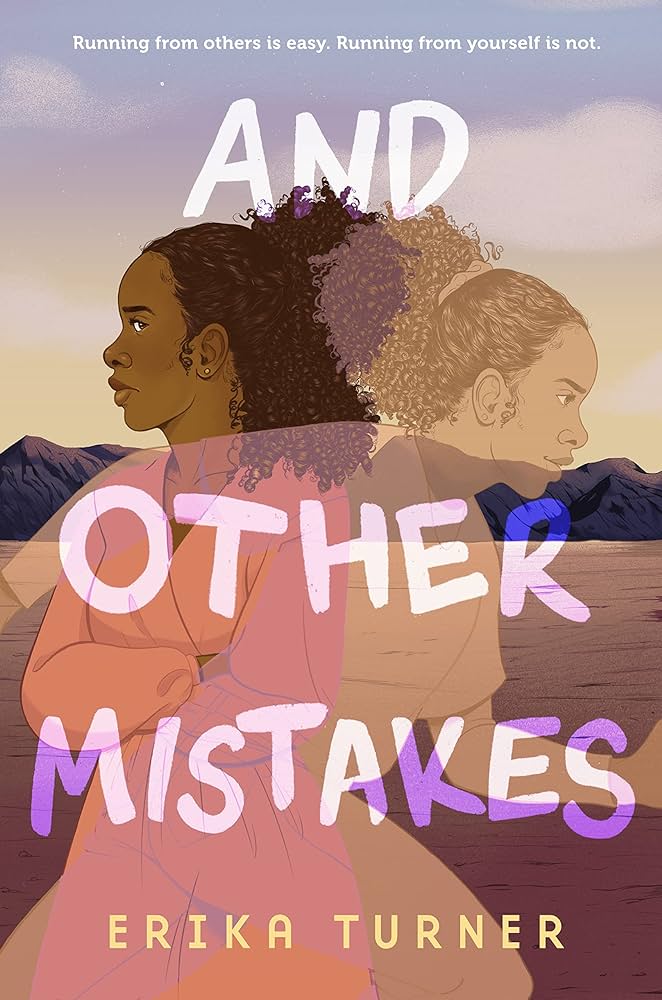
And Other Mistakes – Erika Turner“Every now and then I step to the now/For now I see back then I might have acted like a fool/Now I won’t apologize for it…”

“Echo” – Kristin Hersh

Crazy how I haven’t managed to talk about Kristin Hersh in one of these posts yet…I’m admitting my bias before I make a statement as sweeping as this, but I truly believe that Kristin Hersh has one of the most unique singing voices I’ve ever heard. It lies at an unusual confluence of the tiniest rasp, an understated Southern drawl, and a nasally tremble that, despite there not being words about it that sound complimentary (sorry, Kristin), is only a banner declaring her voice to be like no other. Separately emphasized, those elements would be off-putting (I only mean the Southern drawl in the way that modern country singers lay it on so artificially thick that it becomes meaningless to the All-American image they’re peddling), but where Hersh lies, they’re the perfect parts.

Whatever Hersh intended Sky Motel to mean (I’m between the sky over a motel or a floating, retro-futuristic motel with a rusty sign advertising vacancies on some kind of hover-buoy near the spaceship parking lot), it’s a fitting feel for “Echo.” Faint cricket songs decorate the intro, and combined with the gray, distorted smokestacks and skylines of the music video, it packages that feeling of staring up at the sky from a hotel parking lot, exhausted and operating on too little sleep. The opening lyrics also conjure the space directly before that—for me, somewhere in the dimly-lit back of a taxi from the airport: “White label on the backseat/glows an artificial green.” Amidst ambling keyboards, Hersh seems to stumble through the streets, torn between extremes; caught between the stability of “an empty lifestyle” and the allure of “the very loudest sound.” Every lyric is a contradiction: “I’m loving everybody/And hating everyone I see.” Hersh straddles the two poles just as the music does—each chorus roars from the bug-flecked quiet of the verses, and drunkenly stumbles back into tranquility just as quickly. Though she never lands on which direction she’s pulled towards, there’s a solemn acceptance that the middle ground is in sight, but just out of reach—”Do you hear the loudest sound/Floating out on the echo?” That violent oscillation of contradiction is what makes “Echo” stick so solidly, both in the inability to land between two extremes and only being able to see the most sparing glow of solace—a space I often find myself as such a sensitive person. It’s easy to get swept up in that turbulence, and easier said than done to reach out to that floating echo.

…AND A BOOK TO GO WITH IT:

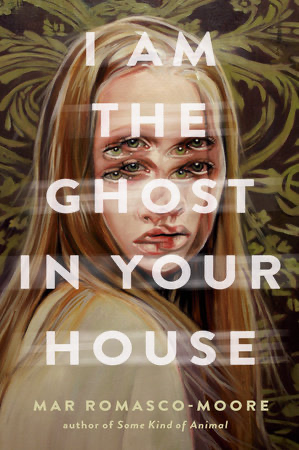
I Am the Ghost in Your House – Mar Romasco-Moore “I crave a midnight something/I crave and something hunts me down/I’m scaring everybody/I’m wearing everybody down…”

Since this post consists entirely of songs, consider all of them to be today’s song.

That’s it for this week’s Sunday Songs! Have a wonderful rest of your day, and take care of yourselves!
Posted in Sunday Songs

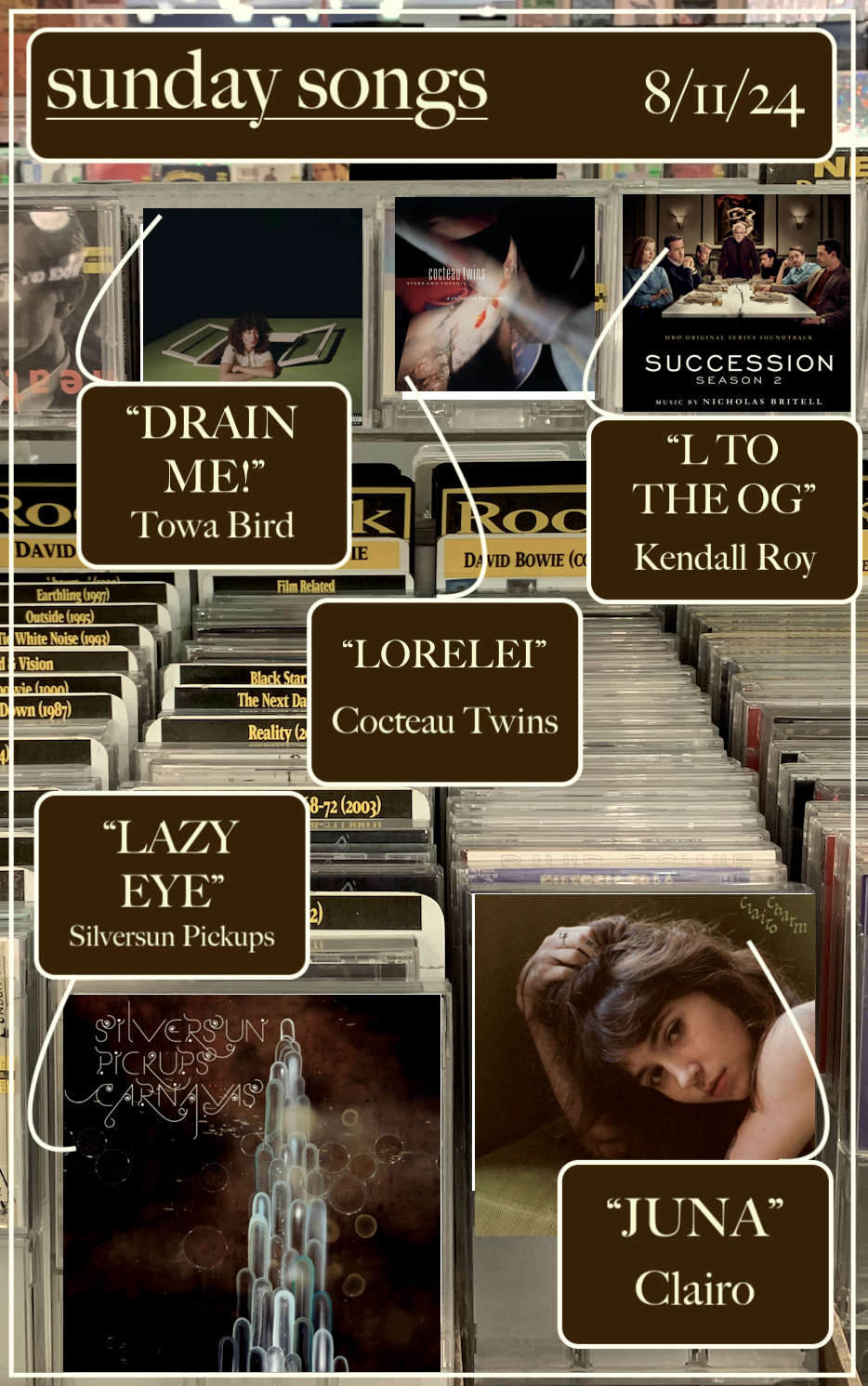
Sunday Songs: 8/11/24

Happy Sunday, bibliophiles! I hope this week has treated you well.

This week: When I say L, you say OG! L TO THE…?

Enjoy this week’s songs!

SUNDAY SONGS: 8/11/24

“Lazy Eye” – Silversun Pickups

This song returned to me like an old friend not long ago, and with it, some misconceptions that were only picked apart when I saw the music video for the first time. For the longest time, I thought that a woman was singing this song; I saw Nikki Monninger and thought, naturally, she had to be the one singing, right? Wrong—Brian Aubert just has a uniquely high-pitched, more androgynous voice. (To be fair to my past self, Monninger does sing lead on a handful of their newer songs, but she primarily plays bass.)

I specifically remember the only other Silversun Pickups song I know, “Circadian Rhythm (Last Dance)” being on heavy rotation on Sirius XMU back when I was in middle school, but even around 10 years apart from each other, “Lazy Eye” has that same meticulous drive that the best 2000’s indie-rock track had. It’s almost startling to me that this song isn’t the opening track of the album, Carnavas, even having heard nothing else from it—there’s just a feeling of it that’s just so distinctly beginning. The instrumentals build up from steady indie-rock, laden with foreshadowing in the form of Aubert’s driving flourishes of both vocals and guitar. “Lazy Eye” segues into a second act that can bear no description other than explosive, splattering in your face like a can of soda shaken up for too long. But as quickly as everything ricochets in a thousand directions, the floorboards fall out from under it, returning to its mellow origins as the repeated outro of “The room, the sun and sky” fades into the woodwork. Paired with the precipice-staring lyrics of anticipation and coming to grips with reality (“I’ve been waiting for this moment all my life/But it’s not quite right”), make it feel molded for the intro of a coming-of-age movie, coming to grips with the fact that nothing’s as perfect as you can ever dress it in your imagination.

…AND A BOOK TO GO WITH IT:

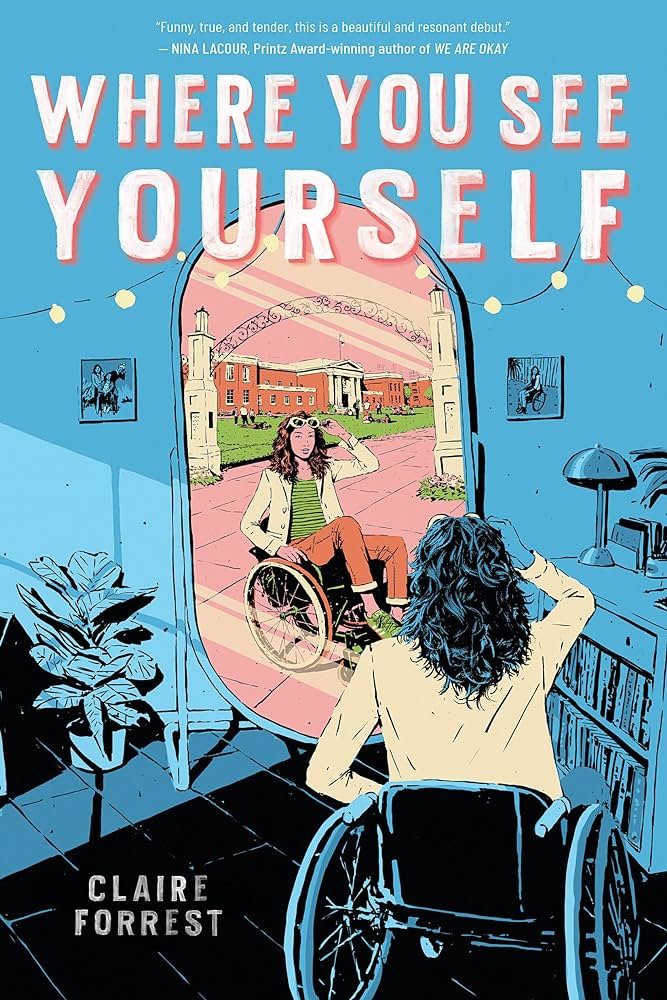
Where You See Yourself – Claire Forrest“I’ve been waiting/I’ve been waiting for this moment all my life/But it’s not quite right…”

“Juna” – Clairo

I’m far from caught up on any kind of Clairo lore, but apparently “Juna” is the first song that she’s ever made a music video for! There’s something funny, unintentionally or not, about having a song (and a singer) as unassuming as Clairo set against the backdrop of a bunch of screaming, oiled-up wrestlers tossing each other around. Somehow, it works.

Clairo has never fully blown me away, but every once in a while, she’ll break through the mellow and snap into something luscious that has me looping it for days. Maybe I just like Clairo when she leans into the ’70s influences—I always come back to the funky bass that comes through the sadgirl mold in “Amoeba,” but “Juna” fully leans into it. If you took away the synths and left in the layered piano riffs, this track would feel like pure ’70s soul. I’d be fully convinced if there turned out to be some grand conspiracy to make this song just to soundtrack playing pool in a dimly-lit club, flickering lights fading both inside and out as the multicolored balls collide across the velvet. It has all the grace of aging, velvet curtains and the twinkling of new, flirtatious love, the kind that pushes you towards things you wouldn’t have done before: “You make me wanna go dancing/You make me wanna try on feminine/You make me wanna go buy a new dress/You make me wanna slip off a new dress.” Clairo’s voice constantly feels seconds away from dissipating into thin air, but she pulls off the sultry groove that “Juna” presents. And somehow, just like the bizarre juxtaposition of this song’s gentle disposition and said video of greasy wrestlers, something about Clairo’s mouth-trumpet breakdown (new sentences are formed every day) fits right in. I’d prefer…maybe more actual trumpet, but I feel like there’s something perfect about this song not taking itself too seriously. (Not necessarily everybody else in the video hamming up said mouth-trumpet breakdown…yeah)

…AND A BOOK TO GO WITH IT:

The Invisible Life of Addie LaRue – V.E. Schwab“Most of these days/I don’t get too intimate/Why would I let you in?/But I think again…”

“Drain Me!” – Towa Bird

One of my first thoughts while listening to “Drain Me!” was that it sounded like Pixies if they’d gone pop. Seems like an oxymoron, but I swear that there’s something about the guitars near the last third and the chord progression that reeks of “Gigantic.” Conclusion: this is Pixies, if they happened to be a) more pop-inclined, and b) ragingly lesbian.

I’m sure you have to be an unattainable, Taylor Swift level of influential to be able to control when your record comes out, but releasing Towa Bird’s debut, American Hero, this May, right before the rush of summer, was a genius move. Granted, this is the only song of hers I’ve heard, but it is a PERFECT summer song. Charged with reckless kisses and clandestine meetings, it feels like the kind of head-over-heels love that’s made for blasting with the windows down, careening down the highway. Bird’s guitar-driven approach pulls it ever-so-slightly out of the mold of mainstream pop, but there’s no denying that this is a summery pop song for our day and age—you make a song like this, and you’re just asking to have it featured in Heartstopper or something. And how wonderful is it that we have so many out, queer pop songs? Open queerness exists in almost every genre right now, but even if I don’t like a particular artist, it gives me hope to remember that songs about women loving women can draw massive crowds—and even better that this one was written by a woman of color. It’s not like this song is revolutionary, but that doesn’t mean it isn’t worth celebrating—and fully worth dancing around to.

…AND A BOOK TO GO WITH IT:

Road to Ruin – Hana LeeDaredevil sensibilities, magic-powered motorbikes in the post-apocalyptic wasteland…and queer women.

“Lorelei” – Cocteau Twins

Thus (tentatively) concludes my Cocteau Twins summer…for now, at least, until it’s cold and I can allow myself to listen to Victorialand. Cocteau T-winter.

I’ll see myself out…

This is the only track I’ve heard off of their 1984 album Treasure, which critics seem to have attached themselves to like the album’s namesake, but has been described by the band themselves in terms including but not limited to Robin Guthrie calling it “an abortion.” Yeah…again, harsh, but if this is the only track I take from it, how on Earth does “Lorelei” deserve that slander from its own creator? Sure, they hadn’t hit their stride at this point; it sounds more distinctly, in-your-face ’80s with its stuttering drum machine and slipshod production, but it’s all part of the charm, if you ask me. That drum machine is the paperweight keeping the billowing curtain of Elizabeth Fraser’s silk-thin voice tethered to the earthly realm. Even so early on in their career, Fraser had already honed the ethereal breath of her voice, able to make every hum, mumble, and lilt the stuff of magic itself, how I’d imagine the texture of fabric woven from the dewy web of a spider in the early hours of dawn.

…AND A BOOK TO GO WITH IT:

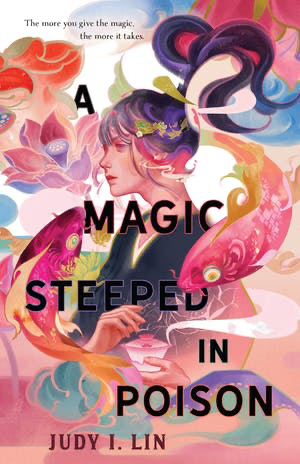
A Magic Steeped in Poison – Judy I. Linthe kind of breathy, enchanting music fit for a magic system based on the properties of tea.

“L to the OG” (from Succession) – Kendall Roy

I’ve finished the first two seasons of Succession, and my main takeaway is this: watching Kendall Roy, a middle-aged billionaire whose vocabulary consists of every corporate buzzword imaginable strung into a sentence, not only try to rap, but say a line like “yo, bitches be catty/but the King Kong daddy/Rock all the haters while we go roll a fatty” gave me more whiplash than the twist ending of the season finale. It’s like watching a train wreck…you just can’t peel your eyes away…

…AND A BOOK TO GO WITH IT:

The Electric Circus – Timothy Lipton“It’s about a young man making his way through the world. It’s set in two different time periods; it kinda switches back and forth…the circus part is a metaphor for the anxiety of modern life.” – Roman Roy, starred review

Since this post consists entirely of songs, consider all of them to be today’s song.

That’s it for this week’s Sunday Songs! Have a wonderful rest of your day, and take care of yourselves!
Posted in Sunday Songs

Sunday Songs: 8/4/24

Happy Sunday, bibliophiles!

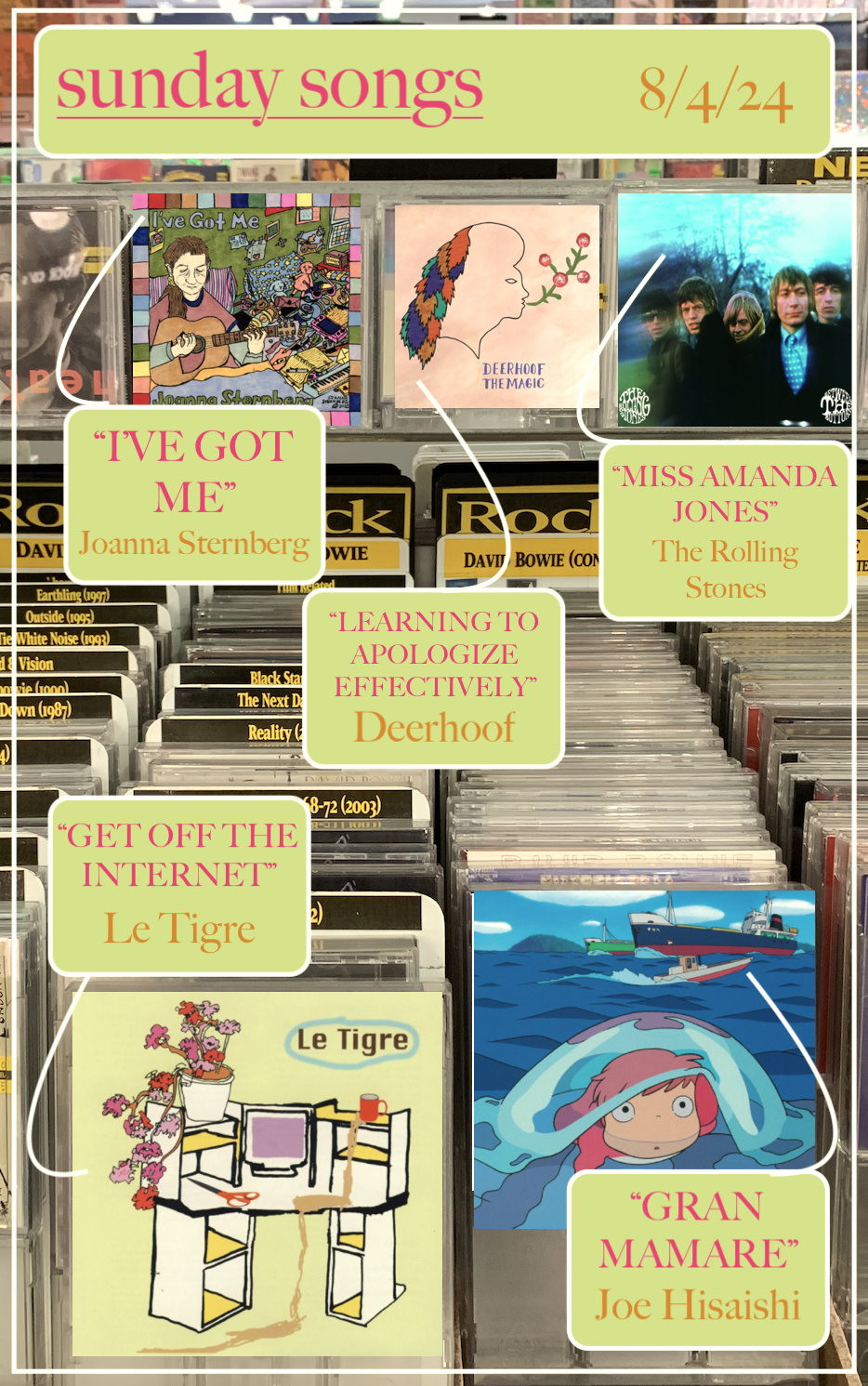
This week: I fully see the irony of putting a song called “Get Off the Internet” on a blog post……….decidedly on the internet, but you get it, right? Right?

Enjoy this week’s songs!

SUNDAY SONGS: 8/4/24

“Get Off the Internet” – Le Tigre

I miss when people could get along despite their politics, but…have you seen Project 2025 lately? Were you not paying attention to Trump’s entire presidency? I wouldn’t be saying this if, y’know, they weren’t trying to take all of our rights away, but…

GET OFF THE INTERNET!! DESTROY THE RIGHT WING!!!!

…AND A BOOK TO GO WITH IT:

Our Stories, Our Voices: 21 YA Authors Get Real About Injustice, Empowerment, and Growing Up Female in America – edited by Amy Reedmodern accounts of femininity and feminism from a collection of incredible authors.

“Gran Mamare” (from Ponyo) – Joe Hisaishi

Watching Ponyo as an adult felt like watching it for the first time. Technically, my recent rewatch was my second time seeing it in over a decade. Every time I’ve thought about it before then, it felt like a fever dream…probably because my first viewing was something along those lines. I was about 5 or 6, and I’m almost positive that I was home sick from school. Either way, I was in my parents’ bed. All I could remember were faint glimpses of Ponyo underwater, the man, the myth, the legend, Fujimoto (close enough, welcome back David Bowie)…and Granmamare.

If there’s any gorgeously-crafted scene (of which there are many) to take away from that movie, it’s any scene with her. No wonder my five-year-old brain retained an image of such beauty, even when it was (probably) sick. Her first appearance isn’t necessarily emotional—all she’s doing is talking to Fujimoto about what to do with Ponyo—but all of the sudden, I found myself overcome with tears. All those years ago, and it took my breath away. (And who better to voice such a goddess of such beauty than Cate Blanchett? It had to be Cate Blanchett.) Maybe I was just in an emotional state, but something in the sheer beauty of that scene stirred up something hidden and beautiful in me. Joe Hisaishi’s sweeping score gives it an appropriately sparkling, John Williams-like grandeur, befitting of a character so powerful that she illuminates the whole ocean with her radiance.

Either way, I’m so glad that I rewatched it. Ponyo want ham.

…AND A BOOK TO GO WITH IT:

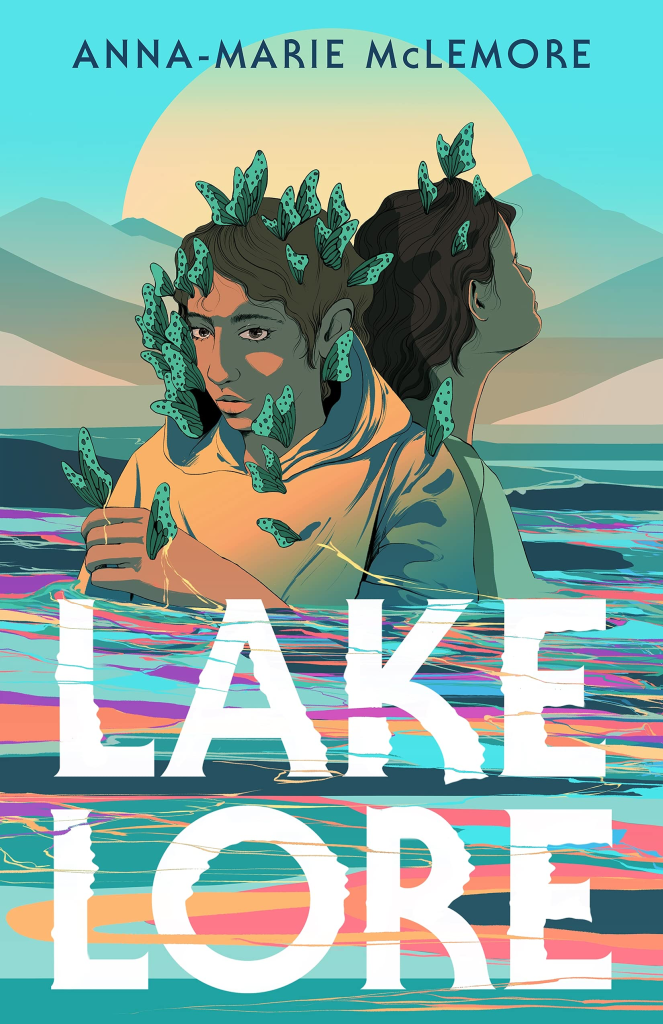
Lakelore – Anna-Marie McLemore – mysterious and magical underwater realms, anyone? (Admittedly, Ponyo delivers much more on that aspect, but you can’t beat Miyazaki.)

“I’ve Got Me” – Joanna Sternberg

The name of the video is a bit of a misnomer, in my opinion—yes, technically it is a lyric video, but the lyrics are accompanied by a full-color comic drawn by Sternberg, which makes it feel like a fully-fledged music video. It’s so worth a watch—they have such a charming art style.

When I say this, I say it with all of the affection in my soul, but it’s remarkable that at only 32, Joanna Sternberg sounds just like a kind, elderly music teacher. Again: nothing but affection. Their voice just emanates that comfort that I associate with the kind of person who teaches preschoolers how to use maracas and such. The album art, as well as the associated art only add to the vibe—the scratchy inking and pastel backgrounds only add to the feeling that I would find this CD in said music teacher’s collection. Heck, I can almost imagine having to sing “I’ve Got Me” in a preschool program, if not for lines like “between self-hatred and self-awareness is a very small, thin line.”

Nonetheless, all of this is to say that “I’ve Got Me” has a purity to it. It’s got the sing-songy sway of a children’s song, but in its touching vulnerability, brushes over a sentiment I’ve battled with for much of my life: “why is it so hard to be kind and gentle to myself?” (Boy, do I relate to the panel at 0:46 with a sullen-faced Sternberg wearing thick-framed glasses captioned “me looking through the file cabinet in my brain that stores all of my bad memories”—even better, it’s alphabetized.) Armed with nothing more than their acoustic guitar and a stand-up bass, they produce a solution that gives this even more of a children’s music feel: “Take the box of self-deprecation/Lock it and put it on the shelf/Then wait five days, take that box/And throw it in the fire.” Through said self-deprecation gathering dust and anxiety on the shelf, Sternberg retains an understated but resilient hope—”I’ve Got Me” as a title feels like an assertion that, no matter if you think you’re alone, you are all you’ve got. You have but one body and one mind, in all of its flaws, and you may not be able to control some of the inevitable bouts of self-deprecation, but it’s still you, in the end.

…AND A BOOK TO GO WITH IT:

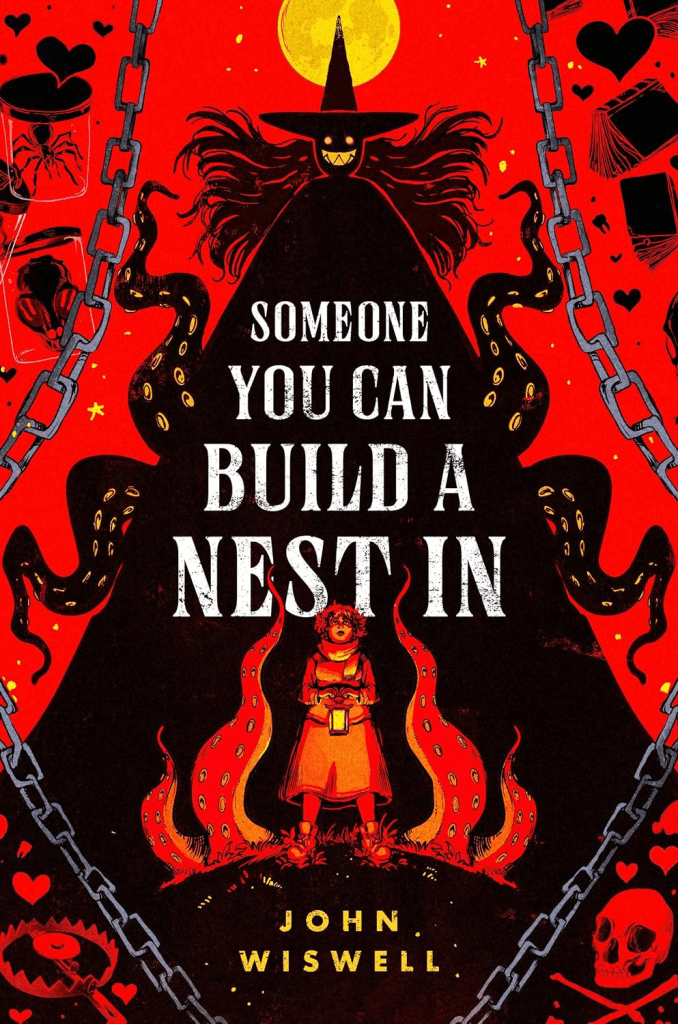
Someone You Can Build a Nest In – John Wiswellin both a literal and figurative sense, learning self-love after viewing yourself as monstrous.

“Learning to Apologize Effectively” – Deerhoof

Being a newcomer to Deerhoof is a unique experience because I can never seem to find a consensus about what they sound like—or what other people think they sound like, at any rate. One reviewer says this is a return to form, another critic says it’s some kind of new venture, like nothing they’ve ever done before. The only consensus I can seem to draw is that they’re bent on being weird—and I have nothing but admiration for that, especially after seeing the craft to their weirdness. (Learning “Future Teenage Cave Artists” on guitar and having to puzzle through not one but four odd time signatures with my guitar teacher sure was something.)

Either way, I’m almost ashamed to say that the YouTube algorithm spat this one up before me, but I’m not one to complain. I’m done being ashamed with how I found out about songs—so long as I have the song in my hands and I enjoy listening to it, what’s the issue, really? “Learning To Apologize Effectively” is much more rock-oriented (as its album, The Magic, seems to be in its entirety), with crashing. classic rock-recalling guitars. Yet even if their inspirations for this track lie more in mainstream rock, there’s that undeniable weirdness that seems to ooze from their music no matter what. Like with “Future Teenage Cave Artists,” Satomi Matsuzaki’s vocals have an uncanny quality to them, not necessarily in the sound of her voice, but in the ever so off-kilter timing of it—I can’t pin down a time signature, but in her “the song is waiting for another song” intro, each pause makes a deliberate form of obscurity, darting into an unexpected corner when you expect it to go down the well-lit hallway right in front of it. It feels like an imitation of rock from a band used to making the most deliberately strange music for most of their career—an imitation that feels almost authentic.

…AND A BOOK TO GO WITH IT:

Lagoon – Nnedi Okorafor“And when we saw what we were doing wrong/We found the cause underwater, long/And then we saw what we were doing wrong…”

“Miss Amanda Jones” – The Rolling Stones

For a fleeting moment, I can pretend that this song exists in a vacuum, and that Mick Jagger hasn’t been acting like it’s 1967 for the past five decades or so. The fact that he (and Keith Richards) have actually survived long enough to act like they’re 20 for so long is almost impressive, but…yikes, dude.

As much as I rag on Jagger and company, I can’t deny that for at least a decade or so, he and the rest of the Stones could concoct some truly legendary songs. Of course they could, they’re the Rolling Stones! Yet somehow, I rarely see this one among the greatest hits—maybe it’s the rose-colored glasses shielding everything once more, but I feel like if it was good enough to name a whole character after it in Some Kind of Wonderful, that has to give it some street cred, right? (So real of them to name a character after a song just so that they could play said song in the movie. I feel like I’m gonna wind up doing that someday.) Aside from being a staple of car rides in my early childhood, it’s just so unbelievably tightly-wound. Not a single cog is winding out of sync, from the twin talents of Brian Jones’ rhythm guitar and Keith Richards’ spiky riffs—in 1966, we already had the precursor to my favorite, early-’70s guitar sound, warm and thick as a fresh pot of soup. It’s a bit too rough around the edges (for the ’60s, anyway) to really be truly jangly, but it’s got the swagger and sway that makes the rock of the ’60s so delightful to listen to.

…AND A BOOK TO GO WITH IT:

Little Thieves – Margaret Owen“Just watch her as she grow/Don’t want to say it very obviously /But she’s losing her nobility, Miss Amanda Jones …”

Since this post consists entirely of songs, consider all of them to be today’s song.

That’s it for this week’s Sunday Songs! Have a wonderful rest of your day, and take care of yourselves!
Posted in Sunday Songs

Sunday Songs: 7/28/24

Happy Sunday, bibliophiles! I hope this week has treated you well.

This week: surprise, surprise…I have sympathy for exactly one (1) live-action Disney remake. Soak it up while you can.

Enjoy this week’s songs!

SUNDAY SONGS: 7/28/24

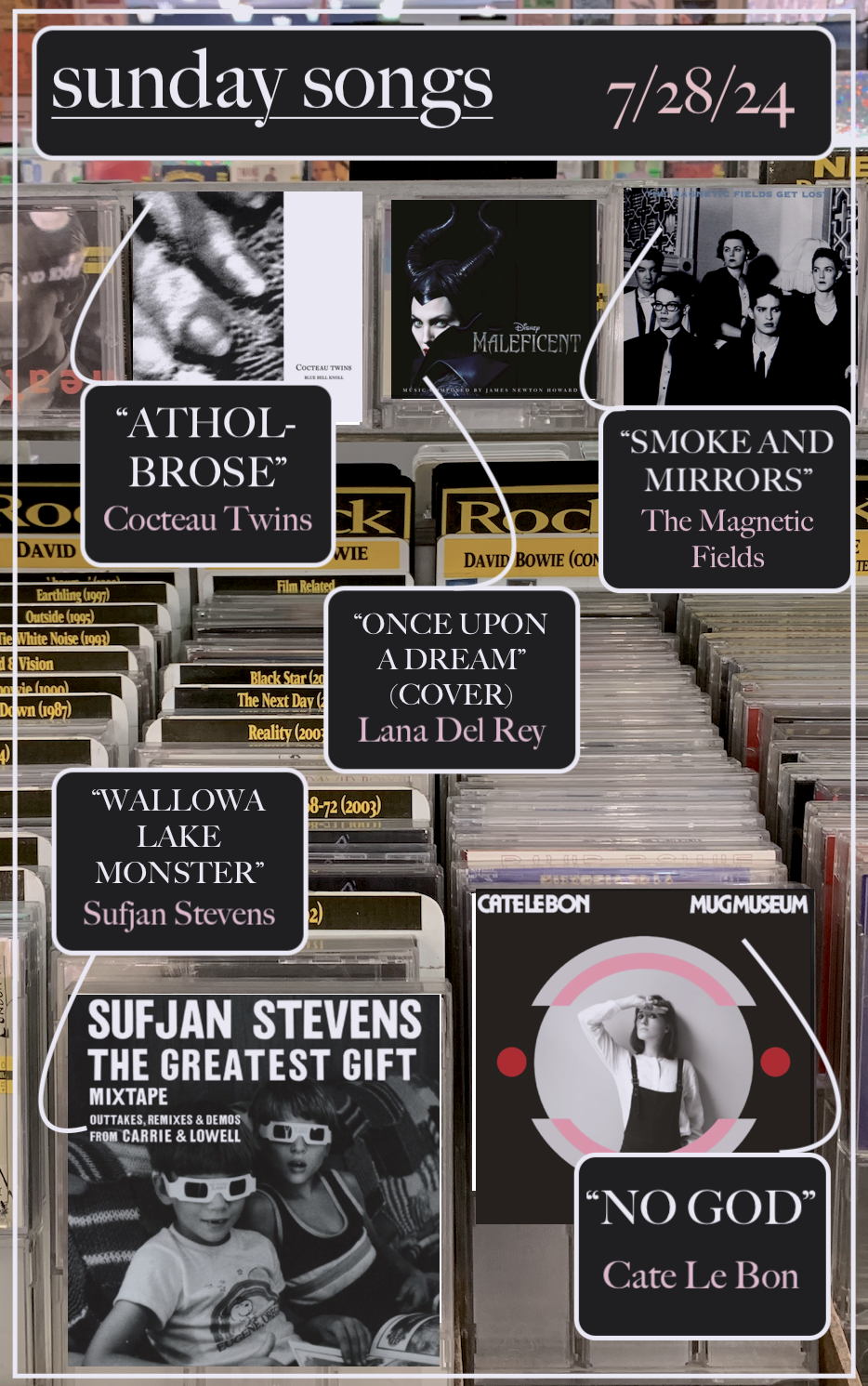
“Wallowa Lake Monster” – Sufjan Stevens

The other night, a friend of mine and I were discussing the merits of album intros—cinematic curtain-openers (David Bowie’s “Future Legend”), gradually creeping easers (IDLES’ “IDEA 01”), and intros so engrossing that the rest of the album almost doesn’t measure up (Cate Le Bon’s “Dirt on the Bed”). I ended up making a Top 5 list that got so overblown that it expanded to top 10, but my friend was remarkably able to whittle it down to 5. “Wallowa Lake Monster” was squarely at the top of their list, and now I understand exactly why.

I’d call “Wallowa Lake Monster” a member of the first category, though in a different sense than “Future Legend.” The album it opens is The Greatest Gift, a mixtape of remixes, demos, and tracks cut from Carrie and Lowell, making “Wallowa Lake Monster” a b-side. I’m now experiencing “Burning Bridge” levels of how the hell was this a b-side, because, in my limited experience of Sufjan Stevens, how does one cut a track this cinematic? Who knows, with what little I know of Carrie and Lowell, save for that it deals with his complicated relationship to his mother. The gliding electronics seem to ripple like lake water itself, as wispy as Stevens’ voice as he opens his tale as one might a storybook: his mother’s twin struggles of alcoholism and schizophrenia become the backdrop for the Wallowa Lake Monster, a creature from Nez Perce legend, as it slowly pulls her under the waves: “And like the cedar wax wing, she was drunk all day/We put her in the sheet, little wreath, candles on the crate/As the monster showed its face.” There’s enough references, from scientific names for flowers to Dungeons & Dragons monsters to the Odyssey, to require three different dictionaries open at once while listening—Stevens has often fallen into the “overly pretentious” side of indie rock in my purview, and although that’s still not without basis, it’s clear that he’s a very literary-minded songwriter. It wasn’t surprising to learn that Stevens originally got his MFA in creative writing! A line as literary as “The undertow refrained with the flame of a feathered snake/Charybdis in its shallow grave” couldn’t have come from anyone but an English major, and that’s pretentious game recognizing game.

Yet in spite of such stunning lyricism, the lyric-less parts are what floored me on the first listen of “Wallowa Lake Monster.” After the flitting, storybook storytelling, clouded in Oregon fog, there was no other way to go but a nearly three-minute, instrumental outro, from synths that cut like searchlights through the dark to a cavernous choir that only rises in its intensity. It grows to such a bellow that you feel its physicality towering over you, much like I would imagine the fraught memory of such a deeply flawed yet deeply important figure in one’s life. It nearly eclipses all else about the song until its final, electronic exhalations.

…AND A BOOK TO GO WITH IT:

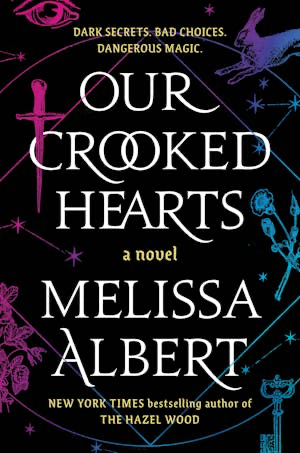
Our Crooked Hearts – Melissa Albert: brimming with magic and secrets, this novel explores a similarly fraught relationship between mother and child.

“No God” – Cate Le Bon

When I talked about “Dirt on the Bed” last week, I talked about how much Cate Le Bon reminded me of St. Vincent, down to their humbler, more arty beginnings. They’re both arty at present, but the art I’m thinking of is more the quaint, fresh-out-of music college sound that St. Vincent had on Marry Me, an era that she recently jokingly referred to as her “asexual Pollyanna” period. Ouch…I can’t say that it doesn’t make sense, because it…does, in a way, but it feels dismissive of all the rampant creativity swirling about in that album.

Cate Le Bon seems to have wallowed in that artsy, borderline twee period for much longer than St. Vincent did; Mug Museum is her third album, and the tracks I’ve heard all ring with that early-2010’s indie, folksy leaning. Le Bon’s Welsh lilt twists ordinary words into melted candy, and much like St. Vincent, her riffs wind around the melody like tiny flower buds bursting from vines crawling up a fading brick wall. Some songs were made for summer strolls, and “No God”‘s bright melodies brim with sunshine and the security of concrete under your feet as you take a morning walk through the city, stopping to sniff a basket of flowers in the window of a storefront. Her vocals get their well-deserved spotlight in the chorus, rich and bubbling with each drawn-out cry of “No Go-o-o-o-o-d,” swirling into the morning dew.

Yet the cheery exterior hides the grief that clouds her 2013 album Mug Museum; much of the album was written after the death of Le Bon’s beloved grandmother, and the title itself explains the memories contained in ordinary objects—an accumulation of mugs, for instance. But the grief of Mug Museum is more of a recognition of lineage; Le Bon said that “The album was inspired by the loss of my maternal grandmother but rather than it being a grief laden album it is more about what someone at the top of the female chain leaves behind.” The lilting repetition of “No God” is suddenly recontextualized as not necessarily spiritual, but the loss of the ground beneath your feet, the rug pulled out from under you now that there’s no maternal anchor. The God here is more a feeling of connection to your feminine ancestors and the security it brings—and the upending of that security once death overcomes the family.

…AND A BOOK TO GO WITH IT:

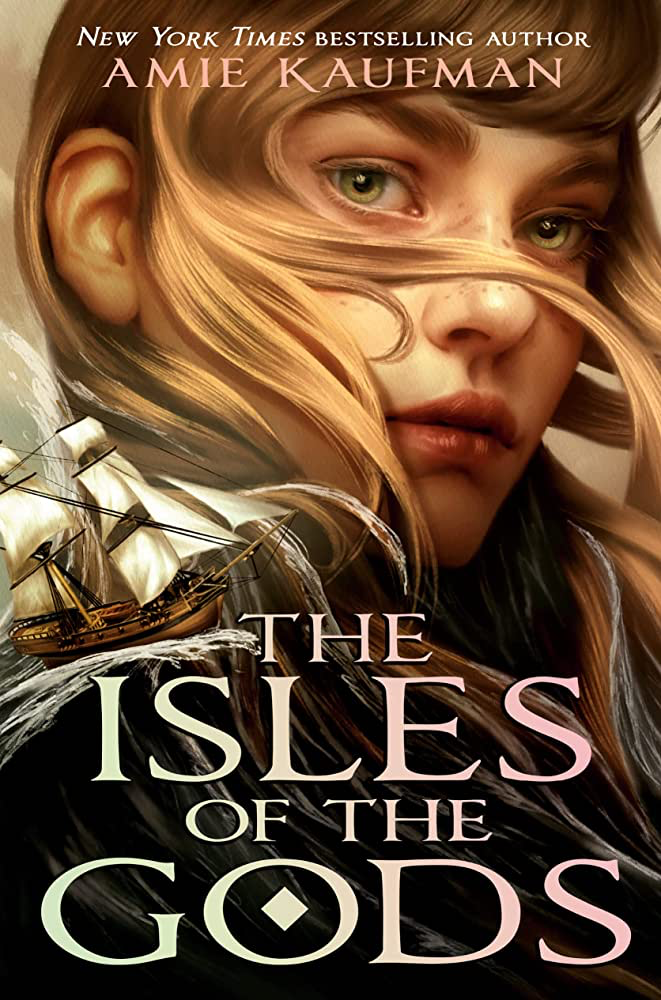
The Isles of the Gods – Amie Kaufman“When leading lambs lose track/Hands hold me back/I saw a face again/I pulled it from my head/No looking, I know it well…”

“Athol-brose” – Cocteau Twins

Another merit I’ve discovered in my apparent Cocteau Twins summer is that they’re perfect for easing overstimulation. In my ongoing journey to better manage my sensory issues, I’ve compiled a playlist full of songs I use to come down from sensory overload, distinct from the playlist where I just pile on all the slow songs. Sensory overload calming demands a more specific kind of slowness, the kind that oozes relaxation and massages every fold of my overstimulated brain.

There you have it. I’ve just described most of the Cocteau Twins’ discography. The combination of their lazy, dreamlike pace and the swirl of graceful gibberish in Elizabeth Fraser’s vocals make them prime sensory calm material. (That instant muscular relaxation I felt when I first heard “Oomingmak” is a sensation I desperately need to bottle the next time I’m overstimulated.) After a recent bout of overstimulation that had me cycling through all of their music that I had on my phone, I decided to bump Blue Bell Knoll up to a higher priority on my Sisyphean Album Bucket List, but also…y’know, Cocteau Twins. I’m waiting until I’m hibernating in December or January for the wintry Victorialand, but Blue Bell Knoll, with its bedsheet white, silken melodies was a welcome embrace after a month of election anxiety (finally quelled for the most part…anyways, HARRIS 2024). I’m glad that I’d only heard “Carolyn’s Fingers” (a song that goes eerily well with “Creep”…somebody needs to make that mashup), because letting Blue Bell Knoll wash over me in nearly-new wholeness was the best way to breathe it in.

“Athol-brose” starts off with a soft-spoken, percussive beat, but quickly swallows you in a murmuring whirlpool, a whispering chorus of voices bobbing and humming in unison like songbirds on the wind. The more distinct, angular synths pave an easy path to Heaven or Las Vegas, their most famous effort, gliding on nebulous wings through a star-flecked field of melody. In Elizabeth Fraser’s mouth, ordinary words are made into alien percussion; the final repetition of “very very silly ball” rolls against her tongue like the rapid flutter of bee’s wings. Like the red floatboat that the album later sings of, “Athol-brose” feels about the closest thing to riding on a motorboat through a sea of stars, then reaching your fingers out to reach for each glowing filament, watching the light trail around your fingertips.

…AND A BOOK TO GO WITH IT:

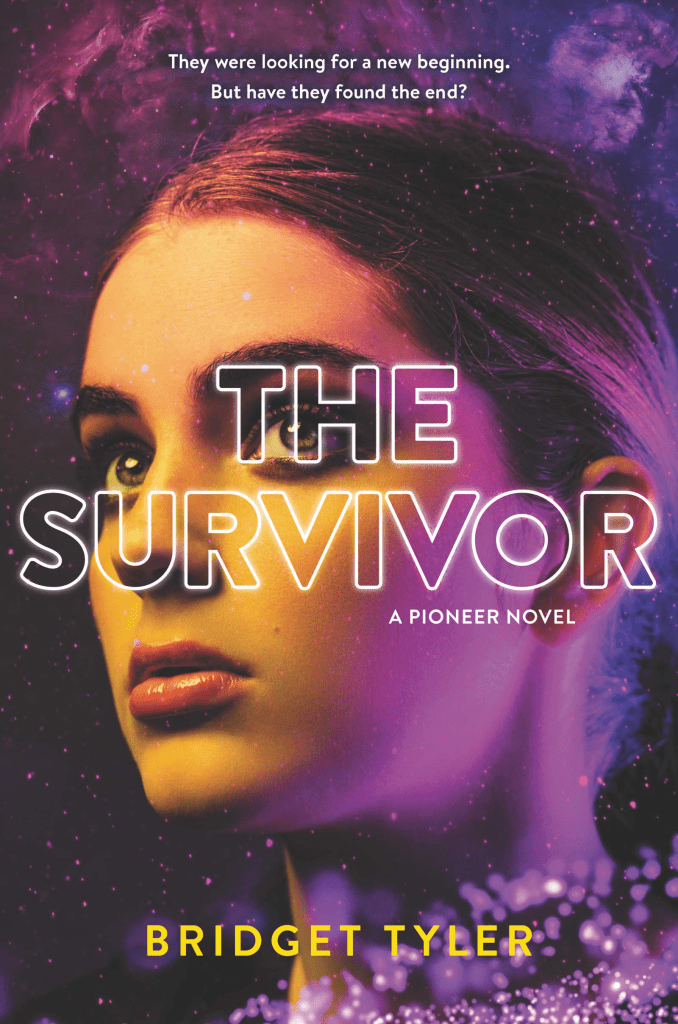
The Survivor (The Pioneer, #2) – Bridget Tylerthere’s a deeply moving scene where an alien character sees his home from space for the first time, and that initial flush of sound fits that explosive wonder.

“Once Upon a Dream” (from Maleficent) – Lana Del Rey

Lana Del Rey and live-action Disney remakes are two things that have never been my cup of tea, although I’ve engaged with some of her music (“Video Games” remains a nostalgic favorite of mine) and some of the movies when I was younger. I write this fully acknowledging that the rose-colored glasses are so far up the bridge of my nose that they’re digging into my skin, but dare I say that this cover—and the film—are exceptions to the mediocrity? Maleficent was one of my favorite movies growing up, and, yeah, it’s Disney, I’m not about to rush to their defense, but I swear it’s the only one of the remakes where they didn’t outright remake it; they flipped it to Maleficent’s perspective and didn’t just rehash the story with CGI…as all the others have done. Who knows. Admittedly, I haven’t exactly been paying close attention to Disney’s army of remakes.

Either way, this is the one instance of trailerized music that clicks into place for me; James Newton Howard’s haunting, sweeping orchestration clearly set the tone for all of the Epic™️ Trailer Music that came after it, but none of his imitators captured that grandeur he establishes. Lana Del Rey’s husky but rich voice hums through a cover that brushes that silky line between darkness and fairytale innocence. I’ll say it again: nostalgia is at the wheel here, but I’d be lying if I said that remembering this cover and listening to it 10 years after Maleficent’s release didn’t give me goosebumps.

…AND A BOOK TO GO WITH IT:

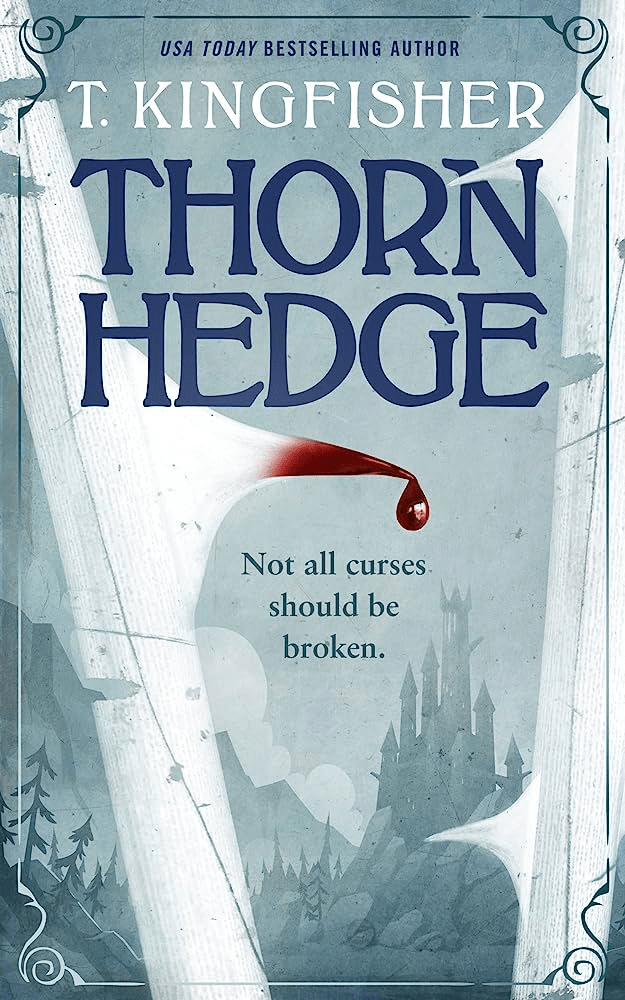
Thornhedge – T. Kingfishera Sleeping Beauty retelling that doesn’t shy away from hidden darkness.

“Smoke and Mirrors” – The Magnetic Fields

At this point, Stephen Merritt has probably had every weird, toxic ex in the book—either that, or he’s happened to have just a handful with all of those horrible qualities rolled into one. Either way, songs like “Smoke and Mirrors” paint him as exhausted by all of them, and understandably so; this track in particular recounts a lover who tried to woo him with sex and affection to distract from the implosion of their relationship (“Smoke and mirrors, special effects/A little fear, a little sex”). He does admit that it was mutual, but keeping up the façade clearly ground him to the bone. Somehow, Merritt makes sounding so exhausted so enchanting and artful. Melding with the appropriately smoky, hazy atmosphere, his voice drifts in and out of focus, just a passing cloud in the thick fog of synths, backing vocals, and bass. Merritt makes such a disaffected mindset into something purple-gray and glittering at the edges, even if all that color and shine is a sham when you fan all the fumes away.

…AND A BOOK TO GO WITH IT:

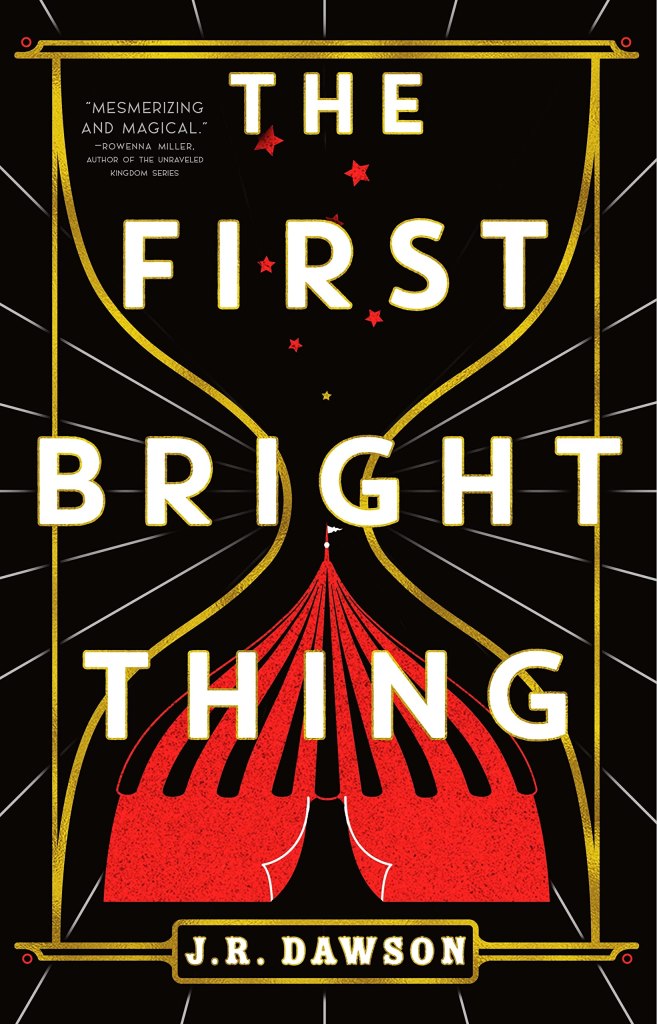
The First Bright Thing – J.R. Dawson“We were foolish, you and I/But there’s no reason to cry/We put on a lovely show, but that’s all/I had to go…”

Since this post consists entirely of songs, consider all of them to be today’s song.

That’s it for this week’s Book Review Tuesday! Have a wonderful rest of your day, and take care of yourselves!

Posted in Sunday Songs

Sunday Songs: 7/21/24

Happy Sunday, bibliophiles! I hope this week has treated you well.

This week: music for pretentious weirdos (me), music for animation, and music that makes me cry on the regular.

Enjoy this week’s songs!

SUNDAY SONGS: 7/21/24

“Dirt on the Bed” – Cate Le Bon

I came into Pompeii with plenty of curiosity, having finally gotten around to listening to Cate Le Bon after hearing her work producing Wilco’s latest album, Cousin, and her vocal feature on St. Vincent’s “All Born Screaming.” Vaguely remembering the buzz and air of weirdness around Pompeii, I decided to listen to it first.

Pompeii and “Dirt on the Bed” have reminded me of why a spectacular album intro can be both a blessing and a curse. If nothing surpasses the first track, then the rest of the album can never recover—or at least reach the heights of the first song. You can enjoy yourself, but never as much as you did after one song. Just one. It’s a horrible dilemma. Pompeii was fantastic from the start, but after the first four songs, nothing’s quite the same—great, but like my experience with R.E.M.’s Green, nothing tops the back-to-back splendor of the first four songs. And that splendor is set in motion by the crawling intro, “Dirt on the Bed.” As the title suggests, it has the dread of something unclean creeping into the house, like a nun on the scent of sin in a shuttered Catholic girl’s school. An off-kilter, stumbling chorus of brass blooms in moldy bursts, an airborne sickness pulsating through each thrum of the bass. Now I know exactly why St. Vincent chose to work with Le Bon—”Dirt on the Bed” is especially evidence of this, but all I could think of during Pompeii is that it felt like St. Vincent had remained lyrically and instrumentally in Actor, but slowly adorned her music with synths. They’re so similar to each other, down to their folkier, precocious indie beginnings that blossomed into full-on devotion to strangeness. This is modern art pop at some of its best, unabashedly weird and precise in every flourish. “Dirt on the Bed” makes even more sense when you see it as a product of a pandemic-produced album; it paces listlessly, putting on a smile as it tries to scrub every trace of illness and dread from a spotless house. Even as calmly as Le Bon sings each lyric, foreboding seeps through every misty horn blast.

That’s how an album intro is done. After several more listens, I’d say that nothing comes quite as close to it, but “Dirt on the Bed,” “Moderation,” “French Boys,” and “Pompeii” is SUCH an undefeated stretch of songs. Pompeii is worth a listen just for that, as is the album’s very St. Vincent closer, “Wheel.”

…AND A BOOK TO GO WITH IT:

Drunk on All Your Strange New Words – Eddie Robson“Sound doesn’t go away/In habitual silence/It reinvents the surface/Of everything you touch…”

“Poor Song” – Yeah Yeah Yeahs

…okay, I can’t possibly be normal about this because I cry a little every time I hear it. Either way, there’s an undiluted purity about this song that makes any kind of analysis feel like ten steps in the wrong direction. It’s a paramount example of how easily beauty and simplicity can intertwine, and it cuts more deeply than some songs I know with hundreds of metaphors.

It’s very nearly perfect. Karen O tends to do that.

…AND A BOOK TO GO WITH IT:

I Love This Part – Tillie Waldenquiet and gentle teenage romance.

“It’s A Wonderful Life” – Sparklehorse

One of the first times I remember hearing this song was in the car with my dad, as I come across many a good song. Looking back, since I was so young, it must have been a trip back into Sparklehorse’s catalogue shortly after Mark Linkous’ tragic passing. But as we drove home that night, the windows buffeted by snow or sleet, my dad made a wry remark about the lyrics: “he’s not feeling too good, huh?”

With every emotion comes an infinite number of ways to express it, not just confined to song. There’s the kind of songwriting that outright says that you’re sad, while others cloak it in metaphor. Neither is better than the other, but what Mark Linkous did feels like a category all its own, albeit closer to category #2. Many of the lyrics of “It’s A Wonderful Life” (if there was ever a more sarcastic title) are nonsensical, as his lyrics often are (“I wore a rooster’s blood/When it flew like doves”), but nestled between these impenetrable tidbits, the ones that do make sense land like anvils to the gut. I’ve never heard such sadness and shame articulated in the line “I’m the dog that ate your birthday cake.” Dare I say it’s one of my favorite song lyrics ever? It’s up there, just for such an unadorned, bare line to have such an instantly devastating effect; You can picture that dog, not knowing that it’s not supposed to eat human food and not processing that there’s a child sobbing at their ruined birthday, but being able to detect the shame all the same, but never know the reason why. It cowers, but it doesn’t know why it’s feeling this way. Linkous delivers it with all of that shame, clouded in the atmospheric cage of keyboards that prickle with heat lightning.

With that kind of lyricism, it came as a massive shock that this wasn’t one of his classic pieces of melancholy. In fact, Linkous wrote it as a jab at critics who panned an image of overarching depression over his catalogue: “I got fed up with people in America thinking that my music is morose and depressing and all that. That song is like a “fuck you” to journalists, or people who are not smart enough to see what it is.” And…listen, I’m a guilty party. I still think that Sparklehorse is one of the preeminent purveyors of high-quality sad bastard music, and he had enough strife in his life to justify every tear-jerking lyric. Yet this new light makes the lyrics I thought were nonsensical fall into place. Linkous describes the rest of the song as follows: “In the end, it was more about how every day, you should pick up something, no matter how minuscule or microscopic it is, and when you go to bed, you can say I was glad that I was alive to see that. That’s really what it’s about.” Wearing rooster’s blood when it flew like doves becomes a fleeting, once-in-a-lifetime capture of lightning in a bottle, and being the only one who can ride that horse th’yonder suddenly rings out as a humbly sung badge of honor. It was never sarcastic—it’s a wonderful life. I won’t ever be able to hear “I’m the dog that ate your birthday cake” without the sadness it insinuates, so maybe I’m just as much a part of the problem as the journalists he was taking a shot at, but the main takeaway for me is how versatile of a lyricist he is—if you look closely enough, he makes the absurdities of life both tragic and humbly hopeful.

Either way you absorb “It’s A Wonderful Life,” you can’t deny how otherworldly it sounds. Even years after I first heard and subsequently clung to this song, I can only name maybe one other artist who has ever come close to sounding like this—Lisa Germano, who, whether or not the two knew of each other, has a similar modus operandi of making music that sounded like rotting wood and empty doll’s heads. Lyrically and sonically, almost nobody sounds like Sparklehorse, and I suspect it’ll take a miracle for anyone to come close.

…AND A BOOK TO GO WITH IT:

The Perks of Being a Wallflower – Stephen Chbosky Sparklehorse is no “Something,” but the crushing weight of depression and self-loathing comes across similarly.

“Girl from Germany” – Sparks

I’d heard bits and pieces of Sparks before, but like “Future Teenage Cave Artists” last week, I have Horsegirl and their episode of What’s In My Bag? to thank. Love those pretentious (affectionate) weirdos.

It seems I’ve only gotten through one strand in the massive haystack in terms of the INCREDIBLY prolific career of Sparks, which started in 1967 (under several different names) and had its most recent entry last year. Edgar Wright made a documentary about their musical exploits, and the list of artists they’ve influenced seems to span an infinite number of genres, all the way up to Horsegirl in 2023. So, having only heard two of their songs (including this one): hats off to you guys, really! Being that flagrantly weird for almost six decades is nothing short of impressive, and I can’t help but admire their musicianship in that regard.

“Girl from Germany” scratches my eternal itch for early-’70s glam rock, although it’s not all glam—it’s more glam in the sense that Brian Eno was glam at the same time, not quite like Bowie or Bolan were glam. Squeaky-clean, warm guitars as far as the eye can see and a healthy dose of theatricality cloaks this track make for a song that’s deliciously meticulous in every aspect. Russell Mael affects high-pitched vocals that wouldn’t be out of place in The Rocky Horror Picture Show while Ron Mael’s keyboard melodies glitter like light reflected off a glass of wine. And like Brian Eno, they used such a theatrical machine to touch on touchy subjects—in this case, in the climate of the early ’70s, bringing home a German girl to relatives who were mired in the horrors of World War II: “Well, the car I drive is parked outside, it’s German-made/They resent that less than the people who are German-made.” Even if every affectation is theatrical to the core, it’s still a prejudice that resurfaces today—assuming that any given person is an extension of the government and horrors of their homeland, and having to grapple with the cultural fallout of such a simple gesture of love.

…AND A BOOK TO GO WITH IT:

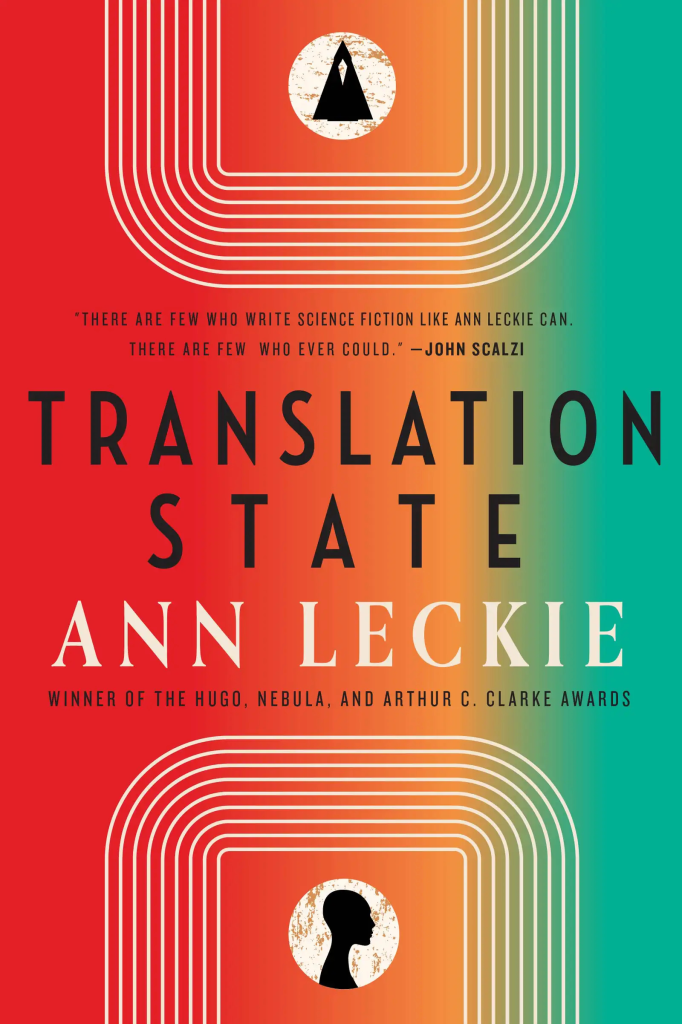
Translation State – Ann Leckie – cross-cultural confusion and characters with heart.

“Hideaway” – The Olivia Tremor Control

Having only heard one song (this one) from Black Foliage: Animation Music, I’ve already logged it into my slipshod mental list of album titles that perfectly describe the music they contain. The Olivia Tremor Control have always been masters of musical density, making soundscapes that unfold like intricate pop-up books, each layer of noise a painted paper cutout in an endless jungle. “Hideaway,” so far, is the pinnacle of that density; with each successive strain of woozy, turn-of-the-century homage to ’60s psychedelia, you’re pulled into a lush forest of plants that unfold just enough to let the tiniest slivers of light through. It’s not just the black foliage that hits the mark so fittingly—the “animation music,” as Will Cullen Hart called it, is “all the stuff floating around…To me, that’s what [animation music] is: sort-of a sound and space, personified—just flying around to greet you in a friendly way.” All at once, the xylophone chimes and trumpet blasts give “Hideaway” the feel of both the colored-pencil animations in Fantastic Planet and the bouncing characters in Schoolhouse Rock!, a papery and breathless expedition into a darkened forest of cartoonish proportions.

…AND A BOOK TO GO WITH IT:

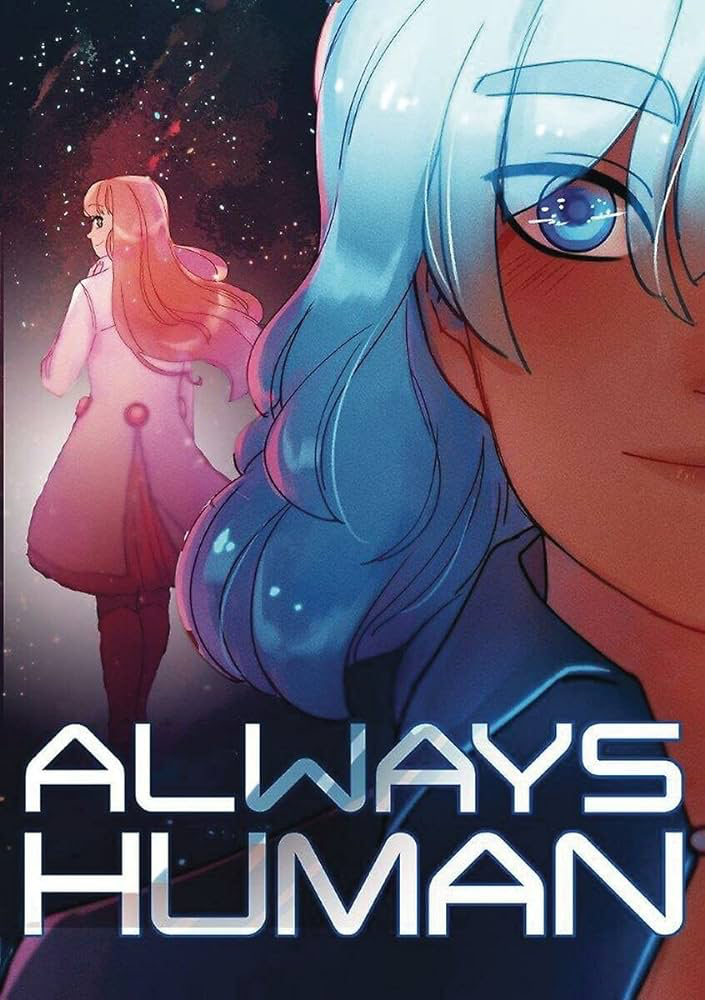
Always Human – Ari North simple, stylized art with vibrant colors—perfect for animation music.

Since this post consists entirely of songs, consider all of them to be today’s song.

That’s it for this week’s Sunday Songs! Have a wonderful rest of your day, and take care of yourselves!
Posted in Sunday Songs

Sunday Songs: 7/14/24

Happy Sunday, bibliophiles! I hope this week has treated you well.

This week: would you like a nice sci-fi in these trying times?

Enjoy this week’s songs!

SUNDAY SONGS: 7/14/24

“Future Teenage Cave Artists” – Deerhoof

I don’t think I’d be alone in saying that we were all feeling apocalyptic in 2020. Fitting that Deerhoof would put out this album in June of that year, a concept album about teenagers making art amidst the collapse of society. Not intentional timing, I’m sure, but maybe too raw all the same. I wonder what it must have been like to listen to Future Teenage Cave Artists during lockdown, but what I can glean is from listening to Horsegirl; on their episode of What’s In My Bag? (worth watching for this and Sparks, The Feelies, and Brian Eno, among others), this was one of the albums that they picked, and drummer Gigi Reece shyly showed off that they’d stitched “Deerhoof” onto the flap of their book bag. So, besides thanking them for their excellent album, Versions of Modern Performance, thank you to Horsegirl for turning me onto this all-consuming song!

The title of Future Teenage Cave Artists reveals exactly what the concept behind the album is: during the collapse of society, cruelty and murder runs amok, but amidst all of this strife, a band of nomadic teenagers hold onto hope and make art. “Future Teenage Cave Artists” is that mission statement made manifest. The whole album was reportedly recorded entirely on laptops and phones (hence the iPhone/tardigrade hybrid on the album cover, drawn by Deerhoof’s vocalist, Satomi Matsuzaki), and I never thought such a simple act could have enhanced the song so much. The shaky, distorted quality of the recording sells the dystopian setting, like we’re not streaming music, but listening to it on some ancient, warped tape recorder leftover from the age of man. It gives it an almost uncanny quality, as though you’re holding onto the last vestiges of this music, and that the battery life on your device is going to run out at any second. It’s so urgent in its hope that I can’t help but play it over and over—amidst this societal collapse, every lyric is a declaration of defiance and purpose: “Gonna paint an animal on a cave wall/Gonna leave it there forever while empires fall.” Concept song or not, I didn’t expect this song to strike such a deeply resonant chord with me; not only does this society feel like it might collapse at any second, but even if it weren’t, we’re surrounded by people who lambast any kind of art as a career—what are you gonna do with that degree? Are you even going to make any money off of that? And in our capitalist landscape, I do have to get myself some money, but it’s separated the real purpose of art from art, the job—threading a piece of your soul out into the fabric of the world, and making art that reflects your image of the world, making contact with a well deep inside (and outside) of yourself. “Future Teenage Cave Artists” is a defiant ode to the lasting, breathless joy of making art—upfront and urgent, and running on an engine of joy. You can’t get a much better rallying cry than what Matsuzaki fills the jerky outro with: “try my sci-fi!”

…AND A BOOK TO GO WITH IT:

This Is How You Lose the Time War – Amal El-Mohtar and Max Gladstonetwo lovers bent on making a mark in a world where individuality is all but gone.


“Sit” – Japanese Breakfast

Having the pretentious music taste that I do, I remember when Jubilee was everywhere in the summer of 2021. Persimmons, Jeff Tweedy covers, and rave reviews as far as the eye could see. Back then, I had a faint memory of hearing in interview with her on NPR sometime in middle school, but it was ultimately the combination of Jeff Tweedy’s cover of “Kokomo, IN,” my mom’s deep-dive into Michelle Zauner after reading Crying in H-Mart, and a friend’s video of Zauner playing “Paprika” with a massive gong on stage to finally give this storied album a try.

“Paprika” remains my favorite, but “Sit” came out of left field; in all of the shining praises of Jubilee, I never heard anybody talking about it. With its almost shoegazy distortion, humming and throbbing like a swarm of restless cicadas, Zauner’s voice pierces the haze like a lighthouse though the fog. Every lyric is spoken like a final message communicated from an ethereal barrier between dreams, the last words of a stranger your brain fabricated while you were sleeping that will haunt you for weeks afterwards. And like a haunting dream, Zauner sings of the memory of somebody that has clung to her with the strength of burrs, no matter how hard she tries to shake them away: “It’s your name in my mouth I’m repeating/It’s the taste of your tongue I can’t spit out.” They walk through her life with all of the transience of a hologram, a trick of the light that appears in every corner, in unexpected places with unexpected people. And what perfect instrumentals to meld with this; any sense of clarity only comes when Zauner is faced with the reality that she’s “caught up in the idea of you,” but as soon as it dips back into painful reminiscence, she’s consumed by the buzzing distortion, closing her eyes as she’s pulled back into the undertow of memory and fantasy. It’s a track with more weight behind it than most people seem to give it credit for. You can’t lift its impenetrable, stinging fog—the fog is the point.

…AND A BOOK TO GO WITH IT:

The Unbroken (Magic of the Lost, #1) – C.L. Clark“Caught up in the idea of someone/Caught up in the idea of you/That’s done too soon…”

“Sometimes” – Erasure

I’d posit that there’s almost no queer experience that is entirely universal, as the queer community is as multifarious as the identities that it encompasses. But one thing that I think most queer people can relate to is looking back on their life before coming out and thinking how did everybody not know I was gay? How did I not know I was gay? There’s an embarrassing amount for me, including but not limited to lesbian Barbie weddings and a pair of blindingly rainbow running shoes I wore almost daily in 6th grade. But the fact that I had such an extended Erasure phase when I was about 8 or 9…yeah, there’s no heterosexual explanation for that. That CD of Union Street that I briefly kept in my room and played on my Hello Kitty CD player was probably the first to catch on. The gays yearn for the synths.

I have nothing but admiration for Erasure, not just as queer icons, but for being so consistent in their musical exploration. Well…exploration probably isn’t the right word, since they’ve been making variations on the same sound since 1986. But never once has it seemed like they’re doing it out of trying to feel young or reliving fantasies of when they were at the height of their popularity. Andy Bell and Vince Clarke are just artists that were built for the late ’80s—nowhere else could they have flourished so vibrantly. The drama. The synths. The yearning, my god. They’re not just from the ’80s—they are the ’80s. They’ve been acting like it’s the ’80s for every single decade since, never once hopping on trends or changing their sound because they know exactly what they excel at. Listen to any song they’ve put out in the past 10 years, and it’s clear that they’ve still got it. But the cosmic alignment that placed Bell and Clarke in the late ’80s was beyond fate—nowhere else could you have “Sometimes”, with its lovelorn pining…and Andy Bell dancing in the pouring rain with a soaked white t-shirt. Does it get any better than that?

…AND A BOOK TO GO WITH IT:

The Lost Girls – Sonia Hartl angst, queerness, romance, and ’80s holdovers. (And vampires.)

“Annihilation” – Wilco

HOT WILCO SUMMER IS HERE!!! Well, it’s been here for about two weeks, but I’m stubbornly committed to these color schemes. But the weather right now is more akin to the Hot Sun, Cool Shroud we’re talking about, so there’s no time like the present. Urgh. I’m not sure much more of this 90 degree heat I can take…

Hot Sun, Cool Shroud – EP proves just how wildly versatile Wilco are. I can’t think of a single band active today that are not only as prolific as they are, but as consistent in quality—and creativity. The prickling apprehension and Nels Cline’s pipe burst of a guitar solo on “Hot Sun” feed straight into “Livid,” a chase sequence-ready metal instrumental that rockets through the air, ricocheting off the walls like a deflating balloon set loose, complete with a barrage of Galaga-like flourishes. “Inside the Bell Bones” has the quiet, uncertain clatter of frigid water dripping from a cave ceiling, and “Ice Cream” and “Say You Love Me” ground the EP to a more emotional conclusion.

But I keep coming back to the chainlink that ties all of these vastly different songs together—”Annihilation.” Next door to “Ice Cream,” it kicks off the second half of Hot Sun, Cool Shroud, returning to a classic kind of Wilco that tugs a particularly tender heartstring. Even if it doesn’t have the sheer gut-punch of “Say You Love Me,” it reminds me of the more grounded moments of The Whole Love. Unlike “Livid”‘s riotous tailspin, this track spirals through the clouds, kept afloat by the wings of love: “A kiss like this/Is endless tonight/This kind of annihilation/Is alright.” Jeff Tweedy’s vocals bring another lyric of his to mind, from 2019’s “Hold Me Anyway”: “light is all I am.” There’s not an oomph behind it, like his voice often has, but this song is so airy and urgent that it can’t be sung any other way. Tweedy described the soundscape of Hot Sun, Cool Shroud as “a summertime-after-dark feeling…All the pieces of summer, including the broody cicadas,” and that makes the lovestruck urgency of “Annihilation” make perfect sense: it’s a secret kiss under the boardwalk as the sun goes down, the lights of the carnival slowly dying as the setting sun sets the sky alight. In that moment, there is nothing but the moment, in all of its humid, breezy warmth.

…AND A BOOK TO GO WITH IT:

The Kindred – Alechia Dow“We’re boiling angels/Let’s kiss for hours/Equal power/Let’s make it art/This kiss is ours…”

“Old Lady City” – Shakey Graves

I’d all but forgotten about “Old Lady City” since I first listened to Deadstock: A Shakey Graves Day Anthology, and it seems that…judging from the lack of lyrics anywhere (which on the internet, the manifestation of too many people with too much time on their hands, is a rarity), so did everyone else. Tough crowd. But it’s so unlike any other Shakey Graves that I’ve heard, not even on Movie of the Week. Shakey Graves has never been afraid of being spooky, but this is a kind of off-kilter eery that he didn’t stray towards until now, or however long ago this was originally recorded. Maybe it was too risky to put it on an album for this reason, but this grittier, spookier side is one that I thoroughly enjoy. With vocals by Buffalo Hunt (Alejandro Rose-Garcia’s wife), “Old Lady City” is a scorched, rickety ball of spikes, no edges sanded down. In between twisted strains of nursery rhymes, purposeful breathing, and Buffalo Hunt’s cartoon witch-like cackle, the lo-fi recording makes for a crunching, off-kilter interlude. Rose-Garcia’s vocals are almost nowhere to be seen, but they float in ghostly tendrils in between the splinters, burnt paper, and charcoal of this B-Side.

…AND A BOOK TO GO WITH IT:

The Library at Mount Char – Scott Hawkinsa raw and rickety story that’s more than its appearances let on, just like its protagonist. (Doesn’t hurt that the book cover matches the feel of the song too.)

Since this post consists entirely of songs, consider all of them to be today’s song.

That’s it for this week’s Sunday Songs! Have a wonderful rest of your day, and take care of yourselves!
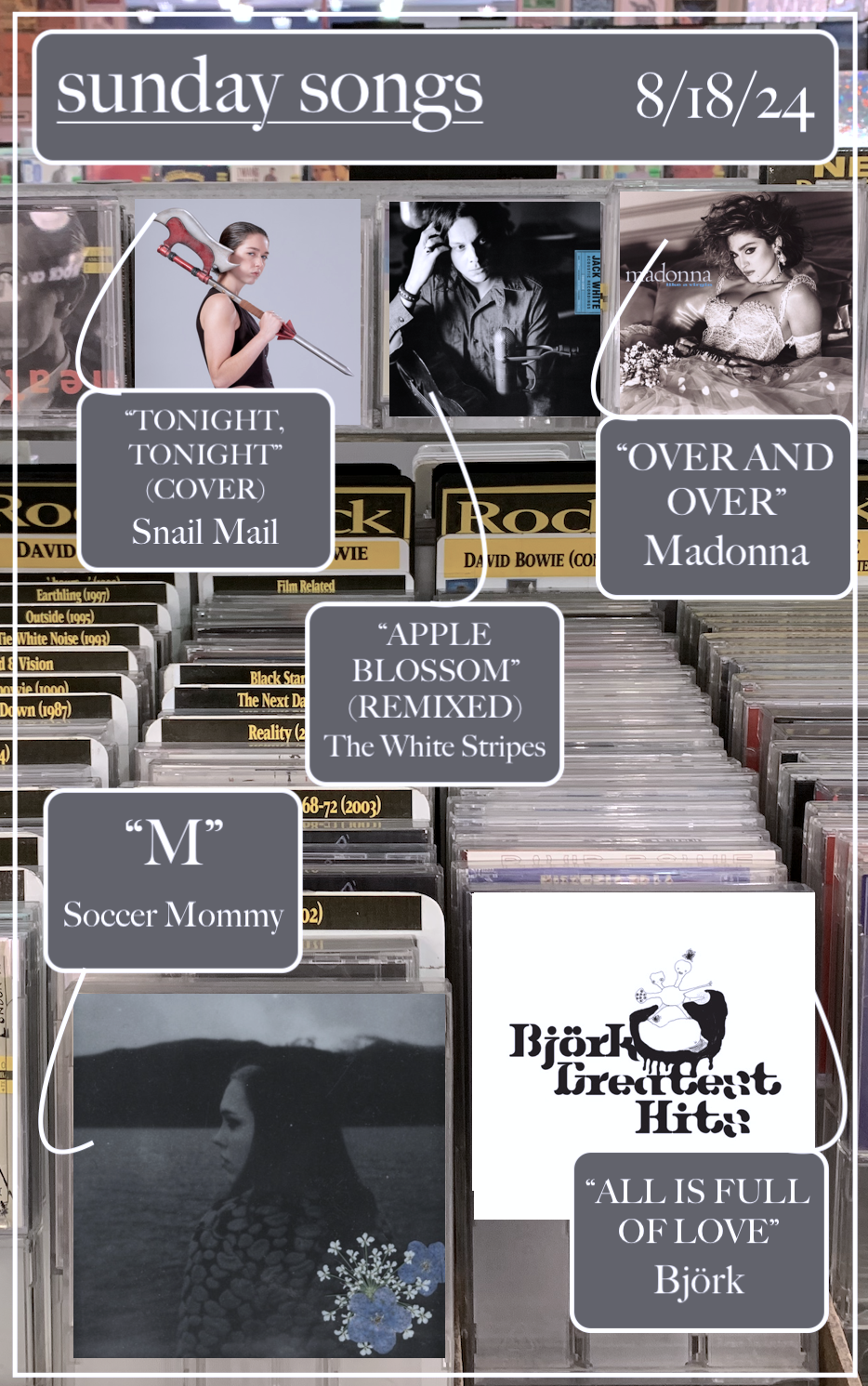
Posted in Sunday Songs

Sunday Songs: 7/7/24

Happy Sunday, bibliophiles! I hope this week has treated you well.

This week: it’ll be two years of making these Sunday Songs graphics in a few days (!!), but I haven’t had many purple color schemes in all that time…enjoy the purple while it lasts. Also, I talk about movies that I haven’t seen and albums that I haven’t quite seen.

Enjoy this week’s songs!

SUNDAY SONGS: 7/7/24

“Claw Machine” (feat. Phoebe Bridgers) – Sloppy Jane

Here I am, an absolute poser, posting this without having seen I Saw the TV Glow. I’m a simple woman. I saw Phoebe Bridgers and Jay Som on the soundtrack and immediately downloaded both songs without knowing any of the context apart from Lindsey Jordan being in her first acting role (I’m lovingly suspicious of her acting abilities, but that shot of her with an axe in the trailer is top-tier), and that “Claw Machine” plays in the opening.

The opening? Is Jane Schoenbrun trying to eviscerate us before the movie even begins? For everyone who’s soldiering through the boygenius hiatus: fear not! Phoebe Bridgers, along with Haley Dahl (aka Sloppy Jane, who Bridgers formerly played bass for) have come to emotionally derail your summer. “I think I was born bored/I think I was born blue/I think I was born wanting more/I think I was born already missing you.” Oh! Good to know that I won’t survive 10 minutes of this movie if I eventually watch it! Yippee!

…AND A BOOK TO GO WITH IT:

Freshwater – Akwaeke Emezi“Your heart is like a claw machine/Its only function is to reach/It can’t hold onto anything…”

“World Shut Your Mouth” – Julian Cope

It takes a certain kind of person to have the guts to name their album Saint Julian, but thankfully, it’s not entirely Julian Cope’s fault. Before this album’s release, his record label was intent on Cleaning Up His Act™️ and making him into their idea of a rockstar, thus: the leather, the haircut, and constantly looking like there should be a vine boom whenever the camera lands on his face. It was the ’80s. Comfortingly, the song “Saint Julian” is about his frustrations with god, but to be fair, anybody who can cover Roky Erikson’s “I Have Always Been Here Before” so heartwrenchingly deserves the saint title.

The ’80s never gave Cope the praise he deserved, save for some alternative hits. Crazy, given the fact that after Saint Julian came around, he’d basically become the unacknowledged father of Britpop. Everybody mentions The Kinks (obviously) and The Smiths as some of the progenitors of the genre, but where’s the love for Julian, who basically molded Parklife’s guitar-heavy confidence seven years prior with “Shot Down”? The clean, punchy guitars? The tongue-in-cheek lyricism? Even the look, even if it was more on the part of the record label than Cope himself—there’s no denying Damon Albarn and Jarvis Cocker took plentiful notes, chiseled cheekbones and all. Regardless of whether people will remember that, at least they’ll remember that he could pen a perfect pop song. Oiled and sleek as a new car, it oozes confidence more than Cope’s fabricated persona ever could. He didn’t need to get his hair did to have the gravitas to belt “World, shut your mouth/Shut your mouth/Put your head back in the clouds and shut your mouth,” just like the song’s unnamed protagonist who “[flies] in the face of fashion.” Complete with a mic stand that Cope could climb up and spin around on, it’s the side of the ’80s that I wish lingered—the slickness combined with clever turns of phrase thanks to the likes of Cope. Even if Cope resented the attempts to make him into a pop star (understandably so), there’s no denying that, at the height of his powers, he could write a perfect pop song. Good for him, though. Presently, he’s out living his best life and writing about Stonehenge and rock history. Go off, king.

I suppose all this means is that I selfishly get to gatekeep Julian Cope while cursed with the knowledge that he may get the praise that he deserves. I’ll Cope. I’ll Julian Cope—[gets dragged off stage by a comically large cane]

…AND A BOOK TO GO WITH IT:

Cloud Parliament – Olivia A. ColeBold confidence abound—the kind strong enough to avenge the dead and bring entire industries to their knees.

“Supersad” – Suki Waterhouse

After a string of recent singles, Suki Waterhouse has announced her new album, Memoirs of a Sparklemuffin, out this September. I have to say…oh, god, that’s a painful album title. It sounds like the kind of thing you’d come up with at age 10 when asked for the title of your hypothetical autobiography. It feels like something that would be printed on a Justice shirt with kittens wearing sunglasses and enough glitter to blind a person at short range. Yeesh. But there is a method to the memoir; Waterhouse named the album after a species of Peacock spider from Australia (I wonder if the scientist who nicknamed it “sparklemuffin” regrets it…at least it’s just a nickname): “I came across the Sparklemuffin—which is wildly colored, does this razzle-dazzle dance, and its mate will cannibalize it if she doesn’t approve of the dance. It’s a metaphor for the dance of life we’re all in. The title felt hilarious, ridiculous, and wonderful to me,” she said to Rolling Stone. My verdict? Still a yikes album title, but at least there was thought behind it…?

The newest single, however? A joyous summer bop, to say the least! For Waterhouse, this has a slight rock edge, but undeniably remains the indie pop that she’s begun to polish. Strung together with “My Fun,” it’s clear that Memoirs of a Sparklemuffin centers rediscovering joy and healing at the forefront; “Supersad” is an anthem to hauling yourself out of bed, letting go of what you can’t control, and embracing fun in all of its forms: “Could be the worst time I ever had/Lose my mind, always get it back/There’s no point in being supersad.” Stagnation and sadness aren’t just detrimental to your health—at the end of the day, it always feels so boring to me, even if, in the moment, I can’t do anything to do it. And there’s a multitude of things that are way out of your control! No matter how long it takes to get yourself out of the funk, it’s temporary—and there’s no point in being supersad. Life is short.

…AND A BOOK TO GO WITH IT:

The Many Half-Lived Lives of Sam Sylvester – Maya McGregorLeaving old ghosts behind to turn over a new leaf—and find love.

“Santidalang” – Master Peace & Santigold

My mom and I are very similar people in a number of ways, but one of the ways that we hadn’t acknowledged until now is that we’ll see a song with Santigold on it and immediately hit download. It’s Santigold!! Who wouldn’t?

Named “Santidalang” in acknowledgment of the aforementioned legend, this track is a slight reworking of Master Peace (ba-dum tssssss)’s “Shangaladang” from his debut album, How to Make a Master Peace (ba-dum tsssssssssss). For someone who frequently cites LCD Soundsystem as one of his primary influences, what I’ve heard of his music is far from the uptight rhythms that I associate with James Murphy. What he’s taken from him, along with several other indie and dance acts from the 2000’s, is a neat rhythm—it’s a box, when you look at it from afar, but one that’s large enough to allow Master Peace a spacious environment to dance. Even amidst the pressing issues of the lyrics, “Santidalang” never stops being carefree; the opening is delivered with a defiant “ha-ha,” and lines like “The police wanna arrest me and my mates/I’m just wanna get myself some good grades/My mom told that she’s gonna send me away” with the goofy ring of a flexatone in the background and a smile that you can hear through the music. Like Santigold, it’s a grinning middle finger to those who would put him in a box and an assertion of joy in spite of it all. That’s why it’s so perfect that Santigold is featured on this finger after championing a similar mentality of joy and self-love in spite of societal expectations. Santigold bursts into an already vibrant track with her signature confidence, immediately claiming the space as hers. Like Master Peace, her smile and persistence cuts through the track like rays of sunshine: “Try to hold me down/I fight the power with my fist up.”

It’s easy to imagine that both Master Peace and Santigold had an absolute blast recording “Santidalang,” but it seems this picture only confirms it:

…AND A BOOK TO GO WITH IT:

A Song of Salvation – Alechia Dow – Defiant love and joy in the face of a universe that wants our heroes dead.

“Freefall” – Björk

Once I hit a valley in my Sisyphean Album Bucket List, I’m due for revisiting Fossora. When it was released almost two years ago, I liked it, but I felt like I didn’t fully get it. Björk is about as out there as out there can get, but even for me, it felt impenetrably so, like she’d ascended to a higher plane of being that us mere mortals couldn’t dream of reaching. Is that still true? It’s Björk, of course it is. But the more I listen, the more the ice melts—it’s not that I never liked Fossora, but for me, its merits become more evident the more time you spend with it. A way-homer, if you will.

I’d forgotten all about “Freefall” in the dust, and in retrospect, the fact that I listened to Fossora while I was figuring out how college works didn’t do wonders for remembering this album—or interpreting it. In Björk’s quest to become the all-knowing fungus queen, she remains as attuned to the surreal thrill of love as she was on Vespertine. Even in the wake of the tumultuous divorce with Matthew Barney (cheating is reprehensible on its own, but IMAGINE CHEATING ON BJÖRK, MY GOD), she has still found time to reminisce about the coalescence that the best relationships produce: “I let myself freefall into your arms/Into the shape of the love we created/Our emotional hammock/Safe inside the fabric of our love-woven membrane.” Of course she refers to it as a membrane, but it’s one of my favorite lyrics; saying that she’s attuned to nature and her body is an understatement—even in such a yearning song, she feels more whole than ever. Love as a fleshy, beating membrane, something to curl up inside like a vital organ (or a cocoon, even), evokes what most songs could not touch with multiple verses. Even if Björk drinking the water of life and willingly being consumed by the fungus has made her music more esoteric than it already was, what strikes me about “Freefall” is that she has such a human understanding of love; not necessarily in the sense of the soul, but in the sense of the sensation of warmth and the bodily joy of watching your heart tie itself to another and merge.

…AND A BOOK TO GO WITH IT:

The Darkness Outside Us – Eliot Schrefer“Our joined presence gains form/Our affections captured in a structure/Visceral sculpting of our love into space…”

Since this post consists entirely of songs, consider all of them to be today’s song.

That’s it for this week’s Sunday Songs! Have a wonderful rest of your day, and take care of yourselves!
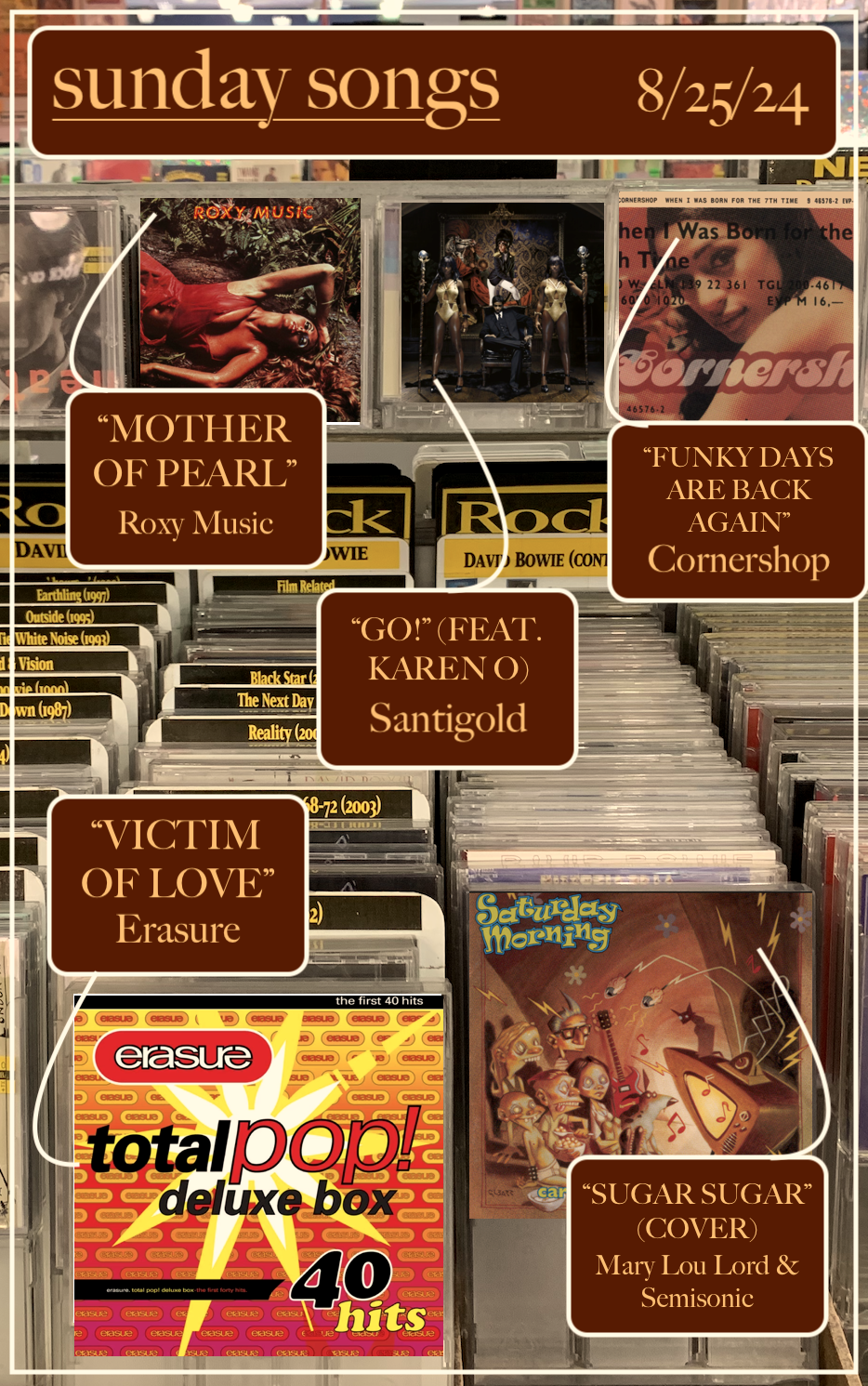
Posted in Sunday Songs

Sunday Songs: 6/30/24

Happy Sunday, bibliophiles! I hope this week has treated you well.

This week: this ain’t rock n’ roll…

Enjoy this week’s songs!
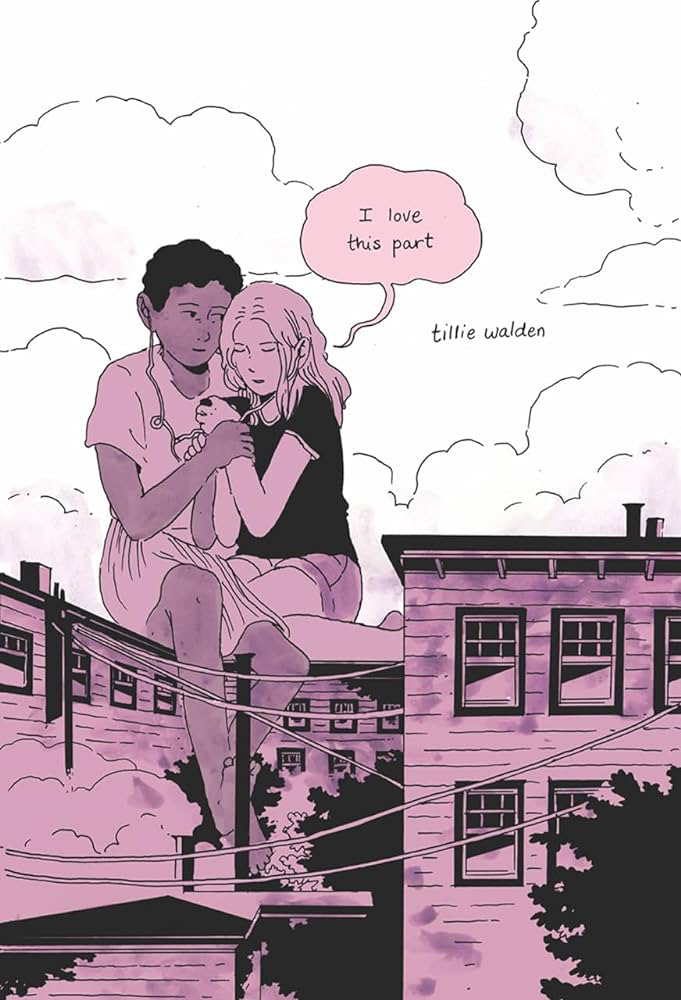
SUNDAY SONGS: 6/30/24

“Future Legend/Diamond Dogs” – David Bowie

Another victim of me trying stubbornly to fit this into a color scheme, and also a victim of me trying to align my albums with what I draw on the whiteboard of my dorm. Listen, if the original sleeve was banned in the U.S., that generally means it’s a cool album cover, but probably not a good idea to be displayed for the world and my RA to see. And I was not about to draw David Bowie’s anatomically accurate canine lower half. Nah.

A time-proven rule: nobody does it like Bowie. You can put on all of the theater and spooky voices that you like, but nobody will ever replicate the sheer goosebumps that the intro to this album induces. The same can be said for many songs on this album (see: “Sweet Thing/Candidate/Sweet Thing [reprise]”), but I put “Future Legend” and “Diamond Dogs” together because the most enriching way to experience them is to experience them as a single song, and that single song is one of my favorite album intros of all time. Diamond Dogs is glam rock covered in flies—the lovelorn hope of Ziggy Stardust remains, but stinking of a world left in tatters, a hunk of rotting meat left for the mutant vultures in the searing desert heat. Cobbled from shreds of William S. Burroughs and Bowie’s failed attempt at a musical adaption of 1984, this album is a dystopia full of lust and peril. As a prologue, “Future Legend” is the height of Bowie’s theatricality. On anybody else, a dog’s howl, distorted as though bellowed through a plastic tube would feel like a feeble attempt to set a scene. Bowie, of course, makes it into the most bone-chilling alarm bell signaling the beginning of the end. It’s not the kind of sound any normal dog makes— it immediately triggers a sense of uncanny valley, a hair’s breadth away from being distinctly, evolutionarily wrong. His staticky narration is accompanied by synthy moans and high-pitched, delirious singsong beasts echoing “love me, love me!” as he tells of an alien landscape where all that remains of the 20th century is the excess it produced, the last monoliths that the mutant survivors of some horrific extinction now cling to. Panting dogs and drooling bloodsuckers lick their lips in the distance as Bowie lifts the curtain to declare this an era beyond the collapsed remnants of our sense of time. No month, no four-digit number to designate this hellscape: it is the year of the Diamond Dogs.

And “Diamond Dogs?” Hearing it for the first time while freshly 13 rearranged my molecular structure. In that moment, nobody had ever done anything as cool as that. It’s still true.

Because there will never be another album intro like this:

And in the death, as the last few corpses lay rotting on the slimy thoroughfare,
The shutters lifted in inches in Temperance Building, high on Poacher’s Hill
And red, mutant eyes gaze down on Hunger City.
No more big wheels.

Fleas the size of rats sucked on rats the size of cats,
And ten thousand peoploids split into small tribes,
Coveting the highest of the sterile skyscrapers like packs of dogs assaulting the glass fronts of Love Me Avenue,
Ripping and rewrapping mink and shiny silver fox, now legwarmers.
Family badge of sapphire and cracked emerald.
Any day now…
The Year of the Diamond Dogs!
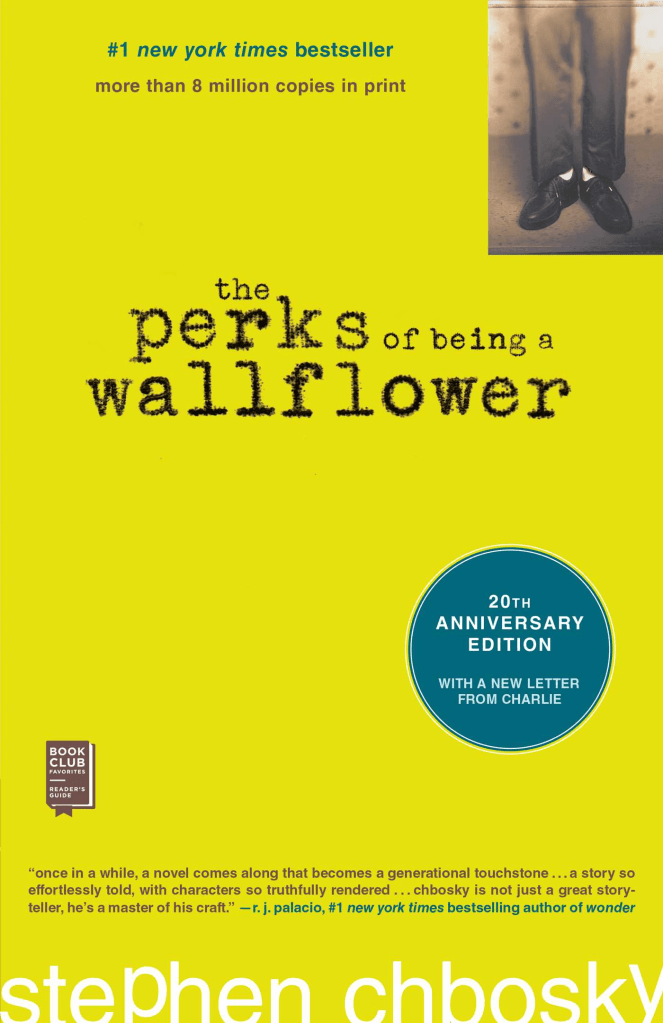
…AND A BOOK TO GO WITH IT:

1984 – George Orwellneed I really explain this?

“On Repeat” – International Teachers of Pop

In terms of Co-Pilot, I end up focusing. more on Jim Noir, which…well, he has played a very prominent part in my musical life, but Leonore Wheatley’s musical ventures rarely get the praise they deserve. Wheatley’s talents extend to The Soundcarriers (big thank you to my brother for introducing me to them!), Co-Pilot (who released their incredible album Rotate almost a year ago!! Make some noise!!), and International Teachers of Pop, where she provides vocals alongside Katie Mason.

I’ve heard far too many bands who desperately want to market themselves as a second-coming of a certain era of music (We haven’t recovered from what Stranger Things did to shove the ’80s in everybody’s faces…I want out), but only end up sounding like plastic imitations. The key, which this school board of musicians has figured out, is not to set out to imitate. This sounds like a product that emerged from a desire to have fun and make catchy dance-pop and not try and sound like somebody more famous. Fun should be the prime motivation to make music, especially in a side project like this, but the bar’s low in such a hit-churning industry. You can hear Erasure and the Pet Shop Boys in every synthy buzz and flourish, but not because they set out to sound like them—it’s an homage, never an imitation. Mason and Wheatley’s harmonies center this pulsating track, built for booming bass and bouncing feet. (It really was a shame to see how lukewarm the crowd was in the video above—why are they barely dancing??) With lyrics swimming between existential dread and a desire for oblivious joy, “On Repeat” is the product an extensive pop study. Maybe the name is a touch presumptuous, but they’ve got the talent to back up their assertion, tongue-in-cheek or not.

…AND A BOOK TO GO WITH IT:

Machinehood – S.B. Divyaooh! aah! capitalism! woo! woo! yeah! this economy cannot sustain human life! get funky!

“I Won’t Tell” – Conlon & The Crawlers

Listen, I am BEGGING the Hacks fandom to do their stuff, because I can’t keep looping this song over and over on YouTube, and I don’t have a record player and therefore have no reason to snag the copies lingering on eBay…PLEASE. WE NEED TO GET THIS ON STREAMING. WHATEVER IT TAKES. DO YOUR STUFF!!!!!

“I Won’t Tell” was one of two one-off singles (the other being “You’re Comin’ On”) by Conlon & The Crawlers, an offshoot of The Nightcrawlers (top 10 band names that I totally want to steal for reasons that are totally not X-Men-related). From the looks of it, neither song went anywhere, and now the only remnants are floating around on eBay, and, thanks to some digging, a few eagle-eyed people on YouTube. All of this begs the question: how were they able to get this on Hacks? Somebody’s got a great record collection…unfortunately, the scene isn’t on YouTube, but it appears in Season 3, Episode 6, and briefly soundtracks a hilarious slo-mo of Ava and Deborah on a golf course, with Ava confidently strutting beside Deborah with her caddy vest on backwards.

The minute I heard it, I knew I had to hunt it down—it encapsulates a very distinct sound of the late-’60s that I just adore. It’s just deliciously jangly, from the opening riff (a reworked and arguably improved version of the opening to The Nightcrawlers’ “Little Black Egg”) to the almost banjo-like strum that builds the track’s backbone. Chuck Conlon’s butter-and-sugar voice spins the strings of “Little Black Egg” into a precocious, peculiar masterpiece—who would forget a song that opens with “A teaspoon holds more than a fork does/A long snail eats more than a short one?” This vibrant, jangly oddball is practically asking to be used for a tightly-shot Wes Anderson montage. Surely it’s obscure enough for him…

…AND A BOOK TO GO WITH IT:

Floating Hotel – Grace Curtislighthearted, jaunty, and equally matched on the Wes Anderson vibes front.

“A Million Times” – Lisa Germano

I’m not sure which direction I should go for next in terms of Lisa Germano’s discography. She has nine studio albums, two of which I’ve already listened to (Excerpts from a Love Circus and Slide). I know I’ll feel like a kicked puppy lying on a dirt road in the middle of nowhere after I listen to any given album, so chances are, it probably doesn’t matter where I start. Either way, on a whim, I dipped my toes into a handful of songs from her 2009 album Magic Neighbor. Many of the reviews have categorized it as having a childlike innocence juxtaposing the veil of darkness that never lifts from her discography, and there’s tangible strings of it stretched throughout. Even if you’ve dictionary-definition Been Through It like Germano has, I feel like you’d still have to have at least the tiniest mote of innocent glee—or humor—left in your soul to name a song “Kitty Train,” even if it’s a short instrumental break.

“A Million Times” has a childish glint to it, but childish here translates to complacency and toxicity; it feels like the emotional progression of “Small Heads,” musically twelve years down the line, but personally, only a handful. (At least…I hope so. I can only hope that the abusive bastard who inspired her to write any of the songs from Love Circus is just one guy, and that he got his comeuppance.) “Small Heads” acknowledges how unhappy she is in said relationship, but wryly admits that it’s not all the other party’s fault: “How convenient to forget/All the lies that you say/When you’re really really drunk…like me.” It’s a mutual kind of tangling, with both people ouroboros-ing themselves into their own minds so deeply that they’ve ceased to think of each other (“Did I ever think of you?/Did you ever think of me?/Probably not, with our heads in the clouds”), or, as Bowie might put it, “making love to [their] egos.” It’s all just fun and games, right? Whee! “What a lonely life!” she sings to the cheer of the crowd and dainty recorders.

Such fun and games echo through “A Million Times.” Said recorder has made a comeback, and all of the egg shakers and brushes in the background sound like remnants of rusty toys being disassembled. Just as childlike, Germano tosses the relationship across the room like a discarded doll, letting its limbs crumple now that she’s had her fun: “We fell in love and we were caught/Inside this game we call together/And it felt good until we found/We had more fun when we were strangers.” Every motion they go through is described in the same way that Ken tells Barbie “we’re girlfriend boyfriend,” smashing doll heads together to simulate kissing. Such kisses and games are a distraction from the inevitable implosion of their excuse for love—they’re so caught up in performing love that both of them have retreated into their own heads, convincing themselves, over and over, that they’re not sick of playing. It’s self-aware in the way that an arsonist is self-aware: they know that they’ve just burned down a building, but they’ll continue to set as many fires as they like. Germano seems to regress as she drags out her cry of “You can’t leave me/No, not really/We are happy with this misery/So we’ll start it all again/A million times, a million times.” Never before have I heard an accordion that sounds so distinctly ominous—the bellow of it as Germano’s lyrics get progressively poisonous might as well be the siren in a bomb shelter, a low, distant warning of disaster to come. “You can’t leave me” is simultaneously the rug of innocence being pulled out and the dread of pulling apart from someone who you know will collapse without you to parasitically cling to. Platonically, I’ve been the host/discarded toy in such situations, so for my sake and hers, I hope Germano’s since quit playing with her dollies. I’m willing to give her some leeway, since if she’s played up the eerie overtones in this song, she recognizes these patterns for the toxic mess they are.

…AND A BOOK TO GO WITH IT:

The Emperor and the Endless Palace – Justinian Huang“We fell in love and we were caught/Inside this game we call together/And it felt good until we found/We had more fun when we were strangers…”

“Feet-like Fins” – Cocteau Twins

Rounding out the month with yet another Cocteau Twins song…sorry, everybody. Get Victorialand‘ed, I guess. The only thing keeping me from swallowing this album in one gulp like some kind of deep-sea abomination of god is knowing that this is the perfect album for winter, what with the Artic and Antarctic inspiration.

Situated near the end of the album, “Feet-like Fins” is a dewy spiderweb of reverb that glitters in waning sunlight through gray clouds. Crested by soft cymbal crescendos, you can never pick out a note from the track that isn’t vibrating like raindrops on a speaker. Even the bongos that gently steady the melody never truly feel percussive, nothing but droplets sending ripples out into the frigid water. Like “Aikea-Guinea,” “Feet-like Fins” is distinctly watery, but where the former feels like being tossed through the waters of time, this track is a gradual descent into the ocean, watching the last threads of silky light disappear into the shallows as you’re pulled downwards. Judging from the “Frozen World,” Living Planet-inspired patchwork of the album, the feet-like fins likely belonged to the various seals that appear throughout the episode: crab-eater seals, fur seals, and elephant seals; Indeed, the sleek movements of this track mirror their bubble-trailing paths through the water as they hunt for prey.

…AND A BOOK TO GO WITH IT:

Lagoon – Nnedi Okorafora mysterious, alien lifeform stretches its feelers and emerges from the ocean…

Since this post consists entirely of songs, consider all of them to be today’s song.

That’s it for this week’s Sunday Songs! Have a wonderful rest of your day, and take care of yourselves!