
Happy Sunday, bibliophiles! I hope this week has treated you well.
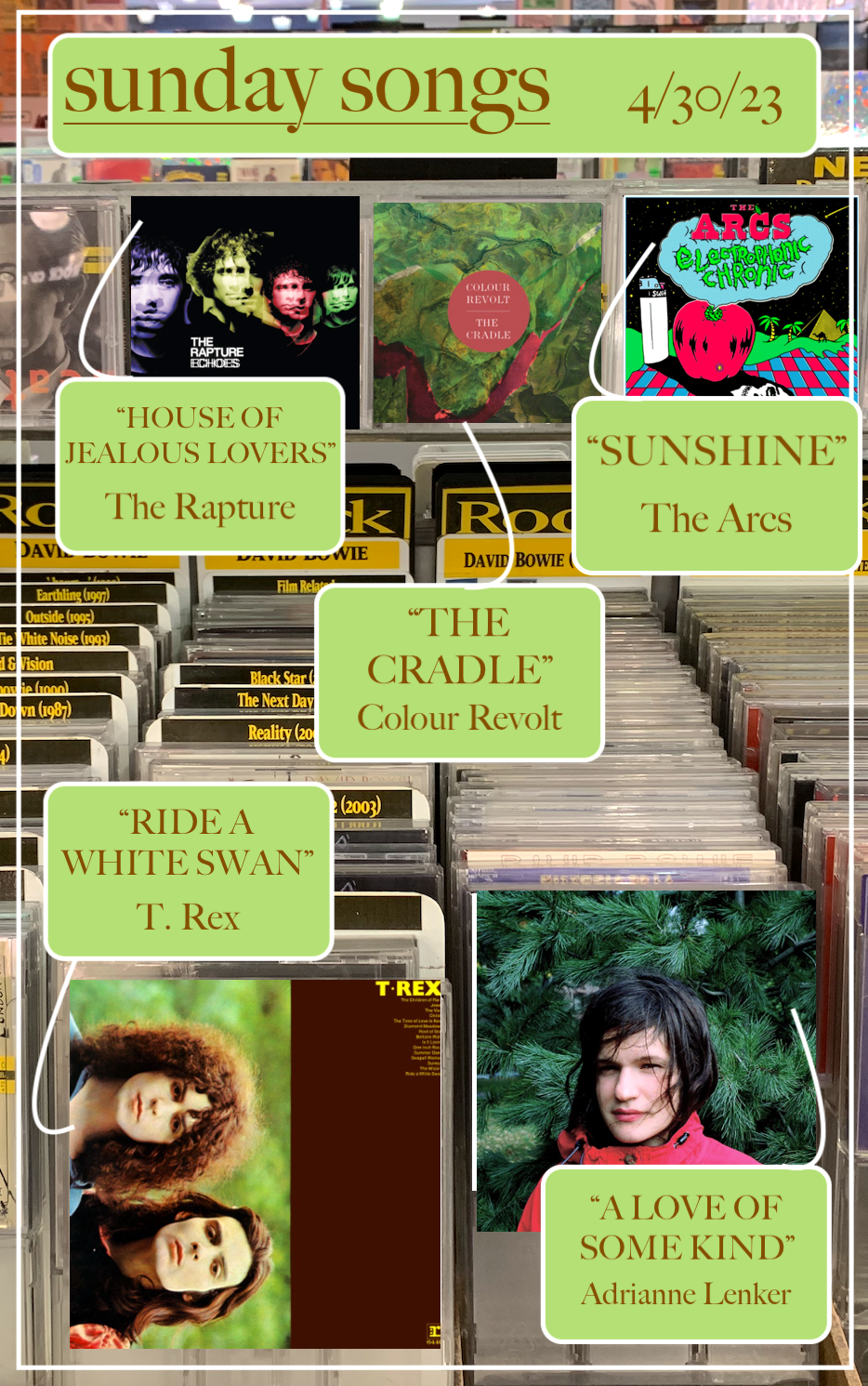
Apologies for the lack of a Sunday Songs last week and a Book Review last week—midterms are one helluva drug. Either way, I have been able to read some fantastic books, so expect a fun review next week. For now, here’s my graphic from last week:
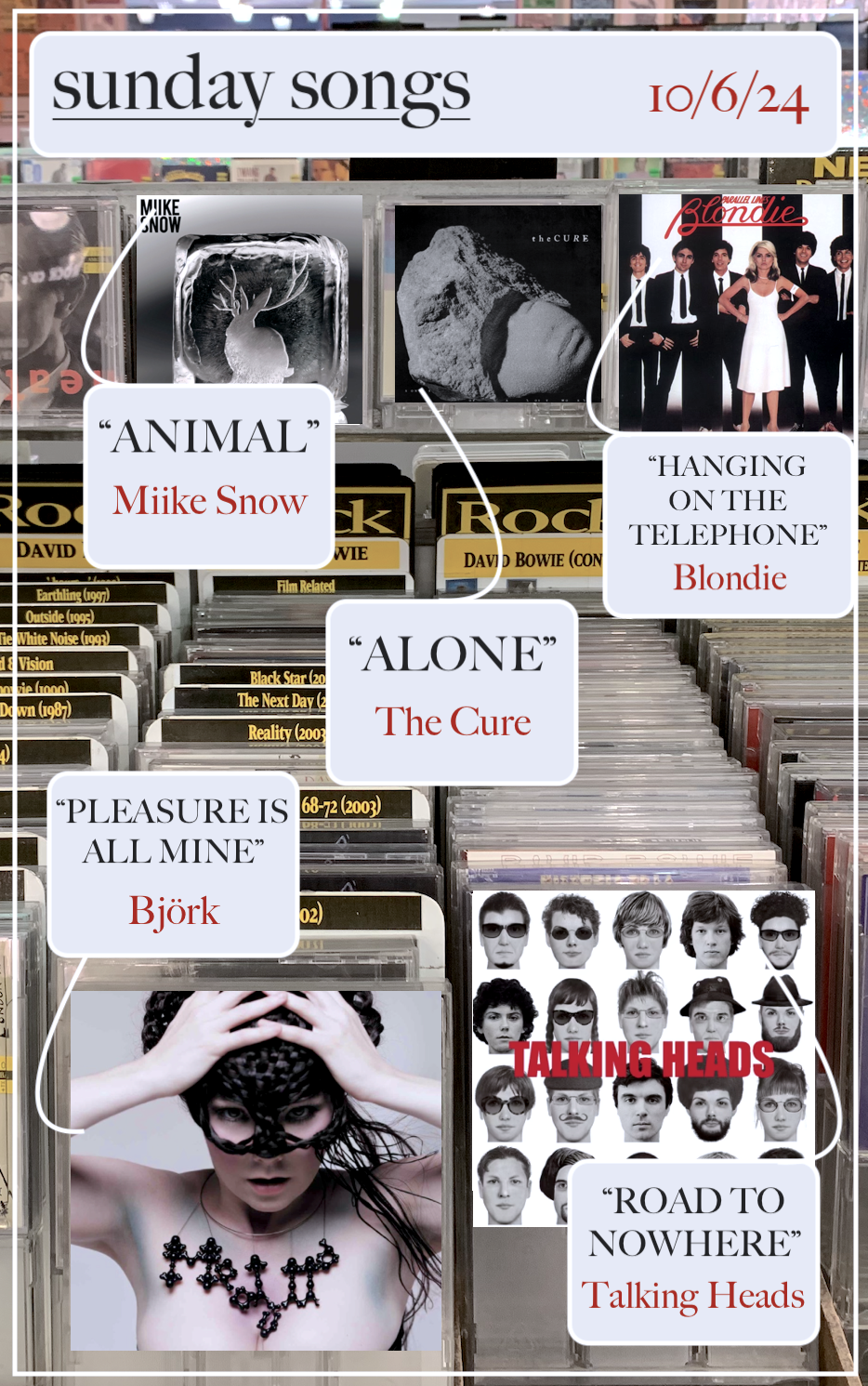
10/6/24:
- “Pleasure Is All Mine” – Björk
- “Road to Nowhere” – Talking Heads
- “Animal” – Miike Snow
- “Alone” – The Cure
- “Hanging on the Telephone” – Blondie
This week: MOM!!! MOM, MADELINE’S GOING AFTER THIN WHITE DUKE APOLOGISTS AGAIN!
Enjoy this week’s songs!
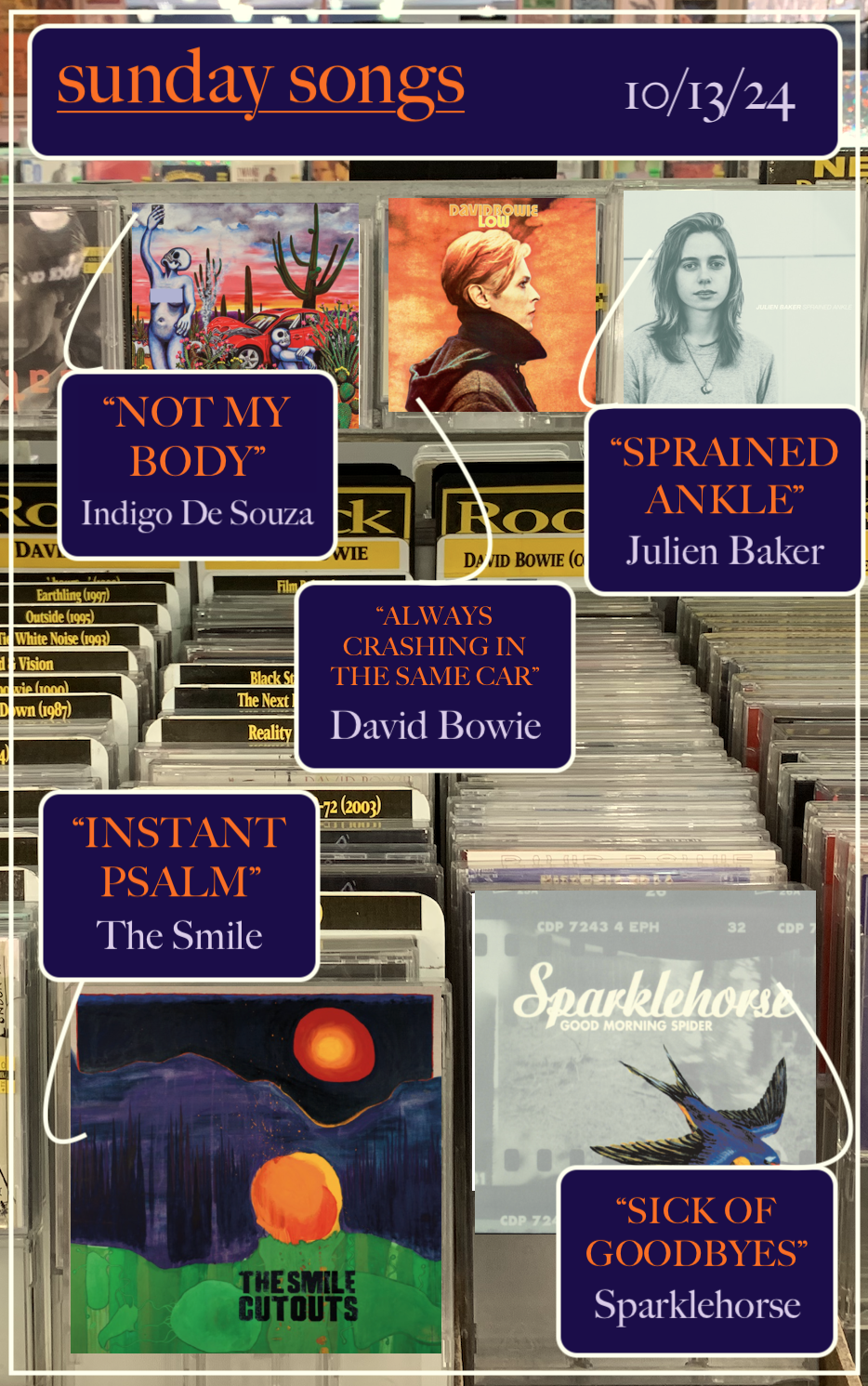
SUNDAY SONGS: 10/13/24
Unprecedented opinion by me: Cutouts, the second album from The Smile in 2024, was…a slight disappointment. Are all of the songs good? Absolutely—this is The Smile we’re talking about, remember? And yet, even though the talent is all there, well-crafted songs don’t make up for an album lacking in cohesion. If they knowingly named the album Cutouts for this reason, it might make sense, but it really does live up to the name; these are the scraps, but for a band as artfully skilled as The Smile, the scraps will be treasures. Even if Cutouts meanders this way and that without the direction of A Light for Attracting Attention, the moving parts are spectacular.
Take “Instant Psalm.” I love when I just have the gut feeling of knowing that a song will rearrange my molecules after only listening to a 30-second snippet of it. From the minute the strings sunburst into existence, you feel that light blooming in the back of your mind. To say that this song only starts would do it a critical injustice: it awakens in the same way a flower does, the same way a cloud of spores puffs from a stomped mushroom, all of its glistening tendrils erupting in slow motion after the joyous moment of birth. “Instant Psalm” lyrically contains about the same existential dread as any other The Smile track, but I’d place it somewhere near “You Know Me!” in terms of siblings; these glistening tendrils have heralded the manipulation that the former track ushered in, and now, all is left is a kind of mental automation where your mind knows that what it’s doing is wrong, but cannot let go of what’s coiled around it: “yes is not a real yes.” It’s so calm in its submission, and that “Instant Psalm” feels like sparkling dust blown into the eyes, the kind that clogs them up enough that they no longer see reality. If there’s anything highly specific that The Smile has excelled in, it’s making songs about submitting to corrupted, outside forces sound so soothing and sleepy. Again: precisely the point.
…AND A BOOK TO GO WITH IT:
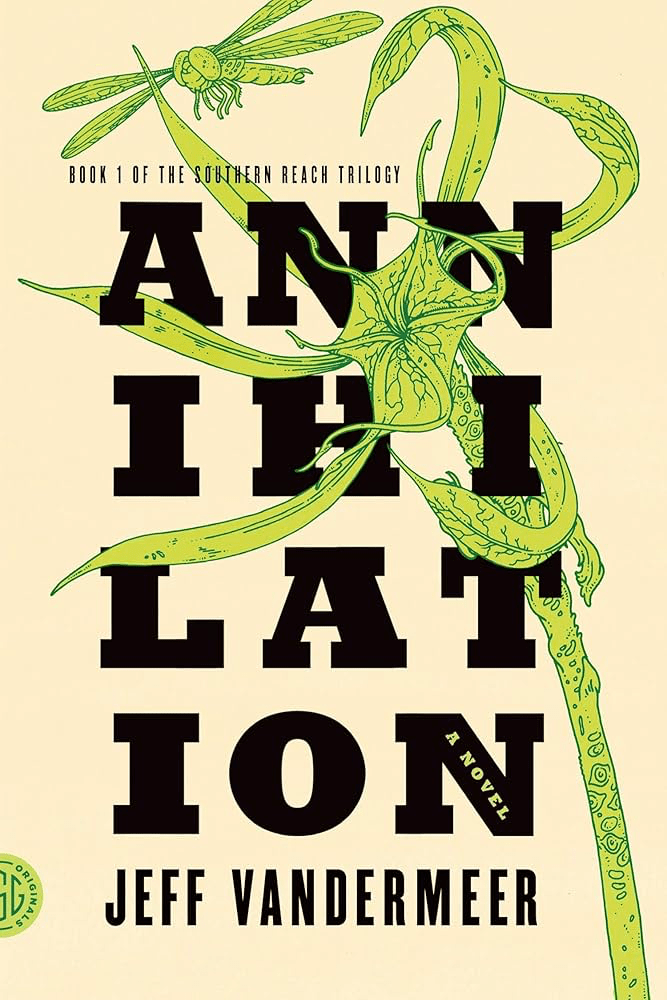
Annihilation (Southern Reach, #1) – Jeff VanderMeer – “We can slide through this narrow gap/The narrow gap that you leave us in/And we feel you near/But so close that you disappear…”
“Sick of Goodbyes” – Sparklehorse
Listening to It’s a Wonderful Life prompted me to return to one of my many depressing high school lovers: Good Morning Spider, the album that preceded the former. I thought “Sick of Goodbyes” was okay back then, and given how much I suckled on that album like a baby bottle, “okay” is harsh. Compared to the irresistible draw of the melancholy of “Sunshine” and the adrenaline-blooded screech of “Pig,” this one stuck out like a sore thumb. Why is it so twangy? And my God, is it actually…upbeat?
To be fair, it really does stick out oddly in Sparklehorse’s catalogue, and for how odd Sparklehorse sounds, that really is saying something. It somehow lies at the crossroads of alt-country and punk, where scratchy guitars meet the place where Mark Linkous hefts his Southern twang into the spotlight. It’s got a vigor that few other songs on Good Morning Spider have (save for “Pig”), but the emotion behind it is no less of a punch to the face than the rest. Linkous’ specialty has always been stirring the surreal into his lyrics like a witch tossing strange objects into a cauldron, and “Sick of Goodbyes” has what I think may be one of his best weird one-liners: “no one sees you on a vampire planet.” No beating that, right?
But beating between lyrics like that is one of the sparer sentiments, but there’s no making it flowery: “I’m so sick of goodbyes.” It is sad in the way that a Sparklehorse song typically is, but the fury behind it makes it seem almost intent on healing. It’s a recognition of wanting to free yourself from the wallowing that you’ve been doing, and saving up all of the energy to declare as such. It’s not lost on me that the final belt of the chorus cuts off at “I’m so sick,” but I can’t not see the momentum. There may be no motion yet, but all of that energy has formed legs that are willing to stand, legs that are willing to rise from the muck and power forwards. “I’m so sick of goodbyes” feels like that spark of energy after you’ve gone through the first, ugly period of your grieving and realizing that you’ve spent so much energy on the dead that you have forgotten to go on living.
…AND A BOOK TO GO WITH IT:
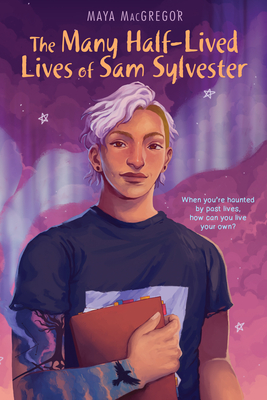
The Many Half-Lived Lives of Sam Sylvester – Maya MacGregor – “If I could just keep my stupid mind together/Then my thoughts would cross the land for you to see/No one sees you on a vampire planet/No one sees you like I do…”
“Not My Body” – Indigo De Souza
“Not My Body,” with De Souza’s intro, starts at 8:02.
While I ping-pong on whether or not I should listen to Any Shape You Take or All Of This Will End in my ongoing Indigo De Souza journey, I watched their Tiny Desk Concert, taken from the period of the latter. When introducing “Not My Body,” she said this about the song: “I think that when I die…what I want is to be composted and to become soil, and for that soil to be used to plant a tree, and I want that tree to be so big and strong. I don’t know what kind of tree yet—still thinking on it—A tree that people can visit and be like, ‘This is Indigo!'” Thus, she joins Peter Gabriel and his oak tree in what I imagine is a growing forest of reincarnation. It’s a soothing thought, to be reborn in the cells of something so sturdy.
Do you ever get those moments where you stop and have this realization that out of the billions of people on this Earth, that you are you, and by some roll of the dice, this is your life, this is your body, and this is who you are? It’s been a recurring thought lately. Those memes about gaining consciousness at age 4 in the middle of a Chuck-E-Cheese honestly hit the nail right on the head. For whatever reason, it’s been a recurring thought as of late. Not ideal for when I’m supposed to be listening to lectures, but it is a humbling reminder. As disembodying as those moments are, they remind me that yes, I do have the reins on this body. De Souza describes “Not My Body” as an ode to nature, and it taps into that feeling of being so conscious of your existence yet, for a moment, a spectator of it: “I’m not my body although you see me/Making moves and walking freely.” Nature, for me, is the missing key in this equation; the redwood tree that De Souza wants to be is the ultimate symbol of groundedness and connectivity—it is rooted in the earth, but its roots connect to all points in the wide world above and below it. There’s a happy medium between awareness and not feeling like you’re adrift in space, and nature has figured it out. And what better way to end such a sentiment than the last third of “Not My Body?” The way De Souza fashions their voice like a theremin, those echoing electronics that almost sound like dolphin calls, the gentle collapse of all the instruments into a single, coalescing being?
…AND A BOOK TO GO WITH IT:
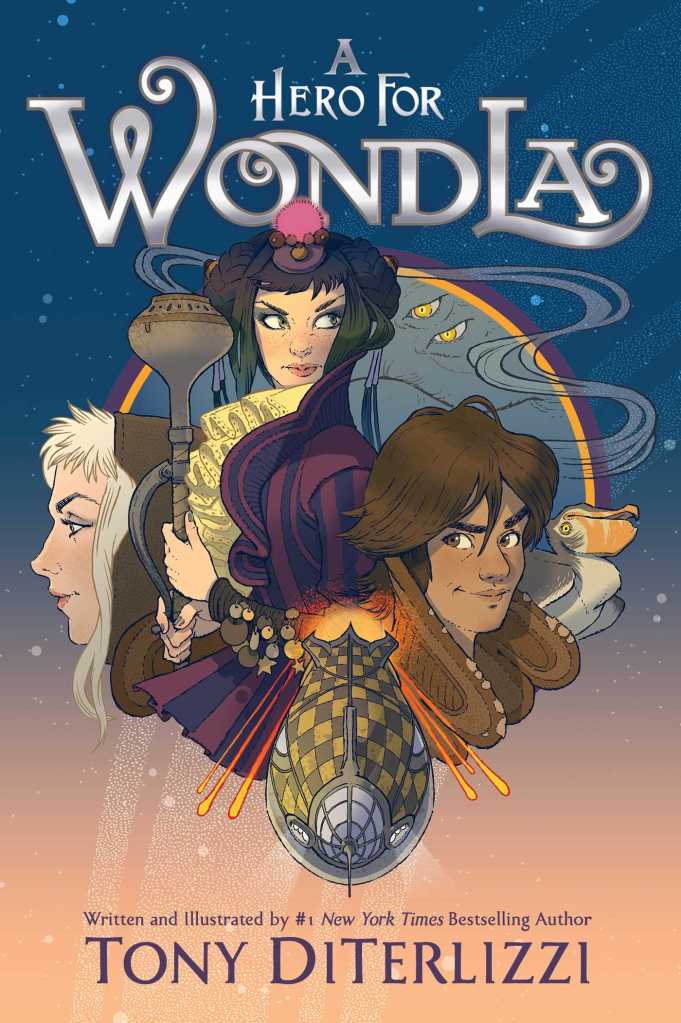
A Hero for WondLa (The Search for WondLa, #2) – Tony DiTerlizzi – without spoiling anything…Eva Eight arc, perhaps?
“Always Crashing in the Same Car” – David Bowie
If you mistook the title of this song for a commonplace idiom, I wouldn’t blame you. Frankly, it should be one. It’s memorable, it’s effective, and it’s a Bowie reference.
Low came at a deeply fraught time in David Bowie’s life. His Berlin trilogy of albums came on the heels of his darkest period, one where he committed actions that he disavowed until his dying day. Hence why I’m always suspicious and disdainful of Bowie fans who think that the Thin White Duke is somehow the “deepest” of his personas. Oh, okay, do you think you’re cool because you like the Bowie who was taking so much cocaine that it addled his brain enough to the point that he had a brush with Nazism? This is the period that Bowie spent the rest of his life thereafter vehemently swearing off (see: “Under the God“), and every clip from that era shows that he was clearly not of sound mind and body. Taking a critical look at the period is one thing, but being so uncritical about a period that Bowie so clearly wanted to forget takes a certain kind of thickheaded edgelord, in my humble opinion. It took him years to return to reality, and the Berlin trilogy chronicles his long and rocky journey towards healing, not to mention getting clean.
The circumstances surrounding “Always Crashing In the Same Car” are a fragment of Bowie’s period of addiction, an instance where, high out of his mind, he rammed his car into the car of his drug dealer. Yet there’s such a calm to this track, both warm and cold. It’s as though Bowie is watching his own life as a spectator, watching the car spiraling out of control from high above the clouds. His voice is placid, restrained, as he resigns himself to the song’s title, doomed to make the same mistakes. Apart from the crooning towards the conclusion, his voice never leaps—what does is the soaring guitar riff that seems to unfold Bowie’s ladder into the sky, from which he can watch his life from a safe distance.
Even if I haven’t gotten to such extreme lows in my life (please hold an intervention if I somehow do, good god), that kind of distance what makes the message of the song land. Breaking out of cycles and unhealthy habits is one of the hardest things a person can do, in my opinion. The effort it takes to change is outweighed by the ease of staying stagnant. You know you’re crashing in the same car, and yet your hands grip the wheel anyway. A few months, I made a commitment at the beginning of the month to stop being consumed by trivial thoughts, and I found myself trapped in an even worse cycle of anxiety just days later. The internal work I did that month was some of the most mentally strenuous that I’ve had in a while—it was far too easy to fall back on ineffective, harmful coping mechanisms than to put in the work to claw myself out of that pit of misery. I’m still working on it. But I’ve put in work. It’s taken a lot of clawing, but I’m growing the armor. Listening back to “Always Crashing in the Same Car” after all that mess gives it a whole new meaning—maybe the triumph I feel from that truly glorious guitar solo is symbolic of how it feels to climb through the sunroof, out of the wreckage, and into the light, knowing that the hard work of breaking these patterns is done.
…AND A BOOK TO GO WITH IT:
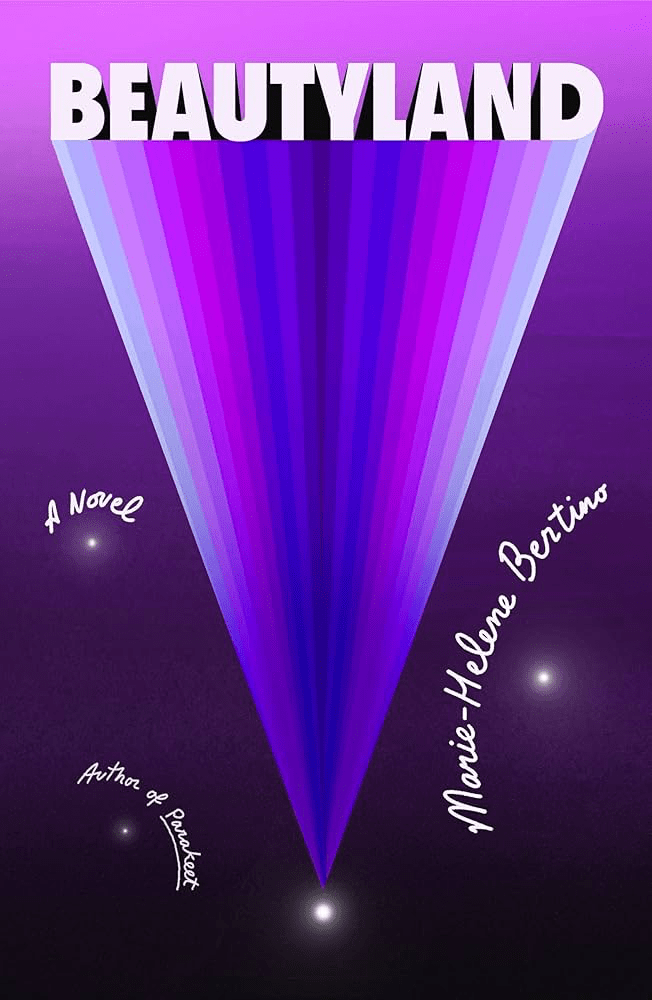
Beautyland – Marie-Helene Bertino – the narration of this novel feels the same as Bowie’s singing here: a kind of cool, matter-of-fact distance through which the world is observed, but not without some warmth.
“Sprained Ankle” – Julien Baker
From all accounts, it seems like Julien Baker has something new cooking up post-boygenius, and…hoo, boy. Am I ready? Nope. Nevertheless: I will listen. I will cry. (I already love “Middle Children” and “High in the Basement,” what can I say?) It seems simultaneously like ancient history and the blink of an eye away from when I first discovered Julien Baker, when, halfway through junior year during COVID, I listened to Sprained Ankle while I was a miserable puddle of grief and burnout. Whether or not that’s the only state you can properly listen to Julien Baker without curling up in a ball and crying is debatable, but…the only way out is through. Dramatic expression for weathering an album, I know, but there’s something gratifying in knowing that I’m a happier, stronger, and more healed person than the person I was when Little Oblivions came out in 2021. To my mom: consider this a formal apology for making you sit through almost a-capella Julien Baker depression while driving to school while it was barely even light out.
In the barest sense, Baker was working with what she had. She didn’t have any backup instrumentalists and recorded this in college at age 20, so there wouldn’t be any accompaniment other than what she played herself until Little Oblivions, alternating between guitar and piano. Yet there is no other way that “Sprained Ankle”—or any of the songs on Sprained Ankle—could have been made. It’s a lonely, self-deprecating, and wound-stingingly raw album, and outside of the lyrics, it sounds lonely. Like the bare, unadorned background of the album cover, many of the tracks feel like being in a cramped room with only the sound of your negative thoughts to keep you company. I realize how awful of an endorsement of Baker that is, but in that dreary state of 17, that was just what I needed. (To be fair, it can get to be too much—“Go Home” was exceedingly hard to listen to even back then, which is really saying something.) In the sparse, Baker creates a kind of confessional solace. Confessions are how “Sprained Ankle” starts off, after all: “I wish I could write songs about anything other than death.” There’s a self-awareness to the sadness, but like “Always Crashing In the Same Car,” the engine is running on borrowed fuel, and the marathon runner is sprinting on sprained ankles. Beyond the metaphor, Baker’s voice is meant to be the loudest thing on this record—like the cramped room, it echoes off the walls it’s given, an oral manifestation of the feeling of knowing that all you’ve got is your body. It would take a few years for it to reach the soaring heights of “Claws In Your Back,” but from the start, Baker always knew she had an anchor in her music—the instrument of her wobbling yet lighthouse-beacon piercing voice.
Now that I’ve mentioned “Claws In Your Back,” I can’t not link this dazzling performance from Baker with the National Symphony Orchestra…dare I say I haven’t felt goosebumps quite like this in years?
…AND A BOOK TO GO WITH IT:
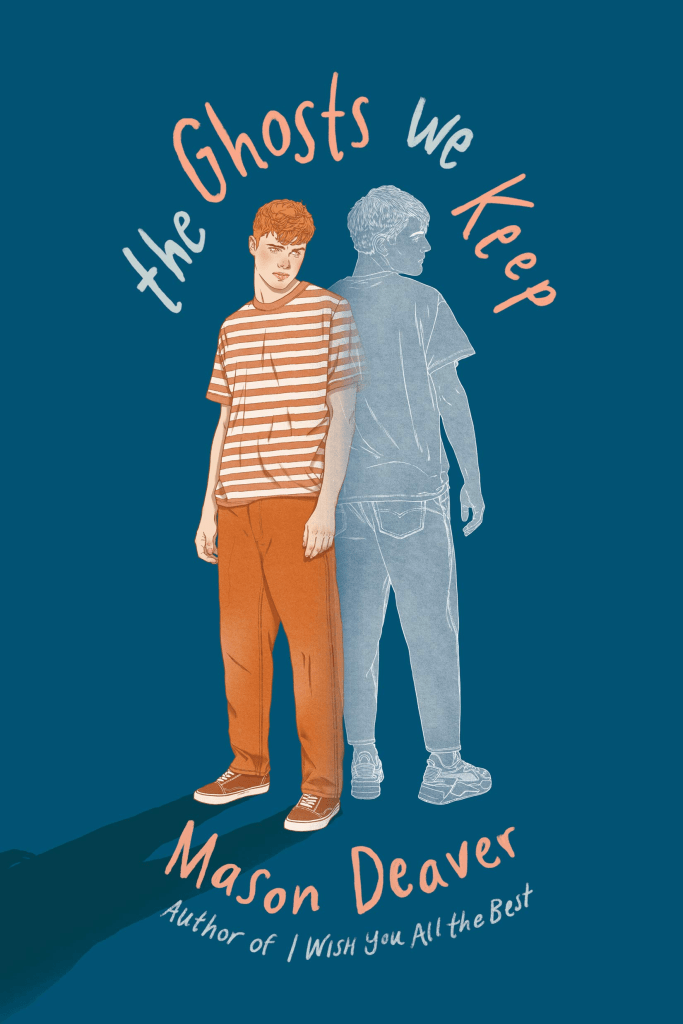
The Ghosts We Keep – Mason Deaver – “I wish I could write songs about anything other than death…”
Since this post consists entirely of songs, consider all of them to be today’s song.
That’s it for this week’s Sunday Songs! Have a wonderful rest of your day, and take care of yourselves!


 The Bookish Mutant