
Happy Friday, bibliophiles!
2024 has proven to be momentous for my inner middle schooler. A new St. Vincent album, and the Apple TV+ adaptation of The Search for WondLa…exists. I may revert to my middle school self if everything else about the show is as terrible as the “reimagined” character designs. But that’s not what I’m reviewing today.
Those of you who have stuck around on this blog may remember me enthusiastically reviewing Daddy’s Home on the heels of surviving the hell that was junior year during COVID. Those who have stuck around longer still remember my middle-school rant about MASSEDUCTION. (I’d rather you…not remember the specifics of the latter, but I still count that album as her lowest point.) Her self-titled record was as much of a friend as an album can be when I was 12, struggling to reconcile being unapologetically myself and wanting the acceptance of my peers. Marry Me was the first album I ever bought with my own money, and Actor, Strange Mercy, and Love This Giant all saw me through high school. All that is to say that St. Vincent has been there for me in the best of times and the worst of times. So naturally, I did scream when I found out about All Born Screaming—not just a new album, but a supposed return to her harder sensibilities—was coming out this year. And while it wasn’t fully the rock album that was marketed—or as musically cohesive as she tends to be—All Born Screaming is, without a doubt, some of her best work in years.
As I’ve been excited about this album for months—and writing more about music than I have in past years—I’ve already reviewed 3/10 of the tracks from All Born Screaming, so I’ll link to each separate installment of Sunday Songs that I reviewed them in, so as not to sound like a feral, sobbing, broken record.
Let’s begin, shall we?
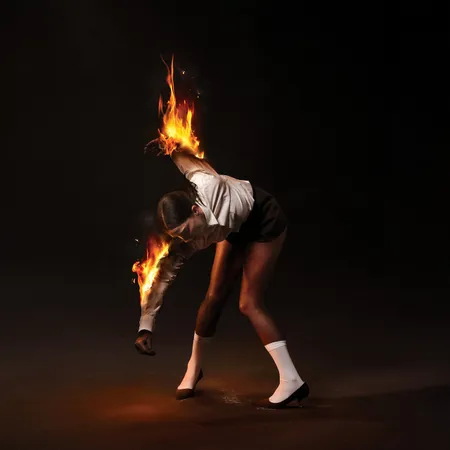
ALL BORN SCREAMING – ST. VINCENT
Release date: April 26, 2024 (Total Pleasure)
TRACK 1: “Hell Is Near” – 8/10
St. Vincent tying the aesthetic and merch in with images of marigolds is pure evil. Diabolical. Diabolical of them to pair one of my favorite artists of all time with my favorite flower…holding out until she announces a date near me until I buy that one marigold shirt, because it’s an inevitability. It’s only a matter of time.
“Hell Is Near” is an opener that creeps through the shadows on feet that you can barely see coming. With a thumping bass that thrums like a heartbeat witnessing horrors in the dark, it feels like the slithering transition between eras and personas, especially with the allusion to “The Nowhere Inn” (“Snubbed out smoke in a pack from the Nowhere Inn”). I can almost see Clark crawling out of some kind of giant shadow box as the song progresses, the heartbeat bass echoing off of every wall as her hands emerge from the darkness. I can’t help but think of the chord progression of “Prince Johnny”—this album is the most similar to the self-titled record since the record itself, and it’s clear that she’s cobbling this current aesthetic upon shadowier corners of that era, with guitar riffs that seem to interlock like strands of DNA. It’s a slow trickle of an opener, and as it dissolves into a flurry of high piano notes and fluttering synth, it leaves you guessing—where could she possibly be taking us to next?
TRACK 2: “Reckless” – 8.5/10
“Reckless” almost feels more like an opener than “Hell Is Near” does, even though the latter does a fantastic job of being an opener. After “Hell Is Near” dissolves, we return to sparse wasteland that the first track set up, but with a significantly darker tone—both speak of leaving the past behind, but “Reckless” turns “Hell Is Near”‘s willingness to move on to dwelling on it.
If there’s one thing about new music that I always live for, it’s those moments where you hear a lyric for the first time and physically have to stop in your tracks just to process how beautiful it is. Last year, I had that moment with Wilco’s stunning “Sunlight Ends”—”you dance/like the dust in the light” made all time stop around me. Jeff Tweedy just does that. And so does Annie Clark—it’s hard to think of a line on All Born Screaming more hard-hitting than this: “I’ve been mourning you since the day I met you.” Even if it precedes “Flea” and its tale of a love so predatory that it becomes parasitic, this feels like the fallout; it feels like a reconciliation, or just a realization of a feeling of destroying everything you touch, knowing that your actions will eventually drive away everyone that you will ever love. Whatever the narrator did has become so thoughtless and violent that it’s left them with nothing but “the smell of your hair on the curtains, babe,” and all that is left of them is a memory that they cling to with all that they can, knowing that what they did was enough to send them running for good. The sparkling synths that burst like faulty wiring at 2:38, around 2/3 of the way through, feel like the memory of the outburst that left them isolated, longing for something more, as Clark stares out the window like a widow remembering how her lover was slain in the war. This, unlike “Hell Is Near,” felt like a more certain sign of things to come—the wires have been cut, the dishes are shattered on the floor, and your heels are burnt and bleeding from stepping on them both.
TRACK 3: “Broken Man” – 10/10
Reviewed on 3/10—I haven’t stopped foaming at the mouth, thank you very much
TRACK 4: “Flea” – 10/10
TRACK 5: “Big Time Nothing” – 8.5/10
This is what MASSEDUCTION should have been.
All Born Screaming was what Clark called “post-plague pop,” and nothing exemplifies the “pop” aspect more than this song. Like the spandex she wore on the MASSEDUCTION tour, the skittering synths clamp the beat down enough so that it hardly even has room to squirm. There’s threads of Björk’s electronic catwalk-strutters and the obvious (to me, at least) nod to Peter Gabriel with the last utterance of “big time nothing” being cut off to a chorus of “big time”; a very fitting nod, since these two Big Times deal with the same Big Time in question: the allure—and detriment—of being under the magnifying glass of fame. Gabriel’s “Big Time” was his view on what fame turned people into—and what he feared that, as his own fame grew, he might become. (Of course he wasn’t going to, though. He’s too humble of a guy.) And even though Daddy’s Home was the first album post-MASSEDUCTION to deal with the litany of events Clark experienced, this one seems to address the scrutiny she felt under the microscope of paparazzi while she dated Cara Delevigne; she was already renowned in indie circles, but she’d never been exposed to that kind of relentless tabloid predation before, and, understandably, it’s done a number on her mental health.
Each lyric is a rapid-fire command, as though being dictated to a model while she’s spinning around for the camera: “Don’t blink, don’t wait/Don’t walk, you’re late/Don’t fall from grace, behave/Don’t trip, sashay.” Every misstep is tabloid fodder, and every move she makes is under heavy surveillance. The dead-eyed delivery of each spit lyric cements the soullessness of it all, other than an occasional vocal dip (“Don’t feel so sick”) where it turns from dead to sinister, a pseudo-coo that seems to come with a promise through red lips and an emotionless pat on the shoulder. It’s pop, but the kind of pop that’s delivered with Clark’s keen (and weary) observations on being in the celebrity spotlight—this is the natural evolution of “Los Ageless,” especially my favorite lyric from it: “girls in cages playing their guitars.” You can entertain, but you can’t move.
TRACK 6: “Violent Times” – 8.5/10
When the starts the All Born Screaming tour, she just has to transition this with “Marrow.” Or any track from Actor, come to think of it. “Violent Times” feels like a version of Actor that leans more into the boldness than the flighty, hiding-under-the-bed sensibilities. With a brass section powerful enough to flatten a forest, the dial is turned from observational pop back to the in-your-face force of “Broken Man,” but instead of the latter’s formal urges, it’s a leather jacket-clad beckoning back to a lover, sunglasses tilted down the nose and not a smear of lipstick out of place. As the brass blasts and the papery drumbeat thrums, Clark sultrily sings of the never-ending glow of kindness in the darkest hour—”I forgot people be so kind in these violent times.” Even though it’s made for Clark’s signature, birdlike dance moves, slick and smoky, it touches at some of the album’s tenderest moments. In the chaos of the modern world, it becomes more difficult day by day to remember that there’s still good left in it. But as Clark reminds us, what’s preserved from history’s great tragedies is always the innate, human quality of love: “When in the ashes of Pompeii/Lovers discovered in an embrace/For all eternity.” The subject matter and the musical atmosphere seem eons away, but in Clark’s hands, they’re all but twins, molded from the same warm clay into one of the most iconic tracks of the year.
TRACK 7: “The Power’s Out” – 9/10
Speaking of nods to other artists…
This one is the most obvious out of the many tributes to her musical inspirations, but for me, it’s the most emotional and poignant. “The Power’s Out” is, in essence, a four and a half minute long tribute to the iconic opener from David Bowie’s The Rise and Fall of Ziggy Stardust and the Spiders from Mars, “Five Years”—in my opinion, one of the greatest album openers of all time, given the artistry, fly-on-the-wall observations, and the overwhelm of emotion. The nods are practically everywhere. My brother pointed out how the drumbeat is almost identical, albeit with one beat more and significantly digitized. The parallels are everywhere:
“Came the message on the station/’The power’s out across the nation/And, Ladies and gentleman, it seems we got a problem’/The man on my screen said, just as somebody shot him.” (Clark)
“News guy wept and told us/Earth was really dying/Cried so much his face was wet/Then I knew he was not lying.” (Bowie)
–
“It was pouring like a movie/Every stranger looked like they knew me.” (Clark)
“And it was cold and it rained, so I felt like an actor.” (Bowie)
–
“And ‘Ladies and gentleman, do remember me smiling’/The queer on the train said as she jumped off the platform/And some blind folks held the police, crying/I swear to you I would not lie.” (Clark)
“A cop knelt and kissed the feet of a priest/And a queer threw up at the sight of that.” (Bowie)
I’ve got a whole Charlie Kelly conspiracy cork board laid out in my head. It’s all blatantly intentional, and it’s beautiful to me, coming from someone who has said that “there’s nobody who I would put above Bowie.” But what separates “Five Years” and “The Power’s Out” for me is the grounding. “Five Years” was the grand sweep of the beginning of his famous concept album, where Ziggy Stardust comes to Earth in its final five years to teach humanity the power of love and music before their time is expired. It’s more emotional than “The Power’s Out” for me (because, like Clark, there’s nobody I would put above Bowie…but she’s very close), but even with the barrage of anguish that Bowie pours out at the song’s climactic, chaotic flurry of an ending, you still know it’s part of something fictional. With “The Power’s Out,” there’s no pretense of total annihilation or alien saviors—it’s the horror of reality, the horror of contending with modern life. The world isn’t ending, but the disarray of the city and the fear being grown and harvested in barrels makes every day seem like a catastrophe. We’re assaulted with hate and fear from all corners of the world, now more than ever, and no one is exempt. With all of the horrific events flooding us, all we can do is try to move through it as best we can, yet still be expected to return to it and live through it all over again; all of the chaos, fear, and violence Clark describes is wrapped up in a whispery confession in the final line, as though to a partner: “That’s why I never came home.” It’s a beautiful conversation with Bowie, one that grounds its inspiration in the maelstrom of dystopian chaos that is 21st century living.
TRACK 8: “Sweetest Fruit” – 9/10
Reviewed on 4/28—good LORD, this is phenomenal
TRACK 9: “So Many Planets” – 6/10
Why does the thumbnail for this video look like I’m at a parent-teacher conference and St. Vincent’s about to pull up my math grade and tell me that my test scores have been slipping 😭
There have been various moments on this album that have made me go “huh?”—unexpected musical turns left and right. It’s an album that, if nothing else, has kept me on my toes. But this was the first on the album that was not a good “huh.” Most of the early reviews of the album called it the emotional centerpiece, so I was expecting something in line with “I Prefer Your Love,” “Live In The Dream,” or even “Slow Disco”—St. Vincent knows how to bring things down to Earth from the grandeur that she paints. But “So Many Planets” is just a jumble of confusing decisions. Here’s the thing: the lyrics are vulnerably beautiful, but the tonal dissonance between said lyrics and the music makes the aftertaste one that I don’t like all the way. It’s got this odd, synthy, bounce, and her delivery is oddly stiff and angular. Usually, Clark is one to mesh two oddly contrasting elements and make them work (see: “Violent Times”), but here, it just feels so tonally distant that it falls flat. Separately, these aspects are commendable, but they weren’t meant to be together. This is the low point of the album, without a doubt, but in the grand scheme of things, if this is the worst song, then it’s a fantastic album.
TRACK 10: “All Born Screaming” (fear. Cate Le Bon) – 7/10
All Born Screaming, as wonderful as it is, doesn’t stick the landing so well…until it does. Combined with “So Many Planets,” “All Born Screaming” is another tonally dissonant, pseudo-reggae ball of confusion that sits strangely in my mouth. It seems like the kind of thing to be paired with the kind of perky dance that Clark often did with her backup dancers on the Daddy’s Home tour, and for a song that’s meant to be the album’s closing thesis and its title track, it…doesn’t work. Most of my thoughts on this song parallel my thoughts on “So Many Planets.”
But.
About halfway through, the freakout starts. Distorted voices bubble through the wire, guitars whine and screech, and an accelerated, anxious heartbeat propels “All Born Screaming” into its final form. Joined by the cavernous voice of Cate Le Bon, Clark turns the album’s title into a clarion call, howling out to the masses: an affirmation that despite it all, we are still here. We were all born screaming, and we will continue to scream until our last breath. We are here, and we won’t go away. We went into the woods that Clark spoke of, scarred by brambles and wild animals, but in one piece, stronger for having pushed through the journey. In the background, the electronics accelerate like sleek cars down a racetrack, setting off sparks. This takes up half of “All Born Screaming”‘s nearly 7-minute length, but even if the first part had been cut away, it would still be one of the most poignant moments on the entire album. I almost get choked up at the sudden drop-off of the electronics and the shift to just the chorus of Clark and Le Bon. It gets to you. Gets you right through the ribs…I just wish the whole song got the memo.
It’s an ode to growth in all of its ugliness, knowing that whatever you have survived, you can and will survive it again.

I averaged out the ratings for each track, and it came out at an 8.5! All Born Screaming, even if it does lean in a musically scatterbrained direction, is some of St. Vincent’s most vulnerable work to date. Self-produced and deeply personal, it seems to map her heart in ways that haven’t been done in her previous albums. All of that shows—it’s a bold, furious, and boundlessly creative ode to surviving—of crawling free of the darkness and finding your way home to the guiding light of love. The journey may turn you feral, but once you’re free of all of the vile parts, you’re free—to scream. And there is no one’s primal scream I’d rather hear more than that of Annie Clark.
Since this post consists entirely of songs, consider all of them to be today’s song.
That’s it for this album review! Have a wonderful rest of your day, and take care of yourselves!




 The Bookish Mutant