Posted in Sunday Songs

Sunday Songs: 10/27/24

Happy Sunday, bibliophiles! I hope this week has treated you well.

This week: if I had a nickel for every year that I’ve had a bright green Sunday Songs color scheme right before Halloween, I’d have two nickels, which isn’t a lot, but it’s weird that it happened twice…bon appetit.

Enjoy this week’s songs!
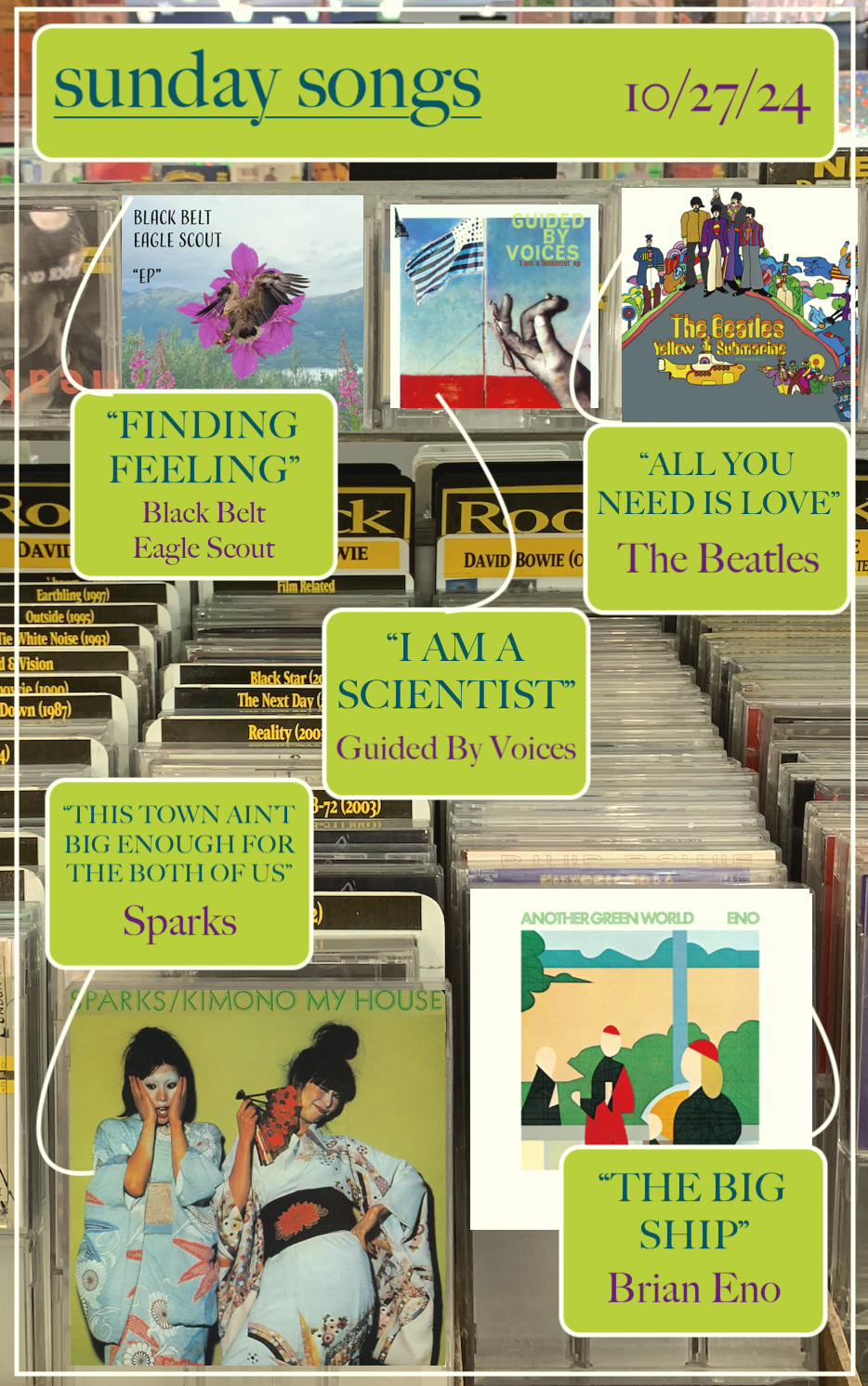
SUNDAY SONGS: 10/27/24

“This Town Ain’t Big Enough for the Both of Us” – Sparks

Because all you musicians totally want my unsolicited advice, I’ll offer it up: this is peak walk-on music. Imagine the band coming onstage the minute the drums kick in after the gunshot sound effect at 0:35. Come on.

In my glacial but nonetheless exploration of Sparks, I realized that I sort of knew this one—it’s one of their most popular and enduring songs, but I knew it from the cover that Siouxsie and the Banshees did, which should tell you all you need to know about how I was raised (read: a hipster). I think my desire for somebody to use this as walk-on music stems from just how punchily theatrical it is. It demands dynamic movement, silk, and finger guns fired into the audience of an opera house. Even though I’d place it well on the outskirts of glam (somewhere near Brian Eno ca. 1974), it walks that line between pure rock and full-face theatre. The Mael Brothers’ brand is significantly tighter than the spandex that their counterparts were (probably) wearing, but the constrained, cagey feel of it adds to the suspense, however thickly they laid it on—it certainly fits with the anecdote about the zoo animals in the first verse. Yet for the slimness of it all, they lean into how over-the-top it is. Case in point: said Wild West gunshot sound effect during the chorus. Brilliant.

Other than Siouxsie, a fair share of artists have covered “This Town Ain’t Big Enough for the Both of Us” over the years. I found out that the most recent happens to be The Last Dinner Party, who…admittedly, other than “Caesar on a TV Screen,” I haven’t exactly liked much, covered it as well, and…eh? The overwhelming vibe I got was that they were trying to go for over-the-top, but, as with…well, everything I’ve heard of theirs, they were trying way too hard. It sounds tight, but there’s hardly any fun in this. And how do you cover Sparks and not make it fun? Siouxsie and the Banshees made it their own—the flow is more dynamic and not as punctuated as the original, but it’s got that theatrical urgency that gives it the oomph that’s necessary to cover the song. The Last Dinner Party restrained themselves so much…and I hate to harsh on them, but they’re missing the whole point! The spirit of “This Town Ain’t Big Enough for the Both of Us” is to go dramatic! Go big or go home! I AIN’T GONNA LEAVE!

…AND A BOOK TO GO WITH IT:

The Good Luck Girls – Charlotte Nicole Davisanother—but very different—twist on Westerns.

“The Big Ship” – Brian Eno

me when I’m in a “making incredibly soothing but also innovative music” and my competition is Brian Eno:

Brian Eno can really do it all. He glammed up the ’70s with Roxy Music, then struck out on his own and glammed some more…and eventually came to be the person responsible for both coining and creating the genre of ambient music. He’s a master of both the lyrical and the instrumental; Another Green World contains both, but is considered by many to be part of his transition to almost exclusively making solo, instrumental ambient music. Even if he did mold the genre, however, I wouldn’t call “The Big Ship” ambient. Compared to something like “1/1,” it has an unmistakable feel of rising action, as in a novel, instead of the former’s soothing plateau. It’s unassuming at first glance, but judging from the outpouring of emotion in the YouTube comments—and its use in deeply emotional scenes from Me and Earl and the Dying Girl and The End of the Tour—”The Big Ship” is anything but. Author David Foster Wallace even said this in his posthumous novel, The Pale King:

“This song is making me feel both warm and safe, as though cocooned like a little boy that’s just been taken out of the bath and wrapped in towels that have been washed so many times they’re incredibly soft, and also at the same time feeling sad; there’s an emptiness at the center of the warmth like the way an empty church or classroom with a lots of windows through which you can only see rain in the street is sad, as though right at the center of this safe, enclosed feeling is the seed of emptiness.”

I don’t think I’ll be able to articulate anything about this song better than Wallace. I don’t think anyone ever could—he really did chip away the truth. You feel all of it. You can touch that drained eggshell’s core of emptiness, but you can see the pinprick of light made by a needle at the top. Whatever you imagine the big ship to be, the gradual rise of the song produces imagery that leads you to believe that this ship could be arriving just as well as it could be leaving. “The Big Ship” is a door ajar, but whether or not you see the light retreating or impending is entirely up to the flip of a coin.

In my mind’s eye, there’s a gargantuan, city-sized ferry, perhaps fueled by a pair of unseen wings on the hull. Like a kind knife through melted butter, it cleaves a path through a roiling sea of fog, curls of mist tracing the polished metal like child’s fingers. It moves slowly, glacially, taking its time to pave a path through the billowing clouds, into whatever lies beyond. I love the title of Another Green World, and even though I haven’t yet listened to all of it, I immediately relate to the concept of the Green World in literature; I was introduced through it by Shakespeare and A Midsummer Night’s Dream, where Athens functions as the world grounded in reality, whereas the realm of fairies, governed by magic, whimsy, and glamour, is the Greener. It is the “false” world, but also the world of innovation and real magic that we strive to create. Like a sprout, it is ripe with possibility, things yet to come to fruition. Perhaps that’s where Eno’s big ship has charted its gentle course.

…AND A BOOK TO GO WITH IT:
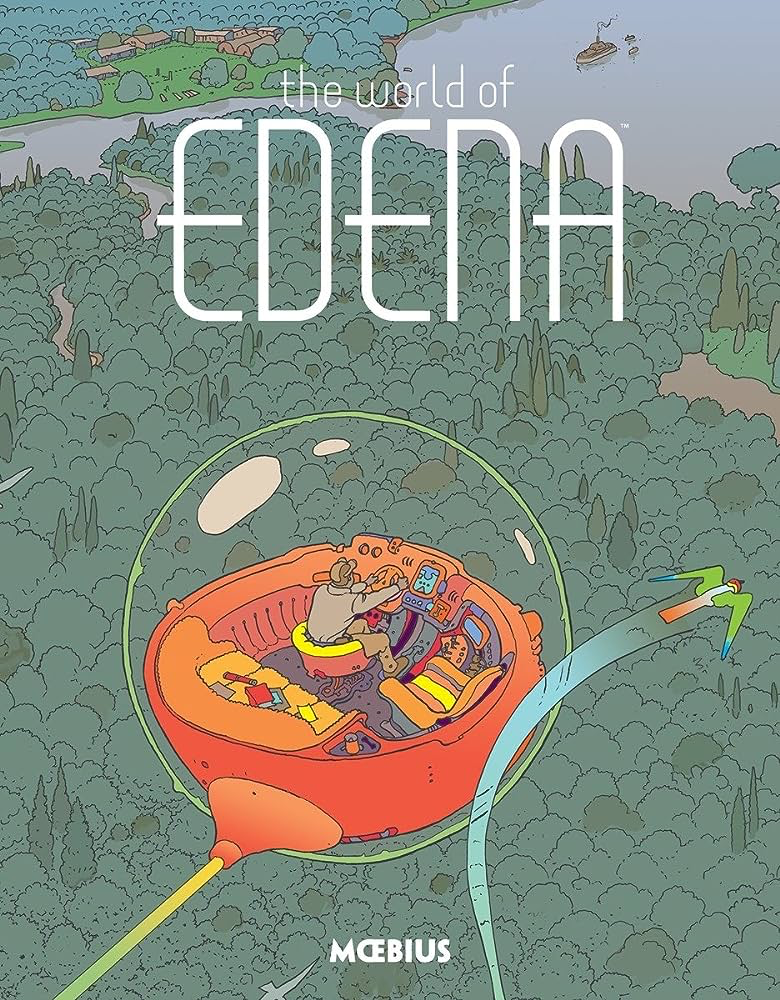
The World of Edena – Mœbiussomewhere, across temporal boundaries, I can imagine Eno and Mœbius creating art together—the latter to create the brightly-colored, simple landscape, and the former to soundtrack the gentle humming of its engines.

“Finding Feeling” – Black Belt Eagle Scout

Ten years ago, Katherine Paul self-released their debut EP on Bandcamp as Black Belt Eagle Scout. A decade later, and Paul has brought this artifact of her career to streaming, letting the world see the infancy of this project. Like Eno, it’s a soothing exercise, sculpted from handfuls of reverb and sparing percussion. Now, I can see the remnants of this sound that later permeated into their debut album, Mother of My Children; it flows as easily as water, but in those early days, they were prone to get caught up in the current and let the same phrase repeat itself for quite some time. It’s not that it’s bad by any stretch of the imagination—Paul just hadn’t hit their stride yet, and didn’t know when to whip out the cutting board to make things more succinct. (“Finding Feeling” repeats itself for the first third of the song…which is six and a half minutes long.) The lyrics lack the artistry that Paul would later learn, but time has proven that her voice has always been as crystal-clear and cooling as still water from the mouth of a glacier. “Finding Feeling” almost describes itself as you nearly get lost in the repetition, but the payoff, though long-earned, is the seed of what would become a soaring talent.

…AND A BOOK TO GO WITH IT:
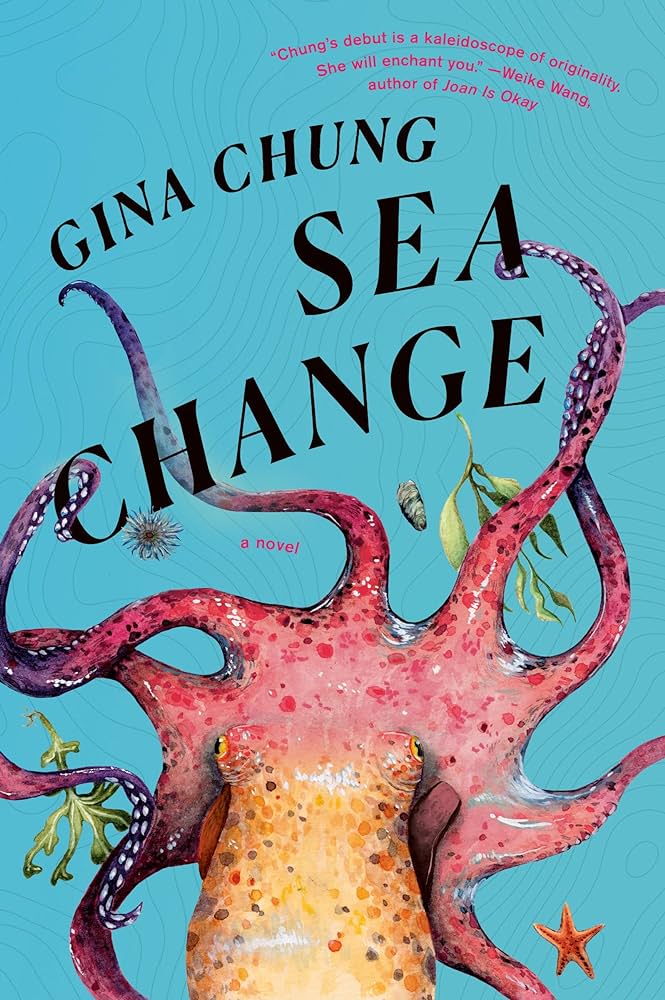
Sea Change – Gina Chung“I go home in the evening/I don’t feel a thing/I don’t know nothing/I go home in the evening/I don’t see a thing/I don’t have anything…”

“I am a Scientist” – Guided by Voices

It’s baffling that this version of “I am a Scientist”—from the 1994 I am a Scientist – EP—never made it onto the album that the original version did (Bee Thousand); the original, as good as it is, screams “demo,” muted in every way. While I’m all for the scrappy, understated recordings (see: everything Car Seat Headrest did until about 2016), the full band backing the EP version makes it into the triumphant march that it was always meant to be. And what a perfect slice of ’90s indie-rock this is—it’s Pavement from an alternate universe, one where they decided to churn out multiple albums a year for the rest of the foreseeable future. I’m no judge of how good said prolific output is, as this is one of two songs I’ve listened to, but if the talent displayed on “I am a Scientist” and the acclaim that their ’90s albums have gotten, I can only assume that said talent hasn’t dried up.

…AND A BOOK TO GO WITH IT:
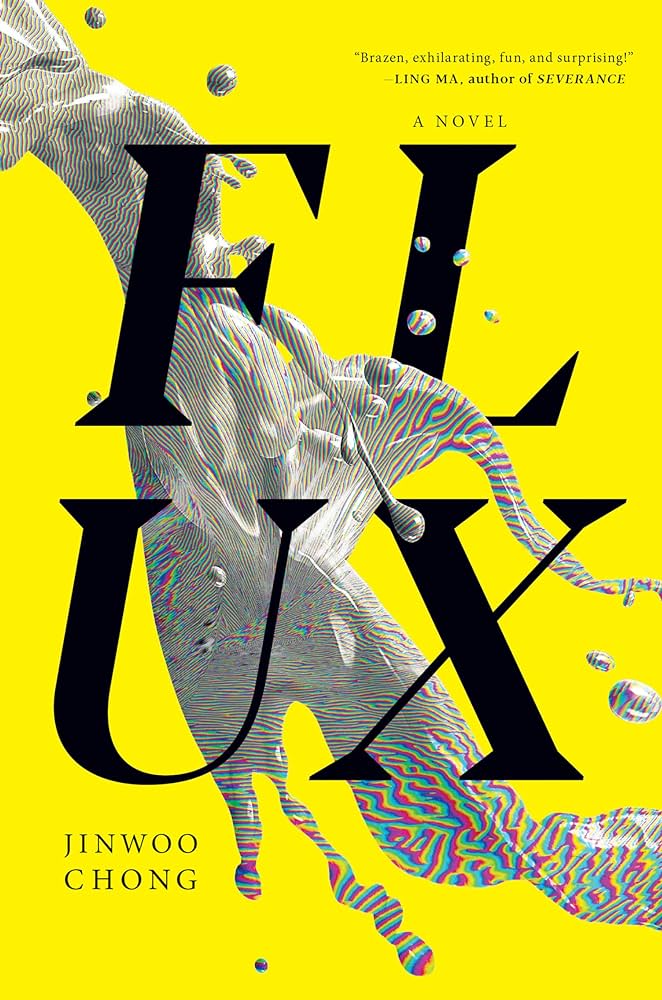
Flux – Jinwoo Chongan unraveling mystery between men, generations, television, and time travel. (Was it always successful? No, but I enjoyed enough of it. I’ll always applaud the ambition of it.)

“All You Need is Love” – The Beatles

I didn’t conceive of Sunday Songs consciously to put them on Sunday—the alliteration was just there, and it worked. But this week feels fitting that it’s on Sunday, and I’m glad I stuck this song at the end.

Here. Take a moment to breathe. We have miles and miles of anxiety ahead of us and miles and miles of horror behind us. But that is not all there is in the world. You see the spinning earth at the end of this video, animated in silence, and remember that there is love. Even if they were summoned into a studio, you can see all of the people gathered together, covered in flowers, and remember there is love. Millions of miles gives way to the possibility of endless cruelty, but if you look hard enough, you will know that our planet was never molded from just that. Whatever happens, there will always be love, and there will always be someone to embody love. Take a seat. Let the confetti brush your cheeks, let the sound lift you into the air.

All you need is love. I’ll take this into the week, I’ll keep it against my breastbone like a locket until the silver wears into my skin. Will you?

All you need is love.

…AND A BOOK TO GO WITH IT:
Since this post consists entirely of songs, consider all of them to be today’s song.

That’s it for this week’s Sunday Songs! Have a wonderful rest of your day, and take care of yourselves!

Posted in Sunday Songs

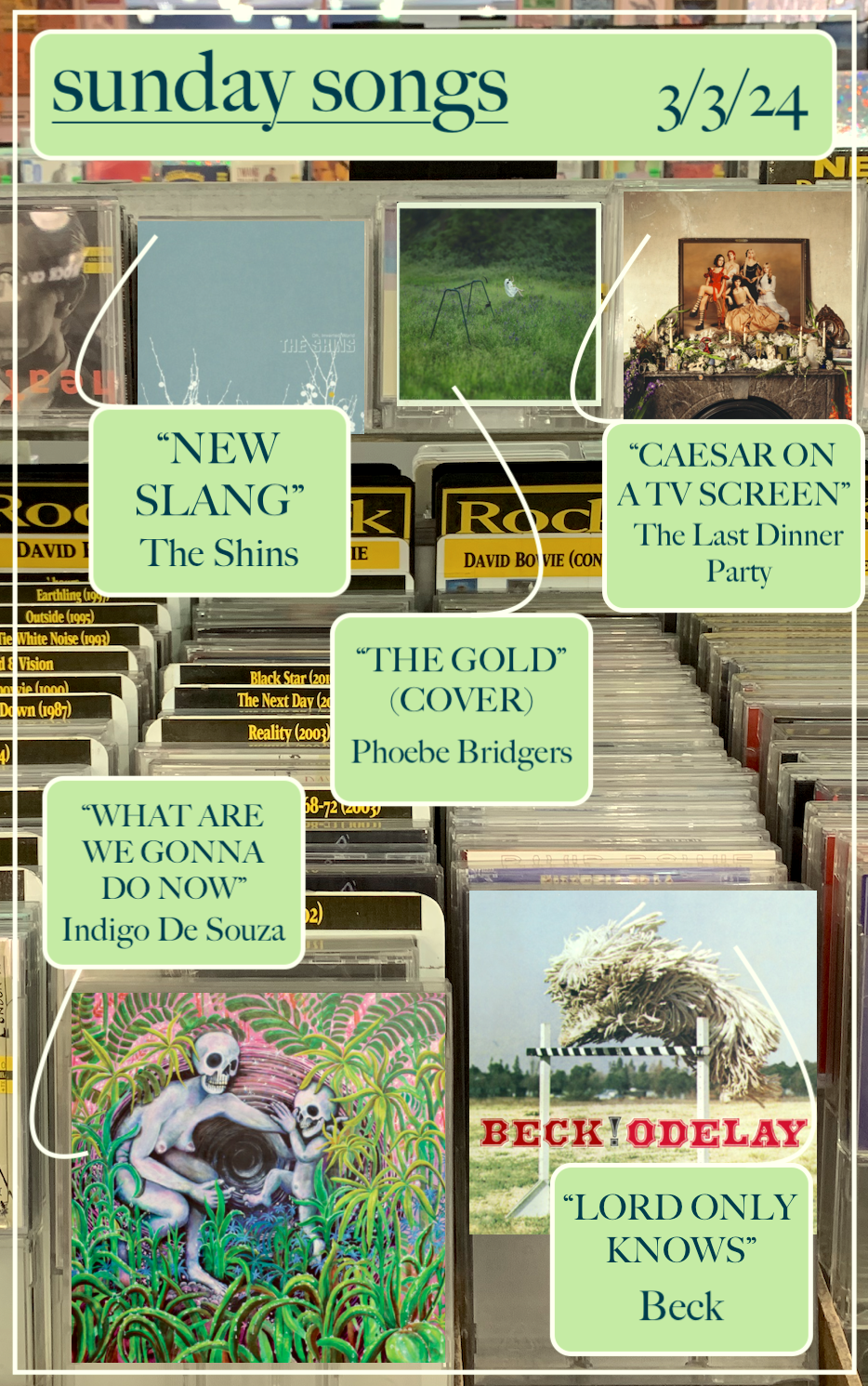
Sunday Songs: 3/3/24

Happy Sunday, bibliophiles! I hope this week has treated you well.

This week: spring green for March, old dogs, and the consequences of the fact that at least 90% of my friends are gay and their music tastes rub off on me.

Enjoy this week’s songs!

SUNDAY SONGS: 3/3/24

“What Are We Gonna Do Now” – Indigo De Souza

This just in: the sad girl kool-aid has never left my system, and it likely never will. Buckle up.

“What Are We Gonna Do Now” lives squarely in the liminal space of uncertainty, as the title implies. It feels like the tense opening to a film; I could just be stuck on this imagery of the line “and we’re still on call with the nurses,” but I can’t help but imagine an opening shot panning out from the slow spikes of a heart monitor, slowly letting out beeps as Indigo De Souza’s voice gently drips like an IV with that lingering, trailing question: “what are we gonna do now?” Almost everything is gradual about this song, as if the verses were frozen in time: a picture of a person standing on the street while snowflakes suspended in midair decorate the space around them. De Souza’s voice dips and dives into nooks and crannies that only a cat could fit into, army-crawling through the shadows as she describes the wear and tear of a relationship in the middle of turmoil—not necessarily on the verge of a fracture, but in the middle of the storm that they aim to push through together. Exhaustion and frustration tinges it (De Souza’s delivery of “and I’m never cooking up what you’re craving” remains one of my favorite parts of the whole song), but it’s never the kind so intense that would throw their love out the window—it’s the determination of trying to find out exactly how to fix things, and scrabbling around, searching for answers in desperation. Like the ebb and flow of love, the instrumentals swerve from a near standstill to a rousing, guitar-driven chorus and back to quiet again, but after the first verse, nothing is the same; it has the same kind of barely-contained chaos of songs like Wilco’s “Via Chicago” and Mitski’s “The Deal,” with a sense that the anxiety of making amends and grasping for solutions. As De Souza’s airy voice rises like she’s gasping for air after emerging from the ocean, trembling drums and tambourines slip in and out of time, ever so slightly off-kilter and teetering, like one sneeze would send them all into disarray. Unlike the former two songs, though, it never fully gives in, but the unraveling is always at the back of the song’s mind, like an overflow of fearful thoughts as they try to pick up the pieces, but a sense of deep-breathing control as De Souza picks themselves back up.

…AND A BOOK TO GO WITH IT:

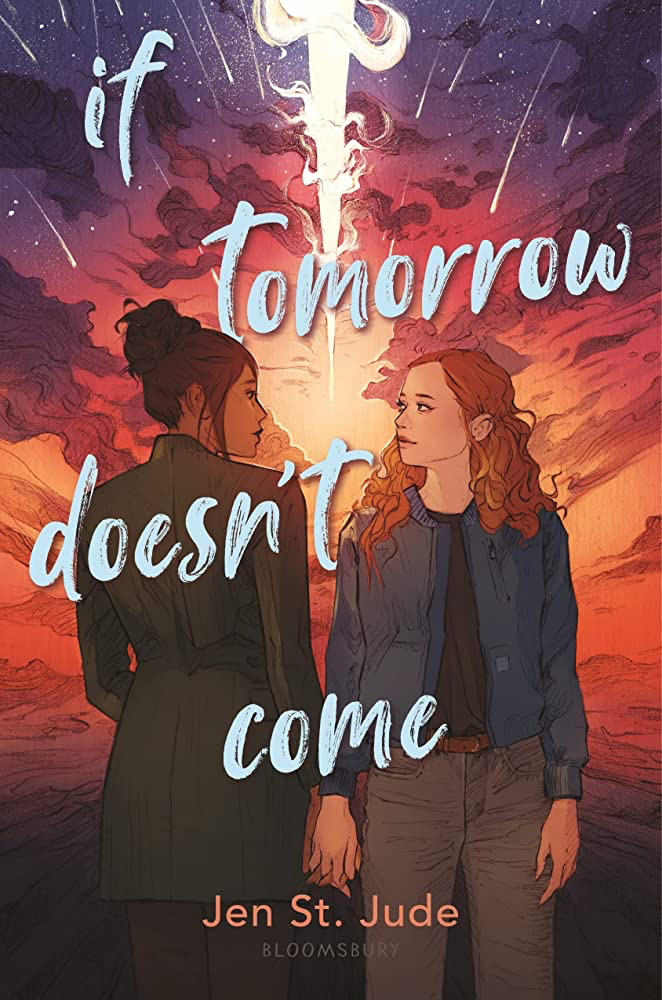
If Tomorrow Doesn’t Come – Jen St. Judeone of the few apocalypse novels that really makes it a mission to focus on the human aspect.

“Lord Only Knows” – Beck

Full disclosure: I definitely ruined this album for myself. I knew it was going to be a good album, and it 100% is, but I’d already listened to about 3/4 of it, so there were no surprises left. All of the songs I remembered were already favorites, and the ones I hadn’t yet discovered weren’t as instantly classic as the others (sorry, “Derelict”). But that’s on me. Maybe on my parents for playing it so much in the car over the years, but mostly on me. Whoops.

That’s not to say that Odelay is a bad album at all—in fact, it’s quite the opposite. It makes me miss the old Beck, the one who didn’t scrub everything to an unnecessary polish, but instead made his music like a sculpture made from bits and bobs found in the junkyard—a bit of a tire here, an old, rusty car hood there, some nuts and bolts sprinkled on top for a finishing touch. It’s a collage, but not necessarily in the way that artists like De La Soul or The Beastie Boys make their collages: while their infinitely clever concoctions feel like they oil every sample into a unified organism of unlikely pieces, Beck’s method (for a while, at least) was to make every spare and found part stick out like sore thumbs, but so much so that all those sore thumbs eventually made a hand so absurd that it makes you think how does that even function as a hand? And yet it’s the perfect hand. There’s no other way that “Hotwax” would work without “I’m the enchanting wizard of rhythm.” In fact, the absurdity of all these samples make this mutant (no pun intended) record so memorable—nobody was doing it quite like Beck. Take this song, which starts out with a rasping scream, then descends into twangy and almost docile acoustic-guitar driven rock. It’s not the heat-waved calm that “Jack-Ass” (my favorite track on the album) exudes, but it’s got that same lazy drawl to it, every word curled at the edges like scraps of paper singed by a campfire. Odelay hadn’t yet reached critical mass of clever silliness that made ’90s-2000’s Beck so fun (that would be Midnite Vultures), but he had plenty of fun to spare—I always find myself laughing at the final lines that Beck sings as the track fades out like a car driving out of view, obscured by the wobbling lines of a heat wave: “Going back to Houston/Do the hot dog dance/Going back to Houston/To get me some pants.” You just can’t deliver the word “pants” with that much emphasis and have it not be funny. Them’s the rules. I apparently have the humor of a five-year-old, but evidently, so does Beck, and we’re all the better for it.

…AND A BOOK TO GO WITH IT:

Fortuna (Nova Vita Protocol, #1) – Kristyn Merbethall of the same lazy, summer-eyed charm, but make it space opera (as things usually are on this blog).

“New Slang” – The Shins

Whenever I go to write about The Shins, I always end up going straight for the purple prose. It’s like the way I get with Radiohead, except they invoke something akin to religious fervor in me. I’m too far gone. But there’s something about James Mercer and his perpetually rotating cast of characters that evokes the lyrical side of my writing. Perhaps it’s that part of me connecting to that part of him, because he’s certainly got songwriting chops for days.

“New Slang” has been lingering in my life for decades; I faintly associate it with a period sometime in elementary or middle school. I think it may have been at the end of a playlist I listened to frequently. The Shins are never all that far from my mind, but this was the perfect song to shuffle out of the blue, soft and smiling like an old dog with white patches threaded into the fur of its snout. And I ran right up to pet that dog—god, I missed this song. Hello, old friend. Mercer has long since mastered the art of the old heartstring-tugging acoustic song, and while its as hipstery as it gets, there’s a calmness to it, a serenity like no other. And yet, for all intents and purposes, it’s James Mercer’s equivalent of a pop-punk “I’m getting out of this town” song; the lyrics were inspired by his experiences separating from Albuquerque, New Mexico, where the first iterations of The Shins had tried to take root. Disillusioned by a scene that he described as “macho, really heavy, and aggressive,” Mercer and company branched outwards, where their lyrical folk could have more meaning. “New Slang” was Mercer’s way of “flipping off the whole city,” as he described it (“Gold teeth and a curse for this town”), but there’s something beautiful in how quietly this song shoots its bitter middle finger. It’s not the jerky angst of separation that pop-punk lends to the subject, but instead the moment of looking back into the sunset, knowing that everything you’ve left behind is in the dust with the approaching night. Perhaps that’s where that serenity I feel comes from—the serenity of knowing that what’s in the past is in the past, and that it has no control over your life anymore. It’s underfoot, only tire tracks in the dirt now. You can’t help but feel a wave of peace at the thought.

…AND A BOOK TO GO WITH IT:

Trouble Girls – Julia Lynn Rubinwhile Lux and Trixie’s reasons for ditching their town are more complicated, there’s no less of a feeling that they’re giving it the finger the whole way out.

“The Gold” (Manchester Orchestra cover) – Phoebe Bridgers

Full disclosure: I hate the original version of this song. Hate it. It stinks of that kind of that faux-earnest, country-leaning pop that forced itself down everyone’s throats in the mid-2010’s like a contagion. If this weren’t obviously a breakup song, I know my music teacher would have made my 5th grade class sing this. I hate to relentlessly dog on a song, but also…Christ. This made me throw up in my mouth a little.

Phoebe Bridgers, on the other hand? A godsend. Leave it to her to make the original lyrics, some of which were actually good sound good, and not like they were being shoved down through the godforsaken Mumford & Sons strainer. I will give Manchester Orchestra (posers, they’re not even from Manchester…) some credit: “you’ve become my ceiling” is genuinely a beautiful lyric. But I just wish it wasn’t being delivered with that smarmy, offensive excuse for authenticity. Again: Phoebe Bridgers is our savior. She grounds this song enough to make the turmoil within it feel real. Never once did this song need belting, stadium-rock grandeur: it needed clarity, a sense of calm amidst the chaos, and a steady hand on an acoustic guitar. It’s got slightly more effects than Bridgers usually allots to a song of this tempo, but it hits the balance of flourish and that acoustic sincerity that she’s come to be known for. It’s a breakup song, but although some of those call for grandiose declarations of sorrow, some of them need time to sit in silence and wallow it in, and that’s exactly the treatment that Bridgers gave “The Gold.” I’ll just go ahead and pretend that she wrote it. Yup. Manchester Orchestra? Who is she?

…AND A BOOK TO GO WITH IT:

Vinyl Moon – Mahogany L. Brownesimilarly, this novel in verse deals with the fallout of a relationship built on mistrust.

“Caesar on a TV Screen” – The Last Dinner Party

Before I listened to the full song, I distinctly remember seeing a snippet of this song advertised somewhere on Instagram and thinking something along the lines of “god, this is pretentious.” And I stand by that. It’s still pretentious. But in context, it’s a good listen.

I’ve heard a decent amount of buzz surrounding The Last Dinner Party, usually falling in one of two camps: that they’re out to save rock and roll and bring it back to its glory days, or that they’re just…okay? The former argument, while I like it in concept, reeks of the kind of mentality that “modern music isn’t good anymore” because it’s not all Pink Floyd, which…okay, cool if you like Pink Floyd, but also…creative rock didn’t die as soon as Y2K hit? You just have to look a little harder now that rock isn’t the reigning influence on popular music anymore. In the modern day, we treat rock music like we often treat women: as something to be saved, when all along, it’s been doing just fine, thank you. I doubt we’ll ever go back to those days, and maybe we shouldn’t—there’s no way you can completely replicate a movement in its full, temporal context, and maybe that’s okay. I’m all for bringing back glam rock, but chances are, anything you try to resurrect is going to feel displaced in our modern day context. You can take inspiration from them, but personally, it’s a hard thing to recreate in all of its flesh and blood.

Which…seems like a good deal of what The Last Dinner Party are going for. Frontwoman Abigail Morris has regularly emphasized how much she and the band enjoy being pretentious (if having their debut album titled Prelude to Ecstasy wasn’t enough of an indication), and if that’s what’s bringing them joy, then all power to them! They’re talented musicians, for sure. Weirdly, the other two songs of theirs that I listened to just sounded like…any old indie pop song, which I kind of hate to say, but if you’re all about “saving rock n roll” and just putting out that, then I feel like you have to keep your mission consistent. But you certainly get that feel from “Caesar on a TV Screen.” As far as the structure goes, it feels slightly disjointed, but the more I watch the music video, I get what they’re going for—a song with a distinct, three-act structure, emulating the epic, Shakespearean twists and turns that inspired it. There’s loads of drama to spare, from the rush of strings in the third act to Morris’ impassioned howl of “everyone will like me!” at the song’s exiting flourish, like she’s brandishing a prop sword with every word. It’s dripping with that kind of theatrical, ’70s and ’80s drama—there’s Queen written all over it, and I can’t help but think that some of that drama was informed by Kate Bush. And…yeah, Freddie Mercury, Kate Bush, and David Bowie, the latter of whom the band have repeatedly cited as one of their primary influences, are probably some of the most colossal shoes to fill in terms of musical artistry. But there’s no doubt that The Last Dinner Party are a skilled bunch in their own right—and god, they look like they’re having the time of their lives. It’s exactly the kind of excess, maximalism, and drama that their band name implies.

…AND A BOOK TO GO WITH IT:

Strike the Zither (Kingdom of Three, #1) – Joan He“When I was a child, I never felt like a child/I felt like an emperor with a city to burn” HMMM…

Since this post consists entirely of songs, consider all of them to be today’s song.

That’s it for this week’s songs! Have a wonderful rest of your day, and take care of yourselves!