Posted in Sunday Songs

Sunday Songs: 8/3/25

Happy Sunday, bibliophiles! I hope this week has treated you well.

This week: even if Wilco wasn’t ever-present in The Bear, we’d have to physically restrain Jeff Tweedy just to stop him constantly cooking in that kitchen. Plus: lots of top tier album intros and some lyrics I probably should’ve reconsidered playing in the presence of my guitar teacher.

Enjoy this week’s songs!
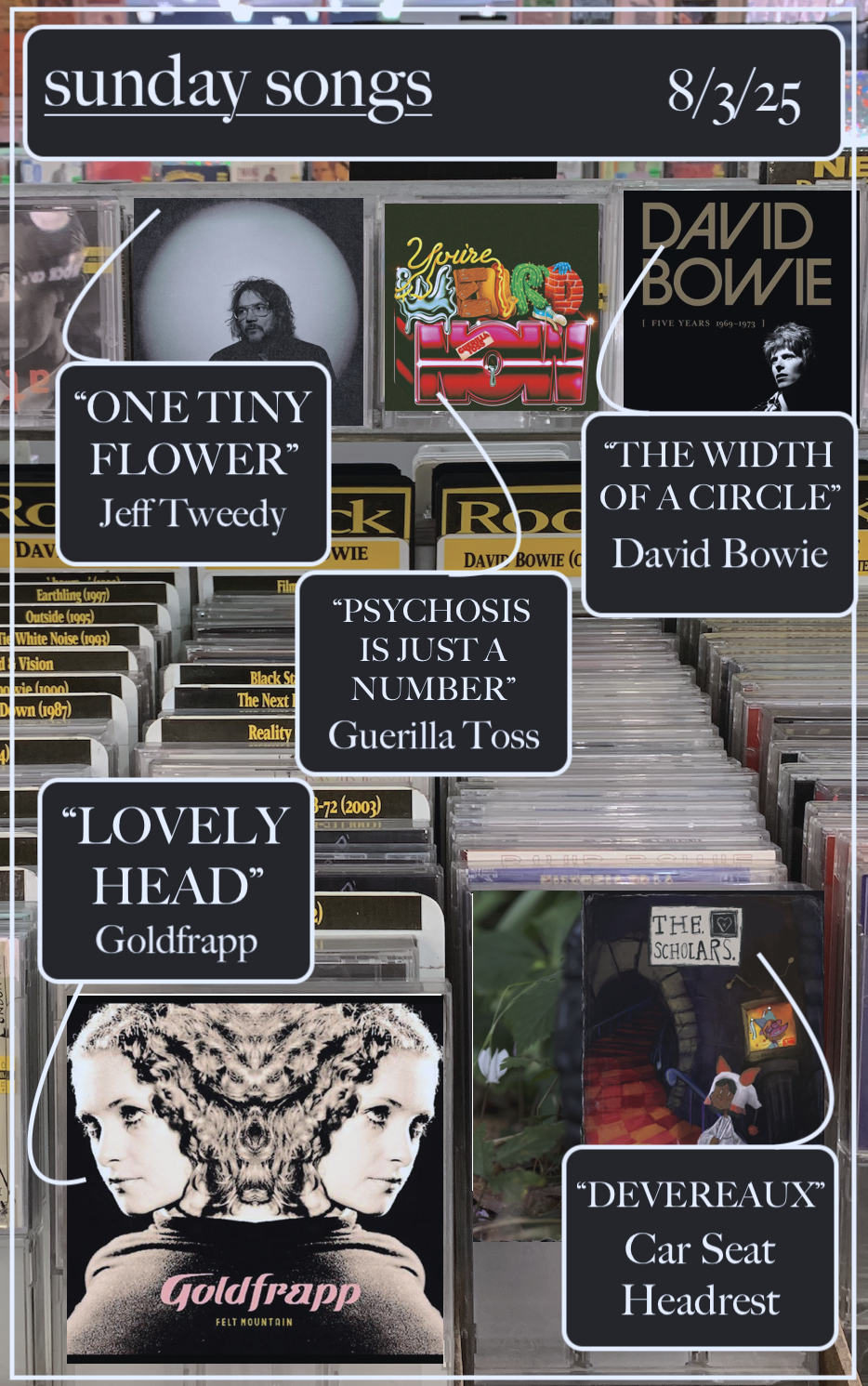
SUNDAY SONGS: 8/3/25

“Lovely Head” – Goldfrapp

Both Alison Goldfrapp and Will Gregory had been musically active before they joined forces, but even then, to come right out the gate with a single like this is so impressive for a band just getting its start. “Lovely Head” was the first single that Goldfrapp ever released and eventually became the opening track for their debut album, Felt Mountain. The U.S. didn’t seem to see the wave of popularity it eventually gained, but in the U.K., it was used liberally in film, TV, and commercials in the early 2000’s. But if there was ever a song that was meant for all of those things, it’s this one. Everything about it is cinematic, from the Ennio Morricone-like whistling intro to the soaring, theremin-like melodies, which wasn’t actually a theremin at all—just Alison Goldfrapp’s voice filtered through a synthesizer. It’s just so deliciously eerie, cool and distant, with lyrics that seem romantic only from the furthest distance, but disaffected and almost scientific once you examine them more closely. “Frankenstein would want your mind/Your lovely head” is probably only romantic for…y’know, a serial killer, or something, but it’s the precise effect that I think the song is going for—a love song penned by a cold-blooded killer.

…AND A BOOK TO GO WITH IT:
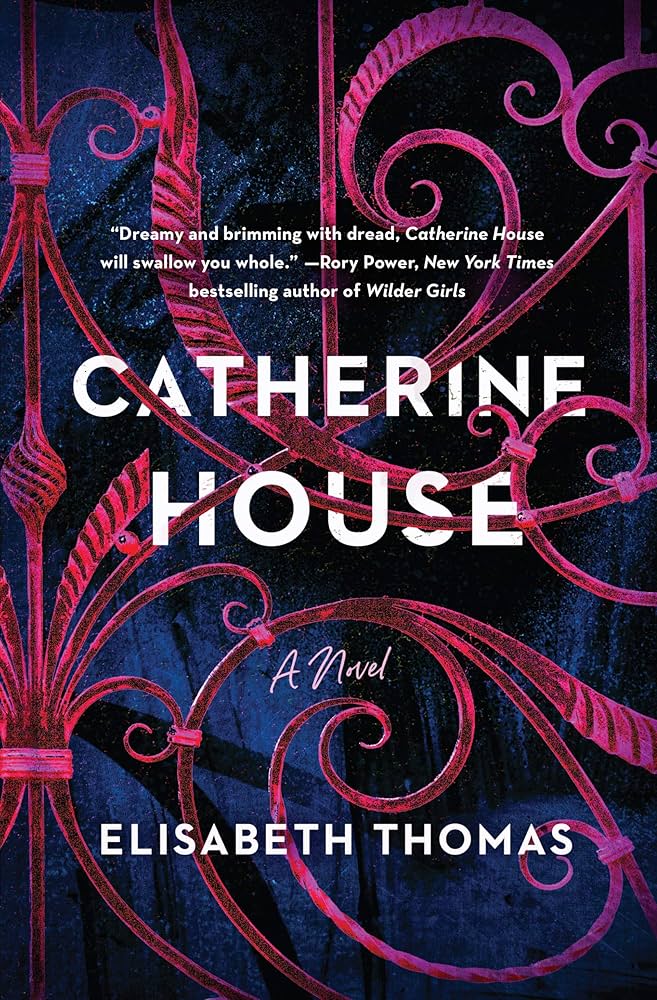
Catherine House – Elisabeth Thomasan eerie atmosphere, eerie interactions with eerie people, all in an eerie, secretive college.

“Devereaux” – Car Seat Headrest

I promise I’ll shut up about Car Seat Headrest for a few more months after this week. Well…I can’t make any promises.

Though I never got around to writing an album review for The Scholars (or any other of the amazing albums that have come out this year…oops. Phonetics On & On is the only album to come out in 2025, folks! Rejoice!), I feel like it’d be a crime for me to not talk about “Devereaux” at some point. After the back-to-back slew of excellent singles, “Devereaux,” along with “Equals,” is the song I’ve come back to the most from The Scholars. It’s what duped me into thinking that the album was going to be a re-hash of Teens of Denial, but even though it calls back to the song, the rest of the album proved me dead wrong…though I wouldn’t complain about Teens of Denial 2: Electric Boogaloo. Despite being from the perspective of one of Will Toledo’s many characters, a crocodile named Devereaux, the themes of living under the roof of religious bigotry and longing for escape could’ve been plucked straight out of his early discography. Anthemic and pleading, I see it becoming a future crowd-pleaser at shows—the kind I’d see the fans emphatically jumping up and down to. Hell, I saw them doing that on this tour, and it was only the second song in the setlist. Toledo’s soaring vocals meld the yearning, melancholic lyrics into a cry of longing: “I wasn’t born to be this, I was born to fight dragons/With a cowl on my face/With an auspicious birthday.” If there was ever a more air-punch worthy song, chock-full of lyrics meant to be yelled into the spacious walls of a sturdy venue, or simply into the darkness of a firefly-tinged summer night, “Devereaux” is it.

…AND A BOOK TO GO WITH IT:
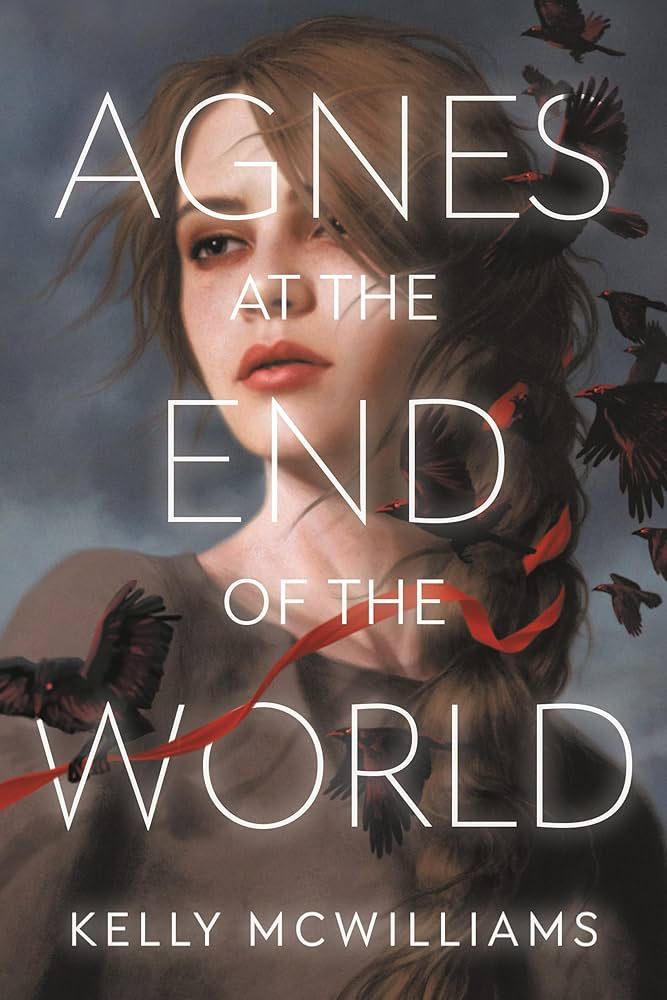
Agnes at the End of the World – Kelly McWilliams“In the land beyond me and you/A bunch of kids who don’t know what to do/We all wait in the silence to hear…”

“One Tiny Flower” – Jeff Tweedy

BREAKING: water is wet, the sky is blue (sky blue sky, even? [gets dragged offstage by a comically large cane]), and Jeff Tweedy cannot stop cooking. Seriously! Even within a band, how is it possible that in the last five years, this man has put out one solo album, two albums (one of which is a double album) and an EP with Wilco, three reissues of past albums, and now a triple album out this September? It’s been a while since I’ve read Tweedy’s book, How to Write One Song, but if that kind of insane output—not only prolific, but consistently good to boot—doesn’t convince you that he can, in fact, teach you how to write one song, then I don’t know what will.

I had a feeling why he continues to be so prolific. In my experience, creativity blossoms most when you’ve got something impelling it: not necessarily spite, anger, or negative emotion, but any kind of passion that pushes you to put something new out into the world. Give yourself into it too much, you lose the outside world, and you lose the reality that must be grounded to; lose sight of it, and you forget that everything pushing against you in the world, positive and negative, can be a source to revive that creativity. Tweedy put it this way in a statement about the album: “When you choose to do creative things, you align yourself with something that other people call God…and when you align yourself with creation, you inherently take a side against destruction. You’re on the side of creation. And that does a lot to quell the impulse to destroy. Creativity eats darkness.” Tweedy saw the veritable tsunami of strife, fascism, genocide, and all the other ills plaguing the world, and put up arms against it by means of art. For me, and for so many people who feel helpless, it’s all we can do. My mom shared this wonderful Ted Talk by Amie McNee about how making any kind of art, political or not, is an act of resistance in this hellscape just by virtue of the fact that you’re putting your time and attention into creativity and not giving money to corporations by endlessly scrolling on social media or participating in other capitalist activities. It comes to mind when I think about the upcoming Twilight Override: now that’s an act of resistance. 30 songs! That monstrous length is also intentional to Tweedy: “Whatever it is out there (or in there) squeezing this ennui into my day, it’s fucking overwhelming. It’s difficult to ignore. Twilight Override is my effort to overwhelm it right back. Here are the songs and sounds and voices and guitars and words that are an effort to let go of some of the heaviness and up the wattage on my own light. My effort to engulf this encroaching nighttime (nightmare) of the soul.” 30 songs is hard to keep consistency with, but nevertheless, I welcome Jeff Tweedy as the musical champion of (twi)light in the overwhelming darkness.

Out of the four singles that have been released so far, “One Tiny Flower” seems most like Tweedy’s mission statement with Twilight Override. It’s not his most lyrically complex song, but it evokes the most classic imagery of resistance and resilience possible: a tiny flower sprouting out from the concrete. It’s an ember of joy, a labor of intensive hard work to make the roots hold onto concrete, and a fuck you to whoever poured the concrete over the space where they didn’t want more plants to grow. Even without the rest of Wilco, “One Tiny Flower” reeks of Cousin, shifting from understated, softly sung acoustic melodies to a jingling, entropic dissolution before straightening itself back up again. The other three songs veer between different sides of Tweedy’s range, but if there are any more songs like this one, then I’ll be satisfied with Twilight Override.

…AND A BOOK TO GO WITH IT:
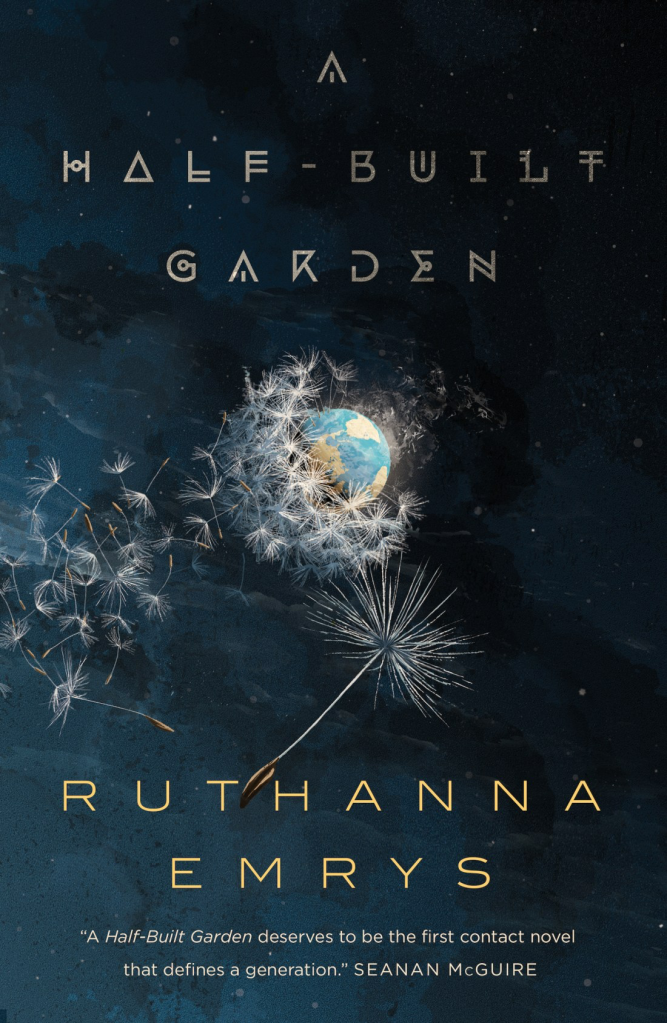
A Half-Built Garden – Ruthanna Emrysa quiet, hopeful tale of climate change and first contact.

“Psychosis is Just a Number” – Guerilla Toss

I’m surprised that I’ve never talked about Guerilla Toss on any of these posts, but I think it’s mainly because my main heyday listening to them ended right around the time when I started making these graphics, several months after their last album, Famously Alive, came out. I don’t tend to habitually revisit them, minus most of the tracks from Twisted Crystal (see: “Come Up With Me,” which I swear needs to be the theme song for a quirky Cartoon Network show with a plucky girl protagonist on a bicycle exploring a magical realm). But even though I’d never place them among my most-listened to bands, I’m always happy to hear something new from them. You’re Weird Now comes out this October, but the truth is, Guerilla Toss have been weird all along—and that’s what makes them special. They’re doing nothing but their own thing, pasting together surreal lyrics with electronic and rock beats frankensteined together. “Psychosis Is Just a Number” mashes together thrumming bass and a surprisingly smooth brass section—I’d never think to compare Oingo Boingo and Guerilla Toss musically, but the madcap, off-the-walls excitement of this track is so wonderfully reminiscent of them. They throw everything at you (the chorus is borderline overstimulating if you listen to it over and over) but that’s just how their unfiltered, raw excitement and creativity shines through.

…AND A BOOK TO GO WITH IT:
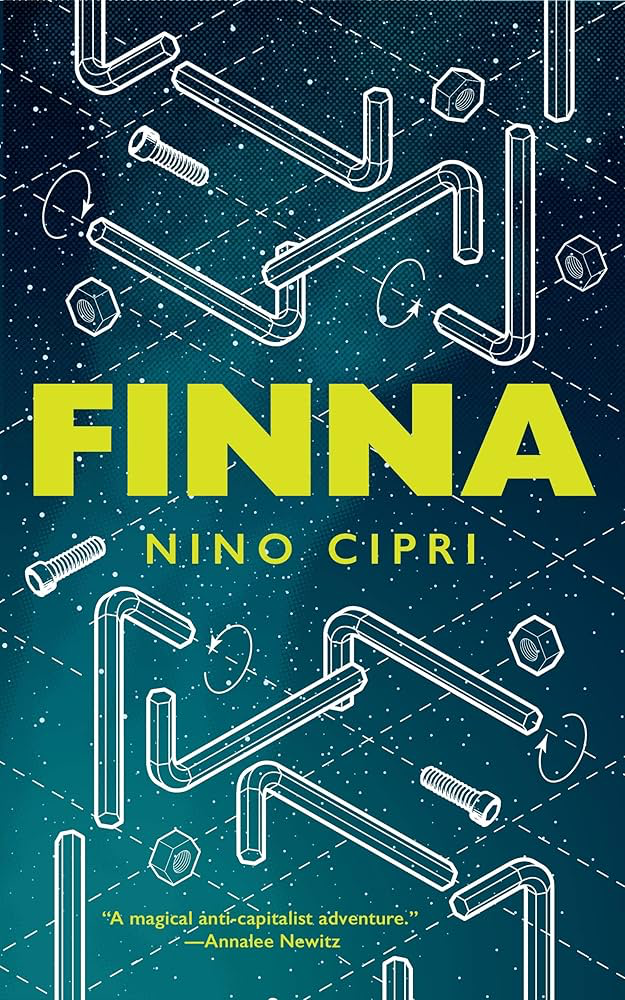
Finna – Nino Ciprithis is a highly specific situation, but strangely, Guerilla Toss seems like the ideal soundtrack to being trapped in an interdimensional, legally distinct IKEA full of monstrous furniture.

“The Width of a Circle” – David Bowie

I’ve loved “The Width of a Circle” for at least a few years, and I’ve been interested in learning how to play it on guitar. Unfortunately, though it has been a wonderful experience, I made a…uh, slight oversight, and didn’t realize how painfully awkward it would be to be in my guitar lesson and have my guitar teacher go through the whole “He swallowed his pride and puckered his lips/And showed me the leather bound ’round his hips” bit. Whoops.

As you probably gathered, “The Width of a Circle” is about as freaky as they come. Though the actual subject is somewhat ambiguous, it’s about Bowie encountering either God or Satan…and proceeding to have the most earth-shattering gay sex with him. (I’m more inclined to the Satan interpretation, as the figure fools the Bowie character into thinking he’s a humble, young God, then opens up the pits of Hell.) Even though The Man Who Sold the World didn’t get a ton of attention when it came out, it’s impressive that this got through any kind of censors and was released all the way back in 1970—just as impressive as the fact that Bowie was slaying in that dress on the front cover of the album. It’s honestly one of the queerest songs in his catalogue to me, and this was even before he made a whole album about a queer alien. The Man Who Sold the World didn’t gain much notoriety until Bowie’s career started picking up in earnest, but in retrospect, it’s the album where his storytelling really took a turn for the truly artful. Though the sound isn’t as cohesive, you can see the leap he took into going more daring places with his songwriting. “The Width of a Circle” truly is an epic in every sense of the word; originally two separate songs, it was tied together by the connective tissue of Mick Ronson’s jamming, expanding it into an eight minute long behemoth of a tale. The theatricality that would come to dominate Bowie’s work in only a few years blossoms here as he takes a journey through innocence and into shock and revelation. Even if it came to my disadvantage in that guitar lesson, this is the first time in Bowie’s career where his imagery takes on the quality of being so startlingly evocative—he’s a master of weaving worlds through song, and whether or not he’s selling them, each song is a Faberge egg of allusions and stunning songcraft.

…AND A BOOK TO GO WITH IT:
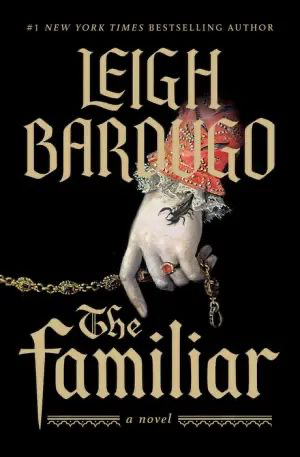
The Familiar – Leigh Bardugo“And I cried for all the others until the day was nearly through/For I realized that God’s a young man too…”

Since this post consists entirely of songs, consider all of them to be today’s song.

That’s it for this week’s Book Review Tuesday! Have a wonderful rest of your day, and take care of yourselves!

Posted in Sunday Songs

Sunday Songs: 5/11/25

Happy Sunday, bibliophiles! First off, a very happy Mother’s Day to my wonderful mom. She inspires me to be a better and more creative person every day, and I don’t think I’d be putting pen to paper (in the drawing and writing sense) nearly as much without her guidance and creative inspiration. So thank you for all your support, hard work, and love. I am so, so lucky. 🩵

School’s out, and it should be back to our scheduled programming soon enough. Of course, every time I take a break, I end up rambling tenfold to make up for the absence…apologies in advance. This is what happens when you let me get ahold of a new Car Seat Headrest album.

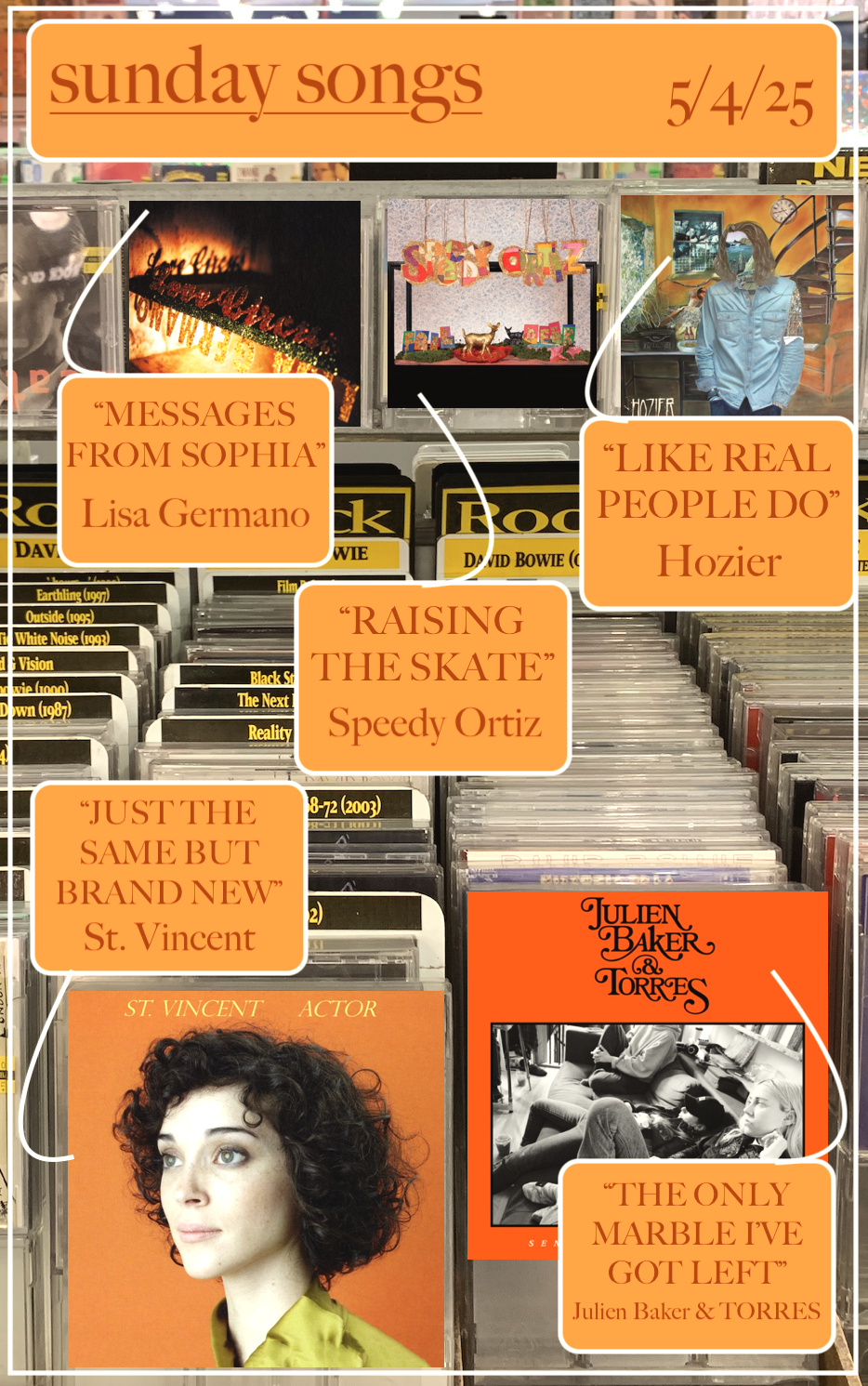
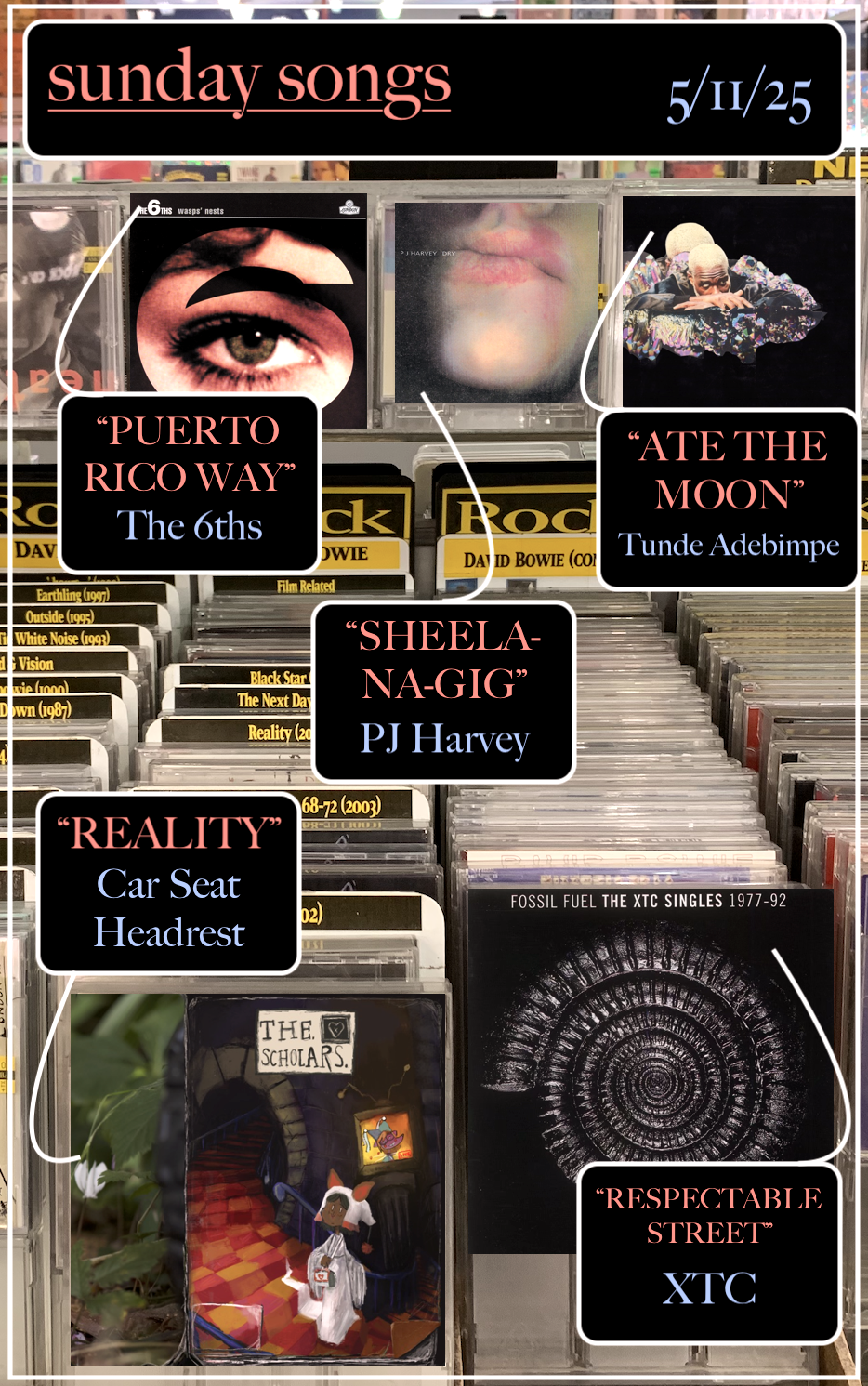
Since I’ve been in the finals doldrums for a bit, here are my graphics from the past few weeks:

4/27/25:

5/4/25:

This week: BRO DOESN’T EVEN REALIZE THIS IS RESPECTABLE STREET! 🫵😂

Enjoy this week’s songs!

SUNDAY SONGS: 5/11/25

“Reality” – Car Seat Headrest

The more I think about The Scholars, the more I realize that this is the extreme of Car Seat Headrest’s qualities. Will Toledo has always been a scholar, and a deeply self-indulgent one. I don’t mean that derogatorily at all—his songs are just packed to the gills with references: often Biblical and also encompassing musical and literary greats. Although his life is still interwoven within the narrative (“Is it you or the sickness that’s talking?” on “The Catastrophe [Good Luck With That, Man]”), The Scholars is a veritable library in and of itself.

Not only are the usual suspects of Biblical references and allusions to music and literature, and Toledo’s past work are there, but The Scholars is Car Seat Headrest’s furry rock opera, an omniscient epic taking place at the fictional Parnassus University. There’s a full summary of it in a libretto that’s only available if you buy the vinyl, but thanks to the saints at Genius who, I’ve been able to piece together some of the narrative; it consists of vibrant characters coming out of the closet to their parents, participating in various subcultures around the college, a rival clown college, and a band of punk troubadours. All this culminates in [checks notes] the Dean of Parnassus University getting poisoned after the students from the rival clown college invade. It’s a trip…but I wish it was more readily available! When I say that The Scholars is self-indulgent, I love it in the sense that Will Toledo has created such an inventive, sprawling world between the notes of this album, and that he’s let his ambition run wild, in terms of the scale of the story and the prog sensibilities of the album. He clearly appreciates the value of letting people solve riddles and puzzles, but he’s left hardly any clues to piece together the narrative if we don’t have the libretto. I’d just like it to be more accessible—not in the sense of being more “listener friendly,” but in the sense that I want to actually be able to access the story. There’s clearly so many layers to The Scholars, and I’m dying to know more of the nuance.

That being said, even if you don’t know the story of the Rise and Fall of CCF and the Clowns from Parnassus University, The Scholars is a treat. For the first half, I was almost duped into thinking that the band had almost dipped back into Teens of Denial territory, which was twofold. On the one hand, Teens of Denial has a deeply special place in my heart, a staple of my fourteen-year-old girlhood and one of my favorite albums of all time. After the missteps of Making a Door Less Open, The Scholars is a return to form in some ways. As good as the first half was, I was afraid that it was too much so—even with the rock opera behind it, songs like “Equals” did rather feel like the same stories of drugs and regret that populating Teens of Denial. Yet after “Gethsemane,” “Reality” takes a turn into the more sprawling—and always fascinating. Trading off vocals between Toledo and Ethan Ives, it plunges into pure, 21st-century rock opera, complete with the avalanche of drama and pounding guitars that comes in at around the five-minute mark. I swear that some of the chord progressions remind me of “Cosmic Hero,” another one of my favorite epics from the band, but it’s painted into an unending landscape. Through all eleven minutes, I get the feeling of the culmination of all of the story’s events before the climax—it’s a drawn-out feeling, but one of certainty: they can’t escape what they’ve made, and they must move forward with acceptance of their fate; the whispered utterance of “no stage left” feels like an admittance that they can’t see what they’ve done, but there’s no escape from the consequences: they can’t see the audience. I’m circling back to self-indulgence, but the term sounds so negative: this just feels like Toledo unleashing the multitude of narratives within him. Is it easy to sit down and listen to songs that are nearly 20 minutes long? No, even for me. Yet as esoteric as it is, “Reality,” and this album, is worth your while, if you’ve got the time to set aside. Bottom line: be self-indulgent with your art. It doesn’t matter if there’s a small audience or no audience—you create what you think the world is missing, and the right people will find it.

…AND A BOOK TO GO WITH IT:

The Scholars 28-page libretto, only available when you purchase the vinyl – not trying to be snarky about it, genuinely. But heck, it’s pretty much a play in and of itself, complete with stage directions in the liner notes.

“Respectable Street” – XTC

This has to be the first Britpop song.

It’s long been accepted that XTC helped mold the Britpop movement as we know it—in fact, he almost had a direct hand in it, as he was Blur’s first choice to produce Modern Life is Rubbish; he produced a handful of the original mixes before departing from the project. But XTC made Britpop 12 years earlier. As much as I adore Blur’s sound and lyrical style from Modern Life up until about The Great Escape, hearing “Respectable Street” makes me realize exactly where they were coming in. I wouldn’t go so far to call some of it a rip-off…well, I almost would. I love Blur too much for that. Blur did develop their own style within this method, but at first, their claim to fame was largely due to songs like these. Not only does this song take a microscope to the arbitrary hypocrisies littering an uptight, quintessentially British neighborhood, but Andy Partridge has the vocal swagger to carry it all. Damon Albarn had the looks, but the line delivery is all Partridge, full of snark and with a cheeky wink as he lays out all of the double standards and not-so-well-kept secrets: “Sunday church and they look fetching/Saturday night saw him retching over our fence.” Of course, almost half of the jabs got butchered by the radio edit (“Now they talk about abortion” was replaced with “absorption,” which makes no sense, but…not a whole lot sounds like abortion, I guess?), but no amount of censorship would dull Partridge’s signature, acerbic style. Piled on with in-your-face production and the quick strikes of guitars, and you’ve got a song that inspired a generation—and hasn’t gotten the least bit old.

Also, about the promo above: I just know that set sounded heinous…I’m gonna go out on a limb and say, however talented all these guys are, that most of them did not know how to play cellos or violins. Definitely the point. Still, it must’ve sounded like middle school band practice in there…

…AND A BOOK TO GO WITH IT:

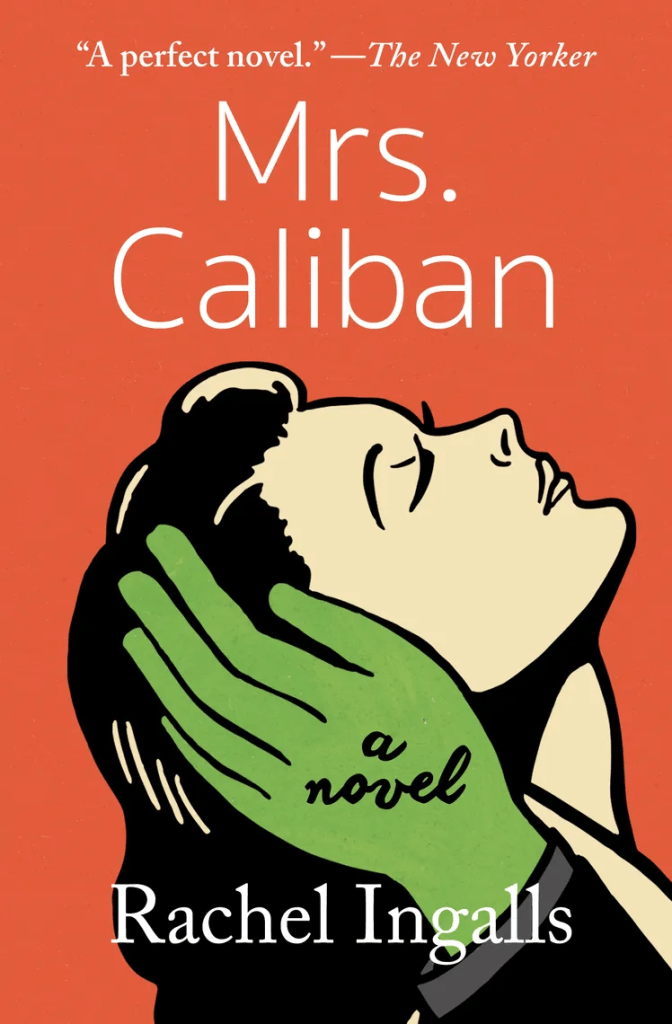
Mrs. Caliban – Rachel Ingallsnothin’ like an escaped frog creature to spice up your respectable street, eh?

“Puerto Rico Way” – The 6ths

Stephin Merritt’s writing continues to be something to behold. Even though Mark Robinson (of Unrest fame) is at the vocal helm here, this is one of the 6th’s songs that’s most indicative of Merritt’s ability to not just set a scene, but make something so objectively seedy and nasty-sounding into the most cheerful, sun-bleached indie pop you’ve ever heard. Take the first few lines:

“The sun pissing in the streets/Of some hungover place/Dances with two left feet upon her face/But soft! She is fast asleep/Beneath her mosquitoes/You would never want to know what she knows…”

First off, the imagery of the sun “pissing in the street” is a stroke of genius, evoking the lazy way that sunlight bends and dapples along the subject’s face—something so objectively beautiful turned wayward and gross, an effect that’s stacked once the drunkenness is emphasized by it “dancing with two left feet.” The environment in “Puerto Rico Way” is so bloated with alcohol and oppressive heat, but it carries itself like all of Merritt’s indie pop songs—with more confidence than it should have, given the disappointing, warmed-over love he often writes about. On the track list, it rides the high of “Here in My Heart,” which could add to the cheeriness, but this track carves out a slice of hope, even if Martina doesn’t accept the narrator’s dance, in this “hungover place.” (The drunk, free-spirited, redheaded Martina does read like a manic pixie dream girl, so maybe it wasn’t meant to be after all. Martina’s so crazzzzzzzy! Love her!!!) The admission that “Oh love, it would’ve been ideal” implies that no, she didn’t, but that indie pop-timism (I’ll see myself out) creates a wrapped towel of sunburnt nostalgia, a photograph bleached in the sun, of a fleeting dance and a fleeting girl.

…AND A BOOK GO WITH IT:

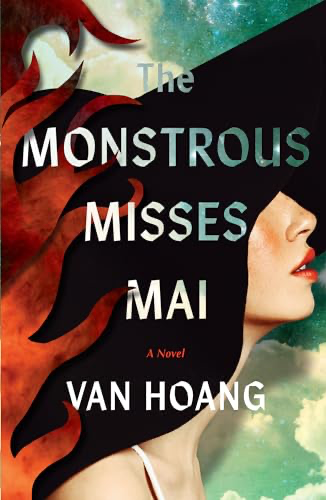
The Monstrous Misses Mai – Van Hoang“She’s drunk every single day/She’s young most of the time/She’s spent all of the rent on her decline…”

“Sheela-Na-Gig” – PJ Harvey

It’s always fascinating to look at songs that seem ostensibly quite feminist, but had none of that intention behind them. Take “Army of Me,” a song that I’ve always interpreted as being about feminine resistance, but was more about Björk trying to get her lazy brother to get up and do something with his life. The lyrics are quite self-empowered, easily interpreted as women breaking free from male-ordered subservience. The feminist leanings are there, but it’s only a sliver of the truth. Do I still feel empowered when I listen to it? Of course. But it’s not the whole story.

The same is true of “Sheela-Na-Gig.” The title references a type of Celtic fertility figure, an image of a laughing woman posing with her genitalia bared outwards. As such, the narrator goes through a sort of comedy of errors as she gets rejected over and over after flaunting her sexual qualities to no avail (“Look at these/my childbearing hips”). It’s easy to take it as a kind of internalizing what men want in women, exhibiting it, and then being turned away when it’s not to their standards; there’s an element of slut-shaming in the male figures not wanting the narrator because she’s “unclean.” The chorus of “Gonna wash that man right outta my hair” (interpolated from South Pacific) is empowered, especially after being kicked to the curb so many times by judgmental men. But PJ Harvey never intended it to be feminist song: as she told Melody Maker in 1992, “I wanted that sense of humour in the song…being able to laugh at yourself in relationships. There’s some anger there but, for me, it’s a funny song. I wasn’t intending it to be a feminist song or anything. I wanted it to have several sides.” And there is something funny about that—if you’ve been rejected with all of the repetition and swiftness of Wile E. Coyote falling off a cliff, all you can do is look back and laugh.

It is a sort of death of the author situation; “Sheela-Na-Gig” hasn’t necessarily been lauded as some feminist anthem (and Harvey said in the same interview above that she didn’t want to be “lumped in” with more forwardly feminist bands), but even a quick glance at any reviews of the song shows that’s how many people tend to take it. In the context of PJ Harvey’s other songs, which are incontestably about misogyny and her struggles as a woman in a male-dominated industry (and world) (see: “50ft Queenie”), “Sheela-Na-Gig” seems to fit into that puzzle. I don’t want to wave that over people’s heads like they interpreted it incorrectly, either—it’s not like I got the aspect on my first listen. (I credit that to Trash Theory.) Personally, I didn’t think all of it was necessarily funny at first, although being as Gen Z as I am, I’ve only heard the phrase “childbearing hips” used sarcastically, so I took that as such. After going through literary theory, I’ve definitely been on the fence-sitting side as far as whether or not to go full death-of-the-author on any given song; the reader’s interpretation does shape the work, but I find it foolish to take it without considering the author’s intent. With “Sheela-Na-Gig,” I think there’s a lot that can be empowering, but what may be most empowering to me is finding the humor in being a woman. The semi-autobiographical narrator swings and misses repeatedly, but doesn’t let any judgement get under her skin. All of the ferocious power chords signal that she’s ready to dust herself off and try again. In the present moment, the narrator hasn’t yet learned, but the fact that PJ Harvey has looked back and learned herself seems more the point to me: having the self-awareness to feel bad for your past self, but be able to laugh at their mistakes. There’s power in being able to look back and laugh instead of wallow in sorrow—when you’re a woman, it’s all you can do sometimes. It may not necessarily be feminist, but it sure is a part of life.

…AND A BOOK TO GO WITH IT:

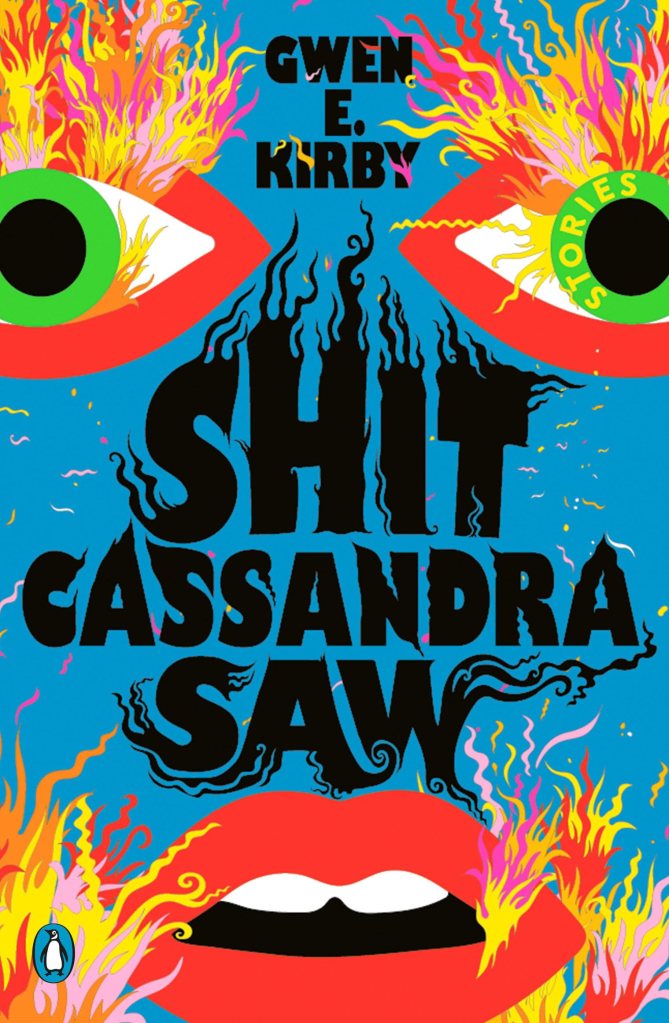
Shit Cassandra Saw – Gwen E. Kirbychronicling the varied experiences of women with wry humor—and honesty.

“Ate the Moon” – Tunde Adebimpe

It’s been almost a month since Thee Black Boltz came out, and the question remains: is this enough to sate us through the dreaded TV on the Radio drought? For the most part, I’d say yes—but it’s a separate, branching effort. Though it proves that Tunde Adebimpe was the beating heart of the band, he’s more than formidable on his own, minus Dave Sitek’s production and piled on with more synths. Though it’s not without its misses, Thee Black Boltz feels like Adebimpe stretching his fingers out in all different directions, but never stretching them beyond what makes me come back to TV on the Radio so often.

With a central theme of overwhelm during times of crisis and searching for light—creativity—amidst the choking smog, Adebimpe turns to synths and more danceable beats (see: “Somebody New,” a bolder, dancier gamble that mostly paid off in spite of the autotune) in order to pull through. “Ate the Moon” is about that overwhelm, if the title doesn’t already clue you in. Swallowed by anxious spiraling and visions of horror, the narrator scrambles for answers, but finds only regret: an echoing, childlike voice proclaims after the “the man who ate the moon” chorus that “and he choked, of course, because he bit off more than he could chew. Such a dummy!” “Dummy” echoes and is pitched down as it fades out, distorted into a trickster baring a triumphant, toothy grin as it disappears into the darkness like the Cheshire Cat. “Ate the Moon” certainly has some of what I think the albums pitfalls are: the lyricism is on the simpler, more obvious side. Not inherently a drawback, but after something as rawly and artfully written as “Tonight,” it feels cheap for him to rhyme “fire” and “desire” for the millionth time. It’s like Jeff Tweedy using someone being “cool enough to be ice cream” as a metaphor after being such an unparalleled poet otherwise. But like “Ice Cream,” it’s easy to love “Ate the Moon.” With the instant hit of Adebimpe’s boxing gloved punch of a voice and the synths and guitars that have been sewn into an electronic gestalt, it’s one of the most unique songs on the album, an adrenaline-pumped trip into the downward spiral of autonomy-less fear.

…AND A BOOK TO GO WITH IT:

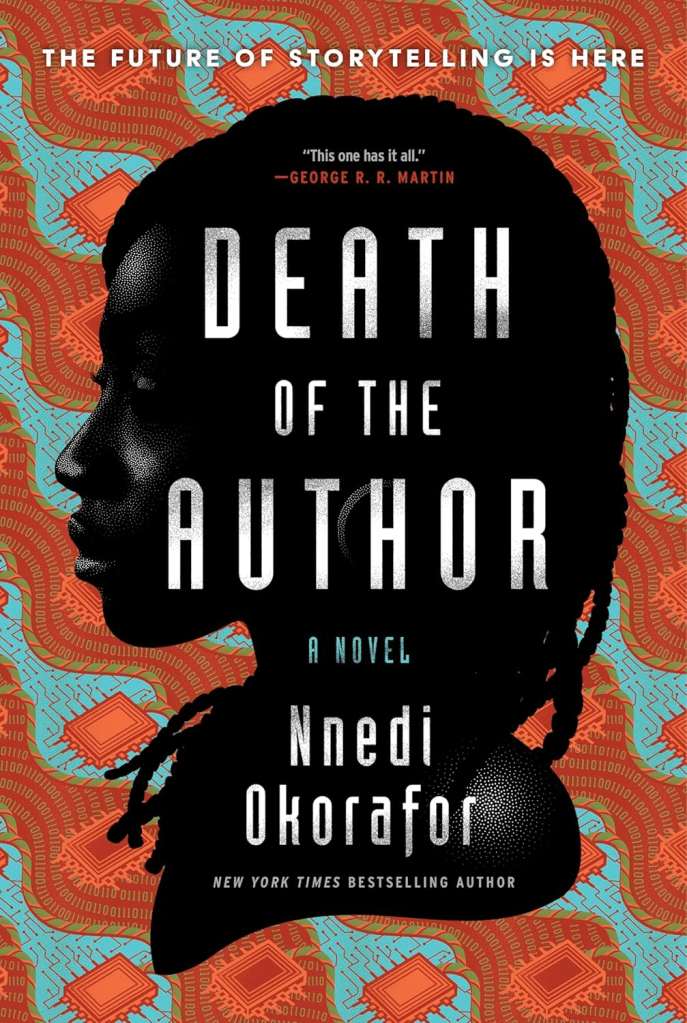
Death of the Author – Nnedi Okorafor“Seems I was iII-prepared/For the fall that finds me here/Sad extremes running through my head/Knocked my blues into the red…”

Since this post consists entirely of songs, consider all of them to be today’s song.

Posted in Sunday Songs

Sunday Songs: 4/13/25

Happy Sunday, bibliophiles! I hope this week has treated you well.

This week: your yearly dose of “Madeline blubbering about the unknowable beauty of the universe and also Björk (in no particular order.”

Enjoy this week’s songs!

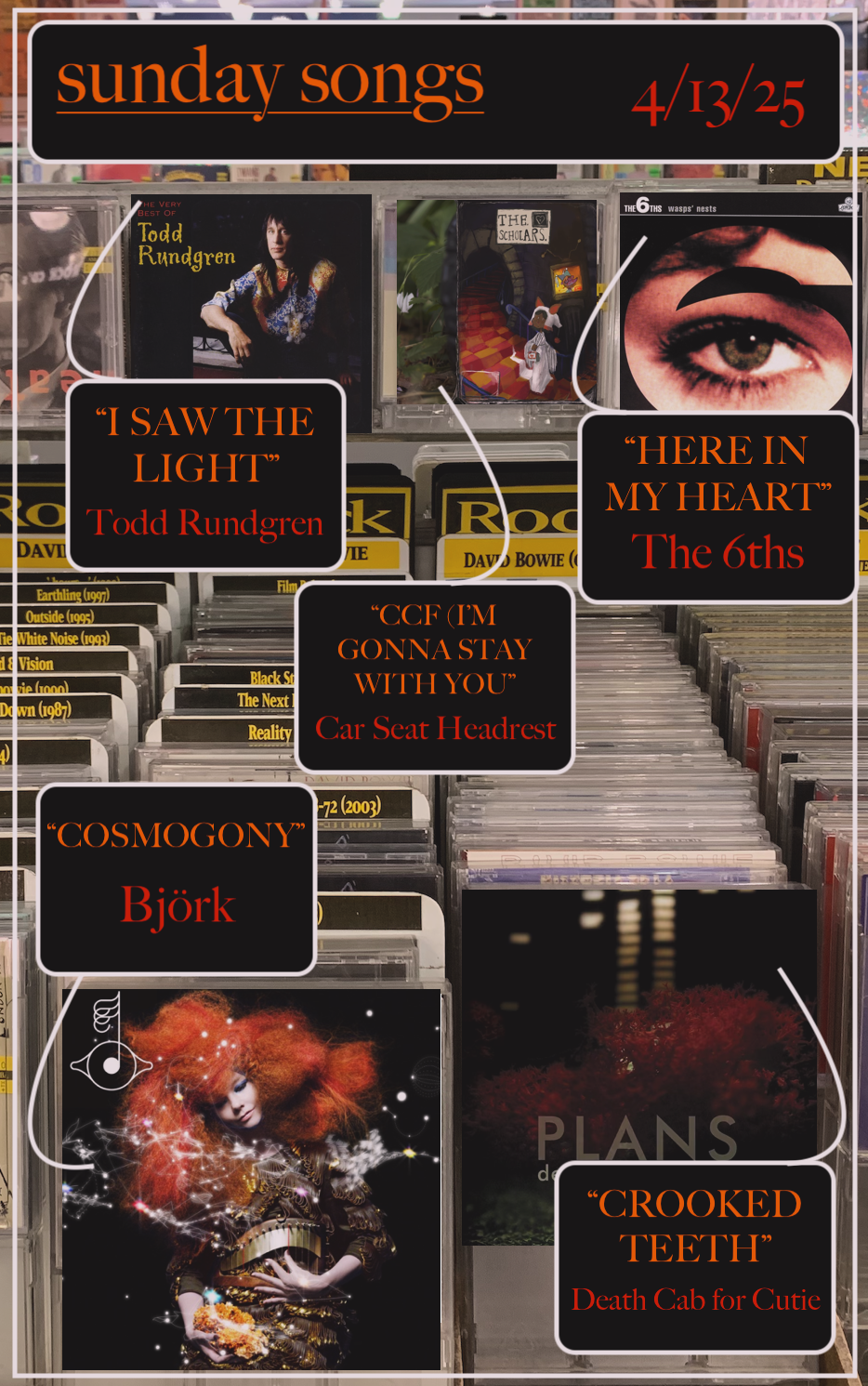
SUNDAY SONGS: 4/13/25

“Cosmogony” – Björk

Not to be dramatic or anything, but I am currently writing this through tears. Every time I pull up the live version of this from the Biophilia concert film, I start crying. Damn you, Björk, could you not carve out the softest, tenderest bits of my soul with a melon baller for once?

Maybe I am the soft, snowflake humanities major that Trump wants to extract from higher education, but I find I understand science best when you bring out its inherently human qualities. We went wrong when we perpetuated the stereotype of the sciences, and scientists by extension, as cold and removed from emotion, because to separate the two is to deny the connectivity of nature, of the universe, and of the particles that quite literally make up all of us. (Which is why SciAll is doing incredible work to humanize the field, and even better that my awesome brother is making content for them!! Shameless Todd family plug, now back to your scheduled program.) Sure, I do believe the stereotype whenever I pass by the absolute brutalist hellscape that is my college’s engineering building, but that isn’t representative of all of STEM. I’ve never gotten physics. I’ve never fully understood it, only bits and pieces. But the other day, I read a great book called Uncommon Measure, a memoir about time and music, which likened quantum entanglement—the way that particles just know how others around them will move—to falling in love with her husband while they learned to dance Argentinian tango in college, and trusting her body to remember the steps and the movements of her partner. Do I understand quantum entanglement any more? Slightly, but I’d still fail a course on it. But I’m on my way, because of that emotion. The moment we lose that connection between ourselves and the very makeup of our universe, we forget ourselves. Quite literally, ourselves.

Now that I’ve finished Sonic Symbolism, my Sunday Songs have admittedly become months of Björk worship in a trenchcoat, but getting this nuanced view on her music-making process has seriously invigorated me. I’ve yet to fully listen to Biophilia, but it’s high on my list. The album was conceived along with an app that aimed to teach children about music through concepts of science; for instance, chords and learning which chords work best with each other is demonstrated by a visualization of tectonic plates. And if that’s not enough, David Attenborough, THE MAN HIMSELF, recorded an intro for the app, which was also featured on the Biophilia tour. Though the app is sadly defunct, it remains a critical piece of Björk’s creative legacy, as well as a tool that was specifically shown to benefit neurodivergent children in learning these concepts. In the grand scheme of things, “Cosmogony” was the menu that held the rest of the app together, a screen where you could navigate to different parts of Björk’s simulated universe. (And even if that didn’t exist, the aesthetic language of the album, with Björk’s voluminous wig that’s the color of oxidizing copper.)

That fusion of the arts and sciences, as well as the inherent humanism that Björk brings to her craft, is what makes “Cosmogony” so special; the song details three creation myths from around the world (Miwok Native American, Sanskrit, and Aboriginal Australian), and she adds the Big Bang theory, which she jokingly referred to as “a creation myth that is 100 years old,” but pointed out that “all creation myths at the time of their making were science.” The song begins with a kind of transcendental choir that rises in pitch, mimicking the motion of eyes searching the stars. It’s the only music that has ever captured the feeling I often felt while taking an astronomy class last year. As I stared up at the planetarium, watching as simulations of the known universe expanded outward ad infinitum, I had this bizarre, incomparable cocktail of emotions—fear, wonder, and somehow, comfort. It’s impossible to feel a single emotion at the revelation that our universe is infinitely large and full of places we cannot even begin to reach or imagine, is it? Space is a cold, unwelcome vacuum, but it is fertile with endless possibility. And that’s where Björk punches me in the gut every time, dredging out the wonder, comfort, and ecstasy of being surrounded by billions upon trillions of stars and planets: “Heaven, heaven’s bodies/Whirl around me/Dance eternal.” I’d say somebody hold me, but I am being held. All of us are, by the arms of the universe.

…AND A BOOK TO GO WITH IT:

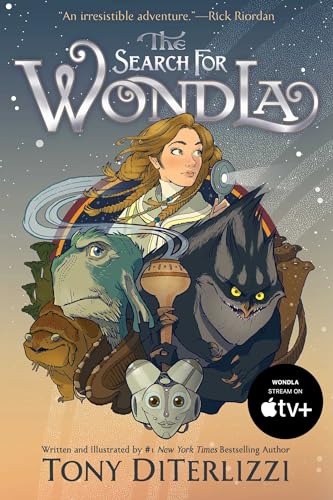
The Search for WondLa – Tony DiTerlizziI can easily imagine this as Eva Nine sees the Rings of Orbona for the first time, coming to terms with her own clashing creation myths.

“Crooked Teeth” – Death Cab for Cutie

Bring back those stop-motion, collaged indie rock music videos from the 2000’s! We lost something when that trend went away. They’re all so inventive and fun, and they all have that token darkly funny moment before going right back to silly little cutouts of floating astronauts and whatnot. (See also: “Can You Feel It?”)

Song lyric of the week, unofficially: “You’re so cute when you’re slurring your speech/But they’re closing the bar and they want us to leave.” This song is an absolute indie hit, and it deserves that status: a three and a half minute-long pocket of sad white boys, clever lyrics, and lovely harmonies. That’s probably why I found myself occasionally remembering the chorus of “‘Cause you can’t find nothing at all” every few years and forgetting the rest of the song. Shame that I forgot the rest, really, because that’s not even the catchiest bit. Admittedly, I find the “I’m a war between head versus heart” bridge rather corny compared to some of the more poetic bits of this song, but that’s because of how descriptive every line is. Ben Gibbard really knows how to make every line count, from the lyricism down to the precise inflection of each word. The way his voice creeps through the notes makes the expression “turn of phrase” make sense—every sentences seems to twist like vines. All of it becomes “the home in my heart” built with rotten wood that leads into the first chorus; much like the collection of landmarks that Gibbard describes, it’s a blurred, drunken stumble through a mutually destructive relationship that keeps losing its water, no matter how many strips of tape you put over the holes in the kiddie pool. Yet all of it is irresistible, as is the last dregs of romance that have drained out of whatever hot mess Gibbard is chronicling.

…AND A BOOK TO GO WITH IT:

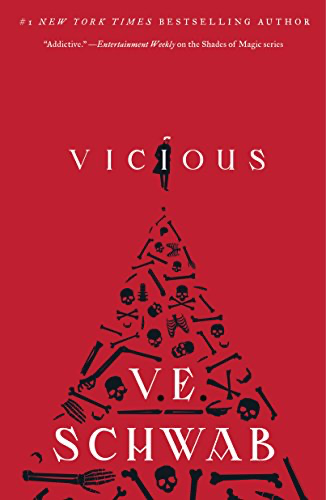
Vicious – V.E. Schwab“‘Cause I built you a home in my heart/With rotten wood, and it decayed from the start/’Cause you can’t find nothing at all/If there was nothing there all along…”

“I Saw the Light” – Todd Rundgren

There’s a sliding scale of what degree of early ’70s that I enjoy. On the one end, you’ve got glam rock: your Bowies, Bolans, Brian (Eno)s, etc. It all depends on that warm guitar tone. By the time you get here, you’ve got the guitar tone, but then you’ve inched into the same breath as Steely Dan, and…okay, that might be where I draw the line. (Admittedly, “Peg” is better than it should be.) That’s about when you get into that yacht-rock kind of cheese that I can’t quite stand. This one Todd Rundgren song, however…safe. Can’t deny how catchy it is, god! Another delightful tidbit of the ’70s I tend to enjoy is the pianos—I’m not sure if it’s the specific kind of piano or just the sound quality, but there’s something so charming about that tinny kind of piano that’s punctuates the background. Each bend Rundgren hits on the guitar strings feels like a sway of the hip, a twist of the leg striding across the dancefloor. Sure, he specifically meant for it to be a hit and not much else (and apparently cranked it out in 20 minutes while addicted to Ritalin), but it works perfectly as such. “I Saw the Light” has a joyful groove that’s been undeniable for 50+ decades, but exists in amber as nothing but 1972: smooth, romantic, and oh so bright in that guitar tone.

…AND A BOOK TO GO WITH IT:

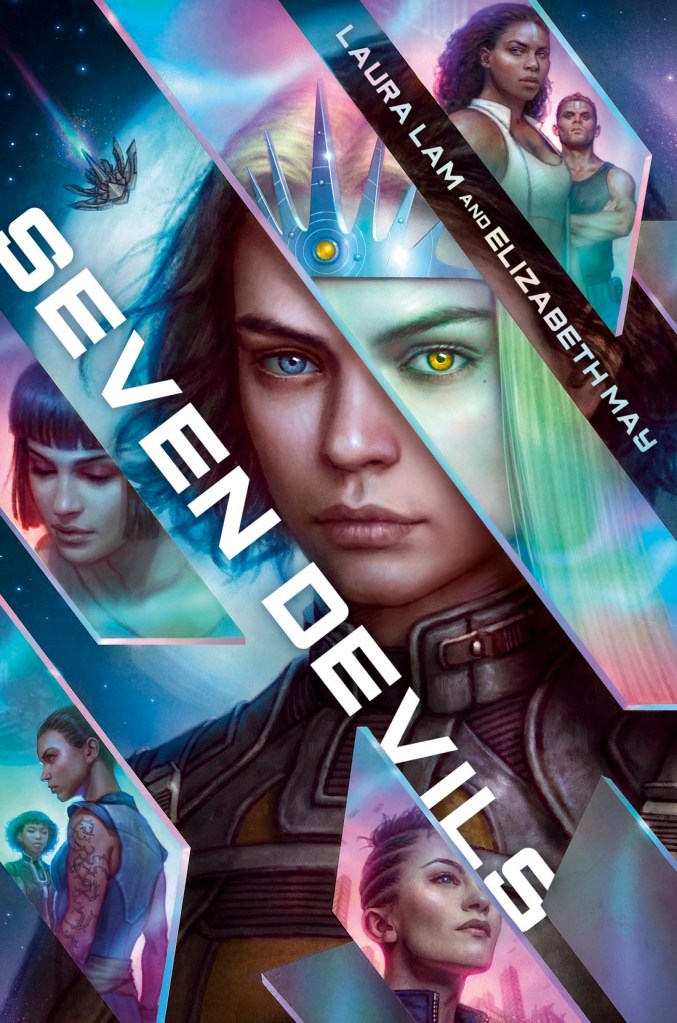
Seven Devils – Laura Lam and Elizabeth Maysongs with lyrics that are on the…more generic side (sorry, Todd) don’t give me as much rope, so it’s mood I’m going off of for this one, a messy, romantic space opera.

“CCF (I’m Gonna Stay With You)” – Car Seat Headrest

Car Seat Headrest is back, and they’re making obscenely long songs again!! Nature is healing!! (And apparently, these aren’t even the longest? The second to last track is purportedly 19 MINUTES LONG? “Famous Prophets (Stars)” has some competition…) So is Will Toledo, evidently—I’m so glad he and the band are taking it slowly on this tour (which I am SO elated to have tickets for), but I’m glad that he’s gotten to a place with his long COVID that he can make some more angsty masterpieces.

It really does seem like The Scholars will be some of Car Seat Headrest’s boldest work to date. Toledo conceived of this album as a rock opera, inspired by the likes of Tommy and The Rise and Fall of Ziggy Stardust and the Spiders from Mars, centered around the fictional Parnassus University. Each song centers around a student; the excellent, nearly 11-minute long epic of a single, “Gethsemane,” for instance, follows Rosa, a medical student who dabbles in necromancy and discovers that she can absorb the pain of others. Aside from said Gethsemane, Toledo also said that he was inspired by his own journey into Buddhist practices while he dealt with long COVID and his lifelong, conflicting feelings surrounding his spirituality. It’s an incredibly ambitious cocktail of ideas and about as spacious as a university campus, but it seems like the pent-up work of five years of not releasing any new material and the flood of ideas that I’m sure came along with it.

If there’s one thing that Car Seat Headrest has perfected the art of, it’s making album intros. They’re all about giving you that antici……pation, but the payoff is even more rewarding than the almost cinematic buildup. Even on weaker albums such as 2020’s Making a Door Less Open, “Weightlifters” had a kind of thesis about the album’s musical motifs, and on the iconic Teens of Denial, “Fill in the Blank” sets the upbeat, angsty tone with ease. “CCF (I’m Gonna Stay With You)” reminded me immediately of “Vincent” and its echoing intro, but what follows is an explosive display of the band’s collective talent. Toledo, Ethan Ives, Seth Dalby, and Andrew Katz’s synchronicity creates a soundscape deserving of a sprawling rock opera, and Toledo’s poetic lyricism is befitting of Beolco, the playwright character this song is written from the perspective of. Long COVID couldn’t beat the healing salve that is Will Toledo’s voice, which simultaneously retains notes of his youth but has undeniably steadied and matured. “CCF (I’m Gonna Stay With You)” has threads of Teens of Denial all over the place (aforementioned “Vincent” similarities, and the horns reminded me of “Cosmic Hero”), but something about it has an inherently spacious vision beyond the storytelling—this is a whole universe that they’ve created, and I, for one, am elated to discover it. MY BODY IS READY.

…AND A BOOK TO GO WITH IT:

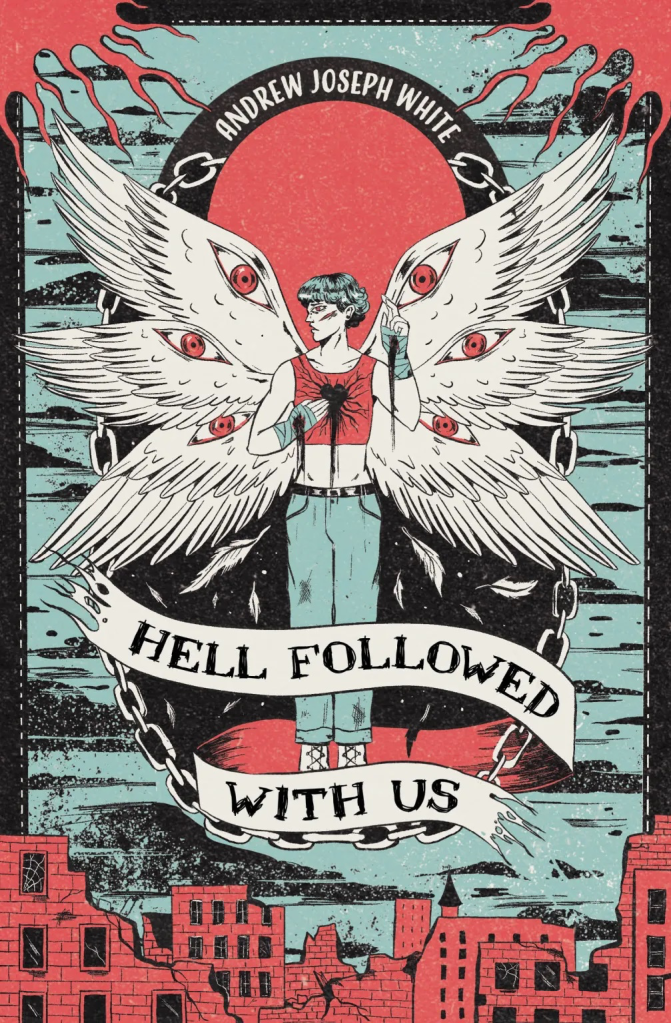
Hell Followed With Us – Andrew Joseph White – “When I come down off this cross of mine/A hairsbreadth apart and as far as the sky/Then back on my spine, there was a line that my idols crossed that I could not cross/On the other side is love, and right here is loss…”

“Here In My Heart” – The 6ths

Another addition to artists who cannot stop cooking: Stephin Merritt. Not only does he have some impressive vocal range and an excellent body of work with The Magnetic Fields, he’s a part of several other side projects—one of which, The 6ths, where he barely even sang, but just did arrangements and lyrics, and had a whole host of amazing indie artists sing for him. Dean Wareham (“Falling Out of Love [With You]”), Chris Knox (“When I’m Out of Town”), Mary Timony (“All Dressed Up in Dreams”), and Mark Robinson (“Puerto Rico Way”) are just a handful of the guests on this album, Wasp’s Nests. (However, he did sing himself on the also fantastic “Aging Spinsters.”) All of them are folded into the lovelorn synth tapestry that Merritt has woven, and though the voices vary, all of it is so distinctly him. The love (or love-related) songs he pens are usually of the lost love variety, but “Here In My Heart” is about as pure as they get; even if the love in question is far away, the yearning spills out of the chorus like thousands of butterflies. Every electronic twinkle glows warmly with love, the kind that makes your chest light up like in Fantastic Mr. Fox, but the glow never feels fake—it’s an ecstatic, crush outpouring that never loses its sheen. Anna Domino’s voice, as twinkling and delicate as the synths, blends in as a shimmering blot of light in the constellation of this starry-eyed love song.

…AND A BOOK TO GO WITH IT:

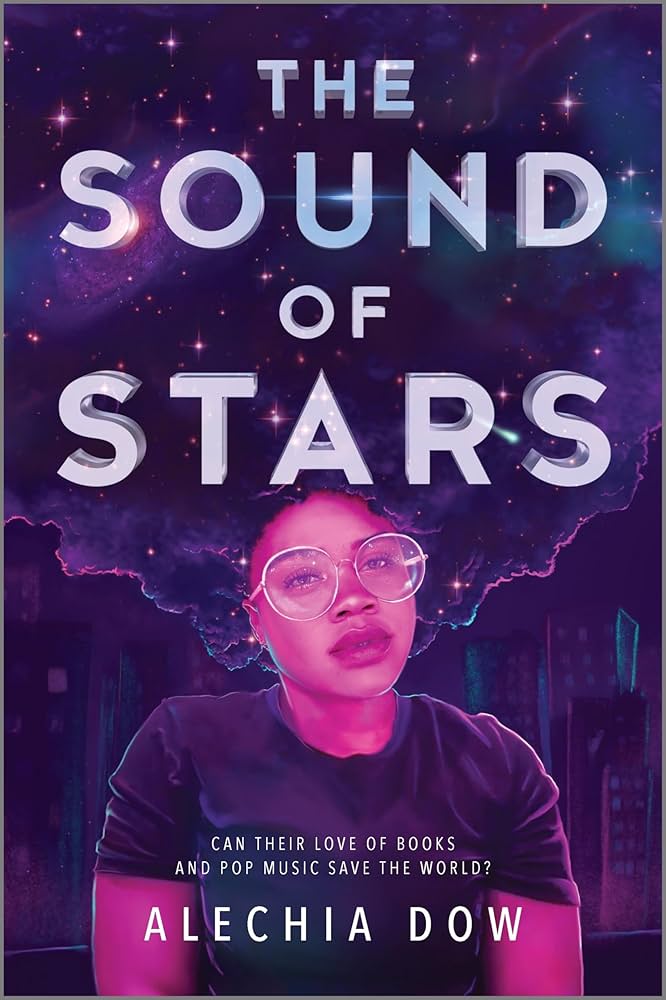
The Sound of Stars – Alechia DowThe lovesickness and synth textures fit with the hopeful joy of this novel.

Since this post consists entirely of songs, consider all of them to be today’s song.

That’s it for this week’s Sunday Songs! Have a wonderful rest of your day, and take care of yourselves!