Posted in Sunday Songs

Sunday Songs: 10/27/24

Happy Sunday, bibliophiles! I hope this week has treated you well.

This week: if I had a nickel for every year that I’ve had a bright green Sunday Songs color scheme right before Halloween, I’d have two nickels, which isn’t a lot, but it’s weird that it happened twice…bon appetit.

Enjoy this week’s songs!
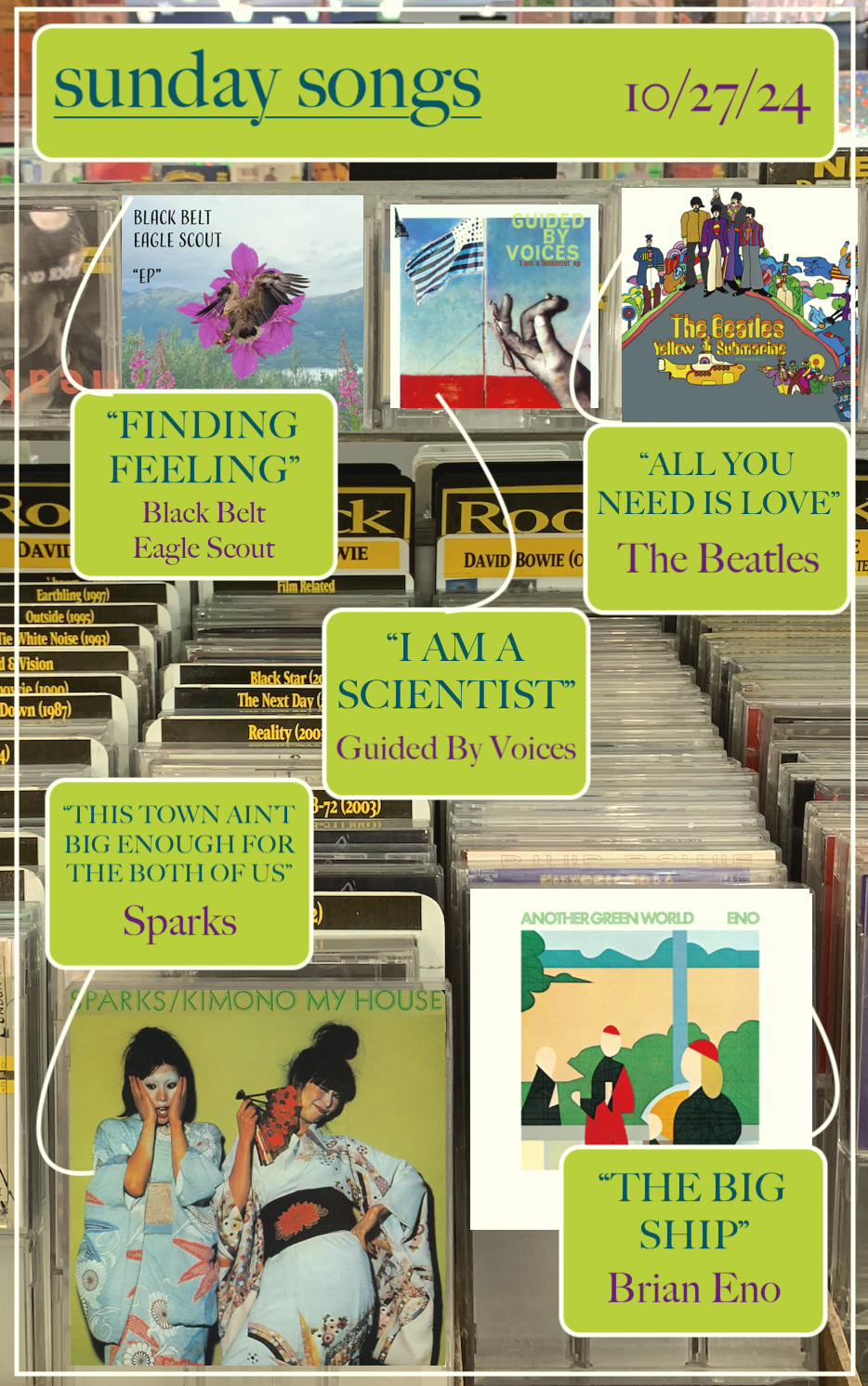
SUNDAY SONGS: 10/27/24

“This Town Ain’t Big Enough for the Both of Us” – Sparks

Because all you musicians totally want my unsolicited advice, I’ll offer it up: this is peak walk-on music. Imagine the band coming onstage the minute the drums kick in after the gunshot sound effect at 0:35. Come on.

In my glacial but nonetheless exploration of Sparks, I realized that I sort of knew this one—it’s one of their most popular and enduring songs, but I knew it from the cover that Siouxsie and the Banshees did, which should tell you all you need to know about how I was raised (read: a hipster). I think my desire for somebody to use this as walk-on music stems from just how punchily theatrical it is. It demands dynamic movement, silk, and finger guns fired into the audience of an opera house. Even though I’d place it well on the outskirts of glam (somewhere near Brian Eno ca. 1974), it walks that line between pure rock and full-face theatre. The Mael Brothers’ brand is significantly tighter than the spandex that their counterparts were (probably) wearing, but the constrained, cagey feel of it adds to the suspense, however thickly they laid it on—it certainly fits with the anecdote about the zoo animals in the first verse. Yet for the slimness of it all, they lean into how over-the-top it is. Case in point: said Wild West gunshot sound effect during the chorus. Brilliant.

Other than Siouxsie, a fair share of artists have covered “This Town Ain’t Big Enough for the Both of Us” over the years. I found out that the most recent happens to be The Last Dinner Party, who…admittedly, other than “Caesar on a TV Screen,” I haven’t exactly liked much, covered it as well, and…eh? The overwhelming vibe I got was that they were trying to go for over-the-top, but, as with…well, everything I’ve heard of theirs, they were trying way too hard. It sounds tight, but there’s hardly any fun in this. And how do you cover Sparks and not make it fun? Siouxsie and the Banshees made it their own—the flow is more dynamic and not as punctuated as the original, but it’s got that theatrical urgency that gives it the oomph that’s necessary to cover the song. The Last Dinner Party restrained themselves so much…and I hate to harsh on them, but they’re missing the whole point! The spirit of “This Town Ain’t Big Enough for the Both of Us” is to go dramatic! Go big or go home! I AIN’T GONNA LEAVE!

…AND A BOOK TO GO WITH IT:

The Good Luck Girls – Charlotte Nicole Davisanother—but very different—twist on Westerns.

“The Big Ship” – Brian Eno

me when I’m in a “making incredibly soothing but also innovative music” and my competition is Brian Eno:

Brian Eno can really do it all. He glammed up the ’70s with Roxy Music, then struck out on his own and glammed some more…and eventually came to be the person responsible for both coining and creating the genre of ambient music. He’s a master of both the lyrical and the instrumental; Another Green World contains both, but is considered by many to be part of his transition to almost exclusively making solo, instrumental ambient music. Even if he did mold the genre, however, I wouldn’t call “The Big Ship” ambient. Compared to something like “1/1,” it has an unmistakable feel of rising action, as in a novel, instead of the former’s soothing plateau. It’s unassuming at first glance, but judging from the outpouring of emotion in the YouTube comments—and its use in deeply emotional scenes from Me and Earl and the Dying Girl and The End of the Tour—”The Big Ship” is anything but. Author David Foster Wallace even said this in his posthumous novel, The Pale King:

“This song is making me feel both warm and safe, as though cocooned like a little boy that’s just been taken out of the bath and wrapped in towels that have been washed so many times they’re incredibly soft, and also at the same time feeling sad; there’s an emptiness at the center of the warmth like the way an empty church or classroom with a lots of windows through which you can only see rain in the street is sad, as though right at the center of this safe, enclosed feeling is the seed of emptiness.”

I don’t think I’ll be able to articulate anything about this song better than Wallace. I don’t think anyone ever could—he really did chip away the truth. You feel all of it. You can touch that drained eggshell’s core of emptiness, but you can see the pinprick of light made by a needle at the top. Whatever you imagine the big ship to be, the gradual rise of the song produces imagery that leads you to believe that this ship could be arriving just as well as it could be leaving. “The Big Ship” is a door ajar, but whether or not you see the light retreating or impending is entirely up to the flip of a coin.

In my mind’s eye, there’s a gargantuan, city-sized ferry, perhaps fueled by a pair of unseen wings on the hull. Like a kind knife through melted butter, it cleaves a path through a roiling sea of fog, curls of mist tracing the polished metal like child’s fingers. It moves slowly, glacially, taking its time to pave a path through the billowing clouds, into whatever lies beyond. I love the title of Another Green World, and even though I haven’t yet listened to all of it, I immediately relate to the concept of the Green World in literature; I was introduced through it by Shakespeare and A Midsummer Night’s Dream, where Athens functions as the world grounded in reality, whereas the realm of fairies, governed by magic, whimsy, and glamour, is the Greener. It is the “false” world, but also the world of innovation and real magic that we strive to create. Like a sprout, it is ripe with possibility, things yet to come to fruition. Perhaps that’s where Eno’s big ship has charted its gentle course.

…AND A BOOK TO GO WITH IT:
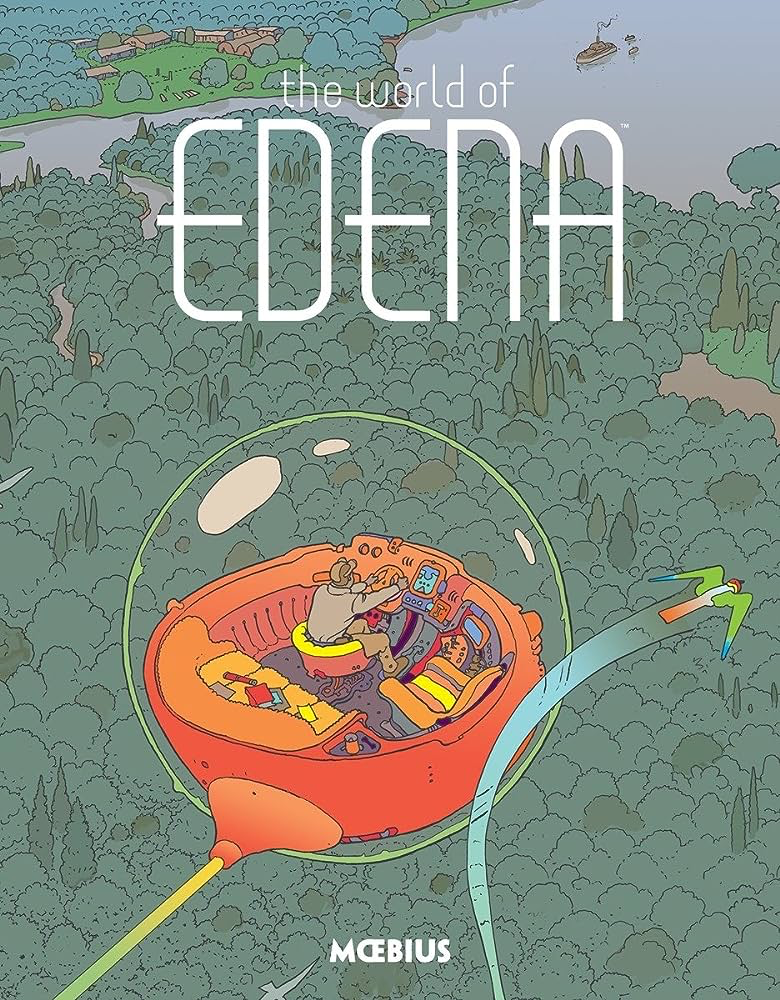
The World of Edena – Mœbiussomewhere, across temporal boundaries, I can imagine Eno and Mœbius creating art together—the latter to create the brightly-colored, simple landscape, and the former to soundtrack the gentle humming of its engines.

“Finding Feeling” – Black Belt Eagle Scout

Ten years ago, Katherine Paul self-released their debut EP on Bandcamp as Black Belt Eagle Scout. A decade later, and Paul has brought this artifact of her career to streaming, letting the world see the infancy of this project. Like Eno, it’s a soothing exercise, sculpted from handfuls of reverb and sparing percussion. Now, I can see the remnants of this sound that later permeated into their debut album, Mother of My Children; it flows as easily as water, but in those early days, they were prone to get caught up in the current and let the same phrase repeat itself for quite some time. It’s not that it’s bad by any stretch of the imagination—Paul just hadn’t hit their stride yet, and didn’t know when to whip out the cutting board to make things more succinct. (“Finding Feeling” repeats itself for the first third of the song…which is six and a half minutes long.) The lyrics lack the artistry that Paul would later learn, but time has proven that her voice has always been as crystal-clear and cooling as still water from the mouth of a glacier. “Finding Feeling” almost describes itself as you nearly get lost in the repetition, but the payoff, though long-earned, is the seed of what would become a soaring talent.

…AND A BOOK TO GO WITH IT:
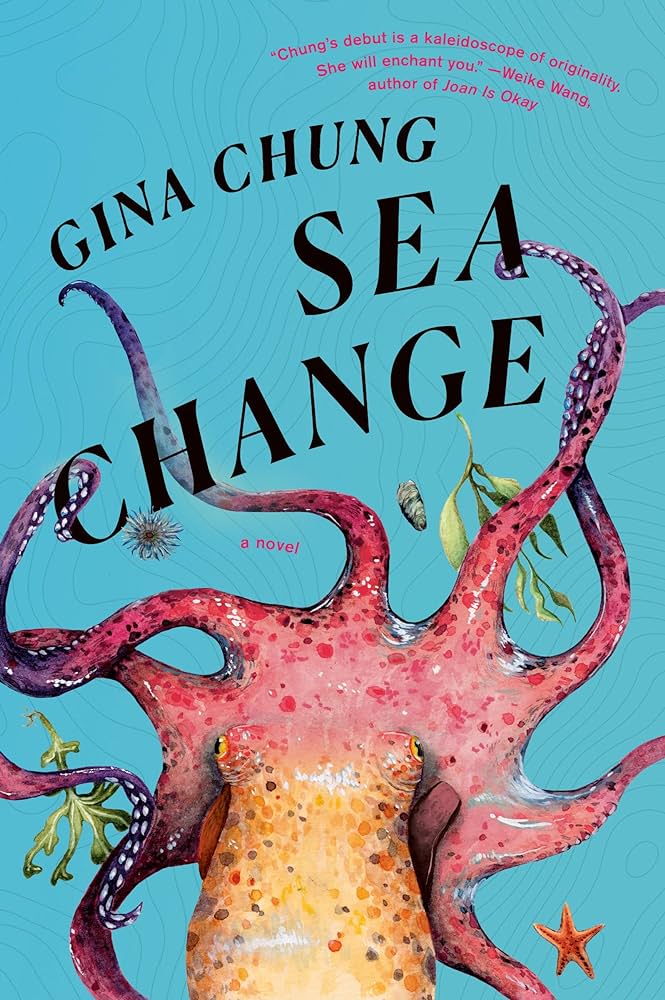
Sea Change – Gina Chung“I go home in the evening/I don’t feel a thing/I don’t know nothing/I go home in the evening/I don’t see a thing/I don’t have anything…”

“I am a Scientist” – Guided by Voices

It’s baffling that this version of “I am a Scientist”—from the 1994 I am a Scientist – EP—never made it onto the album that the original version did (Bee Thousand); the original, as good as it is, screams “demo,” muted in every way. While I’m all for the scrappy, understated recordings (see: everything Car Seat Headrest did until about 2016), the full band backing the EP version makes it into the triumphant march that it was always meant to be. And what a perfect slice of ’90s indie-rock this is—it’s Pavement from an alternate universe, one where they decided to churn out multiple albums a year for the rest of the foreseeable future. I’m no judge of how good said prolific output is, as this is one of two songs I’ve listened to, but if the talent displayed on “I am a Scientist” and the acclaim that their ’90s albums have gotten, I can only assume that said talent hasn’t dried up.

…AND A BOOK TO GO WITH IT:
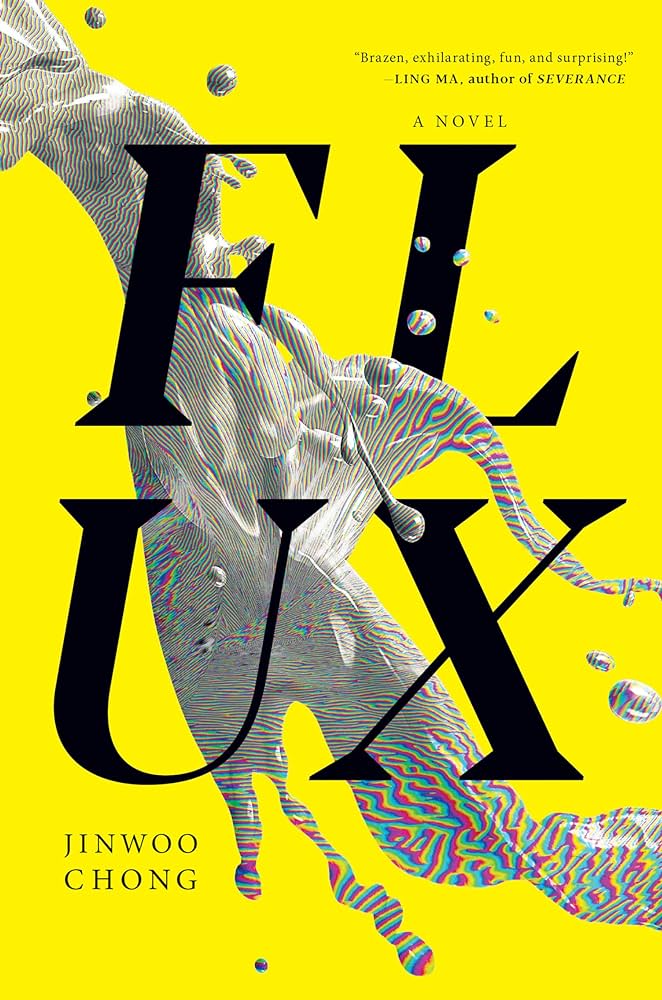
Flux – Jinwoo Chongan unraveling mystery between men, generations, television, and time travel. (Was it always successful? No, but I enjoyed enough of it. I’ll always applaud the ambition of it.)

“All You Need is Love” – The Beatles

I didn’t conceive of Sunday Songs consciously to put them on Sunday—the alliteration was just there, and it worked. But this week feels fitting that it’s on Sunday, and I’m glad I stuck this song at the end.

Here. Take a moment to breathe. We have miles and miles of anxiety ahead of us and miles and miles of horror behind us. But that is not all there is in the world. You see the spinning earth at the end of this video, animated in silence, and remember that there is love. Even if they were summoned into a studio, you can see all of the people gathered together, covered in flowers, and remember there is love. Millions of miles gives way to the possibility of endless cruelty, but if you look hard enough, you will know that our planet was never molded from just that. Whatever happens, there will always be love, and there will always be someone to embody love. Take a seat. Let the confetti brush your cheeks, let the sound lift you into the air.

All you need is love. I’ll take this into the week, I’ll keep it against my breastbone like a locket until the silver wears into my skin. Will you?

All you need is love.

…AND A BOOK TO GO WITH IT:
Since this post consists entirely of songs, consider all of them to be today’s song.

That’s it for this week’s Sunday Songs! Have a wonderful rest of your day, and take care of yourselves!

Posted in Sunday Songs

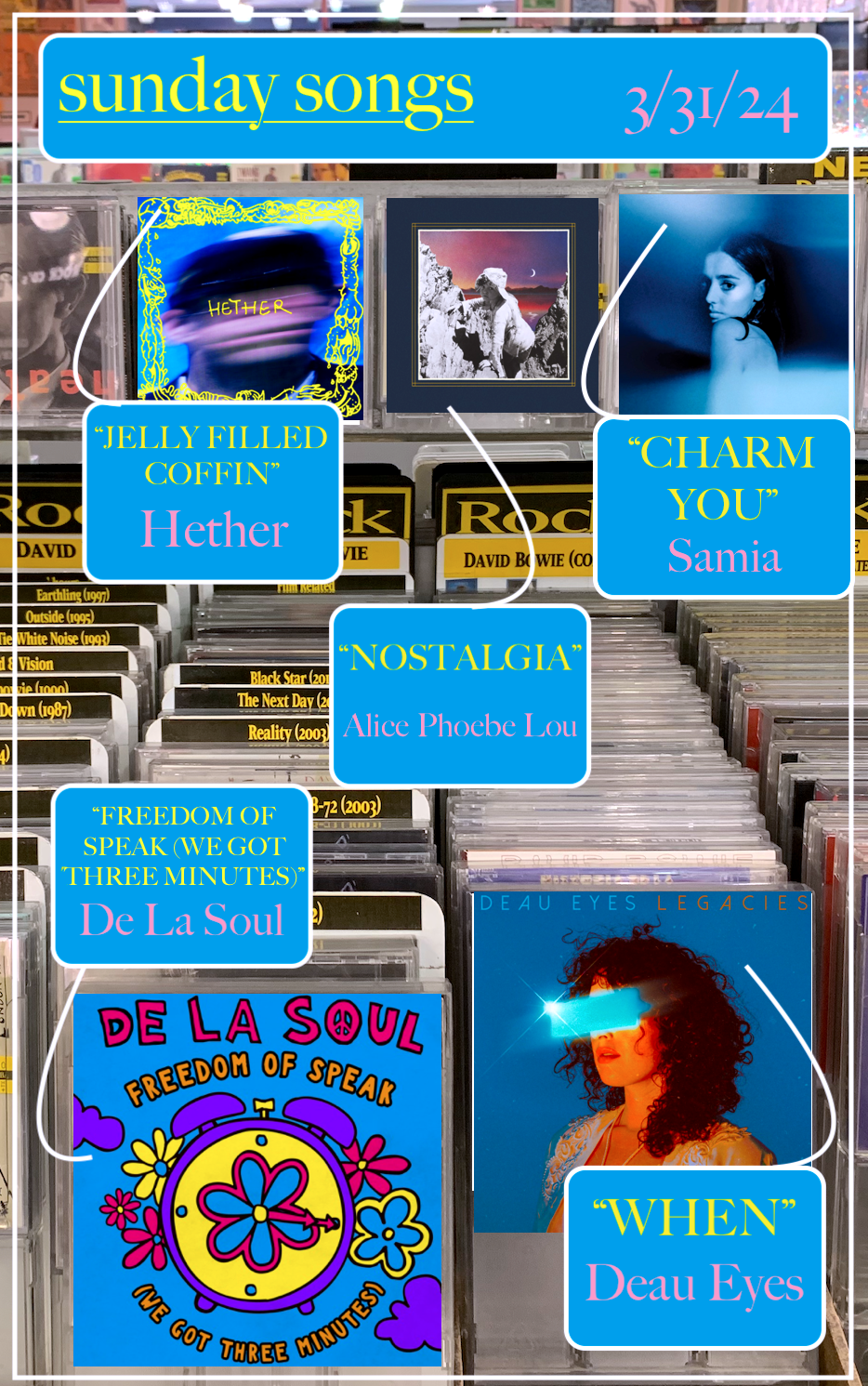
Sunday Songs: 3/31/24

Happy Sunday, bibliophiles, Happy Trans Day of Visibility, and Happy Easter, for those celebrating! I hope this week has treated you well. 🐰🏳️‍⚧️

For once, I’ve got a color scheme that lines up with the festive colors. Enjoy it while it lasts….either way, this week: songs about love, songs that feel like being in a swimming pool, and songs about jelly.

Enjoy this week’s songs!

SUNDAY SONGS: 3/31/24

“Freedom of Speak (We Got Three Minutes)” – De La Soul

It’s been about a year since De La Soul’s music triumphantly returned to streaming after decades of legal battles, and about a year since my De La Soul awakening. Three Feet High and Rising is now permanently etched into my map of my freshman year of college; I spent a good two weeks with that delightfully creative and unabashedly silly album as my soundtrack, and it put a spring in my step even when the weather remained cold enough for those nasty piles of sludge and dirt leftover from at least three separate snowstorms to stay on the sidewalk. I listened to it in spring, but it’s undeniably a summer album, all bright colors and jumping joy.

Three Feet celebrated its 35-year anniversary earlier this month (3/3), and with it came a handful of demos that got left off of the extensive; it feels like a Kate Bush or self-titled St. Vincent situation (and no, I will not stop shoehorning the latter album into every conversation, this is just how it is talking to me) where they were just cooking so much and without any dilution of talent, so they just had to leave a few tracks on the back burner so as not to a) overstuff the album and b) blow our minds more than they already had. I haven’t had the chance to dig through the other demos and scrapped songs that they released, but it’s clear from “Freedom of Speak (We Got Three Minutes)” that it was a tough decision to leave them off Three Feet High and Rising. Never once was their joyous spirit dimmed, and this track is proof. After a conversation with my family, I concluded that part of what endeared me to De La Soul (and a lot of other hip-hop artists at the time) is that they lacked the machismo that defined the genre in the decades to come; not to get all “mOdERn mUSiC sUCks” with it, but I do find myself missing the early days when people like them or A Tribe Called Quest just released their collage hip-hop with subject matters that, most often, just ended up as anecdotes about their days and the snacks that they liked—or, in De La Soul’s case, a PSA about wearing deodorant that clocks in at less than a minute long. (“THAT’S RIGHT! YOU SMELL 🫵”) Who knows why that mentality got left in the dust; I bet it hasn’t gone away entirely, but I’m not well versed in hip-hop enough to know where it ended up. “Freedom of Speak” has a similarly stream-of-consciousness premise, with a good chunk of it being Posdnuos and Trugoy (rest easy) talking about their routines—taking a shower, cooking breakfast, shopping with girlfriends. But even with such a mundane subject matter, they managed to inject it with the same infectious joy that made the whole of Three Feet High and Risin so memorable—ordinary things feel like the smoothest, most cheerful events to grace the earth, and all of it is wrapped around a fake construct: being forced to cram all of their musings into three minutes. They got cut off at 2:51, unfortunately. Oops.

…AND A BOOK TO GO WITH IT:

The World of Edena – Jean Giraud Mœbiusokay, fine. You got me. I’m double-dipping again. But there’s something similar about the ways that Mœbius and De La Soul are creative—and delightfully technicolor.

“When” – Deau Eyes

Lucy Dacus brought me here; while I was doing some digging on “My Mother & I” a few weeks ago, I found a thread talking about the performance with her mom on backing vocals, and a user mentioned seeing her with Deau Eyes as the opener on at least one of her tours. They both hail from Virginia and seem to be on good terms with each other, and any friend of Lucy Dacus (minus T*ylor Sw*ft) is a friend of mine, so I figured I would give her a listen. And…I can’t get fully on board with most of her style— it ranges from somewhat experimental indie to pure twang, but most of it comes off quite forced. And the fact that a lot of the marketing around her weirdly centers around her being a gemini, of all things (?), is certainly odd, but…if that’s her worst sin, then I can let it pass. That one’s probably more on her marketing team than on her.

“When,” against some of the other Deau Eyes songs I listened to, sounds more like 2020’s Sleater-Kinney, which is a win I’ll certainly take. Even if my enjoyment of Deau Eyes extends mostly to this song, it’s a smoothly urgent indie shuffle, rattling along with Ali Thibodeau’s (ohhhhhhh, so that’s where the name came from) vocals, which hold the melody steadier than an anchor holds down a time-battered ship in the stormy sea. Delayed guitar riffs travel in neat circles around the centerpiece of Thibodeau’s voice, playing tricks on my ears as I try to pinpoint exactly where they’re coming from—a single center or hovering all around? It’s almost dizzying on headphones, but Thibodeau keeps it reserved enough to not overwhelm the song. In this case, it’s the lyrics that are the spotlight; in a world where we are told that we are naught but products to be sold, when our bodily wellness is the cost for being able to navigate through the world with any kind of arbitrary success, Thibodeau has a bridge that couldn’t be any more relevant: “Hey, I see you/You matter more than you think you do/Each and every move, it matters too/So set the mood.” Just like how Thibodeau’s vocals anchor the music, she anchors the space around her, encouraging us to follow suit; the lyrics are simple, but undeniably true. Maybe I’m not sold on every part of Deau Eyes’ catalogue, but good on her for spreading the good word of letting yourself take up space in a world that wants to make us small. It’s what you deserve.

…AND A BOOK TO GO WITH IT:

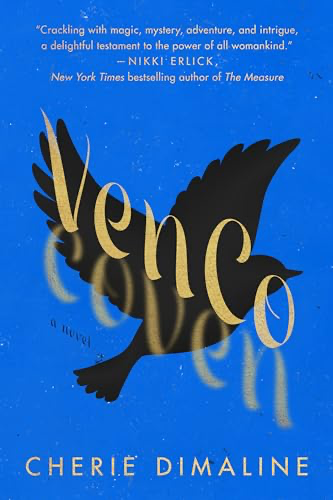
VenCo – Cherie Dimalinethe time has come to reclaim your space, and by “reclaim your space” I mean “exact feminist witchcraft justice upon the skeevy, corrupt white men who wanted to take that away.”

“Jelly Filled Coffin” – Hether

Sometimes, you have a long and sentimental reason for finding and subsequently liking a song. Sometimes Apple Music digs it up, slaps it on the abject depression “Chill” playlist, and you listen to it just because of the name. It’s like “Crocodile Tears and the Velvet Cosh”—if there is ever another song called “Jelly Filled Coffin,” they’ll be copying this guy.

I first talked about Hether (a.k.a. Paul Castelluzzo) a little over a year ago, and I didn’t expect to be talking about him again—”Shy” was sweetly catchy, but I didn’t find myself wanting to uncover more of his music. I guess I’m a lazy, no-good, Gen Z slave to That Damn Phone then, since Apple Music did the discovering for me, but…for once, the algorithm did something good, unlike the time that of Montreal’s nearly 10-minute-long suicidal ideation “No Conclusion” landed on, of all places, the “Get Up!” playlist. I can’t make this shit up. At least we can take comfort in the fact that no human mind could fuck a playlist up that badly. You have to take the wins when they aren’t blatantly the product of automation. Even though Play it Pretty was released only three years after Hether Who? – EP, there seems to have been a shift towards the meandering for Hether; “Jelly Filled Coffin” has the glassy eyes of the peak of summer, humid and delirious from staring too long in the sun. The first comparison that came to mind was a less psychedelic Ty Segall—they have a similar delivery, drifting like a lazy river in the public pool, but just as brightly chlorine-colored. Every line feels like it’s being dictated from somewhere in the depths of the same pool, rippling and unnaturally blue (or is that the jelly? Depends on the jelly we’re talking about). The concept of a jelly-filled coffin was such an oddball pairing that I almost didn’t think of how oddly tragic it could potentially be—presumably being lowered six feet under, but trapped in a substance slippery enough to give you the illusion of movement. That would explain the resignation with which most of the lyrics are delivered: “Rip it out from my chest/Keep the love and leave the rest/Tether me to a post/A parasite chose you, the host.” And yet, even with the exhaustion creeping through the ripples of distortion, it never feels truly sad—it’s more delirium than outright depression, sleepwalking on the borders between sadness and just being tired. My dad made the comparison of his lyrics to Robyn Hitchcock, and many of his songs have a similar quality; on anybody else, it might sound tragic, but here, it could just be as deep as words strung together that sounded unique.

…AND A BOOK TO GO WITH IT:

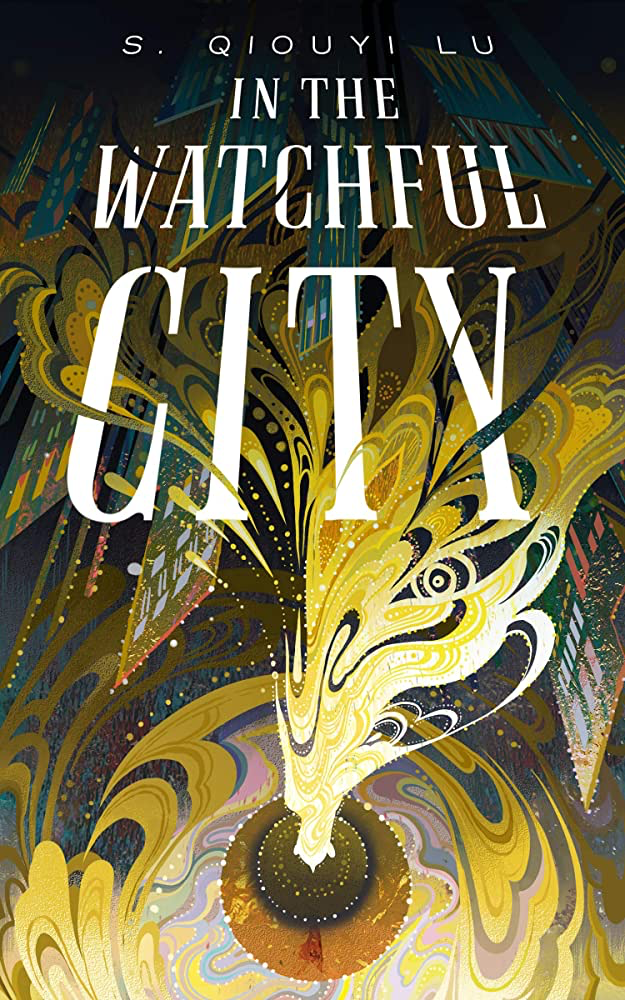
In the Watchful City – S. Qiouyi Lua meandering body-hop between the stories of strangers inhabiting a strange world.

“Nostalgia” – Alice Phoebe Lou

Like Hether, I never expected to be wandering back around to Alice Phoebe Lou. I think it was around two years ago that I found her through “Witches,” which came from an old high school friend after I posted one of those “send me a song that reminds me of you” question boxes on my Instagram story. I was glad to have a new song to spin around in my head, and I was gladder still that something as gently bubbly as “Witches” reminded them of me. It sneaks back into my shuffle every now and then, and I never complain when it does.

“Witches” and “Nostalgia” are only about a year apart in terms of release date, but both of them are broadly categorized under blues; the former doesn’t feel like blues at all—more sparkly indie pop than anything, but I have no purview to talk about how blues has evolved as a genre over the decades—but the latter certainly does. Fitting that this song is called “Nostalgia” in the first place, since all of it evokes a time capsule made of sea glass, harkening back to the slow, swaying melodies of the ’40s and ’50s, but with a distinctly modern touch. If there was one lyric that would properly encapsulate this song, it would be this: “It feels like swimming/Swimming with my eyes closed.” Indeed, the soft organs and Lou’s voice feel like they’re being projected from inside of an underwater cave, a rich gray until the light from a crack in the ceiling makes the water dance on the ripples in the rock. With every lyric, you travel further in the water in slow motion, the foam from your impact fanning out around you, bubbles swirling upwards as you close your eyes, letting the waves kiss your skin. And yet, it feels just as vividly like a ballroom slow dance, engulfed in golden light as the sunset fades into night and drinks clink all around you. Whichever effect Lou was going for—or neither of those at all—is suited to her voice; her voice dips from a quiet, bluesy coo to a musical exhale that echoes through the caverns with ethereal gentleness.

…AND A BOOK TO GO WITH IT:

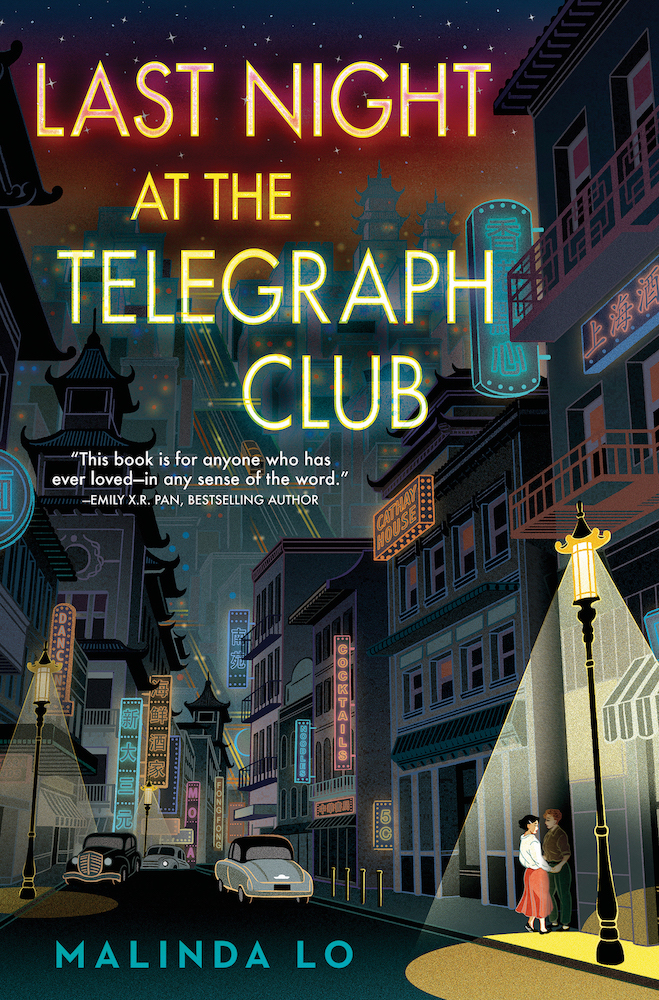
Last Night at the Telegraph Club – Malinda Lolesbian love in the 1950’s, with a dash of butterflies and moonlight kisses.

“Charm You” – Samia

This is one of maybe…three or four Samia songs that I’ve listened to so far, and I wish I liked them all as much as I liked this one. Then again, there’s only a certain type of as-of-yet undiscovered musician that can cover The Magnetic Fields’ masterpiece “Born on a Train” (which I reviewed about a year ago!), and…I hate to say it, but Samia is not that kind of musician. But I’ll let it slide—Arcade Fire covered the same song ages ago, and they didn’t quite pull it off either; they have the extensive instrumentation to theoretically pull it off, but the only recordings I could find were ones where the sound quality isn’t great and Win Butler was singing like he had the world’s most painful case of strep throat, so…not exactly their proudest moment either. It’s hard to cover near-perfection. I feel like Peter Gabriel has been one of the only people I can think of to cover The Magnetic Fields well and not make it sound either more melodramatic than it ever needed to be or just plain bland (seems there’s no in-between), but also, that’s Peter Gabriel. I should also mention The Shins and their excellent cover of “Strange Powers”—that, at least, was perfectly suited to James Mercer’s penchant for bare emotion, and even though The Magnetic Fields have such a dense orchestration to a lot of their songs, making this one acoustic wasn’t as risky of a move as it seems—Mercer makes it work beautifully. (Childhood staple, too.) We aren’t worthy of The Magnetic Fields, and we are similarly not worthy of Peter Gabriel or The Shins. It’s a hard act to follow. So props to her for trying, at least. Chances are I’m just too attached to “Born on a Train,” but I feel like to cover it, you’ve got to back up all that emotion with the toy-train-on-plastic-tracks instrumentals and faded grandeur peeking out from behind the curtain.

That aside, Samia captured something truly rare in “Charm You”—there’s something about it that sets it apart from all the other songs of hers I’ve listened to. Some of her other songs feel like she’s stretching her voice too thin, but the warm wails of this track perfectly suit the mood she’s meticulously crafted—a love song, but not one of wanting to chase a lover down or get them to like her. I’ve unintentionally bunched together too many songs that inherently feel like swimming, but this song in particular is a dive into a hot tub, a slow, boiling love that seeks to bare its soft parts: all of the pretense of a crush is gone, and all that’s left is to fall in deep: “What if we could shut up for an hour or two/Quiet, memorizing what the people do/Wouldn’t have to try and find myself in you.” The style of songwriting that Samia has taken is an approach I’ve seen a lot of indie pop artists take—collaging a hodgepodge of vignettes together to form a cohesive story—often a love story. It’s a move right out of the Phoebe Bridgers/Arlo Parks/Lucy Dacus/[fill in the blank with your sadgirl of choice] playbook, but what makes them stand out from the others is the emotion that strings them together—it’s not random moments just to flash your songwriting chops. That’s a trap I’ve seen a lot of songwriters fall into, but for once, Samia seems to have the writing flair to pull it off; every lyric on “Charm You” sounds like a red-cheeked confession with a bashful smile, giggling at some charmingly awkward memory: “Baby, let me show you the synthetic pond/Couldn’t we believe it was the hand of God/Making water boogie to a Ke$ha song?” Maybe it’s the way that the word “boogie” feels so out of place that it fits in perfectly or the image that it creates (I can see the warm, blue-lit water rippling from here, wherever there even is), but Samia’s vignettes are ones that stick, and not ones that just toss in a fruit metaphor and talk about smoking on the porch, or something. Like the album cover of Honey, there’s a blue warmth about “Charm You” that instantly charms the heart.

…AND A BOOK TO GO WITH IT:

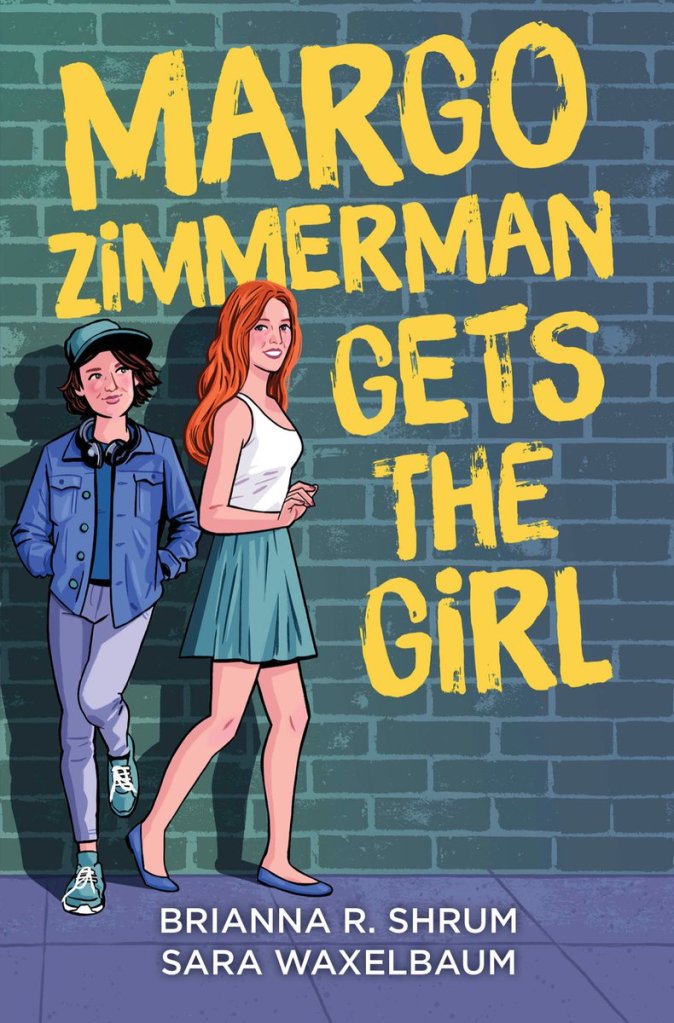
Margo Zimmerman Gets the Girl – Brianna R. Shrum and Sara Waxelbaumtrying to be someone you’re not—even if it’s the prevailing queer stereotype—isn’t the surefire way of making someone like you, but maybe tutoring and mutual pining will…

Since this post consists entirely of songs, consider all of them to be today’s song.

That’s it for this week’s Sunday Songs! Have a wonderful rest of your day, and take care of yourselves!
Posted in Sunday Songs

Sunday Songs: 12/31/23

Happy Sunday, bibliophiles!

Whew, here we are on New Year’s Eve! What a year it’s been, huh? The fact that there’s 2/5ths depressing songs in this batch was entirely unintentional, but I’m of the firm opinion that the last one is a good way to close out 2023. Also—no, somehow the Phoebe Bridgers song this week isn’t one of the depressing ones, bizarrely. Who would’ve thunk.

Enjoy the last songs of 2023!

SUNDAY SONGS: 12/31/23

“Garden Song” – Phoebe Bridgers

This song, like a good song does, came back like an old, loyal dog when I needed it most. But before I get into it, I remembered that I reviewed Punisher when it came out. So let’s see what I thought about it back in 2020:

This was the first single to be released out of the whole album. When I first listened to it, something about it got under my skin, but as I’ve listened to it more, something about it has grown on me (no pun intended). A nostalgic, dreamlike opener to the album. (Rating: 7/10)

…huh. Well, I thought I’d have…more to work with there, but 2020 me wasn’t necessarily wrong. I’d certainly bump up the rating up to at least an 8 or an 8.5, though. It’s what this song deserves, upon a few more years of reflection. It’s a way-homer once you get past the age of 16.

Yes, there is some sad bastard music coming soon in this post (buckle up), but contrary to what…95% of Phoebe Bridgers’ discography would have you believe, this isn’t one of them. Pigeonholing an artist into being just a “sad girl” has a multitude of pitfalls, but one of them is that automatically assuming that slow = sad. In fact, I think this is one of her most hopeful songs. I remember taking a while to warm up to it at first—the startlingly low, Matt Berninger-esque backing vocals, probably several octaves below Bridgers, felt off at first. (In fact, the voice belongs to Jeroen Vrijhoef, her tour manager, who she described as sounding like “Dutch Matt Berninger.”) It’s a stark contrast—Vrijhoef’s rumbling bass almost becomes the unstable ground that Bridgers’ frayed-silk high notes treads over, but it grows on you after a while.

One thing that writing these posts this year has taught me is that I can see more clearly how I approach music; it’s always the music itself first, and unless something immediately jumps out at me (or if I come in expecting it), the lyrics follow on subsequent listens. That’s certainly what’s happened with this song. The dreamlike calmness has never failed to soothe me, but the lyrics have a soothing quality to them as well. The sleepily rambling second verse, where Phoebe Bridgers describes a meandering dream, has the murmur that you would only expect when she’s just woken up and is scrawling the non-sequitur fragments into her journal. (Not to project onto a complete stranger, but I feel like she’s the kind of person to keep a dream journal. I just get that vibe.) But even beyond that, “Garden Song” really is about growth. It’s the soft space where you can look back on your life, recognizing the good and bad, and see it as the soil for other things to grow. It’s the sad smile that you can see as you recall the painful times in your life, but also the comfort in realizing that your sprout has gone beyond that and bloomed, and the hope that there’s blooming yet to do. I find myself going back to 2020, a few months after Punisher came out, when it seemed like all of the lead-weight things pinning my shoulders down would never lift, and inevitably feeling heavy again, but remembering where I’m sitting now, and where my feet have taken me since then. The path was winding and full of twists, but it led us all here. As Bridgers herself said, “…if you’re someone who believes that good people are doing amazing things no matter how small, and that there’s beauty or whatever in the midst of all the darkness, you’re going to see that proof, too. And you’re going to ignore the dark shit, or see it and it doesn’t really affect your worldview. It’s about fighting back dark, evil murder thoughts and feeling like if I really want something, it happens, or it comes true in a totally weird, different way than I even expected.” There’s no denying the darkness, but it is never all there is.

“Garden Song” came back to me towards the end of finals, and of course, I had to sit a while in my spinny chair and sit with it. To me, it’s the perfect song to take with us to the new year—to reflect on how you’ve grown through everything, and that there is so much left to grow through. I’ll leave it with these lines:

“I don’t know how, but I’m taller
It must be something in the water
Everything’s growing in our garden
You don’t have to know that it’s haunted
The doctor put her hands over my liver
She told me my resentment’s getting smaller
No, I’m not afraid of hard work
I get everything I want
I have everything I wanted.”

…AND A BOOK TO GO WITH IT:

The Long Way to a Small, Angry Planet – Becky Chamberseven if the gentle, muted instrumentals didn’t perfectly mesh with the homey atmosphere of this novel, the stargazingly hopeful attitude certainly would.

“Ruined” – Adrianne Lenker

Alright, here’s a blanket. This one’s from another sad girl, and it’s very much actually sad.

If there’s one thing that Adrianne Lenker can write well, it’s a heartbreak song. Unlike most of her solo work that I’ve listened to, there’s no acoustic guitar in sight. This time, Lenker has opted for something equally sparse and solemn: the classic solo piano ballad, aided by some faint, synthy notes in the background, apparently credited as “crystals.” It could’ve easily blended in with the acoustic-dominated landscape of most of her other music, but somehow, the slowly marching piano chords leave the song room to take every rattling breath. Thanks to the music video…I…yeah, I think I’ve now seen more of Adrianne Lenker than I ever needed to see, but this song provides more of that in the metaphorical sense, which I much prefer. She’s a soul-bearer. Something about the plaintive, ever-present waver in her voice seems to age her—it’s not like much time has passed between her solo work, but the shake in her voice seems to indicated that whatever inspired this song aged something inside of her, certainly. Poor thing. Whether or not this song will eventually be a part of an album or remain adrift in Lenker’s discography, it would make a wonderful, thematic addition to the end of an album—it wouldn’t even need to be the very last song, but it would fit in at least the final three or four. The opening lines lend themselves to an album fading into the ether, of both love and music slipping through your fingers—”I wish I’d waved when I saw you/I just watched you passing by.”

…AND A BOOK TO GO WITH IT:

Even Though I Knew the End – C.L. PolkI don’t think Adrianne Lenker would mind the inclusion of vampires, but this is certainly the kind of love that ruins you.

“I’m Not Feeling Human” – The Olivia Tremor Control

My musical wish for 2024: BRING BACK SLIDE WHISTLES, DAMMIT!

I’ve been riding off my dad’s high of Elephant 6 musicians after he recently watched the Elephant 6 Recording Co. documentary (hence the recent spike in Apples in Stereo-related content). There’s something so pure about so much of the music that they put out in the early days. Well…okay, maybe not on Neutral Milk Hotel’s part, but Robert Schneider (of the Apples) and Will Cullen Hart and Bill Doss (of The Olivia Tremor Control) certainly knew how to juice playful simplicity out of synths and all manner of catchy melodies. The Apples in Stereo have a space-age, almost scientific quality to their pop songs, but to me, The Olivia Tremor Control has always come across as something just as whimsical, but in the way of flat colors and simple shapes that bounce around. I’ll die on the hill that this song deserves some kind of Chicka-Chicka Boom Boom-style music video to go along with it. The patchwork of goofy instruments scattered around (including the aforementioned, glorious slide whistle) gives it a delightful whimsy that calls to mind stacks of building blocks. Even the slight discomfort of the lyrics seem to be delivered with a wry smile—”Don’t I feel, don’t I feel like a mineral?/Don’t I feel, don’t I feel like a vegetable?” Maybe it’s the rhymes, or maybe just the fact that I’ve always found the phrase “animal, vegetable, or mineral” funny for no reason (I blame it on what little I remember from The Magician’s Nephew), but even vague alienation has a childlike whimsy to it in the hands of The Olivia Tremor Control. Probably the slide whistle, though.

…AND A BOOK TO GO WITH IT:

The World of Edena – Mœbiuscolored in with the same flat but vibrant colors that “I’m Not Feeling Human” is shaded in.

“Crash” – The Primitives

Okay, we’ve got one more peppy song before the depression hits…let’s ride the high while it lasts.

“Crash,” other than being a nostalgic, smiling thing popping up in my brain’s whack-a-mole system of remembering songs, feels like the better side of late ’80s pop. By then, the oversaturated synths and gated reverb had probably spread faster than the plague; I can’t speak from experience, given that…y’know, I wasn’t alive, but it had to have gotten obnoxious by that point. This song could have easily been that, but The Primitives seemed to know just the right balance to hit to make something instantly catchy, but that also managed to date itself in a way that wasn’t plasticky and corny. It’s distinctively ’80s without being distinctively ’80s, if you get what I mean. The guitars are bright, but not polished into oblivion, and yet there’s no denying the authentic, cartoon stars coming off of the opening riff. It’s practically begging to soundtrack a confident, reckless heroine with a slick jacket and and a pair of rollerblades, the kind with sparks that fly off with every turn she makes. Tracy Tracy, dolled up like some kind of new wave Marilyn Monroe in the music video, knows that she never needed to over-exaggerate her voice—the warmth of it, combined with the fiery embers self-contained in a tidy two and a half minutes, made for a song that’s unmistakable as a hit.

And they put this song in Dumb and Dumber? Huh?

…AND A BOOK TO GO WITH IT:

Little Thieves – Margaret Owen Vanja Schmidt is certainly the kind of reckless firebrand that doesn’t know when to slow down—and it takes her to some unexpected places…

“Motion Picture Soundtrack” – Radiohead

Another thing I have my wonderful dad to thank for: we watched a few episodes of Joseph Campbell’s The Power of Myth (it’s all on Youtube, go watch it), and besides the plentiful, earth-shattering truth bombs, for lack of a better phrase, about the nature of life and myth (and how those two aren’t really separate things after all), a quote from the second episode stood out to me when I was reminded of this song. At about 42:48, after he and Bill Moyers are discussing the manifestation of god in everything, and by extension, machines, Campbell examines the inner framework of a computer and remarks, “have you ever looked inside one of those things? You can’t believe it! It’s a whole hierarchy of angels…and those little tubes, those are miracles.” For the sake of not derailing this post so I can actually publish it on Sunday, I’ll holding back from expanding on all of the aforementioned Campbell capital-T Truth bombs, which he seems to produce with the same frequency as the other Campbell’s soup cans, but I can’t help but think of this song when I think of computers and angels. There’s no other word besides “angelic” to describe the distorted chorus of electric voices that begins at 2:15. That sound couldn’t have come from any other place save for the miraculous angel tubes. There’s some kind of gospel to this song, I swear.

Unless something absolutely drastic and apocalyptic happens, I doubt I’ll ever stop singing the praises of Radiohead. I’m long past caring about how inevitably insufferable I am as a result, but all the language I have about them ends up being hyperbolic. Kid A is probably somewhere amongst my favorite albums—I haven’t formally organized them past top 10, but I’d say that this lands somewhere in the 20s or 30s, at least. OK Computer, even if their chronological placement has doomed them to comparisons as long as there are music critics to do so, will always be the favorite child in my mind, but the special quality of this album can’t be understated. Like Punisher, another red, blue, and black-colored album that I listened to during the summer of 2020, it’s a signpost for a hyper-specific time in my life, and one of the most cohesive showcases of the talents of Thom Yorke and company. But as much as “Everything In Its Right Place” and “Idioteque” hold uncontested places in my heart, “Motion Picture Soundtrack” will wield the ultimate trophy as far as Kid A goes, and for my standards of music in general. Right now, it’s my favorite album closer of all time. (Before anybody says anything, I know, ackshually ☝️🤓 “Untitled” is technically the closer, but at this point, it’s basically a cooling-down extension to this song). As I brought up before, there’s an undeniable air of gospel about it—the synths that press in at the beginning sound like pipe organs run through a dystopian starscape, and if that’s the case, then the choir is certainly the angels dwelling just out of view in the pews.

“Motion Picture Soundtrack” was marinating in Thom Yorke’s massive cauldron of glorious music since the mid-nineties, where it was an acoustic lament befitting of The Bends. After that, it became a deeply solemn piano ballad somewhere in the depths of the OK Computer sessions, but I, for one, am glad that this is the definitive version, even if we were robbed of what was originally the third verse: “Beautiful angel/pulled apart at birth/Limbless and helpless/I can’t even recognize you.” (OW.) “Motion Picture Soundtrack” was always meant for cosmic grandeur; even though the opening mentions of “red wine and sleeping pills” ground us in the dim hours of planet Earth, the sprawling emotion of it all is the definition of all-consuming. It feels like the final leap off the cliff from death to rebirth, watching your feet slip and the gravel crumble beneath them as the electric, harp-like notes fill your ears like an endless field of stars. Within the infinite sprawl of sorrow, you can’t help but see the staggering beauty of life itself blossom in front of you. I’ll go out again and say it: I doubt we’ll ever come close to the tearjerking final line of Kid A: “I will see you in the next life,” and the pleading waver of Yorke’s soul-caressing voice makes it resonate all the more.

Kid A is probably the pinnacle of hopeless sad bastard music, but I can’t help but feel some kind of embryonic hope resting in the egg yolk of this song. “I will see you in the next life” is a release from all the mindless, sorrowful things that the rest of the verses lay out, and the promise of a starry new beginning. The closing of a chapter, the setting of a book back on the shelf, knowing that if you ever go back and read it, nothing will ever fully be the same, but knowing that isn’t always a bad thing.

What a way to end the year, huh? Just like “Garden Song,” I’m glad this song returned to me when it did. Radiohead is the gift that keeps on giving (me too many feelings to handle).

…AND A BOOK TO GO WITH IT:

The Darkness Outside Us – Eliot Schreferthis book takes “I will see you in the next life” very seriously. One of my favorite love stories of all time, and one of my favorite sci-fi books of all time as well.

Since this post consists entirely of songs, consider all of them to be today’s song.

That’s it for the last Sunday Songs of the year! Have a wonderful rest of your day, and take care of yourselves.

Posted in Mini Reviews

MINI REVIEWS | Birthday Books (Gifts + What I Blew my Paycheck On)

Happy Tuesday, bibliophiles!

It might still be a week or so before I completely return to some semblance of my normal schedule, but I’m starting to get to the point where I know where I’m going and what I’m doing. And as much as I hate the constant home football games we’ve been having, at least it means that my already quiet floor is even quieter, so I can get my homework done in a serene environment—and write these reviews as well!

Since my birthday last month, I’ve taken all of the books I got—ones that I bought on my birthday and gifts from family—back to my dorm, where I slowly (yes, slowly, settling into college is weird) devoured them over the course of several weeks. I’m happy to say that it was a fantastic batch—not every one was the best book I’ve ever read, but it’s chiefly in the 4-star range. I got a 5-star book out of these as well! And now they sit proudly on my little dorm bookshelf, ready to be reviewed.

Let’s begin, shall we?

THE BOOKISH MUTANT’S BIRTHDAY MINI REVIEWS

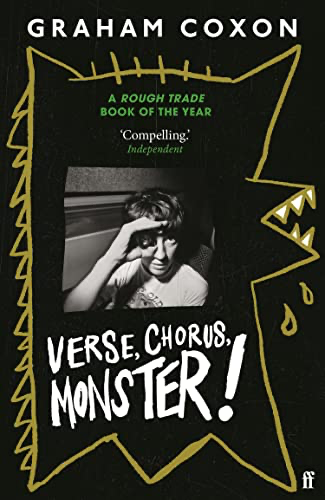
Verse, Chorus, Monster! – Graham Coxon

from Goodreads:

Verse, Chorus, Monster! is the memoir of iconic British musician and Blur co-founder Graham Coxon, charting a life of music, fame, addiction and art. Before the noise and clamour of the Britpop era, Coxon was a shy Army kid tempering his anxiety through painting and a growing love of music. As he honed his artistic skill at school, his band with school friend Damon Albarn, fellow student Alex James, and a drummer called Dave Rowntree began to get noticed. But there are things they don’t tell you before you get famous. There are monsters out there. And some may even be lurking inside yourself.

TW/CW: substance abuse/addiction, themes of mental health issues

I’ve been trying to branch out into more nonfiction over the past few years, but even if I wasn’t, I would have picked this up eventually either way. My Blur awakening back in 2021 made sure of that. So of course I was excited to see that Graham Coxon was coming out with a memoir—he’s always struck me as such a sensitive, creative person, and Verse, Chorus, Monster! fortunately cemented that, for the most part!

I always have a lingering fear that celebrity memoirs will somehow ruin my image of them, but with this one, I still hold that Graham Coxon seems like such a deeply insightful and sensitive soul. This glimpse into his mind was all at once raw and touching; the frequent sections about his struggles with anxiety and alcoholism were difficult to read, but I’m so glad to have verbal confirmation that he’s been getting better as of late, and that he’s starting to work on himself in that respect. Beyond that, there’s just so much about this memoir that was immediately endearing. The insight into one of the main creative forces behind one of my favorite bands (and a fantastic solo artist in his own right) was fascinating to hear from the front lines, and I loved the pieces we got of his creative process—opening the book with the spark of inspiration that lead to the hook of my favorite song (“Tender”) was the quickest possible way to win me over. And it’s easy for memoirs to have a sense of humility that’s manufactured, but Coxon’s personality really did come off as genuinely humble.

All in all, an excellent memoir by a truly admirable creative force—and a refreshingly humble one. 4 stars!

This is How You Lose the Time War – Amal El-Mohtar and Max Gladstone

from Goodreads:

In the ashes of a dying world, Red finds a letter marked “Burn before reading.”

So begins an unlikely correspondence between two rival agents in a war that stretches through the vast reaches of time and space.

Red belongs to the Agency, a post-singularity technotopia. Blue belongs to Garden, a single vast consciousness embedded in all organic matter. Their pasts are bloody and their futures mutually exclusive. They have nothing in common—save that they’re the best, and they’re alone.

Now what began as a battlefield boast grows into a dangerous game, one both Red and Blue are determined to win. Because winning’s that you do in war. Isn’t it?

A tour de force collaboration from two powerhouse writers that spans the whole of time and space.

TW/CW: blood, violence, murder, self-harm, descriptions of bodies/corpses, torture, poisoning, war

Hoowhee, brother. This one was good.

Time War had floated on the edges of my radar for years ever since it came out, but I ultimately decided to pick it up on the recommendations of one of my professors and one of my best friends. And their high praise—and the high praise of so many others—was more than well-deserved.

For such a short novella, Time War packs a truly unforgettable gut punch, vibrant and rich with emotion. Who knew that these two characters identified only by colors would consume so much of my days when I read this? I can’t praise this book enough. The prose is beyond rich, truly enchanting and expansive, fitting for the cosmic scale that this story is set in. It has an almost gothic sensibility to it, even with the firmly sci-fi trappings—what’s more romantic, dramatic, and emotional than two lovers reaching for each other across the vastness of space and time itself? But even with this grand scale, This is How You Lose the Time War is one of the most deeply human stories that I’ve read in ages. It taps into that innate desire to love and be loved, or even to just have someone to talk to as the world around you is collapsing. In spite of the grand, cosmic conflict and multiple universes colliding, nothing can come in the way of our desire for love and connection. It’s one of those stories where plot details—names and how this time-spanning war started—mean nothing in the face of the deep resonance of the characters.

Hold me. I need a minute…

What else is there to say? Go read this, what are you even doing? 5 stars!

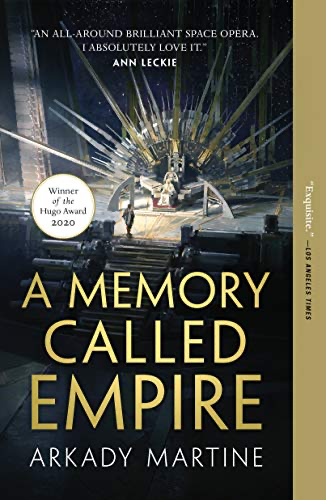
A Memory Called Empire – Arkady Martine

from Goodreads:

Ambassador Mahit Dzmare arrives in the center of the multi-system Teixcalaanli Empire only to discover that her predecessor, the previous ambassador from their small but fiercely independent mining Station, has died. But no one will admit that his death wasn’t an accident—or that Mahit might be next to die, during a time of political instability in the highest echelons of the imperial court.

Now, Mahit must discover who is behind the murder, rescue herself, and save her Station from Teixcalaan’s unceasing expansion—all while navigating an alien culture that is all too seductive, engaging in intrigues of her own, and hiding a deadly technological secret—one that might spell the end of her Station and her way of life—or rescue it from annihilation.

TW/CW: themes of colonialism/imperialism, murder/attempted murder, violence

College isn’t all sunshine and rainbows, but man, it’s fun sometimes. I got an A on a literary theory assignment where I compared this book to an essay we read in class. I love being an English major.

If the fact that I used A Memory Called Empire for a literary theory assignment doesn’t make you think that there’s a ton of great stuff to chew on in this book, I’m not sure how else to convince you. It’s fantastic space opera, but it errs more on the side of a political thriller—a common enough combination these days, but one that was so well-executed in this case. Reckoning with the history of colonialism in science fiction has been on the rise—and for a very good reason—but A Memory Called Empire had such an interesting take on it. This is the first of these kinds of novels that I’ve seen tackle the seduction of colonialism; along with the actual murder mystery afoot, Mahit Dzmare is also being pulled—both physically and mentally—into the clutches of the reigning Teixcalaanli Empire, and is being groomed into the ruling culture as she tries to stay afloat and protect her space station from imminent colonization. The character work is nothing short of excellent, the worldbuilding is top-notch, and the suspense is palpable from start to finish. It’s all a treat.

This book has gotten quite a lot of hype over the years, but it really is all that—alluring, suspenseful, and nothing short of insightful. 4 stars!

The World of Edena – Mœbius

from Goodreads:

Stel and Atan are interstellar investigators trying to find a lost space station and its crew. When they discover the mythical paradise planet Edena, their lives are changed forever. The long out-of-print Edena Cycle from Moebius gets a deluxe hardcover treatment! Moebius’s World of Edena story arc comprises five chapters–Upon a Star, Gardens of Edena, The Goddess, Stel, and Sra–which are all collected here.

TW/CW: nudity, mild sci-fi action

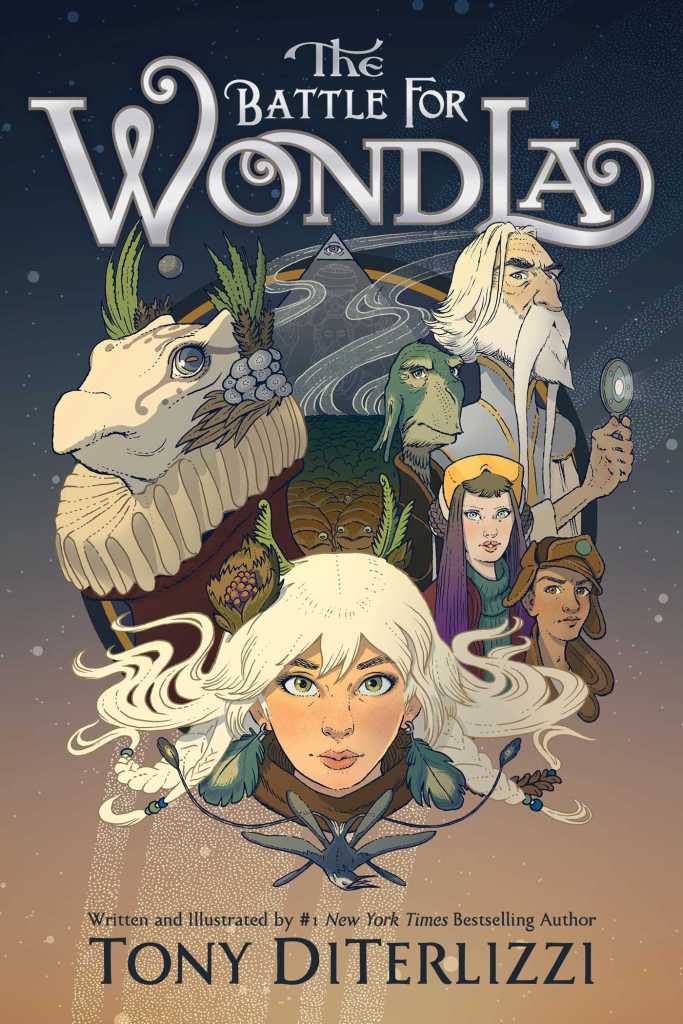
I’ve been meaning to get into Mœbius for years now; ever since I reactivated my pinterest and went on a deep dive of sci-fi art, I’ve been drawn to the enigmatic, meticulous, and downright wondrous quality of his art. (I feel like it would’ve happened eventually—turns out that he was a major influence on Tony DiTerlizzi, and especially his inking style in the Search for WondLa trilogy, which has shaped me beyond repair.) I started here with Edena, and I put it on my birthday list.

I still hold that he may be one of my favorite artists. His style is so ethereally captivating, and I found many a piece that I’ve used for my desktop wallpaper in the past few years inside Edena. His landscapes are instantly transporting, and there’s not a single character design lacking in whimsical charm. The story itself…slightly less so? It’s like a sci-fi Yellow Submarine, but if the script was due in an hour and he’d forgotten all about it until then. Given the circumstances, it’s understandable; Edena apparently started out as a car ad (???), and then it took on a life of its own, completely unplanned. There’s inconsistencies aplenty with both the story and the art, but for the most part, it was just so wild that I enjoyed the ride. If it gives you some idea of what happens, Mœbius pulls the classic “IT WAS ALL A DREAM” move that ends up resolving (if you can call it that) the whole mess. It’s nuts. But there were so many pockets that I wished we could have explored more. There were some super interesting gender themes going on—I wish we got to know why Stel and Atan were on their gender-neutral hormone supplements, for a lack of a better word, but the resulting transformation into their Adam and Eve roles (hence the name) was so fascinating, especially since this only came out in the late eighties or so. (Of course, Atan/Atana effectively becomes a damsel in distress post-transformation, but that’s a whole other can of worms. Ouch.)

In short, The World of Edena was beautiful, if not a bit of a mess. Luckily, the mess was endearing, for the most part, or at least fun. 3.75 stars, rounded up to 4!

Firekeeper’s Daughter – Angeline Boulley

from Goodreads:

As a biracial, unenrolled tribal member and the product of a scandal, Daunis Fontaine has never quite fit in—both in her hometown and on the nearby Ojibwe reservation. When her family is struck by tragedy, Daunis puts her dreams on hold to care for her fragile mother. The only bright spot is meeting Jamie, the charming new recruit on her brother’s hockey team.

After Daunis witnesses a shocking murder that thrusts her into a criminal investigation, she agrees to go undercover. But the deceptions—and deaths—keep piling up and soon the threat strikes too close to home. How far will she go to protect her community if it means tearing apart the only world she’s ever known?

TW/CW: racism, murder, sexual harassment and assault, misogyny, rape, death, gun violence, descriptions of injury, substance abuse

Originally, I put off reading this book because a) I’m not usually much of a YA mystery/thriller person, and b) the mountain of hype was certainly intimidating. I ended up reading Warrior Girl Unearthed because the plot fascinated me more from the start, and I loved it so much that I ended up buying Firekeeper’s Daughter after all. And, once again, I’ve been struck with the luck of hyped books being all worth the hype.

Every part of Firekeeper’s Daughter is excellent, from the effortless way that Angeline Boulley weaves a scene and setting together to the never-ending suspense that kept me guessing for page after page, twist after twist. Making a setting as tangible and populated as hers was is no easy feat—and it suited every other aspect of this book in every conceivable way. You can’t have a corrupt, hidden history of a town without the town itself. The sense of community—and the rifts driven into it—were some of the best I’ve seen in YA fiction in quite a while. Part of that wouldn’t have been possible without Boulley’s equally excellent character work; Just like their community, every character feels nothing short of authentic and multilayered. This all made the twists so much more effective—with such layered characters, I learned to expect the unexpected. And even with the ongoing expansion of diversity in YA as a whole, I feel like I haven’t seen as many novels centering Native American or Indigenous characters and stories, so I’m glad that this book exists in that sense as well. (Shoutout to Darcie Little Badger and Moniquill Blackgoose as well!) And Daunis is mixed-race as well! Yay!!!

If you’re questioning whether or not Firekeeper’s Daughter is worth the never-ending hype: trust me, it’s worth a read. 4 stars!

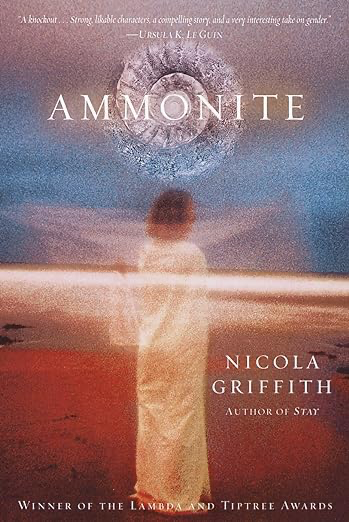
Ammonite – Nicola Griffith

from Goodreads:

Change or die. These are the only options available on the planet Jeep. Centuries earlier, a deadly virus shattered the original colony, killing the men and forever altering the few surviving women. Now, generations after the colony has lost touch with the rest of humanity, a company arrives to exploit Jeep–and its forces find themselves fighting for their lives. Terrified of spreading the virus, the company abandons its employees, leaving them afraid and isolated from the natives. In the face of this crisis, anthropologist Marghe Taishan arrives to test a new vaccine. As she risks death to uncover the women’s biological secret, she finds that she, too, is changing–and realizes that not only has she found a home on Jeep, but that she alone carries the seeds of its destruction. . .

TW/CW: death, violence, animal death, gore

I picked this one up after how much I loved So Lucky, also by Griffith. Thing is, I had no idea that a) this book was written almost 30 years before So Lucky (although this cover should’ve tipped me off to that), and b) that, even with the genre difference, that this would be a very different kind of book. At this point, nothing tops So Lucky for me, but Ammonite was still a fascinating book in its own right.

If you’re going into this book expecting what most would consider traditional science fiction, you’ll be sorely disappointed. Most of it follows Marghe, who is tasked with delivering a vaccine to an isolated colony of women whose community was decimated by a mysterious illness that wiped out all of the men. At its heart, Ammonite is firmly a survival story; it’s a story of the wilderness, of venturing into the unknown, and adapting to the world around you. There are moments of suspense, moments of tenderness, and moments of absolute fear. Another reviewer described it as “Dune but gay,” and other than the more traditionally sci-fi elements of the former, the comparison was spot-on. Ammonite also has the fact that it’s much slimmer than Dune going for it, but given how long Dune is, that’s not saying much. But I think what has seemed to make this book so groundbreaking is its take on gender dynamics. The cast is entirely women, but when all of the men are taken by the illness, the remaining women don’t automatically form a pacifist, hippie commune; there are flawed women, there are good-hearted women, there are warlike women, and everything in between. This banishing of broad generalizations about gender, I think, is what makes Ammonite feel so ahead of its time.

Sidenote: this was written in the nineties, so Nicola Griffith had to have known about goth people…right? Just saying, calling the barely-described alien megafauna “goths” made me envision a giant, towering version of Robert Smith, not, y’know, whatever she wanted us to picture.

All in all, a very unique take on sci-fi and survival with some groundbreaking gender dynamics that have held up for the past 30 years. 3.5 stars!

Abe Sapien, vol. 4: The Shape of Things to Come – Mike Mignola

from Goodreads:

A mutated Abe Sapien fights carnivorous monsters crawling out of the desert sand, a fortified militia that’s walled Phoenix off from the rest of the world, and a vicious zombie swarm, while a mad necromancer rises over the monster-infested ruins of Seattle. Collects issues #6-#7 and #9-#11 of the series.

TW/CW: gore, blood, violence, racism, body horror

I haven’t caught up on the actual Abe Sapien series since…[checks notes], eight grade, I think. Jesus. I just remembered flying to New York when I was about 14 and reading the first volume. But even then, I think I subconsciously chose a good place to pick up with it, since there’s a pretty clear gulf between the first three and vol. 4—before and after Abe gets mutated, shot, and quits the B.P.R.D. Just another day at the office for the guy, y’know?

Suffice to say, I was somewhat disappointed by this volume. It was still enjoyable, and even though I was never the biggest fan of Fiumara’s art, the more stylized look suits Abe’s stretched-out, mutated form. Other than that, there wasn’t a whole lot here that I found terribly memorable. Abe goes through the exact same arc as Hellboy upon leaving the B.P.R.D., but it never seems to culminate in much development on his end. Plot-wise, it’s the same ol’, I’m afraid—Abe goes into a random, apocalypse-ravaged town in the middle of nowhere, and, surprise surprise, it’s time to fight some zombies and witness a copious amount of fungus-related body horror. Somehow, the latter works better when it’s the whole B.P.R.D. trying to deal with it—the group dynamic is what makes B.P.R.D. consistently shine, and as much as I love Abe, I’m not sure if he could carry a story like that when it’s the same format they’ve been using on and off for several years. Abe is one of my favorite Mignolaverse characters, and it’s such a shame that he’s never gotten to shine as much in his solo comics. And judging from the reviews on the later volumes, it seems like the quality tanked until we got the band back together for The Devil You Know. Shame.

All in all, an entetraining trade, but one that ultimately did a disservice to one of the Mignolaverse’s most beloved characters. 3.25 stars.

Today’s song:

I swear, this has to be some of Mitski’s best work in YEARS

That’s it for this batch of mini reviews! Have a wonderful rest of your day, and take care of yourselves!