Posted in Sunday Songs

Sunday Songs: 9/21/25

Happy Sunday, bibliophiles! I hope this week has treated you well.

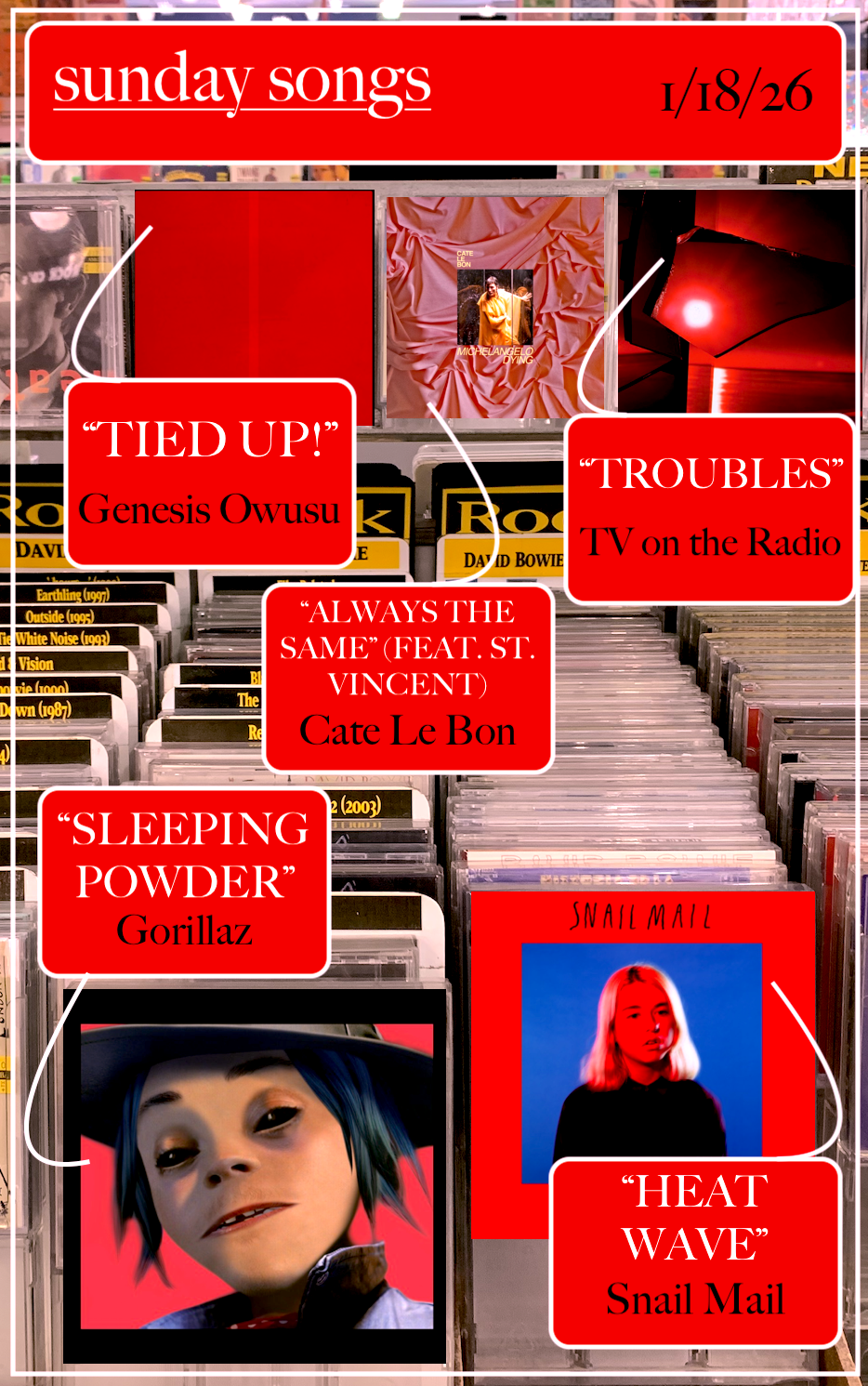
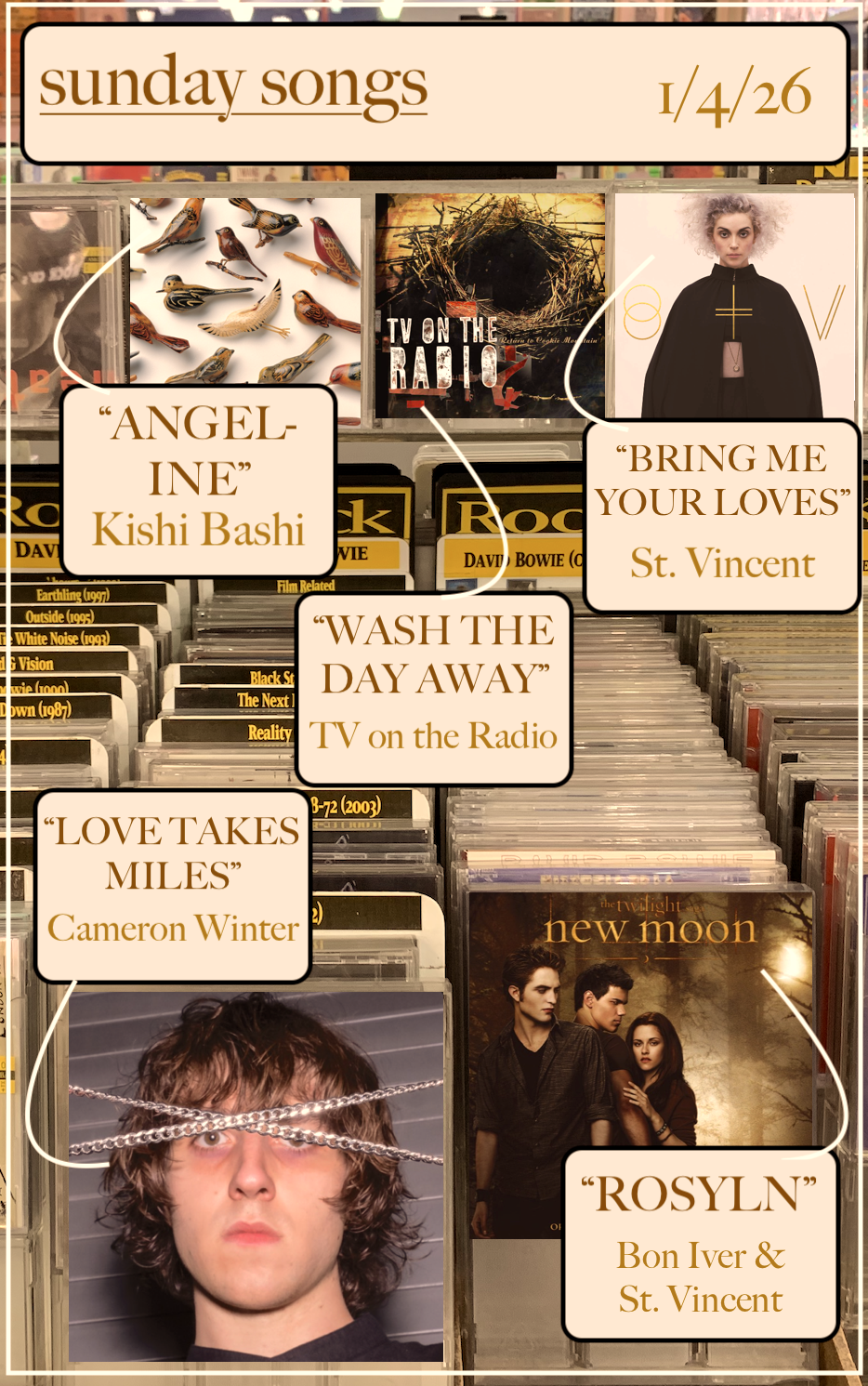
Since I’ve been gone for a little while, here are the graphics for the weeks I was absent, because I am nothing if not a creature who lives for making little graphics:

8/24/25:

8/31/25:

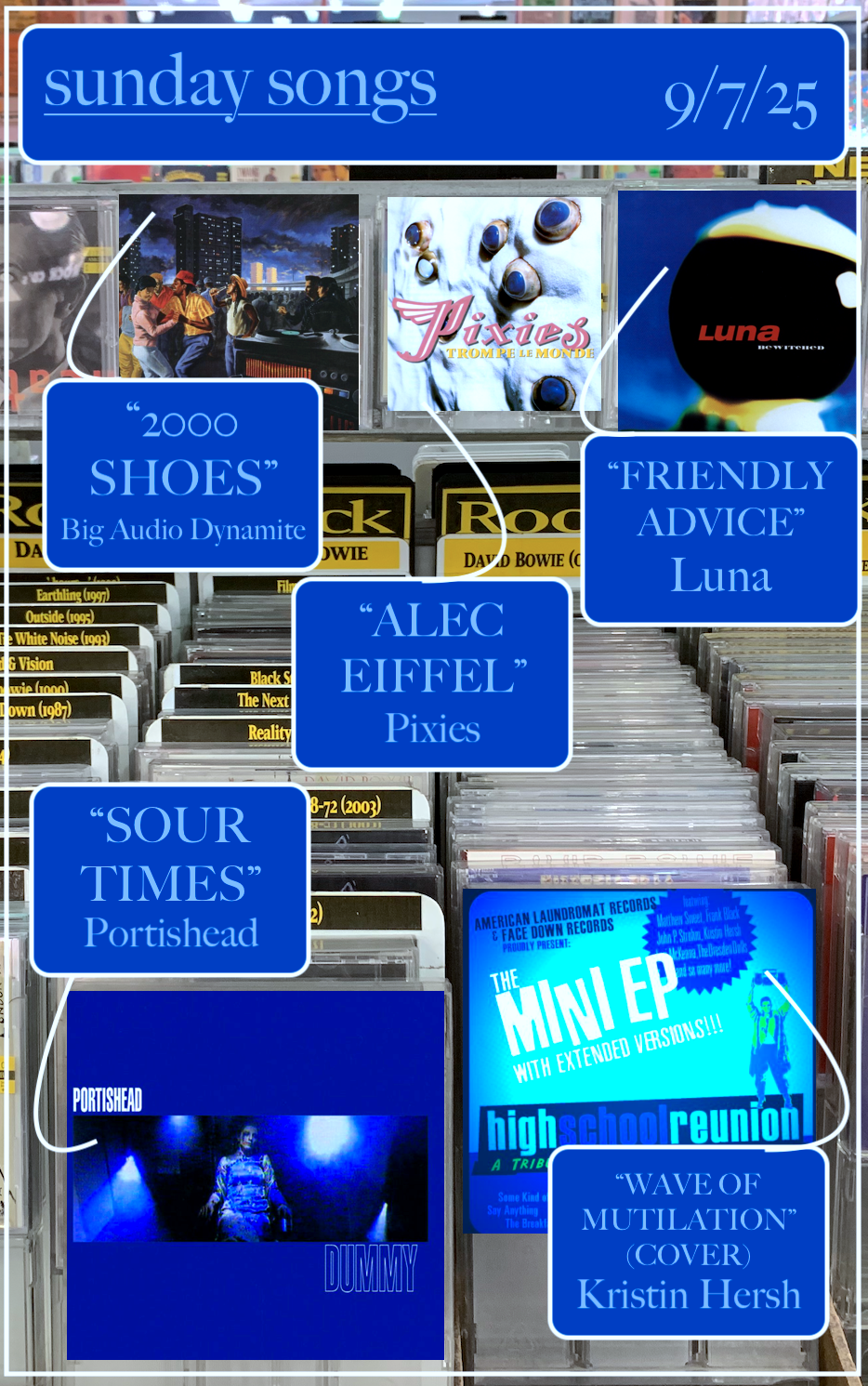
9/7/25:

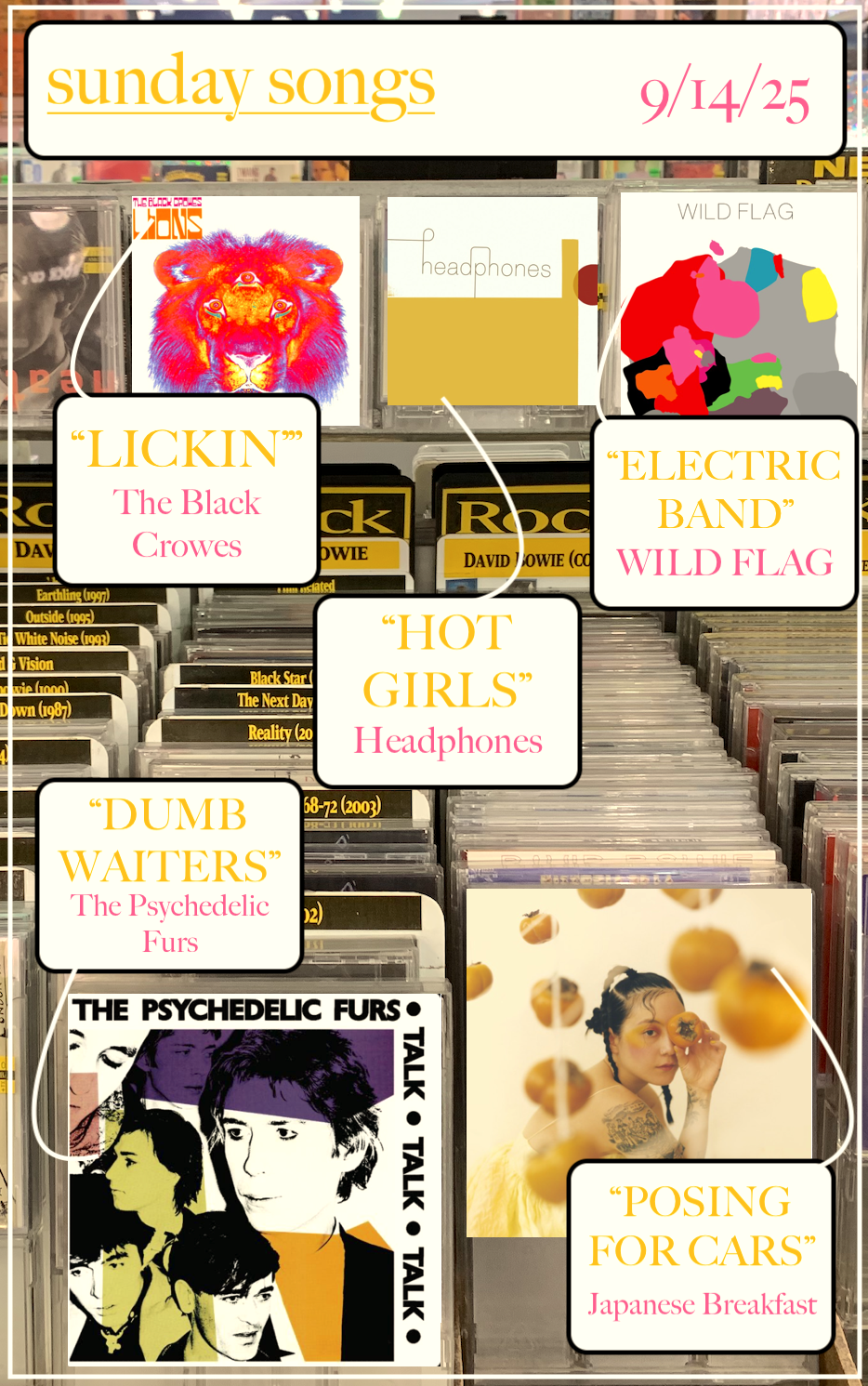
9/14/25:

This week: you’ve been fooled. This is just a front for me yapping about Alien: Earth! BLAH! IT’S ME, THE ALIEN! I’M GONNA GETCHA! I’M THE ALIEN!!

(but really, minor spoilers ahead.)

Enjoy this week’s songs!

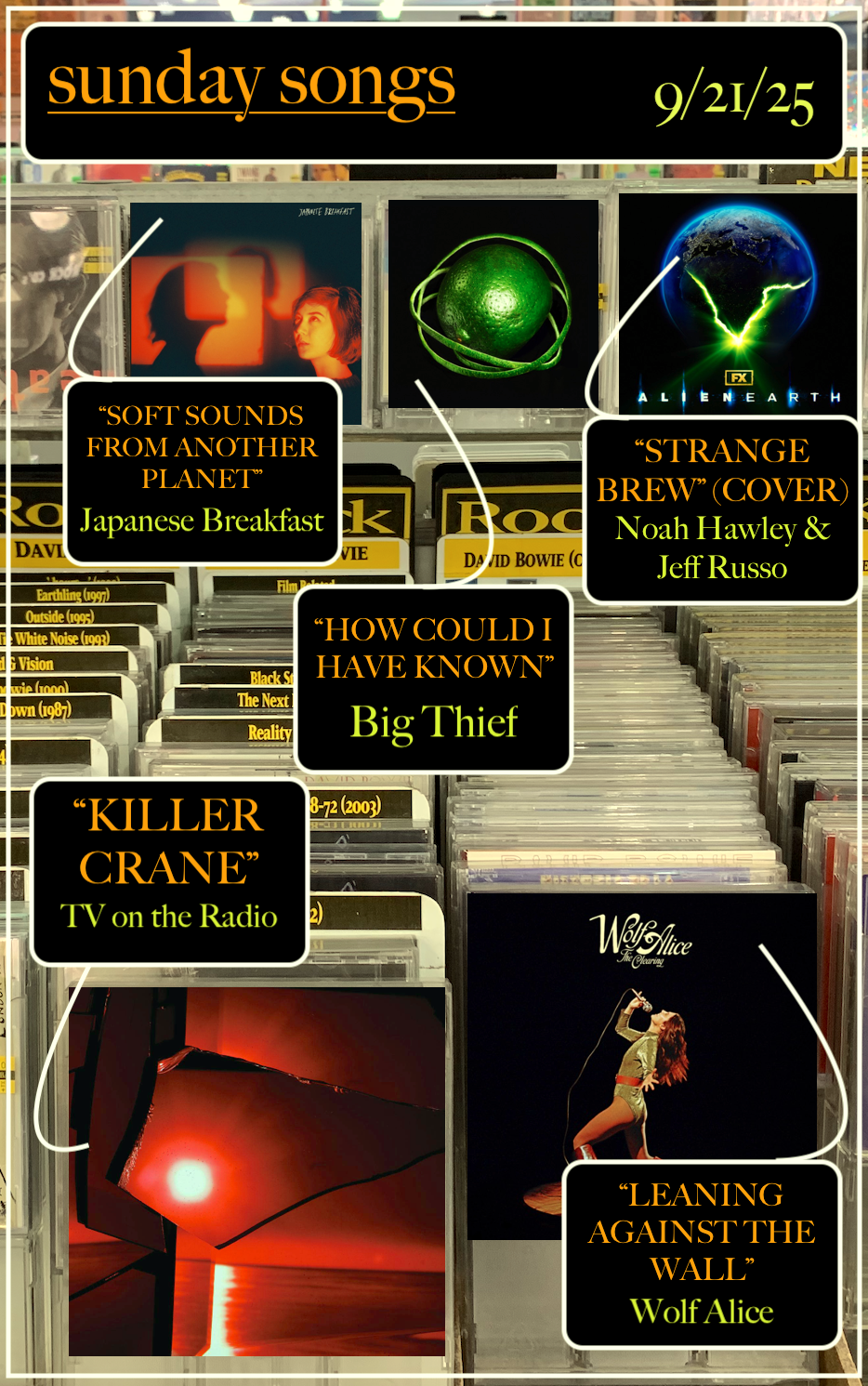
SUNDAY SONGS: 9/21/25

“Killer Crane” – TV on the Radio

You guys…Alien: Earth, right???? Oh my god??? Admittedly, the last two episodes have faltered, but I’d say the first five episodes made me remember why I love Noah Hawley so much. Toss him into another franchise and genre, and he adapts to the environment as swiftly as a frog tossed from the land into a freshwater pond. His take on Alien has sprawled into Fargo’s riddled dialogue and character building and Legion’s avant-garde aesthetics, yet easily stays true to Ridley Scott and Dan O’Bannon’s visions. No notes on the acting (Timothy Olyphant is top tier, Wendy and the Lost Boys are eerily good at playing children in adult bodies, and Babou Ceesay is both a worthy successor to Malvo AND a compelling character on his own). It’s…pushing my limits as far as body horror, for sure (had to knit in silence for an hour after episode 2), but that’s Alien for you.

But one of the more minor aspects of the prospect of new Noah Hawley content that got me going was the needle drops. I joked with my family that I couldn’t wait for the inevitable, devastating Lisa Hannigan cover song to come into the soundtrack, and while that hasn’t happened, I’m more desperate than ever to see this man’s playlist, because my god. For me, nothing’s come close to the pair of needle drops in episode 1 (though “Ocean Size” at the end of episode 4 comes close)—my brother, who has much more metalhead street cred than me, said that “you know Noah Hawley’s a real one because he included ‘E5150’ with ‘The Mob Rules.’

But “Killer Crane?” Even though it wasn’t a TV on the Radio song that I was initially familiar with, I was instantly just giddy. The whole episode made me giddy, to be honest—with a few minor flaws, it felt like such a stunning, comprehensive intro to the show. GOD!! I already knew that Hawley was a fellow fan after he used “Quartz” in the trailer for season 3 of Legion, but I’m just happy to see it shine in a full-fledged show. I still think it’s one of my favorite needle drops in the show so far. It’s amongst one of the many spectacularly-shot scenes throughout the episode: soon after Marcy’s consciousness is transferred into Wendy’s robot body, we see her performing superhuman cliff-diving feats in the idyllic jungle paradise of Neverland. As a scene, it’s just so luscious with the visual metaphor of Wendy leaping off of a literal precipice, paired with the mental precipice of her transition into a new body. Paired with the glimmering, dewy production of “Killer Crane,” it makes for a perfect scene, as does these lyrics: “Her grace’s glide/Across the sea/Across creation/And over time/Her gracious life/Escapes its station.” But the song belies something much more somber; it was written as a tribute to Gerard Smith, their original bassist, who died of lung cancer nine days after the release of Nine Types of Light at the age of 36. Given the hybrid’s consciousnesses, taken from terminally ill children, it’s a grim, apt introduction for their states of being: “Sunshine, I saw you through the hanging vine/A memory of what was mine fading away.” It’s a bittersweet ode to the simultaneous beauty and impermanence of life; the final line of “I could leave suddenly unafraid” could mean both how death could come at any moment for anyone, or leaving the constantly fearful state of mind that comes with grappling with the transience of all things. Damn you, Noah Hawley!! These needle drops are too good, leave some for the rest of us!!

…AND A BOOK TO GO WITH IT:

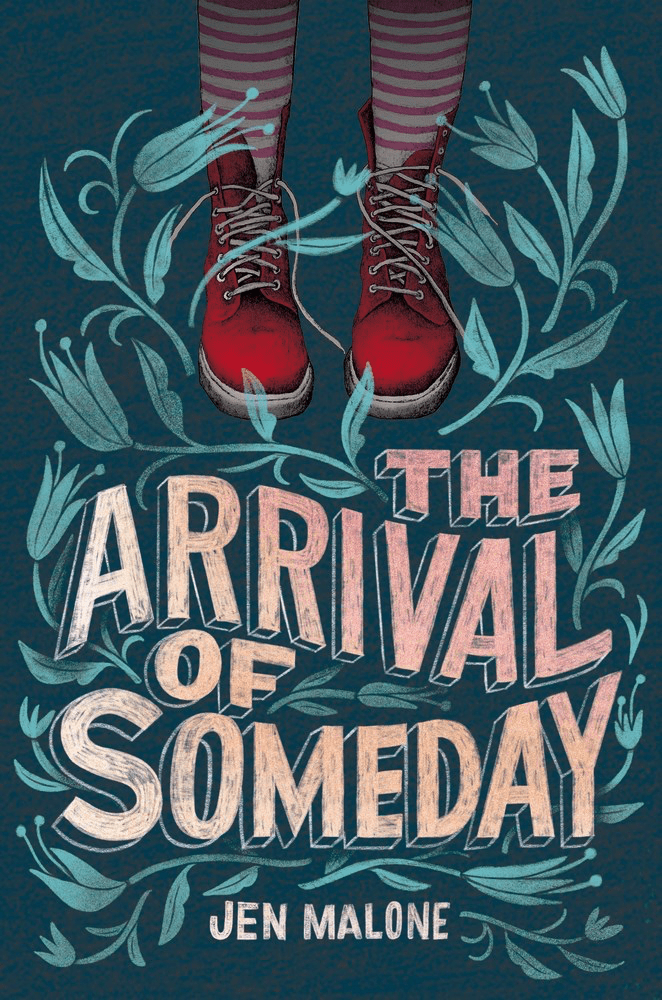
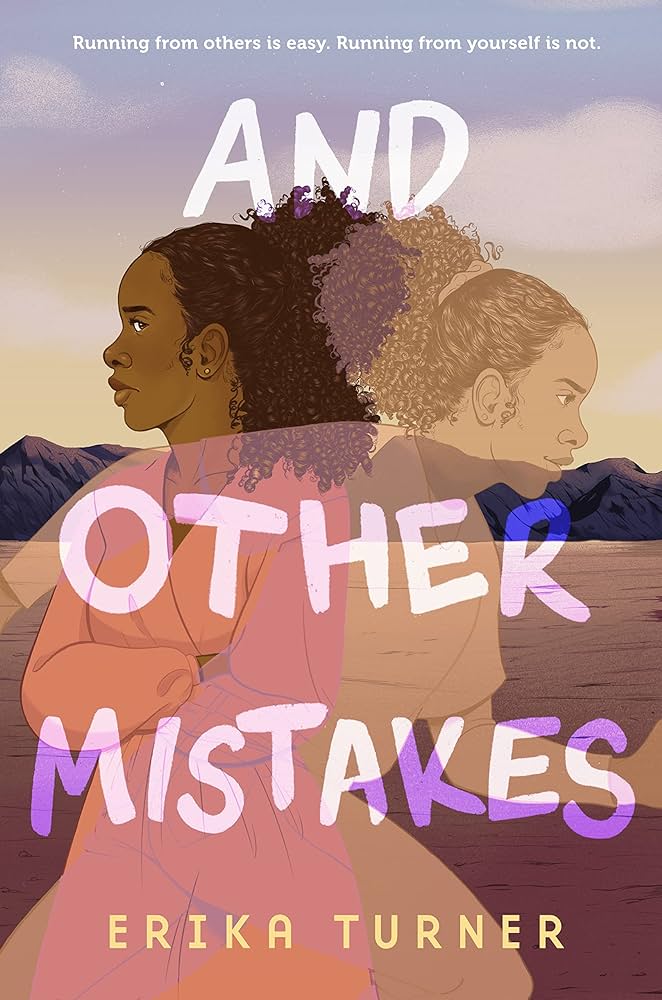
The Arrival of Someday – Jen Malonegrappling with imminent death and soaking up life while one can forms the emotional core of this novel.

“Leaning Against the Wall” – Wolf Alice

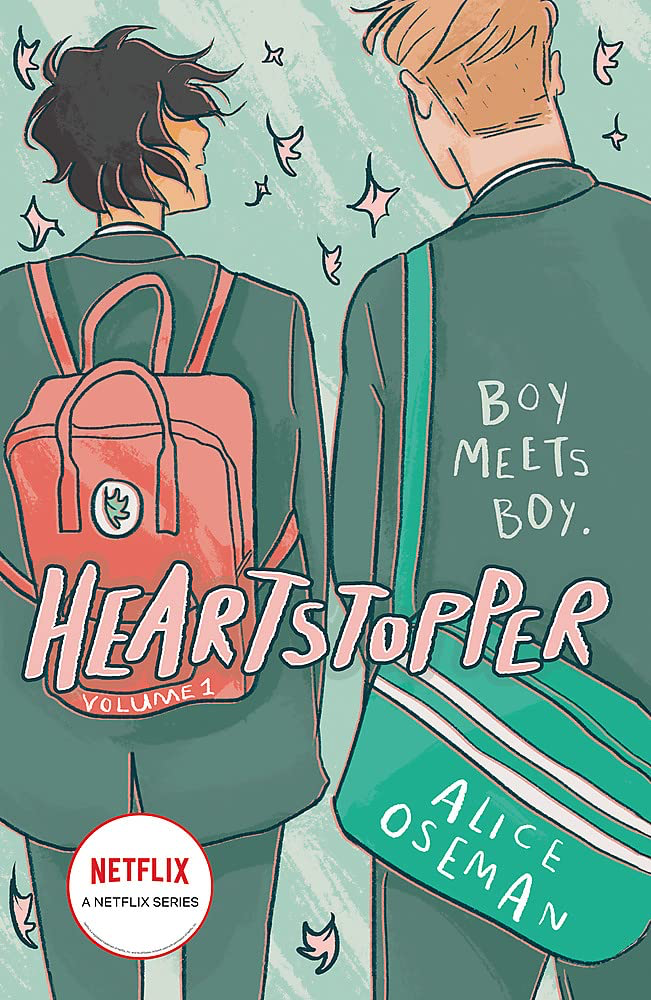
I confess that I haven’t been following Wolf Alice too closely, but if my dear friend’s assessment is worth anything (which it obviously is), they’re still going strong. They released a fourth album, The Clearing, in late August. From the snippets I’ve heard, they’ve certainly polished up their sound, but it’s no less candid beneath the sheen. Their indie pop is as hooky as ever. But I can’t shake the feeling that they’re deliberately just making music for Heartstopper at this point. I mean…c’mon. When that moment kicks in at 1:11? Specifically engineered for a shot of Nick and Charlie gazing longingly into each other’s eyes under a string of fairy lights. But as an earnest, bubbly indie love song, “Leaning Against the Wall” perfectly captures that balance of wanting to run and tell everybody about love, but relishing the private moments in tucked-away corners the most. And as a closing track for The Clearing, it eases the listener into a gentle, artfully rearranged outro that leaves you with lingering butterflies in the stomach.

…AND A BOOK TO GO WITH IT:

“Soft Sounds from Another Planet” – Japanese Breakfast

So…Japanese Breakfast! One of the highlights of my brief hiatus was seeing Japanese Breakfast with a wonderful, dear friend of mine. For an artist touring for an album called For Melancholy Brunettes (& sad women), I couldn’t have imagined a more joyful show—even without the amazing lighting team, Michelle Zauner and co. truly lit up the room, from the sweeping, romantic new songs to the ecstatic rendition of “Everybody Wants To Love You” with the help of Ginger Root. The sets? Truly a spectacle. The setlist? A perfect balance of her whole career. And Zauner just seemed like such a comforting, joyful presence—concerts are always enhanced when the artist actually feels like they want to be there. She played a deep cut solely because she overheard somebody humming it before the show, and that should give you an idea of her presence. And yes, I fucking lost it when she whipped out the gong for “Paprika.” 100% the highlight of my night.

So without further ado, let’s talk about…a song that wasn’t even on the setlist. Oopsie. Either way, the setlist from the show inspired me to dig into more songs from Soft Sounds from Another Planet, an album with one of the best album titles in Japanese Breakfast’s career (though For Melancholy Brunettes is probably tied for the title). Zauner was initially going to make a sci-fi concept album, and though this vision never came to fruition, the atmosphere remains; the album is shrouded in shoegazey, drifting instrumentals that airily swirl around you (see: “Jimmy Fallon Big!”). With a hushed, dreamy tone, Zauner yearns into a starry abyss, longing for an escape: “In search of a soft sound from another planet/In search of a quiet place to put this to rest/Striving for goodness while the cruel men win…” Ow…yeah. If that hasn’t been what life has been like for me since I was a teenager. I don’t have all the answers, but as far as I know, all you can do is look to people like Zauner: make art, spread joy.

…AND A BOOK TO GO WITH IT:

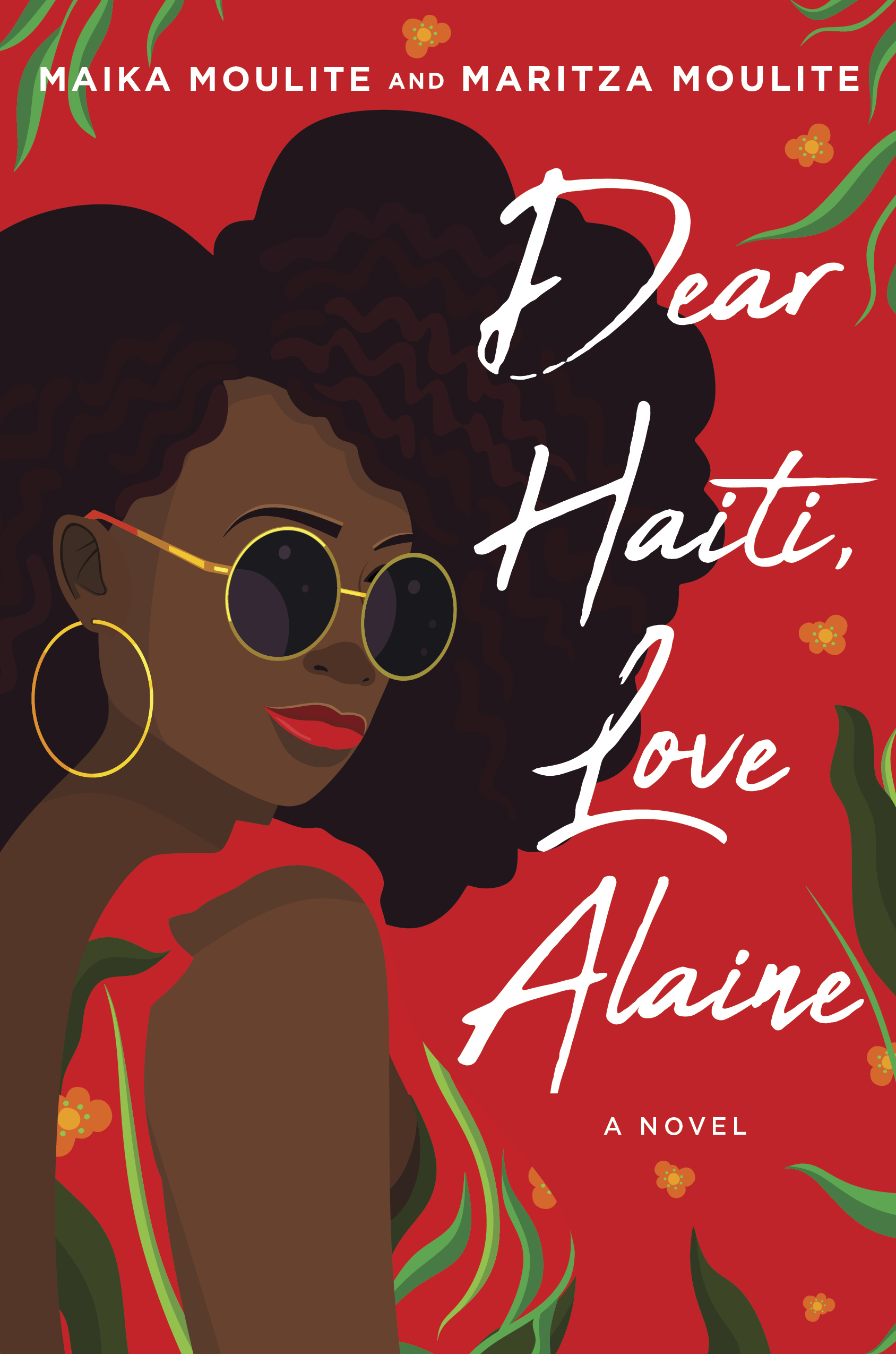
The Library of Broken Worlds – Alaya Dawn Johnson“That’s not the way to hurt me/I’ll show you the way to hurt me/In search of a soft sound from another planet/In search of a quiet place to lay this to rest/Striving for goodness while the cruel men win…”

“How Could I Have Known” – Big Thief

This just in: I’m a total Big Thief poser. Well, maybe not since I’ve actually listened to a full album now, but Double Infinity did turn out to be the first album of theirs that I listened to it in full. There’s something so comforting about it; though it has its weak moments here and there, at its best, it feels like the caress of a warm, woolen sweater, secure and fuzzy. It’s got the feel of Christmas music, but not in the way that you might think; not in the sense of the actual structure of most Christmas songs, but in way that the harmonization feels warm, like the feeling of being curled up by the fire as night fades into he falling snow in late December. “Incomprehensible” remains the pinnacle of the album for me (but how can you top “Incomprehensible,” really?), but the tearjerking closing track comes close.

Talking to my brother and his girlfriend (both much more dedicated fans than me…bigger thieves, if you will) about the album made me realize something about songwriting that’s very contradictory to me, specifically. They were lamenting that some of Adrianne Lenker’s more poetic language had gotten lost in the more plainly spoken lyrics on Double Infinity, and having heard an album like songs, I would honestly agree. If this series has proven anything to you all, it’s that I am an absolute sucker for some good ol’ poetic lyricism. Yet sometimes, things are best said so plainly, affirmations or words of comfort. I can think of ways that the themes of “How Could I Have Known” have been sung more poetically—Wilco’s “Say You Love Me” comes to mind. But sometimes words as simply stated as these can be just as impactful: “They say time is the fourth dimension/They say everything lives and dies/But our love will live forever/Though today we said goodbye.” For me, it’s all in the delivery. Lenker and co. have readily embraced their Grateful Dead jam band era, and honestly, it really isn’t a complaint. The mixing makes it so that the instruments sound truly harmonious, warm and blurred at the edges like snow melting into dirt. The harmonies of the singers themselves not only mesh together beautifully, but they’re just ever so slightly out of sync that it feels like “How Could I Have Known” is being sung around a campfire. And that tight-knit feeling of togetherness is all the better for a song about gratitude for the small, improbable miracles that stacked up that allowed us to meet the people we love.

…AND A BOOK TO GO WITH IT:

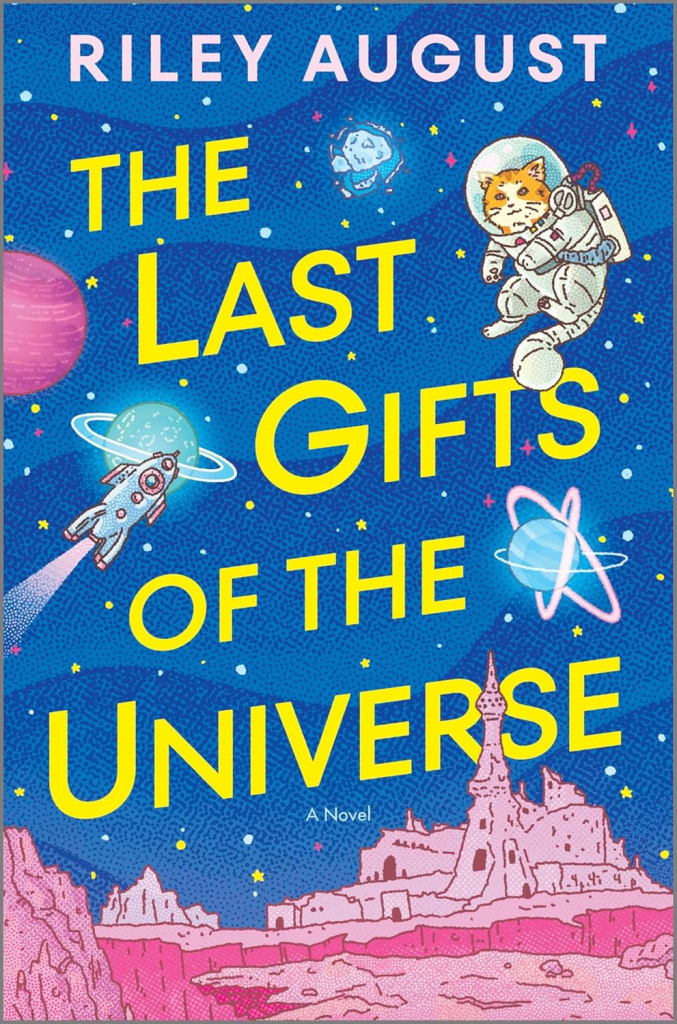
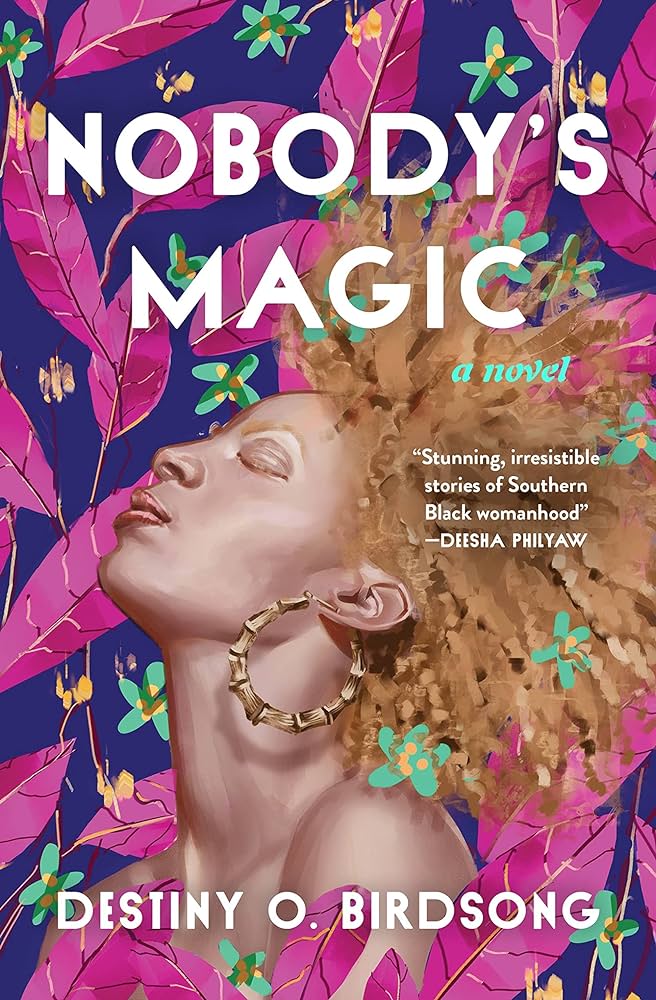
The Last Gifts of the Universe – Riley August“And they say time’s the fourth dimension/They say everything lives and dies/But our love will live forever/Though, today, we said goodbye…”

“Strange Brew” (Cream cover) – Noah Hawley & Jeff Russo

“Strange brew/killing what’s inside of you” that would be the water bottle full of alien ticks ❤

And I thought that Legion meant that we were done with Noah Hawley and Jeff Russo making deeply eerie covers of ’60s-’70s songs…no devastating Lisa Hannigan cover yet, but “if you don’t watch out/it’ll stick to you” really does kinda sum up the entire Alien franchise. As always, Noah Hawley continues to impress me by not just being an accomplished author/television writer, but also by having genuinely great pipes…they put too much talent in that man!! I’ve reached my Alien: Earth yap quota for the week, but god, what a great theme song, complete with some subtle creaky spaceship sounds.

…AND A BOOK TO GO WITH IT:

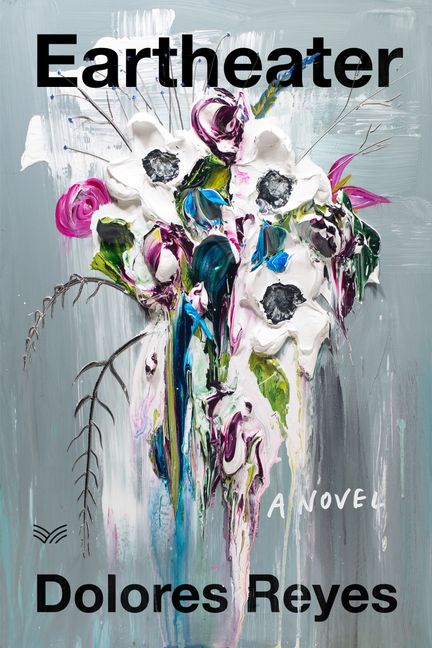
Eartheater – Dolores Reyes“She’s a witch of trouble in electric blue/In her own mad mind, she’s in love with you/With you/Now, what you gonna do?/Strange brew/Killing what’s inside of you…”

Since this post consists entirely of songs, consider all of them to be today’s song.

That’s it for this week’s Sunday Songs! Have a wonderful rest of your day, and take care of yourselves!

Posted in Sunday Songs

Sunday Songs: 6/29/25

Happy Sunday, bibliophiles!

This week: Becky Chambers double-dipping, offloading my gripes about the train wreck that was season 4 of Hacks, and…oh, whoops, I think this post was supposed to be about music. My bad.

Enjoy this week’s review!

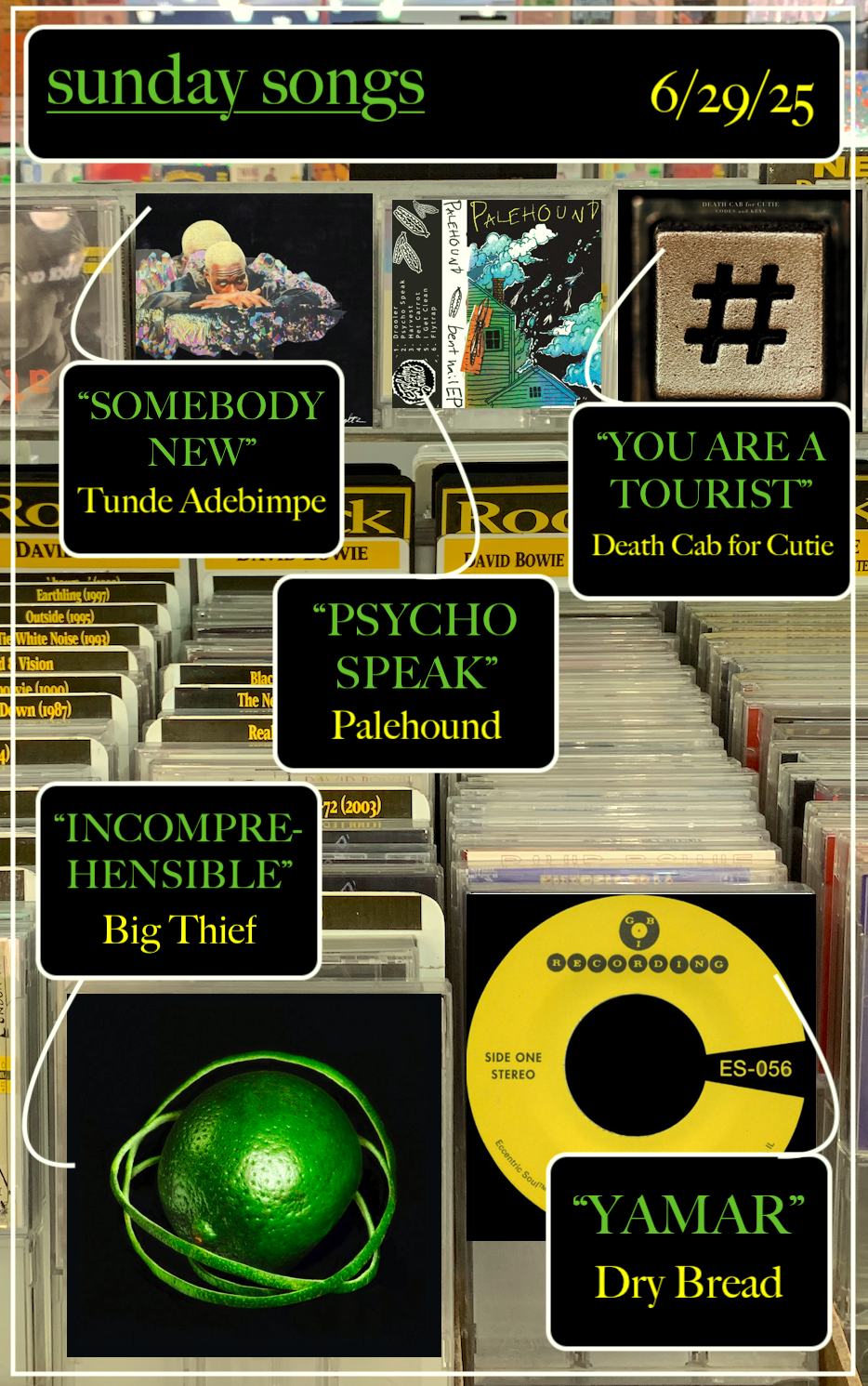
SUNDAY SONGS: 6/29/25

“Incomprehensible” – Big Thief

“They’re back!” I say, having not even listened to a full Big Thief album. This kind of thing sure does happen a lot, huh?

Regardless of whether or not I’ll listen to Double Infinity when it comes out this September or after I’ve finally gotten around to Dragon New Warm Mountain I Believe In You, “Incomprehensible” is a treasure in the here and now. The production is an absolute treat. It’s a far cry from some of their older, more folkier material, but never once does it feel removed from their emotional core. It glistens like dew, icy and starry yet tender and inviting, encircling, even. Guitars glitter and bubble next to the papery percussion. Adrianne Lenker’s voice drifts gently in their fabricated ether, but never once does it distract from the true star of the show: the lyrics, man, these lyrics! Lenker has truly honed her talent for poetic lyricism, and her beautiful messaging and penchant for lush turns of phrase are on full display here. Here’s a snippet:

“In two days, it’s my birthday/And I’ll be 33/That doesn’t really matter next to eternity/But I like a double number, and I like an odd one too/And everything I see from now on will be something new.”

What’s the music equivalent of that “absolute cinema” meme of Martin Scorsese? This deserves it, I think, if not just for that verse. “Incomprehensible” is a heartfelt ode to being free—not just driving down an endless road, as North American highways are wont to make you feel, but being free from societal pressures. I might be ascribing my love to it because it came to me at a time like this, where I am putting all of my energy in being free of expectations and embracing being as weird as possible, but in any other time, “Incomprehensible” would be a pleasure. Intertwined with imagery of nature—rolling clouds, birds, lupine flowers, and the glittering scales of fish—this freedom to just be is fully realized as a natural state: flowers grow and clouds form without any pressure that we have man-made, save for natural ones necessarily for survival. They don’t have the expectations on women to make them dread aging or conform to a certain look, to mourn every hair as it turns gray. The further we are from nature, the closer we get to these false ideals that we’ve fabricated for ourselves. I could go on about the myriad ways about how we could learn from nature, but the lesson in “Incomprehensible” is one of many: if we pay attention more to nature, we realize that all of these societal pressures are just that, constructs; to be more natural is to live free of expectations of what should be and to simply be.

…AND A BOOK TO GO WITH IT:

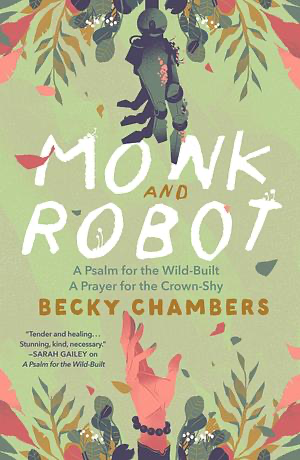
Monk and Robot – Becky Chambers“And as silver as the rainbow scales that shimmer purple blue/How can beauty that is living be anything but true?”

“Yamar” – Dry Bread

I’m not like other girls…I didn’t even know the main reason that most people know this song is because Phish frequently covers it. Oof. I did discover it, as I tend to discover random, obscure ’60s and ’70s songs, through Hacks.

Can we talk about Hacks, by the way? Specifically, how gloriously they fucked up what was one of the longest consistent runs of a good comedy show? They had such a wonderful thing going—the sharp humor, the chemistry between Hannah Einbender and Jean Smart, and the excellent bisexual representation. Season 4 really just threw every single one of those things out the window. I’m still so mad. They were so sensitive and respectful about depicting bisexuality and biphobia, then boom…they proceed to throw the laziest possible stereotype about bisexuality at Ava. She goes from having heartfelt conversations about her identity with Deborah to being thrown into a threesome for reasons that neither furthered the plot nor said anything new about her as a character. At least the resolution was that the other two in the threesome were a chill polyamorous couple who didn’t want to be used for sex, which I appreciated (what with there being hardly any respectful depictions of polyamory anywhere), BUT WHY THE HELL WAS THAT NECESSARY? WHY DID THEY HAVE TO THROW IN THE “I’m in a threesome…supa bi!” LINE??? WHAT POSSESSED THE SHOWRUNNERS TO DO A COMPLETE 1-80 FROM THOUGHTFUL, AUTHENTIC DEPICTIONS OF BISEXUALITY TO WHATEVER STEREOTYPES THEY COULD HIT FIRST ON A DARTBOARD????

Sorry. Had to get that off my chest. Moving on…

As much as I love Hacks, they tend to have an issue with their needle-drops. In most cases, it’s a 30 second snippet from the song in question, and it’s usually shown over an aerial shot of whatever city they’re driving into—usually Las Vegas or Los Angeles. A few times is fine, but…yeah, it’s a little old. Given the absolute gold that was both the scene and the needle drop of “I Won’t Tell” in season 3, I knew they were at least capable of something more. In the case of “Yamar,” it’s in between the two; played at the intro of season 4, episode 6, it’s a small snippet that plays over a shot of Ava wrangling a comically large bundle of birthday balloons.

Though the editing was smooth, “Yamar” was all but hacked (no pun intended) to pieces—they only have about three lines from the verse before they get to the chorus. Which is really a disservice, because this is such a relentlessly catchy gem from the ’70s! My music taste is…well, yeah, it’s very much on the Western side. So I’m always glad when I find a piece of non-Western music that absolutely grabs me. I think the common denominator is the ’70s, regardless of the region it’s from. Even though the lyrics belie a somber reminiscence of looking for the unspoken point of leaving childhood behind and getting older, “Yamar” has an unfailing gallop that signals nothing but joy. That grainy, ’70s production strangely does everything in this song a service, giving the pianos a warm sheen and softening the rapid percussion, like the sun-bleaching of an old photo. It’s hard for me to feel anything but joy from this song, and maybe that could somehow be the point: dancing in defiance of having to grow older.

…AND A BOOK TO GO WITH IT:

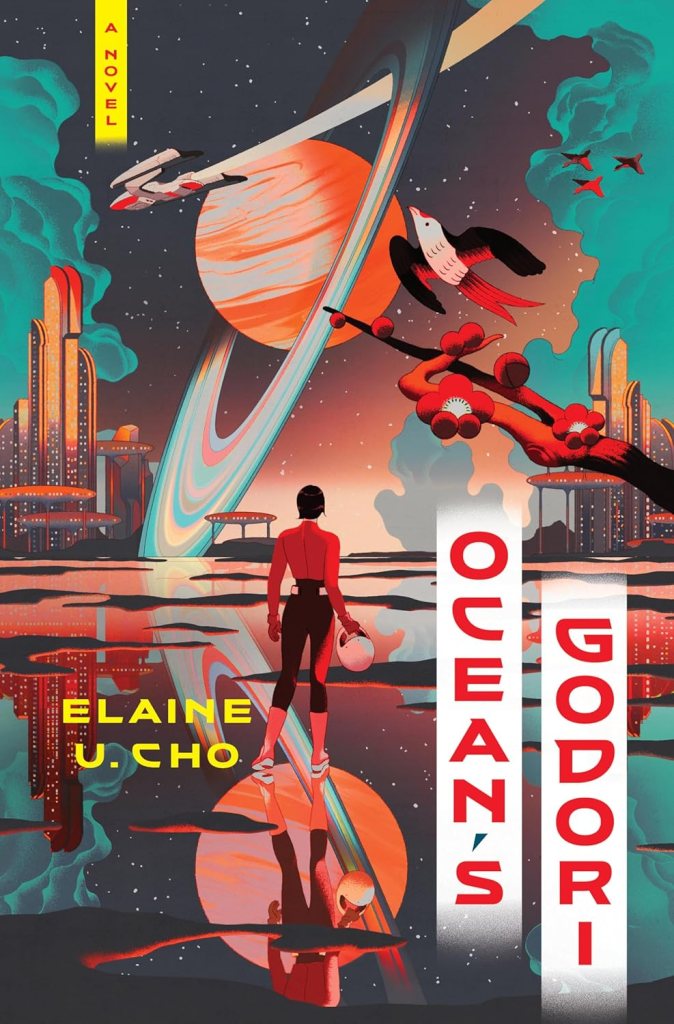
Ocean’s Godori – Elaine U. ChoReconciling with childhood and a skewed sense of identity, but all with a dose of hope and joy.

“Somebody New” – Tunde Adebimpe

It’s once again Tunde Time here on the Bookish Mutant.

I haven’t necessarily come back to a lot of Thee Black Boltz, even though I retain that it’s a great album. Somewhat regrettably, it’s the singles that I’ve mainly been returning to, but at least they were well-picked singles, I suppose? I’d say that “Ate the Moon” and “The Most” were great surprises, but singles like this, “Magnetic,” and “God Knows” are the reigning highlights. Yet “Somebody New” still surprises me in how much I actually like it—even for Tunde Adebimpe. Autotune and a more directly pop direction aren’t directions that typically work for indie rockers like him, but it works. The autotune doesn’t make his voice shinier or more polished—it just distorts it, adding another layer of synth to the synth-pop that this song is soaked in. There’s plenty of ’80s throwback in the sound, from the video production to the synths, but never does it feel like a song meant to vomit up nostalgia—it’s just another in the long line of foolproof methods that Adebimpe has employed that make a song instantly danceable. Along with the delightful music video, in which Adebimpe has a Lego Batman moment with a Yo Gabba Gabba creature, “Somebody New” is one of the best examples of when somebody outside of the pop sphere takes a stab at a pop song—and knocks it out of the park.

BONUS: Here’s his recent performance on the Tonight Show:

…AND A BOOK TO GO WITH IT:

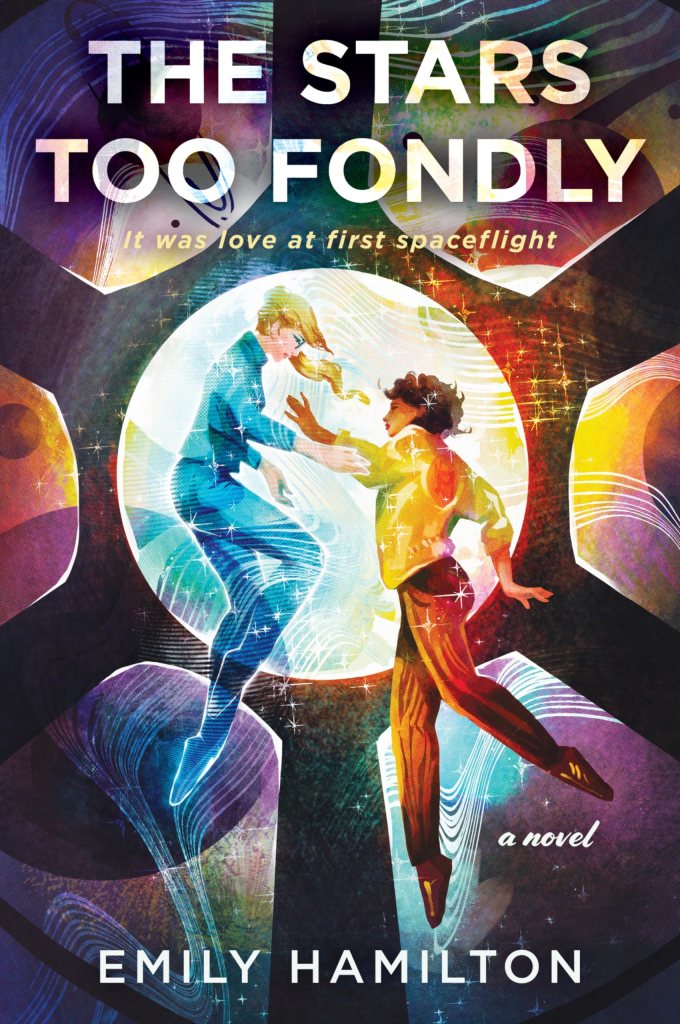
The Stars Too Fondly – Emily Hamilton“I just wanna be somebody new/Is there nothing in the world that we can say about this/Heavenly vibration coming through?/How can we feed this love?”

“Psycho Speak” – Palehound

It’s been about two and a half years since the Palehound Panic that shook the world this blog (alive and well) and my beat-up headphones (rest in peace). Although El Kempner isn’t dominating my Apple Music replay anymore, they’re always a delight to come back to, no matter the era. “Psycho Speak” returned unexpectedly, a cut from their debut EP, Bent Nail. Scrappy encapsulates so much of this barely three-minute-long song: the more indie production of their early days, the verging on out-of-breath delivery of the lyrics, and the cymbal-dominated percussion. Like the EP’s title and album cover, “Psycho Speak” evokes worn-down houses and dirty sidewalks, baseball bats dragged through the dirt. Kempner wasn’t quite at the level of precision that they have on their later songs, but “Psycho Speak” is a song that begs to be a little rough around the edges, fragmented like the end of the song: the final lyric of “I went downstairs and curled up with the cat” feels like a sentence fragment, leaving something unsaid. In fact, this track is built entirely off of things unsaid, in this tale of dating a rich man who leaves intermittently and for long periods, but who takes comfort in the company of his pets. Or maybe it’s that simple of a tale—the tiniest peephole into a story.

…AND A BOOK TO GO WITH IT:

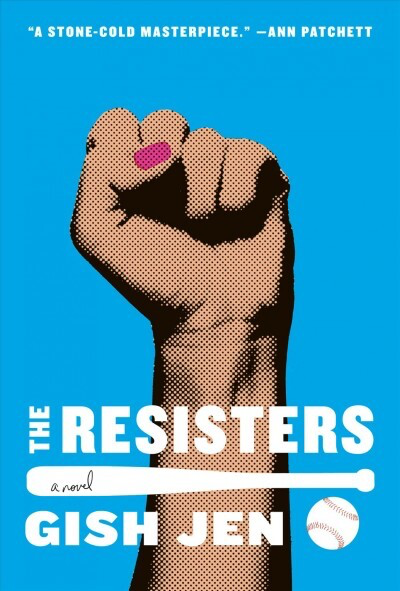
The Resisters – Gish Jenthe atmosphere of this novel, though much bleaker, has a very similar scrappy attitude and feel to it, especially where the younger characters are concerned.

“You Are A Tourist” – Death Cab for Cutie

The buzz around “You Are A Tourist” probably eclipses the song itself; its music video, a Meow Wolf-esque spectacle of kaleidoscopic lights, dancers outfitted in feathers, and geometric backdrops, was the first scripted music video in history to be shot in a single take. Given the impeccably elaborate choreography of it all, it’s honestly astounding. But even before I knew anything about the video or the fact that this song was one of their more popular ones, “You Are A Tourist” captivated me. The melody and arrangement feel so cyclical for me—from the loop at the beginning to the way that the instruments seem to circle each other, as though they were layered in concentric train tracks. And though it’s adjacent to the “I’m in my ’20s and angsty and need to get out of this town” format, as always, Ben Gibbard’s lyricism are what separates it from the rest. Of course, the “And if you feel just like a tourist/In the city you were born” instantly grabs me, but it feels less like a statement of purpose and more of a guidebook for those looking to start over and strike out on their own, a soothing, steady hand on your shoulder in the face of turbulent emotions, a kind of prayer against stagnation.

…AND A BOOK TO GO WITH IT:

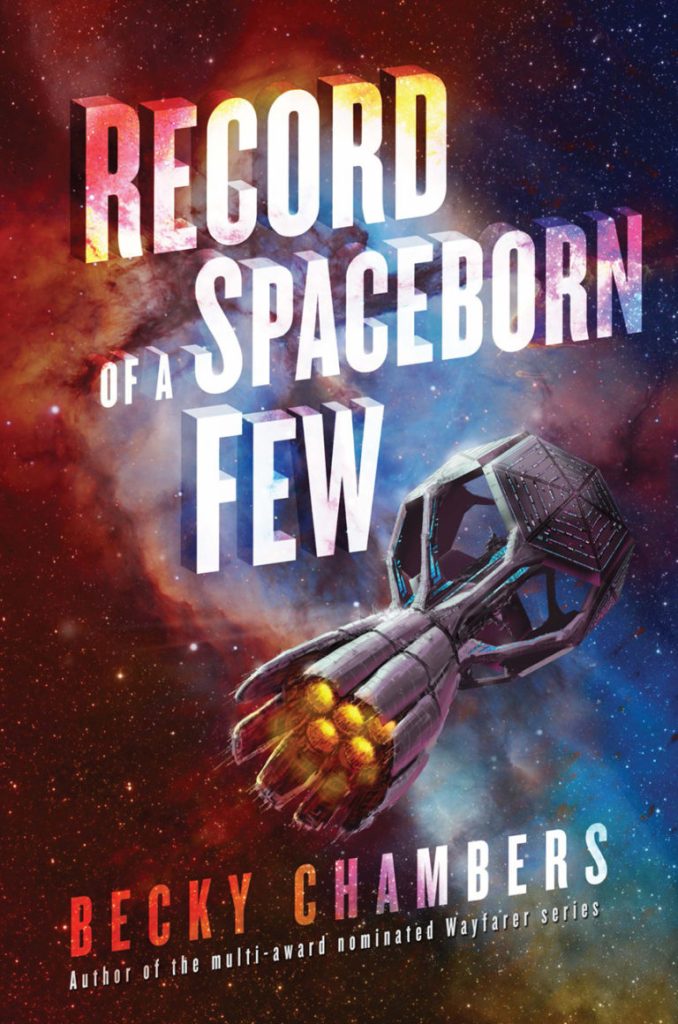
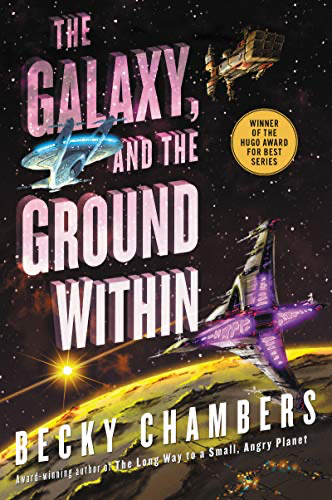
Record of a Spaceborn Few (Wayfarers, #3) – Becky Chambers“And if you feel just like a tourist in the city you were born/Then it’s time to go and define your destination/There’s so many different places to call home…”

Since this post consists entirely of songs, consider all of them to be today’s song.

That’s it for this week’s Sunday Songs! Have a wonderful rest of your day, and take care of yourselves!
Posted in Sunday Songs

Sunday Songs: 5/11/25

Happy Sunday, bibliophiles! First off, a very happy Mother’s Day to my wonderful mom. She inspires me to be a better and more creative person every day, and I don’t think I’d be putting pen to paper (in the drawing and writing sense) nearly as much without her guidance and creative inspiration. So thank you for all your support, hard work, and love. I am so, so lucky. 🩵

School’s out, and it should be back to our scheduled programming soon enough. Of course, every time I take a break, I end up rambling tenfold to make up for the absence…apologies in advance. This is what happens when you let me get ahold of a new Car Seat Headrest album.

Since I’ve been in the finals doldrums for a bit, here are my graphics from the past few weeks:

4/27/25:

5/4/25:

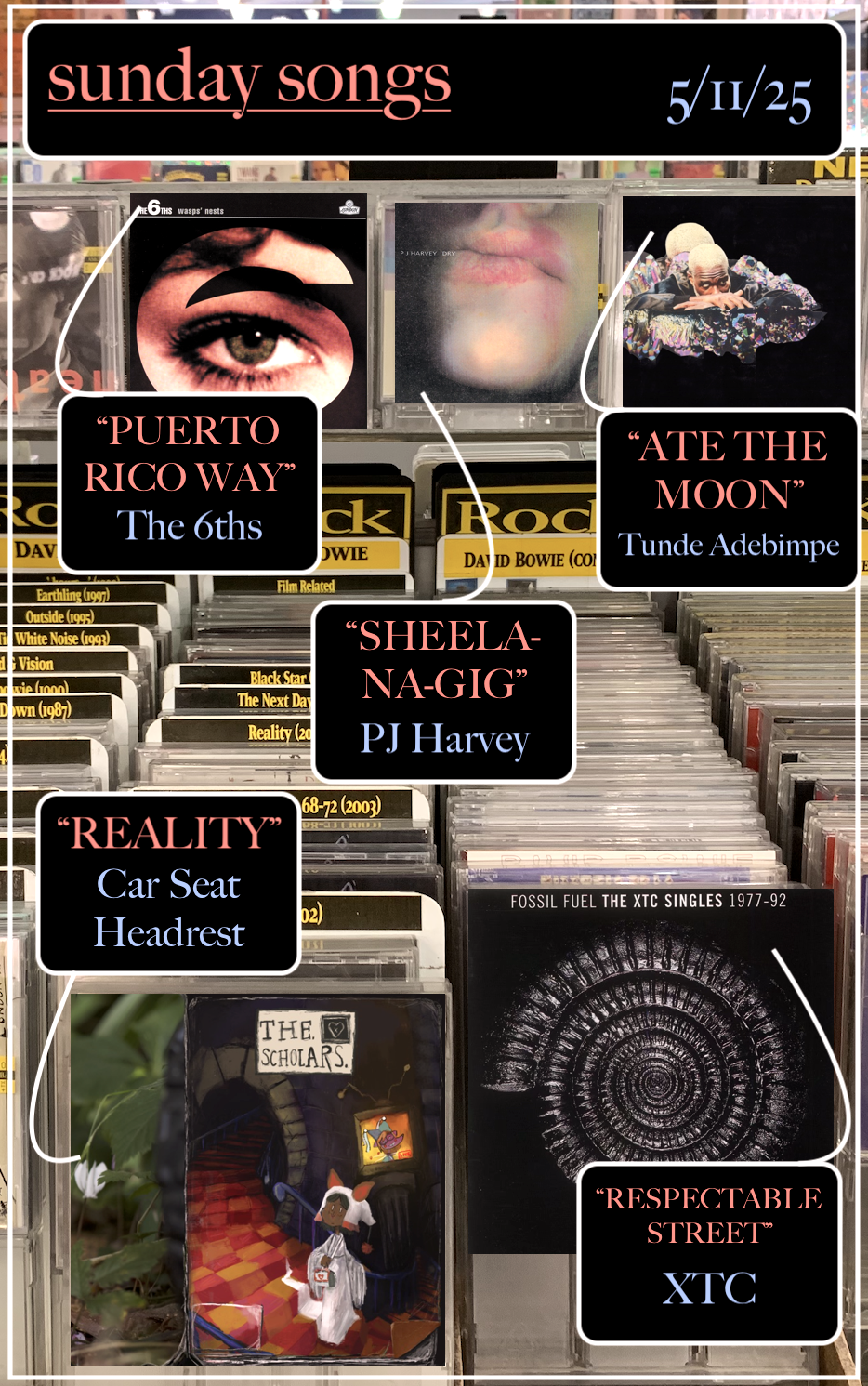
This week: BRO DOESN’T EVEN REALIZE THIS IS RESPECTABLE STREET! 🫵😂

Enjoy this week’s songs!

SUNDAY SONGS: 5/11/25

“Reality” – Car Seat Headrest

The more I think about The Scholars, the more I realize that this is the extreme of Car Seat Headrest’s qualities. Will Toledo has always been a scholar, and a deeply self-indulgent one. I don’t mean that derogatorily at all—his songs are just packed to the gills with references: often Biblical and also encompassing musical and literary greats. Although his life is still interwoven within the narrative (“Is it you or the sickness that’s talking?” on “The Catastrophe [Good Luck With That, Man]”), The Scholars is a veritable library in and of itself.

Not only are the usual suspects of Biblical references and allusions to music and literature, and Toledo’s past work are there, but The Scholars is Car Seat Headrest’s furry rock opera, an omniscient epic taking place at the fictional Parnassus University. There’s a full summary of it in a libretto that’s only available if you buy the vinyl, but thanks to the saints at Genius who, I’ve been able to piece together some of the narrative; it consists of vibrant characters coming out of the closet to their parents, participating in various subcultures around the college, a rival clown college, and a band of punk troubadours. All this culminates in [checks notes] the Dean of Parnassus University getting poisoned after the students from the rival clown college invade. It’s a trip…but I wish it was more readily available! When I say that The Scholars is self-indulgent, I love it in the sense that Will Toledo has created such an inventive, sprawling world between the notes of this album, and that he’s let his ambition run wild, in terms of the scale of the story and the prog sensibilities of the album. He clearly appreciates the value of letting people solve riddles and puzzles, but he’s left hardly any clues to piece together the narrative if we don’t have the libretto. I’d just like it to be more accessible—not in the sense of being more “listener friendly,” but in the sense that I want to actually be able to access the story. There’s clearly so many layers to The Scholars, and I’m dying to know more of the nuance.

That being said, even if you don’t know the story of the Rise and Fall of CCF and the Clowns from Parnassus University, The Scholars is a treat. For the first half, I was almost duped into thinking that the band had almost dipped back into Teens of Denial territory, which was twofold. On the one hand, Teens of Denial has a deeply special place in my heart, a staple of my fourteen-year-old girlhood and one of my favorite albums of all time. After the missteps of Making a Door Less Open, The Scholars is a return to form in some ways. As good as the first half was, I was afraid that it was too much so—even with the rock opera behind it, songs like “Equals” did rather feel like the same stories of drugs and regret that populating Teens of Denial. Yet after “Gethsemane,” “Reality” takes a turn into the more sprawling—and always fascinating. Trading off vocals between Toledo and Ethan Ives, it plunges into pure, 21st-century rock opera, complete with the avalanche of drama and pounding guitars that comes in at around the five-minute mark. I swear that some of the chord progressions remind me of “Cosmic Hero,” another one of my favorite epics from the band, but it’s painted into an unending landscape. Through all eleven minutes, I get the feeling of the culmination of all of the story’s events before the climax—it’s a drawn-out feeling, but one of certainty: they can’t escape what they’ve made, and they must move forward with acceptance of their fate; the whispered utterance of “no stage left” feels like an admittance that they can’t see what they’ve done, but there’s no escape from the consequences: they can’t see the audience. I’m circling back to self-indulgence, but the term sounds so negative: this just feels like Toledo unleashing the multitude of narratives within him. Is it easy to sit down and listen to songs that are nearly 20 minutes long? No, even for me. Yet as esoteric as it is, “Reality,” and this album, is worth your while, if you’ve got the time to set aside. Bottom line: be self-indulgent with your art. It doesn’t matter if there’s a small audience or no audience—you create what you think the world is missing, and the right people will find it.

…AND A BOOK TO GO WITH IT:

The Scholars 28-page libretto, only available when you purchase the vinyl – not trying to be snarky about it, genuinely. But heck, it’s pretty much a play in and of itself, complete with stage directions in the liner notes.

“Respectable Street” – XTC

This has to be the first Britpop song.

It’s long been accepted that XTC helped mold the Britpop movement as we know it—in fact, he almost had a direct hand in it, as he was Blur’s first choice to produce Modern Life is Rubbish; he produced a handful of the original mixes before departing from the project. But XTC made Britpop 12 years earlier. As much as I adore Blur’s sound and lyrical style from Modern Life up until about The Great Escape, hearing “Respectable Street” makes me realize exactly where they were coming in. I wouldn’t go so far to call some of it a rip-off…well, I almost would. I love Blur too much for that. Blur did develop their own style within this method, but at first, their claim to fame was largely due to songs like these. Not only does this song take a microscope to the arbitrary hypocrisies littering an uptight, quintessentially British neighborhood, but Andy Partridge has the vocal swagger to carry it all. Damon Albarn had the looks, but the line delivery is all Partridge, full of snark and with a cheeky wink as he lays out all of the double standards and not-so-well-kept secrets: “Sunday church and they look fetching/Saturday night saw him retching over our fence.” Of course, almost half of the jabs got butchered by the radio edit (“Now they talk about abortion” was replaced with “absorption,” which makes no sense, but…not a whole lot sounds like abortion, I guess?), but no amount of censorship would dull Partridge’s signature, acerbic style. Piled on with in-your-face production and the quick strikes of guitars, and you’ve got a song that inspired a generation—and hasn’t gotten the least bit old.

Also, about the promo above: I just know that set sounded heinous…I’m gonna go out on a limb and say, however talented all these guys are, that most of them did not know how to play cellos or violins. Definitely the point. Still, it must’ve sounded like middle school band practice in there…

…AND A BOOK TO GO WITH IT:

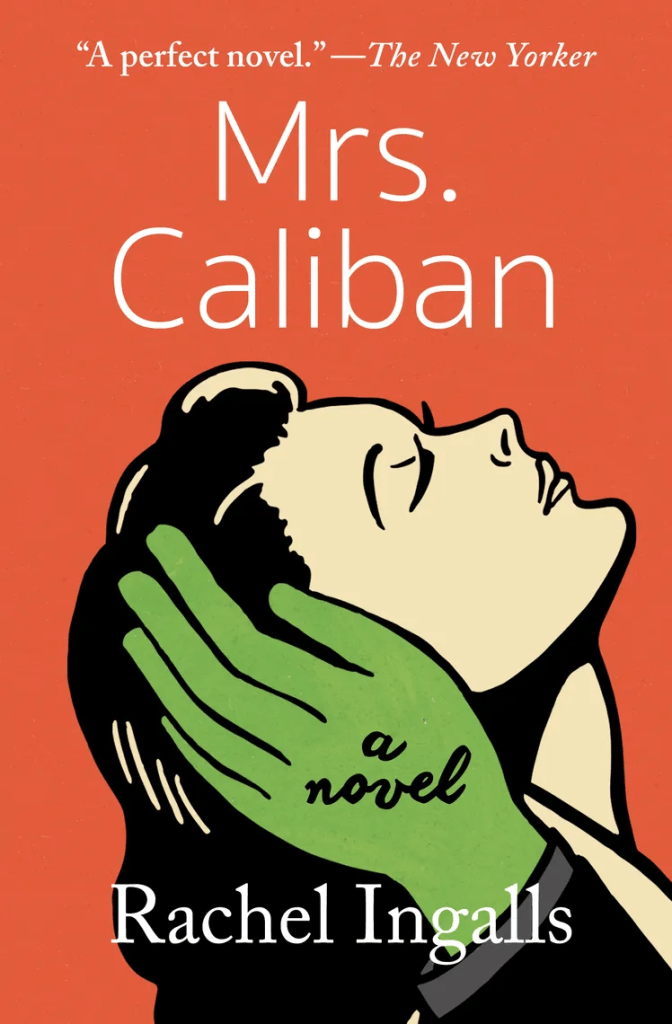
Mrs. Caliban – Rachel Ingallsnothin’ like an escaped frog creature to spice up your respectable street, eh?

“Puerto Rico Way” – The 6ths

Stephin Merritt’s writing continues to be something to behold. Even though Mark Robinson (of Unrest fame) is at the vocal helm here, this is one of the 6th’s songs that’s most indicative of Merritt’s ability to not just set a scene, but make something so objectively seedy and nasty-sounding into the most cheerful, sun-bleached indie pop you’ve ever heard. Take the first few lines:

“The sun pissing in the streets/Of some hungover place/Dances with two left feet upon her face/But soft! She is fast asleep/Beneath her mosquitoes/You would never want to know what she knows…”

First off, the imagery of the sun “pissing in the street” is a stroke of genius, evoking the lazy way that sunlight bends and dapples along the subject’s face—something so objectively beautiful turned wayward and gross, an effect that’s stacked once the drunkenness is emphasized by it “dancing with two left feet.” The environment in “Puerto Rico Way” is so bloated with alcohol and oppressive heat, but it carries itself like all of Merritt’s indie pop songs—with more confidence than it should have, given the disappointing, warmed-over love he often writes about. On the track list, it rides the high of “Here in My Heart,” which could add to the cheeriness, but this track carves out a slice of hope, even if Martina doesn’t accept the narrator’s dance, in this “hungover place.” (The drunk, free-spirited, redheaded Martina does read like a manic pixie dream girl, so maybe it wasn’t meant to be after all. Martina’s so crazzzzzzzy! Love her!!!) The admission that “Oh love, it would’ve been ideal” implies that no, she didn’t, but that indie pop-timism (I’ll see myself out) creates a wrapped towel of sunburnt nostalgia, a photograph bleached in the sun, of a fleeting dance and a fleeting girl.

…AND A BOOK GO WITH IT:

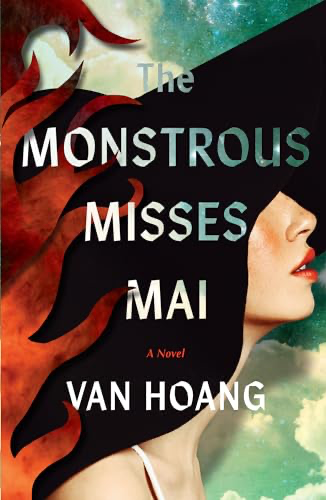
The Monstrous Misses Mai – Van Hoang“She’s drunk every single day/She’s young most of the time/She’s spent all of the rent on her decline…”

“Sheela-Na-Gig” – PJ Harvey

It’s always fascinating to look at songs that seem ostensibly quite feminist, but had none of that intention behind them. Take “Army of Me,” a song that I’ve always interpreted as being about feminine resistance, but was more about Björk trying to get her lazy brother to get up and do something with his life. The lyrics are quite self-empowered, easily interpreted as women breaking free from male-ordered subservience. The feminist leanings are there, but it’s only a sliver of the truth. Do I still feel empowered when I listen to it? Of course. But it’s not the whole story.

The same is true of “Sheela-Na-Gig.” The title references a type of Celtic fertility figure, an image of a laughing woman posing with her genitalia bared outwards. As such, the narrator goes through a sort of comedy of errors as she gets rejected over and over after flaunting her sexual qualities to no avail (“Look at these/my childbearing hips”). It’s easy to take it as a kind of internalizing what men want in women, exhibiting it, and then being turned away when it’s not to their standards; there’s an element of slut-shaming in the male figures not wanting the narrator because she’s “unclean.” The chorus of “Gonna wash that man right outta my hair” (interpolated from South Pacific) is empowered, especially after being kicked to the curb so many times by judgmental men. But PJ Harvey never intended it to be feminist song: as she told Melody Maker in 1992, “I wanted that sense of humour in the song…being able to laugh at yourself in relationships. There’s some anger there but, for me, it’s a funny song. I wasn’t intending it to be a feminist song or anything. I wanted it to have several sides.” And there is something funny about that—if you’ve been rejected with all of the repetition and swiftness of Wile E. Coyote falling off a cliff, all you can do is look back and laugh.

It is a sort of death of the author situation; “Sheela-Na-Gig” hasn’t necessarily been lauded as some feminist anthem (and Harvey said in the same interview above that she didn’t want to be “lumped in” with more forwardly feminist bands), but even a quick glance at any reviews of the song shows that’s how many people tend to take it. In the context of PJ Harvey’s other songs, which are incontestably about misogyny and her struggles as a woman in a male-dominated industry (and world) (see: “50ft Queenie”), “Sheela-Na-Gig” seems to fit into that puzzle. I don’t want to wave that over people’s heads like they interpreted it incorrectly, either—it’s not like I got the aspect on my first listen. (I credit that to Trash Theory.) Personally, I didn’t think all of it was necessarily funny at first, although being as Gen Z as I am, I’ve only heard the phrase “childbearing hips” used sarcastically, so I took that as such. After going through literary theory, I’ve definitely been on the fence-sitting side as far as whether or not to go full death-of-the-author on any given song; the reader’s interpretation does shape the work, but I find it foolish to take it without considering the author’s intent. With “Sheela-Na-Gig,” I think there’s a lot that can be empowering, but what may be most empowering to me is finding the humor in being a woman. The semi-autobiographical narrator swings and misses repeatedly, but doesn’t let any judgement get under her skin. All of the ferocious power chords signal that she’s ready to dust herself off and try again. In the present moment, the narrator hasn’t yet learned, but the fact that PJ Harvey has looked back and learned herself seems more the point to me: having the self-awareness to feel bad for your past self, but be able to laugh at their mistakes. There’s power in being able to look back and laugh instead of wallow in sorrow—when you’re a woman, it’s all you can do sometimes. It may not necessarily be feminist, but it sure is a part of life.

…AND A BOOK TO GO WITH IT:

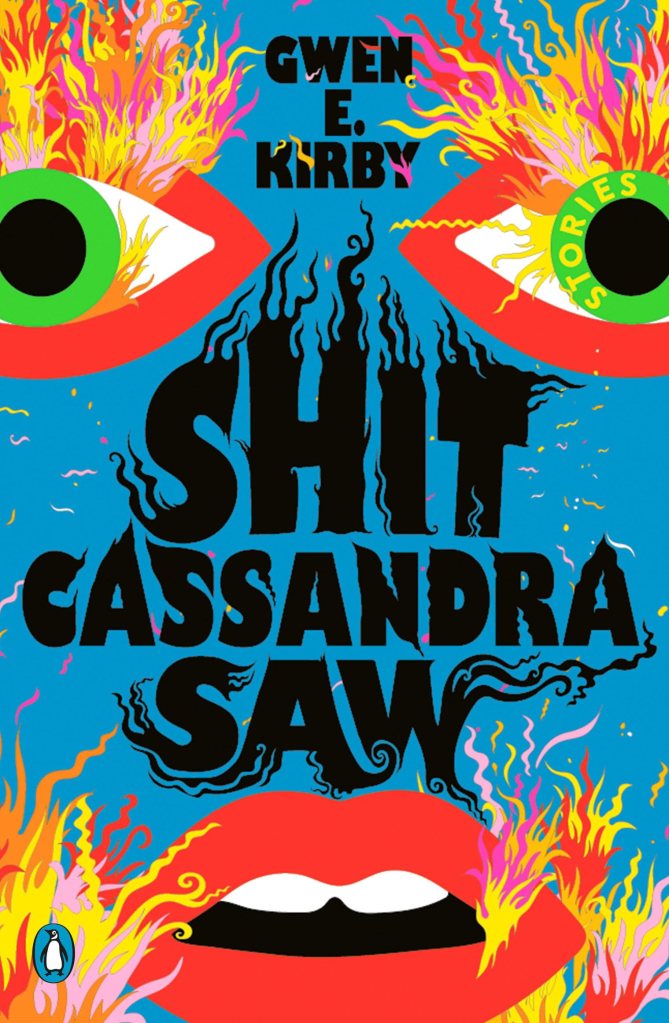
Shit Cassandra Saw – Gwen E. Kirbychronicling the varied experiences of women with wry humor—and honesty.

“Ate the Moon” – Tunde Adebimpe

It’s been almost a month since Thee Black Boltz came out, and the question remains: is this enough to sate us through the dreaded TV on the Radio drought? For the most part, I’d say yes—but it’s a separate, branching effort. Though it proves that Tunde Adebimpe was the beating heart of the band, he’s more than formidable on his own, minus Dave Sitek’s production and piled on with more synths. Though it’s not without its misses, Thee Black Boltz feels like Adebimpe stretching his fingers out in all different directions, but never stretching them beyond what makes me come back to TV on the Radio so often.

With a central theme of overwhelm during times of crisis and searching for light—creativity—amidst the choking smog, Adebimpe turns to synths and more danceable beats (see: “Somebody New,” a bolder, dancier gamble that mostly paid off in spite of the autotune) in order to pull through. “Ate the Moon” is about that overwhelm, if the title doesn’t already clue you in. Swallowed by anxious spiraling and visions of horror, the narrator scrambles for answers, but finds only regret: an echoing, childlike voice proclaims after the “the man who ate the moon” chorus that “and he choked, of course, because he bit off more than he could chew. Such a dummy!” “Dummy” echoes and is pitched down as it fades out, distorted into a trickster baring a triumphant, toothy grin as it disappears into the darkness like the Cheshire Cat. “Ate the Moon” certainly has some of what I think the albums pitfalls are: the lyricism is on the simpler, more obvious side. Not inherently a drawback, but after something as rawly and artfully written as “Tonight,” it feels cheap for him to rhyme “fire” and “desire” for the millionth time. It’s like Jeff Tweedy using someone being “cool enough to be ice cream” as a metaphor after being such an unparalleled poet otherwise. But like “Ice Cream,” it’s easy to love “Ate the Moon.” With the instant hit of Adebimpe’s boxing gloved punch of a voice and the synths and guitars that have been sewn into an electronic gestalt, it’s one of the most unique songs on the album, an adrenaline-pumped trip into the downward spiral of autonomy-less fear.

…AND A BOOK TO GO WITH IT:

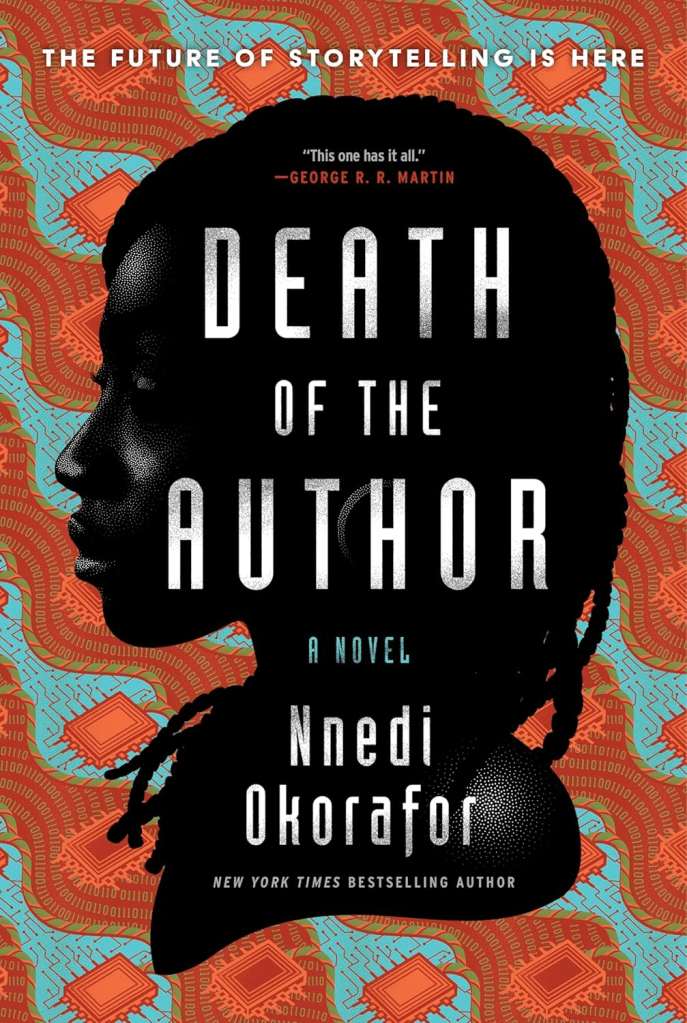
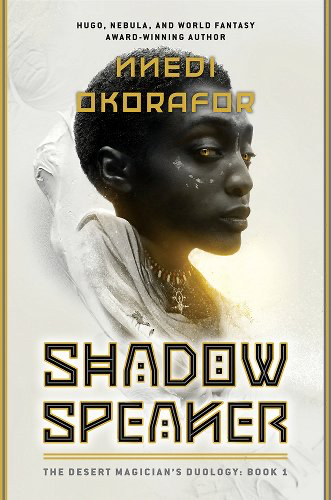
Death of the Author – Nnedi Okorafor“Seems I was iII-prepared/For the fall that finds me here/Sad extremes running through my head/Knocked my blues into the red…”

Since this post consists entirely of songs, consider all of them to be today’s song.

Posted in Sunday Songs

Sunday Songs: 3/30/25

Happy Sunday, bibliophiles! I hope this week has treated you well.

This week: new music from 2025—both released this year and overheard before a Soccer Mommy show.

Enjoy this week’s songs!

SUNDAY SONGS: 3/30/25

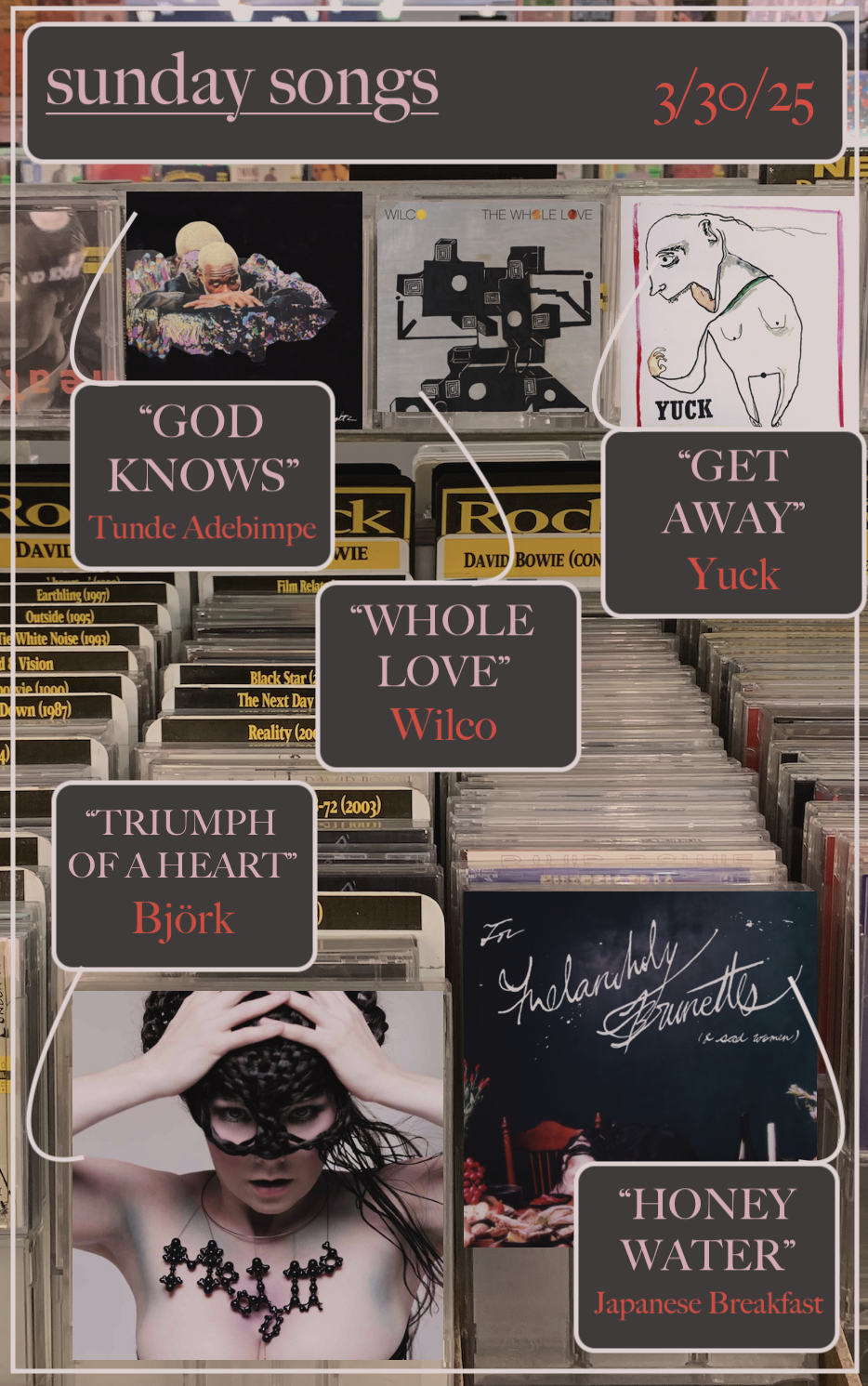
“Triumph of a Heart” – Björk

I’ve finished the Sonic Symbolism podcast, and all it’s left me with is a rabid desire to do a deep dive of the rest of Björk’s albums. Medúlla is enticing as it’s the next one chronologically (even though I’ve given up on listening to her albums chronologically), but also because of the uniting concept behind it. Inspired by primal, prehistoric imagery of motherhood, family, and storytelling around campfires, Medúlla was constructed almost entirely from the human voice. Aside from some synths and piano, it’s almost all a-capella, but not in the way that you’d think. Each voice becomes percussion, scattered onomatopoeia, and rising tidal forces that lift something primal from your soul. And every possible voice ends up featuring on this album—Tanya Tagaq (throat singing), Rahzel, Dokaka (beatboxing), and Mike Patton (deep backing vocals that Pitchfork described as “demonic”) all feature in the varied vocal tapestry. I ended up being too busy to write about “Pleasure Is All Mine,” but that song, in its simultaneous feminist ode and playful toying with women’s capacity to be selfless, really does succeed in digging into something innate, almost instinctual within me.

In concept, “Triumph of a Heart” is almost as ridiculous as the music video. (Fun fact: Björk’s cat husband in this video spawned the “I should buy a boat” meme from way back when.) Forming the percussion of the song, alongside Dokaka’s melodic beatboxing, is what can only be described as restrained raspberry noises and sounds that are almost akin to somebody who’s only heard a cat once trying to make cat sounds. Yet it all works in such a familiar yet alien synchronicity that comes together in a way that only Björk can make it. The track is an ode to how music can make you feel and the joy of dancing, a pleasure shared since early humans were able to whack sticks together and harmonize around the fire; maybe it’s an obvious choice for this album, but using only bodily instrumentation is the perfect medium to explore the visceral nature of music and dance, the way that it sometimes vibrates your soul: “The nerves are sending shimmering signals/All through my fingers/The veins support/Blood that gushes impulsively towards/The triumph of a heart.” I always see such sentiments of people undervaluing the arts, even as they consume it by the truckload and think nothing of it; it’s not a viable, useful profession, more fodder for AI and mindless listening. It’s so easy for us to forget that art in all its forms, the same as the need for medicine and food, is innate to us, and has been since we were gathered in the shelter of the first fires.

As a bonus: here’s some behind the scenes footage of the recording of “Pleasure Is All Mine”:

…AND A BOOK TO GO WITH IT:

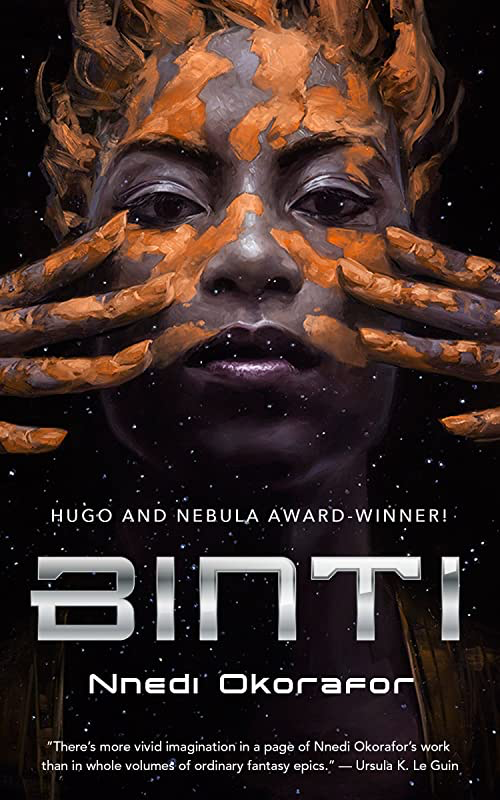
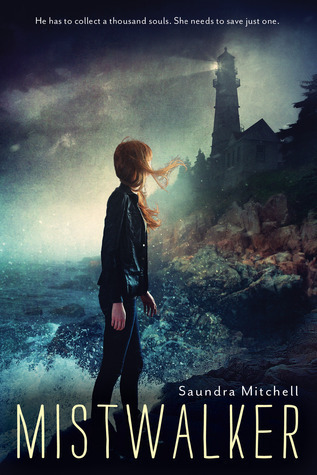
Binti – Nnedi Okoraforthis novella also falls into that merging of preserving cultures that have survived for thousands of years and alien technology, and it blends into a bizarre, delightful trilogy.

“Honey Water” – Japanese Breafkast

For Melancholy Brunettes (& sad women) sadly fell under the She Reaches Out to She Reaches Out to She curse on this blog, which roughly translates to “I wanted to write about at least 2-3 of the singles, but they all ended up landing on weeks where I didn’t have time to write.” Shame, really, because “Orlando in Love” and “Mega Circuit” were silk-drapingly romantic and creepily artful, respectively. Now that I’ve listened to the whole album, at its best, it embodies those qualities, oscillating from semi-autobiographical, tragic stories to some of the more fictional songwriting that Michelle Zauner drew on for Jubilee. She simultaneously leans into the notion of the “sad girl” while critiquing the fact that women are so often pigeonholed into this description (see the title), embroidering her own dramatic melancholy with orchestral arrangements and references to Greek mythology. Though it wasn’t always successful and the end dragged (see: “Men in Bars,” an faux-earnest, ballad-y duet with…Jeff Bridges? Huh?), For Melancholy Brunettes was, for the most part, an artistic leap that was a good 75%-80% successful in its feats of daring. It acknowledges its place amongst the traditionally emotional role of female musicians, but also acknowledges the light that peers in through the cracks (see: “Here Is Someone”—for maximum enjoyment, transition it with “Frosti” by Björk).

“Honey Water” was one of the standout tracks. I never thought of Japanese Breakfast as someone who could necessarily conjure up eeriness. Sure, she’s written plenty about all manner of unpleasant feelings, but I’ve never gotten dread as one of the most prominently featured ones. Zauner’s signature, breathy whisper takes on the feeling of a carnivorous plant laden with dew, ready to ensnare all manner of insects. Yet she’s not the one doing the ensnaring in this song—the narrative, toeing the line between fiction and reality, as her songs often do, speaks of an unfaithful lover repeatedly leaving her for someone else: “The lure of honey water draws you from my arms so needy/You follow in colonies to sip it from the bank/In rapturous sweet temptation, you wade in past the edge and sink in/Insatiable for a nectar, drinking ’til your heart expires.” The dread that Zauner dredges up is more a kind of stagnation, the sinking feeling of seeing the inevitable unfold around you, and yet somehow feeling powerless to move—or leave. The closing refrain, as the guitars rise in a crashing, insectoid drone, echoes Slaughterhouse-Five’s famous tidbit: “So it goes/I don’t mind”; the narrator convinces herself that all of her partner’s unfaithful transgressions are a fact of life. That tired powerlessness is what makes the dread so palpable, the music swallowing her as she mutters the last repetition of her exhausted mantra.

…AND A BOOK TO GO WITH IT:

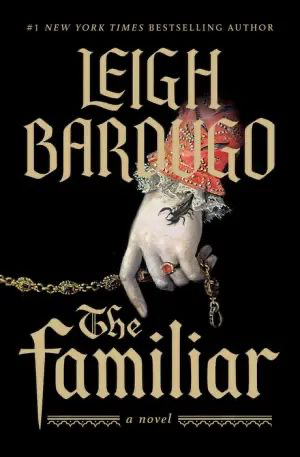
The Familiar – Leigh Bardugo“In rapturous sweet temptation, you wade in past the edge and sink in/Insatiable for a nectar, drinking ’til your heart expires…”

“God Knows” – Tunde Adebimpe

Remember how I was halfway chiding myself for hoping that Thee Black Boltz was just going to be TV on the Radio 2: Electric Boogaloo? Now that “God Knows” is out, I think that might honestly just be what the album is like regardless of expectations. “Magnetic” introduced us to a familiar, nostalgic sound full of energy, “Drop” was the point where Adebimpe seems to diverge, and now we’ve got “God Knows,” which sounds straight off of Nine Types of Light or even Dear Science. It’s giving me some perspective on how much Adebimpe made TV on the Radio—Dave Sitek constructed the scaffolding, but Adebimpe was the heart of it all, without a doubt. Balancing sharp acoustic strumming with synths that ripple and bubble, this track adds to “Drop” in the sense that both songs feel like they’re floating. It fits with the album cover for me—as Adebimpe clings to his geode island in the middle of an undefined void, he’s buoyed through it, like an ocean, propelled by nothing but the endlessly catchy hooks he’s been producing of late. “God Knows” stands out to me as the strongest of the three offerings so far—like “Magnetic,” it’s been sharpened to its tightest point to make indie rock tracks that wouldn’t be out of place 10 or even 20 years ago. Tunde is timeless.

…AND A BOOK TO GO WITH IT:

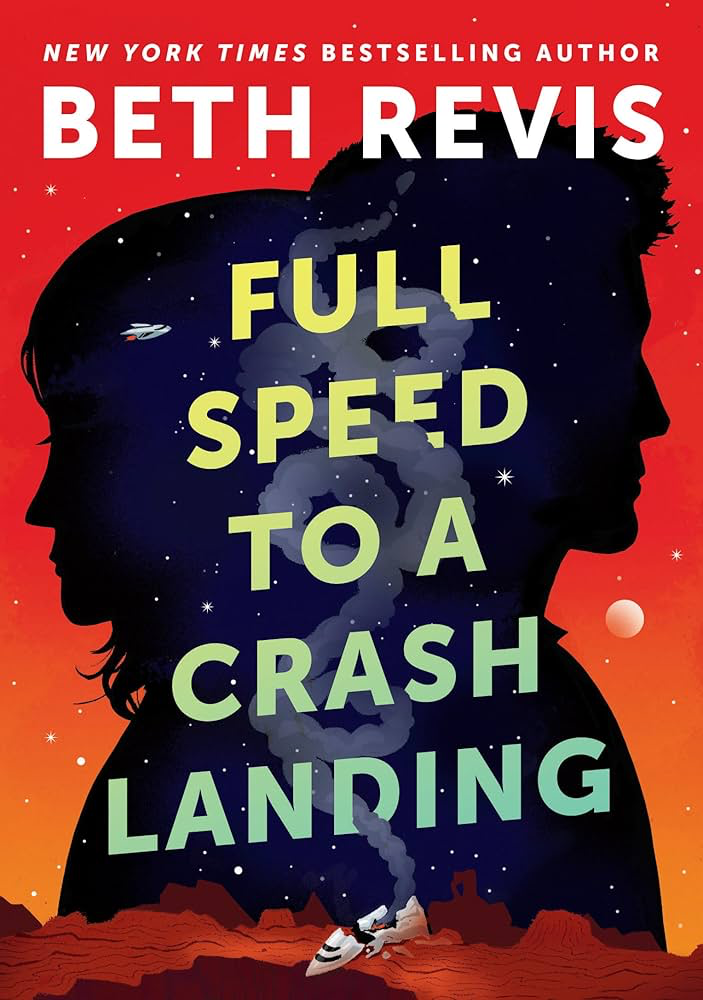
Full Speed to a Crash Landing – Beth Revis“God knows you’re the worst thing I’ve ever loved/And you’re bad news/But we still got to have our fun…”

“Whole Love” – Wilco

Man, YouTube comments are so funny sometimes. I hope the Latina woman who posted “I love this white song, don’t tell my homegirls I listen to this” is doing okay and still listening to Wilco happily. Wilco really is the great unifier.

Here’s an album that I’ve probably listened to in full, but only remember about half of. The Whole Love soundtracked many a car ride to school or piano lessons and whatnot back in 2011. I even remember popping my dad’s borrowed CD into my old Hello Kitty CD player while I was playing with my Build-A-Bears in my room. That should give you a picture of the kind of hipster child I was, but I digress. The resulting tour was also the first time I saw Wilco—and my very first concert, at Red Rocks at the age of eight. So even if I haven’t mapped it out fully, The Whole Love was integral to my childhood, whether it was watching the music video for “Born Alone” on my dad’s old laptop (I distinctly remember saying that it “made my head spin”) or sitting on my dad’s shoulders on that summer night. Really, it boils down to my dad. Raising me on all that Wilco made me turn out alright, I think.

Back to “Whole Love” in particular. The song already carries a metric ton of nostalgia for me, but it never gets old with any successive playing. As far as The Whole Love goes, it feels like one of the more accessible tracks—it’s classic Wilco, but with the artsy twist that the album presents. There’s a passage in Steven Hyden’s This Isn’t Happening: Radiohead’s ‘Kid A’ and the Beginning of the 21st Century that talks about the significance of album openers setting the tone for the album as a whole. Hyden points to “Art of Almost” as an example—with all of the Thom Yorke-esque synth weirdness, it signals to the listener that this is gonna be the weird Wilco album. That experimental nature leeches into the most “accessible” sounding tracks—like this one. Even as Jeff Tweedy brings his gentle, acoustic sway into fruition, the background can only be described as fluttering—they jitter and judder like the freshly-dried wings of just-hatched butterflies, creating tiny fractals in the background. Yet even if you stripped that weirdness away, “Whole Love” would still be a classic—whether it’s craft or my nostalgia talking, there’s something so innately comforting about the layered harmonies, folded on top of one another like layers of fine fabric.

…AND A BOOK TO GO WITH IT:

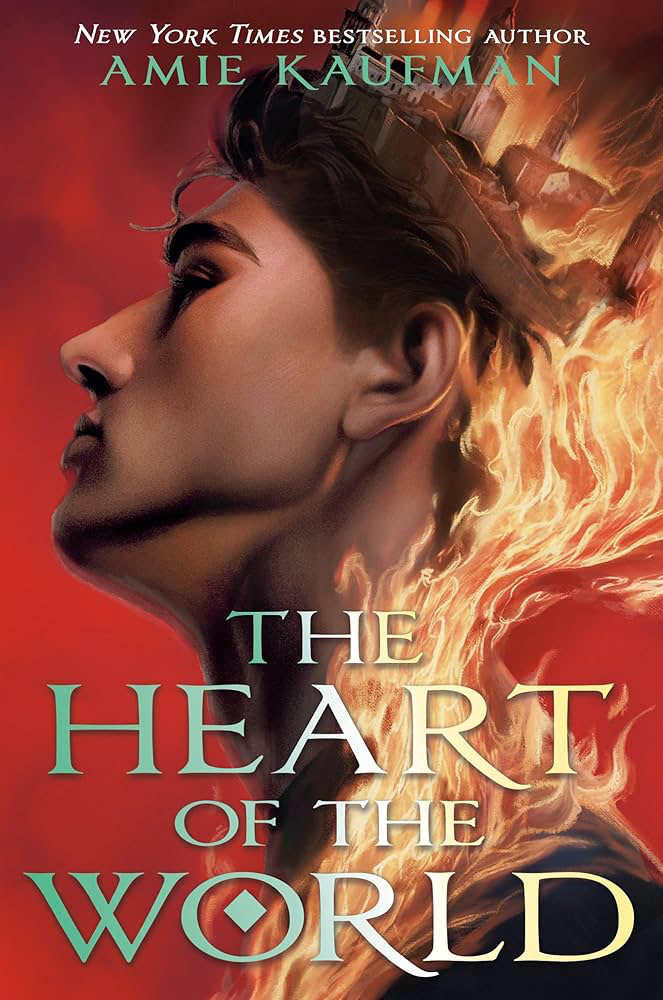
The Heart of the World (The Isles of the Gods, #2) – Amie Kaufman“And I know that I won’t be/The easiest to set free/And I know that I won’t be the last/Cold captain tied to the mast…”

“Get Away” – Yuck

This song played before Soccer Mommy came on when I saw her a few weeks back, and for a split second, I confused it for some Apples in Stereo song that I somehow hadn’t heard in my childhood. Turns out, there’s probably no Apples in Stereo song that I missed when I was a kid, hence why I didn’t recognize it. (Cut me some slack, it was loud in there…) Yuck doesn’t have the same electronically-oriented whimsy as the Apples in Stereo, but they seemed to branch off of the indie sound of the early 2010’s, with their synth-like guitars, ’90s distortion, and the nasally vocals of Daniel Blumberg. Those guitars were what made me nearly mistake them for the Apples in Stereo, but they’re clearly more students of, say, Sonic Youth or Dinosaur Jr. But they had that sun-soaked, 2010’s indie aesthetic down to a science; even without the yellow filter on their music video, “Get Away” just oozes the sensation of a dream of being on a road with no speed limits while the sun beats down through the windshield. Even as Blumberg laments that he can’t get away, wrestling with negative thoughts, the track speeds along with a carefree freedom, kicking up gravel as it forges its own path. Certainly fits right in with Soccer Mommy’s sound too—she’s got an eye for good indie, that’s for sure….

…and so does the Academy, apparently? You’re telling me that this guy just won an Oscar for his original score for The Brutalist? That’s a connection I didn’t expect to make in this post…good for you, Daniel Blumberg!

…AND A BOOK TO GO WITH IT:

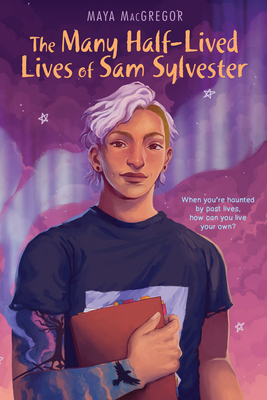
The Many Half-Lived Lives of Sam Sylvester – Maya MacGregor“Summer sun says get out more/I need you, I want you/But I can’t get this feeling off my mind/I want you, I need you…”

Since this post consists entirely of songs, consider all of them to be today’s song.

That’s it for this week’s Sunday Songs! Have a wonderful rest of your day, and take care of yourselves!
Posted in Sunday Songs

Sunday Songs: 10/20/24

Happy Sunday, bibliophiles! I hope this week has treated you well.

This week: we regret to inform you that the All Born Screaming brainrot has persisted for 6 months. It may be terminal. Please stand by.

Enjoy this week’s songs!

SUNDAY SONGS: 10/20/24

“Reckless” – St. Vincent

So. Almost 6 months later, and All Born Screaming remains etched onto the folds of my brain. I already talked about how the climax of this song hit me like a train in my review of the album back in May, but rest assured that time has not dulled its potency. 2024 has been a spectacular year for album intros (see: “IDEA 01,” “Wall of Eyes,” and, I’ll preemptively say it, “Lost”), and All Born Screaming’s “Hell Is Near” rightfully claims its crown in those ranks. But “Reckless” feels like the rightful evolution of it—I’d even to as far to say that it would be stunning as a whole track. Imagine that, combined into about 8:06 of a suspenseful, cinematic build. That’s perhaps the only thing that could make the sonic lightning strike at 2:38 even more explosive. Like a well-shot film, suspense is what drives “Reckless” to its pinnacle of art—every lyric is a footstep down a pitch-black hallway, constantly wary of the faulty wiring in the ceiling that’s ready to burst. Knowing that Clark has opened every setlist for this tour with “Reckless” makes the salt in the wound that SHE DIDN’T COME TO COLORADO ON THIS TOUR even saltier. WHY HAVE YOU FORSAKEN US, ANNIE? YOU WENT TO IDAHO, FOR GOD’S SAKES!

…AND A BOOK TO GO WITH IT:

Death’s Country – R.M. Romero“If your love was an anchor/And I am lost at sea/I hear the riders calling/They’re calling for me…”

“Look What They’ve Done To My Song, Ma” – Melanie

I came here from the wonderful show We Are Lady Parts (highly recommended if you need a laugh and also want to see some Muslim punks being badass and very vulnerable on TV); it’s a fitting soundtrack for the bitter disappointment of the band at the end of the first episode of season 2 as they watch their hit song being covered by newcomers, only for said newcomers to get the bulk of the praise and applause from the crowd.

Given this song’s partial legacy of being butchered for commercial jingles (confirmation that corporate executives never listen to lyrics), there’s something predictably depressing about “Look What They’ve Done To My Song, Ma” becoming exactly what the lyrics talk about. In an slow lament that slants towards an older Broadway standard, Melanie sings of how her music has been dragged through the mud: “Look, look what they’ve done to my song/You know, they tied it up in a plastic bag/And then turned it upside down, oh Mama/Look at what they’ve done to my song.” That kind of Broadway feel is the ideal form for this song—it begs for a spotlight on a sordid character with mascara running down her cheeks as she belts her sorrow into a rapt crowd. The more I think about it, I feel like it’s one of the premier victims of the ’60s-’90s fadeout in music—why, why, why would you start turning the volume down right when she hits the most impassioned belt of the whole song? Melanie specifically wrote it about how her producer (who also happened to be her husband) would often halt her creative process in the studio, diverting her from her vision when he saw what he wanted to be a hit.

“Look What They’ve Done To My Song, Ma” has been covered a slew of times over the years, most notably by greats such as Ray Charles and Nina Simone (!!). Sometimes, with a song that covered, it’s simply a matter of fame, but it taps into what might be one of the most universal fears of anyone in the arts: trying to put yourself out there, but then getting your vision sanitized and reshaped for mass appeal. It’s always at the back of my mind. Being unreceptive towards any criticism is one thing, but I’m always afraid of what I put out there being somehow not right for what publishers want. Whatever finished products I eventually publish will have to be rigorously edited, of course, but it would kill me if there were key parts of my stories I had to dilute just so I could sell more copies. Of course, careers in the arts are often…not the most well paying, to say the least, and I almost fear having to succumb to diluting my vision just because of money more than I fear the dilution itself. Would I be able to live with myself? We’ll cross that bridge when we get to it. No, if. I’ve gotta have a little faith. If this song—released in 1970—was able to break through the constraints of producers and the music industry at large, maybe it isn’t all as bleak. Melanie did get the last laugh, from what I can tell, eventually gaining more creative control and outliving her husband. Sadly, she passed away this January, but her legacy precedes her. I’ve only been familiar with Melanie for a woefully short time, but I hope she’s resting easy.

…AND A BOOK TO GO WITH IT:

Not Here to be Liked – Michelle Quach“Look at what they’ve done to my brain/Well, they picked it like a chicken bone/And I think that I’m half insane, ma…”

“Final Fantasy” – TV on the Radio

Picture this. You open up Instagram. TV on the Radio has posted an ominous picture of their logo on their page. They’ve been on hiatus for almost a decade. When the world needed them most, TV on the Radio returned…

…just to play a few shows in New York, LA, and London.

They’re at least reissuing Desperate Youth, Bloodthirsty Babes for its 20th anniversary and we got “Final Fantasy” out of it. Hopefully the slow creep of the bass and the ominous, razor-sharp lyrics are enough to distract from the fact that we’ve been sidelined…again. I’m just telling myself that they’re cooking up something new, just so I can sleep at night. You can’t just rise from the dead like that only to play…what, nine shows in only 3 locations? Come ON.

…AND A BOOK TO GO WITH IT:

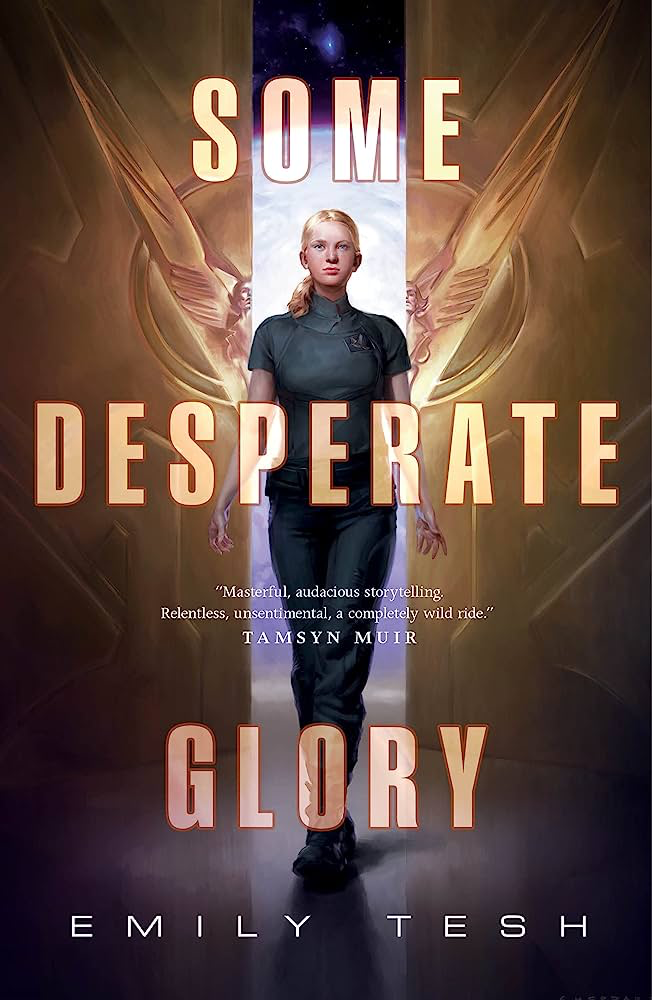
Some Desperate Glory – Emily Tesh “You’ve made a family/Now kill ’em dead/Oh it’s not me Ma/It’s what the TV said…”

“Like Humans Do” – David Byrne

When I heard this in the background of a post on Instagram earlier in the week, I got hooked through the screen—you ever just hear a 10-second snippet of a song and are immediately impelled to download it? It’s so delightfully hooky. No wonder Microsoft chose this song as one of the samples of music for their Windows XP Media Player. It’s now widely accepted as the unofficial “Windows XP Anthem”—the radio edit, that is; Microsoft used the radio edit, which cut out the following line: “I never watch TV except when I’m stoned.” (They replaced the line with “We’re eating off plates and we kiss with our tongues.”) Either way, even though I never got to experience “Like Humans Do” in that context, thank you to whoever decided that David Byrne’s music would be the flagship of Windows XP.

Byrne wrote the song as an imagined perspective of a Martian watching humans interact; the lyrics have a simplistic, domestic calm to them, placidly and warmly recounting the everyday normalities of human life that we take for granted: “For millions of years, in millions of homes/A man loved a woman, a child it was born/It learned how to hurt and it learned how to cry/Like humans do.” With its clanging, light percussion and that classically funky, Talking Heads groove, it’s a jangle that really does embody one of its more delightful lyrics: “Wiggle while you work.” You bet I was IMMEDIATELY wiggling when I first heard this song…and on every subsequent listen. And it feels exactly like the kind of song Byrne would write. It’s in that same vein of Björk’s “Human Behaviour,” but with more of a calm appreciation rather than baffled curiosity on the subject. Relating it back to Byrne’s autism diagnosis later in life doesn’t explain everything, but as with Björk, who said that she “may be semi-autistic” in an interview in 2011, it does make sense for Father Autism himself to take on this kind of subject matter. Of course, you can zoom this lens out to apply this observational mentality to anyone on the fringes of normality, but it does feel like a role I’ve embodied as a neurodivergent person myself. You watch others to learn how to act, and sometimes, you feel like you’re another species collecting enough information to try and blend in. Of course, the freedom comes when you realize that there’s no point in blending in, but for me, at least, there was never a shunning of neurotypical behavior—simply a realization that I would never fully be able to imitate it, and I’d found enough people who understood and words to explain why I am the way I am. “Like Humans Do” feels like the calm epiphany of discovering difference once neurodivergent acceptance becomes reality.

…AND A BOOK TO GO WITH IT:

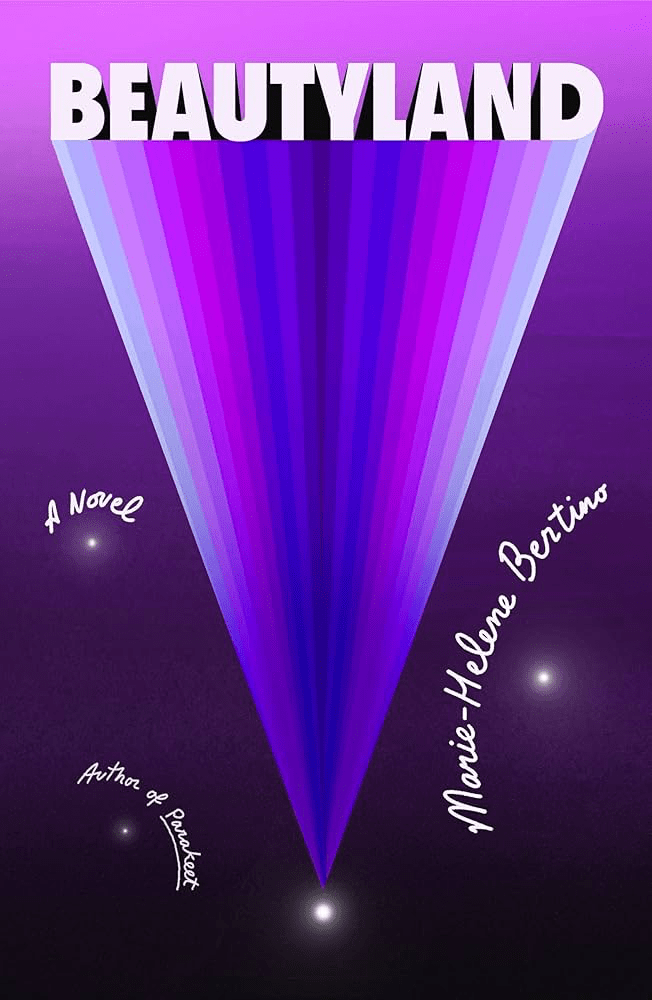
Beautyland – Marie-Helene Bertinolisten, I try not to double-dip on book pairings, especially since I paired this book with “Always Crashing in the Same Car” last week. But…the alien observing humans connection is right there!

“Breaking the Split Screen Barrier” – The Amps

Normally, I take a liking to any given Kim Deal-related song fairly quickly. But “Breaking the Split Screen Barrier” wasn’t so instantaneous for me. The beginning sounds like a series of false starts layered on top of each other. The prolonged space between each chord doesn’t just feel like a ruse: they pile up on top of each other so much that you feel like you’re being served three courses of red herrings. And I hate to say that about The Amps! I don’t think I’m that impatient of a listener, but I’m used to them getting straight to the point (see: “I Am Decided”).

After a few listens, however, you realize how much that slow build pays off. Every instrument has more crunch and crackle than a wadded-up ball of tin foil. In between the gravel and abrasion, Kim Deal murmurs her borderline surreal lyrics into a void curtained by echoing near-abrasion. Maybe I am guilty of being one of those damn gen z-ers with an attention span shorter than that of a minnow, but I think I can be patient—especially when Kim Deal is concerned. It paid off for “Breaking the Split Screen Barrier.”

…AND A BOOK TO GO WITH IT:

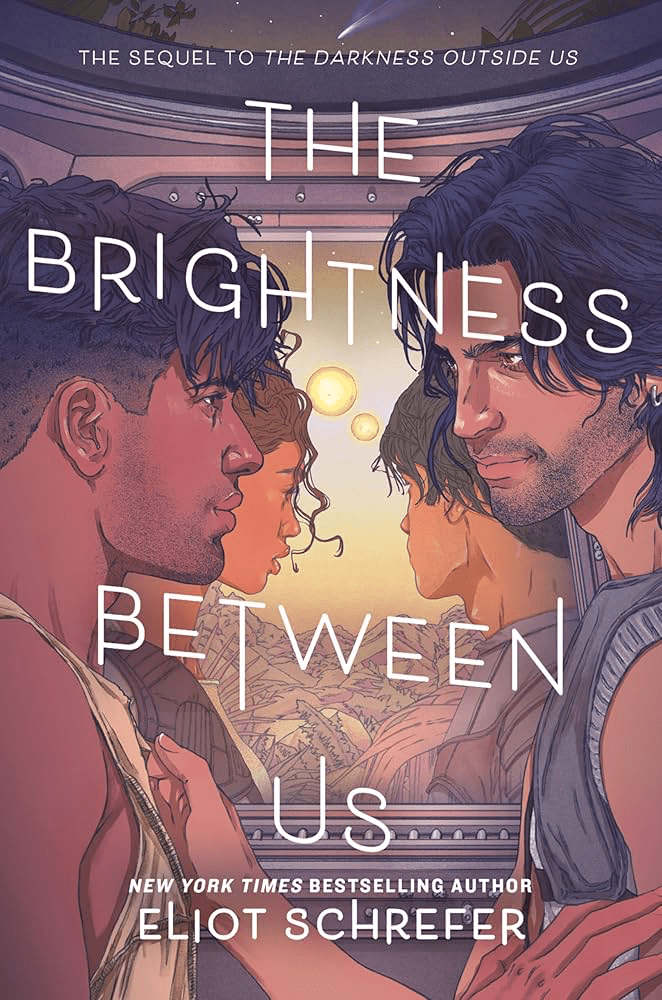
The Brightness Between Us (The Darkness Outside Us, #2) – Eliot Schrefer“I know you’re not sane anymore/That doesn’t mean you’re fine…”

BONUS: the great Jim Noir has a new album Jimmy’s Show 2, out on November 5th! He released a music video to accompany the lead single, “Out Of Sight,” this week:

Since this post consists entirely of songs, consider all of them to be today’s song.

That’s it for this week’s Sunday Songs! Have a wonderful rest of your day, and take care of yourselves!
Posted in Sunday Songs

Sunday Songs: 4/7/24

Happy Sunday, bibliophiles! I hope this week has treated you well.

This week:

Choose the best answer: You can blow with:

a) This

b) That

c) Us

d) All of the above

Enjoy this week’s songs!

SUNDAY SONGS: 4/7/24

“Flea” – St. Vincent

Affirmation of the week: I have listened to this song a healthy amount of times. At least I didn’t pull the “listen but nothing but this song for almost four hours straight” stunt that I did with “Broken Man.” See? I’m better now. I’m savoring this one, and by “savoring,” I mean “listening to it slightly less, but still putting it on repeat for at least half an hour when it comes on shuffle.” What new St. Vincent does to an mf.

“Broken Man” is shining proof that All Born Screaming has a good chance of being my album of the year, but somehow, Annie Clark outdid herself even more with this latest single. I’m glad that “Broken Man” and “Flea” are tracks three and four on the album, respectively; even past the fact that they fit so slickly together, I like the idea that the title and closing tracks are a secret—she’s got something insane up her sleeve. I can just tell. After “Broken Man”‘s torrent of fury, vengeance, and Dave Grohl’s drumming, “Flea” makes the transition into the outright bloody—not bloody in the sense of the trail of destruction that “Broken Man” left, but in the sense of parasitism. Clark described the upcoming All Born Screaming as being bred in “That kind of isolation [that] breeds paranoia and loneliness…loneliness can breed violence.” Now I can see exactly where the whole “post-plague pop” label she stuck on it comes from. “Flea” slinks along on tiny, pointed legs, thrumming with a racing heartbeat and an insatiable thirst for blood; the repetition of “Once I’m in, you can’t get rid of me” is sung lower and raspier, a threat paired with a predatory lick of the lips. The kind of loneliness and violence Clark described seems to be exactly where this kind of sinister lust comes from—being isolated for so long could easily make love turn to lust, and lust consequently to hunger, so drained of human touch that what was once affection has become leeching for nutrients at the other person’s expense. And everything about “Flea” sounds frighteningly hungry, down to the parched-throat rasp with which Clark delivers the verses. When she ends verse two with a dried-out confession of “I look at you, and all I see is meat,” followed by a faint belch in the background, I suddenly got the feeling that I was being watched by something waiting to tear me limb from limb and suck me dry. It’s intense, but it’s the kind of intoxicating thrill ride that I’ve taken with Clark for nearly ten years. And the chorus finds the narrator covered in someone else’s blood, begging for just one more bite; the desperation sloughs off like a second skin, every blood-soaked belt starved and howling. It’s a kind of visceral musicianship that I haven’t seen from St. Vincent in years; although Daddy’s Home was certainly raw, it was the kind of raw you get from getting someone enough wine to spill about their childhood trauma and laugh it off. All Born Screaming is about as raw as flesh itself—it’s all the clearer that Clark has no intention of pulling punches, and that’s exactly what makes a St. Vincent song so iconic. “Rattlesnake” and “Severed Crossed Fingers” don’t illicit waves of emotion in me for nothing—they’re hearts laid bare in the street. In other words: Clark is at her best when she’s herself. Should be a given, but it’s more evident in some albums than others.

God, April 26th can’t come any sooner…

…AND A BOOK TO GO WITH IT:

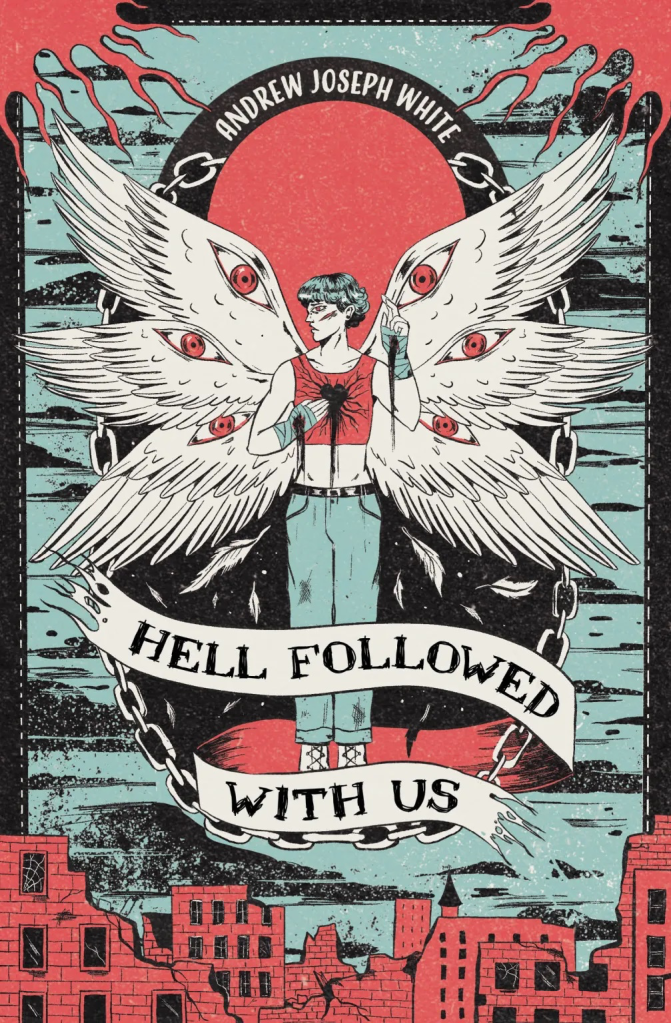
Hell Followed With Us – Andrew Joseph Whitedepending on how All Born Screaming goes, I might preemptively merge this with “Hell Is Here”…

“Tonight” – TV on the Radio

Aaaaaaaaaand, that’s one more album on the Sisyphean Album Bucket List. Between the “Wolf Like Me” (the best song there is about werewolves after this), the deeply moving “Province” with its David Bowie feature (YOU HEARD ME!!), and this, I now know that Return to Cookie Mountain has to make its way into the rotation. I have Chelsea Wolfe to thank for this one; at her fantastic show at the Gothic Theater in March, she played this before the show—I wouldn’t be surprised if she was a fan before, but I suspect that it’s a kind of thank you to the fantastic Dave Sitek, who produced her truly fantastic new album, She Reaches Out To She Reaches Out To She. Also, with a title like Return to Cookie Mountain, I feel like I just have to listen.

What “Tonight” made me realize about TV on the Radio is how effectively—and quickly—they can craft an atmosphere. Some of the most layered ones I can think of are from their early career, namely the first version of “Staring at the Sun” that appeared on their debut EP, Young Liars. Instead of the shorter version that made the cut for Desperate Youth, Bloodthirsty Babes, this one has a thirty second intro (that feels longer, honestly) that consists of just the a cappella vocals of the band, interspersed with an excerpt from a Spanish-speaking radio station. Even though the chatter on the radio station seems cheerful and singsong, the drawn-out gives it a prolonged air of foreboding and sorrow to come, like the next thing we hear will be the somber announcement of someone’s death. Thankfully, that doesn’t happen, but the first lyrics we hear on the heels of that are “Cross the street from your storefront cemetery,” which, bam. That’s how you start a song. When it comes to both of those aspects, “Tonight” operates in a similar way, creating an atmosphere that’s haunting before the instruments even kick in. With the whine of a distant siren and the ever-so-slightly distorted collision of wind chimes, “Tonight” instantly transports you to a place of brown grass and barren vastness, pockmarked by dead trees strung with glass bottles and the faint sounds of the road in the distance. The music seems to lumber with every step, a beleaguered creature that lurches with every step, as if its limbs are tied down with the wind chimes you hear tinkling throughout the song. Hollow whistles harmonize with a moaning clarinet and Tunde Adebimpe’s clarion call of a voice, all at once ragged and brimming with vitality. A fair amount of the buzz surrounding TV on the Radio when they got their start were vocals comparisons of his to Peter Gabriel, and it’s an apt one—they have a similar quality of being roughly visceral, but booming with emotion. Dave Sitek is also credited with “magic” on this song, which I cannot find a musical definition for the life of me, but if there’s anything that you would credit the man for, it’s that. He has the touch.

I often get so caught up in the atmosphere that I only mine the lyrics later, but the lyrics in “Tonight” pop out so prominently on the first listen; as the wind chimes huddle for warmth, Tunde Adebimpe’s voice cuts through them like a steak knife through fabric—”My mind is like an orchard/Clustered in frozen portraits.” How does this man do it? Every single line in this song is a literary gem in and of itself, and it’s not just because of the repeated references to Edgar Allan Poe’s “The Telltale Heart”—like heartbeats rumbling through flimsy floorboards, the lyrics never fail to send chills up my spine: “Her rusty heart starts to whine/In its tell tale time.” My rusty heart sure does whine whenever those lyrics wash over me. And like the sparse nature of the atmosphere, the lyrics tell of a spare mental space, one so full of sorrow and unpleasant memories that, like the telltale heart, cannot be pushed from the mind. The song still haunts me in a largely melancholy way, but it has an uplifting sentiment at its heart. I can’t help but think of Soundgarden’s “The Day I Tried to Live” and its similar atmosphere of doom, but its lyrical heart being the fact that despite all of the horrible things crashing down around you, there will always be something left to live for, so all you can do is push through. Adebimpe’s sentiment feels like wading through a slurry of unpleasantness that never seems to end (“Blossoms that bloom so fine, just to drop from the vine/I’ve seen them all tonight), but he makes the light at the end of the tunnel shine as bright as it can: “The time that you’ve been afforded/May go unsolved, unrewarded/Some nameless you cannot know, may be coming to show you/Unbridled love and light.” No matter how much you have to push down and wade through, never doubt that good things are coming. It’s something I struggle to hold to heart, but I’ve added this song as an unexpected guiding light. I can never know the future. It scares me. But there is certainty in the love lingering beyond my current time. There is always love.

…AND A BOOK TO GO WITH IT:

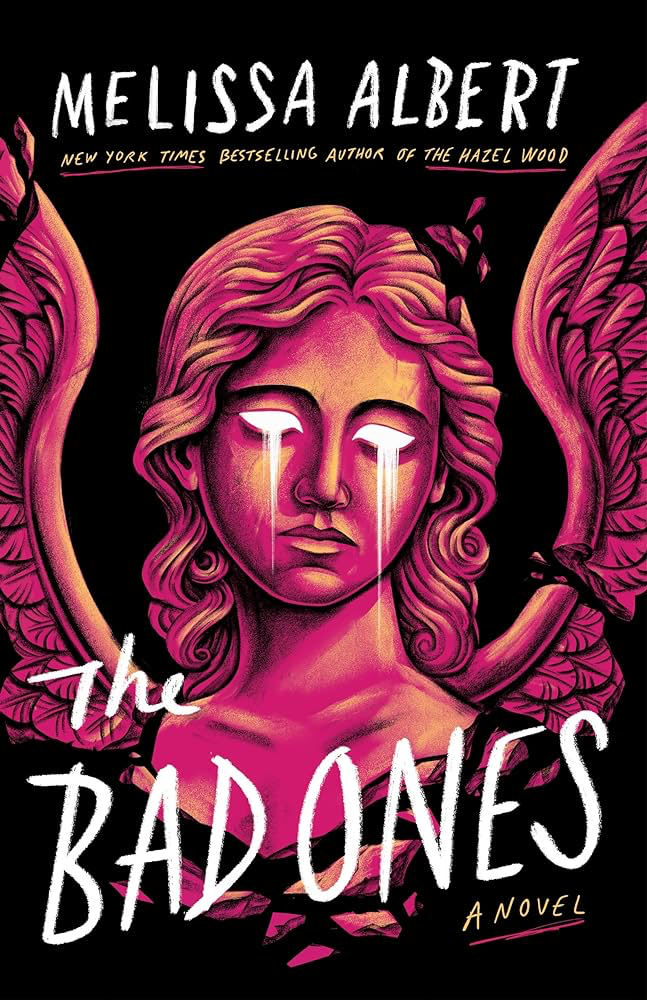
The Bad Ones – Melissa Alberta similarly haunting atmosphere woven from swirling memories.

“the rot” – Dean Blunt

Contrary to my graphic, this is not, in fact, that well-intentioned but ultimately regrettable black square everybody posted back in 2020. My text box accidentally cut out the 2 on Black Metal 2, the only thing distinguishing it from the cover of Black Metal, which is…also just a black square. Gotta admire Dean Blunt for committing to the bit.

I stumbled across this song thanks to Arlo Parks, who chose Black Metal 2 as one of her picks on her episode of Amoeba Records’ series What’s In My Bag?, where she also talks about my bloody valentine and happens to be wearing one of the coolest Radiohead shirts I’ve ever seen. The songs she discusses there—“VIGIL” and “the rot”—serve as bookends, the opener and closer of Black Metal 2, respectively. Both of them have the atmosphere of a massive curtain thrown over your eyes—you’re immediately thrown somewhere else in a space that Blunt has created; no time is wasted in transporting you into his world. While “VIGIL” has the tidal-wave mounting tension of strings to prop it up, “the rot” is the last, gentle minutes of a plane ride home. It’s a distinctly sunset song: you’re slumped back in your seat, golden light is spilling through the window, and you have the sense, more than ever, that a chapter is closing, but not necessarily in a negative way. You can tell that there’s a myriad of different instruments, but all of them are toned down to a faint crawl, strings gently winding, acoustic guitars drifting away like insects in the early evening. “the rot” in particular has such a gorgeous vocal contrast between Blunt and guest artist Joanne Robertson; like Phoebe Bridgers and Jeroen Vrijhoef on “Garden Song,” what grounds the song is the stark difference, although that of Blunt and Robertson feels much more natural and less jarring than the latter. Where Blunt has the warmth and thickness of the ocean lapping over a volcanic shore, Robertson’s words float like the breeze stirring the water. Both of them drift like motes of dust into the air, closing out Black Metal 2. Without even having listened to the whole album, I can tell how successful “the rot” is as a gentle closer.

…AND A BOOK TO GO WITH IT:

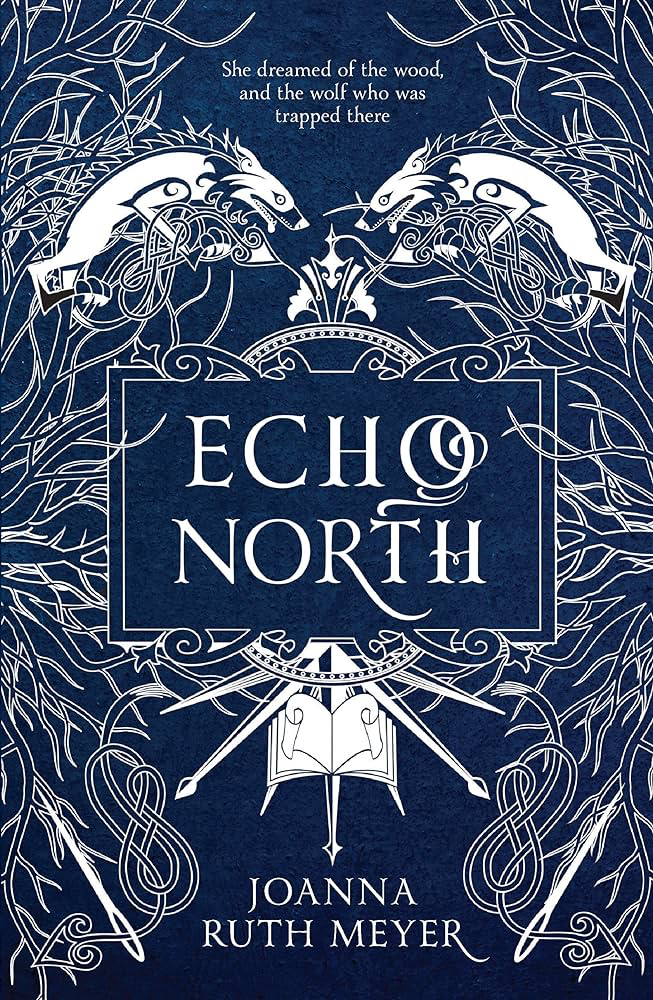
Echo North – Joanna Ruth Meyer – the frost, like the rot, lures you into the woods and makes you chase after old dreams.

“Weapon of Choice” – Fatboy Slim

Me when I walk without rhythm (I didn’t attract the worm):

…AND A BOOK TO GO WITH IT:

Dune – Frank Herbertas is written.

“Satellite of Love” – Lou Reed

Ugh, I’m so glad this song came back intro my regular rotation recently. The outro did wonders for amping me up for my astronomy midterm.

It’s been about four years since I’ve consciously started listening to this song, but I’m sure my dad played it in the car long before that. But I’ll always love this era of Lou Reed, and you know who I’ll also always love? David Bowie. And Bowie, along with Mick Ronson (Bowie’s guitarist in the Spiders from Mars) co-produced Transformer, which has spent a woefully long time on my album bucket list. It’s smack dab in that early-’70s sound that I just live for, and I’ve already heard a handful of the classics from the album already—“Walk On the Wild Side” and “Perfect Day,” to name a few. But “Satellite of Love” remains my favorite thus far, and it’s not just because I collect space-related songs like a bower bird collects shiny rocks and trinkets. As with…well, almost every Lou Reed song, “Satellite of Love” is tinged with melancholy; it tells of love watched from a distance, the aftermath of a breakup watched from below like a stargazer looking at a meteor shower. The offbeat admission of “I love to watch things on TV” feels like an admission of what Reed thought that the relationship had turned into—just something to pass the time and make the eyes go limp. I can’t help but think of Lisa Hannigan—I can’t be sure if this was her exact inspiration, but I wouldn’t be surprised if the chorus of “Passenger” came from a similar metaphor of distant love adrift in the sky—”Oh, my satellite/Oh, my passenger.” For once, Lou Reed is the one that doesn’t sound abjectly in mourning—wistful, sure, but there’s still some light shining in the corner of his eyes, even if it’s just the reflection of a star. For me, the outro is what pumps just the barest pulse of hope into “Satellite of Love”—the piano begins to gallop, clapping and snapping dominates the percussion, and Reed begins a harmony with a wailing, angel-voiced Bowie. Reed remains anchored to the ground, but Bowie, naturally, ascends skyward with every note. There’s something about it that feels like he’s extending a hand from somewhere in the night sky, inviting us to join in the chorus.

…AND A BOOK TO GO WITH IT:

All Systems Red (The Murderbot Diaries, #1) – Martha Wellsthe detached observation of love (and humanity in general) is much more humorous than wistful in nature here, but we can’t deny that Murderbot likes to watch things on TV.

Since this post consists entirely of songs, consider all of them to be today’s song.

That’s it for this week’s Sunday Songs! Have a wonderful rest of your day, and take care of yourselves!
Posted in Monthly Wrap-Ups

March 2024 Wrap-Up 🌾

Happy Sunday, bibliophiles, Happy Trans Day of Visibility, and Happy Easter for those celebrating!

Mentally, I’m still at the beginning of the semester, but somehow midterms are over and I’ve just gotten back from break…ignoring that…

Let’s begin, shall we?

GENERAL THOUGHTS:

I’ve continued to be busy in most of my academic aspects of life, but I’ve managed to stay on top of it—midterms season wasn’t as bad as I thought it was going to be, and it certainly helped that we got an accidental four-day weekend thanks to a snowstorm so drastic that my college called two snow days in a row. I’ve lived in Colorado my whole life, and I’ve never experienced a double snow day…good times, gotta say. I didn’t leave my dorm for all of that Thursday and spent my time playing Minecraft and drinking hot chocolate. A win is a win. But now, the weather’s warming up, and I’m looking forward to soaking it all in.

I honestly thought that this month was going to be my worst reading month, but I read a lot more than I expected; spring break definitely gave me a boost, and March has ended up being my best reading month of 2024 so far! Rating-wise, it’s a different story (certainly more stinkers in this batch), but there were plenty of excellent reads before and after my brief reading slump. Blogging has been about the same—again, school has made it so that I’m mostly sticking to my usual book reviews and Sunday Songs, but I’ve had fun writing them all the same.

Other than that, I’ve just been drawing, playing Minecraft (WE’RE FINALLY GETTING THE DOG UPDATE), studying, watching The Bear, The Completely Made-Up Adventures of Dick Turpin (STAND AND DELIVAH), Abbott Elementary, and Constellation (I haven’t been this stressed out and baffled by a show since Dark, and that’s really saying something), series 17 of Taskmaster, Dune: Part 2 (may thy knife chip and shatter), seeing Chelsea Wolfe live (!!!!! THE QUEEN), and reverting from human to hibernating grizzly bear the minute snow started falling.

READING AND BLOGGING:

I read 19 books this month! I thought it would end up being a lot less than that, but spring break gave me much more time to read. As far as ratings, this has probably been my worst reading month (first DNF and 1-star rating of the year…), but that doesn’t mean that I didn’t read a ton of fantastic books!

1 – 1.75 stars:

The Sevenfold Hunters

2 – 2.75 stars:

Pangu’s Shadow

3 – 3.75 stars:

Womb City

4 – 4.75 stars:

Wuthering Heights

FAVORITE BOOK OF THE MONTH: The Bad Ones4.25 stars

POSTS I’M PROUD OF:

POSTS FROM OTHER WONDERFUL PEOPLE THAT I ENJOYED:

SONGS/ALBUMS THAT I’VE BEEN ENJOYING:

APRIL 26TH CANNOT COME SOON ENOUGH
returning to my sad bastard roots
shoutout to this absolute weirdo and his lyrics
alright I FINALLY listened to this album, great stuff
and the best song title goes to…
such a delightfully summery album
already loved TVOTR, but chelsea Wolfe turned me on to this one. haunting…

Today’s song:

listen this is a banger but don’t think I wouldn’t deck Morrissey in the face without hesitation

That’s it for this month in blogging! Have a wonderful rest of your day, and take care of yourselves!
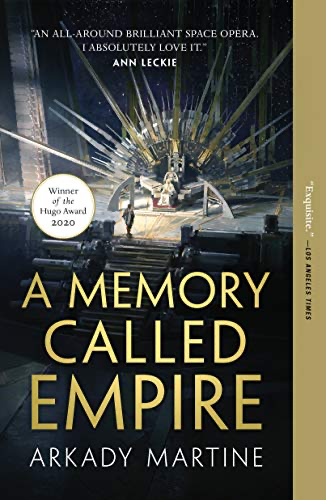
Posted in Books

The Bookish Mutant’s Books for Black History Month (2024 Edition)

Happy Tuesday, bibliophiles!

Apologies for the lack of a Book Review Tuesday this week; like with Sunday Songs, I’ve just had a busy few days, and I wasn’t able to put anything together in time, but I was creating this post in advance, so I figured today would be a good day to post it.

Here in the U.S., February is Black History Month! Since I’ve started making these recommendation lists back in 2021 (and focusing on reading more diversely in general), I’ve discovered so many incredible authors, and now that I’m reading YA and adult novels in almost equal measure, my scope has broadened so much more. (Note: I’m still frugal about my media space on WordPress, but this list, like last year’s, contains both YA and adult novels, even though the header image just says YA.) But as with every single year, it’s more crucial than ever to uplift Black voices—not just to amplify them and other marginalized groups in the fields of literature and publishing (especially when the industry sees diversity as nothing but a box to be checked off, more often than not), but especially since we’re living in a climate here in the states (and elsewhere) that is intent on erasing both our systemic racism (past and present) and silencing Black voices. And one of the most accessible ways to fight this poisonous rhetoric is to read—to open your eyes, to learn for yourself, and to share what you have learned with others. In a landscape where anything other than the white, cishet, abled majority wants to ban any voice that isn’t theirs, reading is an act of resistance.

For my lists from previous years, click below:

Let’s begin, shall we?

THE BOOKISH MUTANT’S BOOKS FOR BLACK HISTORY MONTH

FANTASY:

SCIENCE FICTION:

REALISTIC FICTION:

TELL ME WHAT YOU THINK! Have you read any of these books, and if so, did you enjoy them? What are some of your favorite books by Black authors that you’ve read recently? Let me know in the comments!

Today’s song:

thanks again to my brother for exposing me to this one!

That’s it for this recommendation list! Have a wonderful rest of your day, and take care of yourselves!

Posted in Book Review Tuesday

Book Review Tuesday (3/15/22) – Love in the Time of Global Warming

Happy Tuesday, bibliophiles!

As a bi person, I’ve been on the hunt for more bisexual representation in literature for years. Love in the Time of Global Warming popped up on a whole bunch of lists of YA books with bisexual characters, and the premise intrigued me, so I gave it a go. This one has a lot of bad reviews, but to me, it was a beautifully-written and inventive retelling of The Odyssey!

Enjoy this week’s review!

Love in the Time of Global Warming – Francesca Lia Block

Human civilization has been reduced to its barest remnants after a cataclysmic event known only as the Earth Shaker set the apocalypse in motion. After her house is raided by mysterious men, Pen sets out into the wasteland of what was once Los Angeles in search of her missing mother and brother. Along the way, she meets a cast of strange, lost characters who join her on her quest. But their path is plagued by giants and mad scientists, and they must search the ends of the Earth for what they seek.

TW/CW: sexual content, descriptions of death/murder, past descriptions of abuse/homophobia, use of a trans character’s deadname

Bonus points have been preemptively awarded for the TV on the Radio reference. To Francesca Lia Block—if you see this review, I’m just here to tell you that you have great taste.

I initially picked up this book because I’d seen it show up on loads of lists of YA books with bisexual protagonists, and now that I’ve read it, I’m so glad I did! Most of the reviews I’ve read aren’t too positive, but for the most part, I enjoyed this one quite a bit.

A lot of the complaints about Love in the Time of Global Warming were centered around Block’s writing style. I can usually get on board with more flowery, dreamlike prose, and that’s certainly how Block seems to write. I loved her lush descriptions; the hazy, mystic atmosphere of it made it feel all the more like a retelling, especially one of The Odyssey. Even though Love in the Time of Global Warming was strictly dystopia/sci-fi at its core, Block’s writing gave it a magical feel, which, for the story she was trying to tell, meshed perfectly.

As far as retellings go, Love in the Time of Global Warming was loose, but there were still enough callbacks to The Odyssey to make it feel like a retelling. Pen’s quest did have an odyssey-like feel to it, and some of the parallels (Circe, the cyclops, etc.) were clear, although the addition of Hex reading The Odyssey as they went along felt borderline ham-handed, as though to say “guys! GUYS! Guess what!!! This!!! Is a retelling!!!!1!!” However, Love in the Time of Global Warming was inventive in its brand of apocalypse, which made the setting—and the feel of the retelling itself—a lot more enjoyable. Having giants created by a mad scientist gave the book a fantastical feel without being a fantasy book, which I found to be a very creative move. With Block’s descriptive prose added to that, it made for a very creative retelling.

Another highlight for me was the fact that all of the main characters were casually LGBTQ+! It’s always great to see lots of queer representation in a story, and there is no shortage of queer and trans characters in Love in the Time of Global Warming. Plus, I loved having a brave, unique heroine like Pen be bisexual—always warms your heart to see yourself represented, isn’t it? Certainly warmed mine. Plus, I loved the little jab that they have about being told all their life that they’d be going to hell for being queer, and yet it’s them—not the homophobes—who survive the apocalypse. Call it comeuppance.

However, though most of the LGBTQ+ representation was positive and well-written, I do have a few issues with how parts of Hex, a trans man, was written. Take this as you will, since I’m cis, but there were definitely some parts that rubbed me the wrong way. After Hex comes out as trans, his deadname and old pronouns are used…frequently? Most of it’s in flashbacks, but even still, it’s generally accepted that using a trans person’s deadname and old pronouns after they’ve come out as trans is not the most considerate thing to do. I doubt there was any harm meant by it, but it was a little uncomfortable that Block wrote him this way.

All in all, though, a strange, dreamlike, and unapologetically queer retelling of The Odyssey. 4 stars!

Love in the Time of Global Warming is the first book in Francesca Lia Block’s Love in the Time of Global Warming duology, followed by The Island of Excess Love. Block is also the author of Weetzie Bat, The Rose and the Beast: Fairy Tales Retold, Echo, Witch Baby, and several other books for teens and young adults.

Today’s song:

That’s it for this week’s Book Review Tuesday! Have a wonderful rest of your day, and take care of yourselves!
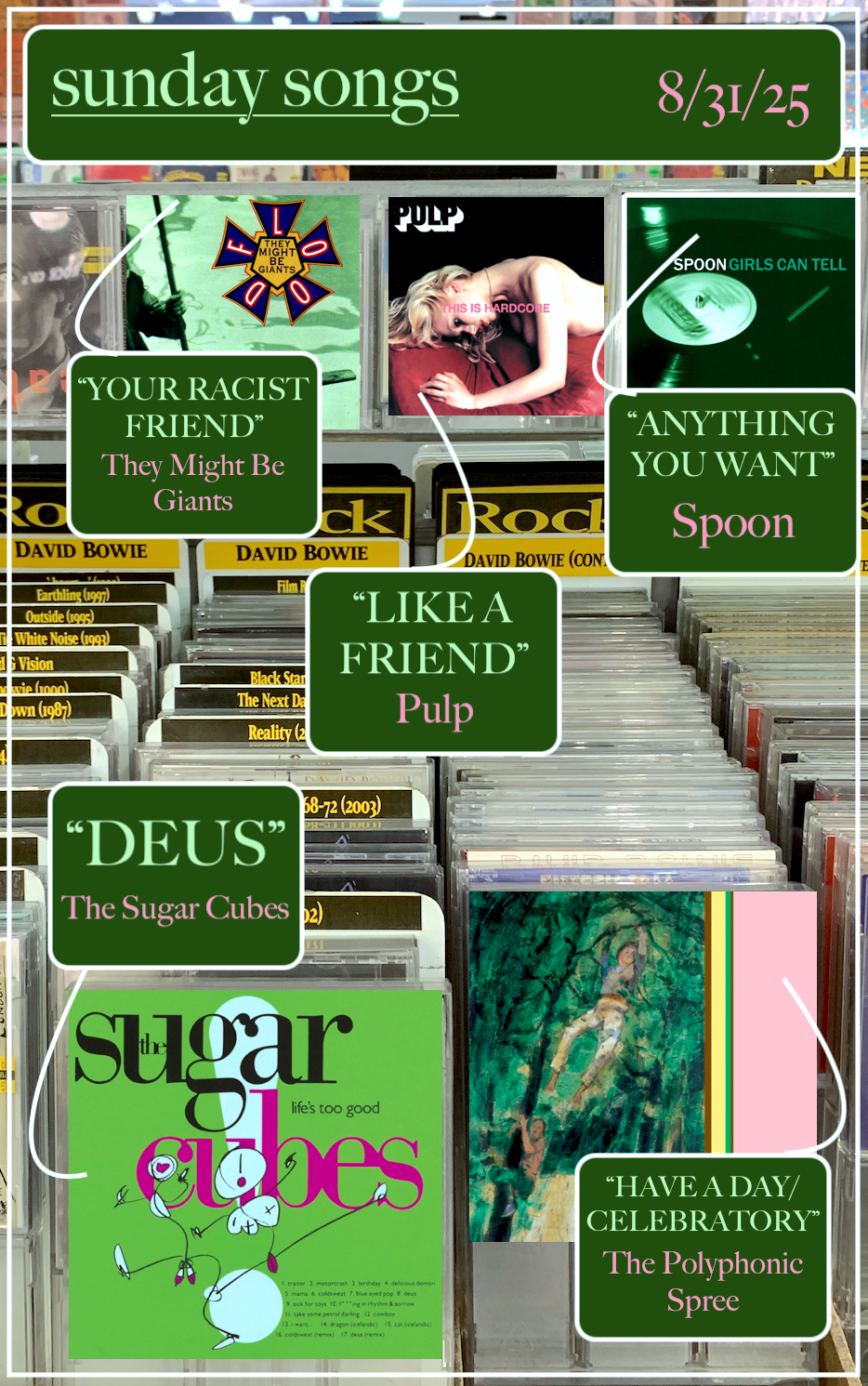
Posted in Book Review Tuesday

Book Review Tuesday (2/1/22) – Beyond the End of the World (The Other Side of the Sky, #2)

Happy Tuesday, bibliophiles, Happy beginning of Black History Month, and happy Lunar New Year! 🐅 My, today’s a momentous occasion…

I’ve been a fan of Amie Kaufman’s for years, and at this point, I’ll read almost anything that she writes. I discovered The Other Side of the Sky during a really tough time in my life, and reading it and immersing myself in her and Spooner’s world made the pain just that much more bearable. I preordered book 2 last year, and it came in the mail recently! Although it was a bit of a slow start, Beyond the End of the World was a jaw-dropping conclusion to a creative duology!

Now, tread lightly! This review may contain spoilers for book 1, The Other Side of the Sky! If you haven’t read book 1 and intend on doing so, I’d suggest that you skip this review just in case.

For my review of The Other Side of the Sky, click here!

Enjoy this week’s review!

Amazon.com: Beyond the End of the World: 9780062893369: Kaufman, Amie,  Spooner, Meagan: Books

Beyond the End of the World (The Other Side of the Sky, #2) – Amie Kaufman & Meagan Spooner

my copy ft. Anakin the cat being very tired of me

Nimh and North have switched places, and only a miracle can get them back where they each belong—and solve the conflict brewing Below.

Nimh and Inshara, the cultist bent on usurping her, are stranded in Alciel, Prince North’s domain in the clouds. But when Nimh wakes up, she realizes that Inshara has contacted the Queen and convinced her that she is Nimh. Below, Prince North is on the brink of discovering a secret that may upend all that Nimh and her people stand for. With the odds stacked against them both, their only chance is to reunite, but the hidden secrets Below may mean chaos for both North and Nimh.

Sky GIF - Sky - Discover & Share GIFs

TW/CW: train crash, frightening situations, descriptions of blood, murder

Every sequel that has a recap of what happened in the previous book is already great by my standards. But in all seriousness, Beyond the End of the World was a sequel that delivered a satisfying end to a uniquely inventive duology!

My only problem with Beyond is the first 100 or so pages; it moves a little slowly for the first quarter, and even though I love Amie Kaufman’s (and I guess Meagan Spooner’s, by proxy, even though I haven’t read any of her solo books) writing, I found myself losing interested. But once the inciting incident—Nimh’s in particular—is set into motion, Beyond’s pace accelerates to the perfect speed.

I loved the prospect of North and Nimh being trapped in worlds completely alien to them, but what made it so tense and well-executed was the introduction of conflict. Once the aftermath of book 1 fades off, Kaufman and Spooner did a fantastic job of setting up obstacles for each of them to overcome. Not only that, but these obstacles had fascinating ramifications that had such a jaw-dropping impact on the last quarter of the book.

I’m not usually one for twists thrown into the last book in the series not long before it ends, but the revelation at the end of Beyond was enough to put a giddy, baffled grin on my face. DANG. Without spoiling anything, I’m still reeling from it just thinking about it. Part of what made it so great was its implications on the worldbuilding—once this domino is set in motion, it tears down everything about Nimh’s world that you thought you knew. So well done, and so well-built-up over the course of two books!
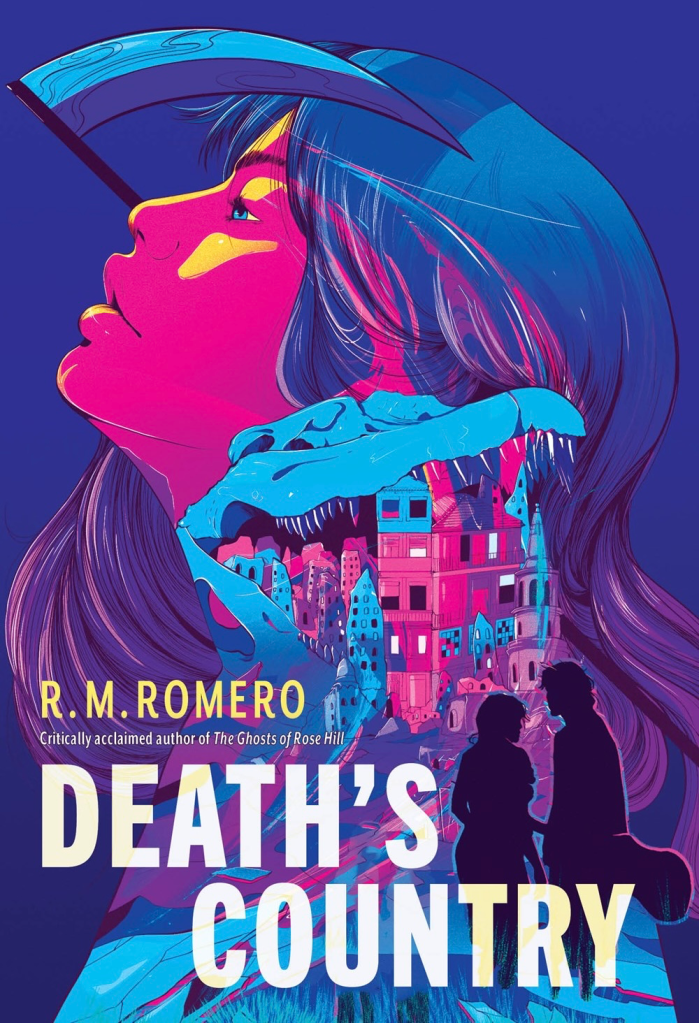
I have one slight problem with said twist. One of the aspects of this duology that I loved so much was the fact that it’s the only “magic vs. technology” book that I’ve read that actually works. The twist, however well-executed that it was, did kind of throw a wrench in the whole concept. Again, no spoilers, but the fact that this is the direction that the twist meant that the “magic vs. technology” part was almost rendered moot. I still hold that this twist was incredibly well-written, but it’s a bit of a disappointment on the themes front.

Of course, it was wonderful to be back in Kaufman and Spooner’s shiny world of goddesses and floating cities. Although I’m more partial to Nimh than North, it was great to see them both again, and it was even sweeter to see them reunite. I didn’t feel a whole lot for the side characters, but given how wonderfully written most everything else, I could let that slide. Plus, cats. I would do anything to pet the Bindle cat.

Overall, a stunning and tense conclusion to one of the most creative series that I’ve come across in the past few years. 4 stars!
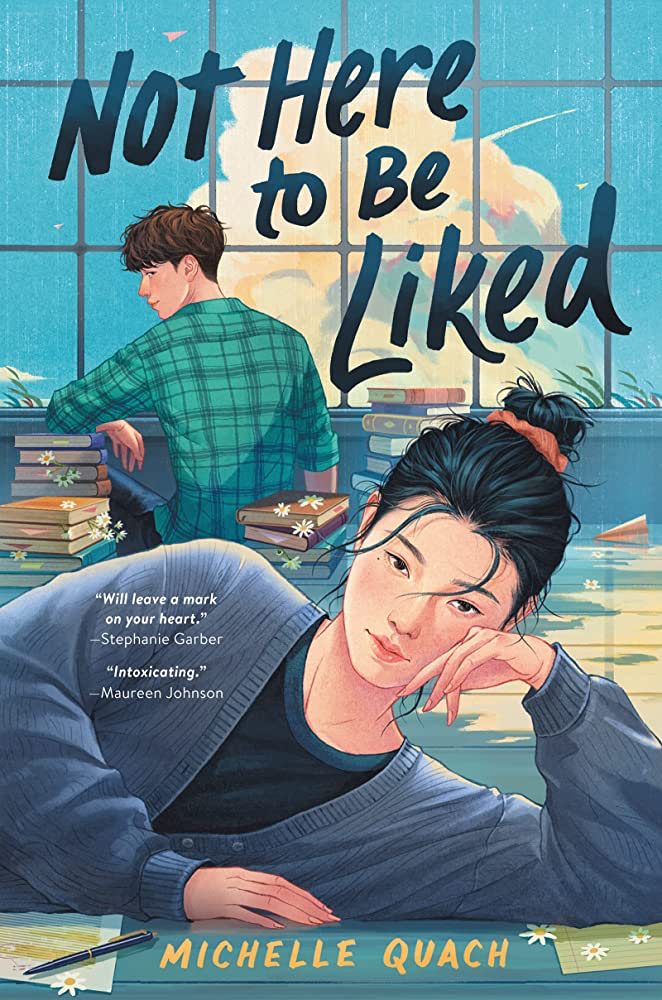
Medieval | Gif Hunt | Aesthetic gif, Gif, The witcher

Beyond the End of the World is the conclusion to the Other Side of the Sky duology, preceded by The Other Side of the Sky. Amie Kaufman and Meagan Spooner have also written the Starbound trilogy (These Broken Stars, This Shattered World, and This Fractured Light) and the Unearthed duology (Unearthed and Undying) together.

Today’s song:

besides being on of my favorite TV on the Radio songs, this music video just cracks me up every time

That’s it for this week’s Book Review Tuesday! Have a wonderful rest of your day, and take care of yourselves!