

Happy Tuesday, bibliophiles!
As Disability Pride Month comes to a close, here’s one last book to finish off the month. This one has been on my TBR for at least a year, and it’s evaded me in the library thus far—thankfully, Barnes & Noble finally brought my chase to an end. Even though I’m growing a little weary of every new sci-fi that hinges on the promise of “incomprehensible space religion, woooooo,” Redsight provided a fascinating twist in the subgenre.
Enjoy this week’s review!
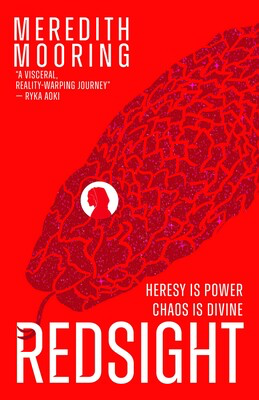
Korinna knows that she is doomed to a life of obscurity. Even though her being a Redseer gives her the power to manipulate space-time itself, she is the weakest of her order, and little mercy is shown to the weak. Resigning herself to a position navigating a warship for the treacherous Imperium, Korinna is at war with herself. But when the warship is boarded by strange pirates, Korinna learns that she has power beyond comprehension—all deliberately hidden. With her newfound abilities and a desire to uncover the secrets of the Goddesses that once ruled the galaxy, Korinna searches for answers, but what she finds may be more dangerous than she could have ever bargained for.
TW/CW: violence, gore, blood, death of children (off-page)
In the last six or seven years, I’ve seen a major trend in science fiction where the plot centers around an ancient, ominous Space Religion™️ (see: Gideon the Ninth, The First Sister, The Genesis of Misery). It’s a Thing. The usual suspects include an AI/vague cosmic entity deity, some form of cult, vague to overt references to Catholicism, and repression. I’m honestly fine with all of these things—in fact, having a cultish religion on an intergalactic scale is often a fascinating way to set up a story, and can be used to many ends, whether it’s deepening worldbuilding or critiquing organized religion in the real world, as it often does. My problem was that it’s everywhere. I feel like every other space opera I find is some kind of retelling of Joan of Arc or “what if God was real and it was a robot and the robot wanted to kill you?” Again, interesting once or twice, but after a point, they all start to blend together. On a personal level, I guess it’s partly because I don’t often connect as deeply to stories about religion/religious trauma, but I swear every other adult sci-fi book out there is like this.
Redsight is one of those books. However, it had enough different aspects that it was separated from the rest for me. It honestly veers into space fantasy at times, toeing the line between that and space opera expertly. Even though the redseers and all of the other witches in the universe had a slightly similar structure to some other books I’d read (spooky magic, incomprehensible goddesses trapped in tombs for thousands of years, etc.), it was Mooring’s exploration of how this insular cult of witches affected the outside world that stood out to me. The space-time manipulation is awesome, first off, but there’s also a host of space pirates, sprawling libraries, and transformative magic that goes…wrong. Snakes are involved. Also, Korinna and the others don’t exist in a vacuum—they’re a small part of a massive galaxy and are entangled in all manner of messy, manipulative politics throughout the universe. (There’s a strong Bene Gesserit vibe going on…I guess Dune might be to blame for the big spooky space religion trend?) They are outwardly very strange to others, and they don’t feel self-contained, as some other similar books are—they felt like a small part of a much more expansive world, which is what set it apart. Plus, I loved how it served as a critique of both that can come from organized religion AND the corruption that spreads into imperial politics—it’s all a great examination of systemic corruption, which I enjoyed thoroughly.
One of the more unique aspects of Redsight was how disability was handled. Up until we leave the Navitas, where all of the redseers are trained, pretty much all of the characters you meet are blind. All of the priests and priestesses of Vermicula are blind, and the way that Mooring shows us how it’s accommodated in the universe is fascinating. Through the power of redsight, they can sense most everything they need to sense through…well, manipulating the fabric of time and space, which is pretty badass in and of itself. But beyond that, I love how many intricacies to Korinna’s life are detailed. We see how she senses space around her with her blindness, how the Order of Vermicula produces special tactile books so that everyone can read the holy texts, and how she navigates the universe without being accommodated like she was within the Order. Knowing that Mooring herself is blind, I’m sure that she thought of everything when it came to how Korinna would navigate the universe, accommodations or not, and it showed through in her writing.
If you’re looking for a twisty book, then Redsight is the book for you! Even though I feel like I’m iffy when it comes to predicting twists, the ones in this novel had me constantly guessing. Mooring nails a critical combination of a very slow-burn first third of the novel, gradually building tension, while also throwing out a red herring where you think you know what the big mid-book reveal is, but…oh boy, I did not. (Red herrings, Redsight, red witches…lots of red in this book! Say, what’s that pooling on the floor?) In all seriousness, Mooring did an excellent job of creating tension and putting up all manner of red flags and misleading clues, and they came up organically: they were both the result of Korinna not knowing any better and the propaganda and narrative control that both the Order of Vermicula and the Imperium had over the knowledge that was passed onto her. It deepened the worldbuilding and the pacing of Redsight…for the most part.
All that being said, the ending was quite rushed. With as much buildup as this novel had, it was kind of bound to happen. All things considered, Redsight is Mooring’s debut novel, so I can let some of it go, because I enjoyed the majority of it. But there was just far too much crammed into the last 100 or so pages of the novel. Even with the theme of undoing systemic corruption, the speed at which it happened was truly just bonkers. For the truly mind-boggling, cosmic scale that everything in Redsight happened in, it seemed illogical that everything that happened in the novel would’ve been able to happen so quickly. After all of that, it was wrapped up strangely tightly—the loose ends were tied up basically because…the Goddesses can just do whatever, and it’s fine. I guess if you’re dealing with universe-creating Goddesses, by that logic, they can also clean up messy endings? It felt cheap. For the amount of time spent just on the buildup in the first third of the novel, everything was resolved far too quickly than seemed plausible, even with my suspension of disbelief.
All in all, a gripping and captivating—if a little messy—story of corruption and history, all set within the bounds of a boundless, magic-filled universe. 4 stars!
Redsight is a standalone, and Meredith Mooring’s debut novel.
Today’s song:
That’s it for this week’s Book Review Tuesday! Have a wonderful rest of your day, and take care of yourselves!
















 The Bookish Mutant