
Happy Sunday, bibliophiles! I hope this week has treated you well.
This week: the chances of being pursued by Brian Eno wielding chopsticks are low…but never zero.
Enjoy this week’s songs!
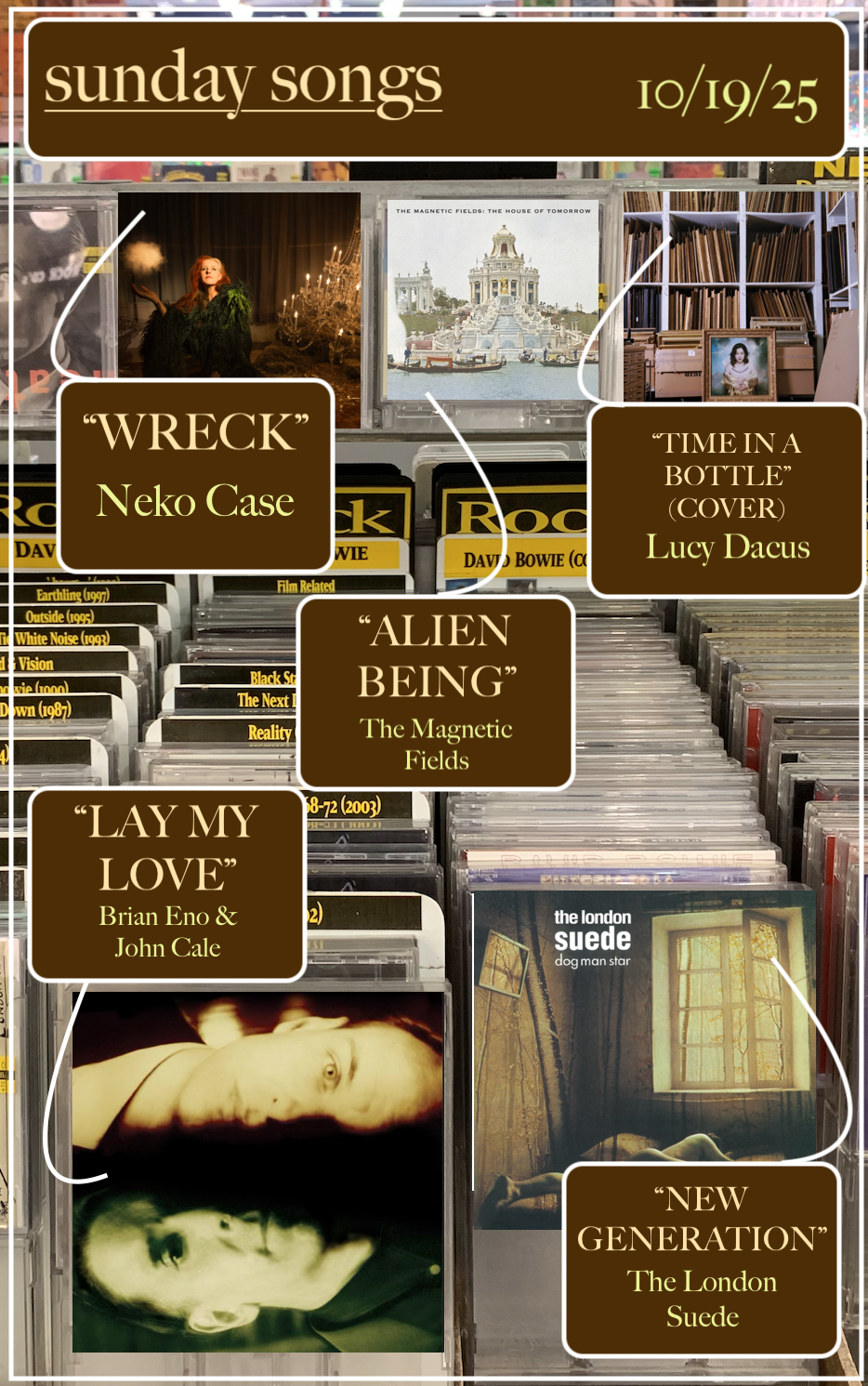
SUNDAY SONGS: 10/14/25
“Lay My Love” – Brian Eno & John Cale
While digging a bit about a song that I’m not even mentioning until next week, I stumbled upon something entirely different. All of those Pitchfork Best Songs of [insert decade] lists (this was from the ’90s one) are very subjective, but sometimes I appreciate looking at them simply by virtue of finding out about something new. Last week, it happened to be a collaboration between Brian Eno and John Cale from 1990, Wrong Way Up, and “Lay My Love” in particular. I was excited by the prospect of Brian Eno already, but man…I have been sucked in. I’ve listened to this one an unhealthy amount of time. It just swallows you whole in the best way possible!
By the ’80s, Brian Eno had built a decade’s worth of entirely ambient music, and there seemed to be no return for him to the more conventional (if you can call it that) rock of his earlier career, abandoning his own vocals almost entirely: in 1989, he told an interviewer that “I’m sure I could, if someone held a gun to my head, crank out a record of songs, but at this point in time I know it wouldn’t be any good.” And given the intensely argument-fraught recording of Wrong Way Up (Cale alleges that Eno once came at him wielding chopsticks, but Eno has insisted that Cale fabricated this), there’s a good chance that in another timeline, this album may not have seen the light of day after all. And yet there they were in 1990: Eno and Cale, frequent collaborators since the 1970’s, making an album consisting of just that.
You’d think that after abandoning singing for so long, Eno would appear rusty. In fact, he’s the exact opposite. “Lay My Love” feels like the distillation of the best qualities of his off-kilter vocals. Even though he’s known for his more removed, uptight vocal quality, this track presents him as warmer than he’s ever come across. It’s a song that makes you believe every word: as he sings “I am the yearning,” you can hear the pleading in his vocals, layered upon themselves ad infinitum. Cale’s rousing violins add an upbeat swing amongst the dizzyingly layered instrumentals. It’s an all-consuming slurry of glimmering sediment and flotsam, all warmed by the sun’s rays, equal parts hymn and experimental electronic music. Eno peppers in some of his most delightfully surreal, offbeat lyrics (“I am the termite of temptation”) with ones that make sense in some unarticulated part of your soul (“I am the wheel/I am the turning”). Above all, you really do feel as though this love is being laid around you like a blanket. It feels like the kind of song to soundtrack a quiet montage in a film of a house being built, or moss growing on a log: gradual, and yet hopeful in its certainty. You know that the love is coming around to you, and when it does, it will be as joyous as every note bursting from this track.
…AND A BOOK TO GO WITH IT:
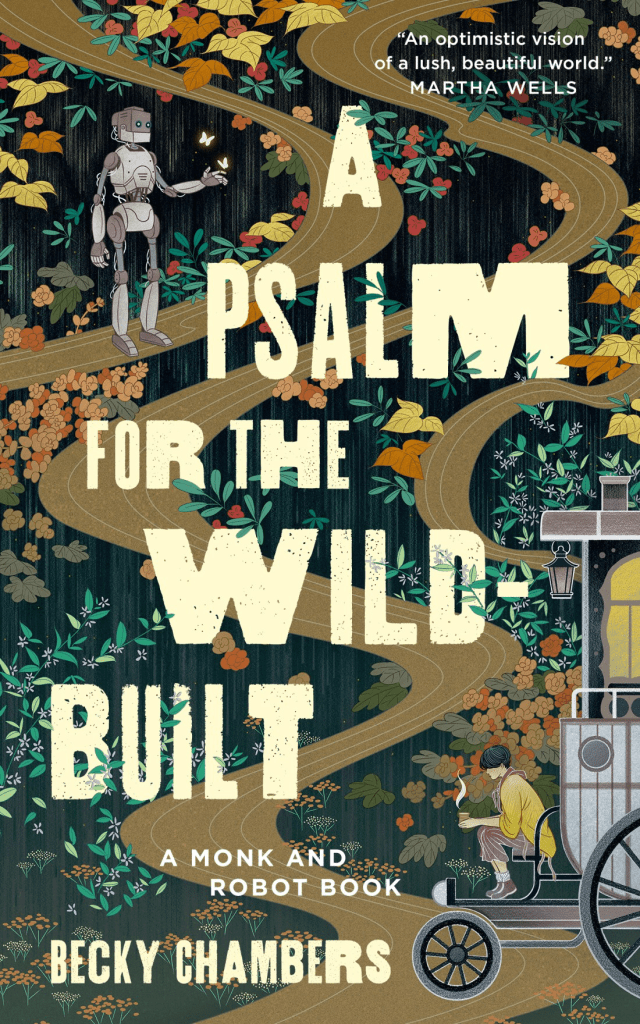
A Psalm for the Wild-Built – Becky Chambers – this seems precisely the kind of song that would soundtrack Sibling Dex and Mosscap’s quiet adventures through the woods.
“New Generation” – The London Suede
As far as the Britpop Big Four goes, The London Suede (known as just Suede in the UK) is the last frontier for me to explore; I’ve heard some of their songs sporadically and loved them (see: “Metal Mickey”), but reading The Last Party: Britpop, Blair, and the Demise of English Rock sparked some more interest in them. Add that to Neko Case’s episode of What’s in My Bag? and I was instantly hooked on “New Generation.” Along with “Lay My Love,” this song’s up there with the songs that I’ve been listening to an unhealthy amount of times. Who am I to deny my Britpop girlie urges?
I really should be a huge fan of The London Suede, given how influenced they were by David Bowie, but then again, not everybody influenced by Bowie is automatically good, of course. Brett Anderson and company seemed to worship the ground he walked on, which resulted in their melodramatic style and soaring vocals. Dog Man Star, which I’ve heard is an excellent album, was said to be inspired by a lot of Bowie’s early ’70s material, which makes perfect sense—”New Generation” feels like fanfiction set in the Hunger City of Diamond Dogs, and I fully mean that as a compliment. If Anderson’s vocals and just-so placed swoop didn’t tip you off, “New Generation” is high on the drama, but that’s part of why it works so well—it’s a strangely dystopian song that’s fit for draping yourself dramatically across the bed, full of distance and yearning. Anderson’s really doing some vocal somersaults here—he said himself that it’s one of the most difficult songs for him to sing—and amidst sepia-toned lyrics of disaffection and substance abuse, his vocals are outstretched arms beckoning for someone to swoop in and extricate him from it all.
…AND A BOOK TO GO WITH IT:
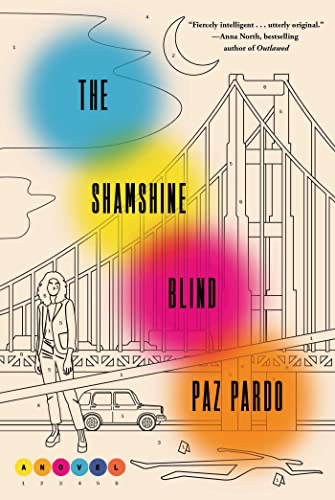
The Shamshine Blind – Paz Pardo – “‘Cause like all the boys in all the cities/I take the poison, take the pity/But she and I would soon discover/We take the pills to find each other…”
Today on incredibly specific comparisons: “Wreck” by Neko Case sounds almost exactly like this meme to me:
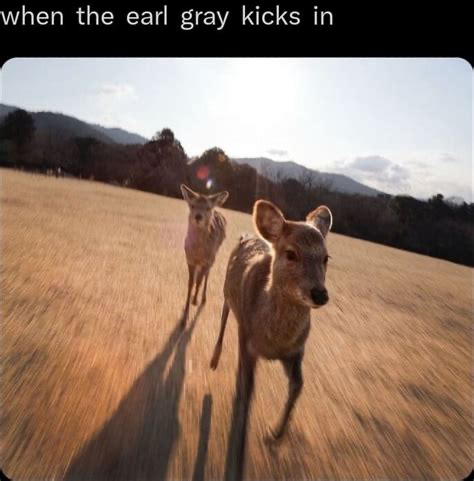
Maybe I do need to listen to more Neko Case after all. I’m a fan of the New Pornographers, but I really haven’t dived into any of her solo work, save for the misfire that was her cover of “Madonna of the Wasps.” You win some, you lose some. But this song, off of her new album Neon Grey Midnight Green (that’s got to be one of the better album titles I’ve heard in a while, for sure), easily falls into the win category.
For a beat, the a cappella intro lulls you into a false sense of security before dropping you headfirst into a churning, breathless whirlpool of head-over-heels romance. I can’t deny a love song that feels like you’re gleefully sprinting through a verdant field at full speed—there’s a bit of Hounds of Love Kate Bush in there somewhere in the unabashed drama that Case peddles: “I’m a meteor shattering around you/And I’m sorry/I’ve become a solar system/Since I found you/I’m an eruption/A wreck of possibilities/A volatility of stars/My clothes can’t hold together.” (Another shoutout is due to “Do I look like the sun to you?/Do I blaze freckles onto your face?”) And right after this, she breathlessly cries “And I know I can’t burn this bright forever!”—right about there, I imagine her smile splitting with reckless glee, a princess dress ballooning into endless layers of silk and tulle, a cry of nothing but sheer joy. It’s an easily addictive ode to absolutely drowning in yearning, and desperately wanting the echo to have an answer.
…AND A BOOK TO GO WITH IT:
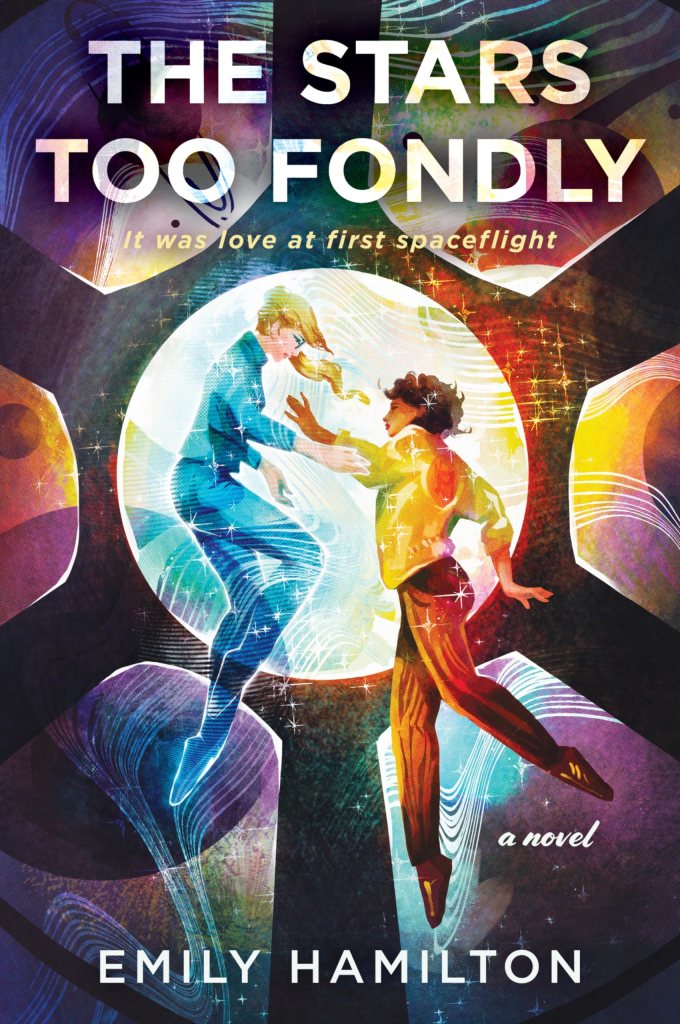
The Stars Too Fondly – Emily Hamilton – “Do I look like the sun to you?/Do I blaze freckles onto your face/I bet I, bet I, bet I do/I’m a meteor shattering around you/And I’m sorry…”
“Alien Being” – The Magnetic Fields
There’s something truly beautiful about the fact that this song only has 10 likes on YouTube and a single comment that reads “being gay is awesome and you gotta try it!!!” Amen, brother.
The House of Tomorrow EP was released very early on in The Magnetic Fields’ career, and from 3/5 songs that I’ve listened to from it (this, “Either You Don’t Love Me Or I Don’t Love You” and “Love Goes Home to Paris in the Spring”), it’s clear that they’d all honed their talents very early. I suppose it helped that Stephin Merritt was in several bands before this, but it’s still very indicative of what a masterful songwriter he’s come to be. It’s also clear from the start that he’d started dissecting unhappy relationships very early on. The lyrics of “Alien Being” aren’t quite as laden with metaphor as they usually are, but they’re monotonous and repetitive—which feels like precisely the point. Almost all of them end with “nothing at all” (“You talk a lot about nothing at all/”Watch TV shows about nothing at all”), adding to the layered, grainy drone of the synths in the background. It’s a perfect encapsulation of being around someone who makes you feel like you’re talking to a wall—no feelings, no opinions, no independent thoughts, no nothing. Good thing Merritt has a lot of those things.
…AND A BOOK TO GO WITH IT:
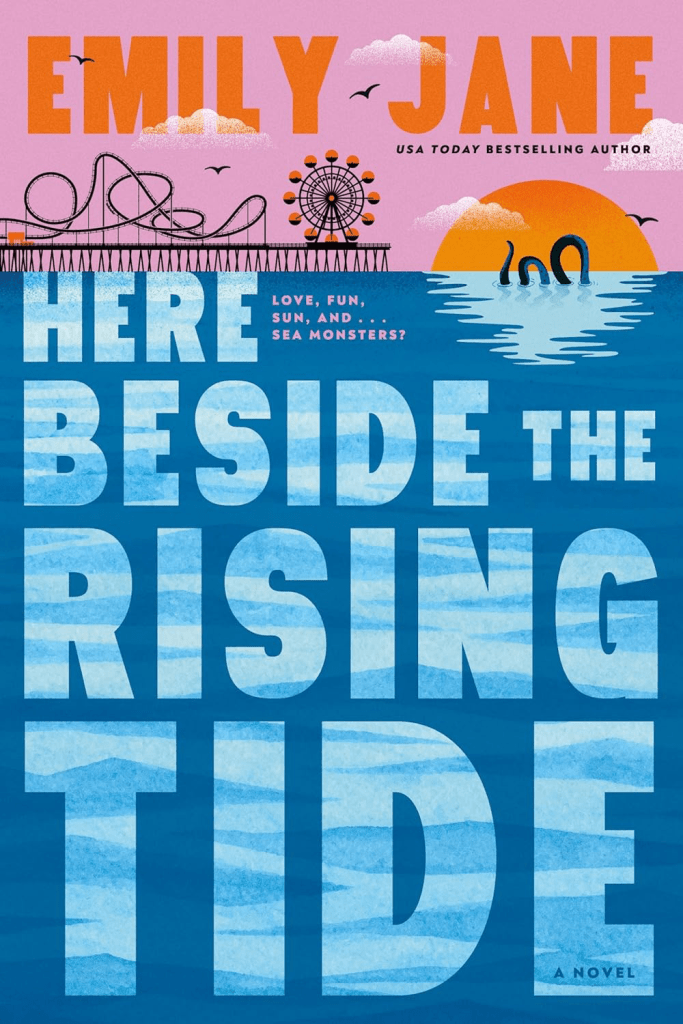
Here Beside the Rising Tide – Emily Jane – “You have no feelings/I think you are an alien being/You won’t let me in/I think you are an alien being…”
“Time in a Bottle” (Jim Croce cover) – Lucy Dacus
The X-Men fan in me and the Lucy Dacus fan in me were both screaming when I found out that this was a thing…I don’t even have any sentimental feelings towards the original, but I just saw the title and got activated like a sleeper agent. Say what you want about the later Fox X-Men movies, but there’s one thing that they did best, and that was make immaculate slo-mo Quicksilver sequences with great needle drops.
I maintain that Forever is a Feeling bordered on being a disappointment, but I’m softening to some of it—especially now that we’ve gotten an expanded edition: Forever is a Feeling: The Archives. It’s mainly demos and live versions, but it had the poignant track “Losing” (should’ve been in the album, that’s my two cents) and this Jim Croce cover. Dacus’ tender, delicate fingerpicking style was practically made for this cover, as was the overall aesthetic of the album, combining acoustic guitar with gently swelling strings. I just can’t get enough of how she treats the guitar as an instrument—the way she plays on “Time in a Bottle” makes it feel like it’s not simply an instrument but a waltz partner. Her rich voice is on full display with this cover, making every note ring out with the yearning I’ve come to love her for. It’s tender in its sparing instrumentation, but her voice fills out all the empty spaces, creating a cover steeped in love and longing, just like the best parts of Forever is a Feeling.
…AND A BOOK TO GO WITH IT:
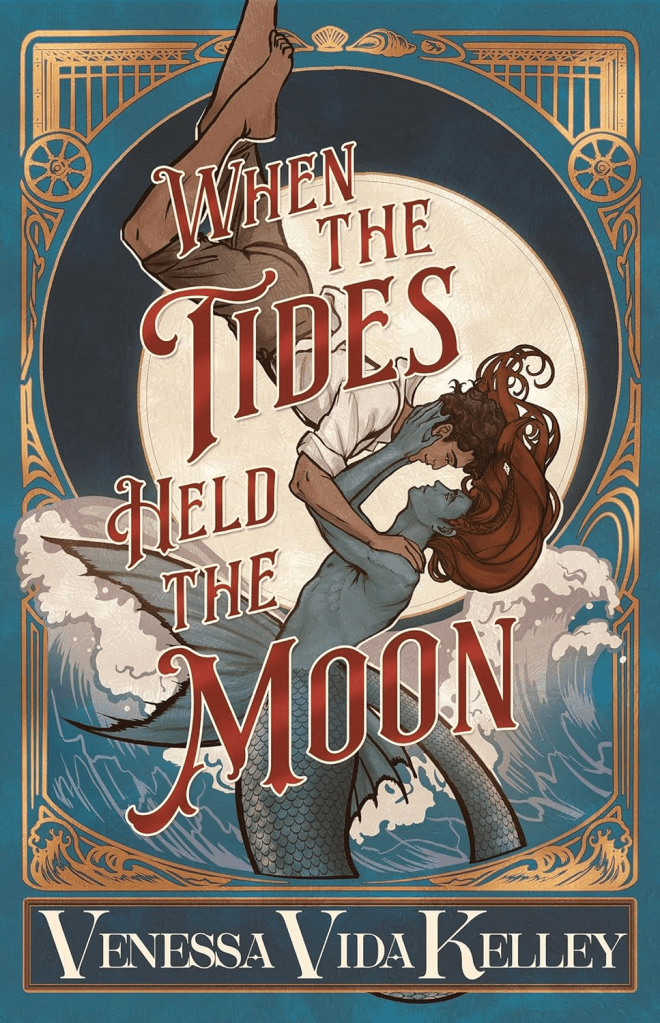
When the Tides Held the Moon – Venessa Vida Kelley – the tender feeling of this cover would fit right in with this heartfelt, moonlit romance.
Since this post consists entirely of songs, consider all of them to be today’s song.
That’s it for this week’s Sunday Songs! Have a wonderful rest of your day, and take care of yourselves!


 The Bookish Mutant