

Happy Tuesday, bibliophiles!
Graphic novels haven’t been all I’ve been reading this month, but I’ve certainly been on a kick of reviewing them. Unfortunately, this one wasn’t nearly as good as The Infinity Particle, but it’s apples and oranges to compare them. I really need to stop putting everything with “sapphic” and “fantasy” in the description on my TBR, because while I love those two things together, they aren’t automatically the recipe for a good book. Sadly, The Marble Queen is proof of that.
Enjoy this week’s review!
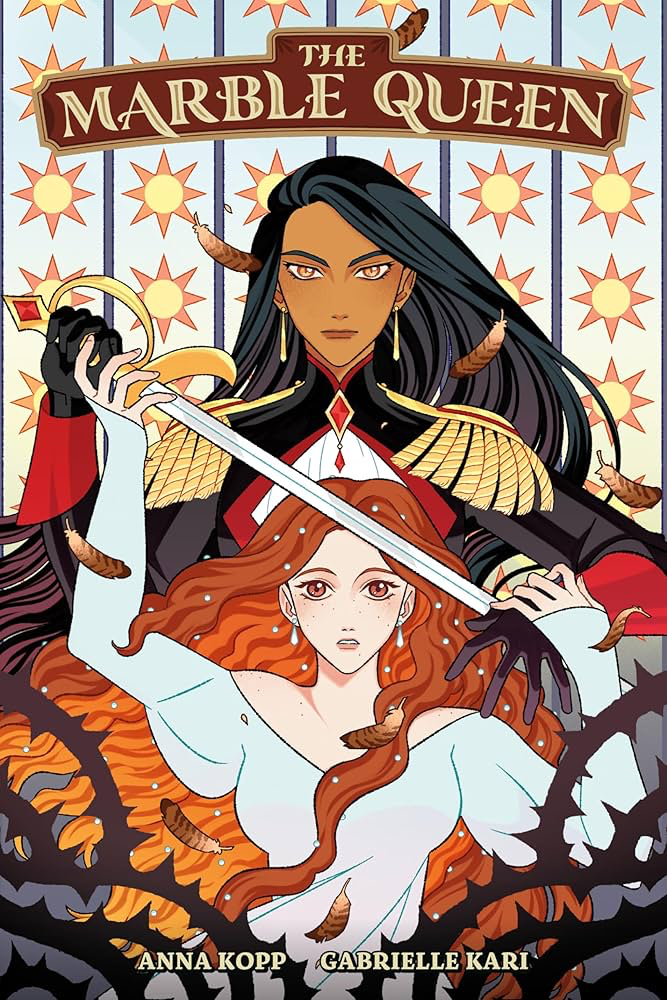
The Marble Queen – Anna Kopp and Gabrielle Kari
Princess Amelia lives in a kingdom in turmoil. Accosted on all sides by pirates and on the brink of war between its neighboring nations, Marion is on the verge of collapse. Only a miracle can save it—and that miracle may be to marry Amelia off to the prince of the neighboring kingdom of Iliad. But soon, she finds out that there was a mistake—it was not the prince she is being married off to, but the new queen, the stunning Salira. Stuck in a foreign kingdom with no control over her destiny, Amelia searches for answers. But with political forces from all sides conspiring against them, she must ally with Salira in order to save both of their kingdoms from ruin.
TW/CW: blood, violence, loss of loved ones, anxiety, poisoning (attempted)
I went into this graphic novel thinking I’d get a sapphic fantasy. The sapphics? They’re here. The fantasy? Not so much. The writing and artwork? The latter picked up some of the slack left by the rushed writing, but not enough. Given more page time and refinement, The Marble Queen could have been something promising, but it was clearly a case of too many plot ideas in a shell that could not hold all of them.
If you’re looking for fantasy, The Marble Queen will likely disappoint. If you’re looking for something more along the lines of a regency romance with political intrigue thrown in, you might be more satisfied. The Marble Queen has plenty of ballroom dancing, flowy dresses, court intrigue, and pirates, but nothing that would necessarily separate it from something in our history. There was a vague, throwaway sequence about some crystals beneath Iliad that supposedly had magical powers, but it ended up having zero consequence to the plot—it felt like Kopp threw it in just so that she could say “See? See? This is fantasy, we promise!” Also, so many of the place names felt so randomly plucked and too close to real world things—kingdoms called Marion (not necessarily a common name, but similar enough to Marianne/Maryanne that it loses the fantastical feel) and Iliad (I don’t think I have to explain that one) made the worldbuilding feel even lazier. The Marble Queen’s artwork also had a lack of immersion—other than the glimpses we got of the palace and the outside world, many of the characters were shown on flat, monochrome backgrounds, making it difficult to get a full picture of the world. Had this been historical fiction with a loose basis in some of our cultures, it might have been more effective.
Additionally, The Marble Queen was all over the place in terms of plot. I got the impression that Kopp and Kari had a plethora of ideas for what to do with the story, but not nearly enough time to execute them. As a result, every subplot felt smushed together like sardines in a tin can—so many of them were there, and yet almost none of them had room for proper mobility. I was particularly intrigued by Amelia’s anxiety and her feelings of isolation in Iliad. Her fear and alienation, although given a fair amount of space in the first half of the novel, had the potential to be poignant, but since it was shoved in unceremoniously against at least six other subplots, it had to room to grow into a compelling, sensitive story. The same went for the political intrigue—I liked it in concept, but the plot with Stefan had so little room to develop that by the time the reveal came, I’d guessed it about 30 pages earlier. In between all this, we get rapid-fire scenes of training montages, poisoning attempts, emotional backstory with not nearly enough grace given to the grief they should have held, said random bit about magical crystals that doesn’t end up being relevant at all, and a pirate that was clearly supposed to be a “fan favorite” character, but only got about 5 pages of character interactions tops. Given more polishing, The Marble Queen could have been a successful story, but it had no sense of direction, which made me struggle to keep my interest in the characters.
Said plot, more overstuffed than a Thanksgiving turkey, is why I think the romance didn’t work for me either. I did get that the arrangement was meant to be rushed, but when so many extraneous plot events were happening around Amelia and Salira, I never bought the chemistry that Kopp so badly wanted to convince the reader that existed between them. We’re supposed to believe that Amelia and Salira are slowly falling in love, but there’s hardly any indication in the dialogue that a connection is being made, save for a heavy dose of panels of Amelia with sparkly eyes and anime blushing. We’re supposed to sympathize with Salira because of the untimely death of her first girlfriend, but we hardly get an indication that she’s uncomfortable during the wedding, and after the explanation to Amelia, she comforts her, and then they make out in front of a painting of her ex-girlfriend and move on. Again, this was a victim of The Marble Queen‘s full-to-bursting plot—a romance that could have been compelling was ruined by a plot that moved too fast and contained too much of the wrong things.
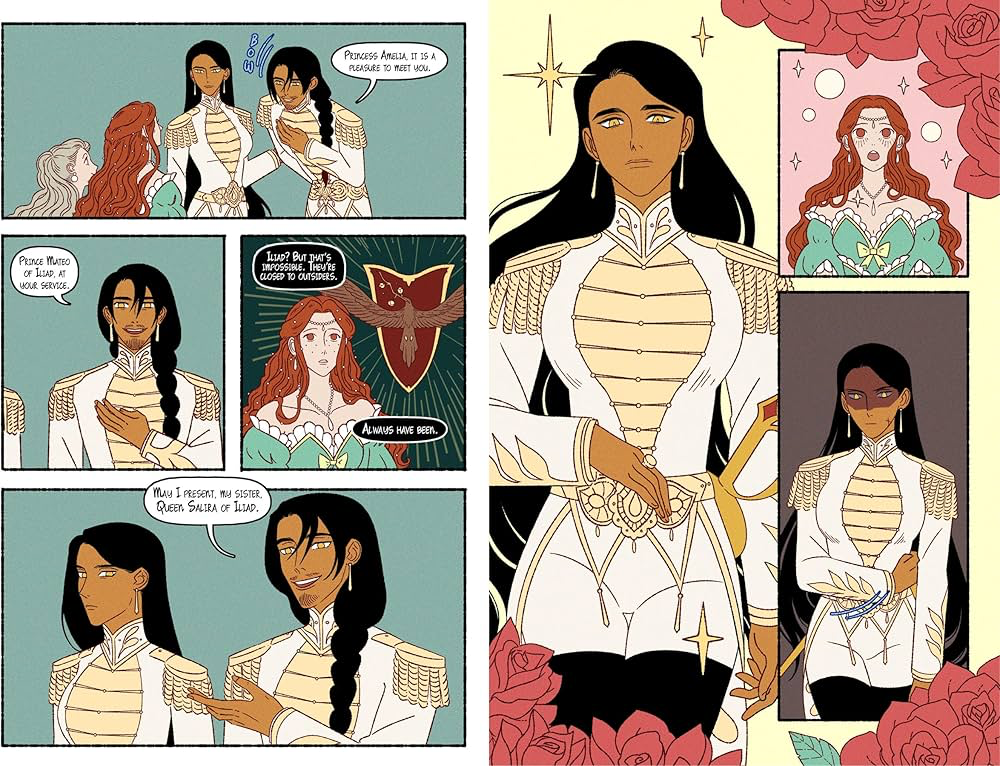
The art was…alright, I suppose. That gorgeous cover set my expectations too high. I could get on board with the almost-Manga art style, and I did enjoy some of the expressions that the characters made. Although the color palette was warm and pleasant, it was largely flat—there was a significant lack of shading and depth, which can sometimes work, but in a story and world this fantastical, some of it was necessary. Additionally, Kari had a tendency to overexplain some of the gestures of the characters. Instead of having some creative (and sometimes silly) depictions of sound effects, there were direct writings of, say, “rise,” “kneel,” or “stab” when characters stood up, knelt or got stabbed, or repetitions of “beautiful” when Amelia first sees Salira. In moderation, some of this could have worked, but in such large amounts (and in places where these things could have easily been inferred by…well, just looking at the artwork), they grated on me.
That being said, I loved Gabrielle Kari’s character designs! She did an excellent job of making the characters expressive and distinctive in their respective looks. Anime blushing aside (I could let it slide after a while), all of the characters had wonderful stylistic quirks and tells, making them fun to follow around their kingdom, even when the writing itself slacked off. The design language wasn’t just clear, but enjoyable to see between the kingdoms; I loved the contrast of Amelia’s flowing, flouncy dresses in contrast to the tighter, more soldierly attire of the royals of Iliad. It added what some of the writing failed to add with the themes of her alienation and isolation—she was clearly an outsider, in both her foreign mannerisms and personality and the way she stuck out in the crowd.
All in all, a fantasy (?) graphic novel with the potential for epic drama, but got dragged down by an overstuffed plot that squeezed the life out of the characters. 2 stars.
The Marble Queen is a standalone, but Anna Kopp is also the author of Lifeblood, as well as many Minecraft novels for younger readers. Gabrielle Kari is also the illustrator of No Holds Bard, written by Eric Gladstone.
Today’s song:
That’s it for this week’s Book Review Tuesday! Have a wonderful rest of your day, and take care of yourselves!

 The Bookish Mutant