
Happy Sunday, bibliophiles, and more importantly, Happy Father’s Day!! I always end up writing one of these posts on Father’s Day, what with it landing on a Sunday and all, but it’s fitting, given that my amazing dad is the one who not only is responsible for a lot of my music taste, but was also the one to encourage me to write these posts and wanted to hear my thoughts. So thank you to him, for all of the gifts he’s given to me, and to my family. I love you. 🩵
This week: before I go radio silent for a week for a road trip, how about a random kick in the pants from 2019? Plus, new Cate Le Bon, old(ish) Shins, and others.
Enjoy this week’s songs!
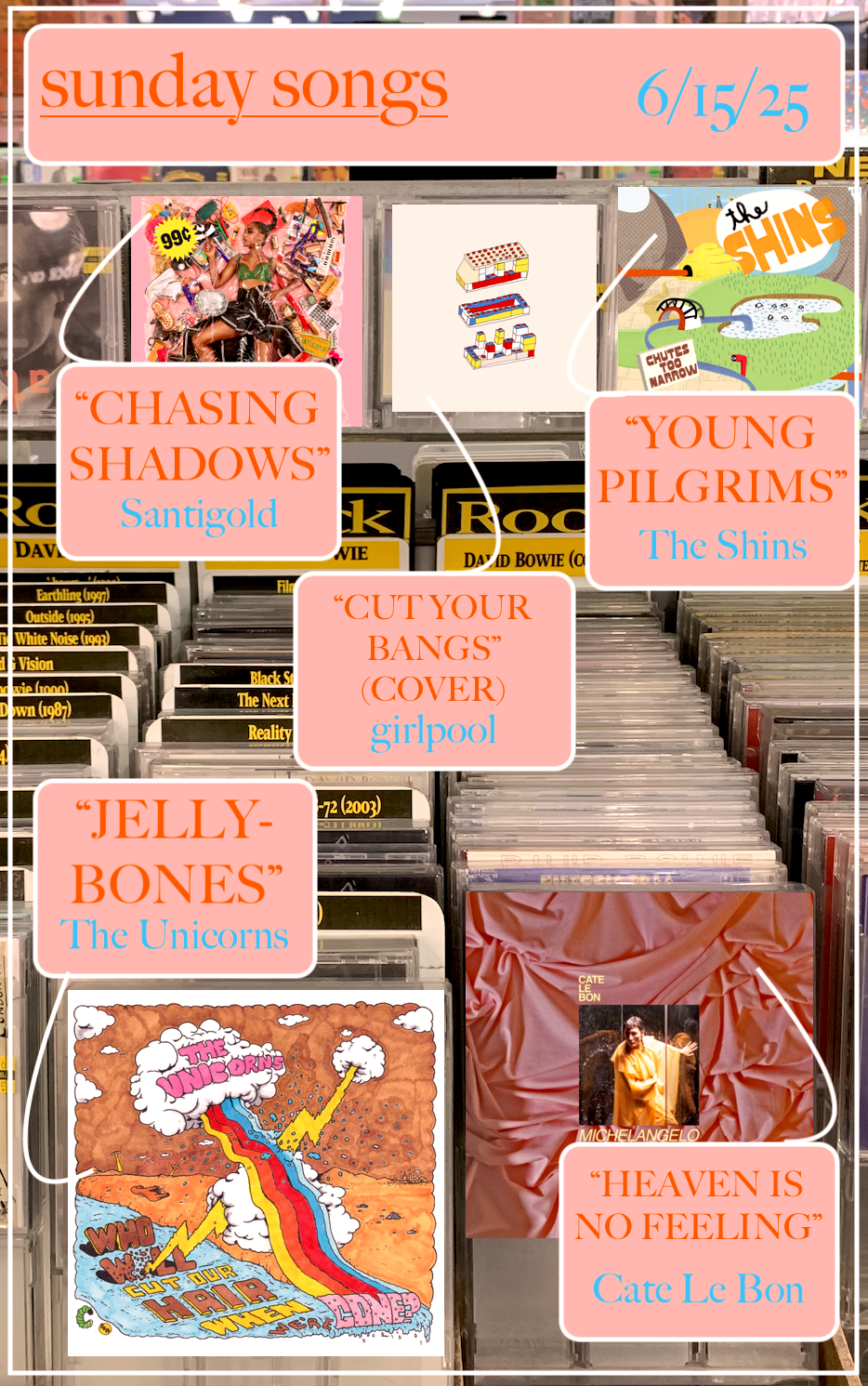
SUNDAY SONGS: 6/15/25
Chances are, given my proclivities for Car Seat Headrest and other like lo-fi, awkward white boys, I probably would’ve stumbled upon The Unicorns eventually. It was an inevitability. Either way, I was introduced to it via Black Country, New Road’s episode of What’s In My Bag?, and I can’t call it much else other than a delight in the many times that I’ve listened to it since. “Jellybones” is a whimsical title as it is, but the rest of the song stays true to that silliness, complete with bone-related puns (“Drove up in my bone-ca-marrow,” ba-dum tsss); the entire song revolves around jellybones (an obscure sort of expression for nervousness) being a genuine malady worthy of going to the hospital and getting limbs amputated for. Everything has a juddering, garagey sound to it, from the engine-like startup to the guitars to the keyboards, which the intro warps into the sounds I feel like I’d hear aboard a clunky, malfunctioning spaceship on the cover of a ’50’s pulp magazine. 2:43 feels simultaneously too short and the perfect length for “Jellybones”—I need more, and yet this song could only ever be a sputtering little firecracker, spurting out sparks and then gently slipping out of existence.
…AND A BOOK TO GO WITH IT:
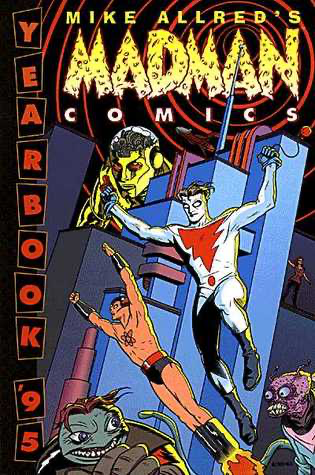
Madman Comics Yearbook ’95 – Mike Allred – Jellybones definitely seems like it could be a genuine illness in the Madman universe. (Least wacky Dr. Boiffard subplot, maybe?) Either way, the lyrics definitely fit with the kind of silliness in these comics.
“Heaven Is No Feeling” – Cate Le Bon
Getting the one-two punch (positive) of new Big Thief (to be discussed) and Cate Le Bon on the same day was almost too much…and just when I thought that we were finished with all of my most anticipated albums of the year! Cate Le Bon’s new album, Michelangelo Dying, comes out this September, and suffice to say, if it’s anything like this song, I’m all ears.
Taking cues from the synth-heavy sound of Pompeii, “Heaven Is No Feeling” opens with an intro too good for a track that’s right in the middle of the album: a murmur of “What does she want?” before launching into a flurry of rippling, watery synths and guitars slathered in enough effects to make them camouflage with the synths. In line with her very ’80s sound, there’s plenty of saxophone, but not enough that it overpowers any of the rest of the song. Gently groovy and keenly observational, Le Bon takes the position of a wallflower: there is a kind of emotional distance to it as she watches the subjects as they move like pawns across a chessboard: “I see you watch yourself/Walk the room/Stroking the air/Like this paint won’t dry.” As she observes the distant fallout of a failed love, the song feels like she’s watching someone through security camera footage, pretending to be distanced when she hasn’t fully gotten over the wreckage—much like the music video, where a buzzcutted Le Bon watches herself on an old TV. Every repetition of “I see you watch me” feels like a degree of separation from the body and from her feelings (surely that’ll end well…), and “heaven is no feeling” becomes a kind of blissful removal from one’s own emotions.
…AND A BOOK TO GO WITH IT:
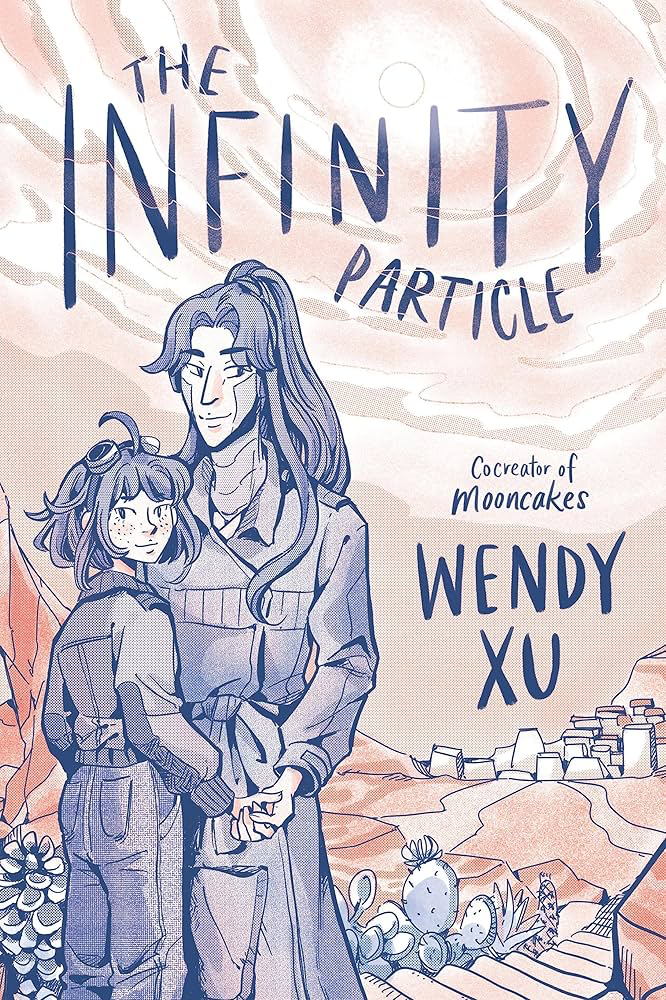
The Infinity Particle – Wendy Xu – “I see you watch me watch you/Watch me move away/You occupy the space/Like a ribbon untied…”
Santigold, man. Nobody’s doing it like her. I often think of 99 Cents as being one of the only happy albums of 2016, but next to Blackstar, A Moon-Shaped Pool, and Teens of Denial, anything looks happy. But what makes me keep coming back to songs from 99 Cents is how she used the veneer of happy, bubblegum pop songs to further her message—they remain peppy pop songs, but they’re all armed with critiques about consumerism and the music industry. Santigold has often talked about her negative experiences in the music industry, whether it’s how unaccommodating the industry is to mothers, especially where touring is concerned, or how her music did not qualify to some critics as “Black music.” Despite how candid she’s been about the physical and mental toll it’s taken on her, Santigold has only used that to become even more herself than ever. Her last album, Spirituals, went fully into Afrofuturism and current politics, and she’s expanded her creativity into a podcast, Noble Champions, where she brings guests to talk about everything from said nebulous category of “Black music” to social media addiction. (From the episodes I’ve intermittently listened to, she’s also had a whole host of amazing guests, including Yasiin Bey, Questlove, Tunde Adebimpe, Mary Annaïse Heglar, and so many more. The only problem is that there’s not more Santigold, frankly.) I saw her perform live last August, and it’s one of the only concerts I can think of where a singer has been truly kind and candid with her audience; decades in the industry didn’t stop her from signing people’s records in between songs.
Like the album cover, where Santigold is shrink-wrapped and slapped with a price tag along with all manner of plastic junk, “Chasing Shadows” reckons with the human toll of commodifying artists. Contrary to Pitchfork’s assessment that the song “basically plods along inoffensively until it ends” (I’m sorry, the fuck?), it’s one of the more steadfast songs on the album, still fast-paced but providing a cooldown between some of the more in-your-face pop songs. Rostam Batmanglij (formerly of Vampire Weekend) produced the track, and knowing that, I can hear him all over the beat—I say this affectionately, but it’s the most 2016 pairing ever. I love it. Through rapidly-uttered lyrics, Santigold reflects on how quickly the industry moves on so quickly from artists once they’re out of fashion, summarized by one of the finals the second verse: “Why they eating they idols up now/Why they eating they idols up, dammit?” Reflecting on seemingly being left behind, her solution, as always, is to defy the standard, continuing to do what she’s doing. The video mirrors this back: she asserts herself in multiple places inside various houses: at the head of a table at a decadent Christmas feast, standing upright and fully clothed in a bathtub, and towering over a child-sized table with a child-sized tea set. No matter the location, she stands firm, defiantly staring the camera, returning the gaze—of the music industry who tried to put her in a box, to racist and misogynist detractors, or to anyone who has ever doubted her. No matter what, she’s looking directly at you, as though to cement her irreplaceable space of individuality that she’s created for herself.
…AND A BOOK TO GO WITH IT:

Victories Greater Than Death – Charlie Jane Anders – “One thing about time, it waits for nobody, you told me, isn’t that what they say/Been batting ‘gainst it and getting nowhere, just racin’ got nothing to say to nobody…”
“Cut Your Bangs” (Radiator Hospital cover) – girlpool
What in the 2019 did my shuffle just pull? I hadn’t even thought of this song in years, and boom, suddenly I’m back in high school art class, diligently obeying the “only one earbud in if you want to listen to music” rule while drawing X-Men fanart because I blew through whatever I was actually assigned. God.
High school…and my first introduction to girlpool through Apple Music. Sure, I’m fully on board with the fact that streaming has harmed musicians more than it has helped them, but for a lot of people, myself included, it opened the floodgates for discovering so many musicians back when I was in high school. girlpool was one of the big ones, prominently soundtracking my sophomore year of high school, from their earlier work on Before the World Was Big (which turns 10 this year, Jesus) to their more current (at the time) What Chaos is Imaginary. Almost six years after I discovered them, girlpool since released one final (disappointing) album, Forgiveness, broken up shortly after, and then…Avery Tucker’s come back with a good solo single, but Harmony Tividad seems to have pulled a Gwen Stefani and now makes pop songs with the most chronically online lyrics you’ve ever heard. How the times have changed. But good for her, I guess? You do you…
Even though girlpool had moved past this inception of their music by the time I got into them, they fit too perfectly into the sad, acoustic indie that comprised most of my music taste, and still kinda does today. “Cut Your Bangs” is a cover, but to this day, it remains one of the best parts of this inception of girlpool. In contrast to the faster, more rock sound of the original by Radiator Hospital, girlpool take the chorus’ ending of “the small stuff” literally, slowing it to a crawl in order to wring the most out of the quietly introspective lyrics. I remember not liking the original when I first heard it, and on reflection, I don’t hate it, but I still think it’s a situation where girlpool knew exactly what to do with it. All of the lyrics need a gentler space to breathe, and the twin harmonies of Tividad and Tucker make them stand out. To this day, the way their voices know exactly which lyrics need a plaintive murmur and which ones need a higher-pitched belt feels almost telepathic—at their best, what made girlpool so successful is that they had such an instantaneous communication that allowed them to switch from gentle to jagged in the blink of an eye, but never once lose their synchronicity.
…AND A BOOK TO GO WITH IT:
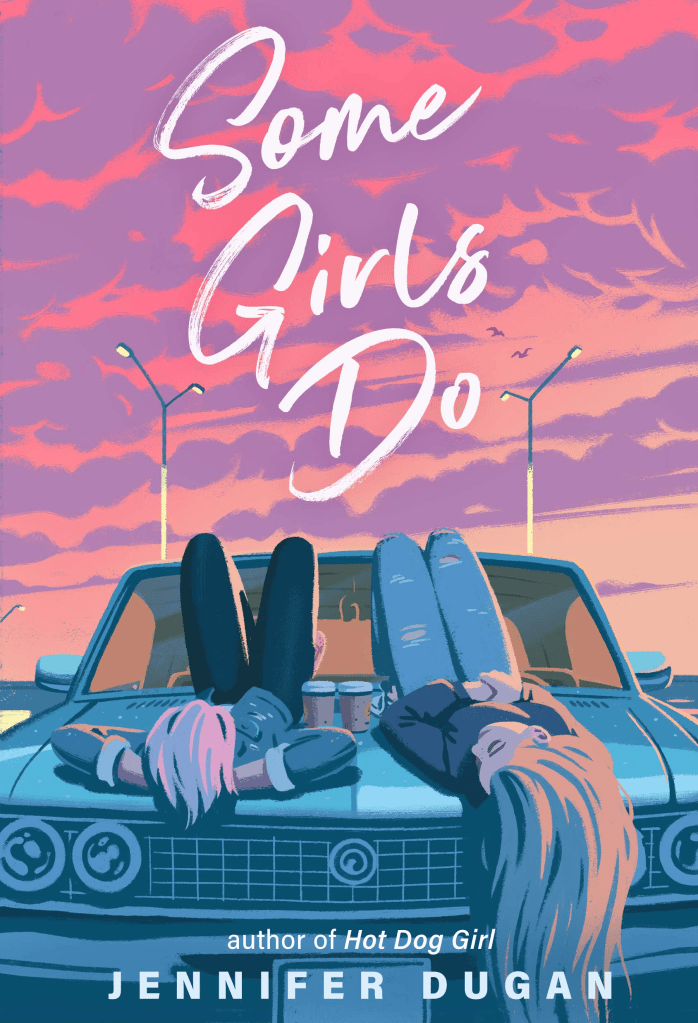
Some Girls Do – Jennifer Dugan – “You say you’ll cut your bangs, I’m calling your bluff/When you lie to me, it’s in the small stuff…”
James Mercer just has such a unique way with words. As music history (and my personal music library) proves, there’s practically a million ways to say a sentiment along the lines of “I’m dissatisfied with my life and it’s cold and wet outside and I’m also depressed.” Mercer saw that and gave us these iconic lines:
“A cold and wet November dawn/And there are no barking sparrows/Just emptiness to dwell upon/I fell into a winter slide/And ended up the kind of kid who goes down chutes too narrow…” HE SAID THE LINE! GUYS, HE SAID THE LINE! CHUTES TOO NARROW!
Said barking sparrows came back to me completely at random, in the way that especially sharp lyrics or melodies do. Although Mercer’s narrator envies the “eloquent young pilgrims” passing by him, I struggle to find words other than eloquent to describe how he articulates such a near-universal feeling, a mess of regret and stagnation and the emptiness that comes with control slipping through your fingers and wanting to regain it. In a simple duet of acoustic and electric guitars, Mercer wrings some absolute poetry out of such a stagnant state, drawing every possible image from ice melting on a train window and the desire to “grab the yoke from the pilot and just/fly the whole mess into the sea.” I love a good literary-minded songwriter, which I guess it’s no surprise that I latched onto The Shins from such a young age. But with age, I appreciate the lyrics even more—James Mercer is one of those songwriters who prove that, at its best, music is eloquent poetry set to music. It doesn’t need to be (and rarely is), but when it hits that spot, I can’t help but relish it.
…AND A BOOK TO GO WITH IT:
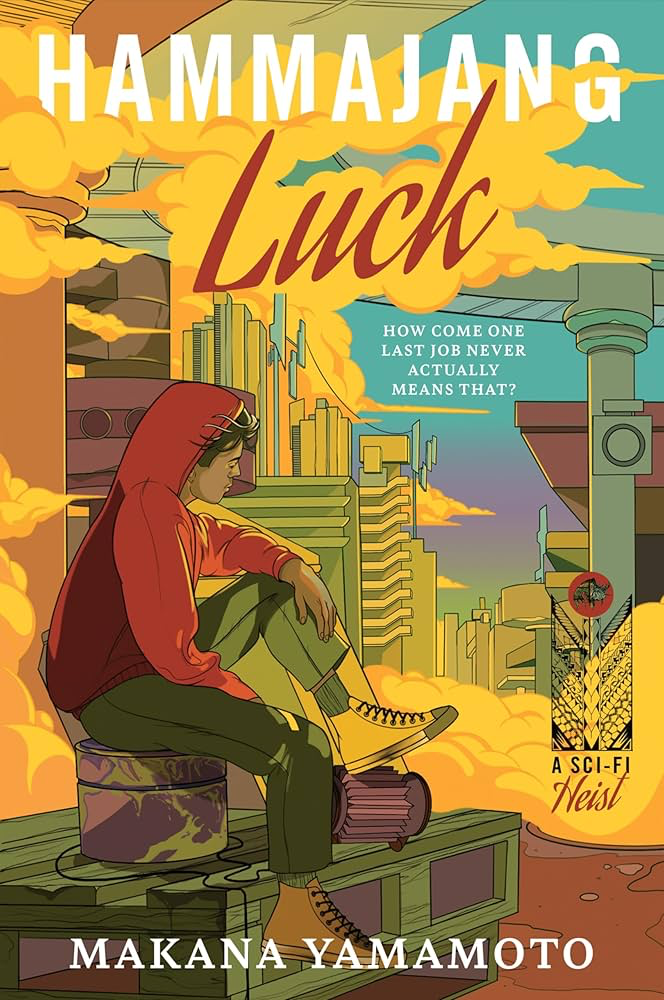
Hammajang Luck – Makana Yamamoto – “But I learned fast how to keep my head up, ’cause I/Know there is this side of me that/Wants to grab the yoke from the pilot, and just/Fly the whole mess into the sea…”
Since this post consists entirely of songs, consider all of them to be today’s song.
That’s it for this week’s Sunday Songs! Have a wonderful rest of your day, and take care of yourselves!


 The Bookish Mutant