
Happy Thursday, bibliophiles!
It’s been a while since I’ve done any sort of movie or TV review, but this is as good an occasion as any. In 2021, it was announced that Skydance Animation would be adapting Tony DiTerlizzi’s WondLa trilogy; in April, after years of delays, we got our first look. From the get-go, it looked startlingly different from the original novel’s aesthetic language and illustration style. As it turns out, that wasn’t the only change that they made to these books.
After such a disappointing prospect, I vowed to tell myself that WondLa was a piece of media entirely separate from DiTerlizzi’s magical sci-fi world. Now that I’ve watched the show, keeping that mentality was easier than I thought—WondLa barely resembles its source material, but none of the changes made any logical sense. It’s all but left behind what made the original trilogy so memorable, and the result is a Disney mimic with hardly any heart or soul.
Enjoy this TV review!
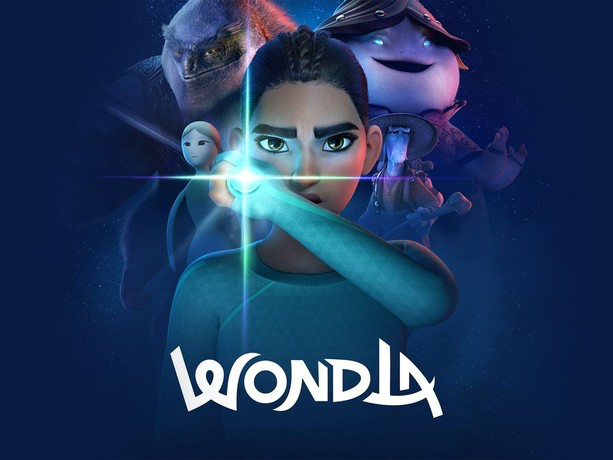
WONDLA – TV REVIEW
Streaming on: Apple TV+
Release date: June 28, 2024 (all episodes available)
WARNING: This review contains major spoilers for both the TV adaptation and the book series, so tread lightly!
Before I get into my disappointment vomit, I will say that there are a handful of aspects about WondLa that I genuinely enjoyed. The 3D, Disney-style animation isn’t my cup of tea, but it’s objectively good animation, and it shows most vibrantly though the backgrounds; although Orbona isn’t as alien as it could have been, the tiny fibers and leaves of each wandering tree and the architectural details of the buildings in Lacus and Solas were rendered beautifully. Joy Ngiaw’s score, although a bit generic in places, had moments of sounding appropriately epic and adventurous—very clearly John Williams-inspired in places. I’ll get to the squishy curse later, but there were a handful of alien species that were translated well from book to screen; Besteel is almost exactly how he looks in the book, and although some of their costumes left…something to be desired, the Arsians (Zin, Loroc, and Darius) were faithfully animated as well. I suppose the latter wasn’t much of a hurdle for Skydance, who seems to favor soft, squishy designs, but given how many other designs they bungled, it’s worth noting. It’s something that clearly took a lot of hard work and dedication to produce, and I’d be at fault if I didn’t acknowledge the labor that went into producing this show. At no point here do I want to disparage the hard work of the animators or the voice cast—this is just the opinion of one person, after all!
Now.
To give you an idea of what my fundamental issue with WondLa is, take a look at this side-by-side comparison of Tony DiTerlizzi’s original artwork with Skydance’s animated adaptation:
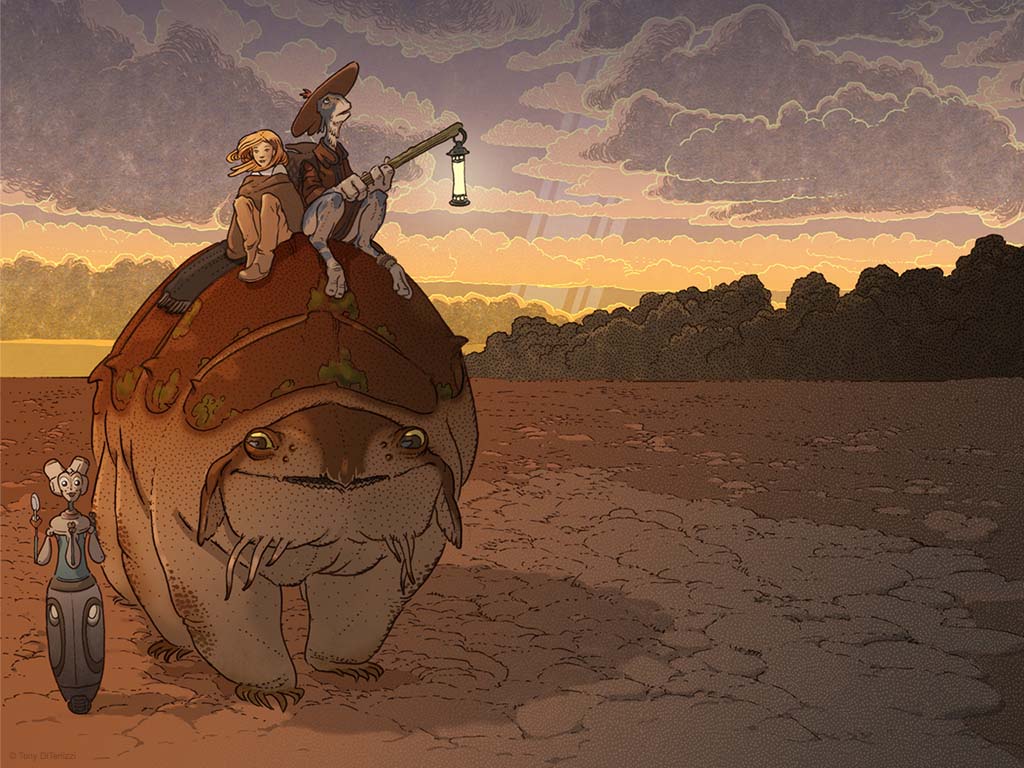
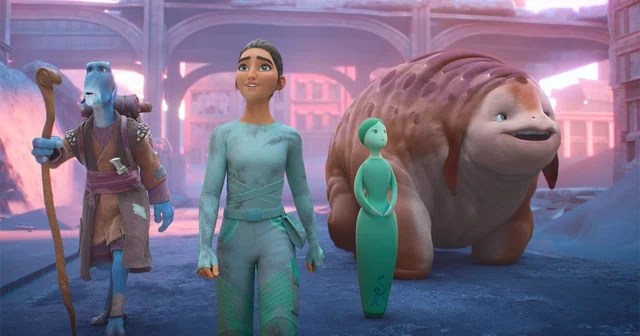
I’m still in physical pain when I look at the two next to each other. For the rest of this review, go ahead and call me Kurt Cobain, because hey! Wait! I’ve got a new complaint! Buckle up.
The main issue with Apple TV+’s WondLa is that it fundamentally denies the weirdness of the original books. Not only does everything look smooth, clean, and approachable, it’s Disneyfied in such a way that it loses sight of the core of the story—navigating an alien world, and forming bonds with beings that first frightened you. Even in the supposedly alien Orbona, everything is bright, cheery, and the kind of squishy that’s only useful for marketable plushies; the aliens only look alien insofar as they’re bluish and feathery. Even the Halcyonus couldn’t escape the curse of Disney hyper-masculinity and -femininity, where the women are skinny as rakes and have massive eyes, while the men are built like refrigerators and have tiny eyes. All of the futuristic human elements have lost their retro charm—Sanctuary 573 is now what would happen if you translated white room syndrome into an entire building. (Perfect conditions to raise a child, amirite?) Nowhere does this journey feel strange—you’re just hammered over the head with how Eva is supposed to think that it’s strange, time and time again.
Having The Search for WondLa 3D animated in this style was a fundamental mistake in adapting it. A lot of the more unique elements required a much larger budget to bring to life, and as a result, none of the original designs retain the vibrance that they had in the books. I love that they made Eva Nine mixed-race (WOOOO) and the reasoning behind it is in line with DiTerlizzi’s original vision for the story, but just because she’s a woman of color doesn’t mean that her design has to be sad and boring! Young girls of color deserve role models that haven’t had all of their defining traits stripped away for budget reasons! The budget was why her signature braids were lost, but even then, they could have added the bright colors in her utilitunic. Muthr now looks like a Playmobil figure with exceedingly rudimentary facial expressions (and having her fatal injury be nothing but a massive dent destroyed any of the emotional impact of her death), and Otto…looks nothing like the water bear that he supposedly evolved from. (Why is he furry? Why is his tail so bulbous?? Why is Otto?) Rovender looks…decent, compared to them, but the front-facing predator eyes still ick me out. It’s just not right. My gripes with the Halcyonus have already been stated, the one Mirthian we see looks like a weasel (and not the slightest bit smiley), and Queen Ojo now has gravity-defying lashes, very faint versions of her signature makeup, and a generic, human-looking tiara…for some reason.
Apparently the show experienced budget cuts and changes in leadership during its production, but that’s the only excuse I can think of for how rushed this storyline felt. Even from an objective stance, fitting almost 500 pages’ worth of material into a 7-episode show with less than half an hour’s runtime per episode is just mind-boggling. Predictably, everything gets the juice squeezed out of it as a result, rendering any kind of character development rushed and inorganic. The first episode alone is just an excruciatingly long training montage, complete with the entire theme song for Beeboo and Company—excuse me, Meego and Friends—instead of…y’know, exposition that wasn’t dump-trucked down the viewer’s throat. I can almost give it slack for being a children’s show, but the book never had that problem, despite being for the same target audience. All of the explanations of Eva’s childhood that took up almost an entire episode only took a handful of chapters in The Search for WondLa. The fact that it was geared towards a younger audience makes Eva Nine’s Percy Jackson-style aging up from 12 to 16 even more illogical—if it’s so clearly for children, why make her a teenager?
Which brings me to what I felt was the most offensive aspect of WondLa: the handling of the characters. Such a compressed time frame left zero room for not just character development, but expanding any of the characters beyond a single base trait.
This show turned Eva Nine (Jeanine Mason) into an adorkable Disney princess. Gone is the inquisitive, sensitive 12-year-old she once was, and in her place is the exact same character I’ve seen in at least 10 different Disney movies—clumsy, socially inept (and not even in a way that makes sense for the “raised in a bunker by a robot” plot), and teenage in ways that speak more to stereotypes about teenagers rather than the truths of girlhood that the books touched on. She’s so quirky! Look at her, she can talk to animals, but has no idea how to talk to humans! Teehee! Admittedly, one change that I did genuinely find funny was that one of the first thing she does upon realizing that she can telepathically communicate with animals is get into an animal’s mind to rig this universe’s equivalent of a horse race. That, at least, felt like something the Eva Nine I know would do at age 12.
Rovender Kitt (Gary Anthony Williams), everybody’s favorite blue father figure, got boiled down to a single character trait—and not even one that defines him in the novels. He’s gruff, he’s got a dry sense of humor, and in the beginning, he’s prickly—as you would be, if you were suddenly in charge of a feral twelve-year-old who confidently tells you that she can talk to animals. But WondLa just made him downright mean—again, a consequence of the terrible pacing, but he stays surly and outright hostile to Eva and Muthr for the glut of the series, until we’re lead to believe that absence has made the heart grow fonder, and he automatically does a 180 and becomes a part of their family. Rovender, who becomes a role model to Eva, was all but reduced to someone who would gladly sell her and Muthr off for parts…until he magically isn’t, to advance the plot. Muthr (Teri Hatcher) had a similar treatment; at least the overprotectiveness that they reduced her too wasn’t necessarily a mischaracterization like Rovender, but never once do we see her internal struggles with obeying her programming versus obeying the foreign laws of the natural world—and coming to love them. Another victim of this god-awful pacing…almost all of said scenes where she experiences these changes were cut from the book. However, it is a sweet, full-circle moment that Hatcher gets to voice Muthr here after being the voice of all three audiobooks. She’s got lots of experience with voicing mothers as well, what with being both the real mother and Other Mother in Coraline. (“Don’t you DARE disobey me, Eva Nine!”)
Besteel (Chiké Okonkwo), at least, was faithful in both design and personality; his design looked appropriately menacing, as was his vocal presence. He appropriately felt like a bully, but one with the hunger for power and strength to bring whomever he wanted to their knees. On the other hand, Otto (Brad Garrett)…where do I begin? His design already looks unbelievably cursed (to quote an Instagram commenter, “they done JJ the Jet Plane’d Otto”), but the way they adapted his telepathic communication made me want to throw my laptop across the room. In the novels, Eva Nine only hears his voice in one to two word sentence fragments, like how you’d imagine your pet speaking to you. It’s cute, but never oversaturated with attempts to be cutesy. This version of Otto has been butchered into the corniest, Secret Life of Pets, cutesy mess—he speaks in full sentences now, but they all sound like “sorry, I ate the yummy fish!” or “you better get us out of here before dinner-stick man gets here!” (Also…my guy’s an herbivore, why would he concern himself with yummy fish anyway?)
Such inconsistencies also translated to the side characters as well. Loroc (Navid Negahban) could have been perfect casting—Loroc does eventually look like the alien version of The Devil With the Yellow Eyes from Legion, after all—but the script makes his lines painfully corny and his design equally laughable. Zin (Maz Jobrani) was merged with his sniveling taxidermist, and all of his scientific wisdom and curiosity was flattened into a pushover who just wanted to dissect Eva and be done with it. Queen Ojo (Sarah Hollis) had a character change that was almost understandable; having her bond with Eva and indicate early on the pressure she’s facing as a young royal could have been charming, if not for, again, how corny the script was. Cadmus Pryde (Alan Tudyk) was a notable cameo, but his lines sounded rushed, even when he comes in at the big reveal at the end of the final episode. (Plus…why does he look like the Chris Pine character in Wish?) Again: I’d say none of the voice actors are at fault, but the terrible script most certainly is.
WondLa experienced a multitude of changes to the storyline as well as the designs; sometimes, tweaking the plot or characters in an adaptation can lead to a more meaningful version of the original (see: Fantastic Mr. Fox and How to Train Your Dragon). Tony DiTerlizzi’s apparent willingness for the writers to interpret WondLa as they see fit is almost refreshing—we writers cling tightly to our stories, so I suppose that it’s good for him to be so open-minded about this adaptation, and easier for the show runners to work with. That being said, almost all of the changes I could think of made no sense.
A multitude of characters or topics are renamed (ex. Beeboo and Company to Meego and Friends, Dynastes Corporation to Dynasty Corporation) for reasons that don’t even advance the plot. Darius, who was notably dead in the first book, replaces the role of Arius, only for her to prove a momentary obstacle and not deliver the prophecy to Eva that’s so integral to the plot later on. (I guess that explains the flattening of Zin’s character—if there’s no mark on Eva’s wrist for him to see, then why would he be sympathetic?) Loroc, who does not make an appearance until the second book, has already waltzed into the narrative, albeit in a similar role. And at the end of the show, it’s not Hailey in his battered Bijou who comes to find Eva, but…Cadmus? Why?? But along the way, it seemed like the writers were trying to signal that yes, this is the book you know and love, don’t worry! Here’s a spiderfish! You remember those guys, right? [Points at something that looks like a salamander] What struck me wasn’t necessarily that the plot had changed—that was inevitable—but that none of the changes made any narrative sense—characters and events were just thrown around with no sense of how their roles shape the series. (Also, gotta love the wholly unsubtle shoehorning of references to Skydance’s most recent and very mediocre-looking movie Luck...it felt like a commercial…)
However, I will say, among the many switches and swaps that were made, the role of Caruncle (John Ratzenberger) made sense. His voice (which I recognized without knowing his name…seems like he’s been in every Pixar movie since the dawn of time?) fit with Caruncle’s sleazy character, and although he’s embodying the version of Caruncle that we don’t see until book three, it made sense to have him here to bait Eva. At his core, he’s still slimy, deceptive, and not knowledgeable at all about what he’s selling, so it made sense.
Also, because I couldn’t let this slide: there’s a whole sequence where Eva is being playfully interrogated by two alien children, who ask if she really has ten toes…which results in a sequence where they focus on a teenage girl’s feet for an…uncomfortably long time. Just…why? Was Quentin Tarantino involved in this script? Jesus Christ…
But one change made me realize just how little the writers seemed to understand about the heart of the story, and it sums up how warped of an adaptation WondLa really is. In a climactic moment where Eva finds a replica of her WondLa—a corroded copy of The Wonderful Wizard of Oz—in the ruins of the New York Public Library, she lines it up with an untarnished copy. Here she is, having found her guiding vision of family and wholeness, and this is her response:
“It’s just a book?”
…
Nothing is sacred, is it?
My only comfort comes from my dear friend, who is an avid Percy Jackson fan: someday, a decade or so down the line, maybe we’ll have a more faithful adaptation. One can only hope. You might be asking me, Madeline, why are you so concerned about pacing and writing and all that? It’s a kid’s show! Here’s my answer: just because a piece of media is for a younger audience doesn’t mean that it shouldn’t be high quality and well-written. It can be done, and has been done many times! In book form, that was what The Search for WondLa was! Remember when I mentioned Fantastic Mr. Fox and How to Train Your Dragon! You can drastically change a children’s story and stay true to its message and emotional core! It’s not like these things aren’t possible.
For the fundamental understanding of what made the WondLa trilogy so impactful and unique—and the emotional duress it put me through—1 star.
Today’s song:
That’s it for this TV review! Have a wonderful rest of your day, and take care of yourselves!










 The Bookish Mutant