Posted in Book Review Tuesday

Book Review Tuesday (7/8/25) – Something More

Happy Tuesday, bibliophiles!

I’ve been looking around for books to read for Disability Pride Month, and in general, trying to find some books by Palestinian/Palestinian diaspora authors. Something More fit both of those, so I figured I would give it a go! Though it wasn’t a perfect novel, it had all of the qualities of a classic YA romance novel—angsty, romantic, and heartfelt writing.

Enjoy this week’s review!

Something More – Jackie Khalilieh

Jessie is determined to turn over a new leaf. On the precipice of starting high school, she wants to show the world that she isn’t the girl who she was in middle school—lonely, awkward, and more importantly, autistic. Keeping her diagnosis a secret, Jessie quickly makes new friends—and new crushes—at Holy Trinity High. But when her friendships begin to unravel and her relationships start to crumble, Jessie questions whether it’s worth it to keep her authentic truth a secret after all.

TW/CW: ableism (external & internalized), xenophobia, racism, substance abuse, bullying

Dude. Jessie and I would’ve been best friends in high school. I would’ve gladly welcomed another neurodivergent Radiohead girlie to go sneak off to the library with during my lunch period.

Though I can’t speak to the accuracy of the representation, I loved how Something More explored Jessie’s identity! It’s something that I assume has a lot of personal importance to the author, and Khalilieh’s explored all of the facets of Jessie’s identity with such sensitivity and love. I’m not autistic, but I am neurodivergent (I have SPD), and I deeply resonated with a lot of her struggles with fitting in and adjusting to high school while being neurodivergent. I loved the arc of Jessie realizing that there’s no reason to hide her autism from her friends, and I also appreciated that a lot of her friends, despite their flaws, were respectful and accepting of her identity. The same goes with her Palestinian-Canadian identity—again, I can’t speak to the representation, but Something More had such a lovely exploration of Jessie’s experience growing up in an immigrant household and feeling like an outsider because of her Palestinian roots. It’s a deeply refreshing intersection of representation in YA literature that I adored!

I normally don’t advocate for things becoming Netflix movies, but I swear that Something More has the perfect recipe for becoming that kind of YA classic that gets a cute streaming movie. I can already see the Clueless-esque ’90s soundtrack from here, tailored towards Jessie’s special interest and the music integrated in the novel. From Jessie’s diary full of friend and boy-related (and getting her parents to get her a phone-related) goals to Jessie’s unique spark as a protagonist, it’s got the classic tropes down to a science, yet never makes them feel tired. She injects the right amounts of both the sass and the vulnerability that comes with a lovable YA rom-com protagonist. Khalilieh perfectly captures the awkwardness of entering high school and the rocky path to fitting in and finding your place. Jessie has so much great development, from realizing her self-worth in the face of her crush being dismissive of her, to realizing that she needs to stand up to her toxic “friends.” Jackie Khalilieh has clearly done her homework on YA, and with a little refinement, is well on her way to making a classic.

Despite what I loved about it, Something More suffered from a few key flaws. The most glaring of them was that…oh my god, there were so many wild, random subplots and side tangents that didn’t contribute much to the plot. Jessie’s grandma, who was almost never mentioned, randomly dies towards the end of the book, one of her friends gets involved with a creepy older man and gets dumped in a parking lot, and the rest of the friend group continuously gets tossed between several skeevy guys, seemingly with no resolution. Yeah, high school is weird, but by the end of the novel, the relationship/ex statuses between Jessie and her friend group looked like that one panel in Diary of a Wimpy Kid with the massive relationship diagram. And that’s just her friend group of FOUR PEOPLE. It was wild. Other than the gross Mel subplot, which…at the very least, I guess it gave some depth to Jessie and Levi’s relationship, none of them added to the plot, and nor did they have any ripple effects throughout the novel. I guess there was only so much time for Jessie to reflect on her grandmother dying, but if they were as close as we were blatantly told in a handful of sentences, why did it barely have an effect on Jessie? Wouldn’t she be…y’know, experiencing some form of grief? It all just felt rushed and took away page time that could’ve been used to develop the more central relationships in the novel.

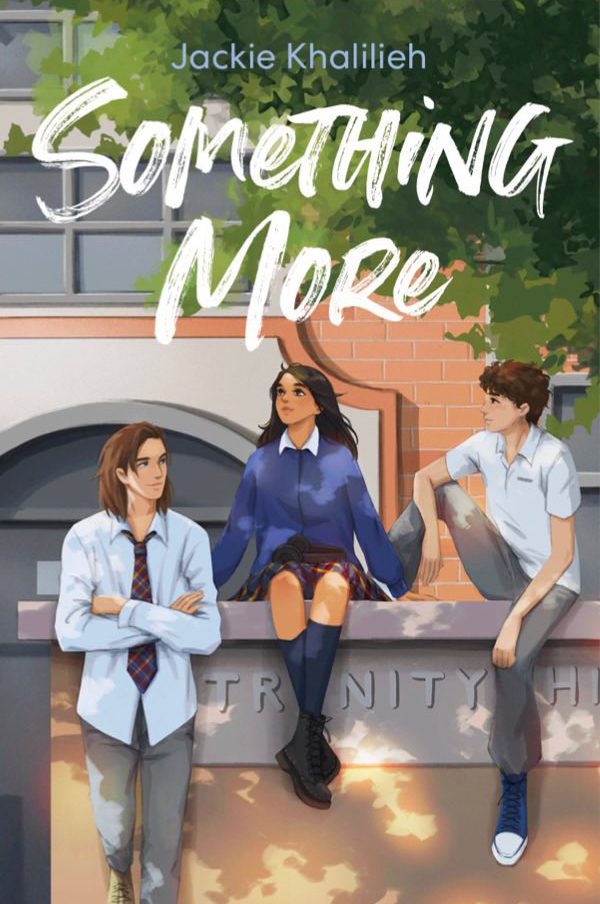
Speaking of relationships…thankfully, as the cover might lead you to believe, there really isn’t much of a love triangle. (Cue a sigh of relief.) I guess you could technically make an argument for it, but honestly, up until the 80% mark, I fully thought that things between Jessie and Griffin were going to stay completely platonic. Yet even then, Levi would’ve been the worse choice…LEVI. What a piece of work! I know that Jessie had to learn, BUT GIRL! YOU CAN DO BETTER THAN HIM! Just because he’s vaguely nice and looks like Kurt Cobain doesn’t mean that he’s not a flaky, disrespectful asshole! I get that Jessie had to learn both her lesson and her self-worth when it comes to falling head-over-heels for guys, but I feel like the writing of their relationship needed some work. I feel like the time between them meeting and having their first kiss was way too fast, even if Jessie was infatuated; their dynamic over the rest of the novel felt repetitive, and it didn’t serve much to the novel save for building the case for Levi being insufferable. As for Griffin, I did like their relationship, but I honestly think it could’ve worked romantically or platonically—I did like them getting together at the end, but I also would’ve appreciated him being part of Jessie’s (abandoned) goal of getting a guy friend and having a healthy depiction of friendships of the opposite gender.

Overall, a diverse YA romance that nails all of the factors for a classic formula, but faltered in its overabundance of subplots and awkwardly-paced relationships. 3.5 stars!

Something More is a standalone and Jackie Khalilieh’s debut novel. Khalilieh is also the author of You Started It and the forthcoming Everything Comes Back to You, which is set for release in 2026.

Today’s song:

I love this song, it sounds like being in a goldfish bowl…

That’s it for this week’s Book Review Tuesday! Have a wonderful rest of your day, and take care of yourself!

Posted in Book Review Tuesday

Book Review Tuesday (5/27/25) – Light Years from Home

Happy Tuesday, bibliophiles!

I’ve had several of Mike Chen’s novels floating around my TBR for quite some time. I’d forgotten that I’d read a short story of his in From a Certain Point of View: The Empire Strikes Back, and I figured I’d give his novel-length writing a try. Plus, I was just in a sci-fi mood (as I always am). Despite the flaws that dragged down the premise, Light Years from Home was an ambitious novel that blended genres and didn’t shy away from being messy. Whether it successfully cleaned up its messes, however, is up for debate.

Enjoy this week’s review!

Light Years from Home – Mike Chen

15 years ago, the Shao family was thrown into disarray. Jakob, the only son, and their father disappeared. Their father later returned, dazed, disoriented, and convinced that he and Jakob were abducted by aliens. He died soon after.

Jakob has been missing for over a decade now. Sisters Evie and Kass haven’t spoken since the incident, with Evie diving into alien conspiracy theories and Kass throws herself into her work and caring for their aging mother. But when Jakob returns, parroting their late father’s theories about alien abduction, the sisters have no choice to bury the hatchet and reunite. As Jakob’s story grows wilder and the rift between the sisters widens, they must contend with the possibility that all of this may be true—but can Jakob be trusted? And if his story is true, what does it mean for the fate of Earth?

TW/CW: death of a parent, grief, dementia themes, substance abuse (smoking, drinking)

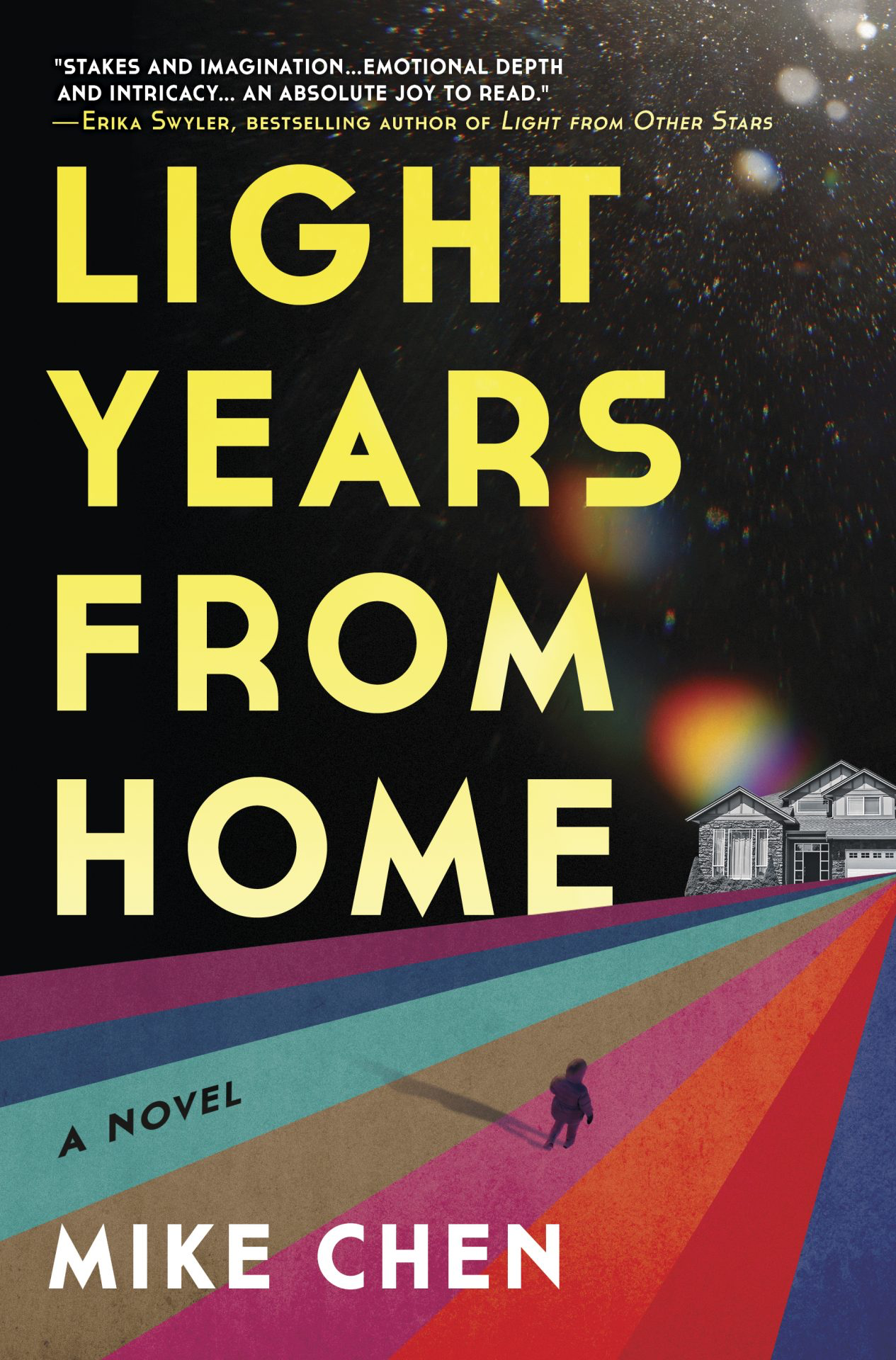
In the acknowledgments, Mike Chen says that this story was initially inspired by “Red” by Belly, and I’m tempted to give it another half a star just because I’ve never heard anyone outside of my immediate family or Pitchfork talk about them. The title also makes me think of The Rolling Stones’ “2000 Light Years from Home,” but that’s a vague enough title that it could be a reference to a lot of things. Although Belly didn’t save every flaw, Light Years from Home is a solid meld of science fiction and realistic fiction.

Light Years from Home has one of the most compelling beginnings of a book that I’ve read recently. You’re thrown right into the action aboard a Seven Bells spaceship in a classic space opera setting. Jakob cradles his alien comrade in his arms as they die, and thus begins his perilous quest back to Earth. But the reader and Jakob are the only people who know about this—the only other character who did (their dad) is notably dead. It would’ve been easy to just have the characters not believe him, but Jakob is already established as an unreliable person—his real life experience sounds suspiciously like an outrageous lie he would’ve told in his college days, which gives the characters both more obstacles to overcome, but more of their messy family dynamic to dissect. In terms of plot, Light Years from Home was a great study in not taking the easy way out—everything was messy and tangled, making for a book that had lots of drama and hurdles to pick apart.

Every single member of the Shao member was on the obnoxious, insufferable side (save for maybe Evie), but Chen did a great job of capturing the complicated family dynamic in the novel. Fifteen years after Jakob’s abduction, the wounds remain raw, and not a single member of the family has recovered from the fallout. Although I wasn’t satisfied at all with the character development of…well, any of the family (I’ll get to that later), Chen did an excellent job of weaving together all of the contrasting beliefs, motivations, and traumas that each family member had. All of them dealt with Jakob and their dad’s disappearance and death, respectively, in wildly different ways, and their coping mechanisms butted heads over the course of the novel. Even though this was ultimately handled poorly at the end, I did also appreciate the sensitive depiction of their mom’s dementia; Chen did a very respectful job of depicting the emotional impact of her memory loss and not being able to recognize her own children.

For all of the focus on the messy Shao family, the promised character development that their dynamic hinged on was not delivered on. There should’ve been plenty of conflict with Jakob reckoning with the man he was on Earth versus the man he was while serving in space with the Seven Bells, yet none of that happened. All of his character development happened off-page, resulting in a character that came off more flatly than I think was intended. Likewise, Kass and Evie were set up for significant development, but nothing happened with them either. Evie’s beliefs were reinforced and she and stayed static throughout the novel, not giving up her fantasies of aliens for the sake of the family. The closest Kass got, if you could call “okay, I guess aliens do exist” character development, was a brief revelation that even though she’s a therapist, that she doesn’t know everything about herself or her family, and that she shouldn’t pretend to know everything. That last half of my sentence amounted to about a paragraph around 50 pages before the novel ended, and it felt like entirely too little too soon. In the end, the character development was a jumble of unfulfilled promises—we got the shells of what could’ve been nuanced characters, but despite the bizarre journey they went on, they came out the exact same as they were before.

Also…I’m sorry, what the hell was that ending? Somehow, it was one of the most anticlimactic parts of the whole novel, and weird in ways that didn’t make sense. Jakob returns to the Seven Bells, but there’s hardly any fanfare or even extended moments of grief from the sisters, even though their brother has just decided to spend the rest of his life in space and never see them again. There wasn’t nearly enough emotion to it, and nor was there page time—this moment only gets around 4-6 pages tops. Instead of an emotional resolution with her daughters, the mom somehow un-dementias herself and remembers everything, and is also eerily content with her only son’s decision to spend the rest of his life in space. It all just felt so rushed and emotionally stunted compared to the rest of the novel, and not nearly as detailed as it needed to be. Weird is the only way to adequately describe it. I felt lost, but also robbed of what could’ve been something so bittersweet. I feel like it’s partially a side effect of none of the characters having any character development, but it felt like such a lack of a resolution. It was practically a non-ending.

All in all, a sci-fi/realistic fiction blend that embraced messiness in both plot and character, but had significant trouble with cleaning it up. 3.5 stars!

Light Years from Home is a standalone, but Mike Chen is the author of several novels. He has contributed short stories to From a Certain Point of View: The Empire Strikes Back and Return of the Jedi, and the full-length novel Brotherhood to the Star Wars universe. He is also the author of We Could Be Heroes, Vampire Weekend, Here and Now and Then, A Quantum Love Story, and many more novels for adults.

Today’s song:

NEW MARY IN THE JUNKYARD WOOOOOOOOOOO

That’s it for this week’s Book Review Tuesday! Have a wonderful rest of your day, and take care of yourselves!

Posted in Book Review Tuesday

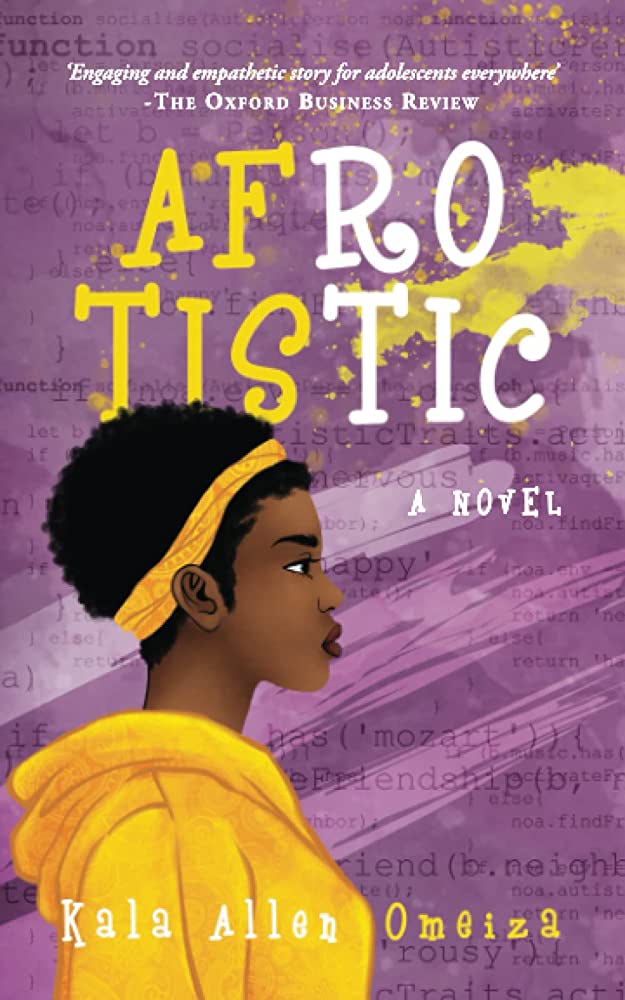
Book Review Tuesday (4/15/25) – Afrotistic

Happy Tuesday, bibliophiles!

April is Autism Acceptance Month, and although I probably won’t have time to make a whole post about it (blame finals), I figured I would review a book with an autistic protagonist and an autistic author! This one’s been on my TBR for a few years, but I was only able to find a copy more recently. Although it wasn’t perfect, it’s a great book to introduce a younger audience to autistic issues, especially from a more diverse perspective.

Enjoy this week’s review!

Afrotistic – Kala Allen Omeiza

15-year-old Noa Ohunene Jenkins doesn’t know where she fits in—or if she can fit in at all. All of her life, she’s never felt Black enough or autistic enough. And now that she’s moving to a new high school, she doesn’t know if she’ll fit into either communities—much less her new school. Noa has her mind set on one thing: a place in the Dean’s Merit Society. The problem is, the only way she’ll get in is if she has leadership experience. Scrambling for answers, she decides to gather up fellow autistic teenagers and forms a group to discuss autistic issues. But will it be enough to show her peers and teachers that she’s just as worthy of praise?

TW/CW: ableism, racism, bullying, mentions of suicide (past), brief mentions of police brutality (in reference to police violence towards autistic people)

Afrotistic has been languishing on my TBR for way too long, but even though it wasn’t a perfect book, I think it’s a great book to introduce people—especially kids and young adults—to autism, ableism, and the intersection of race and disability! It’s already difficult to find neurodivergent representation in literature, but rarer within that category is autistic people of color—for that alone, Afrotistic is such an important book.

For some reason, I misremembered Afrotistic as being middle grade. Who knows why. I kept that assumption going in, and then I of course found out that Noa is 15 years old and a sophomore in high school. Whoops. That being said, going in with that mindset wasn’t all that bad, because I really feel like Afrotistic hits that sweet spot between middle grade and YA that’s so often unexplored. It appeals to a mid-teens age range because of its protagonist, but the writing is accessible enough that I feel like kids as young as 12 or 13 could comfortably read and relate to Noa and the other characters. (The fact that 12-18 is such a huge range of maturity for a single age group is whole can of worms, so I’ll save it for another time.) There are some more mature and sensitive topics that are briefly discussed (police brutality against autistic people of color, for one), but it’s brief enough that I feel like that age range could process and learn from it. Neurodivergent representation is hard to find in books aimed at all ages, and I feel Omeiza’s accessible writing style, as well as the relatability of Noa as a protagonist, makes for a book that could teach tons of pre-teens and young adults alike about Black and autistic identity.

Another reason I’m glad that Afrotistic exists is because of the intersectionality! The primary focus is on Noa’s identity as a young, Black, autistic girl, and how she’s struggled to make her voice heard because of how little attention is paid to neurodivergent (and disabled in general) people of color. Both through the essay excerpts in the story and through her real-time experiences not being believed by her peers and teachers, it was a poignant narrative about how neurodivergent people of color have to fight even harder to have their needs met and understood. Going off of that, I appreciated that within the Roaring Pebbles, there was a lot of intersectionality as well; as well as all of them being autistic, there was a mixed-race character with cerebral palsy, as well as men and women being present.

That being said, I wasn’t as charmed by the characters as the characters themselves seemed to be. I loved Noa and was rooting for her throughout the story, but I found myself less compelled by some of the other characters. It was clear that the friendship between Noa and Brayden was supposed to be one of the core friendships in the novel, but I really didn’t feel any kind of friendship chemistry between them. All Brayden seemed to do was make jokes that didn’t land and make awfully pushy remarks to Noa joining his youth group. I get that Noa is also Christian and doesn’t necessarily mind, but I feel like even if I was also Christian and I had somebody trying to get me to join their youth group that persistently, I’d snap. The issue with most of the other characters is that they were rather underdeveloped; this was inevitable with the amount of characters that were focused on in the Roaring Pebbles, but even the ones that had more page time were boiled down to one or two traits at most. I get that it’s difficult to juggle that many characters, but even the ones that were relatively more in the spotlight weren’t given enough traits to make them stand out. Going back to the whole pushy youth group thing with Brayden, I found it hard to believe that every single member of the Roaring Pebbles were completely fine with their group being filtered through said youth group and having a name with biblical inspiration. I get that if you’re strapped for resources, any venue you can have to gather is essential, but I would imagine that at least one of these characters isn’t Christian…

Additionally, what also soured me to some of these characters was the random side plots that weighed the story down. There’s a whole, completely unnecessary thread of two of the boys in Roaring Pebbles fighting over a girl that gets entirely too much page time and only served to derail the plot. About half of the conflicts that occur throughout Afrotistic felt of this nature—some of them were natural (like the inevitable issue that some of the autistic people have different triggers, which was something I appreciated being included and discussed), but others felt like filler. Here’s the issue: Afrotistic is only about 250 pages (on my Kindle edition), so there could have been so many more opportunities to discuss more aspects of Noa’s friendships, identity, or even her home life. Instead, we got problems that were solved far too quickly and didn’t contribute anything to the plot.

Also: I’m not completely sure how to feel about this, but I had to mention it. At some point, when Noa is surveying the different cliques in the lunchroom, she labels two of them the “woke kids” and the “cool woke kids.” It was…odd, to say the least? I can kind of see it as being a factor of her not feeling autistic/Black enough for those crowds, but I’ve never once heard cliques described as “woke” unless it’s some weird, insecure conservative person. I guess I’m so used to seeing “woke” being lobbed at anything vaguely liberal (or considerate of basic human decency) these days, but Afrotistic was published in 2022, and the same was true then. I’m just not sure how I feel about that.

All in all, a timely novel that deftly highlights the issues that autistic people of color face, but stumbled in terms of its characters and frequent plot digressions. 3.5 stars!

Afrotistic is a standalone novel, but Kala Allen Omeiza is also the author of Autistic and Black: Our Experiences of Growth, Progress, and Empowerment, and The Worst Saturday Ever.

Today’s song:

SO glad I found this song!! Brian Eno never gets old

That’s it for this week’s Book Review Tuesday! Have a wonderful rest of your day, and take care of yourselves!
Posted in Book Review Tuesday

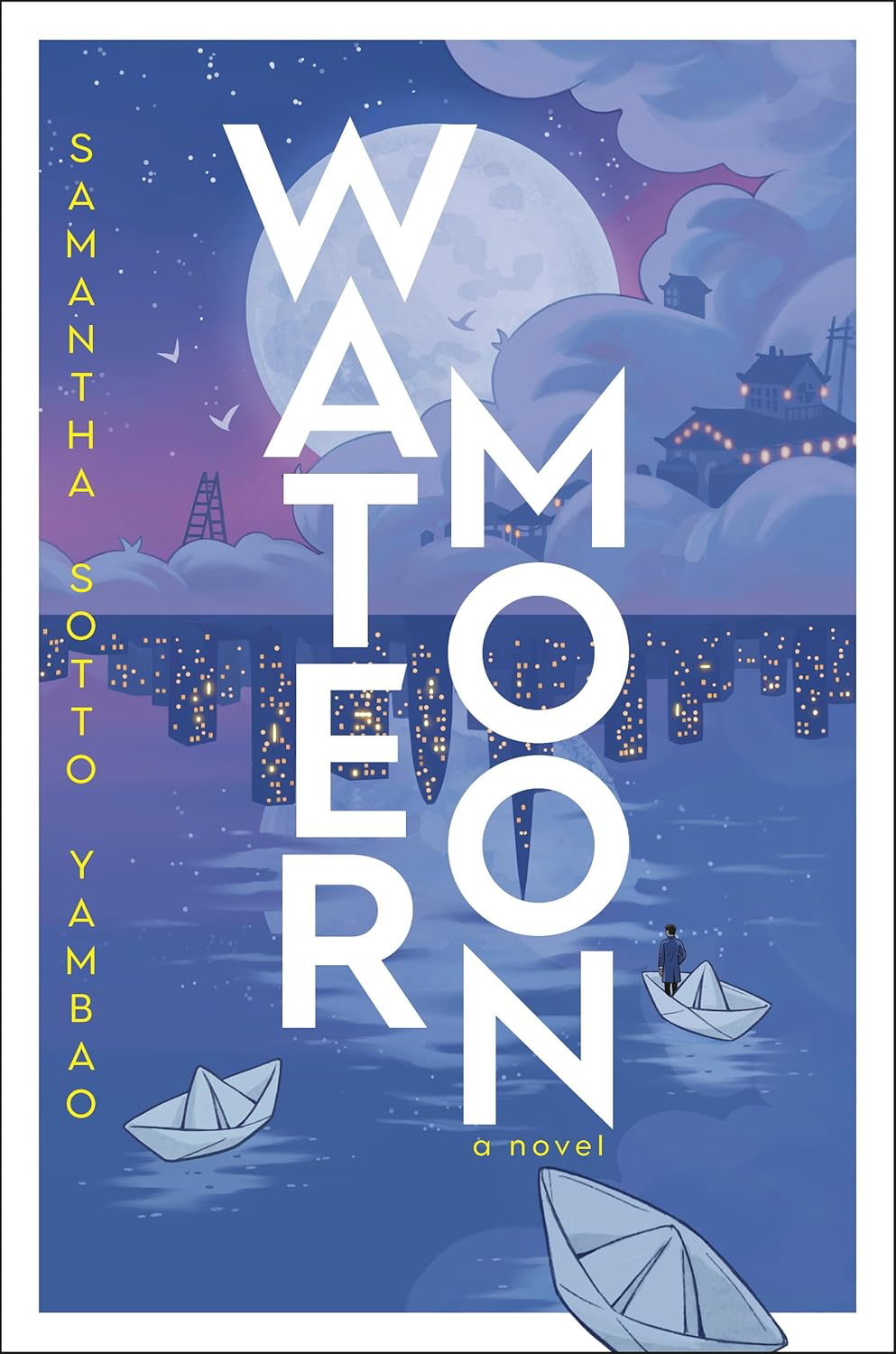
Book Review Tuesday (3/25/25) – Water Moon

Happy Tuesday, bibliophiles!

Even with me being slightly less online than I’ve been in the past few years, I’ve seen a lot of buzz about Water Moon. Enough that it warranted a hardcover copy that was a whole $31 at Barnes & Noble…not even a special edition or anything, just a regular copy. Nevertheless, I wanted to give it a less expensive try, so I got it on hold at the library. Though it didn’t live up to both the $31 or the Studio Ghibli comparisons it warranted, Water Moon was a heartfelt, if a little confused, about the connectivity of people and the choices that lead us to the places we end up.

Enjoy this week’s review!

Water Moon – Samantha Sotto Yambao

Hana Ishikawa is set to receive a very unique inheritance. Her father has given her control over his old shop in Tokyo; tourists and passersby will see a ramen restaurant, but once you look inside, you find that its wares are something completely different: a pawnshop where you can exchange your life’s regrets and unpleasant choices. But on her first day on the job, Hana finds the shop destroyed. Looking for answers, she instead finds Keishin, an American tourist searching for answers of his own. Their search leads them into a strange realm of magic and wonder that may hold the keys to the problems they’re facing…and more.

TW/CW: loss of loved ones, grief, abandonment, mentions of abortion/pregnancy issues (brief), blood/violence, descriptions of injury

Water Moon was a good stab at magical realism; it had some beautiful elements that had me enraptured, but not for long enough. Its fundamental issue is that it wanted to do too much but didn’t have the space to do it. What we have here, messy as it was, at least read well and presented some moments of lovely, whimsical magical realism.

While this novel had some issues throughout with thematic cohesiveness, I do think that the central one (or the one that felt like it was supposed to be central, at least), was a beautiful one—connectivity through the choices we make. Hana’s life is dictated by regret, but she learns, through jumping through fantastical worlds, that it’s the unexpected things in life that bring us together that make life worth living. I especially loved the connection to the Super-Kamiokande Neutrino Detector, something that Keishin has returned to Japan to study—capturing the secrets of this elusive, subatomic particle that can only be observed (if you’re lucky) in an observatory filled with distilled water underground. I’m a sucker for when writers are able to articulate that emotion with science, especially with something as misunderstood as physics; Water Moon did a lovely job of using that as part of the larger metaphor about how lucky we are to experience the unexpected, and how that can bring us together. I just wished Yambao had done more with it, but what we had, I loved.

I also loved the worldbuilding in Water Moon! I don’t think the childlike wonder that Yambao was going for was properly executed all the way, but I love the inherent whimsy that’s integral to holding the worldbuilding together. You travel to these parallel, unseeable worlds found in puddles on the ground, and in those worlds, you find everything from villages dedicated to hanging the stars at night and origami and paper planes with a life of their own. Even with the rather sinister undercurrent that runs through it, the glimpses of the fantasy worlds were almost dreamlike. They had a distinct quality of feeling like the kinds of fantasies you imagined when you were a kid (especially the puddle travel), which enhanced the feel of the world overall.

However, that whimsy only came off in varying degrees. That was due to the writing, which often came off rather rote. Yambao presented the reader with a myriad of fantastical, objectively wondrous elements in this parallel world that Hana and Keishin venture into, only to describe it in the flattest terms. For a magical realism novel, the writing felt almost utilitarian, designed to describe a setting or a phenomenon with the absolute minimum amount of description for the reader to get an idea of what it looked like. Sure, Water Moon didn’t need to be excessively flowery or purple in its prose, but when you have a setting as whimsical and magical as this, more description is necessary.

The same applies to the feelings of the characters—they hardly seemed to react to their settings, only serving to be chess pieces that were dragged around at will when the plot called for it. Keishin at least had something of a personality, but other than him, most of the characters, including Hana, were defined only by what had happened to them. They were defined only by their backstories, and that dictated everything that they did throughout the story—not their motivations or their personalities. All of this, combined with Yambao’s relatively flat writing, made their romance lackluster. Not only did it feel like the classic “oh, our main characters are a boy and a girl, therefore they have to fall in love,” it was just so rushed and un-earned—we didn’t get nearly enough development (or page time) from either of them to merit a full-blown romance. Even though they’d jumped through magical puddles together and visited whimsical worlds, I found myself barely caring for either of them, or their romance.

Back to the subject of themes…I wholly believe that a book shouldn’t be constrained by talking only about one theme. In fact, most every book does that anyway—having a book centered around a single theme without even a handful of sub-themes or topics is practically impossible. Like I (and Yambao) said, everything is connected. Water Moon, however, had a problem with articulating it. Beyond the bit about choices and connectivity, Water Moon wanted to say so much about so many things—motherhood, grief, regret, parent-child relationships—and yet it didn’t know what to say about any of them. A theme was introduced with the same emotional weight as the central theme, it got 50 pages of page time, and then it barely resolved itself. Water Moon had almost no sense of direction, leaving me with a book that didn’t resolve itself in a satisfying or logical way. Ultimately, this felt like a case of too many cooks in the kitchen—it was an ambitious attempt to tackle every theme and give it the same weight, but it ended up in a plot (and characters) that ran around confused for almost all 374 pages and underbaked statements on what it wanted to say.

Overall, an ambitious and dreamlike novel with a world that was a treat to explore, but offered up flat characters and had no sense of what it wanted to do with itself. 3.5 stars!

Water Moon is a standalone, but Samantha Sotto Yambao is also the author of Before Ever After, Love and Gravity, A Dream of Trees, and The Beginning of Always (under the name Samantha Sotto).

Today’s song:

so hauntingly beautiful :,)

That’s it for this week’s Book Review Tuesday! Have a wonderful rest of your day, and take care of yourselves!
Posted in Book Review Tuesday

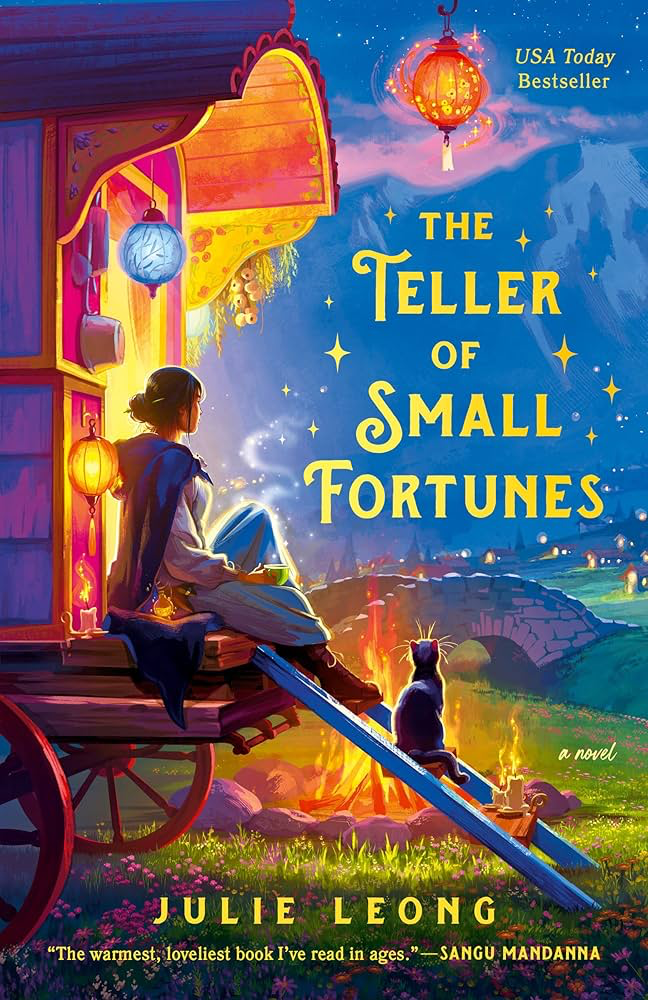
Book Review Tuesday (3/18/25) – The Teller of Small Fortunes

Happy Tuesday, bibliophiles!

You know it. You know I’m all for cozy literature. I wasn’t particularly in a moment where I needed cozy fantasy, but these days, I love to space them into my regular reading rotation to keep things lighter, if need be. I’m usually more for sci-fi than fantasy, but I love a good fantasy every once in a while. The Teller of Small Fortunes wasn’t the best cozy fantasy I’ve read, but like a mug of tea, it was great for a momentary hug of warmth and love.

Enjoy this week’s review!

The Teller of Small Fortunes – Julie Leong

Tao is an immigrant from Shinara, making a living far to the west in Eshtera. She makes a living off of fortune-telling, but hers are not like the grand tales that people expect from those with Shinn heritage. But Tao’s fortunes have a catch: they are small fortunes, minor events that seemingly have no consequence, but will add up towards a life of crucial choices. She cannot stay for long in one place, lest these fortunes pile up and her customers start to expect more complex predictions. But when she crosses paths with an ex-mercenary and a thief-turned-poet on the road, Tao has to keep a promise to the fortune she gave them: they’re looking for a missing girl, and Tao knows that she’ll be reunited with them. What’s unknown, however, is how it’ll happen…

TW/CW (from Julie Leong): political conflict, death of a parent, parental neglect, racism, grief, alcohol

While The Teller of Small Fortunes wasn’t the best cozy fantasy I’ve ever read, if you’re looking for something sweet to tide you over, look no further! In the mood for found family, cats, spells, and wonky pastries? I’ve got just the book for you.

Given the crowds that I hang around with, it might surprise you that I’ve never actually played DnD. I’ve always been adjacent to people who are into it and frequently play it, but I’ve never played myself. By osmosis, I know enough about it to discern that anyone who loves DnD will absolutely eat up The Teller of Small Fortunes! Somebody with more DnD knowledge could probably sort each character into a class, but I’m illiterate in that department; yet even still, I can tell that it came about in the way that many DnD campaigns seem to: out of love and out of friendship. Leong’s cozy fantasy has the perfect balance of wholesomeness, levity, and more serious themes, and overall, it’s an ode to the friends we find in unexpected places. The contrasting personalities of Tao, Mash, Silt, and Kina made for a delightful found family with goals that often got in the way of each other, but twisted to form a journey across a fantastical land that taught them lessons about identity, friendship, and individuality. It’s just so sweet. Admittedly, it did border on a bit cloying at times (even for me, both with my cozy fiction proclivities and my merciless sweet tooth), but overall, cozy fantasy fans will be more than satisfied. Plus, there’s a cat. Automatic win in my book.

Tao’s character arc and the themes around it were the heart of The Teller of Small Fortunes. This novel focuses heavily on her immigrant identity, but it explored something that I haven’t often seen with these narratives. In order to make a living outside of her home country, Tao has to perform a stereotype—in her case, being a seer. She relies on this preconceived notion of her people all being able to see the future, and knows that she’ll be able to make money off of it, yet she tries so hard to make it define her. On the other side of the coin, there’s the Guild of Mages, who physically want to use her as a pawn, fitting her into their similarly superficial stereotype of what a magic-user should be. Yes, The Teller of Small Fortunes is very much a “be yourself” narrative (I will always hate Disney for making people trivialize this kind of message), but it’s one that’s complicated by the nuance of the aspects of Tao’s identity. For her, being herself is a lifelong fight, held up by several systemic forces of oppression. Her journey is a mental one just as much as it is physical, and it required the same labor, with a satisfying conclusion: the conscious effort by her to not let other people box her in.

However, the writing sometimes got on my nerves. For me, cozy fantasy can sometimes fall into the trap of being almost condescending in its writing style; it veers to strongly into the “and what did we learn today, kids?” kind of storytelling, even if it’s often aimed at adults. There is a marked difference between having a low-stakes plot and dumbing down the language for your audience. The Teller of Small Fortunes didn’t completely fall into making the language overly digestible, but every plot point and side quest (of which there are many) tended to have a very clear, obviously stated lesson that accompanied the ending. Even if said plot points were well-executed—which they often were, especially the scene with the phoenix egg—their impact was often lessened by the regurgitating of what the scene was meant to mean for the characters and the message, as if we couldn’t figure it out. I honestly didn’t mind that these plot points, especially the ending, were wrapped up in notably kind, easier ways—that’s almost a staple of cozy fiction, at this point—but we didn’t have to get their message shoved in our faces on a neon sign. Additionally, as a character, Kina also erred on this side of saccharine—she was sweet in the way that some cozy fiction characters are, but like the pastries she made, it got a little too sweet in a grating way.

I also found the worldbuilding to be quite generic. The Teller of Small Fortunes was one of those fantasy novels that took existing countries, copied and pasted them into the narrative, and added magic and mythical creatures; Shinara was clearly an analogue for China, which, while it was great for the themes of anti-immigrant sentiment and xenophobia, didn’t make for worldbuilding that was interesting or novel in any way. The same can be said for most of the other places that Tao and the gang pass through—most of them fell under the “vaguely European, I will not elaborate” curse that plagues high fantasy, and the only things that distinguished them, if any, were some of the exports/trades that they had. I will say that I loved the system of the Guild of Mages, and they served as great commentary for tokenization and a distant but tangible source of corruption in the world, but they didn’t have enough of a presence for them to have an effect on the world for me. It all felt very lackluster to me in contrast to the care that was put into the characters. I also would’ve liked more clarification on the regional magic. It’s implied through some of Tao’s background that magic is often associated with/endemic to particular regions (hence the stereotypes of Shinn people being seers/fortune tellers and whatnot), but we don’t get a clarification of whether or not the rule also applies to the surrounding regions.

Overall, a cozy fantasy that had lovely, poignant characters and themes, but was less fortunate in the worldbuilding department. 3.5 stars!

The Teller of Small Fortunes is a standalone and Julie Leong’s debut. Her next novel, The Keeper of Magical Things, is a companion novel set in the same universe as The Teller of Small Fortunes, and is slated for release in October 2025.

Today’s song:

That’s it for this week’s Book Review Tuesday! Have a wonderful rest of your day, and take care of yourselves!
Posted in Book Review Tuesday

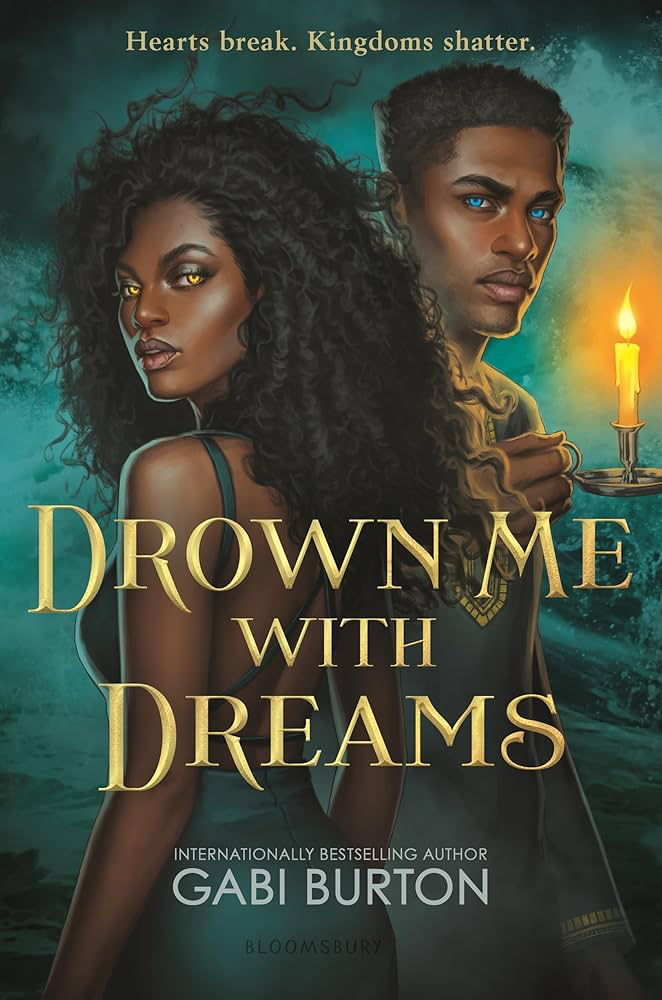
Book Review Tuesday (2/18/25) – Drown Me with Dreams (Sing Me to Sleep, #2)

Happy Tuesday, bibliophiles!

QUICK ANNOUNCEMENT: because I’m trying to divorce myself from Amazon as much as I can, I’m finally moving over from Goodreads to The Storygraph. From now on, my reviews will be available there @thebookishmutant.

I started the Sing Me to Sleep duology last year, and now that book 2 is out, I figured I would pick it up for Black History Month, but also so I could finally get some resolution! And I sure got a resolution…one that wasn’t as enjoyable as the first book, but nonetheless a twisty, romantic ending to a fantasy duology that balanced fun and social commentary.

Now, tread lightly! This review may contain spoilers for book one, Sing Me to Sleep. For my review of Sing Me to Sleep, click here!

Enjoy this week’s review!

Drown Me with Dreams (Sing Me to Sleep, #2) – Gabi Burton

Saoirse is on the run. Now that her siren identity has been exposed, she must flee to the other side of the wall that divides Keirdre from the rest of the world. Taking sanctuary with the budding Resistance, Saoirse discovers a world full of different species that Keirdre drove out of its kingdom, all waiting for the day that they can take back what is rightfully theirs. But tensions are brewing, and war is imminent. On the other side of the wall, King Hayes, her secret love, awaits, but do his loyalties remain with Saoirse? And will Saoirse be able to fend off the rising tides of war?

TW/CW (from Gabi Burton): murder, graphic violence, discrimination/segregation (fantasy), genocide themes, blood, descriptions of injury, imprisonment

You would think that a book that’s over 400 pages would have plenty of time to work out all of the wrinkles in the plot and the worldbuilding…apparently not. In a perfect world, Drown Me with Dreams would be a great second book in a trilogy, but in this world, it was a duology concluder that tried to do far too much. That doesn’t mean that it was bad by any stretch of the imagination, but it was certainly a step below Sing Me to Sleep.

Oops. I end up stumbling into books with startling relevance to the current climate, and oh my god, am I sick of using that phrase. But. Drown Me with Dreams does an excellent job of expanding on its themes of resistance, racism, and misinformation! Saoirse has now figured out that there’s a wide world beyond the walls of Keirdre that has been obscured by the racist regime in her home kingdom; now that she knows the truth, she’s exposed to a myriad of perspectives and has to do the work herself to deconstruct the lies she’s been fed all of her life. She meets dozens of new mythical species that have been respectively discriminated against by Keirdre, and finds out firsthand how many falsehoods that the ruling powers have upheld for decades. The simultaneous revelations and discomfort of Saoirse discovering the truth is such a wonderful thing for a YA fantasy book like this to explore—in the end, it’s up to us, in our varying experiences in the real world, to discover the truth about how our governments can shape (and mis-shape) the narratives we grow up on. I also love the themes of solidarity present—fantasy or not, I love that the kind of feminism that Drown Me with Dreams champions is the kind that holds celebrating individual experience and solidarity under shared oppressions in equal regard. It’s the kind of unity that I believe will push feminism forward, and it made for a powerful statement in Drown Me with Dreams.

Even though Saoirse and King Hayes were kept apart for the first half of the novel, Drown Me with Dreams had a great resolution to their romance! Was it classic, YA fantasy romance cheese? Yes. Was it good cheese? Absolutely. To paraphrase one of my high school English teachers, there’s a difference between gourmet cheese and “American cheese-food.” I’ve been a YA reader for quite some time now, and there’s a difference between cringeworthy cheese and high-quality cheese. Drown Me with Dreams falls into the latter category, 100%. There’s angsty angry-kissing aplenty, but it’s written believably. If anyone is looking to do slow-burn, enemies-to-lovers romance right, look no further. Saoirse and Hayes weren’t just given enough time to have their romance develop—the stakes of their forbidden love were built up for the whole series, and their chemistry together made for some high quality smoldering. It’s not trying to be enemies-to-lovers in the way that most BookTok fantasy books try and fail to do—Burton’s given us a well-developed romance you can root for, and it made Drown Me with Dreams a standout read in that department.

In my review for Sing Me to Sleep, I mentioned that the book’s main flaw was that it was juggling far too many characters. In that same review, I commended Burton’s ability to craft a rich, layered fantasy world. Both of those aspects collided in Drown Me with Dreams with disappointing results. In Drown Me with Dreams, we finally see the world beyond Keirdre, and it’s full of all of the creatures that Keirdre drove out—dryads, goblins, sprites, you name it. On the surface, I was so excited to see this aspect of the world, but two main issues arose. The first was that we were introduced to a truckload of characters, almost 80% of which had barely anything memorable about them other than the fact that they were from a “new” species. Some of them were slightly consequential, but only just. I had so much trouble keeping track of all of them, which definitely muddied my reading experience. The second problem was that all of this worldbuilding was crammed into a single book—with a kingdom and world this expansive, it needed at least another book to develop fully, which hindered how fleshed out the world ended up being, after all of these promises of it being fascinating and new. (Also, I get the point about racist narratives being made with the goblins, but…what was the reason for making goblins into glorified elves? Why did they need to be conventionally attractive?)

Which brings me to my second major gripe: this series should not have been a duology. Not only are we introduced to a staggering amount of worldbuilding that only amounts to a single book, the same goes for the plot. A full resistance movement, the tensions within said resistance movement, the looming threat of war from multiple sides, and the fallout from said monumental war are crammed into 424 pages…should be enough, right? Most of what I described only happens in the last 2/3rds of the book, and nothing gets nearly the attention it deserves. We get dragged along with a pointless red herring of a love triangle (only for Saoirse to end up with her main romantic interest and for the other guy to just DIE GRUESOMELY? I didn’t really care about the guy, but pour one out for Carrik), and all of the interpersonal conflict rarely lasts, only providing detours on what should’ve been a rich plot on its own. As with the worldbuilding. Drown Me with Dreams should have had at least one more book to expand on everything. It’s a case of Burton biting off far more than she could chew, to unfulfilling results.

All in all, a duology-concluder that didn’t deliver on its epic worldbuilding promises and rushed its climax to a dizzying degree, but delivered on its past themes and promised romance. 3.5 stars!

Drown Me with Dreams is the second and final book in the Sing Me to Sleep duology, which begins with Sing Me to Sleep.

Today’s song:

so uh guess who’s obsessed with the apple tv+ björk concert film

That’s it for this week’s Book Review Tuesday! Have a wonderful rest of your day, and take care of yourselves!
Posted in Book Review Tuesday

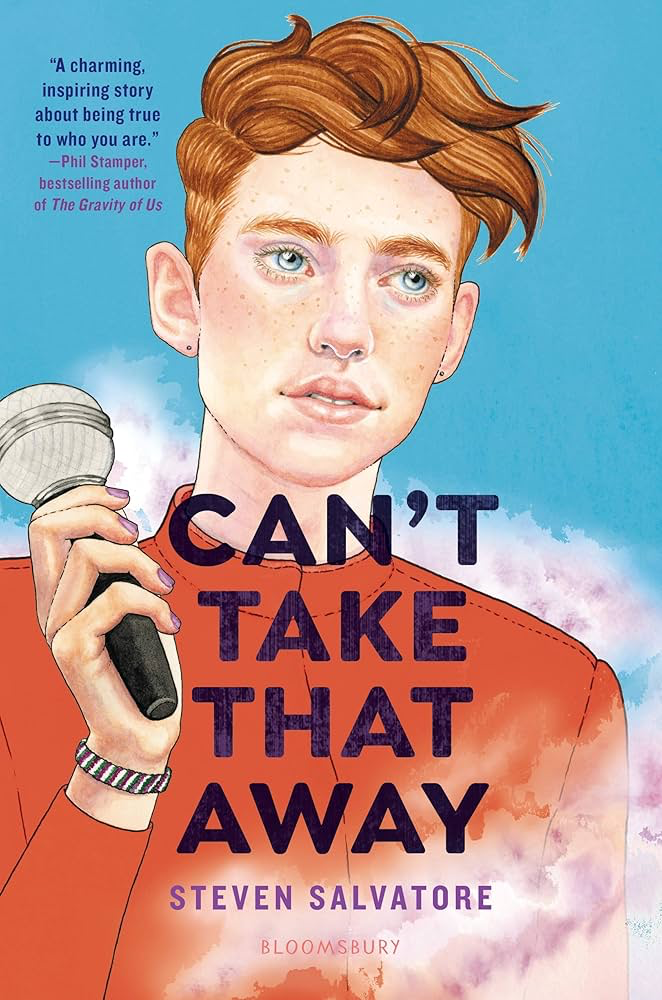
Book Review Tuesday (12/17/24) – Can’t Take That Away

Happy Tuesday, bibliophiles!

For the time being, I’m back! Safe to say I was swamped this semester, so I’m glad that I’ll have about a month of rest before I go back to school for the spring semester. When I wasn’t writing here or in my WIPs, I wrote around a combined 24 combined pages for various papers…and they say being an English major is easy…

Either way, I’ve had Can’t Take That Away on my radar since it came out in 2021. As with most other books on my TBR, there’s no real rationale for it languishing there for so long. I ended picking it up because of the premise; queer YA and MG books are bearing the brunt of bans and challenges here in the States, so I wanted to support them whenever I can (even if it’s already a good amount of what I read). (I can’t find anything definitive on whether or not this one was actually banned or challenged other than one Goodreads reviewer shelving it as such.) Either way, though it had its flaws, the storyline of Can’t Take That Away feels ripped right out of the headlines, and it’s a vital piece of literature for trans teens looking to find their voices.

Enjoy this week’s review!

Can’t Take That Away – Steven Salvatore

Carey Parker was born to be a diva. With an unwavering love for Mariah Carey and aspirations of stardom, they have fought tooth and nail to express themself the way that they want. So when a friend convinces them to audition for Elphaba in their high school’s production of Wicked, they seize the opportunity—and land the leading role. Yet in spite of their apparent talent, parents and teachers cause an uproar about genderqueer Carey’s casting in the role of a leading lady. With mounting threats to kick them out of the play and dismantle the production all together, Carey must find their voice in order to prove that they deserve to be heard—and sing.

TW/CW: homophobia, transphobia, misogyny, misgendering, physical assault/violence, descriptions of injuries, bullying, gender dysphoria, suicidal ideation, cheating, loss of loved ones

I have nothing against Wicked, but reading this while being oversaturated with all things Wicked every time I opened up Instagram was an experience, for sure…I guess if Carey were a real person, they’d be over the moon at the prospect of the movie, so there’s that.

Without a doubt, Can’t Take That Away is a story that needed to be told. For the most part, I applaud Steven Salvatore for delivering this novel with unflinching realism (about 90% of it, at any rate. More on that later). The plot—parents and teachers cause an uproar when a genderqueer teen takes on the role of Elphaba in their high school’s production of Wicked—feels like a headline waiting to happen. I have no doubt that it’s already happened. My only minor complaint is that the main villains (Mr. Jackson and Max) felt cardboard, but they too, in a way, felt like the adults raving and ranting about “gender ideology” and the online trolls bent on tearing queer people down. They leaned on the side of exaggeration, yet…some people are just like that, unfortunately. That realism is what fueled the story; Carey’s manifold struggles, from grappling with gender dysphoria, bullies, and first love, was delivered both candidly and sensitively. Salvatore didn’t hold back from the ugly parts of some of these topics (be warned—happy ending aside, it’s a rough ride), but it made them all the more important to show that, like the plot, Carey is as real a person as your trans classmate. Carey could easily be someone in your life, and that was what made the story ring so resonantly.

That being said, I felt that the romance was incredibly messy, and not necessarily in a good way. Having Carey have their first love as they’re fighting to find themself was a good side plot in concept, but…it was just a dumpster fire for no reason. I don’t know if this is just me reading YA and no longer being a teenager, but half of the romantic drama felt unnecessary in contrast to the very timely, very upfront main plot. Why did Carey need to kiss some random guy in a basement while they were dating Cris? How are Carey and Cris just okay with everything that the other did? Maybe this is just me, but if my partner kissed somebody else in a basement while we were dating, I wouldn’t come running back…see? MESSY. Can’t Take That Away already had high drama aplenty, and I know that’s a hallmark of YA to some extent (that I appreciate), but this bordered on ridiculous.

I’m rather conflicted about the ending. It was wrapped up quite neatly, which isn’t inherently a crime, especially since it’s YA. There are bound to be some things that are tied up more nicely than they would be in real life. Can’t Take That Away is aimed at high schoolers, and unless it’s too neat, this quality isn’t always an instant flaw in YA books. That being said, Can’t Take That Away bordered on taking that to an extreme. After the protest, the cops are immediately on the side of the queer people and people of color, and have almost no hesitation about punishing the white male perpetrators of the hate crimes. Carey’s protest immediately goes viral, and they get so famous that they get free tickets to see Mariah Carey and go onstage and sing with her. The bad guys get their comeuppance almost instantly, and the good guys get the greatest rewards possible. I’m not saying that Carey and company didn’t deserve a happy ending—they absolutely did—but it felt unrealistic to a point where it almost felt like the fulfillment of a fantasy. Sure, that’s what writing’s for to some extent, but when dealing with a plot that felt ripped from the headlines, the resolution felt much less so. You can give characters a fulfilling, satisfying victory that feels earned and realistic!

Yet at the same time, queer kids deserve these kinds of stories. There are easily infinite examples of straight characters getting unrealistic endings that end in instant fame and wish fulfillment, so why shouldn’t Carey? Why shouldn’t all of the trans kids reading their story? Yes, it made me roll my eyes a little when this story, one that ended well enough, had to escalate everything to “and then Carey got everything that they ever wanted in life! Yippee!” But after the deluge of hatred and violence that Carey endured throughout Can’t Take That Away, why shouldn’t they get that ending? This novel is not escapist by any stretch of the imagination, but there’s a kind of necessary escapism in these stories—very real circumstances resolving with the absolute best possible outcome with no strings attached. Sure, it was a stretch, but Carey deserves it—and so do all of the queer teens reading this book.

All in all, a book with flaws here and there, but ultimately proved a timely story about finding your voice. 3.5 stars!

Can’t Take That Away is a standalone, but Steven Salvatore is also the author of And They Lived…, No Perfect Places, The Boyfriend Subscription, and the forthcoming novel When Love Gives You Lemons, which is slated for release in May of 2025.

Today’s song:

this is the least fitting pick for a book about a teen who loves Mariah Carey, but I only pair books with songs in my Sunday Songs, so…enjoy the whiplash. Bon appetit!

That’s it for this week’s Book Review Tuesday! Have a wonderful rest of your day, and take care of yourselves!
Posted in Book Review Tuesday

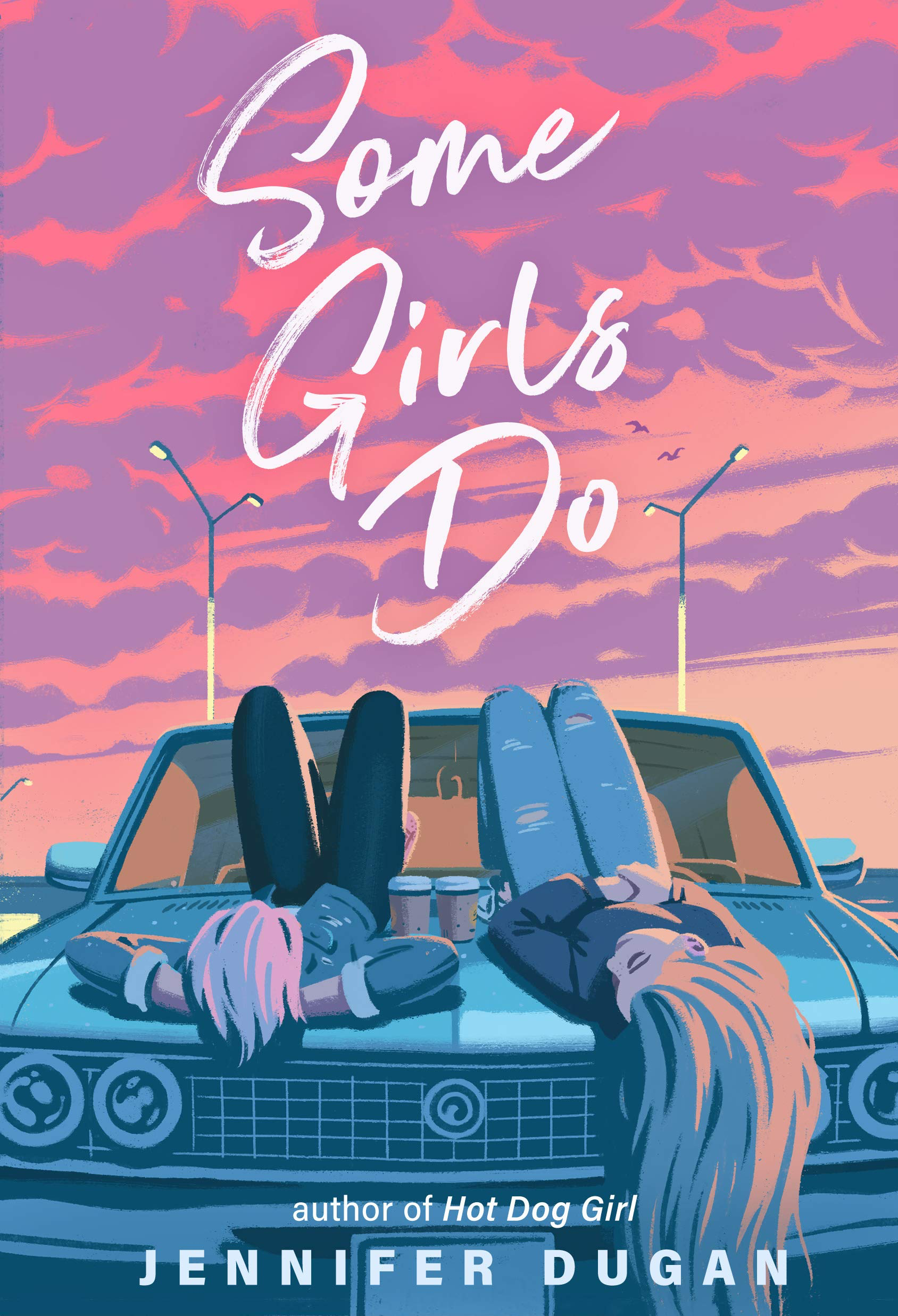
Book Review Tuesday (9/24/24) – Some Girls Do

Happy Tuesday, bibliophiles!

More importantly, Happy Bisexual Visibility Day…one day late! 🩷💜💙 I figured I would center a bisexual story for this week, and between my readings for school, I’ve been trying to squeeze in some books for this occasion and for Latinx Heritage Month as well. I’ve read a handful of Jennifer Dugan’s other novels, and I can always count on her for a solid queer YA romance. Some Girls Do wasn’t her best work, but when it hit the right notes, it was appropriately sweet.

Enjoy this week’s review!

Some Girls Do – Jennifer Dugan

Ruby Torino is intent on keeping her head down until she graduates high school. Even though she’s sick of competing in beauty pageants to appease her mother, she knows that it’s the only way out—the next one’s prize is a scholarship to a community college. There, she can be openly bisexual and not have to please her parents. But when Morgan Matthews, an out-and-proud athlete who was kicked out of her Catholic school after they found out she was a lesbian, transfers to Ruby’s school, her world is turned upside down. Against all odds, the girls end up falling for each other. But Ruby can’t risk coming out—and Morgan can’t seem to let it go.

TW/CW: homophobia, biphobia, verbal and emotional abuse, pressure to come out

Some Girls Do wasn’t a perfect romance, but it was about imperfect people, and for half of the main cast, it worked out. It didn’t blow me away, but it was a solid read for Bisexual Visibility Week!

I wasn’t a fan of both members of the couple (more on that later), but Ruby was such an excellently complicated protagonist! All of her life, she’s been in a volatile position, what with her mother, who had her when she was a teenager, pressuring her into competing in beauty pageants to fulfill the dream she never got to live out herself. Between that and her abusive, homophobic father, she’s learned to guard herself, making her outward personality prickly and unapproachable, even as she blends in with the popular crowd. She’s far from a perfect person, and yet I found myself rooting for her in a way that I couldn’t bring myself to root for Morgan; Ruby’s struggles were tangible and her victories hard-won, and the biggest aspect that kept me reading Some Girls Do was the desire to see her dreams fulfilled.

I find that there’s a limbo that a good amount of queer media doesn’t talk about in terms of environments that people can grow up in. The hometown of Ruby and Morgan is in an in-between place: on paper, it’s mildly liberal and accepting, but there’s still a stigma around queer people. The high school has a pride club, but its members fear holding hands in the hallways. Some of Morgan’s friends act supportive, yet turn up their noses at the idea of the pride club. It’s a dynamic that I haven’t seen explored in queer media often, and Dugan did such a wonderful job in both portraying it and shedding a light on it. Like Ruby and Morgan’s relationship, it’s uncertain what the next day will bring, but there are pockets of unconditional shelter and safety if you look hard enough.

With that out of the way…Morgan. I was not a fan of her. To Dugan’s credit, it’s shown pretty clearly where she’s coming from; by being out, she’s had to risk everything, and is adamant that those who wronged her are proven wrong. But in being so out and proud, she comes off as callous and selfish in all of the wrong ways. When she and Ruby are trying to make it work, she continually pressures Ruby to come out, seemingly oblivious to the very real consequences that could befall her if her parents found out that she was bisexual. Even in her staunch “warrior defending the LGBTQ+ community” stance, she somehow completely forgot that not everyone has the privilege to be openly queer. There was some reconciliation of her attitude and said privilege towards the last part of the book, but in the end, it felt like too little too late.

In concept, Ruby and Morgan’s relationship was cute; once they got into a good rhythm, they had moments of quiet, tender bonding and sweet banter in equal measure. Yet despite Dugan’s efforts to make it work, the way that Morgan was written made it so that it never fully landed. It felt as though no matter how hard they fell for each other, Morgan would never accept that Ruby wasn’t comfortable with public being her girlfriend; even though there were moments at the Pride Club meant for Morgan to learn the error of her ways, she continued to pressure Ruby to do things that weren’t just uncomfortable but unsafe for her. If you took all of that out of the equation, they had some solid chemistry. But Morgan’s unwillingness to accept that Ruby had to stay closeted for her safety made the foundations of what could have been a good romance fold. Encouraging your partner to put her safety in jeopardy is decidedly not romantic.

All in all, a sapphic romance starring some girls that were thoughtfully written and easy to root for, but some girls that were too selfish to even try to like. 3.5 stars!

Some Girls Do is a standalone, but Jennifer Dugan is also the author of several other novels for YA and Adult audiences, including Hot Dog Girl, Melt With You, Verona Comics, The Last Girls Standing, Love at First Set, and many more.

Today’s song:

I’m SO glad my shuffle brought this one out of the depths, I forgot how much I loved it :.)

That’s it for this week’s Book Review Tuesday! Have a wonderful rest of your day, and take care of yourselves!
Posted in Book Review Tuesday

Book Review Tuesday (7/30/24) – To a Darker Shore

Happy Tuesday, bibliophiles!

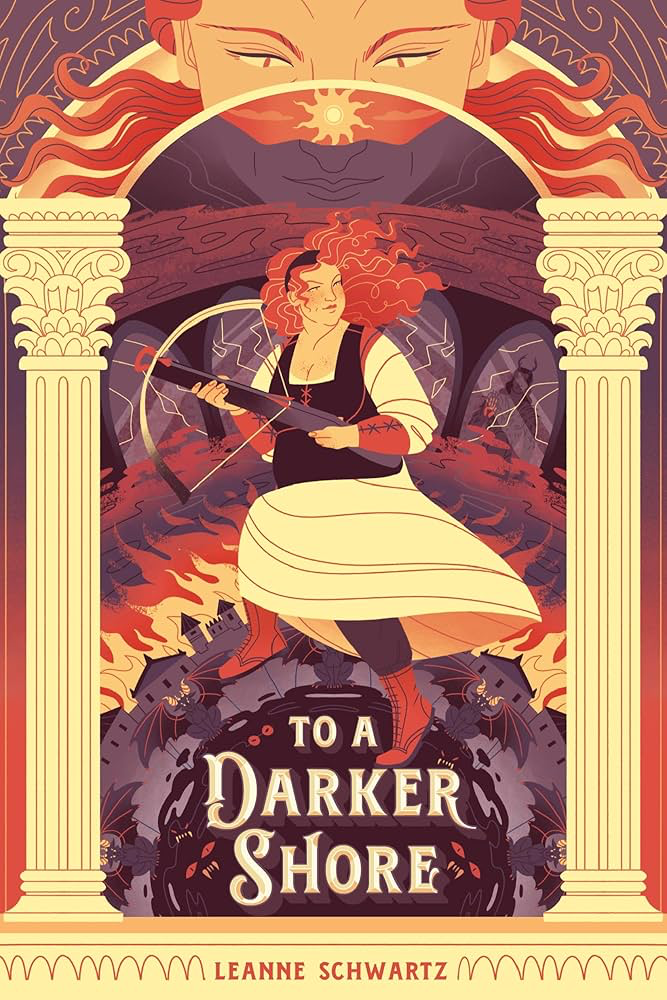
I was first exposed to Leanne Schwartz through A Prayer for Vengeance, and enjoyed her YA fantasies that centered autistic and plus-size protagonists. I’d forgotten that she’d written another book featuring an autistic protagonist, and I figured it would be perfect for Disability Pride Month. While it didn’t blow me away, To a Darker Shore had a lovely setting with immersive writing and the journey of a courageous girl who would quite literally walk through hell to save her best friend.

Enjoy this week’s review!

To a Darker Shore – Leanne Schwartz

If there’s one thing that Alesta has known her whole life, it’s that she knows that she has something to prove. Poor, autistic, and plus-size, she means nothing to the townsfolk, save for what she can provide as a sacrifice to their hungry god, Hektorus. So she throws herself into intricate inventions, hoping they can earn her favor with the king. But when a test flight of one of her flying machines goes awry at an exhibition, Alesta knows she’s bound for hell. Yet it’s Kyrian, who helped her test the machine, that takes the fall, now condemned to hell instead of her. Alesta will do anything to bring Kyrian back…even if it means venturing into the treacherous depths of Hell itself.

TW/CW: loss of loved ones, misogyny, fatphobia, ableism, violence, blood/gore, claustrophobia, panic attacks, grief, homophobia

Why does WordPress keep trying to autocorrect “Alesta” to “Alert?” I can only imagine how it was while Schwartz was writing the book in the first place…

Even though Leanne Schwartz isn’t my favorite author, I love her apparent goal of putting out YA fantasy novels with plus-size, queer, and neurodivergent characters at the forefront. A Prayer for Vengeance didn’t blow me away, but it was an enjoyable read nonetheless; to an extent, I feel a similar way about To a Darker Shore, but it’s clear that her writing has improved greatly in the span of two books!

Schwartz’s lovely prose was clearly the star of To a Darker Shore. Throughout the novel, there’s a stark contrast between the fantasy, Renaissance Italy-inspired whimsy and the monstrous realms of hell, but Schwartz handled each of them with the appropriate weight they deserved. The first part of the novel did a wonderful job of immersing me in Alesta’s kingdom, and with every description of the coastline surroundings and the bustling cities, I was instantly transported. Schwartz’s balance of humor and weighty subjects (ableism, fatphobia, and purity culture, to name a few) was handled with aplomb—the strength of all of these aspects is how balanced they were. Additionally, To a Darker Shore’s writing felt like the perfect transition between Middle Grade and YA; apart from some violence and strong language, the accessible writing style and the narrative voice of Alesta could be a great bridge for younger YA readers to start in the genre.

Alesta was also a fantastic protagonist to propel the reader through this treacherous journey into hell! Schwartz did an excellent job of relying on showing to build up to the suspense of losing her best friend; by the time Alesta’s quest through hell begins, you truly do understand her relentless devotion to rescuing her friend, even if when they reunite, hell has permanently altered him. She stopped at nothing to make sure Kyrian made it out of hell alive, and you believed every part of her friendship and steadfast adherence to her mission. Her relentless spirit not only gave the story stakes (I certainly got the sense both she and Kyrian would fall apart without the other), but a reason to follow her along—at its best, there were times when I was invested in the story just because Alesta cared so deeply for succeeding in her impossible mission. Although I liked A Prayer for Vengeance, Leanne Schwartz’s way of writing her protagonists has improved since then, and Alesta is living proof.

I came away from To a Darker Shore with mixed feelings about the worldbuilding. On the one hand, I enjoyed the Renaissance Italy-inspired setting; Alesta is compared to Leonardo Da Vinci in the synopsis, and I loved the aesthetic of her wooden flying machines and the various magical contraptions that she constructed. The worldbuilding surrounding the religion that concerns most of the novel was also well-executed. Schwartz did an excellent job of setting up exposition in a variety of ways, ranging from stories that Alesta had grown up with to descriptions of religious festivals that served to explain some of the mythology. However, even with the obviously Christian inspiration that this religion was based in…why call it Heaven and Hell if it’s an entirely different religion? I get the comparisons here, but it kind of took me out of it to have a whole fantasy religion and then have the exact same names of Christian concepts in it. Considering how detailed most other aspects of this religion were, it comes off a bit lazy—either make it a more direct analog to Christianity, or give Heaven and Hell different (and more creative) names, in my opinion.

Additionally, there were quite a few side characters that surrounded Alesta that didn’t seem like they had anything to do. Along with the dreaded time skip that came out of nowhere [hisses like a vampire with holy water chucked on it], we were just as abruptly introduced to some of Alesta’s other friends. It wouldn’t have been a problem if they had any role in the novel other than to tell the reader that Alesta has made friends after Kyrian’s sacrifice. They were pushed aside as soon as Alesta ventured into hell (a section that takes up about a third of the novel), and therefore had no room to have distinct personalities or roles other than being Alesta’s friends. Since To a Darker Shore is centered so prominently around the unbreakable friendship between Alesta and Kyrian, it would have been better to scrap them entirely—or at least not give them a role that Schwartz seemed to place disproportionate importance on.

All in all, a YA fantasy that took some shortcuts with its side characters and worldbuilding, but was nonetheless a satisfying story of friendships strong enough to survive hell itself. 3.5 stars!

To a Darker Shore is a standalone, but Leanne Schwartz is also the author of A Prayer for Vengeance.

Today’s song:

no idea how I forgot about this one, but I’m so glad I did!! a nostalgic childhood staple, for sure.

That’s it for this week’s Book Review Tuesday! Have a wonderful rest of your day, and take care of yourselves!
Posted in Book Review Tuesday

Book Review Tuesday (7/23/24) – Finna

Happy Tuesday, bibliophiles!

Finna has been on my radar since it came out back in 2020; it had a funny and clever concept, but it just kept being pushed back on my TBR for whatever reason. I ended up picking it up after hearing praise from one of my creative writing classmates, and although it wasn’t perfect, it delivered on its inventive premise.

Now, tread lightly! This week’s book review contains spoilers for the novella, so if you intend to read Finna, skim at your own risk.

Enjoy this week’s review!

Finna (LitenVerse, #1) – Nino Cipri

Ava and Jules barely make a living working minimum wage at LitenVarld, a Swedish furniture supply giant. Ever since they broke up, they’ve been trying to avoid each other, and with the labyrinthine structure of the store, it’s easy. But the two are thrown together when an old woman goes missing and the manager tells them that LitenVarld is no ordinary store—it’s prone to opening wormholes that lead to alternate dimensions. Ava and Jules must search across the universes to return the old woman to safety at any cost, but their superiors appear less and less like they have their needs in mind…

TW/CW: blood, violence, grief, mental health themes (anxiety and depression), misgendering

My main concern with Finna was that it would only have the premise to hold it up. It’s a fantastic premise! And although it wasn’t a perfect novella, it went far beyond the expectations for its ideas, delivering an anti-capitalist spin on the monstrous multiverse.

Making Finna a novella was, without a doubt, a wise move. It’s got an inviting premise—a not-IKEA store that’s home to a multitude of portals to strange and hellish dimensions—but it’s one that could have easily been stretched out. It partly works because…well, if you’ve ever been inside IKEA, that’s where your mind naturally goes, but Finna mainly succeeded because Cipri knew the limits of the idea. If it had been a full-length novel, I’m sure it would have been interesting to see the other dimensions hidden within the interdimensional labyrinth of LitenVarld, but the plot couldn’t have sustained itself beyond 100 pages. I’ve seen too many novels where the story has been stretched far too thin, so to have an author know the limits of their story—and have an inventive novella to show for it—was incredibly refreshing.

Finna is the perfect story for right now not just because it has a fun concept, but because it truly nails the kind of corporate neglect that runs rampant in workplaces in this day and age. Even against the threat of a multiverse full of monstrous obstacles (including but not limited to man-eating furniture), Ava and Jules are having to tackle threats leagues beyond their pay grade, and their only compensation is gift cards for a pasta restaurant. Their managers openly tell them that they don’t actually care about the old woman who’s gotten lost in the multiverse—they just want Ava and Jules to find an alternate universe replacement for her so that they can keep up appearances. It’s all so blatantly uncaring and corporate—and it’s all realistic. If some massive chain of stores discovered a wormhole in one of their locations, they would absolutely cover it up until it was no longer possible to do so, especially at the expense of the minimum wage employees. I will say that, although you got hit over the head with this even though the commentary was right there already, Finna’s setup made it perfect for the anticapitalist commentary that Cipri explored—corporations only make it look like they care about you when it looks good for them, and even then, the worker is always dispensable. The execution of this corporate setting was, in the end, what made Finna so successful in that regard—it seems like a real, capitalist response to a fictional problem.

That being said, even though Finna works best as a novella, it did fall victim to some of the pitfalls of novella writing. It’s difficult to develop characters in just over 100 pages, and this worked to the detriment of its protagonists, Ava and Jules. We only knew them from the lens of their situations and their breakup; after finishing the novella, all I knew about Ava was that she a) had a failed relationship with Jules, b) had anxiety and depression, and c) hated her job—nothing much about her personality. This is about as deep as we get with her, and for Jules, we get even less, other than the fact that they’re more reckless and cocky, and for that reason, Ava doesn’t like working with them. The plot was compelling and well-executed enough for me to continue reading the story, but it was so plot and theme-driven that the characters were left in the dust.

Such underdeveloped first drafts of characters meant that the emotional impact of Finna was all but deadened. I got the feeling that I was supposed to feel something when Jules sacrificed themself so that Ava could return to her home dimension, but since I knew so little about them, I never felt much. What Jules needed, perhaps more than a handful of base personality traits, was some kind of motivation; it could also be down to how quickly the second half moves, but their quest through the other dimensions gave us no indication of why they would go from reckless to selfless. It could just be the constraints of the novella format, but I’ve read plenty of novellas longer and shorter than Finna that have been able to establish well-rounded characters with believable motivations, so I’m not sure if there’s much of an excuse for this.

All in all, a novella with a funny, inventive premise and sharp anti-capitalist commentary that was dragged down by its underdeveloped characters. 3.5 stars!

Finna is the first novella in the LitenVerse series, followed by Defekt. Nino Cipri is also the author of the short story collection Homesick: Stories and the forthcoming YA novel Dead Girls Don’t Dream. They have also contributed stories to Nonbinary: Memoirs of Gender and Identity, Transcendent: The Year’s Best Transgender Speculative Fiction, and several other anthologies.

Today’s song:

forgot about this song for ages…

That’s it for this week’s Book Review Tuesday! Have a wonderful rest of your day, and take care of yourselves!