Posted in Book Review Tuesday

Book Review Tuesday (12/24/24) – The Lost Story

Happy Tuesday, bibliophiles, and a merry Christmas Eve (and Christmas, in advance) to those who celebrate! No matter your beliefs, I hope you’re staying warm and spending time with your loved ones this week. Happy holidays! ❄️⛄️🎄🍪

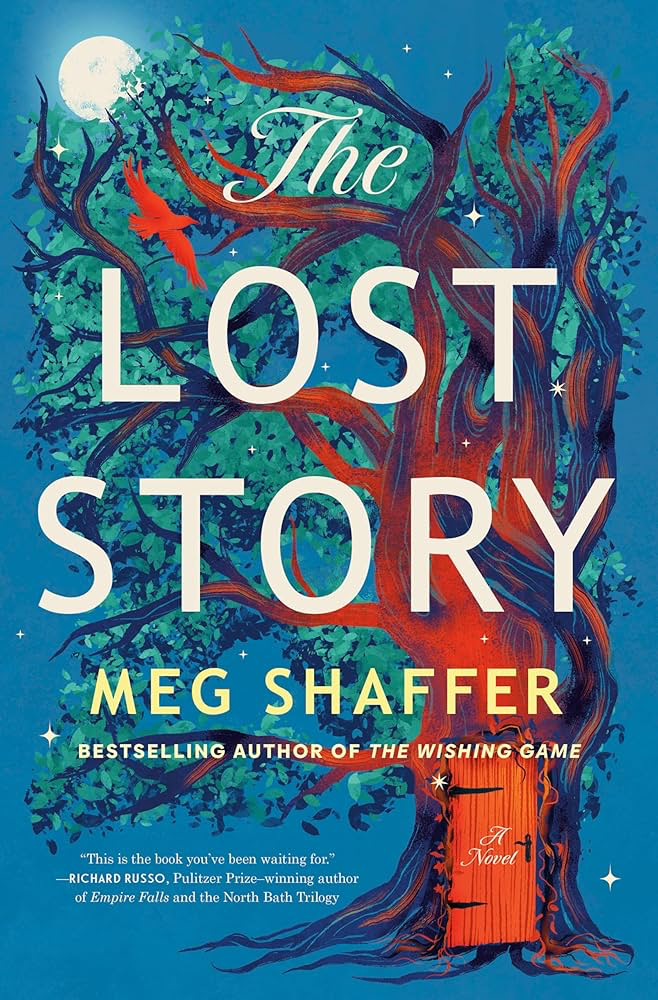
I discovered Meg Shaffer’s debut novel, The Wishing Game, about a month back and loved it. (Bottom line: if you’re an adult who wished they could’ve gotten Willy Wonka’s golden ticket as a kid, READ IT.) Naturally, I moved onto The Lost Story the minute it became available at the library. Although it wasn’t as strong as Shaffer’s debut, The Lost Story is a testament to the healing power of fantasy.

Enjoy this week’s review!

The Lost Story – Meg Shaffer

When they were 15, Rafe Howell and Jeremy Cox went missing in the West Virginia woods. Six months after their disappearance, they came back, seemingly unscathed. What the rest of the world doesn’t know is that they escaped to a fantasy world hidden deep in the Red Crow State Forest. But only Jeremy remembers their odyssey. Now, distanced for 15 years, Rafe remembers nothing about what happened that day, and Jeremy has a magical knack for discovering missing persons.

Emilie Wendell has gotten wind of Jeremy’s talent for locating the missing, and enlists his help to find her older sister, who vanished in the same stretch of woods where he and Rafe went missing all those years ago. With Rafe and Jeremy in tow, Emilie discovers a magical world that could have only sprung from the mind of a child, only visible to those who look hard enough. But confronting this world and its secrets may lead to the very reason that Jeremy and Rafe never spoke of their time together—and the reason why Emilie’s sister never returned.

TW/CW: near death situations, discussions of child endangerment/kidnapping (past), abuse (physical and emotional), homophobia, loss of loved ones (past), fantasy violence, mentions of suicide (past)

I never got around to reviewing The Wishing Game (which I liked better than The Lost Story) here, but it’s safe to say that Meg Shaffer is out here doing the good work, and by the good work I mean writing books about reclaiming childhood innocence and joy via the stories we loved as children. Having read both books, Shaffer really gets the power of stories—and the power of rediscovering them in adulthood. The balance between childlike wonder and whimsy and the harrowing realities that come with adulthood are a difficult balance to strike, but The Lost Story lives in the reality between them and never denies either aspect. Rafe and Jeremy’s journey of healing, rescuing people who may not need to be rescued, and realizing their love for each other was a rickety, emotional ride, but one that, once the plot got going, paid off in spades. Plus, I love that Shaffer made this story a distinctly queer one—I always love queer books, but the fantasy escapism plot with their queer identities made so much sense when you consider how fiction can be a sanctuary for queer people.

Part of what made that aspect of The Lost Story land so well was that Shanandoah truly felt like a child’s wonderland. There was a charm to the misplaced names (the Valkyries being only what a young girl would think of the real Valkyries of Norse myth, for instance) and the over-the-top magical ones, and each fantasy element had the nonsensical aspect of a child’s mind. This world is full of magical horses, impossibly sweet fruit, vengeful spirits, and everything a child could possibly populate a fantasy world with—and all of it is delightful. The Narnia influence was clear (it’s wonderful! Imagine C.S. Lewis without the proselytizing), but there was a whimsy to it that Shaffer excelled in—even if it was separate from the real world, she fully succeeding in making a world feel like it was ripped from the pages of a 13-year-old girl’s notebook.

However, I really didn’t see the point of Emilie being a part of the story. In contrast to Jeremy and Rafe’s complicated relationship, the only thread connecting her to the narrative was the fact that it was her sister who happened to have gone missing. Her personality bordered on grating—there wasn’t much to her other than a determination to find her sister and having her “teehee! so quirky”-isms when the plot called for it. (But did it really call for it?) My main issue with her is that she didn’t have the development that the other characters did. She witnesses the wonders and horrors of Shanandoah and comes out of it having barely changed, save for the fact that she’s reunited with Shannon. In contrast with Rafe and Jeremy, it just seemed increasingly obvious that she didn’t have as much business being there, even though she was purportedly the main character. The Lost Story might have been stronger if she had been nixed entirely—she was placed as the protagonist, but at its heart, it was the story of Rafe, Jeremy, and Shannon, not her.

Additionally, The Lost Story had some issues with its pacing. It took nearly halfway through the book for the characters to reach Shanandoah, the whole premise of the book. The first third or so, although Shaffer’s establishment of the exposition was spread out evenly, tended to drag. Instead of more development that could have lead more to the (excellent) arcs of the characters later on, we get drawn-out scenes of banter between the main characters once they reunite, as well as some tired training montages that could have been flattened out into a much shorter scene. As a result, the first half of the events in Shanandoah were rushed together—our heroes reach this famed fantasy land, and almost immediately, they’re separated and thrown on wildly different adventures that only converge in the last quarter or so. For such a grounded story, there needed to be more even allocation of events that truly mattered, which is why I couldn’t give it the full 4 stars.

That being said, I loved how the duality of the themes were tied together in the end. For all of the characters, the land of Shanandoah was escapism, but they had different ways of handling reality while in it. For Rafe and Jeremy, they couldn’t stay because there were real monsters they had to confront; Shanandoah worked both as a place for them to rekindle their relationship, but also to confront the very real demons back in the real West Virginia. For them, they had to return to the real world to heal. But for Shannon, Shanandoah was the realest part of her life. She had gotten into a situation that no child should ever be placed in, and for that, her childhood wish for another world came true, and it became her sanctuary. If The Lost Story had gone with either interpretation, I would’ve been happy, but I loved Shaffer’s approach in depicting both sides of fantasy and escapism. Fantasy can be a place to ignore all of your troubles, but also a place you return to when you need healing. Even if it’s fictional, it can be the truest, realest part of you. Both can be true.

All in all, a heartfelt and heartstring-tugging fantasy for all of the kids who wanted to return to Narnia. 3.75 stars, rounded up to 4!

The Lost Story is a standalone, but Meg Shaffer is also the author of The Wishing Game.

Today’s song:

That’s it for this week’s Book Review Tuesday! Have a wonderful rest of your day, and take care of yourselves!

Posted in Book Review Tuesday

Book Review Tuesday (11/19/24) – Loka (The Alloy Era, #2)

Happy Tuesday, everyone!

…so. Elephant in the room here, quite literally. I’ll venture to say that last Tuesday was one of the worst Tuesdays in American history. Hence, no activity. (Also, I had a whole cocktail of midterms to study for and papers and annotated bibliographies to write.) I needed the time to grieve. Let me tell you the truth: I’m so scared. I’m betrayed. Being in my formative years under a president who systematically mocked the identities of everyone who isn’t him—not just the ones that comprise my family—forced me to confront the fact that America had no regard for me. If there was change to be made, I had to do it myself, and with the help of the communities around me. So I started writing. I started educating myself. The process is never over, and will continue until my dying day; even with the sort of beef that I have with Sara Ahmed (yeah, killjoy etc. etc. etc., I’m on board with 50% of it, but can’t feminism be gleeful sometimes?), I look back to her words: “To become a feminist is to stay a student.” I am always learning. I am far from perfect, but I am trying. The key here is motion: we can’t afford to stay static, not in our ideas or in our actions. Resistance comes in many forms (and don’t let anybody tell you that there’s one right way to fight), but the key is that we must always keep moving. Donate. Protest. Pay someone a compliment. Make art. Write with hope in your heart. Trump and his ilk win when we’re too far into the quicksand of hopelessness.

Never lose hope and never lose love, because that is what the Trump administration lacks. Grieve, and grieve on your terms. I certainly did. The last thing I wanted was a repeat of that November morning when, at the age of 13, I woke up to my dad hanging his head over the kitchen counter as he made lunches for my brother and I. I remember clinging to him tighter than I ever had, frightened of every horrid possibility. Some of them came true. Some of them didn’t. I called both of my parents. I cried the same tears to them that I cried when I was young. Cry the same tears, but remember that they are the same tears. I’m frightened. But if we can resist Trump once, we can do it again. We can fight the same good fight. I love you.

All this is to say that, even though my output has been lessened lately (college!), this won’t change a thing. I’ll still be reviewing queer books aplenty, and no election will change that. Gather ’round.

After a solid two weeks of reading nothing but fluff to keep my mind off of everything, I remembered that Meru, one of the more innovative new sci-fi novels I read last year, had a sequel that was finally out! I was eager to re-immerse myself into S.B. Divya’s endlessly creative futuristic landscape, and Loka found itself on my Kindle in no time. Loka turned out to be contrary to my expectations and a very different book to Meru—it was a mixed bag at first, but by the final third, I’m happy to say that it stuck the landing in a deeply moving way.

Now, TREAD LIGHTLY! This review contains spoilers for Meru, book one in The Alloy Era series. If you haven’t read Meru and intend to do so, read at your own risk!

For my review of book one, Meru, click here!

Enjoy this week’s review!

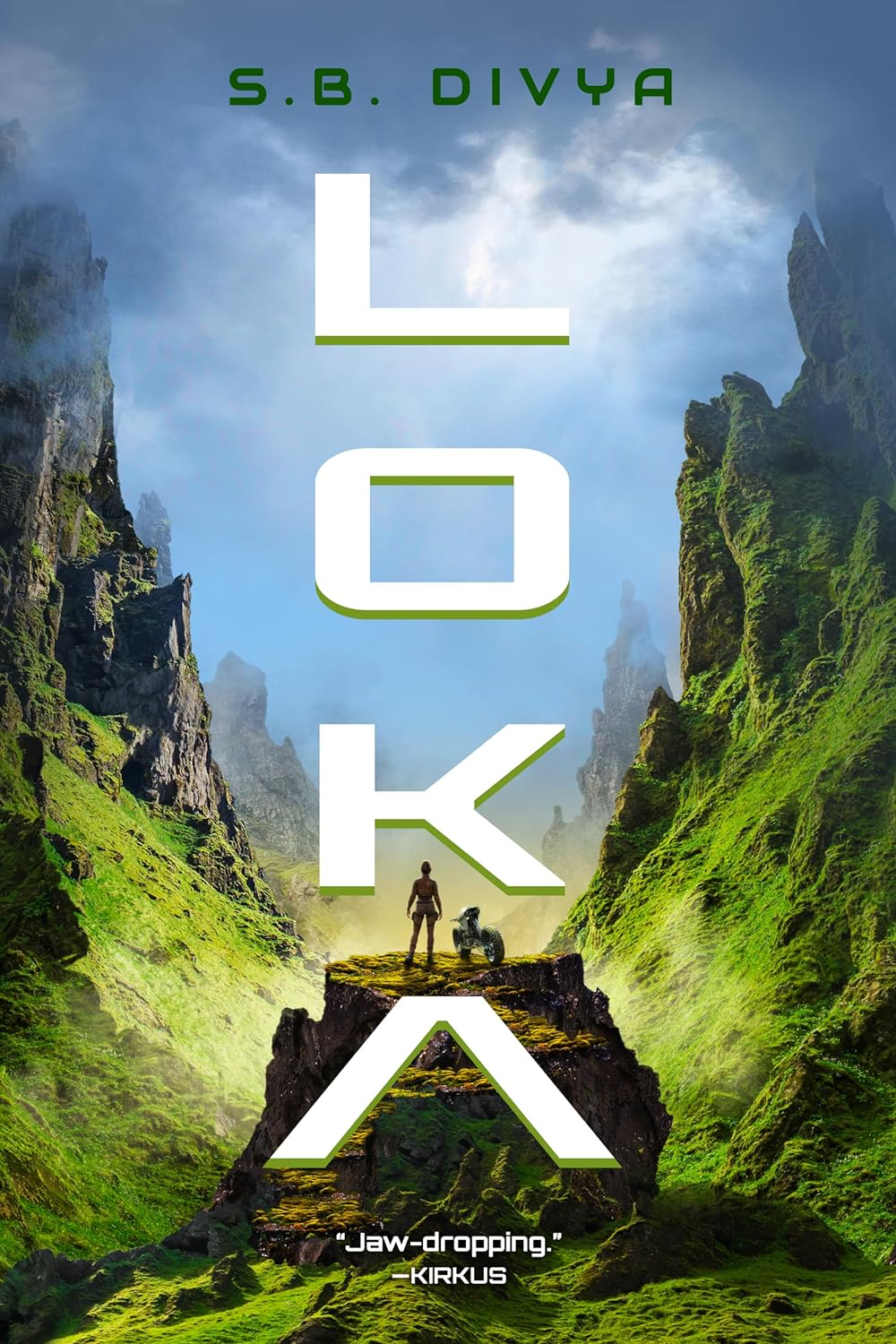
Loka (The Alloy Era, #2) – S.B. Divya

Akshana is a child that defies all existence. Her mother is human, and her maker is an Alloy—a post-human being with godlike powers. The ruling Alloy government condemns her very existence. For years, she has lived a sheltered existence on the planet Meru, raised by her human mother. But once Akshana turns 16, she heeds the call of Earth, the ancient homeworld of humankind. With the help of her friends, she takes up the rigorous Anthro Challenge: a trek to circumnavigate the habitable zone of Earth. As she navigates foreign terrain, Akshana comes to terms with how she was born and created—and where her destiny lies.

TW/CW: near-death situations, medical emergencies (related to sickle-cell anemia), xenophobia/discrimination (fictional), life-threatening storms

I thought that Meru had scared off all of the people who thought that S.B. Divya invented neopronouns, but apparently people are still complaining about it in the reviews for Loka? Did you just…miss book one in its entirety, or what?

I’ll get my main gripe about Loka out of the way first. The more I think about it, the more that I realize that my issue with Loka is that to some extent, it has the exact same stakes as Meru: a young girl/woman has to take a daring trek onto a foreign landscape, all the while facing prejudice from the outside world and alien, terrestrial dangers from the ground beneath her feet. S.B. Divya remains an excellent writer and crafter of worlds, but in terms of plot, in this case, lightning couldn’t strike twice. Aside from Akshana’s differing personality and the novelty of Earth 1,000 years in the future, there wasn’t as much to distinguish the two plots once I broke them down.

I wasn’t crazy about the main plot of the Anthro Challenge. In the future landscape of Loka, this challenge is designed for humans and Alloys to circumnavigate the landscape of Earth as humans did millennia ago. Only a few strips of Earth remain habitable (forming ringed borders around the world), but the brave adventurer must cross swaths of the Southern hemisphere and the Atlantic and Pacific Oceans in order to complete the challenge. In concept, it’s a great bit of worldbuilding, but it didn’t make for a very compelling of a plot. For the first half of the novel, it felt like the same regurgitation of 1) reach new landscape, 2) inter or intra-personal conflict within the friend group, and 3) make a harrowing trek to the next stop on the Challenge. This was rinsed and repeated with less change than I wanted; even with the new landscapes, none of the side characters had much time to develop, and they seemed to encounter almost the exact same problems for a solid 100 pages. It bordered on feeling cheap, given how innovative Meru was.

That being said, even though the plot faltered, Divya’s writing never did. You’ve just got to trust in her abilities at this point, because she can write some fantastic sci-fi, even if the foundation of the plot is flimsy. Her voice for Akshana perfectly captured that teenage urge to explore beyond your parents’ backyard and prove everyone wrong. Divya’s descriptions of future Earth, from the raging seas to the lush greenery to the plains of a futuristic America, immersed me instantly in a vibrantly crafted vision of the future. I’ll get to the specifics of the emotional core of Loka later, but that was perhaps the best part of the novel—S.B. Divya’s brand of space opera borders on hard sci-fi for me, but it keeps the emotional center that so many other hard sci-fi novels forget to consider.

The subject of disability was one of the more compelling aspects of Meru; in a genre rife with eugenic practices that get dismissed as signs of a “progressive” society, Divya changed the game by creating Jayanthi, who, in a future when most disabilities were edited out of the gene pool, was specifically engineered to have sickle-cell anemia. More than that, her sickle-cell anemia was advantageous for surviving the landscape of Meru. Fast-forward 16 years, and Akshana is experiencing, as I said before, the same plot, but her sickle-cell anemia presents unique challenges on Earth, leading to many a close scrape when she exhausts herself to near-fatal levels. She has thoughts of resentment towards her mother, who made a conscious decision to pass this gene down to her. S.B. Divya said that Loka was inspired by their experience being a disabled parent, and that shone through in Loka; eugenicists would have you believe that this would constitute cruelty on the highest level, but Akshana comes to reconcile with—and understand—her mother’s logic. By erasing this gene and others from the gene pool, the Alloys past erased entire cultures, as well as the ways in which they moved about in the world. Being disabled is challenging, to say the least, and in my experience, bothersome and at times taxing to deal with on a daily basis. Yet it has shaped my life in ways that I will never regret. Akshana comes to realize that her mother, even though the road to this decision was rocky, merely wanted her to know that individuality, adversity, and culture cannot be erased by a purging of the gene pool.

Which brings me to the ending. The buildup of Loka concerns the mounting pressure and prejudice surrounding daring Akshana and her friends as they complete the challenge and return to a world that wants to erase their bravery and ban the Anthro Challenge altogether. Not only has she come to terms with her disability, she has come to reckon with her status as a half-human, half-Alloy being in a galaxy where neither party wants her to exist. Yes, there was the physical challenge, but the real Anthro Challenge is the identity crisis you have along the way, amirite? All jokes aside, that was the real hurdle to overcome. I know how corny I sound, but the real journey was Akshana’s journey to self-acceptance in all of the facets of her identity. At the end of the treacherous paved with prejudice and hatred, Akshana learns that the only way to survive is to be yourself, unapologetically so. As she says, in Loka’s stunning final lines:

“Our bodies don’t have a true end. Subatomic particles bounced between skin and air continually. So what did that make me, or any person? If I coexisted with everything and everyone, then part of me was also part of them, and vice versa. To some people, I would never be human enough. To others, I would always be too human. In the end, I had no choice by to be myself.”

And if anything could save Loka from being a letdown, it would be this, and the character arc it coincides with. Excuse me for a moment…no, I’m not crying, it’s just raining on my face.

All in all, a sequel with a plot that nearly dragged the novel down, but just like Akshana completing the Anthro Challenge, beautifully stuck the landing after a rocky journey. 4 stars!

Loka is the second book in The Alloy Era series, preceded by Meru. S.B. Divya is also the author of Machinehood, Runtime, and several other science fiction short stories.

Today’s song:

NEW HORSEGIRL IN FEBRUARY? ON VALENTINE’S DAY? PRODUCED BY CATE LE BON? today is a GOOD day

That’s it for this week’s Book Review Tuesday! Have a wonderful rest of your day, and take care of yourselves!
Posted in Book Review Tuesday

Book Review Tuesday (7/9/24) – Stars in Their Eyes

Happy Tuesday, bibliophiles!

I’m always on the hunt for books with disability and bisexual rep, and I’ll always go for a graphic novel, so Stars in Their Eyes was a natural pick for me! With a charming story and graceful handling of social issues, this graphic novel was an adorable, light read that’s perfect for readers in transition between middle grade and YA.

Enjoy this week’s review!

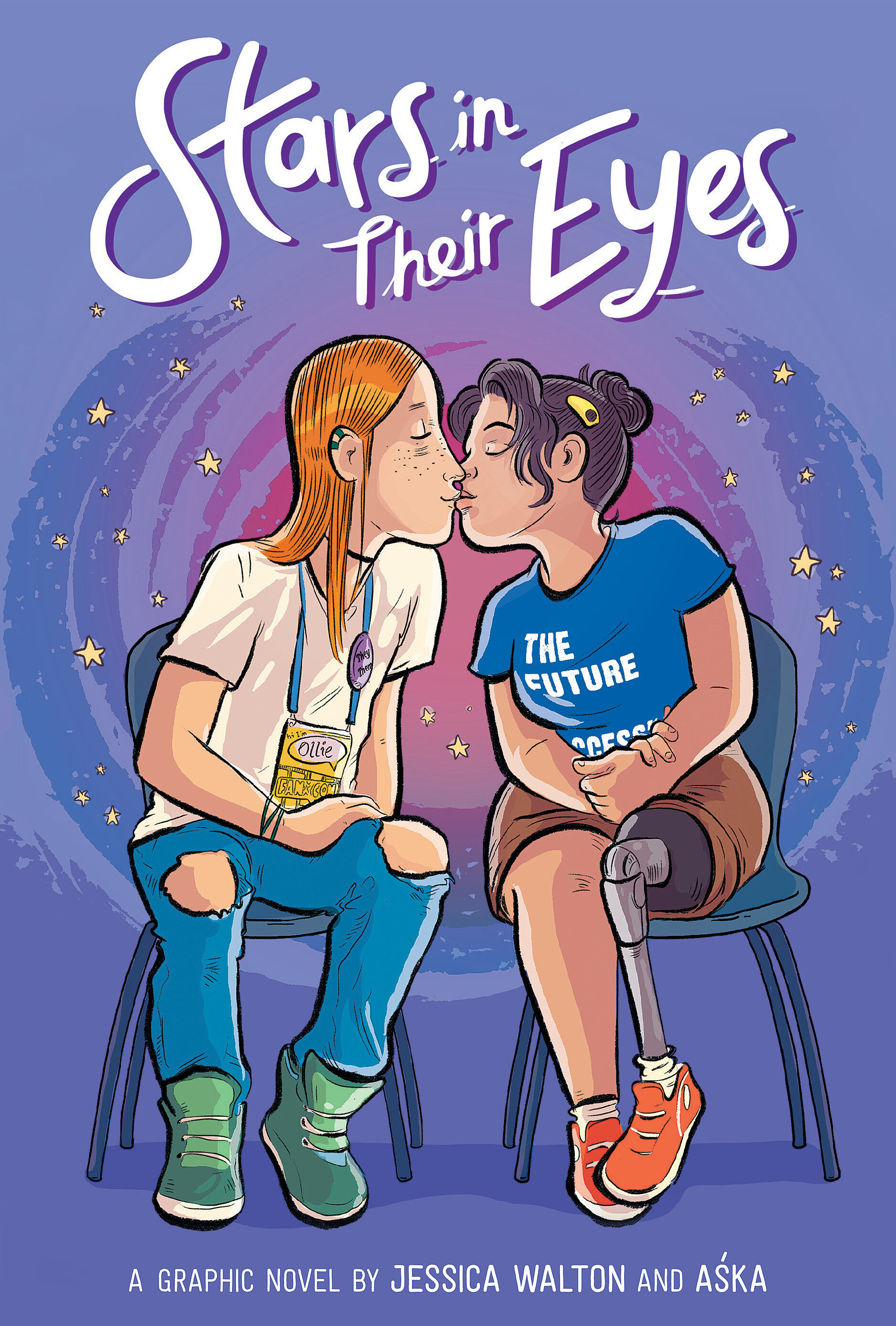
Stars in Their Eyes – Jessica Walton and Aśka

Maisie has saved up to go to her first FanCon, and now she’s finally on her way! She’s excited to meet her idol Kara Bufano, an action star who’s an amputee just like her. On arrival, FanCon isn’t everything that Maisie thought it would be—it’s loud, confusing, and it’s making her chronic pain act up. But when she meets Ollie, one of the young FanCon volunteers, it’s love at first sight. Maisie feels comfortable talking about her disability and queerness with them, but how will they manage when FanCon is over and they have to go home?

TW/CW: panic attacks, descriptions of cancer (past)

I’m firm in the belief that there should be some kind of smaller, transitory genre between middle grade and YA; the gulf between kid’s books and books meant for teens, especially in terms of maturity, is larger than most realize. But Stars in Their Eyes hits the perfect sweet spot between the two. With younger protagonists but a more nuanced view of social issues—and love at first sight—this graphic novel is a light, comforting read!

Even though I can’t speak to the accuracy of the specific disability rep (Maisie has a lower-leg amputation as a result of childhood cancer), it was so refreshing to see a disabled character written by a disabled author! It’s kind of painful to say that, but…the bar is so low, after so many middle grade and YA books that misrepresent disability. Nevertheless, the discussions surrounding Maisie’s disability were not only important to represent, but well-executed as well! There were plenty of natural segues that were used in Walton’s writing to get into topics such as overexertion and the importance of positive representation (!!!!), and it’s wonderful to see a pointed criticism of the narrative that disabled people exist to inspire non-disabled people. Stars in Their Eyes is bound to be so meaningful to so many young disabled readers, and it warmed my heart.

Stars in Their Eyes is also bound to be crucial for young queer people as well! Maisie is bisexual. and Ollie, the love interest, is nonbinary, but beyond that, there was an emphasis on being young and discovering your identity that I’m so glad is being represented. At 14, Maisie has only come out to a handful of people, and is nervous about being in queer spaces and going to queer events; it’s an issue that I rarely see in queer media, but it’s so important for young queer people know that it’s okay to be nervous about these things! There’s a first time for everything and everyone, and it’s natural to be shy or scared about showcasing your identity or belonging in queer spaces for the first time.

The comic con setting of Stars in Their Eyes was spot-on! I went to comic cons frequently when I was Maisie and Ollie’s age, and it’s a wondrous, nerdy experience—and it’s also an overwhelming one. It’s been several years since I’ve been to one, but I’m glad that this fictional one had a quiet-down room—I hope that soon becomes part of the institution, because what a lot of people don’t talk about with comic cons is that they’re a lot. (Man, I wish my comic con had one of those back in the day…) There’s so much to take in, from all of the booths and celebrities and cosplayers (and all of them crowded in one building), but all of that amounts to a ton of crowds and sensory overload. It’s the first comic con story I’ve seen tackle this aspect, and it’s a refreshing angle to see discussed. I have sensory issues, so that’s mainly why I got overwhelmed so easily at comic con, but it’s great to show younger readers that even though comic con is a wonderful place, it’s natural to be overwhelmed, sensory issues or not.

However, even though pop culture and comic cons were the focus of Stars in Their Eyes, a key part of it was mishandled and hindered some of my enjoyment of this graphic novel. Aside from two fictional TV shows that Maisie and Ollie bond over, almost everything is a fake reference—Barb from Stranger Things is now Bard from Danger Things, Star Wars is now Sci-fi Wars (??) and the Dark Side is the Far Side (????), and any Doctor Who-related media is referred to as “Time Doctors.” I get making faux-pop culture references to dodge copyright or establish a fictional world, but the sheer amount of them and how obviously they were referencing other very popular pieces of media just got so tiring and eye roll-inducing after a while. If it’s that obvious that you’re referencing a piece of media, it defeats the purpose of having a fake piece of media. It got so concentrated that I ended up bumping my rating down from the full 4 stars.

All in all, a lighthearted graphic novel about first love, geekdom, and the being confident in your queer and disabled identities. 3.75 stars, rounded up to 4!

Stars in Their Eyes is a standalone; Jessica Walton is also the author of Introducing Teddy, and has also contributed to the anthologies Growing Up Disabled in Australia, The (Other) F Word: A Celebration of the Fat & Fierce, and Meet Me at the Intersection.

Today’s song:

decided to give cate le bon a try after hearing her work with wilco & st. vincent…pompeii did NOT disappoint!!

That’s it for this week’s Book Review Tuesday! Have a wonderful rest of your day, and take care of yourselves!
Posted in Book Review Tuesday

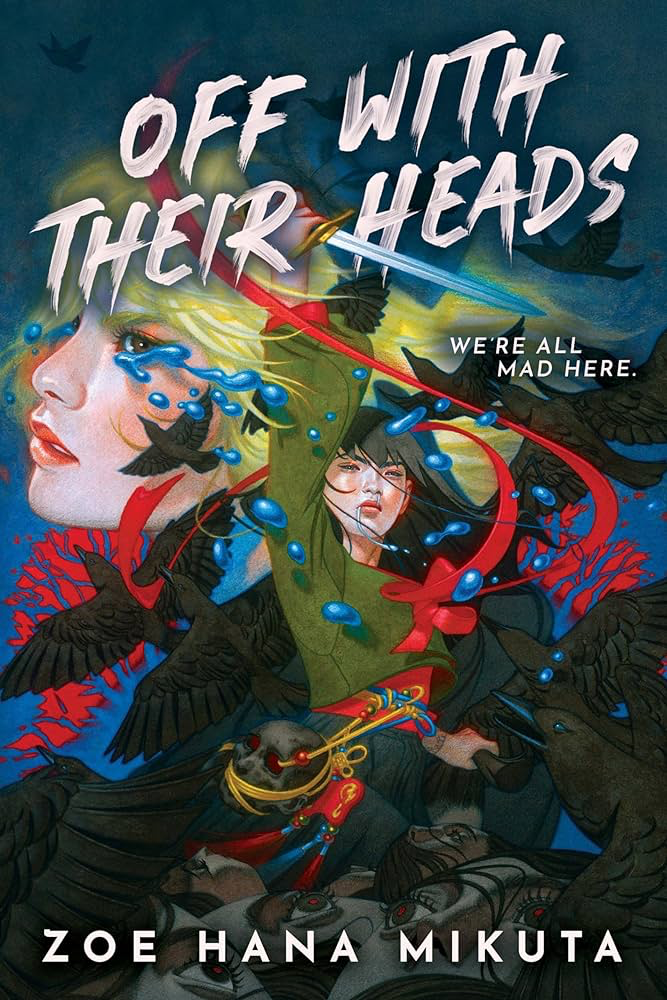
Book Review Tuesday (5/7/24) – Off With Their Heads

Happy Tuesday, bibliophiles! I’ve returned from finals hell!

I’ve been a massive fan of Zoe Hana Mikuta ever since I fell in love with her Gearbreakers duology a few years back. Off With Her Heads is her most recent novel, having just come out in late April, and even though I would’ve read it no matter what genre it was in, the idea of her writing a novel loosely based on Alice in Wonderland intrigued me—and it did not disappoint.

Enjoy this week’s review!

Off With Their Heads – Zoe Hana Mikuta

Wonderland is full of monsters.

After a deadly plague ravaged the land, most of the remaining witches and magic-users have transformed into monstrous Saints: bloated, bloodthirsty beasts that scour the land looking for fresh meat. Carousel Rabbit and Iccadora Alice Sickle were brought up in a world of predators and plague, orphaned at a young age and eventually escaping their decrepit orphanage together, madly in love with each other. But their obsession tore them apart, and their paths diverged.

Now, Caro has become the Red Queen’s royal butcher, killing Saints and watching as the Queen stitches together Saints of her own through dark, flesh-binding magic. Alice has been on her own for years, slaughtering Saints to get by. With every Saint that she kills, she treads closer and closer to the Red Queen’s throne—and to Caro, who Alice will stop at nothing to bring down to size. But what she finds in the Red Queen’s palace may be even greater of a threat than the love that once tore her to shreds…

TW/CW: loss of loved ones (past), murder, graphic violence, body horror, disease, blood, gore

Dark fairytale (or fairytale-adjacent) books used to be everywhere on the YA landscape. It’s the kind of stuff I ate up from about ages 12 to 16, to various degrees of quality. What they had in common, however, were universally horrible covers. God. They’ve circled back around to being hilarious now, but you could just snag any book off of the YA fantasy shelf at Barnes & Noble, and it would have a cover with an airbrushed white girl with flowy hair and an equally flowy gown either spinning gracefully or fixing your stare with a photoshopped smolder. And the gown was usually melting into…I don’t know, feathers or blood or some shit. It was all very emo. Since then, this subgenre has slowly begun to die down in popularity (or maybe not? My tastes have probably just shifted). Whether or not Off With Their Heads is the slow beginning of that subgenre’s resurgence in YA remains to be seen, but either way, I’m glad that we’ve got much prettier covers for the next generation of budding YA readers. It’s what they deserve. (Give it up for Tran Nguyen’s gorgeous cover art!)

After the Gearbreakers duology, I figured that I would read just about anything that Zoe Hana Mikuta writes. Even if Godslayers was a bit of a lackluster series concluder, it was still a fun read. Even if it isn’t her best work, you’re going to have a good time reading it regardless. Gearbreakers got a fair bit grim, as dystopias are wont to do, but Off With Their Heads is the darkest that Mikuta has ever gone (so much so that it almost borders on new adult and not YA), and she writes it with a unique talent. Whether or not the urge was pent-up, this novel revels in the “dark” of the “dark fairytale retelling,” drenching Alice in Wonderland in bloodlust, obsession, and backstabbing. However, what a lot of the dark fairytales of yesteryear interpreted darkness as was just being edgy; most everything was for shock value and appealing to the “what if this fairytale was………BAD and EVIL” urge that ropes in all the 13-year-olds and it didn’t go far beyond that. But this genuinely feels like horror, and not being an edgelord for edginess’ sake. It’s gory, it’s grim, and it’s bloody, but more in the interest of horror than shock—these characters are surviving a truly horrific world, and it turns them into horrific people for understandable reasons. There’s a distinction to be made there, and Mikuta certainly recognized it. (Also, it’s worth noting that Off With Their Heads is unflinchingly queer, which, given that most of said older fairytale retellings only added in queerness when it was a side character that would inevitably die, is a vast improvement. The bar is low, but it’s noteworthy that it’s being exceeded nonetheless. Let’s go, lesbians!)

I’ve seen a lot of reviews call Caro and Alice “morally gray,” and…I have some thoughts. I almost see it. Almost. But if they were gray, it would be an incredibly dark gray, if anything. Maybe they were morally gray at the beginning, but by the time we get to the present timeline, they’ve both become such awful people that they’re nearly indistinguishable from the one evil person that they’re respectively allured by (Caro) and disgusted by (Alice)—the Red Queen. To paraphrase Obi-Wan Kenobi (hey, I missed my chance on May 4th), they’ve both become the very thing they swore to destroy. They’re both just despicable people, but their differences are written in such a way that their different breeds of horridness play off of each other fascinatingly; Caro’s become this world’s version of a class traitor and idolizes the pinnacle of evil, while Alice has become so consumed with revenge that she’ll justify just about anything. Add in the fact that the root of their personal vendettas lie in their past romantic relationship, and you’ve got a dynamic that was delicious to pick apart for all 400+ pages of the novel. Again, it all makes sense for the truly cutthroat circumstances they were brought up in—they’re products of their surroundings, in the worst possible way.

Even as someone who doesn’t engage with a ton of horror media in general, I know that the key to executing it is making the suspense feel real, especially if the threats in your world are entirely fictional and alien to the audience. Mikuta had a multitude of ways that kept the suspense palpable, and all of them hooked me over the course of the novel. I’m not sure why it is that the “There are [x] remaining Saints” count excited me so much at the beginning of each chapter, but it was a failsafe way to keep track of both the danger and the kill count of the various characters—the tangible effects of the butchering they’re described as doing. Having those numbers up front also provided a sense of scale; in the present timeline, the Saints numbered in the thousands, giving an idea of just how dangerous being in Wonderland truly is—you can’t go for a walk in the woods without encountering a bloated, bloodthirsty, and quite possibly engineered monstrosity on the prowl for flesh. It’s a constant danger—and Mikuta make it feel much more dangerous just by having a chapter subheading.

However, what brought down some of my suspension of disbelief was the worldbuilding. Clearly, there was attention to detail, but only in the ways that Mikuta saw fit. There were tidbits here and there that I wished were expanded on—I loved the concept of the original Alice dreaming being this world’s creation myth, but we never got anything more out of that past the prologue. Outside of things like the Saints and the royal lineage, the worldbuilding was rather messy. I get that Off Their Heads is a very loose retelling at best—just using Alice and Wonderland and its characters as a jumping-off point for the setting—but there were so many convoluted and contradictory bits that I wasn’t completely invested. It’s mentioned that there’s a Jabberwocky court amongst the gentry of Wonderland who are described as humanoid, and yet the girls find a Jabberwocky in the woods described monstrously that has clear intention to kill them. Either that was a poorly-described Saint, or there’s some inconsistencies that need to be addressed. The reworking of Alice in Wonderland-related names into the characters were also a bit sloppy and corny; I get that there’s got to be some signal to the source material, but they were often so obvious, and barely related to the original character that they just made me cringe. I expected more from Mikuta on this front—slapping on character names just to remind the reader that, yes, this is a retelling, doesn’t seem like her style. I almost think it would have worked better if all of the Alice in Wonderland pretense was stripped away and made into a dystopian fantasy world.

Overall, an unflinchingly horrific retelling that displays Mikuta’s love and talent for suspense and obsessive sapphics—but her pitfalls in worldbuilding. 3.75 stars, rounded up to 4!

Off With Their Heads is a standalone, but Zoe Hana Mikuta is also the author of the Gearbreakers duology (Gearbreakers and Godslayers), and an untitled novel slated for release in 2025.

Today’s song:

That’s it for this week’s Book Review Tuesday! Have a wonderful rest of your day, and take care of yourselves!
Posted in Book Review Tuesday

Book Review Tuesday (4/9/24) – A Tempest of Tea

Happy Tuesday, bibliophiles!

I enjoyed Hafsah Faizal’s Sands of Arawiya duology when it came out, but when I heard that she was doing a fantasy heist novel with vampires and tea involved…yep. I’m in. No questions asked. And like her previous books, A Tempest of Tea was full of heart, humor, and more than a little blood.

Enjoy this week’s review!

A Tempest of Tea (Blood and Tea, #1) – Hafsah Faizal

Arthie Casimir runs a tight ship. By day, she runs a tearoom, but as soon as night falls, it’s a hub for vampires. It’s her only livelihood, and the one thing keeping her off the streets. But her secret is slowly spilling out—and the only way to keep it under wraps—and running in the first place—is to make a deal with some of the most dangerous vampires in the city. And infiltrating their inner circles isn’t a job for just one person. With a ragtag crew at her back, Arthie finally has an in—but will they be able to get out in one piece?

TW/CW: loss of loved ones (past), blood, gore, violence, themes of colonialism, racism, human trafficking/kidnapping (past), fire

Everybody, say it with me: every YA fantasy novel with an ensemble cast and a heist plot isn’t ripping off Six of Crows! Every YA fantasy novel with an ensemble cast and a heist plot isn’t ripping off Six of Crows!

Sure, the inspiration is there (it’s hard not to be inspired by Leigh Bardugo, after all), but like The Gilded Wolves or Into the Crooked Place, the similarities end with a fantasy heist plot with multiple POVs. (The same cannot be said for Among Thieves. BOOOOOO.) I already had high hopes that Hafsah Faizal had the skill to pull off a fantasy heist of her own, and she more than delivered—A Tempest of Tea was nothing short of a delight from start to finish.

Hafsah Faizal has a knack for creating lovable characters, the kind that easily bounce off one another and produce no shortage of genuinely clever banter. I’m glad to say that this quality carried over tenfold into A Tempest of Tea! Arthie was such a compelling protagonist to follow; her wit and determination made her the perfect mastermind for the Athereum heist, and her charm made every line of dialogue a treat. Her relationship with the equally charming Jin made for a pair with instant chemistry—they were similar enough that they meshed with each other excellently, but different enough to make them unique assets to the team that they were building. Flick, though the least developed of the three, was just as compelling—I find myself wanting so much more of her backstory! I imagine we’ll get more of that in book 2, but having that part of her somewhat hidden gave her so much more appeal, especially given that she was instrumental to the heist.

The setting was equally lovable in all of its lush descriptions! Already, it’s just pure fun to begin with—a historical, London-like setting with vampires embedded in the culture—what’s not to like? There’s really not a whole lot of magic, but just by introducing vampires and having them affect Arthie’s world in the ways that they did made A Tempest of Tea so much fun to pick apart. A lot of those shifts were evident in the changes Arthie made to her teahouse (and bloodhouse) when night fell—subtle hints like those made the world feel so much more real—and under a very palpable strain. The vampires themselves weren’t the most original take on vampires I’ve ever seen (not really much to distinguish them from any other vampire), but Faizal’s way of writing them is what made them stand out—they were often alluring, but in a way where the predatory side of them was transparent, but their influence of the characters was as well.

Part of why I was so excited for Faizal to do a heist novel was that her style seems like it was made for that all along. She has such a cinematic, action-packed writing style that made the Sands of Arawiya books such an adventure. It seems like more years of writing experience under her belt have benefitted her greatly—all that time honing her writing made A Tempest of Tea a finely crafted heist novel! All of the beats were there, and though they were familiar, Faizal’s writing practically jumps off the page, making the atmosphere seep through the ink and drag you right along with Arthie and her band of outcasts and criminals. There’s tons of well-choreographed action, but just the right amount that it didn’t overwhelm the narrative. Up until the ending (more on that later), the pacing was similarly excellent—the balance of character development/backstory, worldbuilding, and delicately constructing the plot made for a book that I had to force myself to not read in one sitting.

However, my only major issue—and the only thing keeping me from giving it the full four stars—is how the culmination of the heist was executed. We got all of the tension of sneaking into the Athereum and some of the confrontation, but the execution of it felt incredibly rushed. I could almost stretch my suspense of disbelief enough to side with Faizal and say that it was supposed to feel like a blur, but that’s reaching, even for me. There were far too many twists and turns crammed into a single scene, and for all of the somewhat quiet scenes that went on earlier in the novel, I could have used some more page space to spread all of these events out. It was discombobulating, but not in a way that felt stylistic or intentional in any way. It also dampened the emotional impact of the ending—we’d been going so fast that I barely registered that the book had actually ended when it did.

All in all, an action-packed heist fantasy that faltered in some execution at the end, but flourished in its cinematic writing and characters. 3.75 stars, rounded up to 4!

A Tempest of Tea is the first book in the Blood and Tea duology, with an untitled sequel tentatively slated for release in 2025. Hafsah Faizal is also the author of the Sands of Arawiya duology (We Hunt the Flame and We Free the Stars), and has contributed short stories to the anthologies Eternally Yours and The Grimoire of Grave Fates.

Today’s song:

That’s it for this week’s Book Review Tuesday! Have a wonderful rest of your day, and take care of yourselves!

Posted in Book Review Tuesday

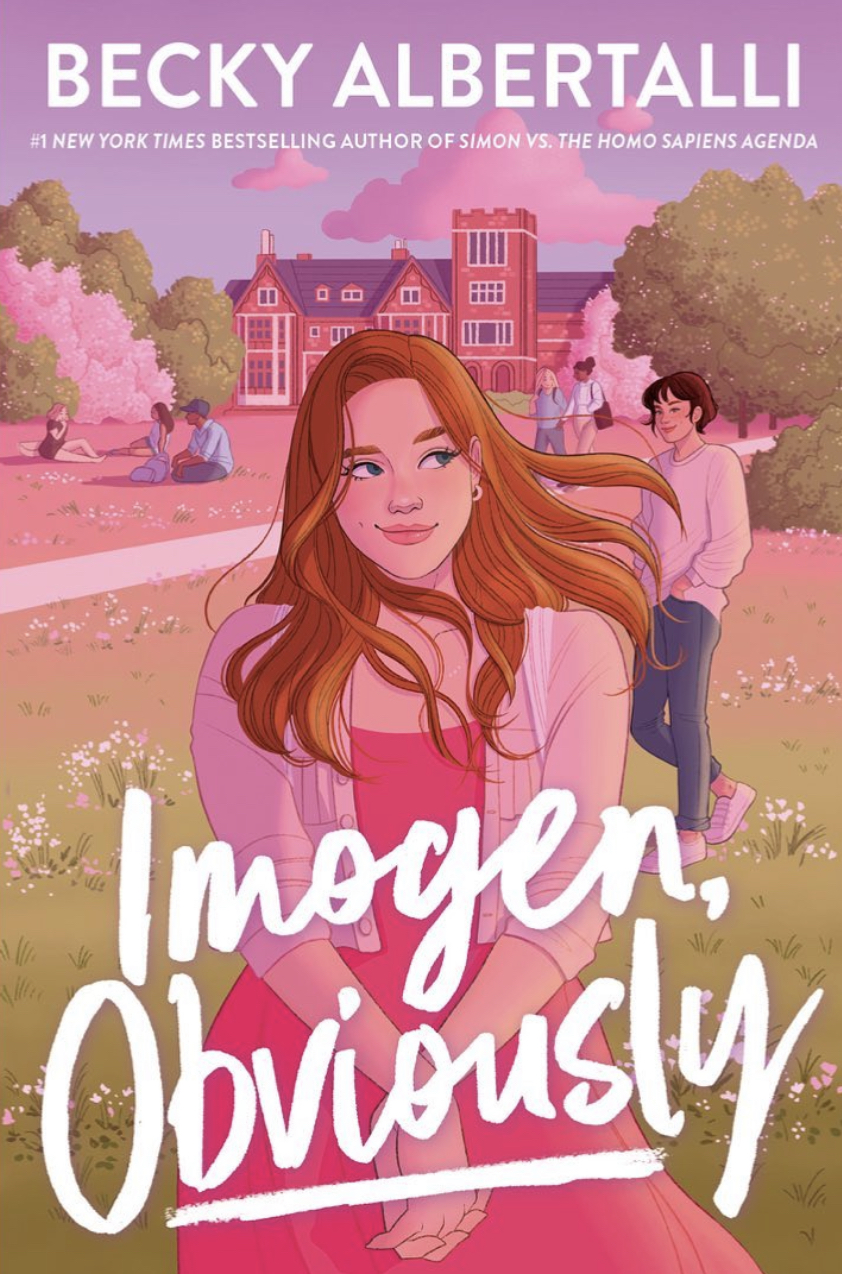
Book Review Tuesday (8/22/23) – Imogen, Obviously

Happy Tuesday, bibliophiles!

I’ve been reading Becky Albertalli’s YA books since middle school, and they’ve always had a special place in my heart. Although some of them have been hit-or-miss, I was looking forward to reading this one—it seemed so deeply personal to her, and I was so excited for the bisexual rep! And although it wasn’t perfect, it was such a deeply authentic depiction of the bisexual experience.

Enjoy this week’s review!

Imogen, Obviously – Becky Albertalli

Imogen Scott knows her place—the token ally amongst her very queer friend group. She knows the nuances of queer culture and discourse in and out, but she’s confident in her heterosexuality. But all of that changes when she stays with her best friend Lili at her new dorm in college. Lili, who happened to tell everybody that Imogen was her ex in an ill-thought-out lie. Imogen is happy to keep up the ruse, but when she meets Tessa, one of Lili’s new (and very cute) friends, she begins to question whether or not it’s the role of “ally” that’s the lie after all.

TW/CW: biphobia/homophobia (external & internalized), forced outing, underage drinking

From the start, I knew that Imogen, Obviously was going to be a deeply personal book for Becky Albertalli. That’s exactly what it was, and that’s exactly what it should have been. Even though it wasn’t without its flaws, Imogen, Obviously is an incredibly important book in that it shows us a narrative of bisexuality that isn’t portrayed as much, and that there is no one true narrative of how bisexuality is in the first place.

As a bisexual reader, Imogen’s story resonated so much with me, even if our coming-out journeys were different. And the fact that Imogen has a coming-out journey that deviates from a lot of the bisexual representation in media in general is a breath of fresh air; along her path of self-discovery, there’s some fantastic discussions about how we internalize stereotypes, the pressure to be “queer enough,” internalize biphobia and feeling like you don’t belong in queer spaces, and so much more. (And I’m glad that somebody’s talking about how random bisexual “traits” that float around social media…I once saw one that said “you may be bisexual if winter is your favorite season”…huh? What does that have to do with anything?) It’s a love letter to those who who feel like exceptions from the norm in a place that’s already populated by outsiders.

Adding onto that, what makes Imogen, Obviously such an important book to me is that it has such an important message about bisexuality, and about queerness in general: there is no one way to be bi, and that the entire queer experience doesn’t have to be entangled with suffering. We watch Imogen struggle with feelings of imposter syndrome in the queer community and repeatedly being put down by a “friend” who feels like she has the ultimate queer authority because she’s experienced quite a lot of homophobia, and it serves as an important reminder: we can’t exclude queer people from their own community just because they “aren’t queer enough” by some arbitrary measure. Again, it speaks to the personal element of this book, what with Albertalli’s own recent forced outing, but it’s a message that needs to be loud and clear.

Apart from the many wonderful messages that this book spreads, I loved watching the relationship between Imogen and Tessa develop! It really felt accurate to having your first queer crush in real time, with all of the stomach butterflies and shy conversations. They were a lovely match for each other, and although I was cheering for Imogen for every page, the two of them made my little bi heart so happy. Their romance really was a resonant and joyful one, something that Albertalli has nearly mastered writing.

All that being said, I had some issues with the writing that prevented me from giving Imogen, Obviously the full four-star treatment. I don’t remember enough about her other books to say how they were written (it’s been a while), but the way that she wrote these high school and college characters just felt so…off. She just peppered in all of the gen z slang into her dialogue whenever possible, and none of it felt natural or genuine. It felt like somebody observing gen z and/or TikTok from a distance, then trying to employ said slang from memory. It all felt so clunky, and at times, as much as I hate to say it, painful. I’m pretty sure that nobody says “discoursing” as a verb for discussing discourse. As fantastic as the rest of the book was, the cringy nature of the writing put me off from fully enjoying it.

All in all, a beautiful and necessary depiction of bisexuality that was hindered by its attempt to capture gen z speak, but excelled in every other department. 3.75 stars, rounded up to 4!

Imogen, Obviously is a standalone, but Becky Albertalli is also the author of the Simonverse (Simon vs. the Homo Sapiens Agenda, Leah on the Offbeat, and Love, Creekwood) and Kate in Waiting. she is also the co-author of What If It’s Us and Here’s to Us (with Adam Silvera) and Yes, No, Maybe So (with Aisha Saeed).

Today’s song:

That’s it for this week’s Book Review Tuesday! Have a wonderful rest of your day, and take care of yourselves!
Posted in Book Review Tuesday

Book Review Tuesday (8/8/23) – Machinehood

Happy Tuesday, bibliophiles!

After I read Meru back in June, I immediately went through the rest of S.B. Divya’s full-length books and put them on my TBR. Even though sci-fi is my favorite genre, I don’t readily jump for sci-fi thrillers quite as often, but after loving Meru, I was willing to give this one a chance. And while it wasn’t without its flaws, Machinehood was an incredibly detailed and twisty novel!

Enjoy this week’s review!

Machinehood – S.B. Divya

2095. In Welga Ramirez’s world, humans and machines work in an uneasy symbiosis. Artificial intelligence has become so advanced that humans must take all manner of pills, not only for them to keep from getting sick, but to be strong enough to compete with the machine labor force. Welga has intentions to retire from being a bodyguard. But after a client is killed in front of her and a hybrid human-machine terrorist group called the Machinehood is to blame, she must track down her killer—and the members of the Machinehood that have threatened to attack every major pill funder until production comes to a standstill.

TW/CW: violence, murder, racism, substance abuse, abortion/forced pregnancy, miscarriage

You ever finish a book that’s so detailed in its worldbuilding that not only can you imagine all of the described conventions and their ramifications, but the massive google doc that was probably behind it all? That’s how Machinehood felt to me—aside from the one other S.B. Divya book that I’ve read so far, Machinehood was one of the most thoughtfully-crafted books I’ve read in a long time.

At its best moments, Machinehood felt like a good Christopher Nolan movie. There was no shortage of suspense, and while it was difficult to keep up with at times, it was always an enjoyable read. I don’t gravitate towards sci-fi thrillers as much, even though sci-fi is my favorite genre, but this novel reminded me of what the really well-written ones are capable of doing; the suspense kept me guessing, the tension hardly ever let up, and there were twists aplenty to satisfy any sci-fi reader’s appetite. And of course, nothing makes a thriller like a main character about to retire, and then has to do that One Last Mission™️. When it’s not a part of a huge franchise, it works for me.

Machinehood is S.B. Divya’s first novel, and even then, it’s easy to see the threads from where they eventually branched off to Meru. The most prominent of those was, by a long shot, the worldbuilding. Like Meru, the dystopian, AI-dominated world of Machinehood is painstakingly detailed, down to the most minute consequence of any given sociopolitical ramification. I wouldn’t be surprised if Divya had some kind of Pepe Silvia-style conspiracy cork board to keep track of all the possibilities of this world that they created. There truly was no stone left unturned, and for the most part, it was a positive experience—between the moments of suspense, it was fascinating to see these possibilities unfold. From the myriad of pills that keep humans competing with the AI labor force to the ways that genetic and physical modification advanced, there was nothing that Divya didn’t think of, and that created one of the most fleshed-out sci-fi worlds that I’ve read recently.

Unfortunately, the downside of all of that excellent worldbuilding was its delivery. Having read Meru first, it’s easy to see how Divya improved on this delivery from Machinehood to there. Meru deftly toed the line between explaining its complex worldbuilding and dumping it all in one sitting. Machinehood, on the other hand, could have used some work in that department. As much as I enjoyed how richly layered the worldbuilding was, Divya had a frequent tendency to ramble on about said worldbuilding; even with all of the suspenseful plot points falling into place, this novel took frequent breaks to explain why [x] was a result of [y] and [z], which took away from the tension built up during the parts where the actual plot occurred. It’s a pitfall that I can almost excuse, given that a) Divya’s worldbuilding is obviously top-tier, and b) this was their debut novel, but it definitely took away from some of my enjoyment of the book as a whole. This novel probably would’ve gotten the full 4 stars from me if not for all of this.

All in all, a twisty and suspenseful debut with extensive worldbuilding that sometimes suffered from just as extensive rambling. 3.75 stars, rounded up to 4!

Machinehood is a standalone, and S.B. Divya’s first novel. Divya is also the author of the Alloy Era series (Meru, Loka, and an untitled third book) and Runtime, and has contributed to many short story collections.

Today’s song:

been listening to this song a bunch again, we’re levitating over here

That’s it for this week’s Book Review Tuesday! Have a wonderful rest of your day, and take care of yourselves!

Posted in Book Review Tuesday

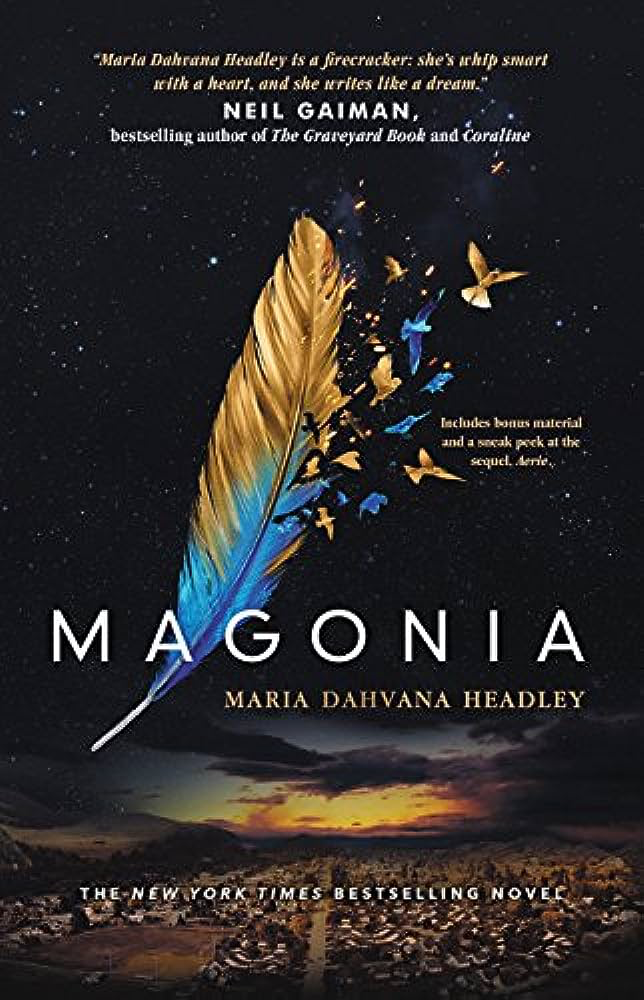
Book Review Tuesday (8/1/23) – Magonia

Happy Tuesday, bibliophiles, and happy August! I always look forward to my birthday month, but…I could do without everybody posting that one Taylor Swift song (sorry swifties my neighbors blasted it over and over when I was in school and I can’t take it any longer 😭)

This book has been on and off my TBR over the years; I feel like I put it on my list when I first got Goodreads, lost interest in it a few years later, then got it recommended to me by a friend who saw it on another list. The reviews don’t lie: Magonia really was a strange book, but despite some of its flaws, its strangeness was 100% its strength.

Enjoy this week’s review!

Magonia (Magonia, #1) – Maria Dahvana Headley

All of her life, Aza Ray Boyle has had a mysterious lung disease, incapable of being diagnosed by all kinds of doctors. She can barely breathe or speak without assistance, even with the copious medications prescribed to her. But recently, Aza has begun to see giant ships in the sky. Her parents chalk these visions up to her medication, but Aza knows that something in the sky is waiting for her—and it is. But after a freak accident leads her family to believe that she is dead, Aza is swept up into the world of Magonia, a world of skyfaring ships where she can finally breathe. But as she discovers her hidden Magonian heritage, she discovers that this idyllic world in the clouds is not as peaceful as she once thought—and that the world below may be in danger…

TW/CW: fantasy violence, death/funeral, themes of grief

To put it plainly, Magonia was a weird book. For a YA book that was published in 2015, it feels a lot more daringly weird than most YA books got back then and still do today. Magonia was Maria Dahvana Headley’s first YA novel, and it shows, but not necessarily in a bad way; despite its flaws, it was a refreshingly quirky addition to the pantheon of early to mid-2010’s YA.

I’ve seen this book shelved as having disability rep, and that’s part of why I decided to pick it up again. Aza has a lung disease, but it’s fictional; all of her life, doctors cannot seem to diagnose her, until it is discovered that the disease happens to be a whole bird growing in her chest that factors into the book about a third of the way through. And…I’m torn on whether or not to call it disability rep. On the one hand, the descriptions of Aza’s life before the bird revelation match a lot of other stories I’ve read about people and fictional characters with breathing-related illnesses and disabilities, what with being constantly in and out of hospitals and struggling to fit in with one’s peers. And on the other hand…it feels a little strange, as a disabled reader, to categorize having a fictional ailment of bird growing out of your chest as a disability, especially since the problem resolves itself almost immediately once Aza arrives in Magonia. My issue isn’t that this plotline exists—it’s the category of others labeling this as disability rep that feels questionable to me.

That aside, Magonia was a refreshing novel to read! Especially for a YA book published in 2015, when the industry was so mired in self-serious Hunger Games rip-offs, the unapologetic weirdness of this novel felt like a breath of fresh air, even almost a decade later. We need more whimsy like this in YA—it shouldn’t just be reserved for middle grade. The whimsy doesn’t just die when you hit the age of 13! (Or, at least, it shouldn’t.) I loved the world that Headley created, full of winged people, whales that swim through the sky and giant bats (CREATURES YEAAAAAAAH) and massive frigates that patrol the skies. Headley put so much love into this part of the worldbuilding, and it shone through in every page. It did not hold back in its magical fun, and I am so much better for it.

I’ve seen a lot of reviews saying that they didn’t like how Aza’s voice was written, and to a point, I can understand it. From the looks of it, most of Headley’s body of work is aimed at adults, so it makes sense that she felt as though she had to tone it down and write Aza in a certain, “teenagery” way. But for the most part, I feel like it worked—Aza really did read like she was really 15 going on 16: despite her circumstances, she was still an angsty teenager, but that wasn’t her whole personality. She reacted to her situation as a real teenager would, had her priorities set where a teenager would have them. Aza really was a teenager, and teenagers tend to over-exaggerate things sometimes. It wasn’t all over-exaggeration, though—it was just the right amount of drama and realistically being frightened by everything going on around her, because who wouldn’t be?

However, as engrossed I was with the whimsical fantasy worldbuilding, I found the ending to be quite messy. I get that it’s the first book in the series, but Magonia could have been wrapped up in a much neater and more cohesive way. Details that were only given in the last 50 pages suddenly had utmost importance to the plot, all of the loose ends got even looser, and everything felt generally rushed. Looking back on how much I enjoyed the worldbuilding, it feels like a case of paying too much attention to that and not enough to how the plot would actually play out. Everything felt crammed together and sped through in such an unceremonious way. It’s why I felt like I couldn’t quite give this novel a full 4 stars; the ending made the rest of the intricacies earlier into a rushed mess.

All in all, a refreshingly weird YA fantasy that excelled in its whimsical worldbuilding, but failed in the messy pacing of the ending. 3.75 stars, rounded up to 4!

Magonia is the first in the Magonia series, followed by Aerie. Maria Dahvana Headley is also the author of The Mere Wife, Queen of Kings, Some Gods of El Paso, and many other novels and short stories. Headley also translated a modern version of Beowulf in 2020.

Today’s song:

NEW WILCO JUST DROPPED?????

That’s it for this week’s Book Review Tuesday! Have a wonderful rest of your day, and take care of yourselves!
Posted in Uncategorized

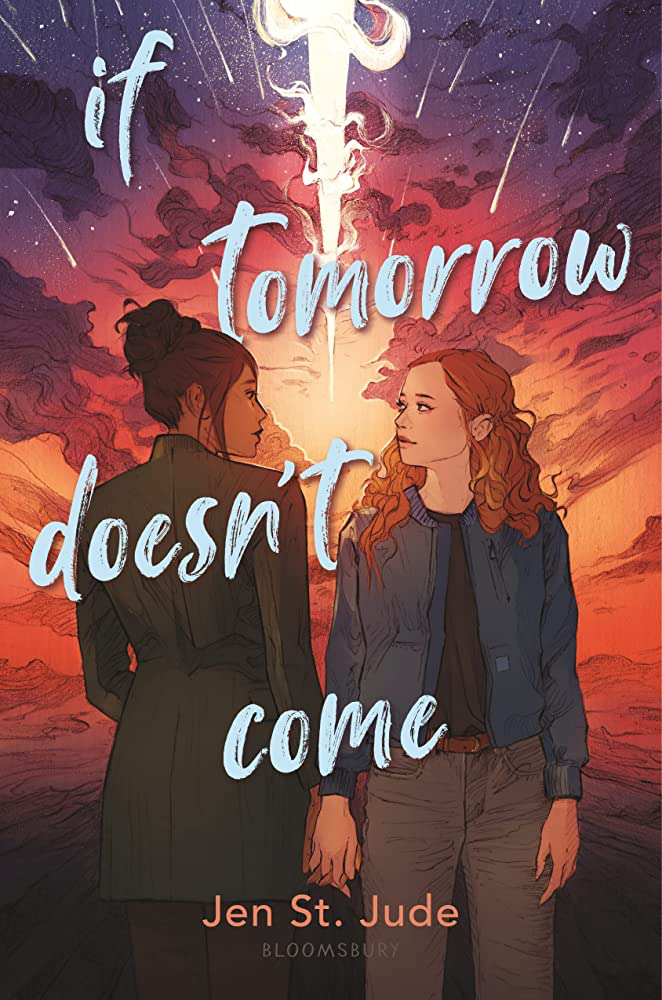
Book Review Tuesday (6/6/23) – If Tomorrow Doesn’t Come

Happy Tuesday, bibliophiles!

This book came out around a month ago, and I figured it would be a great read to start off pride month (after a very disappointing biography of Josephine Baker). If Tomorrow Doesn’t Come was my first exposure to Jen St. Jude (it’s her debut, after all), but after this, I’m ready to watch for anything else she writes.

Enjoy this week’s review!

If Tomorrow Doesn’t Come – Jen St. Jude

The news has just broken that an asteroid capable of wiping out the population is headed towards Earth in nine days. Avery Byrne had planned to drown herself on her college campus that day—being closeted from her religious parents, the mounting pressure of college, and undiagnosed depression had become too much to bear. But now, she’s forced to flee her college and face her family. Among them is Cass, her best friend and longtime crush, who she’s been hiding the truth from for years. With nine days until the end of the world, Avery must come face to face with everything that she wanted to run from, but must also realize the hope at the end of the world—maybe she finally has time to make things right.

TW/CW: suicide, suicide attempt(s), suicidal ideations, homophobia, religious bigotry, mental health issues (depression), natural disasters/end of the world scenarios (impending asteroid impact)

This is a heavy one. That can’t be understated enough—I always put trigger warnings before my reviews now, but these ones are really important to keep in mind. If Tomorrow Never Comes is a devastating novel—but a deeply important one, as long as you’re in the mental headspace for it.

That being said, one of the best parts about this novel is how Jen St. Jude handles such topics. It would’ve been easy to romanticize or otherwise dramatize Avery’s very real struggles with mental health and queer identity, but everything was handled with such care and grace. It’s clearly a very personal novel; nothing is glossed over, but nothing is overblown to amp up the tension needlessly. We’re very slowly coming out of the post-13 Reasons Why romanticization of suicide and mental health issues, so it’s very important that books like these exist to counteract that—presenting these subjects exactly as they are.

All of the relationships were also done so well in this novel! Each character was crafted with so much care, and the interactions that each one had with the other really made them stand out. The forced reunion of Avery, her friends, and her extended family in the event of the asteroid created so many moments that felt refreshingly human—messy and hard to read at times (part of the ending made me cry, full disclosure), but authentic and genuine. Again—in the face of an onslaught of very dramatic apocalypse-oriented YA in the past, it’s so nice to see one that’s full of emotion, but more in the way of real, interpersonal relationships and not 2012 love triangles in the face of impending doom.

That being said, I did have one major problem with this novel. I liked the format that St. Jude had where the novel was split into Avery’s past and present, but the flashback chapters felt somewhat stilted compared to the present day chapters. They leaned a lot more on telling—giving us information about Avery’s life, friends, and family in a very rote way, as opposed to letting all that bloom naturally. It’s even stranger considering that the present chapters didn’t have this problem at all—maybe it was just some kinks to work out when writing in Avery’s past tense. With all of the heart that this novel had, it just left me wishing for something as fluid as the other chapters.

I’ve seen some people complaining about the ending, but I feel like this novel couldn’t have ended any other way. This novel was always going to be about relationships during the apocalypse, and the mechanics of the apocalypse weren’t meant to be the star of the show. I will admit that I had to turn back to check that yes, this really was the end, it felt like the quiet, tender ending that this novel deserved.

All in all, an emotional and deeply personal story of love at the end of the world. 3.75 stars, rounded up to 4!

If Tomorrow Doesn’t Come is a standalone, and it is Jen St. Jude’s debut novel.

Today’s song:

SAW THE YEAH YEAH YEAHS LIVE LAST NIGHT IT WAS MAGICAL

That’s it for this week’s Book Review Tuesday! Have a wonderful rest of your day, and take care of yourselves!
Posted in Book Review Tuesday

Book Review Tuesday (5/2/23) – Star Splitter

Happy Tuesday, bibliophiles!

Honestly, it’s a wonder that I managed to get my hands on this book when I did. I heard about it from a few “out this week” blog posts from other book bloggers (thank you!!), and as of today, the book’s only a week old. I put it on hold on the Kindle library, and it came in surprisingly quick, to my relief! I was super excited by the sci-fi premise, and in most of the relevant aspects, it absolutely delivered!

Enjoy this week’s review!

Star Splitter – Matthew J. Kirby

The method of space travel that 17-year-old Jessica Mathers is familiar with isn’t the kind you’d expect. In for the process to work, teleportation is a crucial step—the body that you’re in on Earth isn’t the same one that goes to space. But either way, after six years of waiting to reunite with her scientist parents on a faraway exoplanet, Jessica is going to space.

But when she wakes up, she’s alone in the wreckage of the ship that was supposed to carry her and the crew, stranded on an alien planet. The walls of the wreck are covered in the evidence of something sinister, and her parents are nowhere in sight. And a teleported clone of herself may be the only person she can trust—and the only person for miles around on this planet.

TW/CW: sci-fi violence, blood, murder, body horror, loss of loved ones

tread lightly – this review contains some spoilers!

Sci-fi that references old(er) poetry is an incredibly niche demographic, but I’d be lying if I said I wasn’t squarely in the middle of it. You got me there.

This book kind of came out of the blue for me—I forgot that Matthew J. Kirby existed after reading a few of his books in middle school (sorry), so Star Splitter was more of a left-field pick for me. But despite its flaws, it was a fascinating and gripping read—certainly a better addition to the world of YA sci-fi!

Hard sci-fi is hard to nail down for a young adult book; astrophysics and quantum mechanics are hard for anybody to understand, but I can speak for myself as an (older) teenager and a longtime YA when I say that it might be even harder to understand for a younger-skewing audience. Not to insult anybody’s intelligence—I’m fully including myself in there, in all my new English major glory. But Kirby hit the near-perfect balance with explaining the mechanics of teleportation, and how it factored into space travel. It wasn’t explained like it was being explained to a child, but it didn’t dump all of the information in an unceremonious chunk of jargon, either. And it’s a super fascinating concept to boot—it adds a layer of suspense to an already suspenseful book, there’s significant ramifications for most everything about the world that Kirby sets up, and there’s an existential aspect too. It’s all great there.

The story itself held a lot of water for me as well! There was so much to pick apart in it‚ from Jessica’s existential conflict about interacting with her own clone (HUH) and her own body to the mystery of what happened to the DS Theseus and its inhabitants. (Also, loved that we had a spaceship called Theseus. I’m assuming it’s a nod to the Ship of Theseus, but it also works on another level when you consider what happened with the crew. I won’t spoil anything about that in particular.) Kirby’s writing consistently kept all of that afloat, juggling two different timelines with suspense unfolding in both of them. His descriptions of the landscape of Hades (Mr. Kirby really likes his Greek mythology, huh?) were also nothing short of lovely—I’m a sucker for any kind of alien planet exploration, and Star Splitter, for the most part, adequately scratched that itch.

I say “for the most part” because, as much as I loved it, there were so many parts that seemed too important that were just left out of the final conflict. The sideplot about the ruins of an alien city with a giant pile of ground sloth-looking skeletons???? Bioluminescence everywhere?? BEING PURSUED BY AN UNSEEN ALIEN IN THE SHADOWS??? That was my favorite part of the whole novel, but we really didn’t get any resolution to it. It felt like such a crime that we never got to see where that thread led, given how much it was foreshadowed and otherwise built up. I get that it wasn’t necessarily the main conflict, but Kirby gave it a similar amount of weight to the main conflict, so it felt like it was in need of a more satisfying conclusion than “Jessica got out of the city ruins somewhat unscathed.” I NEED MORE. GIVE THE PEOPLE (ME) WHAT THEY WANT.

I feel like this happened a lot with Star Splitter for me—aside from the main conflict, there were so many fascinating and inventive things going on with the world that felt so creative, but were just tossed aside as afterthoughts once they were explained. The fauna on Hades? Mt. Ida? QUANTUM GHOSTS? I was just taken aback by so many parts of the plot, only to have them scrapped in favor of the main conflict, which I…halfway understand. All this is to say that said main conflict was excellent, but I just wanted more. It wasn’t like Star Splitter was an exceedingly long novel either—320 pages leaves some room to explore at least a few other aspects of the world, I think. That’s why I’m *officially* putting my rating at 3.75 instead of the full 4 stars—there was so much creative stuff to chew on, but not enough of it was expanded upon. I’ll be needing a sequel, please and thank you. 🫶🏻

All in all, an inventive and fascinating sci-fi novel that presented a plethora of creative aspects to fill up the plot, but still left me wanting in some places. 3.75 stars, rounded up to 4!

As of now, it looks like Star Splitter is a standalone, but Matthew J. Kirby is the author of several other books for children and young adults, including the Dark Gravity Sequence (The Arctic Code, Island of the Sun, and The Rogue World), The Clockwork Three, A Taste for Monsters, and many others.

Today’s song:

getting caught up on Palehound before Eye on the Bat comes out…another great album!! this song reminds me so much of Wilco

That’s it for this week’s Book Review Tuesday! Have a wonderful rest of your day, and take care of yourselves!