Posted in Book Review Tuesday

Book Review Tuesday (10/6/26) – The River and the Star (The Warring Gods, #2)

Happy Tuesday, bibliophiles!

I read The Sun and the Void back in 2024 and really enjoyed it; although I didn’t remember everything about the plot, I figured I would go ahead and pick up the sequel. Thankfully, I didn’t have too much trouble readjusting to the world, but that was the least of my problems. The River and the Star had its moments, but I feel like I read a book from a completely different series.

Now, tread lightly! This review contains spoilers for book one in the series, The Sun and the Void. For my review of book one, click here!

Enjoy this week’s review!
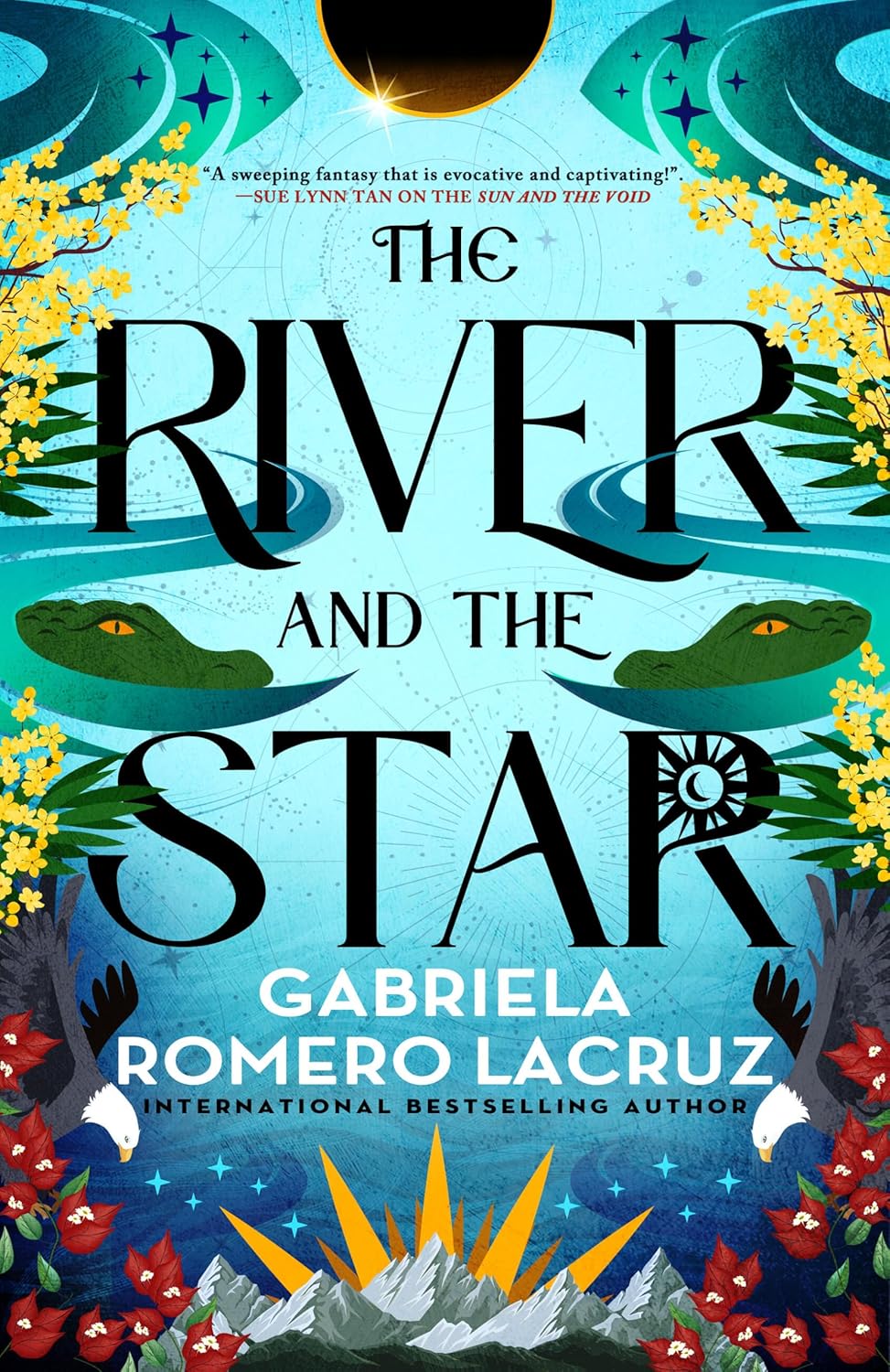
The River and the Star (The Warring Gods, #2) – Gabriela Romero Lacruz

Reina and Eva’s lives will never be the same.

Both of them are now in thrall to separate gods—the god of the Sun and the god of the Void. While Reina revels in a new domestic life with her girlfriend Maior, Eva struggles with the dark powers brewing inside of her. But trouble is on the horizon for Tierra’e Sol, with armies of wretched tinieblas invading the shores. As the gods grow hungrier for power, Reina and Eva must choose which side they belong to—and which side is worth fighting for in the first place.

TW/CW: rape, violence, murder, colonialism, religious bigotry (fictional), descriptions of injury

There’s a specific brand of overlong genre fiction book that just leaves you thinking “this could’ve been an email.” I’m all for languishing and having narrative elements that aren’t necessarily practical, but some books have no business being over 500 pages. Unfortunately, The River and the Star was one of them.

It’s been two years since I read The Sun and the Void, and back then, I remembered really enjoying it, for the most part: the Venezuela-inspired setting, commentary on colonialism and war, compelling characters, artful prose. Somehow, The River and the Star treated all of those positive elements as an afterthought, and I think that’s where Lacruz went wrong. Everything about this novel seemed simultaneously overlong and dialed back: the prose is somewhat duller, the commentary feels less cutting, and everything that made the characters compelling is either rehashed or forgotten entirely. At a certain point, I had to accept that this wouldn’t be a satisfying end to the duology just because Lacruz had drained most of the juice out of the narrative. It’s just a shell of book one.

So what, you might ask, filled that void (no pun intended) left by all that? 500+ pages of unnecessary angst. Half of what “drives” the plot of The River and the Star ended up being overwritten angst and yearning. Listen, I’m all for a good yearn, but this was just too cornily written. It almost made me wonder if there was some pressure on Lacruz to make it more of a romantasy, because I feel like we took a hard left from the nuance of book one into “oooooh he’s a morally gray sexy man 😏 but NOW he’s turning into a DEMON 😏” COME ON. Eva and Javier’s dynamic was strange enough in book one, but I feel like it never got rectified in The River and the Star; all of his borderline abuse got swept under the rug, which, for a novel that wasn’t afraid to condemn the ways that men in positions of power use physical and sexual violence as leverage, felt exceedingly weird. As for Reina and Maior, they were all sunshine, rainbows, and overwritten sex scenes, and until the last 50 pages, quite flat as characters. It’s just such a letdown after how layered they were in book one.

That’s not even acknowledging just how boring the Rahmagut/Ches plot turned out to be. It just felt like a disservice to turn the complexity of The Sun and the Void into a very black-and-white story about people being puppeteered by the gods of light and dark. There’s a fancy macguffin, a Big and Bombastic Climax where The End Of The World Is At Stake, ooooooooh, but everything gets wrapped up in a nice bow at the end. There’s nothing inherently wrong with doing that in a fantasy novel, but given that The Sun and the Void really got into the weeds about power, the nature of revolutions, and, oh, the moral complexity inside each and every person no matter their chosen cause, it felt especially cheap. Plus, while Eva predictably had some serious consequences to being puppeteered by Rahmagut, it’s like Lacruz just straight up forgot that Reina was a vessel for a whole god. If the synopsis didn’t say anything about her being possessed, I would’ve had no clue. Whoops. Seems like a pretty important detail, I dunno…

To be fair, The River and the Star wasn’t all bad. I’m just bitter that a lot of what I loved about The Sun and The Void got chucked in the trash, but that doesn’t mean that I didn’t enjoy a few moments of it. I think the political intrigue was at least salvaged, even if it was less nuanced than it was in book one. With the plotlines of all the squabbling families and Eva and Reina being vessels for Ches and Rahmagut (which was, in and of itself, an invasion of autonomy), I feel like Lacruz did an excellent job of continuing the thematic thread of the loss of autonomy and independence, both personally and as a vital part of the revolution. Maior’s subplot with Laurel accentuated that wonderfully, and she was one of the few characters that got spared the fate of the others and was developed more meaningfully. As a kind of end to the revolution/liberation plotline, I feel like this was a decently executed thread, even if the rest of the novel didn’t quite hold water.

All in all, a sequel with enough redeeming moments to keep it afloat, but none of the staying power of its predecessor. 3 stars.

The River and the Star is the final book in the Warring Gods duology, which began with The Sun and the Void. She is also the author of the forthcoming novel Song of Fallen Stars, which is Slater for release in 2027.

Today’s song:

That’s it for this week’s Book Review Tuesday! Have a wonderful rest of your day, and take care of yourselves!

Posted in Book Review Tuesday

Book Review Tuesday (9/10/24) – The Sun and the Void

Happy Tuesday, bibliophiles!

Looks like I’m back! I’ve returned to college, and, as it always does, it has taken me some time to settle in. My ducks aren’t fully in a row, but they’re straightened enough that I’ve figured out when and where I’ll have times to squeeze in some writing. Key word is some: chances are I’ll stick to the two posts a week for a while now that I’ve got lots of schoolwork on my hands.

For this week’s Book Review Tuesday, I have a book that it’s almost miraculous that I liked as much as I did; at their worst, overly long epic fantasy novels are the bane of my existence. The Sun and the Void clocks in at nearly 600 pages, and I expected at least some of it to be a slog. Lo and behold, this novel held so much more in store—vibrant characters, Venezuelan-inspired mythology, and a daring quest across an inhospitable land.

Enjoy this week’s review!

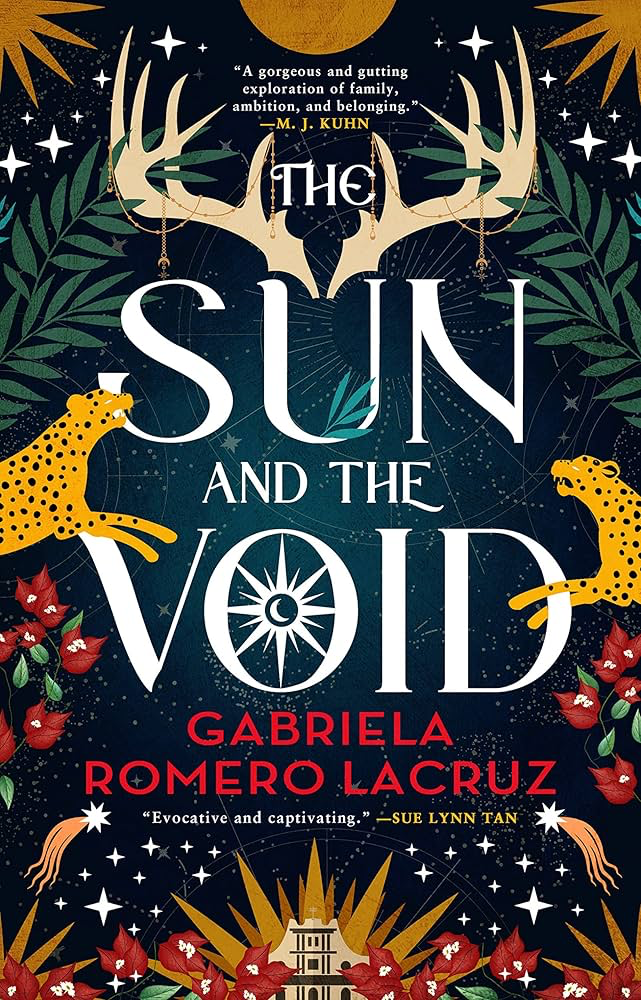
The Sun and the Void (The Warring Gods, #1) – Gabriela Romero Lacruz

Reina has lived her life on the outskirts of society. Though her kind, the nozariels, have won their freedom, her tail and features mark her as an outcast. Reina returns to her estranged grandmother in dire need of healing—and answers. Now kept alive by means of dark, unpredictable magic, she is now the owner of a terrible secret: her grandmother is in league with a demon-god hungry for sacrifices, and one such sacrifice may be someone that she holds dear.

On the other side of the kingdom, Eva struggles to hide her true self. Her mixed heritage—part human, part valco—makes her a target. Soon after she is set to be married off to a man she barely knows, she falls in with a revolutionary. But this charming, volatile man has a darker side, a hunger for power that will not spare her if she stands in the way.

The paths of these women intersect as the clock ticks, and the fate of both of their worlds may hang in the balance…

TW/CW (from the author): alcohol, assault, blood, child death, childbirth, death, demons, emotional abuse, gore, infertility, kidnapping, pregnancy, racism, religion, sexually explicit scenes, mentions of slavery, violence

Ever since my tastes started drifting more into adult novels, I’ve had a history of getting a hundreds or so pages into an epic fantasy novel, losing my way, and coming out with only the vaguest sense of plot and one character. There’s some of it that’s on me, but it’s often a case of rambling; I’ve found many such novels to be more wordy than necessary and convoluted in their delivery of the worldbuilding. I lowered my expectations for The Sun and the Void for this very reason, though I clung onto it because of the promise of the Venezuelan and Colombian-inspired setting and anticolonial storyline (!!!!!!!!!!!!). Beyond being sick of generic, catch-all European settings in fantasy, my half-Colombian Spidey sense was tingling…and for good reason! The Sun and the Void is an overlooked gem of epic fantasy, with magic and action abound.

The vibrant setting that Romero Lacruz crafts was the clear star of The Sun and the Void. Her South American-inspired landscape was a breath of fresh air in a sea of vaguely European epic fantasies, breathing some much-needed life and diversity into the genre. Logistically, this region of South America—Venezuela and Colombia—also provides a variety of biomes to play with: we get flashes of deserts, forests, and glittering, tropical beaches, all with a fantastical dash of demons and monsters. That alone would have already put it a step above your average epic fantasy, but it was this series’ unique fantasy races that truly shone! As metaphors for oppression and who the dominant power in society deems “acceptable,” the nozariels and valcos were effective on that front. Their designs, however, were what made them so fun, making for memorable characters in looks and culture as well as personality.

In my experience, there are certain brands of epic fantasy that are allergic to accessible writing. When I say accessible, I don’t mean simple; accessible doesn’t mean the absence of artful prose or clever metaphor. For me, accessible prose is inventive, but not so caught up in making itself sound clever that it becomes a chore to read. Romero Lacruz’s writing is a fantastic case study in how to hit the balance between artful and digestible. Every action scene, political machination, and argument is rendered in ways that do feel like how people talk, and yet she never forgets to season her prose with unique metaphors and descriptors of the characters and their surroundings that keep you hooked—or, in my case, vigorously highlighting on my Kindle. At no point did the writing feel pompous or overly convinced of its own talent—it’s writing for writing’s taste, which is what writing should be.

Power dynamics were at the forefront of The Sun and the Void, and the explorations of them were some of the most impactful parts of the novel. Through the side characters, Romero Lacruz portrays the different way that power manifests itself in people; no matter how “noble” their causes, characters like Doña Ursulina and Javier became so obsessed with achieving their goals that it subtly began to eclipse all else. What was unique about The Sun and the Void, however, was how it was framed: through the eyes of vulnerable, sensitive women that get pulled under their spells. Such abusive dynamics meant that Reina and Eva were respectively drawn into the web of these other characters. At no point were they helpless—they were victim to people that promised them healing or freedom, and became so entangled in the schemes of others that they had to fight tooth and claw to find their way back to the light.

That being said, the weakest links in The Sun and the Void lay in the worldbuilding. Even though this novel is one of the few lengthy epic fantasies that I’ve read that miraculously doesn’t get overly convoluted, the price it paid was that some of the worldbuilding was left messy and sloppy once I took a closer look. The glossary was helpful, but it took quite a while to get used to some of the intricacies of the magic system. Terms are thrown around in a very slipshod way, and instead of the dreaded page-long block of worldbuilding exposition, we get…a few sentences, at most, before said facet of the magic system is barely mentioned for the rest of the novel. It’s an issue with followthrough—once something was mentioned, it often took 300 pages for it to make a brief appearance, only to poof back into the unexplained ether. It’s clear that there was a lot of thought behind the worldbuilding, but the issue was more of following the time-honored rule of Chekhov’s gun—Chekhov’s magic system, in this case. The gun did go off in the end, but it took so long to get to that moment that I completely forgot the significance of it being there in the first place.

All in all, an epic fantasy that defied the conventions of the genre—setting, writing style, and more—in all of the best ways. 4 stars!

The Sun and the Void is the first novel in the Warring Gods series, followed by The River and the Star, which is slated for release in 2025. The Sun and the Void is Romero Lacruz’s debut novel.

Today’s song:

BLESSED WITH ANOTHER NEW SOCCER MOMMY TRACK AND A NORTH AMERICAN TOUR NEXT YEAR!!!!!

That’s it for this week’s Book Review Tuesday! Have a wonderful rest of your day, and take care of yourselves!