Posted in Sunday Songs

Sunday Songs: 8/23/26

Happy Sunday, bibliophiles! I hope this week has treated you well.

This week: the last vibe I expected to have from a Chelsea Wolfe album was “go girl, give us nothing!” but here we are.

Enjoy this week’s songs!
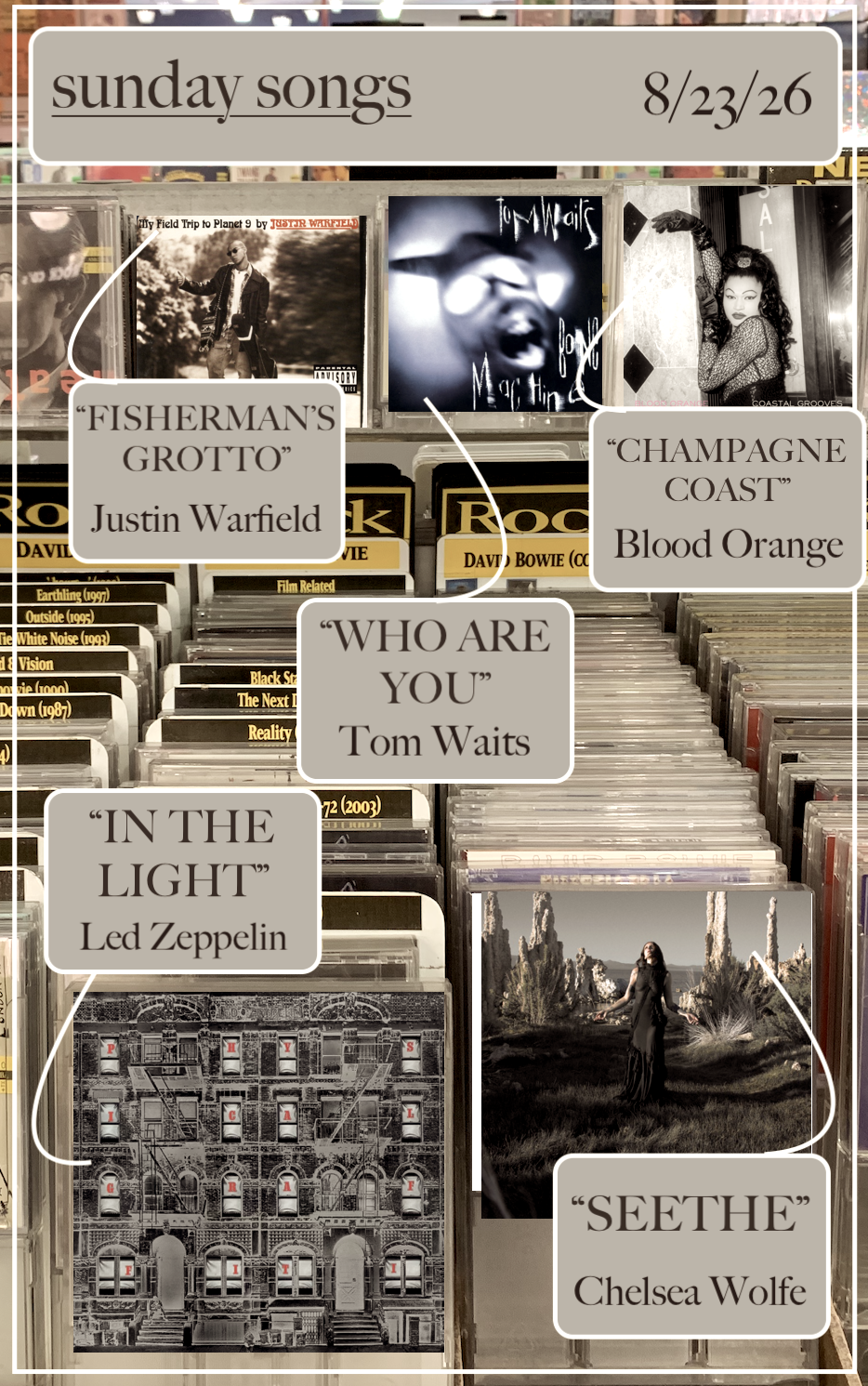
SUNDAY SONGS: 8/23/26

“In the Light” – Led Zeppelin

It’s a real shame that I haven’t talked much about Led Zeppelin here, but to be fair, they are talked about quite a lot—as is what they deserve. I did go through a brief Led Zeppelin kick last year after watching the great documentary Becoming Led Zeppelin, but somehow, it never made it here. (In lieu of that, I’ll share their goosebump-inducing cover of “I Can’t Quit You Baby.”) But somehow, even though I spent my childhood hearing snatches of Led Zeppelin, “In the Light” slipped through the cracks. All I can ask, at this point, is how? How did I miss one of the best Led Zeppelin songs I’ve ever heard for this long?

“In the Light” feels mammoth in every way, as do a lot of classic Led Zeppelin songs. Partially, that’s the length—this track is nearly nine minutes long, and it’s one of those songs that deserves every minute of its runtime, because Led Zeppelin juices every ounce of gravity from it. Every second is used to its fullest extent—the intro, which lasts nearly two minutes, is a sparse palette consisting of synths and Jimmy Page’s best party trick: using a cello bow on his guitar. (I eat it up anytime somebody does it. I saw Johnny Greenwood do it on his bass with The Smile and I haven’t been the same since.) It’s enough to make you shiver with antici……pation. But once the full band kicks in, the momentum never stops feeling colossal. “In the Light” is just towering—it feels like staring up at a crumbling, ancient monument, a relic brimming with power underneath the surface. I can’t pin down the time signature, but there’s something so enticing about how John Bonham’s drums have such a consistent, fairly ordinary rhythm to them while Jimmy Page and the others just go absolutely nuts over it—that’s half the fun of the average Led Zeppelin song, to be honest. It has this zigzagging, staircase rhythm to it—everything feels like it’s climbing, with chord progressions that call to mind the Beatles in their later career. And of course, it’s held together by Robert Plant’s rich vocals, his signature howl becoming the weathered stone holding “In the Light” together. It doesn’t feel like a long song at all—you just get so hopelessly lost in it.

…AND A BOOK TO GO WITH IT:
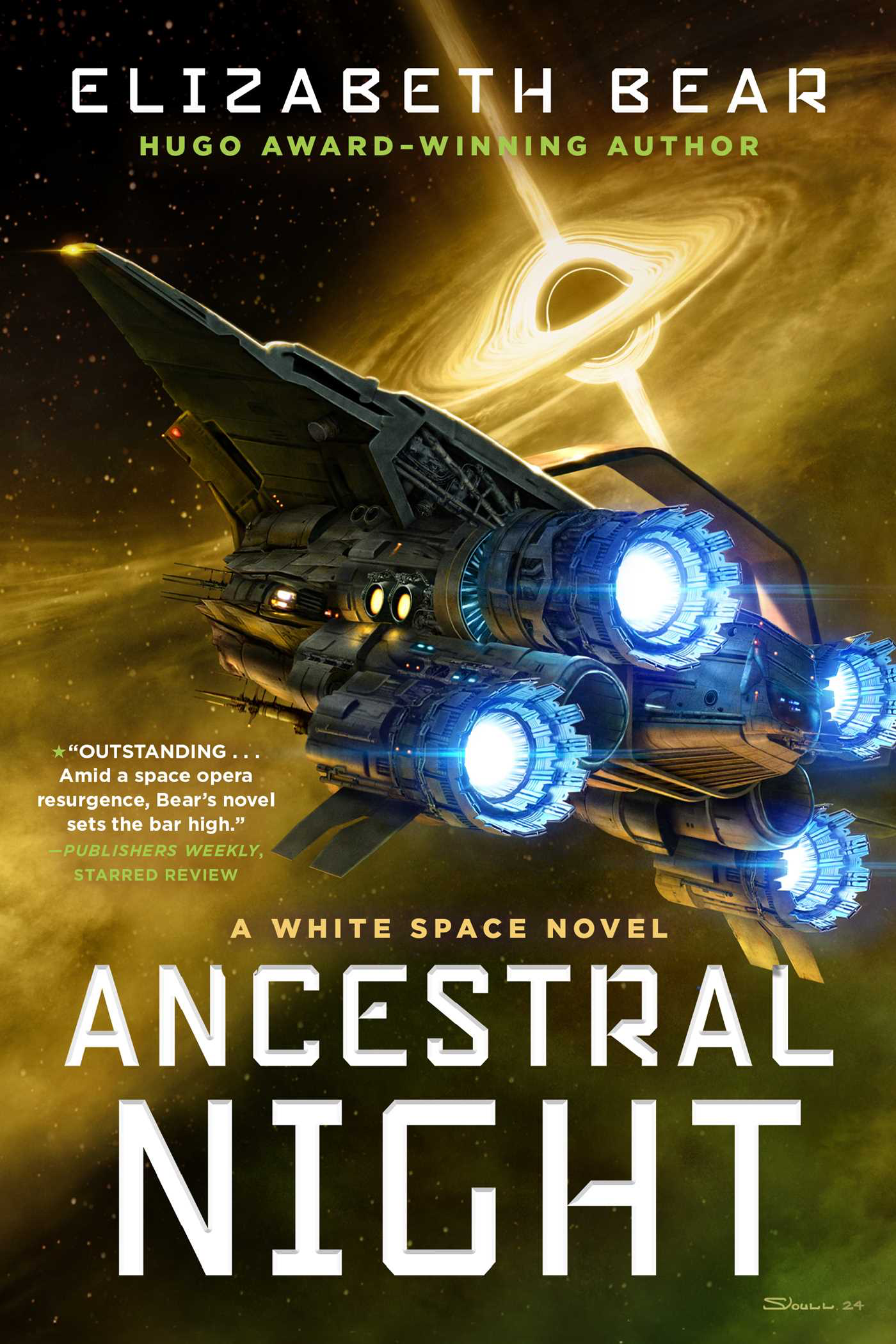
Ancestral Night (White Space, #1) – Elizabeth Bearyou know what the best Led Zeppelin songs and good space opera novels have in common? Feeling this expansive, colossal, and ancient.


“Seethe” – Chelsea Wolfe

How did Chelsea Wolfe go from having one of the most hard-hitting albums of 2024 to…this?

So, The Dark. I came away thinking that Wolfe’s newest batch of 10 goth-rock (citation needed, at this point) tracks were…perfectly fine. Pleasant. Solid. But those aren’t words that I want to describe Chelsea Wolfe with. She’s adventurous, she pushes boundaries, she’s not afraid to get in the mud, to get raw and visceral and vulnerable with it! She’s a poet that finds the empathy even in the darkest corners of the psyche! So why does The Dark feel so lightweight? The lyrics are significantly weaker, the song structures are traditional, the instrumentals just fine…it just feels like she’s holding back. Of all the artists I’d expect to play it safe, Chelsea Wolfe wasn’t one of them. Unfortunately, that’s my overarching takeaway from The Dark. Even the album title is just vague. Like, oooh, naming your goth album The Dark? Completely uncharted territory…

That’s not to say that “Seethe” is a bad song. I feel bad ragging on these lyrics, but next to, I dunno, “Be All Things” or “Dusk,” it feels a lot simpler. It’s like Jeff Tweedy having some of the greatest poetry in American rock n’ roll and then using a metaphor about somebody being “cool enough to be ice cream.” (Again: nothing against “Ice Cream,” but it just feels like low-hanging fruit. At least Hot Sun, Cool Shroud – EP was leagues better than The Dark is.) But for “Seethe,” I feel like it isn’t the song for gothic, flowery poetry: it’s just a fun song about getting your righteous revenge. You don’t necessarily need a lot of complex metaphors if you’re on Chelsea Wolfe’s list and she’s out to get you—she’s just coming for you, she’s got her knife in her pocket, and she’s gonna getcha if it’s the last thing she does. Her vocals are as flowing and ethereal as ever, and we get some top-notch, raspy screaming in the background towards the end. With its ragged guitars and mile-a-minute bass and percussion, “Seethe” is a perfectly fun cut from the album—it’s just Wolfe letting loose, and who can fault her for that?

…AND A BOOK TO GO WITH IT:
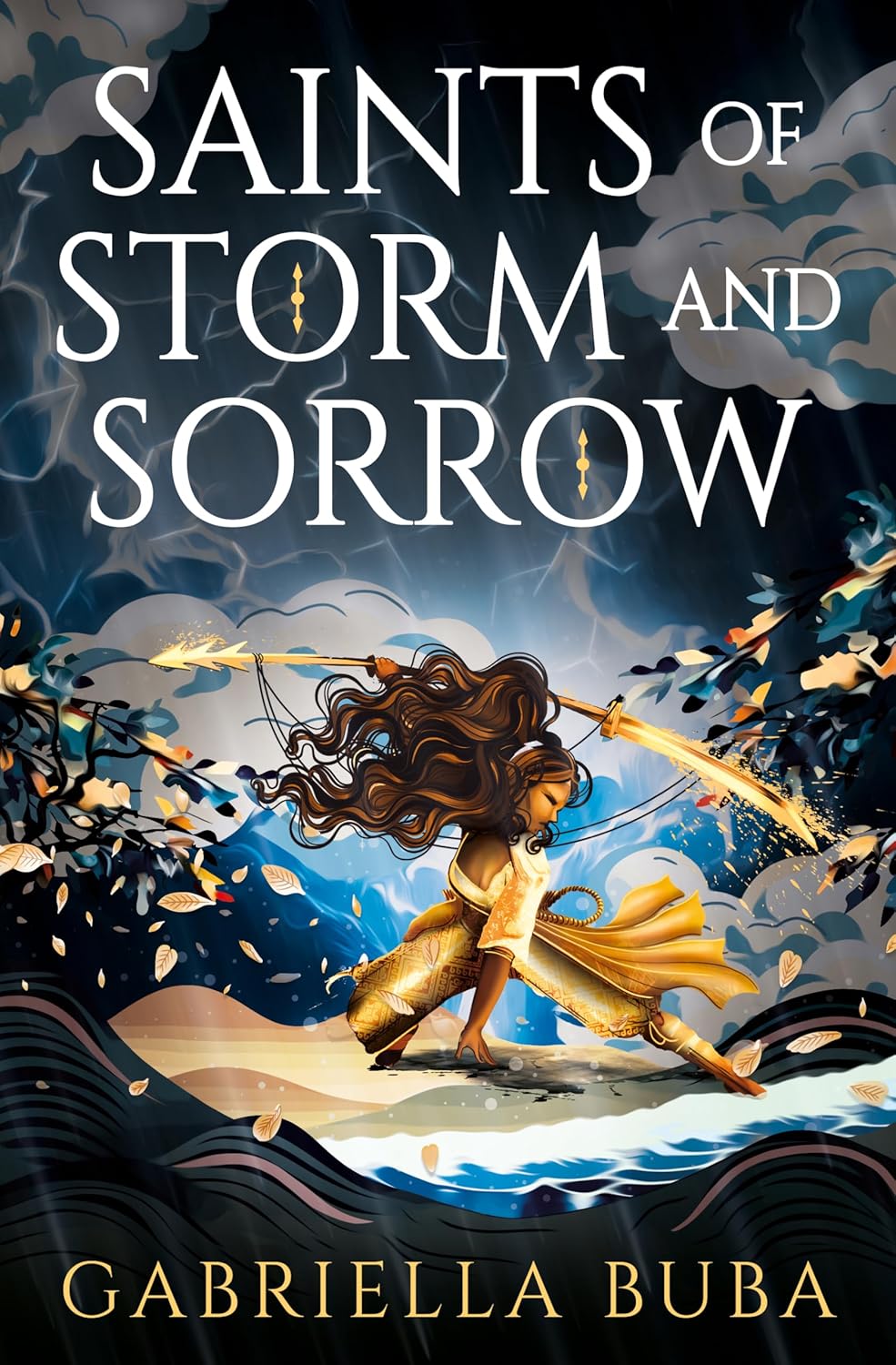
Saints of Storm and Sorrow – Gabriella Buba“I see the ill in all of you/The violence hidden out of view/What I have done, if you only knew/I’ve got sharp edges all for you…”

“Fisherman’s Grotto” – Justin Warfield

As much as I credit my dad for my musical upbringing, I feel like my mom equally deserves the credit—especially when it comes to hip hop. Particularly, she’s basically given me my hip hop education: I know about Queen Latifah, Lauryn Hill, De La Soul, and the Beastie Boys (who she loves) because of her. And she’s the reason that I know about Justin Warfield—this track, as well as the low key instrumental “Guavafishcentepede (Aquatic Meditations).” Speaking of the Beastie Boys, Warfield samples them in “Fisherman’s Grotto” (that’s a sped-up portion from “Hold It Now, Hit It,” which appears at 1:24). It reminds me of how much artistry can go into samples; the centerpiece, to me, is the blaring horns that introduce “Fisherman’s Grotto.” You’re instantly hooked—it’s the audio equivalent of watching Warfield kick down a brick wall. Said horns are sampled from Blood, Sweat & Tears’s “Lucretia MacEvil,” and from there, Warfield expertly rides the groove of this track—it’s so effortlessly smooth from beginning to end.

…AND A BOOK TO GO WITH IT:
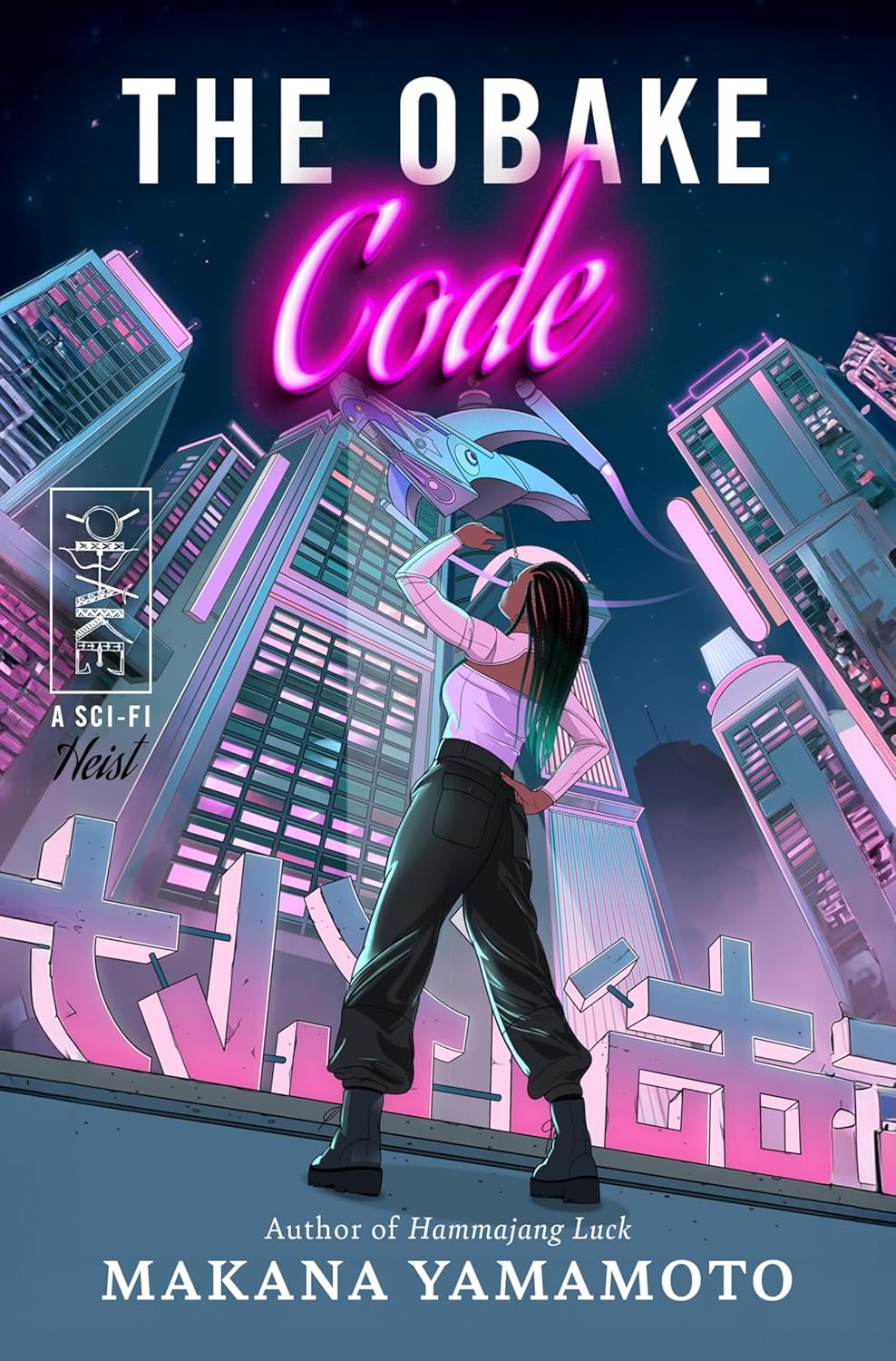
The Obake Code – Makana Yamamotothis is exactly the kind of soundtrack I’d expect this gritty yet trickstery cyberpunk world to have.

“Who Are You” – Tom Waits

Physically and mentally, I haven’t recovered from my grand decision to listen to Bone Machine and Lost Weekend in the same week. I know I’m cooked. I really haven’t changed since the age of 16. I love a sad bastard. Of course, if this was a sad bastard music competition (Phoebe Bridgers is also a noted fan of Tom Waits), Tom Waits would come crashing into first place—Bone Machine was the emotional equivalent of riding a dilapidated roller coaster with rotten, wooden slats that’s been decommissioned since the ’70s and should not humanly hold any weight beyond two pounds. It wildly oscillates from some of the most plainly, horrifically sad songs that I’ve heard in my life, and then we’re back to hootin’ and hollerin’ like a bunch of rabid swamp goblins around a campfire. Whiiiiplaaaaaash. Moments of unlikely beauty rub shoulders with moments of depravity and rot, but they’re all strung together by Waits’s uncanny knack for storytelling. A lasting impression, carried over from “The Earth Died Screaming,” is that he has more than a way with words.

“Who Are You” falls into the latter melancholy category. The minute the lazily ambling upright bass kicked in, I was transported to some rusting, barely populated pub at an ungodly hour, with Waits dejectedly slumped over the bar. It’s a track that’s positively drenched in venom and scorn, but Waits’s bitter storyteller’s bent gives it such a distinct feel. “I did my time/In the jail of your arms” feels like the exact kind of lyric I’d expect from Waits, but it gets so much better—and evocative—from there. Evoking the imagery of a run-down carnival and drunken, reckless escapades, Waits maps out a rugged terrain of a relationship gone sour: “Do you cry? Do you pray? Do you wish them away?/Are you still leaving nothing but bones in the way?/Did you bury the carnival with the lions and all?/Excuse me while I sharpen my nails.” All delivering in Waits’s wavering, throaty growl, “Who Are You” hits all of the visceral parts: biting, stinging, and raw.

A final note: I swear that Bone Machine gives the distinct vibe of the exact kind of music that Hellboy would listen to. The vibe carries over the whole album for me, but there’s a few moments on “Who Are You” that have pronunciations that sound straight-up Ron Perlman. Tom Waits and Ron Perlman do have a vaguely similar vibe, now that I think about it.

…AND A BOOK TO GO WITH IT:
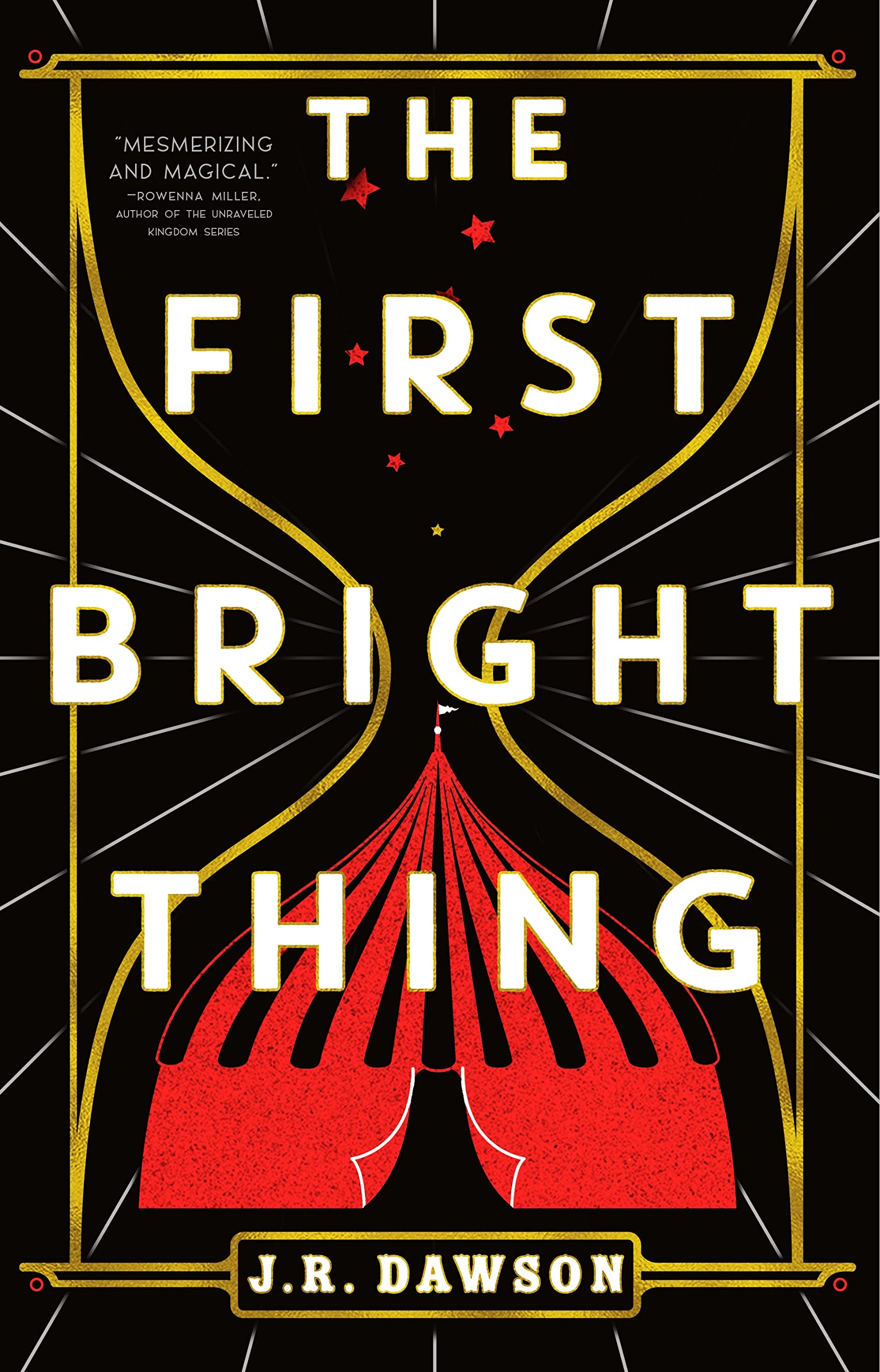
The First Bright Thing – J.R. Dawson“Tell me, what did you do? What did you do the last time?/Why don’t you do that?/Well, go on ahead and take this the wrong way/Time’s not your friend…”

“Champagne Coast” – Blood Orange

Alright, steady now. Hold my hand. We’re getting out of this Bone Machine morass together. Go take a shower, let’s dance! Up and at ’em! Life is worth living!

I’ll get it out of the way: yes, I remember “Champagne Coast” primarily from when it had a moment on TikTok about two years ago. The instrumental almost-chorus, with its high-pitched guitar riff that just glittered, was easily understandable as a catchy hook—and unfortunately, a backdrop for the unattainable beach vacations of influencers. (Happens to the best songs, I guess. I miss when TikTok didn’t know who the Yeah Yeah Yeahs were.) But on its own, “Champagne Coast” is a solid piece of indie pop—Perfume Genius is the best comparison that comes to mind, with Devonté Hynes’s warm, breathy vocals and the airy quality that lingers around the track like a silvery garland. Breathless and yearning, Hynes’s near-mumbled lyrics speak to a loving kind of desperation while waiting for a lover to return home. But its centerpiece is that viral, delicately plucked guitar, performed by Hynes himself; the greatest tragedy about “Champagne Coast” is that even though it’s nearly five minutes long, that guitar doesn’t get much room to breathe. Come on, man! “Let it rip” isn’t appropriate for a song this light, but give that guitar some love!

…AND A BOOK TO GO WITH IT:

Love Galaxy (The Imperial Broadcasts, #1) – Sierra Branham“I told you I’ll be waiting/Hiding from the rainfall/Tell me, what’s the joy of/Giving if you’re never pleased?”

Since this post consists entirely of songs, consider all of them to be today’s song.

That’s it for this week’s Sunday Songs! Have a wonderful rest of your day, and take care of yourselves!

Posted in Book Review Tuesday

Book Review Tuesday (8/11/26) – The Celestial Seas

Happy Tuesday, bibliophiles!

Have I read Moby Dick? Nope. Do I intend to? It’s not a high priority. But will I read any sci-fi retelling of it? Absolutely.

There’s such a dearth of YA sci-fi, so much so that the tagline for The Celestial Seas compares it to two very different books (Aurora Rising and Iron Widow). It’s so sad that there’s not even enough popular books to make a valid comparison to this novel, even if it is just a marketing technique. And though it wasn’t without its issues, The Celestial Seas is a wonderfully weird addition to the pantheon of YA space opera.

Enjoy this week’s review!

The Celestial Seas – T.A. Chan

Years ago, a giant Ballena—a sentient biological spacecraft in the shape of a whale—destroyed an entire spacefaring whaler, leaving Ishara Ming as the sole survivor. Now, with a scrappy crew and rapidly dwindling supplies, she’s on the hunt to avenge her former shipmates. They all dismiss her thirst for revenge as delusion, but Ishara knows what she saw. But when Augustus, a mysterious mechanic who wants to kill this Ballena as much as her, appears on their ship, Ishara begins to question the truth of her bloody memories—and whether this thankless whaling quest is worth it at all.

TW/CW: descriptions of injury, loss of loved ones, substance abuse, murder, violence

First off, I’m in love with this book cover! I’m obsessed with Carolina R. Fuenmayor’s style, and it suits Chan’s book wonderfully. AND SHE’S COLOMBIAN!! LET’S GOOOOOOO

I’ve never read Moby Dick, but if there’s one thing that promises some good old-fashioned sci-fi weirdness, it’s a sci-fi retelling of Moby Dick. (The other one that comes to mind is China Miéville’s gloriously bonkers Railsea, which I liked much better than this, but it’s a hard act to follow.) I’ve absorbed enough from pop culture to know the gist of the story, so it’s not all that hard to understand without the context of the book. Either way you look at it, The Celestial Seas is a spirited YA debut with undeniable charm.

Half of the fun of The Celestial Seas was diving into the worldbuilding. It’s a refreshingly original setting. You’ve got your sentient space whale-ships, for starters, but it only gets better from there. We’ve got a win for the Latines in space, because some sort of Pan-Latin-American coalition ends up settling a large portion of space before the events of the novel, and a lot of the slang was informed by Spanish; for Ishara, there’s also remnants of Mandarin Chinese that remained in her original language, which was also super cool. There’s got all sorts of cultural and technological quirks to pick apart. T.A. Chan covered all of her bases when it came to the worldbuilding, and it showed. The one caveat was that Chan plunges you headfirst into said worldbuilding—a lot of the information I just talked about isn’t explained in-scene; personally, I don’t think it’s much of a problem, since it’s easily decipherable thanks to context clues. But there sure is a lot of sci-fi technobabble, so buckle up. Personally, I think it was all part of the charm.

Saying that I loved Ishara as a protagonist is complicated. She was developed fantastically, but I really wasn’t a fan of her personality. Is she likable? Not really, no—not until the last third of the novel, to be honest. But does it work for the novel? Absolutely. Especially given Moby Dick, Ishara’s bloodlust (is it bloodlust if it’s a sentient spaceship? Ishara certainly doesn’t think so) and grief were exactly the kind of protagonist that The Celestial Seas needed. Chan was unafraid of making Ishara flawed and reckless. She had an excellent arc by the end of the novel, and I loved how her quest for the Ballena tied into questions about her identity, and whether or not it was worth it to base her entire life’s purpose on the past and a singular, dangerous goal—and whether it was worth it to brazenly risk the lives of her crew along the way. Quinn and Augustus were both solid foils to Ishara, and I’m glad that they haven’t turned into a love triangle…yet.

Unfortunately, that same care wasn’t afforded to the rest of the cast of The Celestial Seas. To a point, it’s understandable; you’ve got a whole crew of a spaceship, and there’s not that much time to develop every single one of them. That would be excusable, if not for two things. First off, most of the supporting cast (aside from Quinn and Augustus) had a single, shared personality—they were each assigned a job, and then they all got a turn pushing the sarcastic one-liner button when the time called for it. Second, by the end of The Celestial Seas, we’re all supposed to care so deeply for all of them, as evidenced by the impassioned inner and outer monologues given by Ishara; of course, they had almost no importance to the plot, so all of said monologues felt hollow. I get that every novel with a largish cast doesn’t have time to make everybody the star, but Chan left everybody but three people in the dust.

Chan’s writing style was solid, but it had some pitfalls that dragged The Celestial Seas down. Her renderings of the celestial sea in question were nothing short of immersive, and she nailed that sci-fi charm of new slang and technobabble without drowning the interactions between the characters. However, there are places where Chan holds your hand in a way that felt too much, even for YA. (Probably not even suited for YA—yes, the audience are younger, but you don’t insult the intelligence of teenagers, of all demographics!) Like Ishara’s Big Emotional Speech during the climax, there were moments where Chan unceremoniously shoved the Big Message in our faces, which got old quickly. I know, YA, but there’s only so much repetition of “the girl with the wildfire eyes” one can take. What’s worse is that most of these moments didn’t have the textual evidence to back them up—I know that Quinn is the girl with the wildfire eyes, but Chan doesn’t even care to explain what that means. It wasn’t the best combination, but Chan’s writing is at a solid starting point.

All in all, an ambitious YA debut full of determination, spirit, and massive space whales. 3.75 stars!

The Celestial Seas appears to be a series, but no sequels have been announced. T.A. Chan is also the author of the adult novella One Last Game.

Today’s song:

goddamn, this might be my favorite led zeppelin song…

That’s it for this week’s Book Review Tuesday! Have a wonderful rest of your day, and take care of yourselves!

Posted in Sunday Songs

Sunday Songs: 8/13/23

Happy Sunday, bibliophiles! I hope this week has treated you well.

Since I’ve been making these Sunday Songs graphics for just over a year and writing about them for about half that time, I’ve noticed that there’s inevitably at least one light blue week per month. Different shades of blue, but there’s always at least one, and it’s always pale. Like this one. Or this one? Either way, here’s the court-ordered blue period for August. Bon appetit.

Enjoy this week’s songs!

SUNDAY SONGS: 8/13/23

“1 Billion Dogs” – Jay Som

I listened to Everybody Works entirely on a whim, just to have something shorter to have as a soundtrack while I rearranged the bulletin board in my room. But I should’ve predicted that any given Jay Som record—much less this one—would be so much more than that. Perfect summer album, I have to say. Go listen to Everybody Works, guys.

Everybody Works is an album of many faces, from the chugging indie rock of “Take It” (which works way too perfectly with boygenius’ “Satanist“—can somebody with the ability to make mashups make this a reality?? please?? makes sense, seeing that she’s the bassist for boygenius’ touring band), the pop hooks of “The Bus Song” (BUT I LIKE THE BUS!), and the fever dream atmosphere of “(Bedhead).” But never once does it feel inconsistent or lacking cohesion—if I had to pick them from a crowd, all of these varied songs would still feel distinctly Jay Som. But amidst all of that, aside from the two tracks I already remembered from the album (“The Bus Song” and “Baybee”), “1 Billion Dogs” was an immediate standout. The title alone would have caught my eye on any other record, but strangely, even though it has nothing to do with dogs, much less billions of them, it has that feel to it. It fits. “1 Billion Dogs” is a song with an immediate urgency; even with Melina Duterte’s reserved voice almost melting into the instruments, it’s a song that grabs you by the shirt collar, then invites you to jump around and dance. But even the crashing rhythm guitars, steady bass, and just-so off-kilter riffs can’t take away from the electronic haze that never lifts from Duterte’s music. It’s a uniquely Jay Som flavor to me: dreamlike and fuzzy, like it’s cloaked in multicolored static.

“Evicted” – Wilco

September is shaping up to be a heavy hitter as far as albums go. I’ve already talked about tracks from Shakey Graves’ Movie of the Week and Mitski’s The Land is Inhospitable and So Are We, but I haven’t yet talked about the new Wilco, with their new album Cousin coming out on September 29! And only about a year and a half removed from their last double album, Cruel Country…Jeff Tweedy is just cranking ’em out, huh?

Tweedy and co. have advertised the upcoming Cousin as their art-pop/rock album. Wilco has always had a penchant for the experimental, but I feel like when they’ve previously advertised their albums as a certain genre, it doesn’t always fit the label. Take Cruel Country—”country” was literally in the name, but it felt like more of a folkier side of Wilco than anything, which, given their roots, wasn’t much of a stretch. Rather, as Tweedy said in his Starship Casual newsletter, “Cruel Country was our idea of country music and a lot of people went, ‘Huh?! this doesn’t sound like Colt Steed!’ (or some other plausible sounding country mega-star name).” So I’ll have to go into this album knowing that it’s Wilco’s idea of art-pop—and that’s certainly promising. And maybe I was screwing myself over when I saw “art rock” and immediately went into this song thinking it was gonna be “Art of Almost” 2. It isn’t. Even as much as I love Wilco, I feel like even that would be hard to reproduce. That’s not to say that “Evicted” is a bad song in any way—if there’s anything that Wilco has been in the last 10 years or so, it’s consistent. Regardless of our personal definitions of where this song fits into, “Evicted” is proof that Wilco’s ability to feel relevant and rock-solid will likely never fade. With its timeless guitars and the gently ethereal backing vocals and Nels Cline’s quietly glittering riffs rising like plumes of dust in the background, it’s a deceptively simple song—much like the Trojan Horse that Tweedy compared his definition of bubblegum pop to. And if I’ve learned anything from Cruel Country, it’s that I can’t judge an album by its first single. I’d be lying if I said that “Evicted” wasn’t an earworm. Jeff tweedy is true to his word.

Also, can I take Colt Steed as my new stage name?

“Crash” – Lisa Germano

EMERGENCY WEATHER REPORT: we regret to inform you that sad girl fall is scheduled to arrive two months earlier than expected. Hunker down, everybody.

A song that begins with the line “You could say I feel this way/’Cause it’s the way I feel” doesn’t seem terribly memorable at first glance. But that’s the thing. You have to wait. Not even that long of a wait, really. Because it’s followed up with “Or you could say I’m making it up/I want it to be real.” See? Have a little faith in Lisa Germano, in all of her raw, dilapidated-house-with-rusty-nails-lying-everywhere craft.

My introduction to Lisa Germano goes to show, once again, how deeply and wonderfully my dad knows me. Here I was, almost a year ago, when my dad made his annual birthday playlist for me (yep, that’s how cool of a dad he is), and played me “Victoria’s Secret” in the car; Immediately, I was lost in the eerie, spare-and-found-parts, and 90’s (in the best way…I really do love the 90’s) universe of Lisa Germano. (Guys. C’mon. “Victoria’s Secret” has her cat purring in the outro. It’s so good.) I listened to Slide in its entirety a few months later, during what we can actually call sadgirl fall (read: November), and bits and pieces of that record have constantly drifted around me ever since: specters, all of them, but welcome ones. Somehow, though, as much as I played tracks like “Way Below the Radio” and “Reptile,” I forgot about “Crash” until it came on shuffle not long ago. And now that I’ve listened to it more and more (you know it went STRAIGHT to the library playlist), I’m almost ashamed that I let it slip through my fingers, if only temporarily. On further listens, it’s so clear to me that it’s one of the best tracks off the whole album. “Crash” is a song that purposefully droops and lumbers, only faintly held together with fraying twine and half-intended promises. As Germano creates her oft-expressed lyrical landscape of languishing in depression and a lack of motivation (“Wonder why it’s so easy/to be the way I hate”), the instruments sit on the verge of falling apart; they all play in time, but they teeter enough to get the sense that it would only take one sneeze for them to collapse. Germano’s silk-thin voice is a gentle hand that barely caresses you, cool and ghostly, but undeniably present. And it wouldn’t be a Lisa Germano without an uneasy, 40-second piano outro. If there’s anything that she can do, it’s create an atmosphere. Slide was the perfect album to listen to in November, in retrospect; there’s something about this song (and most of her other songs that I’ve heard) that capture the melancholy limbo of that snowless but undeniably wintry chill.

“The Rabbi” – Blur

I’ve been conned. Again. And Damon Albarn is to blame. Twice this year, we’ve gotten albums from projects of his where the album as a whole has been disappointing, but then he comes back with the deluxe edition, and at least one song that would’ve made the original album SO MUCH better. Damon, you sly dog, you pulled a “Captain Chicken” on us AGAIN. (For reference: the other disappointing album happens to be Gorillaz’s Cracker Island.)

I wouldn’t call “The Rabbi” as good as “Captain Chicken,” but then again, it’s hard to replicate the chokehold that the latter had on me for at least 2 months after it came out. But amidst the decent but disappointingly flat expanse that was The Ballad of Darren, this new addition was a breath of fresh air and energy. Equipped with the jangly brightness that Blur has been the master of for 30+ years now, “The Rabbi” is an upbeat spark, and a welcome injection into the album. Graham Coxon’s guitar finally gets its time to shine outside of “St. Charles Square,” but where that recalled the grungy, disillusioned punch of their self-titled record, these joyful riffs feel more youthful, calling back to Parklife and even further back. Like “Barbaric,” the instrumentation of “The Rabbi” is nothing short of upbeat, but cleverly cloaks the underlying disillusionment and melancholy that permeates through the rest of The Ballad of Darren; as Coxon goes off with said jangly guitars, Damon Albarn drawls about how “‘Cause where’s the joy in this self-delusion?/We’re all practitioners of vague illusions/Hieroglyphics and pictures.” Even if I’ve come away from The Ballad slightly sore, at least I have one more song that I can actually nod my head along to and believe that it’s Blur. I refuse to shut up about “St. Charles Square,” though.

“Monkey” (Low cover) – Robert Plant

A reenactment:

The family car. Some time in the early evening. MADELINE and her family are driving on the highway. Robert Plant’s cover of “Monkey” plays over the speakers.

MADELINE: Huh, this song sounds like it could be in Legion.

EITHER MY DAD OR MY BROTHER (I FORGET): That’s because it was in Legion.

The realization hits MADELINE. Cue vine boom.

~

There have been many such moments in my life. But for all the ones that my brain decides to loop in the odd hours of the morning, at least I got a song out of this one.

Unlike my brother, the world’s biggest Legion fan in the world, I haven’t gone back and rewatched any of it since it came out. I’d rank it as my second favorite TV show, right behind Fargo, but I haven’t gone back to any of it in years, save for the fantastic Superorganism musical number in season 3. I don’t think it would ever be ruined by further rewatches (simply impossible for any Noah Hawley project, the man can do no wrong…okay, Anthem was a lot, but other than that), but it’s been like a beautiful, terrifying insect trapped in amber in my mind—it’s hard to replicate that feeling of sheer confusion, horror, and wonder when I had no idea what was going on with that show. But even with the mounting pile of shows and seasons that I need to catch up on, this song reminds me of Noah Hawley’s unmatched craft—and his unmatched music taste, along with the keen eye of Maggie Phillips, the show’s music supervisor. I can’t find the clip anywhere on the internet for the life of me, but this song is slipped into a chilling scene in season 1, episode 3, where a young David Haller chases after his wayward dog on Halloween night. It’s a scene that stressed me out, even if only for a few minutes’ rewatch—Cary did tell present David to “think of something stressful,” after all. And I can’t think of a better song to illustrate that pit-stomached sense of creeping dread than this. Low’s original version has that feeling of dread, but with an unmistakable urgency; Robert Plant’s version (and yes, it is that Robert Plant) swaps that urgency for a grinding, chugging sound that watches you from the darkest corner of the room. “It’s a suicide/Shut up and drive” would have been a blatantly chilling lyric in any other circumstance, but Plant’s strained, hollow whisper makes the chill up my spine all the more chilly. Patty Griffin’s backing vocals, somehow more audible than Plant’s, seem strangely sinister, even with the lightness of her voice. I can’t help but get a little anxious every time I listen to it—all the more reason that Hawley and Phillips were really onto something when they picked this one.

Since this post consists entirely of songs, consider all of them to be today’s song.

That’s it for this week’s Sunday Songs! Have a wonderful rest of your day, and take care of yourselves!

Posted in Book Review Tuesday

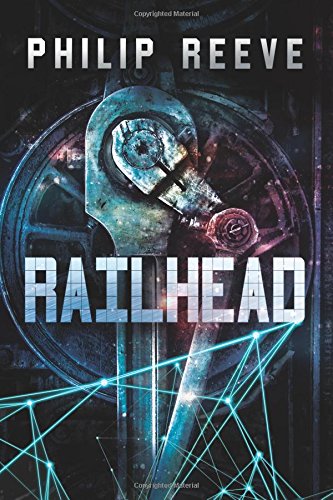
Book Review Tuesday (1/25/22) – Railhead

Happy Tuesday, bibliophiles!

As of last week, it had been ages since I’ve read anything by Philip Reeve. I’d gotten through the whole Larklight trilogy in middle school and loved it, and I read Fever Crumb as well and wasn’t as much of a fan. I forgot about him for a while, until I got a recommendation from Sabrina (thank you!) about another series of his—the Railhead series. I decided to pick it up, and I ended up liking it—after reading this, I definitely want to see how the rest of the story goes!

Enjoy this week’s review!

Amazon.com: Railhead: 9781630790486: Reeve, Philip: Books

Railhead (Railhead, #1) – Philip Reeve

In the distant future, it isn’t spaceships that transport humanity across the stars—it’s a massive network of trains. The Great Network spans across the entire galaxy, and one line can take you anywhere that you so choose. It’s the perfect place for Zen Starling, a young thief who makes a living from the goods he steals from passenger cars. But when he attracts the attention of the mysterious Raven, Zen finds himself entrenched in a royal conspiracy. Soon, his own identity as a nobody from the streets is called into question, and his success on Raven’s mission may determine the rest of his career.

Star Wars Prequel - Planet Coruscant | Star wars, Film inspiration, Gif

TW/CW: violence (fairly mild), descriptions of killing animals/dead animals, fire, fear

It’s been about 5 years since I’ve read anything by Philip Reeve; I loved the Larklight trilogy but didn’t have the same luck with Fever Crumb, so he was generally hit-or-miss for me. But ultimately, I’m glad I picked Railhead up! It was the perfect antidote after reading something as heavy as Anthem; fun, light-hearted, and fast-paced. (Thanks again for the rec, Sabrina!)

The worldbuilding of Railhead made the whole book. It’s the kind of intricate worldbuilding that I aspire to have in my own writing; no stone is left unturned in terms of the little details that make the Great Network so genuine-feeling and fleshed out. Best of all, none of it is delivered in info-dumps; pieces of information are spaced out and don’t distract from the overall story. There was so much love put into every little nook and cranny of Reeve’s world, from the trains to the android history to the graffiti on the walls. I especially loved the Hive Monks—the concept behind them was so inventive! I wished we’d seen more of Uncle Bugs and the others.

As far as characters go, I didn’t get attached to many of them, but they were at least decently flushed out. Zen himself didn’t have many traits that would distinguish him from the average middle grade/YA protagonist, and having him get saddled with this trilogy’s equivalent of the chosen one trope didn’t exactly help his case. He was simply…alright for me. I felt the same way towards most of the other characters; they were distinct enough to not be trope-y, but not distinct enough to be rememberable. I did like Nova, though. She was my favorite out of the main cast—I liked her backstory a lot, and her being an android (or a “moto,” as is the lingo in Zen Starling’s world) added a unique layer to her story.

The plot itself was a little lacking for me, but its fast pace saved it. At its worst, the plot seemed to [Robert Plant voice] ramble on without any clear direction, but at its best, it was loads of fun. You do get the sense that you’re clinging to the top of a speeding train, the way the events move—it’s very fast-paced, and given both the setting and the premise, it’s perfect!

I wasn’t as invested in the main plot, but I tended to gravitate more towards the side plots, the short anecdotes that fleshed out Railhead’s world even more. The fact that I got more excited about seeing giant manta ray creatures and looking at the insides of futuristic trains than the actual should probably say something about the book itself, but those parts gave me joy, and that’s that. Again—it’s the tiny details that made Railhead as entertaining as it was.

All in all, a romp through a futuristic world at breakneck speed that shone in its detailed worldbuilding. I’m on board with continuing the rest of the series! 3.75 stars, rounded up to 4!

Padawanlost — ✩ star wars gif meme ✩ [¾] planets: Coruscant...

Railhead is the first book in the Railhead trilogy, and it is followed by Black Light Express (#2) and Station Zero (#3). Philip Reeve is also the author of the Larklight trilogy (Larklight, Starcross, and Mothstorm), the Mortal Engines quartet (Mortal Engines, Predator’s Gold, Infernal Devices, and A Darkling Plain), the Fever Crumb series (Fever Crumb, A Web of Air, and Scrivener’s Moon), and several other series for young adults and children.

Today’s song:

That’s it for this week’s Book Review Tuesday! Have a wonderful rest of your day, and take care of yourselves!