
Happy Tuesday, bibliophiles!
Thankfully, after last week’s disappointment, we’ve got something to save the track record for Disability Pride Month. I started Elizabeth Bear’s White Space trilogy earlier this year, and I knew I wanted a physical copy of book 2. It’s one of the great joys in life when a sequel is better than the first book—and Ancestral Night was already a 4.5-star read for me, so this was huge! Machine was a fantastic step up for a series that’s already a cut above the rest.
Enjoy this week’s review!
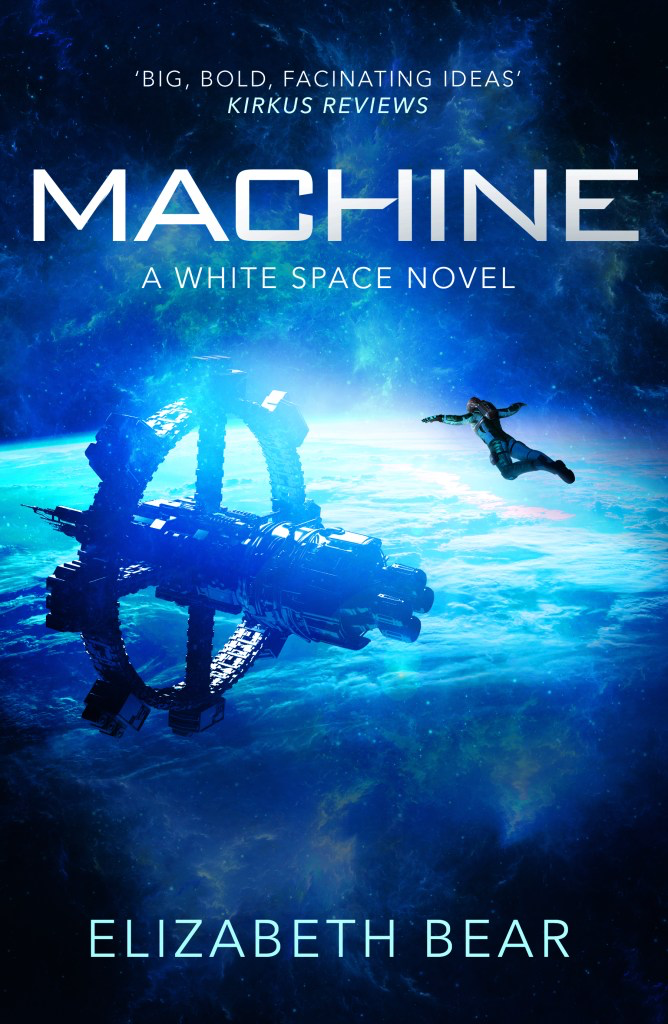
Machine (White Space, #2) – Elizabeth Bear
Dr. Brookllyn Jens is a special kind of doctor. Her patients are usually aliens, and her status as an emergency specialist means that her job description tends to involve having to jump out of spaceships. It’s already a job that keeps her on the edge. But when Dr. Jens and her crew discover two ships that have been abandoned for thousands of years, they uncover a mystery with layers upon layers of disastrous implications. With a strange, antiquated AI, an entire human crew in cryosleep, and a potential conspiracy on their hands, Dr. Jens and her crew must race against the clock to make sure that everybody makes it out alive.
TW/CW: ableism, misogyny, medical content, xenophobia, violence, murder
Genuinely, my sole problem with this novel is the title. Elizabeth Bear thought out this intricate and complex space opera world full of thousands of aliens and unique space travel, and couldn’t think of a more memorable title than Machine? I mean, yeah. There sure are Machines. Lots of ’em. But come on, really.
As much as I enjoyed Haimey’s story in Ancestral Night, I really think that making the White Space series several collected companion novels was the right move. It expands the intricate world that Elizabeth Bear has crafted in so many exciting ways that were only possible through the eyes of a different cast of characters. I loved the ways that the Synarche and all of the different species within it were fleshed out. Bear’s writing is as sharp as ever—her voice is so witty and hilarious, but she also knows just how to stick the landing when it comes to the more climactic or serious moments. The pacing was top-notch, especially considering that Machine is nearly 500 pages long—I blew through hundreds of pages at a time, and Bear never lost me.
I absolutely adored Dr. Jens as a protagonist, and Bear’s willingness to let her protagonists be messy yet lovable people made her shine. Dr. Jens has such a dry sense of humor, and her wry observations about the world around her made Machine such an entertaining read. But beyond that, I loved her continuous self-reflection—about the ideas she’s constructed about herself, but also about her work and the world around her. The supporting cast was so vibrant and lovable—it was a treat to see Cheerilaq again, first off, but all of the characters were so delightful and added a real human (and syster) authenticity to Core General’s staff. Sometimes your coworker gets on your nerves for no discernible reason, and they’re also a massive cetacean-like being getting wheeled around in a massive tank. On that subject, I loved all of the new Systers that Bear introduces. My creature design brain predictably became that meme of the dog with the propeller beanie and the giant lollipop seeing all of the truly alien aliens that populated the Synarche. But Bear went beyond good creature design and into crafting memorable, multilayered characters, which is what makes her space opera stand out in the end.
In particular, the expansion of the AI and robots in the Synarche was one of the most intriguing aspects of the world that Bear discusses in Machine. The whole plotline with Helen Alloy was one of the most well-executed. I love how Bear interrogates the objectification of women and how sci-fi has historically translated this into female-presenting robots. The visceral discomfort that Dr. Jens has that Helen was specifically created to have a hypersexualized, feminine form felt was like seeing the sun peer through the clouds after decades of weird men writing all kinds of messed-up sex-bots. It’s treated with the appropriate level of disgust—both on Helen and Dr. Jens’s part. Helen’s manipulation also ends up being vital to the later twist, and her entire arc of deconstructing the lies that she was programmed with was handled with such tenderness. Beyond the robots, I think that thread of treating people who have been brought up with hateful ideologies and not immediately dismissing those with different opinions was one of the best aspects of Machine; Bear’s insistence that people—human, alien, or AI—are not inherently bad, only victims of harmful ideas, was so necessary.
Bear’s take on disability in a sci-fi context was also such a respectful and well-researched one! She listed off several sensitivity readers in the acknowledgements, and their work paid off—for someone who seems to be non-disabled, by all accounts, this might be one of the most caring representations of a disabled person and their struggles in sci-fi I’ve seen by a non-disabled author. Dr. Jens has a chronic pain disorder, and she has a special exo-suit that manages some of her pain, but not all of it—sci-fi tech still has limitations in the far, far future. She still aches and gets physically taxed from her daring missions. Granted, I’m not chronically ill, but it felt like Bear paid so much attention to how Dr. Jens’s symptoms would present and how her high-stakes profession would affect it. Additionally, there’s a lot of talk about how disability is handled in the future; there was lots of discussion of “rightminding,” a process that, among other things, mitigates the effects of some mental illnesses. It would’ve been so easy to just slap it on as a cure-all technology, but Bear’s approach was one that I rarely see in sci-fi. It’s not necessarily “disability isn’t cured,” but it’s handled on a case-by-case basis, there’s an understanding that different kinds of disabled people have different needs and opinions about how they want to live with their disabilities with the technology available. This rejection of the one-size-fits-all approach to disability was a breath of fresh air, and wasn’t afraid to get into the nuance of how disabled people live their lives.
Disability wasn’t the only issue that gets dealt with in a refreshing amount of nuance. Bear was not afraid to get into the weeds with this novel, and it made my reading experience so much better. Machine, more so than its predecessor, gets into how a utopia and utopian ideas can be twisted into something sinister. It all feels very Ursula K. LeGuin—the Synarche is without a doubt an ambiguous utopia like The Dispossessed. (First off, I liked that Bear interrogates the ethics of “rightminding” targeting potentially “dangerous ideologies,” and how that ends up being decidedly non-utopian.) I appreciated that Bear discusses how well-intentioned utopias can be co-opted into vehicles for hatred, but also how that revelation wracks the people who genuinely believed in this utopia—people like Dr. Jens. Her arc in having faith in her hospital and the Synarche was so human—her entire reality and faith in the organization she devoted her life to is messily upended. But the realization that she comes to—that you can take the good work you wanted to do and the faith in your fellow people outside of corrupt organizations and do your own work—was one that feels so vital. I also loved the thematic potential of the infectious meme—not unlike the spread of a hateful ideology—that is treated as an infection that has to be weaned out with attention and care. Bear’s depictions of that crushing realization and how Dr. Jens and her coworkers pick up the pieces was so heartfelt, and a very potent message in this day and age.
All in all, a spectacular companion to Ancestral Night that expanded Elizabeth Bear’s masterfully crafted space opera universe with pulse-pounding action and heart. 5 stars!
Machine is the second book in the White Space trilogy, a series of companion novels set in the same universe; it is also includes Ancestral Night (book 1) and Folded Sky (book 3). Elizabeth Bear is also the author of several other series, including the New Amsterdam series (New Amsterdam, Seven for a Secret, The White City, Ad Eternum, and Garrett Investigates), the Jacob’s Ladder trilogy (Dust, Sanction, and Grail) and many others
Today’s song:
That’s it for this week’s Book Review Tuesday! Have a wonderful rest of your day, and take care of yourselves!


