
Happy Tuesday, bibliophiles!
I hate to say it, but while Amie Kaufman has never let me down with her books, her book recommendations are less reliable. That’s how I found out about Field Guide for the Formerly Villainous, but to be fair, I’ve been reading and enjoying Autumn K. England/M.K. England’s books since I was in high school. They’ve never been a favorite or auto-buy author for me, but their books have been consistently solid and enjoyable in a pinch. Unfortunately, their cozy adult debut is their weakest novel to date.
Enjoy this week’s review!
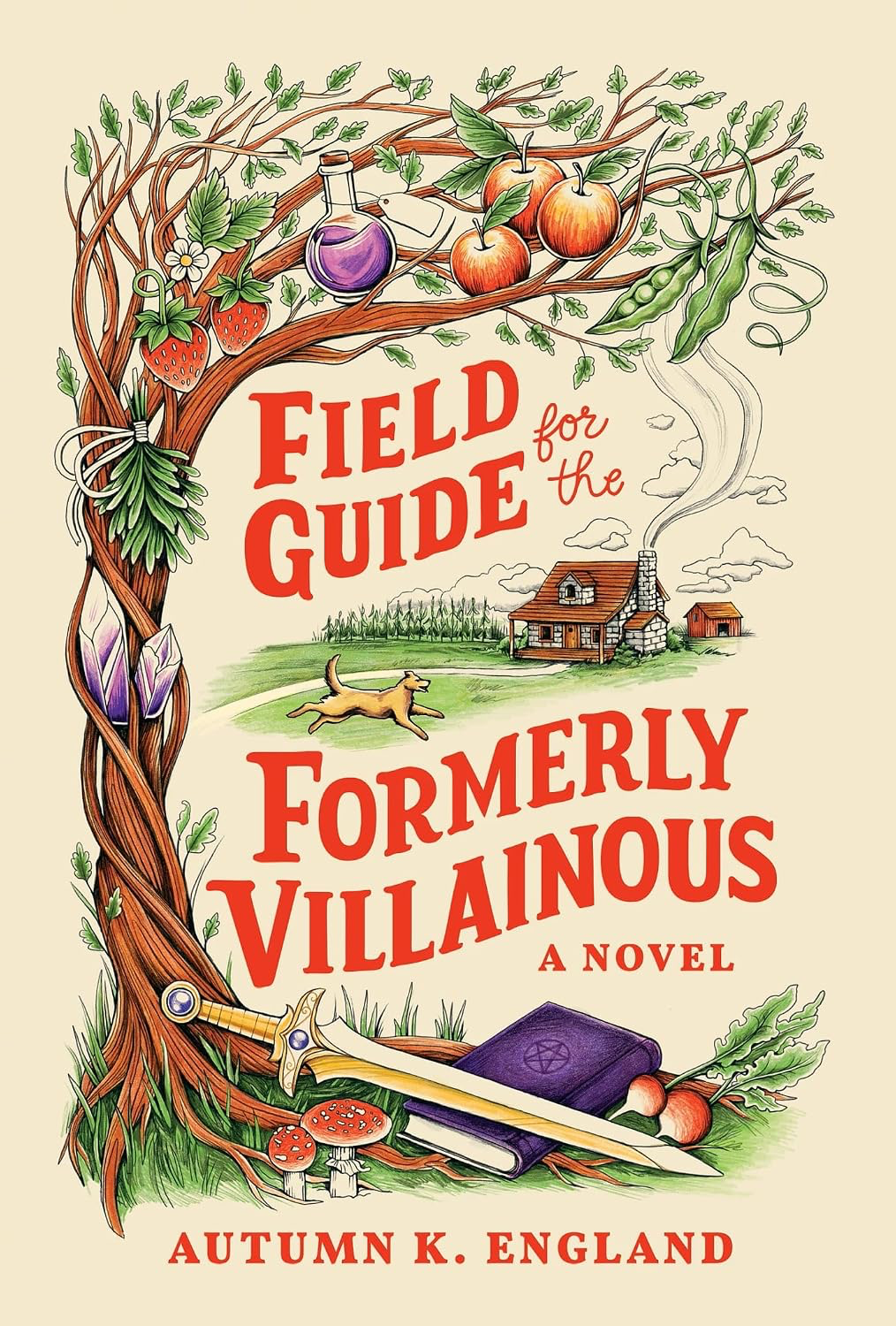
Field Guide for the Formerly Villainous – Autumn K. England
Oaklin Nettlewood is turning over a new leaf. After narrowly escaping from a magical cult, Oaklin has fled to the small town of Mossley’s Rest. In a fit of desperation, they buy a farm, not knowing that its former occupant was a beloved staple in the town before her death. Her ghost lingers in the barn, and she’s bent on helping Oaklin revive the farm in earnest. But between painful flashbacks, suspicious townsfolk, and Oaklin’s self-imposed barriers, will they ever be able to start over?
TW/CW: panic attacks, mental illness themes, past descriptions of murder/violence, substance abuse
I wasn’t a massive fan of England’s books before, but they were consistently entertaining, which is why I’ve kept reading them. This might be where I break up with them. I should’ve seen the red flags when this was compared to Can’t Spell Treason Without Tea, which I rated too generously in retrospect. Field Guide for the Formerly Villainous was largely bland, and when it wasn’t bland, it was grating; there are so many ways to make cozy genre fiction compelling, and England used none of them.
Field Guide for the Formerly Villainous did have a prominently good aspect; it’s not just a matter of “the main character is disabled/mentally ill and that’s cool,” but England’s depiction of Oaklin’s PTSD was so empathetic. England did an excellent job of writing all of the facets of Oaklin’s trauma and mental illness. No punches were pulled with the depictions of their violent flashbacks, and their frequent panic attacks and harshly critical inner monologue were treated with the appropriate balance of sympathy and authenticity—unlike some other parts of the book, none of it felt sanitized, which I appreciated. It didn’t just feel like representation for representation’s sake—it felt like a genuine attempt to humanize a mental illness that’s quite stigmatized.
I’m not sure if I was just able to pass over the flaws in England’s novels in high school because I wasn’t super discerning or if Field Guide for the Formerly Villainous is just their worst novel. Whatever the case, one of the biggest weaknesses of this novel was just how downright bland it is. I hate to say this, but I genuinely can’t think of a single unique quality that England’s writing has. There were a few nicely flowery metaphors here and there, but it just felt devoid of any individuality. The bucolic setting was described at the barest minimum, as were the relationships between Oaklin and the others. I wasn’t expecting a worldbuilding marvel, or anything, but any sense of the world beyond the absolute bare minimum was missing. England’s writing style was just exceedingly nothing. This was certainly a book. With words in it.
I was hoping that England’s characters and dialogue would pick up the slack that the boring writing left off. Unfortunately, that was not the case. Apart from Oaklin, who was decently written, and Granny (whose main distinguishing factors were that she was a ghost and had the mannerisms of an old lady), the supporting characters were lazy copy and pastes of each other. Looking back, the only thing that distinguished Lior from the others was that she was [checks notes] an attractive woman who had a different job from the others. Ryn and Jules were the exact same character. (I think one of them plays guitar? That’s all that distinguishes them.) But what really exacerbated this issue was that all of their dialogue sounded the same. To make matters worse, they all had these very modern, gratingly “quirky” mannerisms that felt like some insufferable person’s DnD campaign. For all the effort that England put into making the people of Mossley’s Rest seem like the kind of small town folk that you’d be comfortable being neighbors with, I just wanted to leave as soon as possible.
An extension of this character issue came in the form of the romance. I liked the setup of Oaklin and Lior’s relationship, but none of it felt earned. From the start, I knew that they would end up together. That in and of itself wasn’t the problem; the problem was that their romantic progression felt so fast and unearned. So much of how their relationship developed fell into the many timeskips throughout the novel, leaving what we had on the page insufficient. It just lacked tension. In cozy genre fiction of any kind, romance is a great way to introduce an element of low-stakes tension without making the novel overly tense. Here, it was just insta-love, and wholly unearned. The only real barriers were Oaklin’s past identity and their conflicting professions, both of which got smoothed over pretty quickly. I do like that Lior was able to accept Oaklin in spite of their past, but it just felt like it robbed the book of some fluffier tension that it very much needed.
That being said, I will say that, in spite of not enjoying myself throughout most of Field Guide for the Formerly Villainous, I did love the ending. It’s messier than a lot of cozy fantasies like it are willing to get, and the biggest takeaway is that Oaklin is fundamentally deserving of love in spite of their past, which they had no control over. Yes, it was a little sappy, but I always appreciate narratives about the harsh criticism that characters have about themselves being proven wrong. England stuck the landing, but it wasn’t enough to save the whole novel.
All in all, a cozy fantasy that was forgettable in all senses of the word. 2.25 stars.
Field Guide for the Formerly Villainous is the first novel in the Everyday Magic series, but no sequels have been announced yet. Autumn K. England (also writing as M.K. England) is also the author of several other books for teens and adults, including The Disasters, Spellhacker, Roll for Love, All Fired Up, and many others.
Today’s song:
That’s it for this week’s Book Review Tuesday! Have a wonderful rest of your day, and take care of yourselves!


One thought on “Book Review Tuesday (7/21/26) – Field Guide for the Formerly Villainous”