Happy Tuesday, bibliophiles, and more importantly, happy Halloween!
I really should be used to this by now, but getting this much snow two days before Halloween always feels so wrong. I like snow this time of year generally, but not when I have a costume to wear.
Let’s begin, shall we?
GENERAL THOUGHTS:
Usually a month this busy would dampen my overall feeling of it, but for once, it really hasn’t! That’s the magic of the Halloween season, I suppose. I’ve had a ton more stuff to do on the heels of midterm season, and even though I’m still somewhat busy (hence the scant amount of posts I’ve been able to make this month), I’m still enjoying myself.
However, even though most of the month has been favorable for me, my reading…hasn’t been as much so. Since the beginning of the month, I’ve been in a slump that I’ve only just been able to get out of in the last week or so. After the first few days, I just fell into a bad spell of especially mediocre books—for a solid two weeks, I didn’t run into much that I ended up rating higher than 3.5 stars. But I’ve slowly gotten out of the dry spell, and the end of the month has been filled with some fantastic reads!
I’ve also tried to get back into the rhythm of fiction writing, since I’ve fallen off the wagon for that since school started. Although I haven’t been able to adhere to the schedule to a T, I’ve allotted a good time of night towards writing at least 1,000 words a day, and that got me to the end of my first draft of the second book in my main sci-fi project! This one ended up being almost 82,000 words! Pretty proud of myself. Sadly, as I’m getting older, November has become a worse and worse year to try and crank out 50,000 words, so I’m not doing NaNoWriMo this year. The July Camp is a much more reliable time for me. In the meantime, I’m hoping to polish up some of my short stories to send off for publication…
Aside from that, though, there have been SO many fantastic things going on. First off, Sir Patrick Stewart (!!!!!) stopped by my school for his book tour, and it was incredible! I wish I had more pictures to show for it (we weren’t allowed to take any), but he just had the kindest, warmest presence, and it was such an honor to hear him speak about his life. What an incredible man.
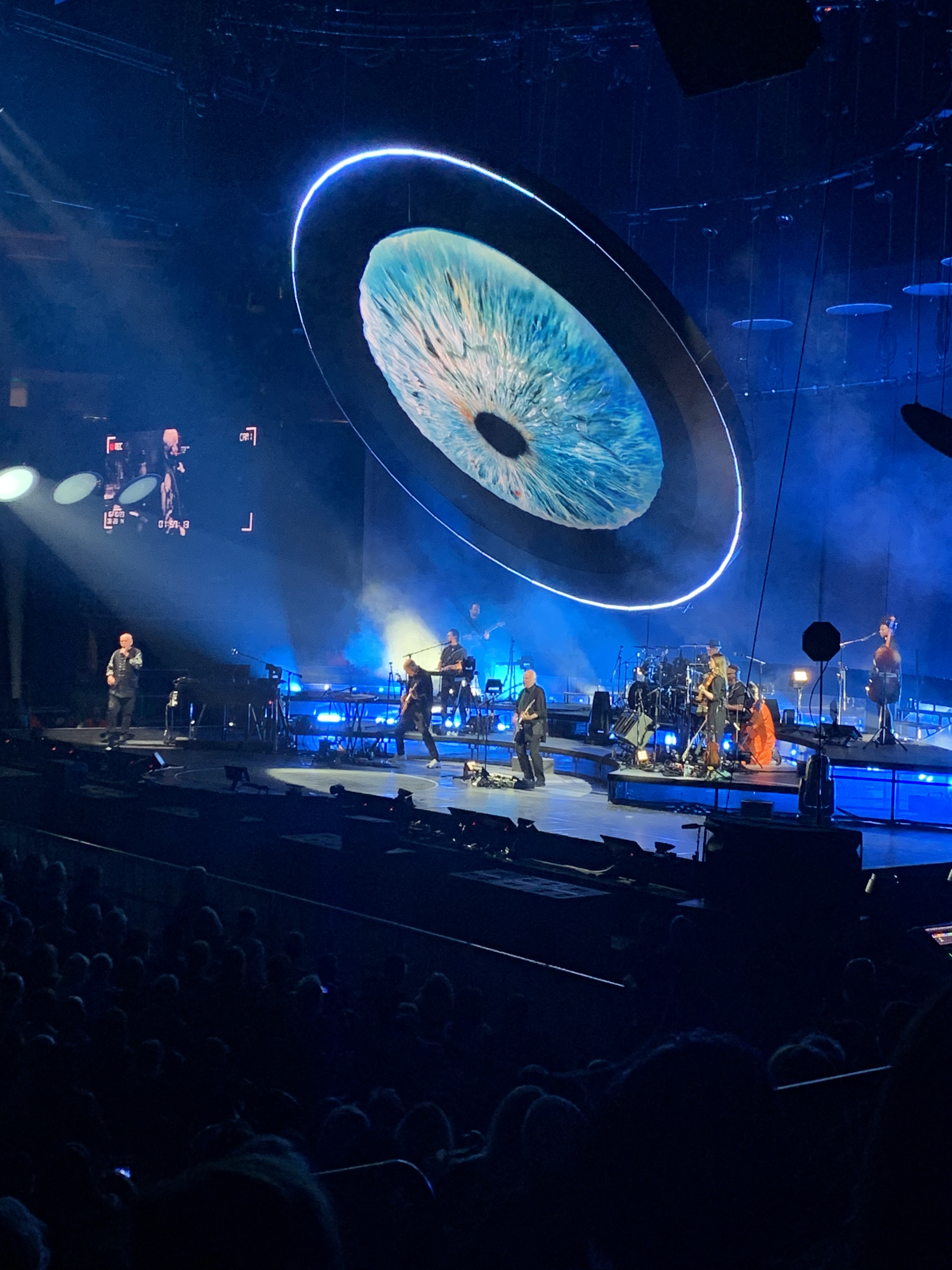
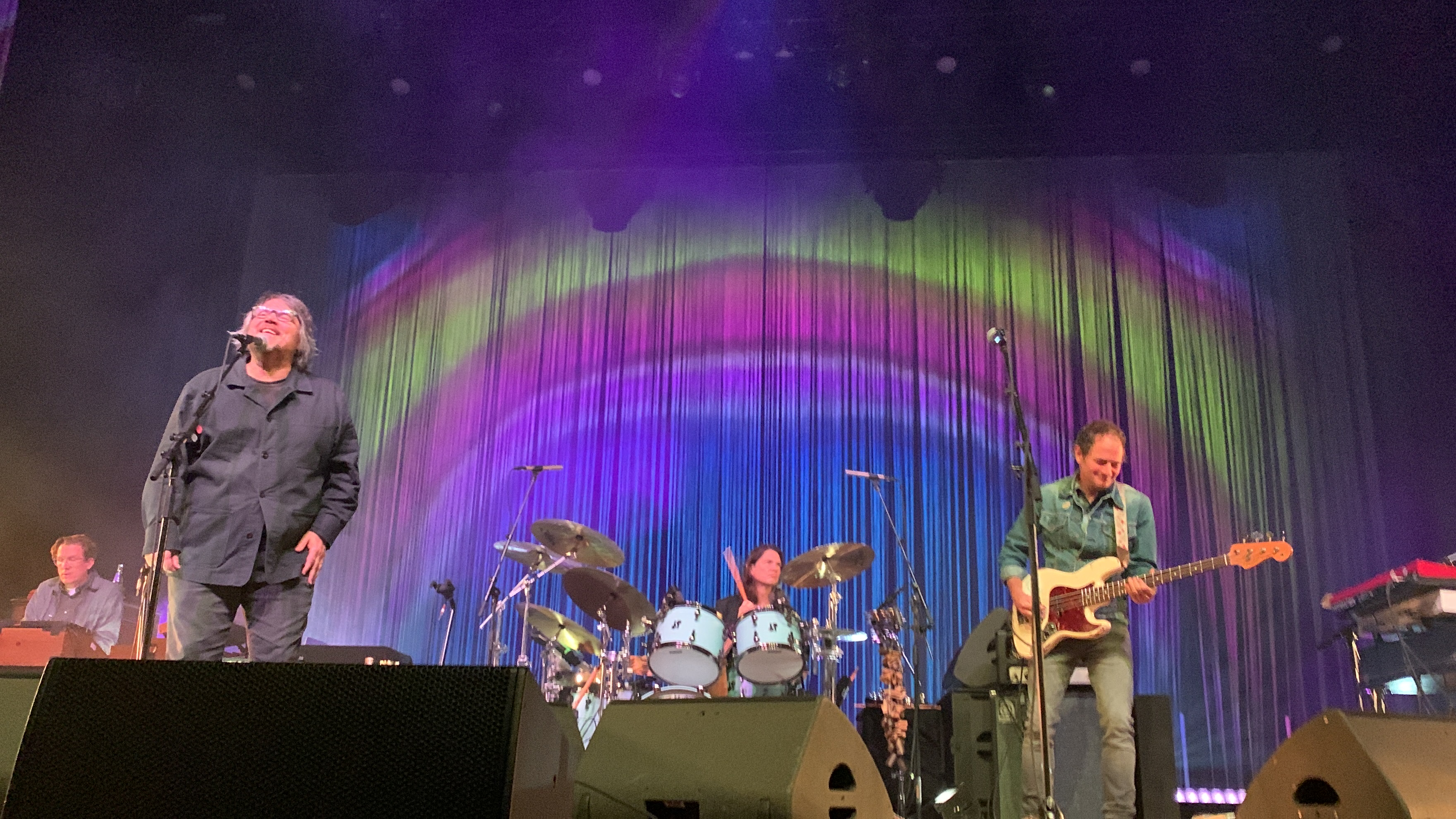
After that, I had the amazing luck of being able to see Peter Gabriel and Wilco in the same week! Both were such phenomenal shows in their own ways—seeing Peter Gabriel when I thought I’d never even see him tour was the most transformative, beautiful experience, and seeing one of my favorite bands perform their best setlist yet (and seeing them from the front row!!) was just as wonderful.
Peter Gabriel at the Ball ArenaWilco at the Mission Ballroom
Other than that, I’ve just been getting back in the rhythm of drawing, playing some guitar now and then, taking far too many pictures of the pretty leaves on campus, drinking my fill of apple cider, watching Taskmaster (FINALLY GOT THROUGH SEASON 15! THE BINGING HAS CEASED!) and catching up on Only Murders in the Building (please stop pairing Mabel up w randos, she deserves so much better), and soaking up the fall weather. At least I was until we got snow 2 days before Halloween. Oops.
READING AND BLOGGING:
I read 16 books this month! This month was slow going, and I ended up in a somewhat extended reading slump, but there were bright spots here and there.
Happy Sunday, bibliophiles! I hope this week has treated you well.
First off, apologies for the lack of a book review/Sunday Songs this week. I’ve just been busy with school, and I didn’t have as much time to sit down and write something that wasn’t the draft I’m trying to get myself back into the rhythm of writing. (I’ve been cobbling at this post in advance before this week, so that’s why you’re able to see it now.) Plus, I was just generally exhausted on Tuesday, but it was a good exhaustion, all things considered, because I’d seen Peter Gabriel the night before! Words don’t do justice to how incredible of a show it was. You’ll definitely hear about it later.
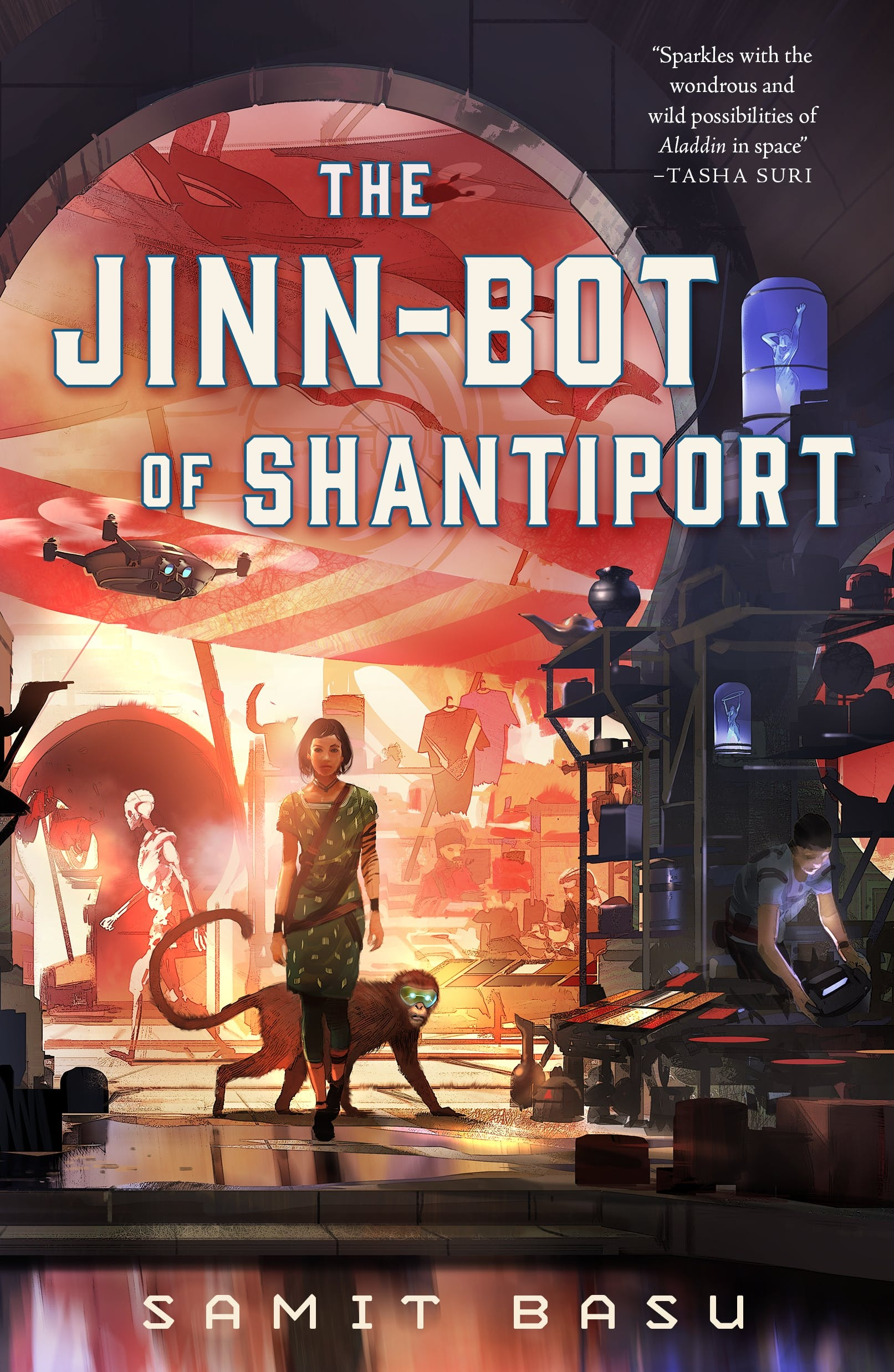
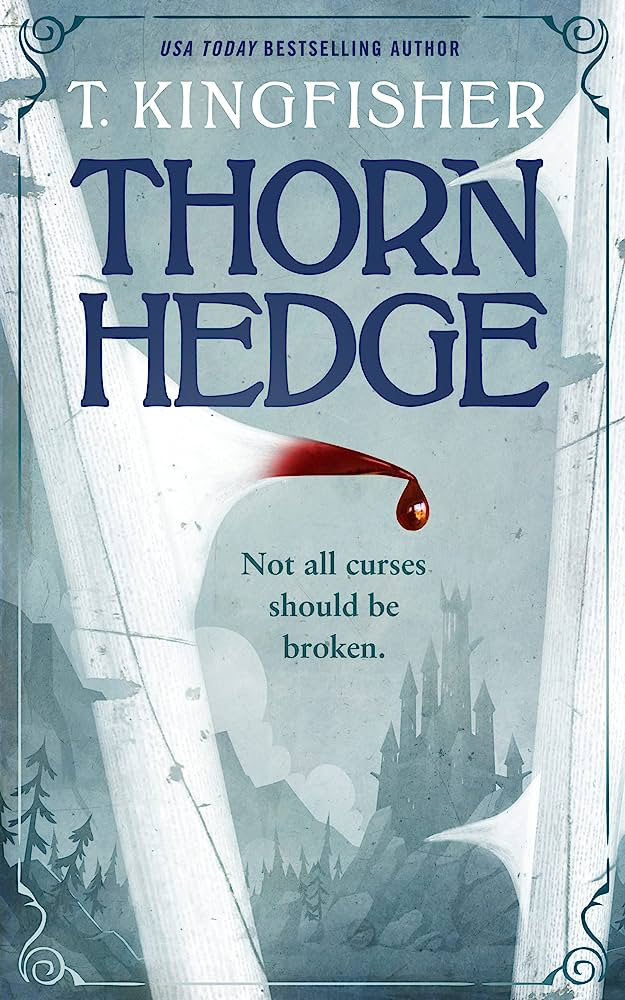
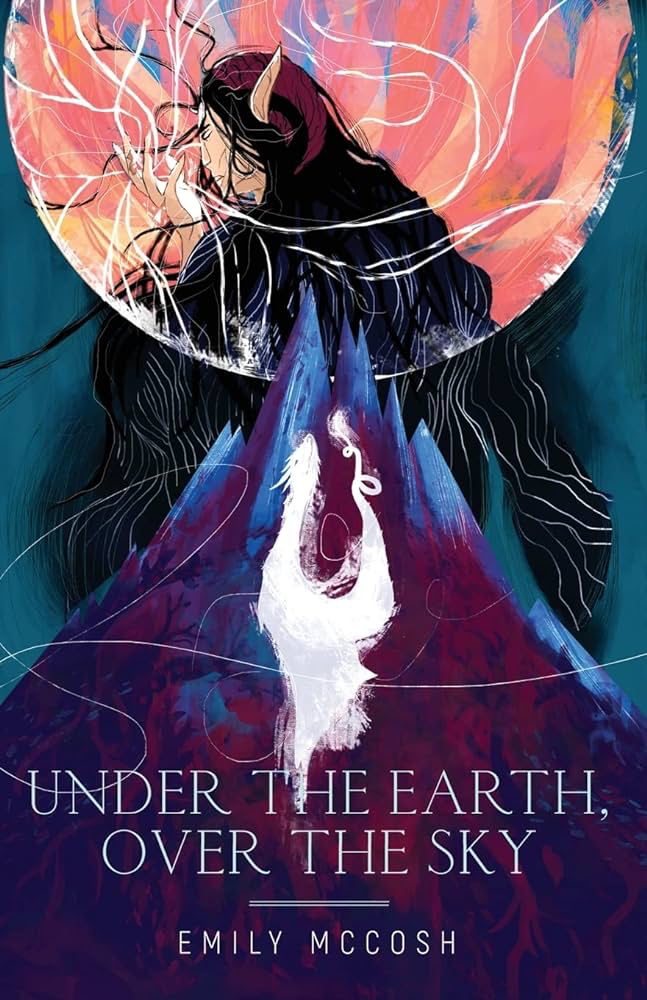
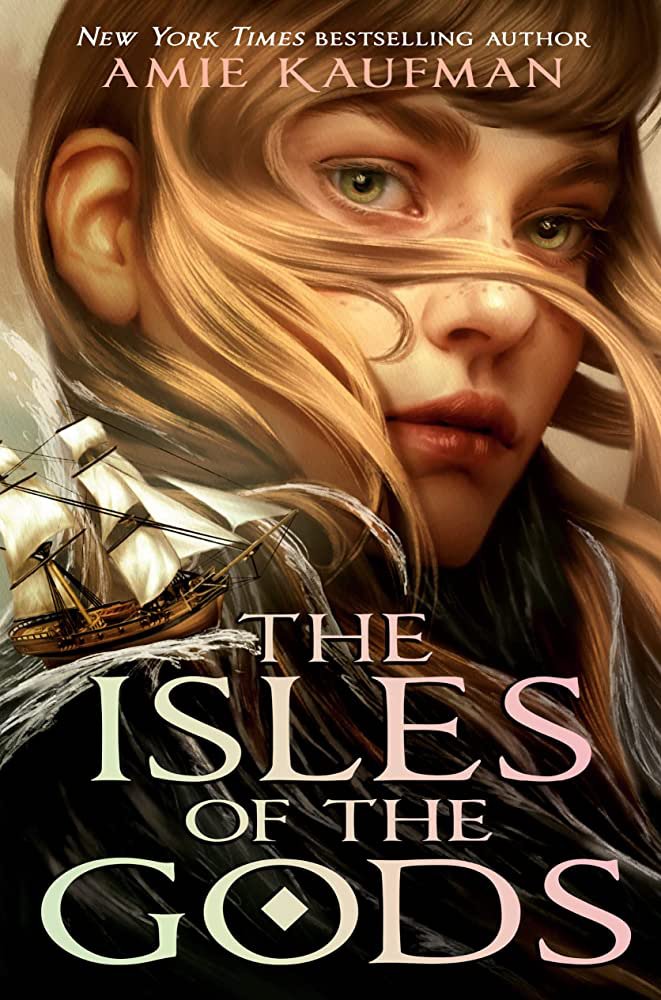
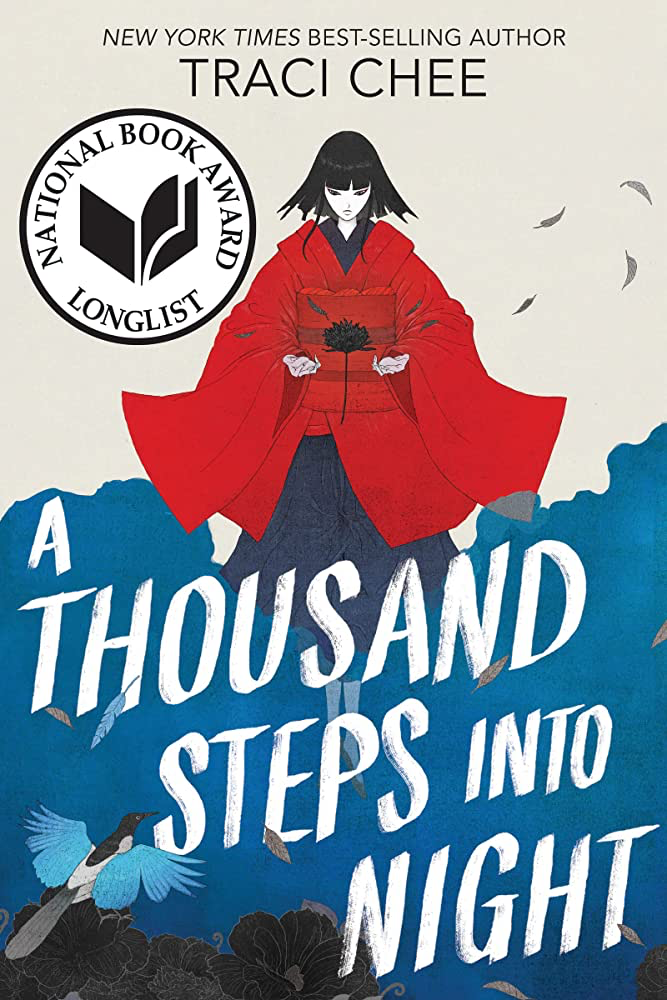
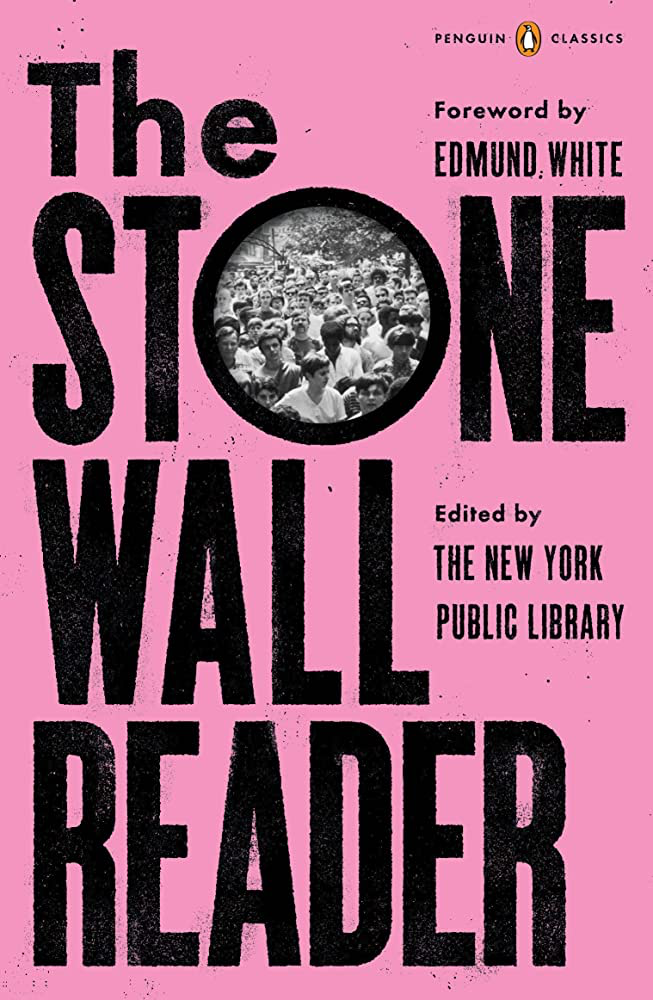
Here in the U.S., Asexual Awareness week, or Ace Week, is celebrated from October 22-28! Even though I’m not on the asexual/aromantic spectrum, it’s impossible to not see how much this community gets left behind, even within the LGBTQ+ community; just as any other spectrum of identity, it’s just as valid and worthy of respect as anything else. I’ve been meaning to make more asexual book lists, but this time of year is kind of crazy for me. But this year, I figured I would start early so I would have another book list—we need to shed more light on these fantastic books and authors!
TELL ME WHAT YOU THINK! Have you read any of these books, and what did you think of them? What are your favorite books with characters on the asexual spectrum? Let me know in the comments!
Today’s song:
That’s it for this year’s recommendations! Have a wonderful rest of your day, and take care of yourselves!
Happy Sunday, bibliophiles! I hope this week has treated you well.
THIS IS A CODE RED, I REPEAT, WE HAVE A CODE RED! IMPENDING BOYGENIUS BREAKDOWN IMMINENT! BRACE, BRACE, BRACE! BOYGENIUS BREAKDOWN HAS REACHED MACH 1, I REPEAT—[RADIO GOES DEAD]
I’m writing this on the day that the rest – EP came out, and I can assure you that’s been the only thing pouring through my headphones all day. I’ve lost count of how many times I’ve run through the whole thing. It’s easy to do it endlessly—only four songs, 3/4 of then in the two minute range. That’s this EP’s only crime—those three songs are just too short. Other than that, they’re so criminally flawless that it was exceedingly difficult to pick just one to talk about this week. There was the appropriate all-consuming but gentle harmonies of “Black Hole,” the painful relatability of “Afraid of Heights” (Ms. Lucy Dacus could you not stare into my soul today? Please?), and the gut-punches of “Voyager.” I was trying to have a good morning, but then, boom: Phoebe Bridgers hit me with that beautiful line about the pale blue dot. Ouchie.
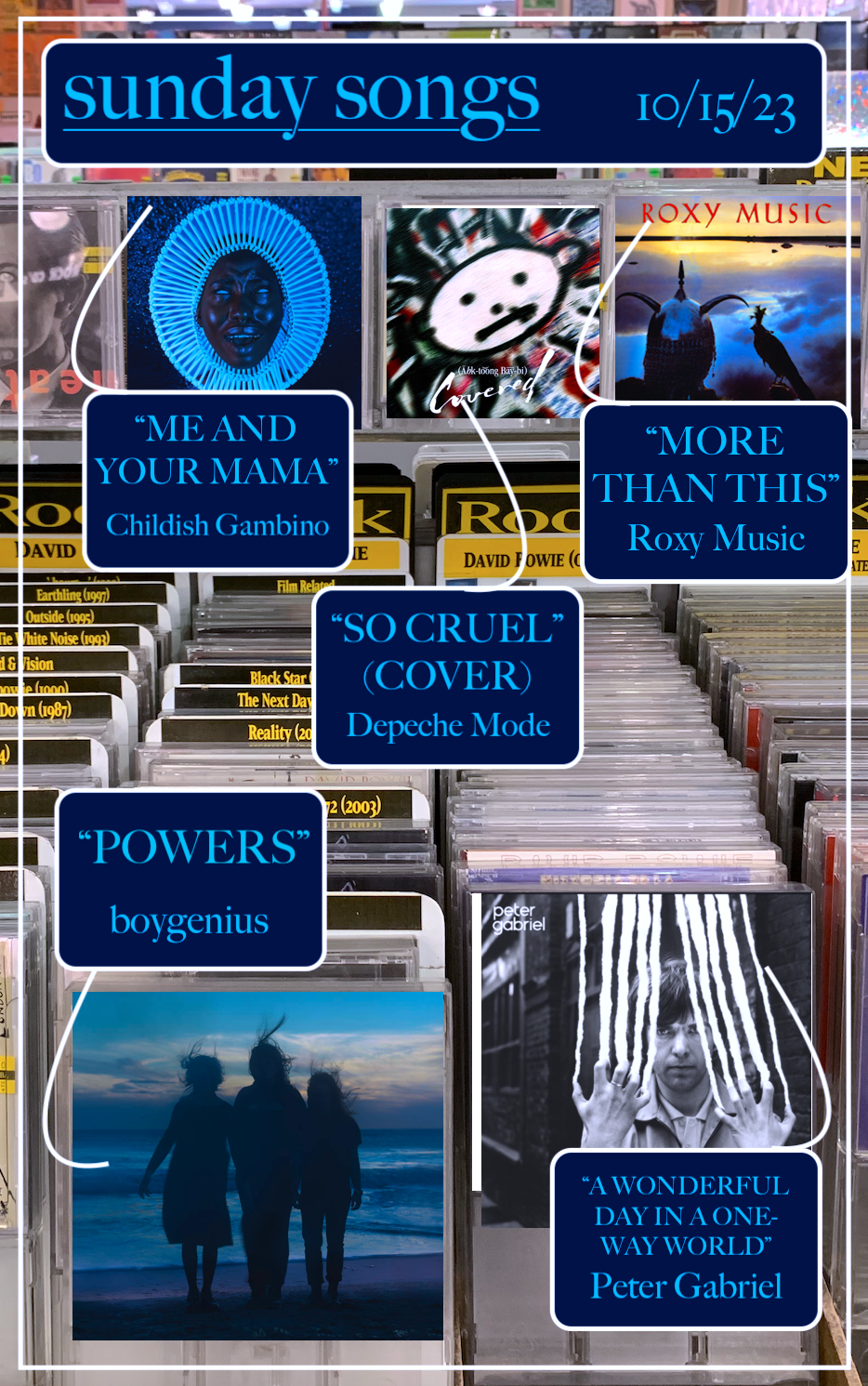
But from the start, “Powers” would have always broken through as a standout amongst standouts. Led by Julien Baker, this song is appropriately the EP’s longest, and one of boygenius’ most lyrically exciting songs. It’s something that I wouldn’t have expected out of them—of all things, a superhero origin story. It’s the coolest. Who wouldn’t get that rush of excitement as Baker and company croon “Either way, I have been wondering/Just how it is that I have never heard/The tale of how I got my powers?” Leave it to a line so inviting, so promising of something cosmic, to immediately steal my heart. Over the course of the song, Baker ponders this untold tale, searching for some remnant of the event that made her extraordinary—”Did I fall into a nuclear reactor/Crawl out with acid skin or something worse/A hostile alien ambassador?” It’s the kind of subject matter that lends itself to a more pop-rock sensibility, something punchy and full of action, but the subtle rise from acoustic guitars to atmospheric, electronic background noise feels just as sweeping. As the background reaches something close to a quiet crescendo, the lyrics are all it takes to ramp up the stakes: “No object to be seen in the supercollider/Just a light in the tunnel and whatever gets scattered/Life flashing before the eye of whatever comes after.” And with a whole album about their shared friendship, how could the final lines of “The hum of our contact/The sound of our collision” not be about just that—the strange journey that led three to become one and create such meaningful music together? And to follow it with a somber, resonant chorus of brass as the EP fades out? Glorious. “Powers” really is boygenius at the height of their own powers—purely cinematic, all-consuming, and as emotional as ever. Long live the boys.
It’s long overdue that I talked about Peter Gabriel 2: Scratch. I listened to it all the way through…wow, a month ago? But stubbornly, I refused to put it in because it didn’t at least vaguely fit into one of my color schemes until this week. As everything has been with my eternal Peter Gabriel summer, Scratch was a strange and jaunty little adventure. It seems to be his only album that never really produced any “hits,” as we’d define them, but it still charted to #10 in the U.K. Scratch didn’t chart quite as high in the U.S., and you can sort of see why—it wasn’t made for hitmaking. Neither was Car, but that album was just so nuts and all over the place that a hit was bound to come out when the dust settled. It’s still got that playful weirdness that Car had in spades, now with the cohesion that Car lacked. It’s still experimental and abrasive as all get-out at times (see: “Exposure,” another favorite of mine from the album), but you can see the unifying threads.
“A Wonderful Day In a One-Way World” was a surprise favorite for me, but it really shouldn’t have been. I’m not fully warmed up to prog in general, but Peter Gabriel’s late 70’s take on it has a certain jaunt to it that makes it endearing. Like some of Kate Bush’s weirder music coming out at around the same time, it’s got that hip-swaying, Bowie-inspired groove that propels it for the whole length. Something about the particular arrangement of instruments and the light, airy key that it’s in makes it feel so playful. I’d even go so far to say that it borders on sounding like a show tune. Again: not something I’m normally receptive to, but the combination of Peter Gabriel’s theatrics (no doubt leftovers from his Genesis days) and the winking spirit of the whole song make it much more fun to listen to. The wry lyricism only adds to that theatricality (“There’s an old man on the floor, so I summon my charm/I say, ‘Hey scumbag, has there been an alarm?’”) as the self-absorbed narrator makes his way through his one-way world (“Time is money/And it’s money I serve”). If there’s anything that this journey through the Peter Gabriel catalogue has taught me, is that he’s always been full of surprises, and continues to be to this day—that’s what’s made him so lasting, in my opinion. Whether he’s looking outward or inward for inspiration, he always has something new to offer. That sure is a rarity for an artist of his age.
As for me, I’m excited to see his newest surprises on tour tomorrow! Ready to cry…
This is probably one of the more left-field songs that I’ve ever ended up including on these posts. I’m 100% under a rock when it comes to most mainstream music; most of what I know is a) what I remember from middle school dances (not fondly), b) random stuff I pick up from following Pitchfork and Stereogum, and c) my neighbors. It’s always just background noise for me—thankfully, I’ve matured past the “I don’t like mainstream music and therefore I’m better than anyone else” mindset that plagued me in middle school, and even though most pop/mainstream rap still remains not my cup of tea, I’ve gotten to the point where I can admit how cool something sounds. I’d be remiss if I didn’t deny that it happens once in a blue moon.
Like this. I only happened upon it because a friend of mine put it in the background of their story, but the snippet I heard blew me away. We’ll get to that a bit later. But if there’s any song that screams “album intro” louder than anything else, it’s “Me and Your Mama.” It starts off at a crawl, with some gentle, twinkling synths and a beat that doesn’t persist so much as creep up on you. There’s a nearly 2-minute wait for anything to change about this song—it takes a while to really kick in. But the payoff? Jesus, the payoff. The first time I hit the 2:01 mark when listening to this song all the way through, I swear my soul left my body. Everything about it makes it worth the wait—come on, how could that Halloween-store-skeleton laughter not immediately elevate everything? All of it—the sudden collision and time signature shift, the bass—it’s like getting an electric shock straight to the heart. And right on the heels of Donald Glover absolutely howling the rest of the lyrics. Even when some of the earthshaking soundscape fades in favor of letting a bit of acoustic guitar slip through, none of the momentum gets lost. Every line is delivered rawly, like it’s freshly covered in blood, pulsating with captivating energy. And just as it reaches its crescendo, it’s gone. Two minutes more of spacey synths, and this song drops out of existence. Poof. I can’t not see the expert craft that went into every note of this song—it’s elevated from a song to something reaching beyond an experience. It really does swallow you whole for all 6 minutes and 18 seconds. I only have a vague notion of the rest of Childish Gambino’s catalogue, but damn. That’s how you open an album.
All for a song called “Me and Your Mama.” Go figure.
I’m gonna say it: I’ll absolutely defend U2. Up to their more recent stuff, I’ll still hold that they’re an incredible band, the “we’re going to put our new album on every single apple device and there’s nothing you can do about it” incident notwithstanding. I might’ve been too young to understand the full degree of annoyance of every apple user who wasn’t into U2, but I wasn’t too young to have a ton of fun at one of my first concerts—U2, on that same tour. Even if Songs of Innocence wasn’t their best work, I can still remember how the show was just pure fun. And whoever was in charge of the visuals was putting out their absolute best work—even almost 10 years after that show, I still remember how wowed I was by them. Sure, their more recent work has gone more than a little stale, but they’re far from deserving of the “worst band in the world” title that people have foisted on them in the last 20 years or so. How is everybody putting that on them when…I don’t know, Oasisexists?
Oh, they toured together, you say?
…oh.
Anyways. I’m not necessarily here to talk about U2 themselves. Just as U2 has been the soundtrack to many a car ride in my childhood (see: at least a quarter of How To Dismantle an Atomic Bomb), so too were many songs from this album of U2 covers. I’ve always been back and forth about Depeche Mode—I love their atmosphere in general, and I like some of their songs here and there. (“John the Revelator” will ALWAYS be a banger.) It’s that atmosphere that elevates their cover of “So Cruel.” The original was already chock-full of drama, and Bono’s soaring voice, as it usually does, sells it all. But Depeche Mode’s interpretation gives this drama and heartache a new flavor, taking it to goth heights that make both the heartbroken, enchanting moan of both Bono and David Gahan feel all the more palpable. The landscape of synths consumes the whole of this cover, with a murmuring heartbeat of a drum machine blanketed by a static hum of electricity that feels fizzly enough to touch. It grows sparser (and bleep-bloopier) in the chorus, but that’s exactly what it needs. Gahan’s cavernous voice needs all the more room to breathe, and it’s given that and more. It’s hard to think of anybody other than Bono who could deliver lines like “Her skin is pale like God’s only dove/Screams like an angel for your love” without sounding ridiculous. It’s an excellent cover—and a welcome surprise from my shuffle.
This one’s been a long time coming on one of these posts. I listened to it a ton this August, but it got lost in my desire to create a somewhat coherent color scheme, despite the chills it gives me on every listen. But now here we are, in our nice little blue period, and here we are. Perfect time for us to join hands, close our eyes, and feel like someone’s blowing a nice, big gust of wind into our long, lustrous heads of hair.
There’s few songs that I can think of that are as instantly transporting as “More Than This.” I’m not usually as receptive to that eighties, saccharine synth extravaganza, but this feels like the fleeting, sweet time capsule of that moment in time. It does call to mind that angle where the subject is blindingly front-lit, glowing from within with the wind blowing in their hair. I feel like we would all be receptive to feeling that glow once in a while, right? I wouldn’t complain. Maybe it’s because “More Than This” came before this was the concrete norm—this was 1982, and we were still a few years removed from the overlords of synthesizers and consumerism, so maybe that’s why it doesn’t feel as contrived. Somewhere in between Roxy Music and the rest of the eighties, the romantic grandeur of this song was lost—and that’s what keeps this song so powerful. It perfectly matches the starkness of the album cover; Bryan Ferry conceived of Avalon, the album where this song hails (its title track and first single), while visiting the west coast of Ireland. I haven’t been, but I can imagine that kind of stormy environment of steep, gray cliffs, the kind that have endured since time immemorial, would tend to stir that up in a person. And even though I haven’t listened to the rest of the album, that sweeping beauty shines through. As the narrator languishes in melancholy, hoping that there is something beyond this deep sorrow but being so entrenched in said sorrow to definitively say so, the instrumentals make a combination of guitars, synths, and saxophone sound as expansive as the sea. Bryan Ferry’s voice isn’t the deepest, but it hits that level of deep that sells the existential plea of it all. “More Than This” really feels romantic—not in the lovey-dovey sense, but in the 19th century poetry sense. Is it too much of a stretch to say that somebody like Shelley or Keats would have rocked with this? I’ll stand by it. Bottom line: yes, we put too much focus on old dead white guys in literature, but sometimes nobody hits it quite like certain subsets of old dead white guys. Keats knew what was up. And if this song is proof, so does Bryan Ferry.
And as a bonus, here’s the legendary Karen O’s acoustic take, from a few months back:
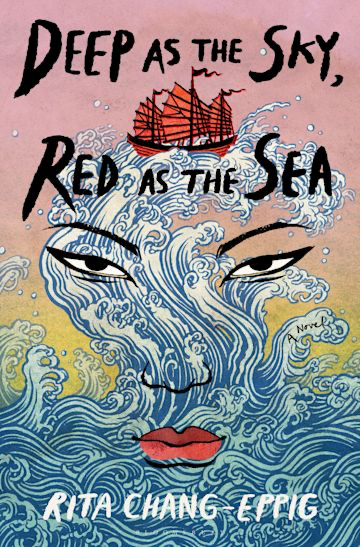
Fingers crossed, I should be able to keep up with at least these reviews and my Sunday Songs now. Plus, I’ve read some good books lately, and I’m itching to write a full-length review! Especially about this one. I’ve seen it here and there on the blogosphere, and it’s getting average reviews on Goodreads as of now; I don’t usually gravitate towards historical fiction, but Deep as the Sky, Red as the Sea was such an engrossing read!
The pirate Shek-Yeung has a reputation that precedes her. After her husband is murdered by a Portuguese sailor, she takes it upon herself to do everything in her power to take his fleet for her own, starting with marrying her husband’s second in command and having his son. With the ship under her iron rule, she becomes just as feared as her husband once was. But as the Emperor of China begins a crackdown on piracy and her crew begins to turn against her, Shek-Yeung must grapple with the power that is slipping through her fingers—and taking care of her new son.
TW/CW: blood, gore, near-death situations, descriptions of illness, loss of loved ones, misogyny
I love a good swashbuckling pirate book, so I never considered that a more grounded pirate story could possibly exist. And it does—its name is Deep as the Sky, Red as the Sea, and it has just as much of a punch and importance, even if it lacks the conventional adventuring that typically comes along with pirate stories.
I’m not usually much for historical fiction; it’s not a genre that I typically gravitate towards, but if I pick it up, it’s usually because it’s intertwined with another genre (fantasy, etc.). Literary historical fiction, even less so—that usually brings to mind the thousands of WWII novels with the exact same font that I always have to reshelve at the library. But Deep as the Sky, Red as the Sea occupies a very unique niche. It has all of the diligent research and worldbuilding of any good historical fiction, with a fair dose of drama and an emotional core that sets it apart from the often distant literary fiction novels that I can think of. Even though I know next to nothing about the time period in which its set (listen, I took AP World History online, you can understand my situation), Chang-Eppig clearly put so much time into fleshing out Shek-Yeung’s world—and all of it paid off.
On that note, I’ve seen a lot of complaints about this book having dry writing. At times, the worldbuilding and negotiations did trail in the slightest, but to me, this novel was just the right amount of captivating. Even with all of said drama and heavy plot points, the writing felt cinematic—I don’t mean that in the way of a blockbuster, but of that special kind of Oscar-winner that you actually watched and enjoyed. It knew when to hold its breath and let the silence fill the page, and it knew when to make your emotions swell. I wouldn’t call it perfect, but it’s impressive enough that I’m wowed by the fact that this is Chang-Eppig’s debut novel. I’d gladly watch a movie adaptation of this book.
The characterization in Deep as the Sky, Red as the Sea was just as stellar as the other aspects! Shek-Yeung was such an expertly written protagonist in almost every way that I can think of. Chang-Eppig captured every aspect of her personality effortlessly; she lives at that intersection of aging and legacy where she isn’t as physically strong as she was in her youth, but she’s just as fearsome and skilled as she was back then. She’s been beaten down by the trials of womanhood and the shadows of her past trailing her, but is slowly learning to love again. Every part of her was nothing short of captivating, and she was the perfect emotional core for the story, even if she was reluctant to show her own. The side characters were just as wonderful as well, and the perfect foils to Shek-Yeung. Yan-Yan was my absolute favorite. She was just the sweetest…my girl needs a hug
That being said, I feel like more could have been done with Shek-Yeung’s character development at the end of the novel—and the ending of the novel in general. Throughout the novel, Shek-Yeung basically had that mentality of “we’re all just meat sacks on a floating rock and we’re all just animals that don’t care about each other” (it’d be insufferable on any other character, but…she’s a middle-aged pirate in the Qing Dynasty who’s just witnessed the brutal murder of her husband, I can at least kind of see it in her case). But most of the smaller arcs with her seemed to be leading up to her learning how to heal and love again, what with her son and with the rest of her crew (esp. the more optimistic Yan-Yan). But even after the climactic events of the last part of the novel, she hardly seemed to change. It just didn’t make sense for her, who’d been so well-written up until this point, to suddenly go static. Most of the ending felt rushed in general—it felt ambiguously but not necessarily in a literary way, but more in an “I don’t know how to end this book, so I’m going to write a few more sentences and call it a day” kind of way. It just felt like such a disservice to what was an otherwise stellar novel.
All in all, a beautiful historical drama with some of the most well-written characters I’ve read in a while. 4 stars!
Deep as the Sky, Red as the Sea is a standalone; it is also Rita Chang-Eppig’s debut novel.
Today’s song:
favorite song from this album!!
That’s it for this week’s Book Review Tuesday! Have a wonderful rest of your day, and take care of yourselves!
This week’s batch originally included a cover of “The Wreck of the Edmund Fitzgerald,” but for several obvious reasons, I omitted it since I feel like that would be the absolute worst possible timing. Whoops.
quick trigger warning: there are mentions of suicide in part of this post, so if you don’t want to read that section, skip over “Evening Star Supercharger.”
Here I was thinking that “Come Talk to Me” and my 8th grade graduation were the only times that pipes of some kind (bagpipes and uilleann pipes, in this case) would ever make me feel anything…
This time, I wouldn’t say that said feeling evoked by “The Sensual World” isn’t the same kind of visceral, scoop-my-heart-right-out-of-my-ribcage of said Peter Gabriel song; this time, it’s more of a “how could she make that sound so incredibly cool” feeling. Normally, I wouldn’t be on board with these kind of fiddling, dressing up in medieval outfits kind of tunes, but I have to keep reminding myself: if anybody can do it, of course it’s Kate Bush. Of course. My favorite songs of hers make me feel like growing my shaved head all the way back out and running through the woods in a white dress (see: “Burning Bridge”), so I’m glad that she and Peter Richardson channeled that for the music video. And even without knowing much of anything about James Joyce’s Ulysses, I can’t think of a better way to adapt a monologue from a classic like that—this version is a mishmash of Molly Bloom’s monologue and Bush’s own lyrics, since Joyce’s estate didn’t grant her the rights to make the song all Joyce. (She later re-released it as “Flower of the Mountain” as a sung version of Molly Bloom’s monologue, once she was granted the rights.) I would’ve passed it off as Kate Bush and nothing but—the silky, airy cohesion throughout, the rush of joy once the fiddle and uilleann pipes kick in at the start of the chorus…everything. The chorus remained faintly in the background of my childhood memories, the title and the rest of the song lost up until a few years back, just like my favorite song was up until around two years ago. And while it’s hard to compete with my favorite song of all time at the moment, I’ve enjoyed every minute that I’ve spent with this unearthed song.
Complete coincidence—I had no idea that Exile in Guyville just turned 30 a few days ago! Perfect occasion to talk about this song, I suppose.
Most of my Liz Phair exposure prior to a few weeks ago came from two moments: seeing this album cover in passing on our iTunes library while my brother and I were trying to make a playlist for our dad ages ago, and two Whip-Smart tracks (“Supernova” and “Whip-Smart”) that defined a specific chunk of 8th grade. Listening to either of them instantly transports me back to a bus ride in the early hours of the morning, driving out to the middle of nowhere with my school to watch the total solar eclipse. And for years, I thought that that the Exile in Guyville cover was an illustration, and that the hood over her head was her actual hair. But the other day, my mom mentioned in passing, while we were listening to Palehound, how much it sounded like Liz Phair. I believed her, having a vague memory of said two songs.
And then my mom put on the first four tracks of Exile. Holy crap, dude.
I haven’t even gotten halfway through this album, but I haven’t fallen in love with an album this quickly in ages. This track is the one that keeps coming back to me—the minute the guitars kicked in, I was reeled all the way in. And even without the context of the last half of the album, this song seems to encapsulate its thesis perfectly—daring to have the courage to break into a male-dominated indie scene and make an irreplaceable mark on it. There’s the sly turning of the Rolling Stones’ lyrics back in their faces. And of course, there’s the references to height—”and I kept standing 6’1″/instead of 5’2″” isn’t just Phair keeping her head above the water after a nasty breakup, but a joking reference to her own height—she calls this song “the bravado that [she] manifest[s]” that seemed to confuse everybody once they saw how short she is. And…yeah, if I had a nickel for every person who’s said “I thought you’d be taller” to me, I could probably buy Amazon from Jeff Bezos. Liz Phair still has an inch on me, but…yep. The short king (queen?) experience.
So, to my mom, who talked about how cool it was that we were listening to the same knds of music at the same ages: I think it’s cool too. This one’s gonna be in heavy rotation once I listen to the whole thing. I love listening to music with you too.
Happy week-belated birthday to Sir Paul McCartney! Another song that ended up on here by coincidence, but I won’t argue against doing something for the occasion.
The White Album has something for everybody. Over the course of both sides, you have classic epics of songs (“While My Guitar Gently Weeps”), nursery rhyme-style political commentary (“Piggies”), eight and a half minutes of experimental discomfort (“Revolution 9”), and everything else under the sun (here comes the). It’s part of why this album is my favorite of the Beatles’ discography—there’s no shortage of songs that you can come back to, and each time, it feels like reuniting with an old friend. Yes, even “Wild Honey Pie.” I will defend that song with my dying breath. It’s hilarious.
But it’s some of Paul McCartney’s quieter, acoustic moments that have stayed with me the most whenever I revisit parts of this album. It has the pleasant simplicity of their earliest, poppiest songs, but with McCartney’s added experience, there’s a weight to it that would’ve been difficult to achieve in their very early youth. I just now realized that the bass part is just his gentle singing—there are so many moments of quiet brilliance on this album. I added this to my playlist when I went up to Washington, and every listen felt like a warm hug—and every subsequent listen still does. 1:45 of nothing but comfort. Paul McCartney just seems to have that effect.
I saw the Yeah Yeah Yeahs at the beginning of the month, and it was EXACTLY as phenomenal and soul-healing as I’d expected it to be. Karen O brought an infectiously joyous energy to every minute of the set, complete with her glittery, Elvis-but-cooler outfits and confetti cannons aplenty. It genuinely warmed my heart to see the giant smile on Brian Chase’s face every time the camera panned over to the drum kit—the whole band just felt so, so happy, and that made the show all the better. Even with how damp that night generally was, I enjoyed every second.
Of course, you can’t really live up to that as an opening act, but I enjoyed parts of Perfume Genius’ opening set, without question, even only knowing one song of his beforehand (“Queen,” which…apparently he does a whole strip tease to that one normally? I guess the weather only permitted him to make generally strip tease-like motions while dragging an itchy-looking gray sheet around…the spirit is willing, but the flesh is a bit too chilly?). Every song wasn’t a winner for me, but “Describe” certainly was. Both on streaming and live, Mike Hadreas (a.k.a. “Mike on the Mic,” according to Karen O.) seems content to let his voice take a more understated backseat, which suits the propulsive guitars that wall this track in. The combination of these driving, battering rams of guitars and Hadreas’ whispery voice form a unique sound—a song that simultaneously feels sharp and prickly like porcupine spines, but smoother than a silk sheet. Hadreas toes that line of juxtaposition exceedingly well on this song—the two contrasting sounds blend only at the edges, making for a song that never feels like it’s teetering one way or the other—it’s content to plant one leg on either side of the fence and keep them there. My only real complaint is the minute-odd ending of muttering, synth-y silence, but it’s short enough to skip, and not long enough to be a major qualm. It’s probably a transition between songs on Set My Heart On Fire Immediately, but I wouldn’t know.
I always struggle with posthumous album releases. At their worst, they’re blatant ways to capitalize off of an artist’s death and keep the nostalgia machine running, even if it’s just a collection of demos that were never meant to see the light of day. Even in David Bowie’s case—he’s my favorite singer, if I haven’t gone off about him for years on this blog, but even then, officially releasing his shelved 2001 album Toy felt weird—and it wasn’t his best work, either. I’m comforted by the fact that Bowie did actually want that album to see the light of day and seemed to be heartbroken by the fact that it got shelved, but I’m still dubious on whether or not that was Warner Music Group’s rationale for releasing it. I can say about the same for Prince’s Originals, even though I haven’t listened to it all the way through—especially with him and Bowie’s death being so close together, there’s definitely a 2016 pop-icon grief nostalgia machine running.
But Mark Linkous wasn’t necessarily a Bowie or a Prince. He wasn’t a worldwide superstar who changed the course of rock music—I can’t even think of anybody outside of my immediate family who might know about Sparklehorse. He’s gained significant renown in the indie community, but this feels different—given his history, it doesn’t seem like a cash grab at all. It seems like a genuine endeavor by Linkous’ siblings to revive some of his unreleased catalogue, not for reasons of greed or nostalgia. Toy felt somewhat off-putting; Bird Machine feels genuinely touching.
And the result of “Evening Star Supercharger” is purely Sparklehorse, without the touch of greed but still polished enough to sound smoother than a demo. It doesn’t feel far off from what I’ve heard off of Dreamt For Light Years in the Belly of a Mountain—the music has a polish of tinny glitter like a string of Christmas lights, but retains the unmistakable melancholy that ran through all of Linkous’ music. There’s an undeniable wish for stability and peace without the drugs and self-medication, but he still describes being wrenched through “the grinding metal gears/from a carnival of tears.” Knowing that he never achieved that kind of stability, leading him to take his own life in 2010, makes this unreleased material all the more heartbreaking; through the Christmas lights, it’s undeniably the sound of a damaged man. If anything, I hope Bird Machine allows us to celebrate the undeniably creative spirit that he had.
Happy Sunday, bibliophiles! I hope this week has treated you well.
Just a note—I’ll probably be radio silent for the next week (save for liking all your wonderful posts 🫡) because I’ll be on vacation! I’m heading up to Olympic National Park, so I’m pretty excited. But for now, have a nice, blue-gray color scheme and some silly goofy music while I’m gone. And of course, we’ve got Phoebe Bridgers, The Magnetic Fields, and Ernie and Bert for pride month.
So…here I am. Finally got around to listening to Peter Gabriel 1: Car the other day. Fantastic album, but if I had to describe it in one word, that one word would be whiplash. I already knew I was in for a ride knowing that the album started out with the absolute proto-Danny Elfman insanity of “Moribund the Burgermeister” and the album’s classic radio hit “Solsbury Hill” one after the other (as much as I love the latter, it’s a crime that it’s all this album is typically remembered for…doesn’t surprise me, though), but even that couldn’t have prepared me for the full experience.
But if there’s any song off of this album that characterizes said whiplash, it’s this one. I went in expecting it to be weird, but the pure shock of this one just sent me into the nth dimension of musical weirdness. I’m not even exaggerating. This one starts out with a barbershop quartet. It’s just nuts. And I love it. It’s like Peter Gabriel was just unleashing every ounce of the pent-up goofiness within. It’s kooky. It’s whimsical. It’s silly. I’d unironically call this one of the best tracks on the album, just because he just goes all in on the silliness. However, I go back and forth on whether or not the incoherence of this album is a pro or a con—I’ve tentatively decided that it’s more pro than con, but some of it didn’t work for me. Coherence is not a quality that an album needs to have to be enjoyable, but you can doan album where every song has a different feel, genre, etc. from the next and still have it feel cohesive and joyfully carefree at the same time (see Super Furry Animals’Rings Around the World). But on the other hand, the antici……pation of having no clue of what comes next was such fun to experience. There were some songs on Car that were genuine misses for me (sorry, “Down the Dolce Vita”), but albums that are pure chaos, like this one, are a special experience. Go crazy, Peter.
(are we all still okay, bisexuals? nope? I thought so)
Now, here we are with something of a legend amongst Phoebe Bridgers’ catalogue. Famously written when she was only 16, it’s hidden in the shadows despite being a fan favorite, existing only in older video performances and a brief stint on Spotify as part of the Lost Ark Studio collection, before being mysteriously taken down. And now that it’s on Bandcamp, more of us can lose ourselves in it!
The fact that Bridgers wrote this at 16 is still incredibly impressive, but with all due respect, it…makes sense. It’s 6 and a half minutes of pure angst—she hadn’t quite nailed the lyrical flow and subtleties that came with experience yet. There’s nothing subtle about “If you were a waiting room/I would never see a doctor/I’d just sit there with my first aid kit and bleed.” But the point of this song was never to be subtle—it’s a time capsule, capturing young, unrequited love at the epicenter of its emotion. If Bridgers hadn’t nailed her lyrical style just yet, she had already nailed her innate ability to conjure engrossing emotion. There’s something about the lines “Wanna make you fall in love as hard as my poor parents’ teenage daughter/She’ll be the best you’ve ever had, if you let her” that always get me. Aww, little Phoebe…
And it all comes to a head in the iconic refrain of “Know it’s for the better,” repeated for the last half of the song. The instrumentals rise in intensity along with Bridgers’ voice until it all crashes down in a tidal wave of guitars. It really is a song to lose yourself in—the last part of the song really does make it feel like everything else has ceased to exist around you. And even though this song has gone through several iterations over the years, it’s still a feat to achieve so young. If anything, I’m just glad to exist in a world with Phoebe Bridgers in it. I know it’s for the better.
Alright, here’s a childhood nostalgia pick-me-up after Phoebe Bridgers’ sea of teen angst. I wouldn’t blame you if you needed a palate cleanser.
This one was a last minute addition, but I’d be remiss if I didn’t include it in this. I haven’t thought about this song in a solid 15 years, but the other night, I had a dream—I can’t even remember what the dream was even about, but whatever the case, it dredged this song up from the dark recesses of my mind. And I’m not complaining! There’s nothing like the joy of uncovering a forgotten childhood song, like digging through dusty old boxes of mementoes in the attic. Or, at least, that’s how I imagine it. I don’t have an attic. I digress. It’s moments like this where I really appreciate the incomprehensible eccentricities of the human brain—which neuron fired and made me remember this all of the sudden?
Even though they have the worst possible band name to have included on a kid’s album (which they did—not just this, but the classic Snacktime!), The Barenaked Ladies really do have a talent for making nostalgic, clever kid’s songs. This one is technically a cover, but for once, I’ll defer to them instead of Sesame Street; in any other circumstance, I’d immediately call blasphemy, but in this case, their take on “La La La La Lemon” surpasses the original for me. No disrespect to Ernie and Bert, the original gay TV couple. This is the only exception. They reign supreme in all else. Nothing tops the Rubber Ducky song.
The slower, more subdued Sesame Street version fits when you consider that our crotchety friend Bert is singing half of it. But The Barenaked Ladies gave this song an infectious energy—just by picking up the speed, the song gains a far more carefree, loose, and altogether more joyous feel. Maybe my preference is the nostalgia talking, but I swear that this version manages to turn the kookiness up to the perfect level—the level that made me giggle as a kid and still makes me smile now, when I’m somehow an adult with a job. Man, how’d that happen…
Either way, the main takeaway is that comedy peaked at at “La la la la, linoleum!”
I’m entirely serious when I say that the only thing keeping me from listening to 69 Love Songs right this second is because of…said 69 songs. I will, eventually, but it’s gonna require a nice, long, uninterrupted stretch of…[checks notes] almost three hours, Jesus. But you’re not gonna catch me complaining about nearly three hours of Stephin Merritt and company.
In the meantime, it seems like almost every song I hear on its own from this album rearranges my brain chemistry for a solid three days before I can snap out of it. Case in point: this one. The minute the buzzy background synths and deeply distorted…well, everything kicks in, I lost myself. Again. With his signature, dry witticism, Merritt pens another two-and-a-half minute bite of love gone sour, cloaking the thought of “[taking] a sleeping pill and sleep at will/and not have to go through what I go through” in a web of tinny distortion. I always come back to the tongue-in-cheek lines of “Or I could career of being blue/I cold dress in black and read Camus,” because…I mean, he did kind of make a career out of that? Almost? Aside from a few songs, most of The Magnetic Fields that I can think of is about love left to get moldy after a few weeks in the fridge. But here’s the thing—it never feels like Merritt is spinning a broken record—each time, has has something new to bring to the table, whether it’s the drowning melancholy of “I Don’t Believe in the Sun” or the confessional nature of “Born on a Train.” He always finds something inspired to spin out of love lost or gone the way of spoiled milk, and every time, it’s a rush of inventiveness to the head.
Here’s my PSA for today: if you haven’t watched both seasons of Prehistoric Planet on Apple TV+ …respectfully, what are you even doing? If David Attenborough’s part in it isn’t convincing enough by itself, will a masterfully-animated, nature-show style documentary about Cretaceous dinosaurs and other prehistoric life entice you? The animation puts almost everything else of its kind to shame—so much so that it looks too real to beanimated, which adds to the nature show feel. Plus, it acts like a good nature show should, not focusing all on “DINOSAUR FIGHT!!!!!1!!! RAAAAAAH THEY ARE ANNIHILATING EACH OTHER RAAAAAH!!1” and giving a speculative insight into many aspects of these extinct creatures’ lifestyles. It’s a beautiful show, whether or now you’re interested in prehistoric life. You will be, after watching this.
Even though the animation obviously steals the show (as it should), I couldn’t help but notice parts of the artfully crafted soundtrack as well. The ammonite section of season 2’s ocean episode wasn’t just my favorite moment of the season because of the tiny prehistoric cephalopods—the paired track, “World of Ammonites,” made it all the more gorgeous. Nothing fits the image of thousands of funky little guys with weird shells bobbing about in a prehistoric sea than a mixture of low woodwind, violins, and synths tinny enough to fit into a sci-fi B-movie from the fifties. The synths especially capture the audio representation of the likeness of these bizarre animals; fitting these very spacey sounds with such alien-looking creatures feels like an obvious choice, but it’s a genius one. Prehistoric Planet has consistently been a joy to watch, but nothing quite gave me the rush of joy that the ammonites—and this track—did. Love me a good cephalopod.
Since this post consists entirely of songs, consider all of them to be today’s song.
That’s it for this week’s Sunday Songs! Have a wonderful rest of your day, and take care of yourselves!
Happy Wednesday, bibliophiles! Hope this month has treated you well.
How is it already the end of May? It feels like I was trying to get dust bunnies out of the corners of my dorm room just a few days ago…(so many dust bunnies 😭)
Let’s begin, shall we?
GENERAL THOUGHTS:
Whew! May has been pretty busy, but everything’s…temporarily winding down. I finished up my finals and managed to make straight A’s this semester—I just found out I got on the dean’s list, too! Still can’t believe I’m already finished with my first semester of college; it was such a scary and jarring experience at first, but I’m already finding myself missing parts of it. What a weird and wonderful year it’s been. Now that I’m back home for the summer, I’ve just been trying to soak it all up—I’ve had a few quiet weeks, but I’ll be going back to the library soon, which I’m so excited about!
My reading and blogging have both still been slower, with all of the bustle of finishing…everything, but I’m starting to get back on track now that summer’s started. I’m slowly trying to get back on a writing schedule as well—I ended up deciding to write the sequel to my main sci-fi WIP, and once I finish outlining it (which I’m in the middle of right now), I’ll get back on my writing schedule. That’ll probably be what I end up working on for Camp NaNoWriMo in July…
Other than that, I’ve just been drawing more, playing guitar, watching Kindred (Octavia Butler deserves a better adaptation), committing to binge-watching my way through Taskmaster (there’s strength in arches, y’know), and enjoying being home. We’re still in the “summer, but not disastrously hot yet” stage here in Colorado, so I’m enjoying that while it lasts…
And more importantly, I’m going to a virtual Q & A with the one and only AMIE KAUFMAN tonight!! I CAN’T WAIT!!
READING AND BLOGGING:
I read 18 books this month! My reading’s still a bit slowed down after finals and moving out (!!!), but I still feel like I read a good amount. It was a really mixed bag, though—two 1 star books (one was a DNF, the other would’ve been had I not been trying to wait out a lightning storm before going to sleep 🥴), but THREE 5-star (one rounded up from 4.75) books! Can’t remember the last time the former happened. Either way, I found a ton of great reads for AAPI heritage month, and finally got my hands on some of my most anticipated reads of the year!
If this month’s 1 star reads are any indication, maybe the word “monster” is the problem…?
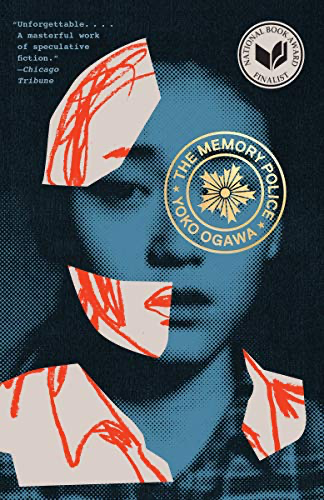
I forget how exactly I came across this novel, but it was one of the first books that I put on my Libby wish list way back in March 2020, when I lived off of Kindle books. At the time it was always on hold for weeks when I tried to check it out, and so gradually, it faded to the bottom of the list. But after years of forgetting about it, I rediscovered this novel—and it was finally available! Usually, literary science fiction doesn’t always do it for me, but The Memory Police was a strangely quiet dystopia with a powerful undercurrent.
A young writer leads a quiet life on a distant, unnamed island, grieving a multitude of losses. Her parents passed away many years ago, but it isn’t just people that are disappearing—it’s objects, animals, and ideas as well: hats, birds, ribbons, and all manner of things. Once they disappear, nobody on the island has any recollection of their existence—they simply fade from public memory. And to enforce this, the island is under the iron fist of the Memory Police, who are there to make sure that these forgotten things stay that way. But she seems to be one of the only people who still clings to the memory of what’s been lost.
When the writer’s editor falls under suspicion from the Memory Police, she hatches a plan to hide him under her floorboards, silently completing her novel as they evade capture. And as more and more objects begin to fade into obscurity, her writing may be the only thing left to cling to.
TW/CW: loss of loved ones (past), kidnapping, police brutality
The Memory Police has been compared time and time again to 1984, and the comparison is clear, but it seemed to take a more literary approach. And while the “literary” part initially made me suspicious, this was one of the most creative and wholly human dystopian novels that I’ve read in a long time!
What sets The Memory Police apart from most other dystopias that you can think of is its perspective. We aren’t given an extensive history as to how the unnamed island came to be under such totalitarian rule, and how everything began disappearing and why. Nor do any of the characters—save for the main character’s editor, referred to only as ‘R’ in this translation—have names, save for their roles or jobs (the protagonist’s parents) or their physical appearance (the old man). All this book seeks to do is give you an ordinary person’s view into something haunting—the protagonist is just as confused as you are, and she is moving through this world in the only way that she can. Naturally, I was curious about the main plot points (how and why everything was disappearing, and how the Memory Police came to be), but I got that the point wasn’t to explain such things, but to see it happening firsthand through somebody else’s eyes, when they may know about as much as we do. I assumed the Memory Police were in control of what disappeared and they had some degree of immunity, which I was curious about, but the decision to omit these details at least made sense as a stylistic choice.
Make no mistake—The Memory Police is certainly haunting, but there’s a quietness to it that makes it stand out from the rest. In this state-surveilled, isolated island environment, this novel is the closest thing that you can get to a slice-of-life story. Other than some chilling instances involving break-ins by the Memory Police, it’s the story of one woman flying under the radar and trying to write her novel as the world is crumbling around her. There’s a constant fear surrounding everything, but in between, she finds time to craft a novel, share secret memories about her parents’ world and what they loved, and hold parties from an elderly man who helps keep her editor hidden. Sometimes, frightening change doesn’t come in the form of something obvious—it’s often slow and goes unnoticed, and it is the small things that keep us going through it.
Literary science fiction like this often comes off like it’s trying to be better than “regular” science fiction, like it boasts some lofty message that your common novel can’t possible get across. I’m glad to say that The Memory Police does none of that—some of the writing does fit that style, but nothing about it comes across as belittling or haughty. In fact, it has an incredibly powerful message. With all of the plot centering around the loss of memory and holding on to the last remnants of a past world, the ending made an incredibly powerful statement: as long as there is somebody around to keep a memory of something alive, memories never really die—they always stay with us. It’s a beautiful message on loss, and about resistance in general—maybe the most powerful thing we can do in the face of tyranny is to know that there is a way to change things, and hold memories of what our forebears did in the face of similar situations. This book is proof that dystopias don’t have to be flashy and overtly gritty to get their themes across—quietness can be just as powerful.
All in all, a nontraditional dystopia that made an incredible impact from reveling in its quiet moments. 4 stars!
The Memory Police is a standalone, but Yōko Ogawa is the author of many other novels that have been translated into several different languages, including Revenge, The Housekeeper and the Professor, Hotel Iris, and more.
Today’s song:
Peter Gabriel Summer 2 is upon us
That’s it for this week’s Book Review Tuesday! Have a wonderful rest of your day, and take care of yourselves!
Happy Sunday, bibliophiles! I hope this week has treated you well.
This post was brought to you by the never-ending Dark brainrot (it consumes), my disappointment in Kindred’s TV show adaptation, and the continued Palehound Panic™️. But this is all merely the calm before the storm, because now we’ve got the news that Blur is coming out with a new album in July…BRACE YOURSELVES
Somehow, it was this song, and not the original, that made me realize that the line was actually “the dark, sacred night” and not “the dark, say goodnight.” Whilst I was crying my eyes out at the Dark finale. Whatever it takes.
It’s been about two weeks now since I finished Dark and got through that gut-wrencher of a finale, and I can say with absolute certainty that I doubt I’ll ever emotionally recover from…well, anything about that show. I’ll spare you any spoilers, other than the fact that this song is present. But hopefully that part shouldn’t be a surprise, at least, with how the show-runners have now triple–dipped with the Soap&Skin needle drops, including the theme song itself. I may be an atheist, but the atmospheric covers of Soap&Skin and the eerie, dew-covered-forest, small-town-murder-mystery-that-turns-into-something-way-worse aesthetic of Dark together is a match made in heaven. There’s something that she brings to this near-untouchable song (except for a third grade singing program that I did? I think), that no one else could have—it’s got all of the makings for the same haunting instrumentals of her cover of Robert Johnson’s “Me and the Devil,” but it’s impossible to take any of the love or hope out of this song. The synths make it sound like something that would’ve been in the running for a Golden Record candidate (or at least the backing track to a shot of a satellite in space), and Anja Plaschg’s rich, cavernous voice create a shadowy atmosphere, but one illuminated by an undeniable light at the end of the tunnel. It’s impossible to make this song sound anything but hopeful, but there’s different ways that hope can sing—and this was a perfect fit for the tearful, bittersweet ending to a series that’s taken up a welcome amount of space in this brain.
But while I’m here, I will offer the following…this was a great song to send off Dark with, but consider: “Blood of Eden?” Again, no spoilers, but…it’s all right there.
Except this time, one show is a time-travel masterpiece, and the other is FX’s adaptation of Kindred. Octavia Butler deserves better than THAT. (@ the showrunners: Kevin being a somewhat static character in the book was NOT a sign to make him into a total dudebro. The X-Ray Spex shirt isn’t fooling anyone.)
However, as generally peeved as I was with that show, if there was one great thing I got out of it, I’d point to this deliciously eerie Beatles cover. I’ve since given up the whole “don’t cover the Beatles” mindset, even if we are living in an uncharted sea of awful “Here Comes the Sun” covers, because with how influential they were on…well, almost every aspect of rock music that you can think of, there’s infinitely many things that can be done with these songs, classics as they are. Take picking this song to cover—the original song is nothing short of experimental, psychedelic insanity, deliriously noisy and filled with rubber duck noises at random intervals, as one does. It’s glorious. It’s a childhood staple of mine. But Junior Parker’s taken all of the trimmings off of it, slimming it down like a tree stripped of its bark. When the dust settles, all we’re left with is bass, soft drums, scattered keyboard chords, and Parker’s sonorous, bluesy voice. The bare-bones construction of this cover makes “Turn off your mind/Relax, and float downstream” feel like a chilling whisper of coercion, not a famous allusion to psychedelics. I never thought that this song could get quite this ominous—and, despite my general beef with the Kindred show, it was a perfect fit for the show’s atmosphere—definitely the best needle drop of the show, right at the end of episode 2. It wasn’t all bad, I guess.
Listen. I only know the basics of studio recording technology, but somehow, it’s “Night Time is the Right Time” that makes me appreciate what they were trying to do in the 50’s—not necessarily what it could do, but what it caught. The version I have on my iTunes library is plenty scratchy, cloaking almost everything in that signature fuzz you get from most recorded music up to the 60’s or the 70’s. It’s charming—it’s the sound of the era. But here’s the thing—the key word is almost. In almost every recording that I’ve listened to, no matter when it was mixed, Ray Charles’ voice sounds as clear as day. You could probably chalk that up to the main goal of said recording technologies being to record his voice first and foremost, but I can’t help but romanticize that in my head, Charles’ resonant voice soaring through any technology and defying any attempts at being aged. But no matter how fuzzy or remastered any recordings get, it’s always a beacon, the foggy gleam of a lighthouse across the sea.
And on the other side of the coin, there’s Margie Hendrix’s iconic voice—not spared the fuzz, but with what I’d argue is an almost equal amount of power. She put everything into that first call of “BABY!” and never slowed down. Her voice did fall victim to the scratchy fuzz, but her declarative growl of a voice almost fits with it; there’s a rough edge to Hendrix’s voice, the kind that makes my throat raw just thinking about belting out those notes. Knowing she was in her early twenties when she sang that makes it all the more impressive. It’s a voice that instantly conjures an image—screwed-up eyes, mouth open wide, putting every ounce of lung power into the verse that you have. The song is a testament to both of their talents, what little that I know about either of them—but either way, there’s a reason that they called Charles “The Genius,” and just as much of a reason for the influx of YouTube comments declaring their love for that iconic shout of “BABY!”
Another find on my quest to absorb as much of Palehound as I can before Eye on the Bat comes out, here’s a single that El Kempner released about a month before it all went wrong. February 27, 2020, to be exact. Yeesh. Simpler times.
I noticed a pattern after listening to both Dry Food and A Place I’ll Always Go—indie-rock lightness and guitar fun are the main priorities, but Kempner always has a few melancholy, slower tracks to balance everything out, nudged just past the middle (“Dixie”) or nestled at the end (“Feeling Fruit”) of any given album. “See a Light” allows this breed of Palehound to stand on its own. It’s the perfect vessel for Kempner’s whispery voice to flourish, drifting along like fog amidst the homegrown, shoegaze-y, bedroom production. It gently crawls along to a slow drum machine and glossy guitar notes, settling in your lap like a kitten. Distortion creeps in at perfectly calculated moments, fuzzing up the edges of the instrumentals and Kempner’s voice. Beyond all of that, it’s one of the best instances of album covers (or single covers, in this case) perfectly matching the feel of the song(s) itself—the combination of the handwritten typeface and the basketball hoop taken over by bright green vibes, set against a cloudy, gray sky, matches all of the bits that make me go back and listen to this song.
📢YOUR REMINDER TO SUPPORT JIM NOIR ON PATREON (link above) IF YOU CAN HE’S AMAZING📢
Ever since Jim Noir has started said Patreon, we’ve gotten a handful of his older catalogue in between the new EPs. One such offering is this—a collaboration from 2000, between himself and a longtime friend, now remastered from the original ten tracks and expanded to 30 (!). (For reference, the tracks are grouped into four chunks on the Patreon link.) It’s not the first time that Jim Noir, under whichever name, has offered up his experience with making ambient music (see Omission Sound, also available on Patreon). I’m not as well versed in ambient music in general, but I’ve gotten tastes of it from him over the years; usually, I’m ambivalent about it—for me, his ambient music functions mostly as background music, plus the odd sample with a nice layer of distortion thrown in. But “Cubist Castle – Part 1” feels different than Omission Sound’s Solutions—there’s something cheerier about it that sets it apart. Including an early version of “Everytime” (a bright soundtrack to many a painful hour studying during the pandemic), “Cubist Castle – Part 1” has calm woven into it. Although some of the later parts get plenty ominous, there’s something so gentle about this first chunk—the tinny, bubbly synths, samples of birdsong and beach sounds…it’s just nice, simply. Nice. Nice is often such an inadequate word, but given the background-music nature of this album, it fits. It’s like the auditory version of a baby sensory video. I’m just glad that all of the essay writing that I did to the tune of “Cubist Castle” didn’t ruin it.
Since this post consists entirely of songs, consider all of them to be today’s song.
That’s it for this week’s Sunday Songs! Have a wonderful rest of your day, and take care of yourselves!
Happy Sunday, bibliophiles, and happy Mother’s Day!! Eternally grateful for my wonderful mom—who knows what I’d do without her. Love you 🫶🏻
Alas, even though “Cool About It” is still my most listened to song of the year so far, the Boygenius Breakdown™️ has made way for some Palehound Panic™️ (or, alternatively, a Palehound Party™️?) so I can catch up on everything before Eye on the Bat comes out this July (!!!!). Feast your eyes on the spring color scheme.
And just when I thought that I’d already gone through almost all of my most anticipated albums of the year…
Even though I haven’t filled in the sonic gaps between this new sound, Black Friday, and A Place I’ll Always Go, I’m all on board with this new Palehound! There’s power in every note of “The Clutch,” from first notes of Kempner’s voice to the unrelenting chords that follow the rest of the song. El Kempner has such a unique voice—it’s hard to think of any other artist whose voice is simultaneously whispery and rowdy, and she embraces the rough edges on every part of this song. Underneath all of the pounding drums and incredible guitar work is some of Kempner’s sharpest lyricism to date: “I didn’t mean to hurt you/You didn’t mean to show me how,” followed closely by “I’m glad that you know better now/And I’m glad that you found yourself/But you didn’t need my help…” WHEW those are some LINES right there…and what better way to close the song with a shouting outro of “you didn’t need my help”? If this song is any indication, Eye on the Bat is gonna be the perfect summer album—and a fantastic album in general. SO glad I got on this Palehound kick all the way back in September. Haven’t regretted a single minute of it.
The only acceptable way to dance to this song is to dance like you’re one of those wooden snakes from the craft store. The ones that make those crack-crack-crack noises when you wiggle them around?? Please tell me somebody knows what I’m talking about, please…
right, THESE ones. Just gotta feel it. Flail. Castanets do that to a gal.
Usually I try to put my album listening in the hands of fate (read: the list randomizer), but after the Palehound Panic/Party subsides, I think it’s shaping up to become Peter Gabriel Summer 2: Electric Boogaloo. Why? It’s only taken 3 songs to convince me to listen to Peter Gabriel 1: Car (because he’s That One Guy who puts out 4 self-titled albums for kicks and giggles and refused to make any title more than one word long after that). I’d already heard this album’s iconic hit “Solsbury Hill,” but after hearing this back to back with the equally wondrously weird “Moribund the Burgermeister,” I just know that Car is gonna be a wild ride.
Fresh off of his split from Genesis, Peter Gabriel’s prog rock action has never quite ceased, but from just this song, it seems to have taken on a life of its own, morphing into something that’s purely him. It’s a song of many faces—starting with quiet synths and weary vocals for the first minute, and then breaking down into some absolutely INSANE castanet/accordion-aided craziness that lasts for all too short of a time. The instrumentals just feel so delightfully kooky (you know it’s gonna go nuts when the accordion comes out) before bursting out into some classically prog sprawl as Gabriel’s voice and lyrics deepen in scale: “from the white star/come the bright car/our amoeba…” And the amoeba, as it happens, was his first daughter, Anna-Marie Gabriel, who had just recently been born. I don’t know about you, but I’d be honored to have a song this weird to commemorate my birth. Just saying.
I was going to say that this was a left turn from the other Palehound song on this post, but…no, “The Clutch” is probably the one that’s a left turn, really, though I can’t say how much of one it is without having listened to Black Friday…nevermind, this is pointless without context…ignore me
After “The Clutch” came out, I made it my mission to start dipping my toes into more Palehound before Eye on the Bat comes out in July. A Place I’ll Always Go was next chronologically, so I went right in—I’m still torn on whether I like it better or as much as Dry Food, El Kempner’s debut, but it’s packed with songs that have kept me listening long after the first run-through. This one quickly became my favorite track off the album; it’s got a sound that’s so close to being fully-realized—all at once, it sounds purely like Palehound, but still reeks of Wilco influence. Kempner’s wry, meticulously constructed lyricism bursts forth in every measure (“Sun above her/never had a lover in my room”), but the instrumentation, even though it’s all her, just screams Wilco—the neat percussion and soft, restrained guitars have Jeff Tweedy written all over it. I can almost see the guy in a buttoned-up denim jacket and a beanie holding his acoustic guitar in a completely horizontal line somewhere in the background. But Kempner’s whispery rasp of a voice, slowing coming out of its burrow, makes sure that this track is all her own—and it’s an excellent one. I can’t help but nod at the endlessly hooky chorus—”she keeps me up/she keeps me up/she keeps me up/at night,” the last word drawn out intoxicatingly.
I haven’t made a habit of consulting any of Apple Music’s auto-generated playlists like I used to when I first started using the platform. But sometimes, when I’m in a musical drought, or if I’m just bored, I’ll have a look. Usually, I only ever find one or two interesting songs, but sometimes there are ones worth keeping.
All I knew about Fenne Lily beforehand was that she’d toured with Lucy Dacus somewhere along the line. But this song is so calming; sometimes, songs linger on the precipice of exploding into sound without ever getting there, but this song never feels the need to stretch itself to places it can’t go. It’s subdued, but subdued in the exact way that it should be. Lily’s voice is smooth like mercury, whispery at the edges but moving along like frigid water in a creek—the perfect indie-folk kind of voice. The song’s title was what originally grabbed me, but from what I’ve heard of her newest album, Big Picture, I love its thesis—trying to write songs about the small things and forgettable days that we let fly by. There’s a comforting coziness to everything about “Dawncolored Horse”—the soft, sparkly guitar riffs scattered throughout, Lily’s voice, and the gentle percussion. It almost feels like I’m in the tiny, model house on the album cover, looking through the glass. And just like the album cover, it really does feel like a tiny memory under a glass case.
And now, let’s end with a relic from my “not-like-other-girls” period in 8th grade trawled up by the enigmatic deep-sea fishermen of my iTunes library on shuffle, shall we?
I got swept up by Car Seat Headrest right in the middle of middle school (and not because of my early teenage crush on Will Toledo…yeah), and if I had to put a soundtrack to 8th grade, they would dominate the glut of it. Every bus ride, vacation, and absentminded hum were probably along to them—probably kind of concerning, given their lyrics, but we all do weird stuff in middle school. I’m almost positive that I bought this one off of an iTunes gift card that I’d gotten for…graduation? Maybe? It’s a distinctly April-May 2018 song for me—I can’t place a specific memory to it, but the feeling is so distinct that it’s become its own little time capsule.
And now, having not listened to it in years, some of these lyrics remind me of what endeared me to Car Seat Headrest all that time ago. Even though I didn’t quite understand it at the time, I still smile at a particular line near the end of the song—”most of the time, I’m just getting older/but I’ll get to heaven standing on your shoulders.” Despite most of this song’s complex grappling with religion (with the many references to both Judeo-Christian religion and Hinduism scattered throughout—he really just loaded this one up, no wonder it’s almost 7 minutes long) and life itself, there’s a darkly humorous element to it; “God” isn’t always God, but Chris Lombardi, the founder of Matador Records (“got to believe that Lombardi loves me”), and the strained chanting of “hey man, we listened to your demos” throughout. This one’s definitely a little contrarian as far as lyricism goes—early on, Toledo claimed that he was attempting to let the lyrics flow naturally and let the words speak for themselves without putting symbolism in beforehand. And yet…after that first verse, he just stuffed it with enough references and idiosyncrasies to fill a Thanksgiving turkey. It’s a rich song, from the callbacks to so much of his earlier catalogue to the thick web of lo-fi instrumentation surrounding his muffled, honeylike voice.
Or maybe that’s all for naught. Maybe it’s just as he claims:
“Bees?”
Since this post consists entirely of songs, consider all of them to be today’s song.
That’s it for this week’s Sunday Songs! Have a wonderful rest of your day, and take care of yourselves!









 The Bookish Mutant