
Happy Tuesday, bibliophiles! My finals are pretty much over, so it looks like I’ll be coming back.
Yeah, I thought I’d broken my “comes back from break, immediately writes a negative review” streak too. As always, I maintain that a balance is necessary.
For the most part, my quest to find more diverse sci-fi has been successful and has led me to find so many remarkable new books and authors. However, there are always some misses along the way, because as always, diversity isn’t a guarantee that a book will have a sound plot and characters. I’d seen Planetfall come up on several lists of science fiction with solid queer and disabled rep, so of course I snapped up a copy at the library when I had the chance. Unfortunately, Planetfall was lukewarm at best, and a jumble of unfulfilled promises at worst.
Enjoy this week’s review!
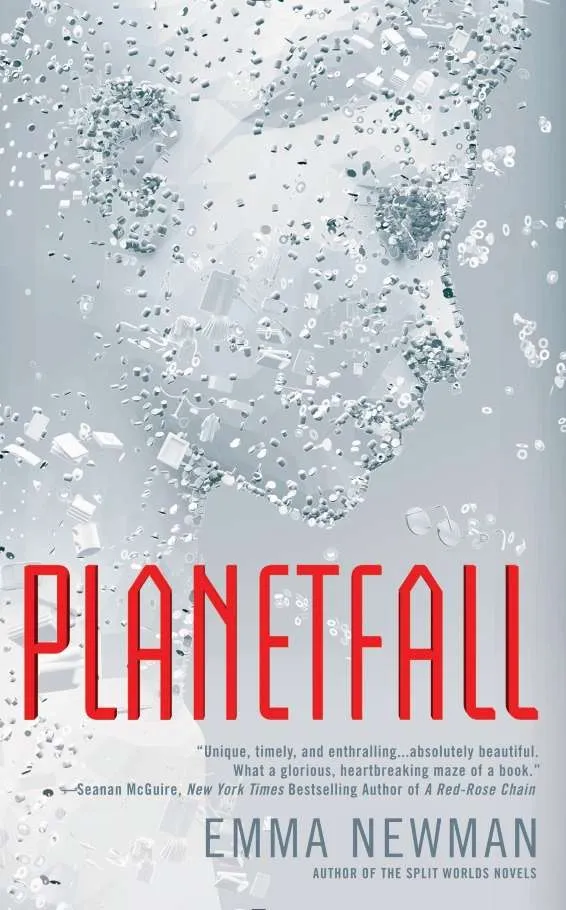
Planetfall (Planetfall, #1) – Emma Newman
22 years ago, escaping the brink of certain extinction, the last remains of humanity formed a colony deep in the cosmos, on a mysterious planet home to a strange alien structure. Leading them was Lee Suh-Mi, a godlike figure who has retreated in recent years to live inside of the alien structure. Renata “Ren” Ghali, an engineer, has spent her life toiling away to make this new haven habitable for humanity. But when a stranger arrives on their doorstep bearing an uncanny resemblance to Suh-Mi, Ren must question everything she knows about her new planet—and her supervisors.
TW/CW: panic attacks/mental illness (PTSD, anxiety) themes, ableism, grief, death, murder, descriptions of injury, death of a child, substance abuse (alcohol)
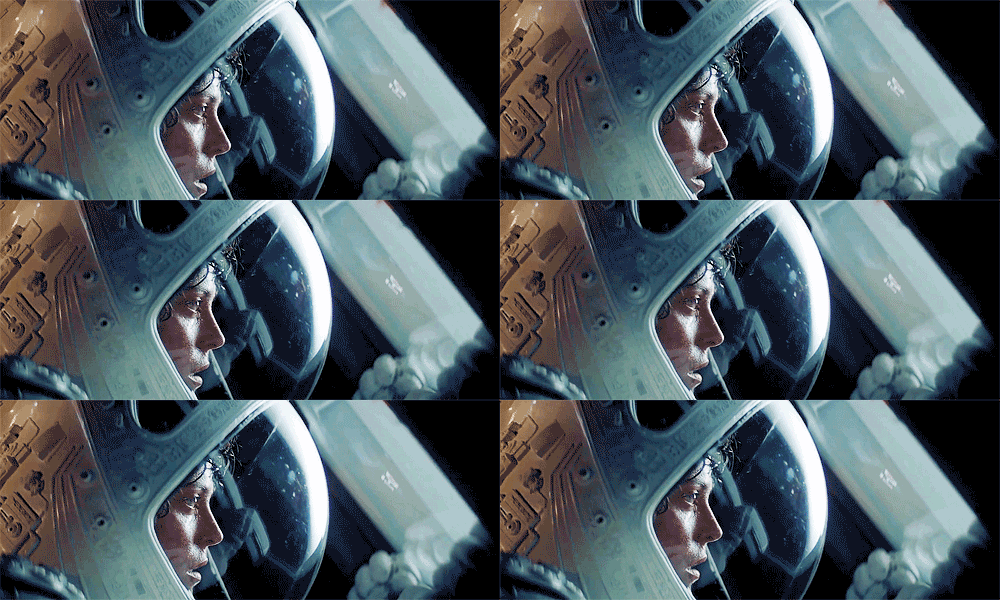
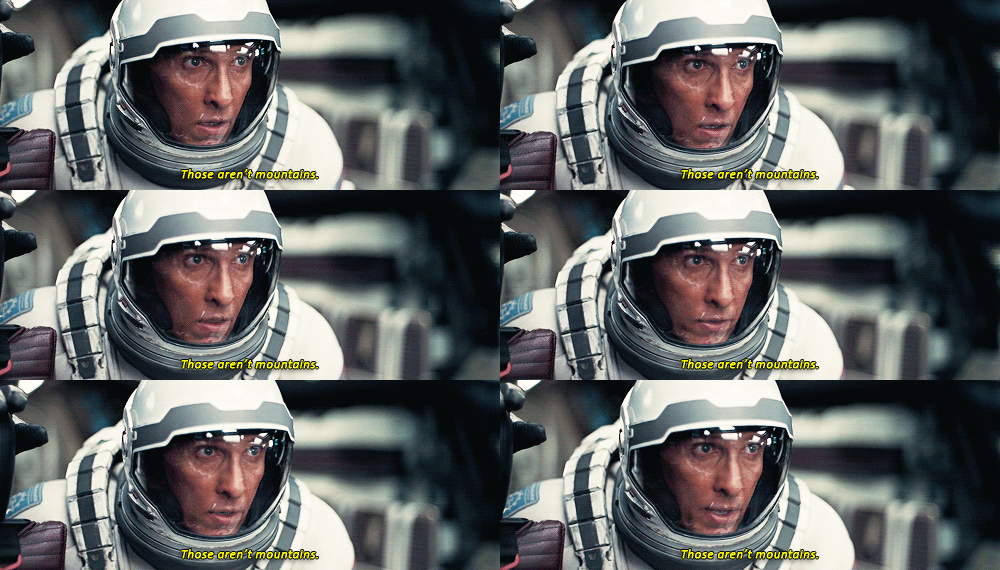
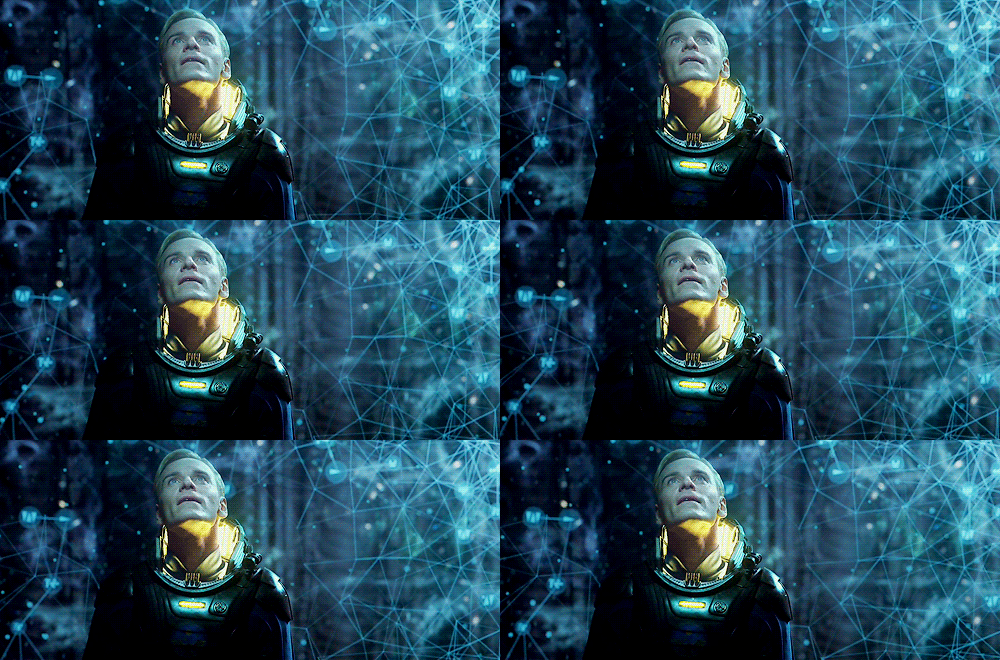
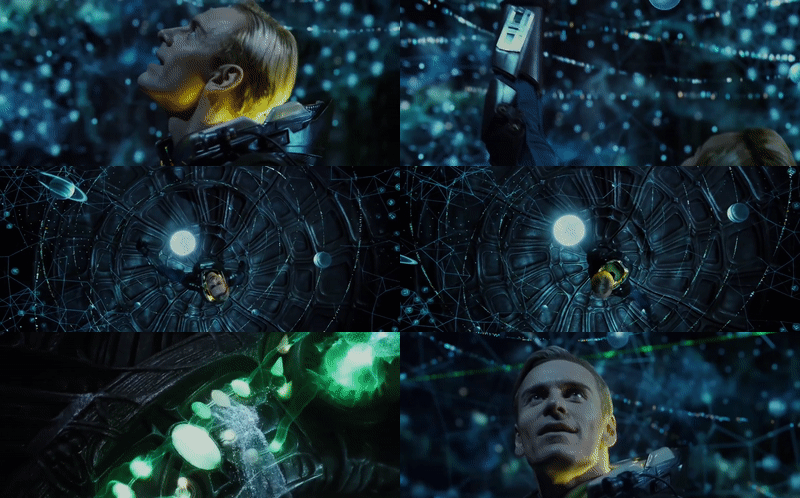
Once I got past the halfway mark of Planetfall, my recurring thought was “This is just Prometheus if it sucked.” Prometheus is already a divisive film (I’ll always have a soft spot for it, I don’t care), but this novel feels like what would happen if you separated Prometheus from the Alien franchise…and then surgically extracted everything that was interesting about it.
I will say, even though my overall experience with Planetfall wasn’t the best, there were some significant positives. Newman’s prose had moments of being very clever and poetic, though they were few and far between. I liked the inclusion of Renata’s mental illness, and the pushback of the narrative of disability/mental illness needing a cure, especially in sci-fi settings. The casual inclusion of lots of characters who were queer and/or people of color was also a plus.
Yet once you get beyond that, there isn’t much to like about Planetfall. One of the worst things to fall short on in genre fiction in general is the sense of place. If you’re in the real world, you can let go of descriptions on the basis that your reader exists in this world and knows how it functions; when you’re creating something entirely new—say, an alien planet—grounding the reader in the setting is almost always an absolute necessity. I was so excited to explore the alien colony that Newman set up, but hardly any of it was expounded upon. Other than a few throwaway descriptions of Ren hearing alien creatures’ mating calls (how do you not follow up on that?? Tell me about the creatures!) while trying to fall asleep at night, I have almost no clue about how this planet looks. I think there’s…some caves? Maybe? All I can say with certainty is that there’s an ominous alien structure. That’s about all I can tell you. That also extends to the interior of the colonists’ base—I’m lost as to even what that looks like, even though that’s where we spend most of the novel.
This novel’s biggest pitfall is that it sets up far too many things—both in terms of plot and theme—and there’s practically no payoff for any of it. Newman clearly wanted to say something about religious fanaticism, but her analysis didn’t get further than “religious fanaticism is bad,” which, while that’s obviously true, really merits going deeper than that. The plotline about Ren’s guilt and mental illness was the closest Planetfall had to having something tangible to say, but even that got lost amidst the tangled mess of half-baked threads. Given the prominence of guilt and religion in this novel, there could’ve been something compelling for Newman to explore, but those dots were barely connected, if at all. The same is true of the plot. The entire foundation of the colony is upended? Nah, we’re dealing with that later, I guess. There’s a whole thread where they find evidence of an alien language, and…nothing happens. I kid you not. They just drop that thread and leave it there. If you go into Planetfall thinking that any of the plot threads will be resolved, prepare yourself for disappointment. Reading this novel made me feel like Darla from Finding Nemo shaking Nemo in a plastic bag, desperately trying to get him to “wake up!” Spoiler alert: it never did.
Part of what accentuated that feeling of narrative unresolution was the fact that the characters weren’t developed nearly enough for me to even care what happened to them. Ren came the closest, but I suspect it was more because she was actively being horribly mistreated by some of the other characters. I’m not sure if I know a lot about her other than what happens to her, even though Planetfall happens entirely from her point of view. To Newman’s credit, her guilt was written quite evocatively, and that was where I felt the glut of my sympathy for her. She was less of a character and more of a chess piece for things to unceremoniously happen to. Had she been characterized beyond her crushing guilt, I might have been much more interested in the story—guilt is an emotion, not a character trait.
The same can be said for all of the other characters. All Mack really did was act badly enough for Newman to have an excuse to slide him in as the antagonist in the eleventh hour. Sung-Soo didn’t have any discernible traits other than the fact that he upends what the colonists had believed for decades. Speaking of other colonists…other than maybe four other named characters, where were they? With the lack of description, I fully would’ve believed you if you told me that there were only seven people tops on this planet. Planetfall was just so painfully bare-bones in most regards. All of the promises of a good story are here, from the themes to the plot, but it’s all promises and no deliverance. It’s the literary manifestation of doing the least to get your readers to believe that there’s a story going on.
All in all, a sci-fi novel that promised intrigue, mystery, and devastating secrets, and delivered on…none of those things. 2 stars.
Planetfall is the first book in the Planetfall series, followed by After Atlas, Before Mars, and Atlas Alone. Emma Newman is also the author of several other series, including The Split Worlds (Between Two Thorns, Any Other Name, All is Fair, A Little Knowledge, and All Good Things), the Industrial Magic duology (Brother’s Ruin and Weaver’s Lament), The Vengeance, and many others.
Today’s song:
That’s it for this week’s Book Review Tuesday! Have a wonderful rest of your day, and take care of yourselves!















 The Bookish Mutant