Posted in Sunday Songs

Sunday Songs: 10/11/26

Happy Sunday, bibliophiles!

This week: This is a long one, but I did this to myself by putting Phoebe Bridgers, Soccer Mommy, and Bowie all in one week. You’ve been warned.

Enjoy this week’s songs!
SUNDAY SONGS: 10/11/26

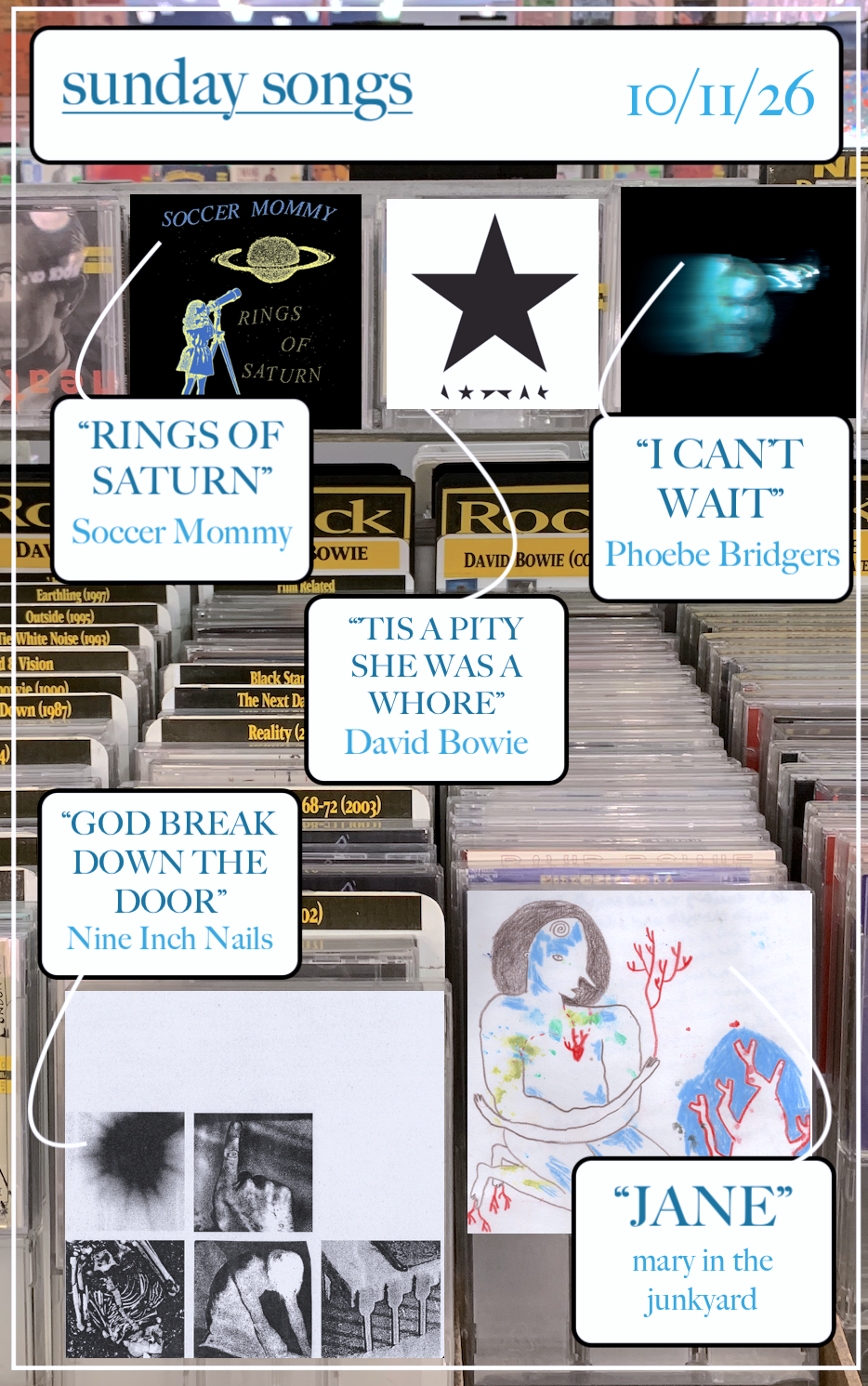
“God Break Down the Door” – Nine Inch Nails

Noisier, more metal-adjacent music isn’t usually my forte. I used to hate most forms of industrial or metal music when I was younger, up until about high school. This was true for all but a few Nine Inch Nails songs (admittedly, I did love a handful of songs from Pretty Hate Machine in middle school…fitting, and also, “Head Like a Hole” will always be a banger). To this day, I still can’t decide how much I regret not seeing them with the rest of my family back in 2018, at a Red Rocks show where they ended up playing one of the only live performances of “The Perfect Drug” up until that point. Cruelly, it took me until a few years ago to like that song, too.

Nowadays, I can appreciate Trent Reznor much more as an artist, having gone from the throes of addiction to sobriety but still keeping true to his mission of making art to exorcise pain and create a safe space for those working through similar issues. Anybody with that mindset automatically has my respect. But of course, everything goes back to Bowie with me—I think I heard “I’m Afraid of Americans” around the same time as I started sort-of-kind-of liking Nine Inch Nails, and I don’t think there’s a way that you can come away from that experience without thinking that Bowie and Reznor are the coolest people on Earth. Hearing “God is an American” for the first time in the Trump era was certainly pivotal. But to hear of their relationship—Bowie taking Reznor under his wing, seeing pieces of his younger self in him and helping Reznor work his way out of his addiction and help his artistry blossom—is such a critical part of the Bowie and Nine Inch Nails story that a lot of Bowie fans who only fixate on the ’70s or ’80s woefully miss. The ’90s marked a turning point for Bowie musically and personally, with his no-holds-barred dive into experimental music and the peace of his private life, which allowed him to become that stable mentor for people like Trent Reznor, and many others afterwards. And then, of course, there’s the legendary tour they did together.

So understandably, Bowie’s death left an indelible mark on Reznor. Even before I got into Nine Inch Nails, I could understand that if anybody could, nay should cover “I Can’t Give Everything Away,” it was him. That’s not even mentioning his concrete song about grieving Bowie, “This Isn’t the Place.” Yet even if “God Break Down the Door” wasn’t directly about Bowie, it kinda still is, in its warped way. It’s a writhing mass of tentacles frenetically squirming ever outwards towards entropy. Reznor’s blares of saxophone are the most obvious Bowie (specifically Blackstar) callback and a connection point between them, as they both played the instrument in their younger years. But amidst all of the seemingly disparate aspects of the track—the writhing beats (almost goes into yoinky sploinky territory), the marimba, the persistent drone of it all—it creates something so singly whole. That fleeting beat of silence amidst Reznor’s droning and the explosive exorcism of sound that comes afterwards bottles a kind of feeling that I can only describe as a black hole being reversed, like all of the matter of the universe being shot back out from the point of oblivion. It’s the door that God’s broken down, from my interpretation. But to me, it’s not just the sound of Bowie that Reznor inherits: it’s the floodgates of creativity being busted open in the ’90s, wiggling free of all corporate and fan expectations to create something nobody expects.

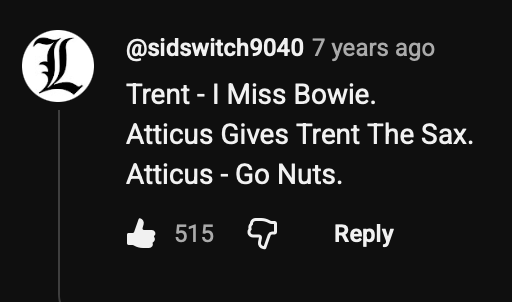
It’s very succinctly summed up in this YouTube comment:
…AND A BOOK TO GO WITH IT:
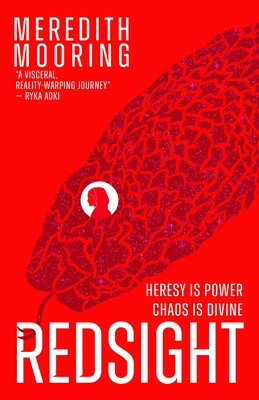
Redsight – Meredith Mooring – “God break down the door/Everything all at once/There aren’t any answers here/No, no, not anymore…”

“Jane” – mary in the junkyard

mary in the junkyard is a band I expect to come forward with something fresh lyrically, whether it’s feral people in the woods, reincarnated mice, or people turning into trees. Clari Freeman-Taylor has an eye for the left-of-center, the unloved creatures and inherent weirdness that reveals itself once you peer beyond the space between branches; her songwriting cradles spiders, mice, and impish creatures and nurses them back to health, patting them on the head when most people would run away and abandon them. So it’s no surprise that “Jane” is similarly unique. It hung in unreleased but often played live-limbo, where it was introduced by Freeman-Taylor as a love song about her period, who she named Jane and is “too annoying and honest.” Ain’t that the truth.

Writing affectionately about your period is a daring undertaking, given that it’s the bane of pretty much every AFAB person’s existence. But I think that the same tenderness Freeman-Taylor offers to the unloved creatures translated naturally to menstruation, which frequently makes you feel like an unloved creatures, and is a kind of unloved creature in her hands. The understated combination of electric guitar and Saya Barbaglia’s plaintive viola makes it feel like an apology, the sort of intimacy of cupping your hands over somebody’s chin as they weep. (Which, once again, very much a period feeling.) For me, it evokes the fear when I went through puberty as a young girl, developing at a rate that felt entirely too fast for the uncertain body I was in, doddering around like a foal: “It’s hard to be a woman, is it harder to be here?/It’s hard to be someone when everything is new.” To me, it’s both about that womanhood/AFAB experience as well as Jane herself being new in the world, emerging like some nocturnal creature every month. I never considered that my sentient period didn’t want to be brought into this world either. Maybe I’m the bad guy. Nobody’s having a good time here. But that’s where “Jane” finds sympathy, for both herself and Jane being constant, confused, and cramping companions.

…AND A BOOK TO GO WITH IT:
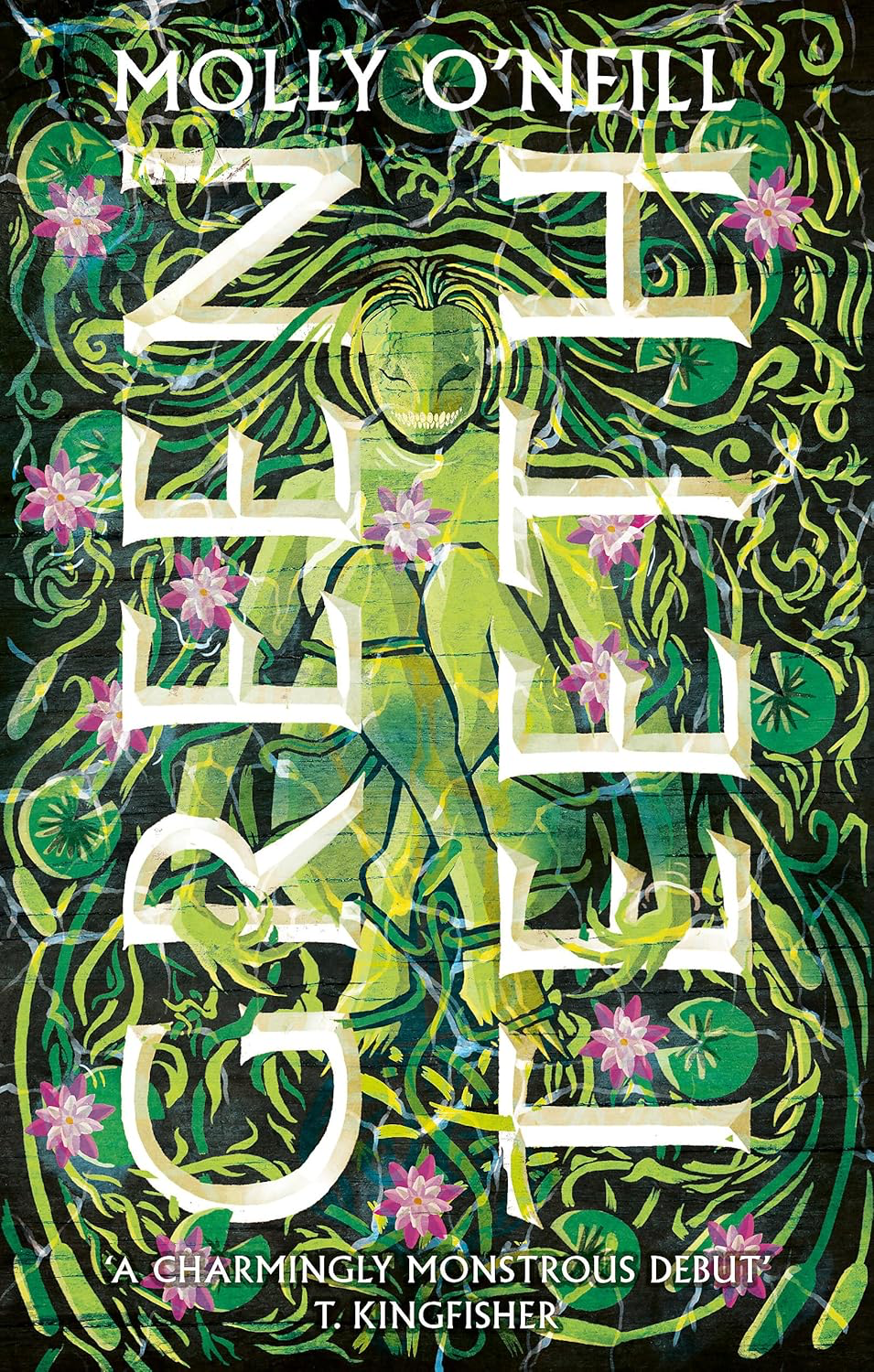
Greenteeth – Molly O’Neill – to be honest, I haven’t exactly read many books that are a) about menstruation, or b) sentient periods, but Greenteeth gives me the tenderly, whimsically dark yet sympathetic feel of a lot of mary in the junkyard songs.

“Rings of Saturn” – Soccer Mommy

Have I gotten to the point where I’m ambivalent about Soccer Mommy? I don’t think so, but I think I’m dangerously close. “Rings of Saturn” is a nice song. That’s about it. It’s a nice Soccer Mommy song. But I feel like it’s not a huge leap from any of her other work. I feel like this could be an outtake from color theory, which isn’t necessarily a complaint. Yet with somebody like Soccer Mommy, I expect at least something new with each new release—there was the color-coded concept behind color theory, the experimental daring of Sometimes, Forever, and the acoustic grief cataloguing of Evergreen. Other than the production, there’s not much that separates “Rings of Saturn” from the rest; but I do enjoy the production, with its spacey, retro graininess. The lyrics are solid too—certainly relatable, and they would’ve been even more so when I was in high school. “Rings of Saturn” is perfectly fine, but I just wanted more. At worst, Evergreen’s tracks blended together, and I’m just afraid that it’ll happen again. Then again, back when she released “Shotgun,” it felt like she was playing it safe, and then came Sometimes Forever. So who knows? I want more from “Rings of Saturn” because I know she’s capable of something more. Tentatively, I’ll follow Soccer Mommy wherever this constellation leads.

…AND A BOOK TO GO WITH IT:
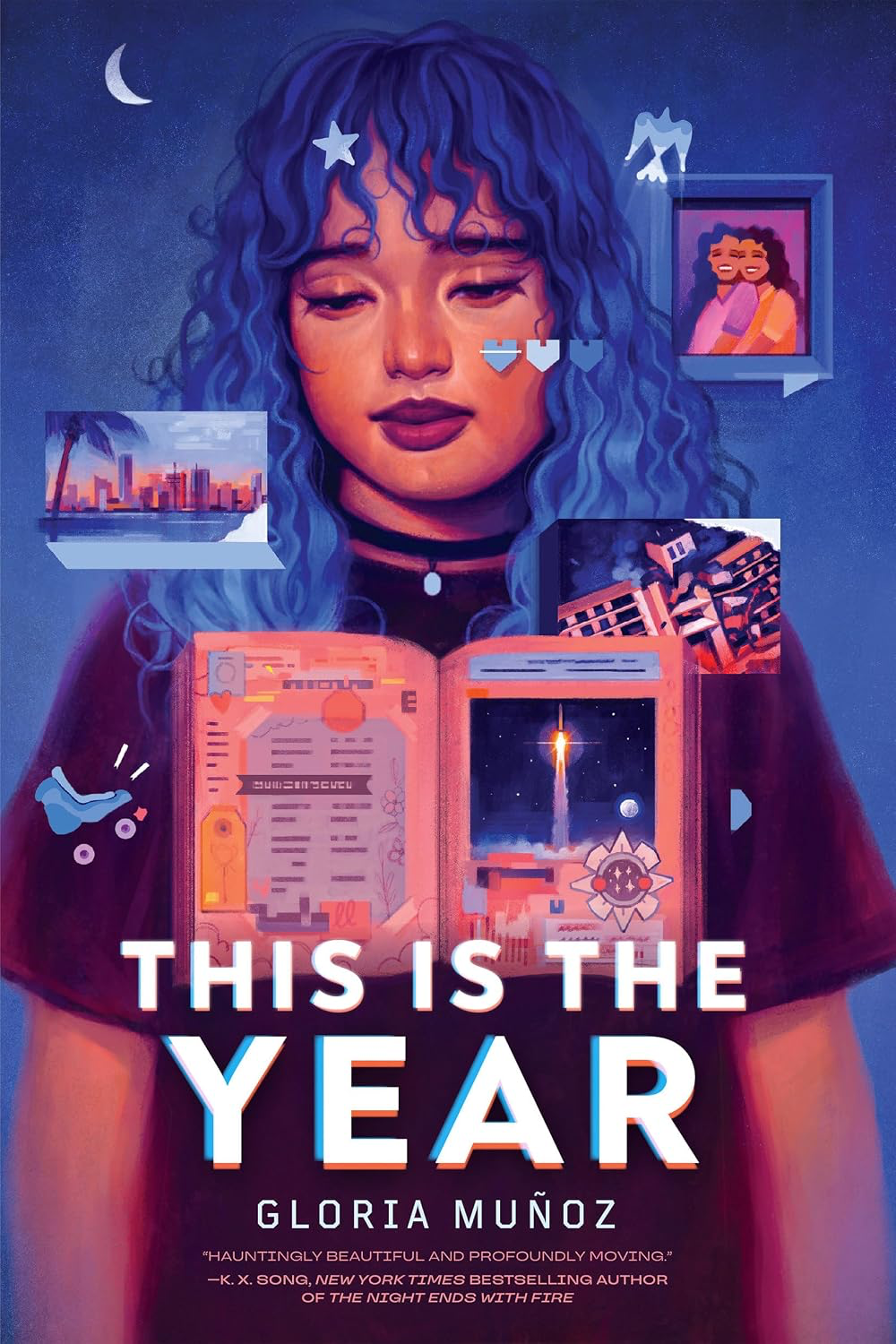
This Is the Year – Gloria MuĂąoz – “The stars, they hardly shine/In the city lights, but I/Point my finger to a halo in the sky, I see your light/Rings of Saturn, do you hear me when I cry?”

“‘Tis a Pity She Was A Whore” – David Bowie

Blackstar was always going to be an album that I needed to sit with. It took me years to even listen to it all the way through. A second time around, and I could barely handle the crushing weight of grief coupled with the ecstatic art-jazz-rock freakouts. And then I bought the record because it was within my self-imposed budget, a fine addition to my collection, etc., and that final piece clicked for me. Granted, most of the tracks still make me cry like a baby, but once I vomited up that initial onslaught of sadness, I could peek back and not just appreciate but genuinely enjoy the artistry behind it. It’s not that I didn’t get it before—even while I was actively weeping, I recognized all of the snatches of odd time signatures and how flooring pretty much all the lyrics are—but the immediacy of it had worn off.

I hate hearing the sound of breathing. Not even consciously heavy breathing, that’s obvious, but just any audible breathing. It’s very much a sensory issues thing, but hearing breathing (nay, any kind of mouth noises), chewing, sniffing, it all makes me fucking squirm. Something about it sets my perpetually askew nervous system on high alert. And that’s how “‘Tis a Pity She Was a Whore” begins. David Bowie breathes into the mic, then licks his lips. You can almost hear how chapped they are. It’s laborious. The exhaustion, the energy sapped out of him, is immediately apparent in seconds, and even when the saxophones and pounding drums kick in, you can hear him heaving. Bowie never gave a statement as to what the lyrics were about: all he ever said about the track was that “if Vorticists wrote rock music, it might have sounded like this.” Keeping the art movement in mind, characterized by cubism, harsh angles, and secrecy, it’s very apt. But that no-frills, human panting and breathing inclines me to believe one of the more popular interpretations of the song; Bowie describes a woman (in quite disparaging terms) who “punch[es] him like a dude” and “steal[s] his purse with rattling speed”…what could said “whore” be if not cancer?

Even if the language is more sparse than the usual flowery, cosmic Bowie epic, “‘Tis a Pity” is an epic in every sense. There’s no shortage of aspects to pick apart. There’s the gender dynamic of the cancer personification, clearly marked as a woman but whose violence takes on distinctly masculine language (“Man, she punched me like a dude”). There’s the title, taken from a 1633 play by John Ford, which is only tangentially related to the song’s themes, but nonetheless contains that same undercurrent of violence. The literary references continue with an interpolation of Robert Southey’s Sonnet 1, part of a collection of poems condemning the Transatlantic Slave Trade, where Bowie gets “hold your mad hands.” (Thanks are due here for the no doubt exhaustive research from the blog Pushing Ahead of the Dames.) Through it all, it paints an image of Bowie as a frail boxer, battered but impossibly full of energy until his last breath. It’s a harrowing song, especially with that final ragged yelp he lets out at the end. He sounds beaten. And yet, he was ready to throw those creative punches in the ring until the bitter end.

…AND A BOOK TO GO WITH IT:
The DSM-5 – American Psychiatric Association – we all need therapy after this, let’s be real…

“I Can’t Wait” – Phoebe Bridgers

Are you imagining me somehow serenely, sitting stationary while writing this post? Wrong. I’m still vibrating at the thought of Lost Weekend, mainly because I’ve got tickets to see Miss Phoebe (!!!!) very soon!! I’ve come back to the album constantly—easily one of my favorites of the year so far, and it only gets better every time I revisit it. This week’s pick was a real tossup—I could’ve easily gone with the enchanting slow dance (and brief Gracie Abrams diss) of “The Governor’s Waltz,” the bittersweet, country-fied healing of “Haunted,” or the visceral existential pleas of “As Above.” Now that I’ve had almost two months to sit with it, I think Lost Weekend represents the height of Phoebe Bridgers’s powers (no pun intended) so far. Dare I say that it’s better than Punisher? I do dare say it. She’s skyrocketed in fame and artistic ability, a rare combination; she’s only strengthened the emotional, raw pull in her lyrics without sacrificing a subtly adventurous spirit. The soundscapes have turned from artfully sparse to cosmically expansive, doffing shoegaze, country, and electronic hats with an ease that most musicians of her standing couldn’t attempt.

Yet I keep coming back to “I Can’t Wait.” There’s about a million puns I could make about this song and the fact that I can’t wait for the concert, but I’ll hold back. Another aspect of Lost Weekend that endears me is the fact that, in spite of the tragedy that led up to the album’s release, Bridgers has started finding peace of mind. Despite being labeled as such by the press and her fans, she’s frequently chafed against both a static sound and being pigeonholed as a sad girl; and, yes, while that’s part of why I love her, seeing her write songs of unabashed hope and love is like watching a depressed friend start healing and doing better for themselves. “Bobby” is the more obvious example, but “I Can’t Wait” hits me in the gut the most. With its juddering, harmonized sprint at the start, it’s brimming with anticipation. This time, it’s not the end-of-the-world prophecies of Punisher, but being excited for the first time about what’s on the horizon: romantically, emotionally. Bridgers paints herself as more than a little bruised and beat up, but she’s ready to run towards the finish line no matter how much dirt she’s got smeared over her bloodied knees: “I’m not good, but I’m better/Missed my cue, but whatever/It’s now or never.”

And of course, as if “I Can’t Wait” wasn’t one of Bridgers’s best already, it also solves one of the problems that she’s had for her whole career: her duet partners. She’s finally picked somebody with a lower vocal register than her to duet, and it actually works. They said it couldn’t be done…but if anybody could do it, it was obviously Cameron Winter uh [cough] excuse me, Son-John Johnson, my bad. The beat where the electronic skittering dissipates into folksy embers around a campfire, where Bridgers and Winter’s voices delicately intertwine, feels exactly like the song’s excellent music video; at that moment, the fly that the video’s POV has been from, gets gently cradled in Bridgers’s palms. It’s so secure, warm, and the moment that their voices coalesce feels like home, somehow. Incidentally, that’s where the real love song part of “I Can’t Wait” comes in, but that brimming, brilliant nucleus of hope and genuine excitement for the future gets me choked up. You can change your mind, but you can’t change mine…

…AND A BOOK TO GO WITH IT:
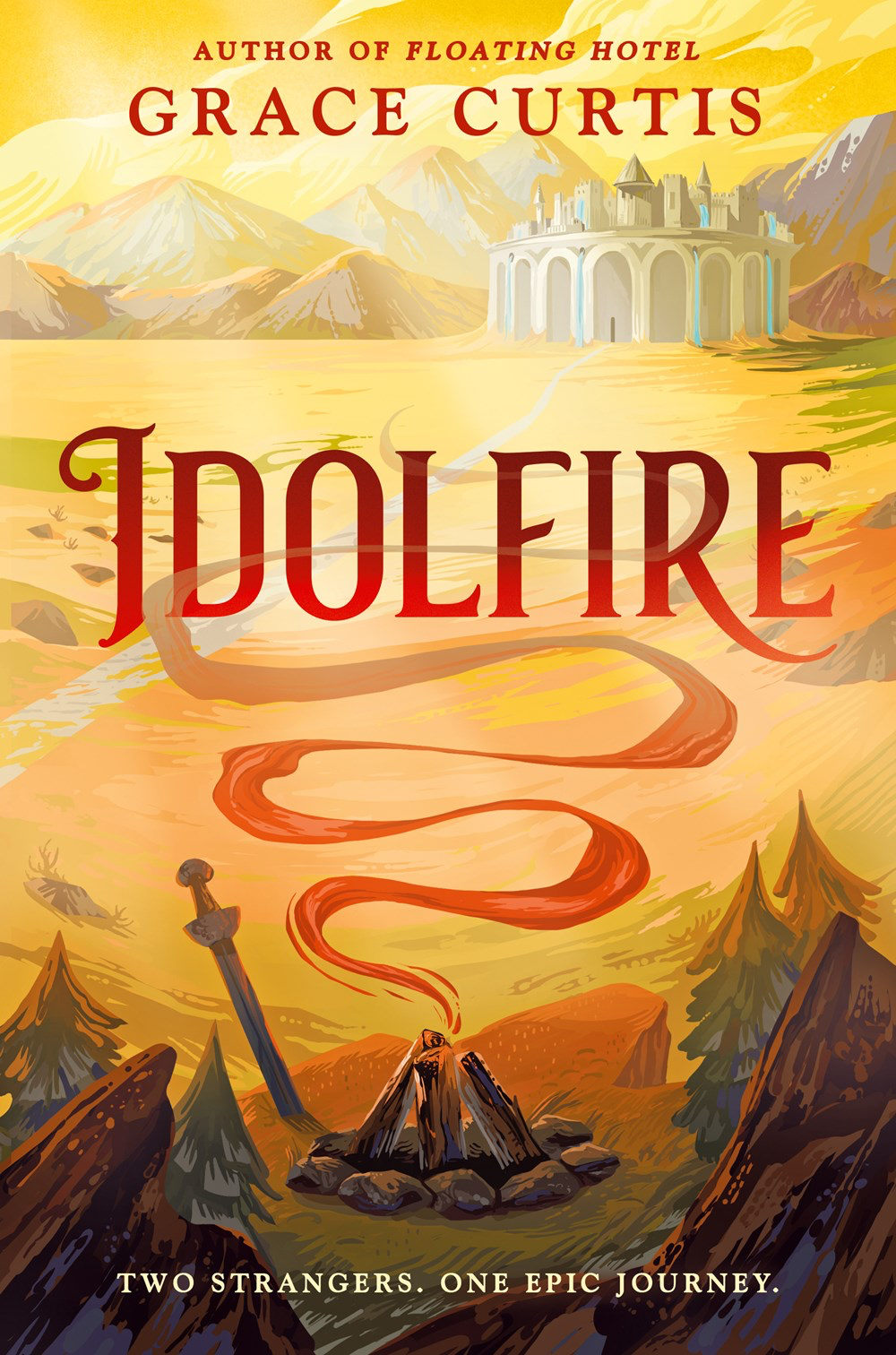
Idolfire – Grace Curtis – “Baby, baby, if you leave me/Can you take me with you?/I can sit in the back seat…”

Since this post consists entirely of songs, consider all of them to be today’s song.

That’s it for this week’s Sunday Songs! Have a wonderful rest of your day, and take care of yourselves!

Posted in Sunday Songs

Sunday Songs: 9/29/24

Happy Sunday, bibliophiles! I hope this week has treated you well.

This week: high school throwbacks, off-kilter oddities, and a few too many people trying to explore each other’s minds than I’m comfortable with. Cool it, Charles Xavier…

Enjoy this week’s songs!

SUNDAY SONGS: 9/29/24:

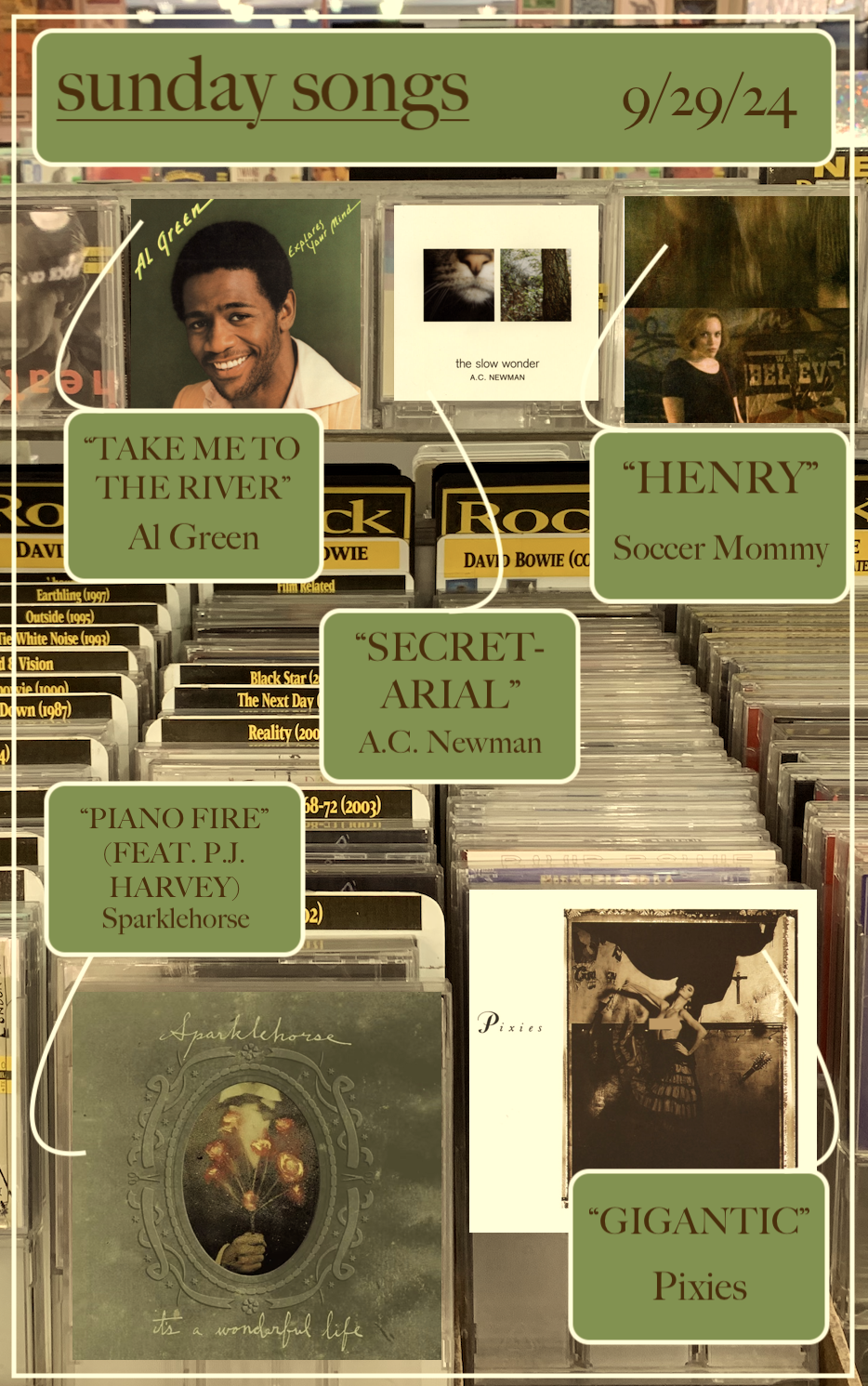
“Piano Fire” (feat. P.J. Harvey) – Sparklehorse

It’s a Wonderful Life is one of those albums that took me a bafflingly long time to listen to. I know, I know, I did it to myself, but the fact that I didn’t pick it up when I was 15 and irreparably mired in Good Morning Spider astonishes me. It’s probably owed to the fact that I was also even more irreparably mired in OK Computer, which tends to overshadow things a tad bit. Looking back, maybe it was for the best that I wasn’t on an all-Sparklehorse diet at that age. I already looked pathetic scuffing my snow boots through the hall while blasting “Maria’s Little Elbows” through my earbuds between classes. I was 15, guys. It was 100% that serious, trust me.

What I can say is that I think I would have felt the same way about It’s a Wonderful Life at 15 as I do now—it’s a triumph of an album. Scattering through surreal urgency and subdued melancholy, it has every kind of Sparklehorse you’d like—along with a smattering of collaborators. It’s almost funny how different said collaborators are (take Nina Persson’s delicate backing vocals on “Gold Day” and then Tom Waits growling like a hulking ogre on “Dog Door”), but the power of Sparklehorse has always lain in the disparate elements Mark Linkous cobbles together. Like some kind of American Gepetto, he constructs all of his songs into tiny figures made of warped wood and bird bones, and what totters to life creaks with every step. They’re quaint creatures with acorns for heads and cigarettes and toothpicks for legs, but there’s no other way to love them save for exactly as they are.

Those he chooses to collaborate with feel much the same way. P.J. Harvey, of all people, was a left-field choice when I first heard about her featuring on “Piano Fire.” The only Sparklehorse song I could conceive being able to contain the kind of raw fury she exudes was “Pig,” and that had already come and gone by the time It’s a Wonderful Life came out. “Piano Fire,” however, is one of the most upbeat tracks on the album; you feel a racing urgency to it, immediately sprinting down an overcast beach the minute the first guitar chords kick in. Or maybe it’s the searing heat of airport tarmac that you’re sprinting across the minute you hear the opening line: “I got sunburnt waiting for the jets to land.” Sunburnt describes “Piano Fire” surprisingly well; it has the texture of an old photograph left out in the sun too long, all of the colors now bleached to unnatural, pale shades. Linkous almost takes a backseat on his own song, never raising his voice when he dishes out surreal vignettes of “Fiery pianos wash up on a foggy coast/Squeaky old organs have given up the ghost/Fire them up and kill the piano birds.” But that urgency is why P.J. Harvey is so perfect for this song; once the chorus kicks in, her soaring voice provides the jet fuel for this creaky old jet to careen off the runway and into a sky littered with the strangest birds you’ve ever seen.

…AND A BOOK TO GO WITH IT:

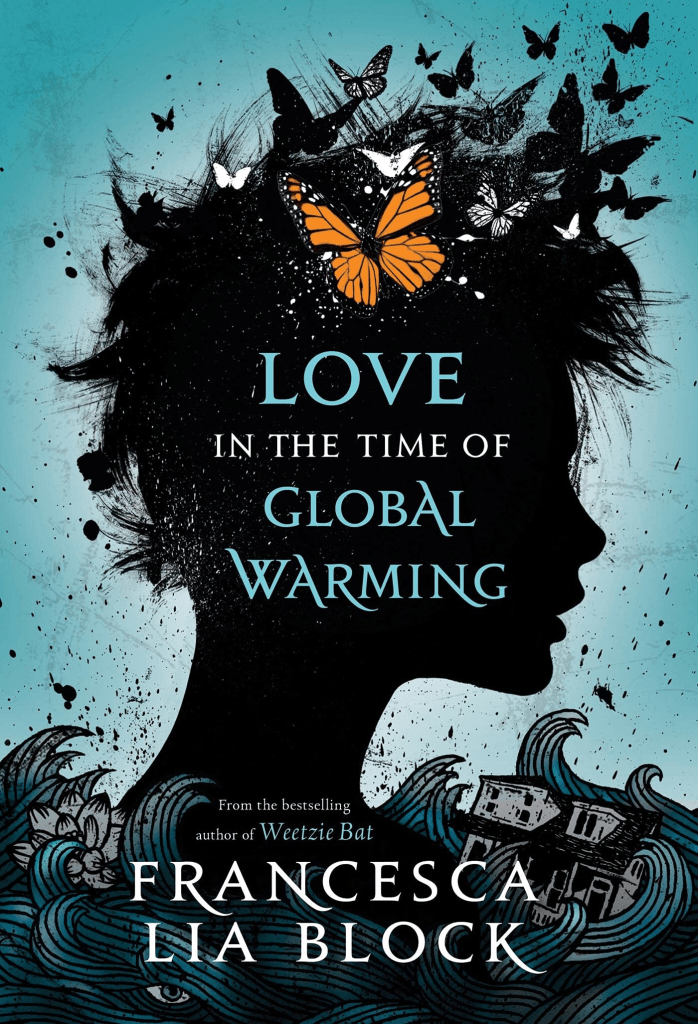
Love in the Time of Global Warming – Francesca Lia Block – Block’s bizarre, dreamlike prose certainly fits with the surreal imagery that Linkous employs in this song—and the majority of his catalogue.

“Gigantic” – Pixies

In almost two and a half years of making these Sunday Songs graphics…this is the first time I’ve double-dipped. It was bound to happen eventually, not just because my music taste is finite, but because this song has lingered with me from a young age. I faintly remember being around five or six and hearing this song in my dad’s old car, driving in fading light down the road back to my house, and hearing the iconic chorus: “Gigantic, gigantic/Gigantic, a big big love.”

I’ve often talked about how simplicity in lyrics can convey more than the most complex songs in some cases, and if you need further proof, look no further than “Gigantic.” Most of that work is done by the immense, never-fading talent of Kim Deal, who sells every metric ounce of explosive love in this song; with every cry of “A big big love,” you get it—there’s no other words that can adequately describe the kind of secretive, all-consuming romance that swirls through every pluck of the bass. That opening bass riff is the shy, cracking open of a bedroom window when the parents are asleep, an invitation with a blushing, anticipatory smile. What follows never fails to knock me off my feet. I say “knock” and not sweep or lift me off my feet precisely because that’s what it feels like, as though the ground has opened up beneath you, and you’re falling headfirst into the unknown—contained in a kiss that consumes every cell of your body.

…AND A BOOK TO GO WITH IT:

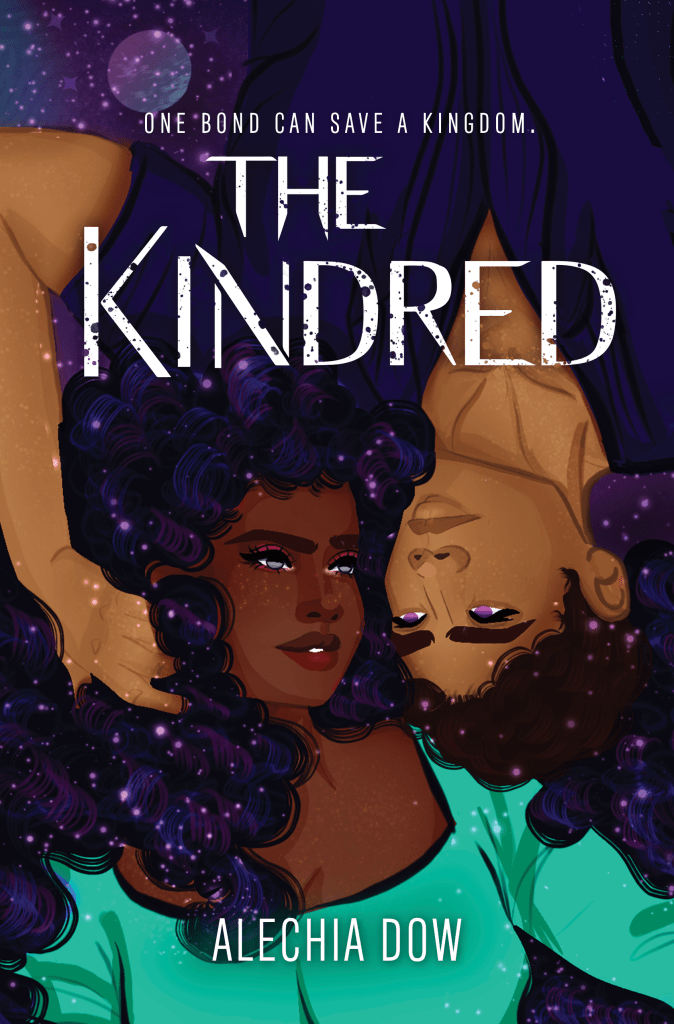
The Kindred – Alechia Dow – all-consuming, explosive, and intergalactic love.

“Take Me To The River” – Al Green

I’m sure Al Green is a perfectly nice guy, but…that album cover and title is not it, man…”Al Green Explores Your Mind?” Can he…can he not?

The fact that they were just naming albums anything back in the day aside…how did I not know about this song for so long? I’ve loved the Talking Heads cover for years, but somehow, it never dawned on me to look it up and discover that it was a cover. There’s something to be said for the phenomenon of white artists’ covers of songs by Black artists overshadowing the originals, but this isn’t quite the case—from the looks of it, between the amount of times that this song has been covered (most recently by Lorde for a Talking Heads tribute album, oddly enough) and the royalties from [checks notes] those animatronic wall fish, it’s cemented itself as an enduring classic of soul. I’m sure Al Green isn’t complaining about the latter though, given that he’s gotten the most royalties from the fish cover. Yet no matter the strange journey that “Take Me To The River” has taken, none of it has overshadowed how deliciously groovy it is. It’s endured for five decades in counting precisely because it wastes no time in getting straight into its slinky, infectious funk. Green’s voice flies from slick to howling in seconds and recovers in record time, all in time with the blasts of an impeccable horn section. 50 years, and you can’t not bop your head. I’m still not jazzed about Al Green exploring my mind, but I can’t deny that he worked some undeniable, immortal magic with this one.

…AND A BOOK TO GO WITH IT:

The Final Revival of Opal & Nev – Dawnie Walton – though the musical genres differ, the atmosphere and climate of the ’70s runs through both.

“Secretarial” – A.C. Newman

I’ve had a turnaround. I’ll be honest—even though I’ve liked several New Pornographers songs since I was young, “Secretarial” has always bugged me for some reason. I never hated it, but it was always one of those songs where, over the years, I developed a reflex of just skipping it whenever it came on shuffle. I didn’t question it for a while. Many years have passed, and for once, I didn’t skip…and here we are.

A.C. Newman—and most of The New Pornographers’ catalogue, by extension—has this songwriting style that’s just so distinctive in a way that I can’t put my finger on. Even if you separated his or Neko Case’s voice from the lyrics, I could hear a line like “So come on, let the sun in/We’ve been gunning for promotion/Postering the slogans on the roadsigns.” and immediately go “yup, A.C. Newman wrote that.” What makes it so distinct has bugged me for years, and to this day, I can’t fully put my finger on it. The closest I can say is that their specific diction has an inherently off-kilter quality to it. Newman is never overly verbose, but the way he arranges words is always slightly askew. His lyrics dwell in the thin limbo between obtuse poetry and sense, situated in a place where you can decently get the metaphor he’s going for, but instinctually, you know that those syllables just don’t go together neatly. “Secretarial,” like another other Newman product, might as well be a puzzle, in that sense, but one that was put together wrong with the pieces that only look like they should fit together, but stick and slide against each other. I’ve never been great with time signatures, but this one is angular enough to match the slanted lyrics. Even if you don’t know the guy, you can’t deny that it takes some serious talent to not just think of but pull off “Lady, it’s secretarial” as a hook.

…AND A BOOK TO GO WITH IT:

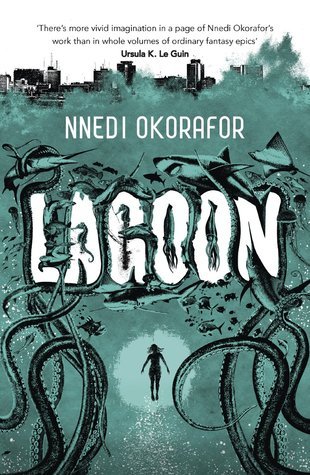
Lagoon – Nnedi Okorafor – I’ve used this book more than once, but it was right there…

“One day you blew across the water/After racing through the countdown/Spewing ancient wisdom like your friend/The revelation had come and they were looking for me…”

“Henry” – Soccer Mommy

Oh, early Soccer Mommy…oh, “Henry.” This one sure soundtracked many a one-earbud-in free draw in art class my sophomore year. I think it was in the fall that I found this song as well; it carries a distinct smell of wet leaves and wood chips in the pumpkin patch. Cheesy as the title of this album, the self-released For Young Hearts, is, it’s not like it’s a lie. Here’s to many more high schoolers listening to this in art class.

It seems that “Driver” has put a pin in this tradition, but “Henry” is part of a long lineage of Soccer Mommy songs about the seduction of Bad Boys™️ (see also: “Death By Chocolate”). Of course, the natural conclusion was that the ultimate bad boy was to be conquered in “lucy,” that being…the devil himself. (God, I need to stop. I sound like a youth pastor.) But here in 2016, “Henry” chronicled the kind of guy who hung out behind the high school, smoking cigarettes in a leather jacket, and giving you a wicked smile as you passed. Sophie Allison’s younger voice, along with the plucky instrumentation (cannot get enough of that bass), makes you feel like you’re following a mischievous wood sprite through sunlit woods. Light and lovesick, it captures that heady, teenage love drug that makes every step stumble: “‘Cause Henry has a laugh like fire/And it’s spreading through the streets and burning on telephone wires/I don’t know just what it is/But he’s driving all the good girls bad with that evil smile of his.” Soccer Mommy’s had that golden, indie touch all along—”Henry” remains a classic to me.

…AND A BOOK TO GO WITH IT:

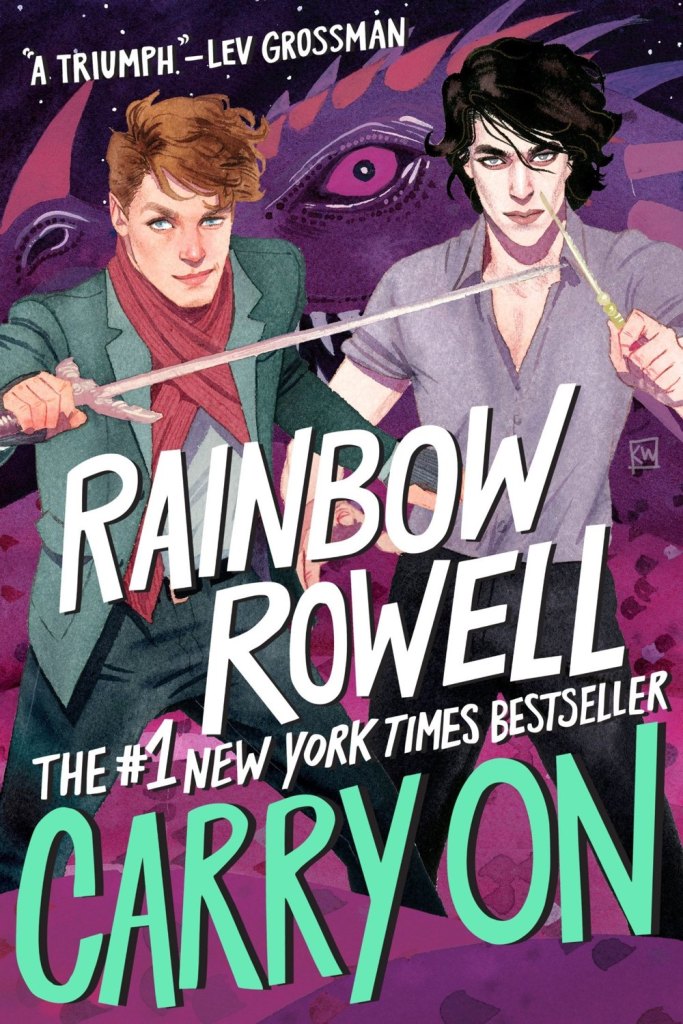
Carry On (Simon Snow, #1) – Rainbow Rowell – “I don’t know/Just what it is/But he’s driving all the good girls bad with that evil smile of his…”

Since this song consists entirely of songs, consider all of them to be today’s song.

That’s it for this week’s Sunday Songs! Have a wonderful rest of your day, and take care of yourselves!
Posted in Sunday Songs

Sunday Songs: 6/16/24

Happy Sunday, bibliophiles!

First off: happy Father’s Day to my incredible dad! Not only are you such a wonderful role model for being a genuinely kind, accepting, and truly empathetic person, you’ve given me the gift of sharing music—what these posts are all about. To be able to share music with you back brings me all the joy in the world. I love you.

This week: 🚨SOCCER MOMMY HAS COME TO SAVE THE SECOND HALF OF 2024, THIS IS NOT A DRILL🚨

Enjoy this week’s songs!

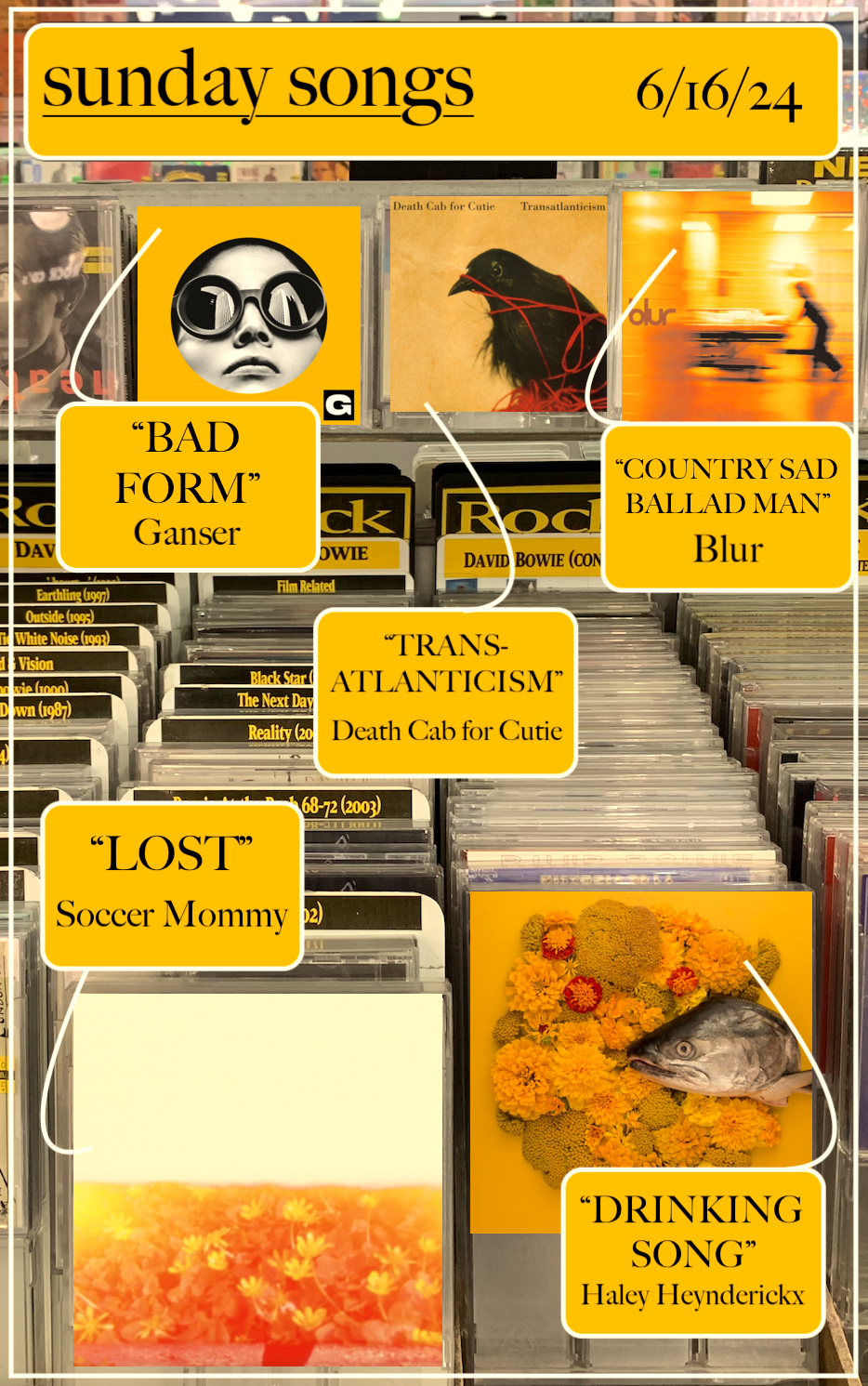
SUNDAY SONGS: 6/16/24

“Lost” – Soccer Mommy

SOCCER MOMMY RETURNS!!! Given the short tour (that’s nowhere near me……..no, I’m totally not mad, no way) that she’s currently embarking on to support some of this new material, there’s a fourth album (sixth, counting the self-released albums) on the horizon, and hopefully on a happier date. Poor thing. I still haven’t gotten over the fact that her last album, Sometimes, Forever, was unintentionally released on the day that Roe v. Wade was overturned. Jesus.

Something that I’ve admired over the years about Soccer Mommy is her willingness to experiment with her production. At their core, her songs have never changed their essence: honest, tender confessions of the trials of heartbreak, grief, and mental health. But the dressing is never the same twice, from color theory’s color-coded tonal shifts and synth-dusted melodies to the darker, more distorted soundscape of Sometimes, Forever. With the latter, Chelsea Wolfe wasn’t somebody that I’d readily compare to Soccer Mommy, but then she comes along with “Unholy Affliction,” and the comparison, at least on that track, is as clear as day. Just when you think she’s playing it safe, she comes out of nowhere with instrumentation that you’d never imagine attributed to her name—and almost every time, it still feels like nothing but Sophie Allison. There’s a boldness to her that’s rare in the genre; there is an expectation of sameness in the kind of indie circles she’s in, an expectation to box yourself into the image that the record label deems as “authentic” in order to stay in their good graces—and the good graces of fans who cling to their raw lyrics. Julien Baker, although her first two albums adhered to that, took a similar leap with Little Oblivions, and that, for me, was her best album to date.

But Soccer Mommy can’t help but be herself. “Lost” strays nearer to some of her sparer, more traditionally indie roots, but with production that feels spun from silk; inside of the glowing cocoon where Allison resides, threads of synth, birdsong, and yearning strings coalesce in what can only be described as the musical form of a grainy polaroid, a sunset tinged with ink, film, and bygone memories. Bygone memories, like much of her other material, is at the core of “Lost,” specifically bygone memories of those bygone. Given the trajectory of “yellow is the color of her eyes,” some have speculated that “Lost” is about her mother’s death, although Allison has chosen to not disclose the subject. whatever the case, I’m glad that Soccer Mommy doesn’t have the kind of rabid Swiftie fanbase that would relentlessly strip away at the press and at Allison herself to get to the bottom of who she’s mourning, because…that’s her own business, dammit. I’m glad us…whatever Soccer Mommy fans are called (does this fanbase have a name?) have the heart to give a human being space to breathe, because, judging from the lyrics (and all of color theory, frankly), Allison needs it. “Lost” distills grief in the truths of the cliche that every movie seems to repeat about grief: “I wish I’d had more time.” Most media leans on that universal kernel to hold the weight of such a complex, unmappable sensation, but Allison scratches at its heart; her grief rests not just in tangible objects, but in the reminders of the time never spent: “I’ve got a way/Of keeping her with me where I go/But how she feels, I’ll never know/It’s lost to me.” The pain of this track is in the insurmountable truth of never being able to fully know a person; of course you can never fully, truly know a person beyond yourself, but grief exacerbates that unsurmountable summit—even if you tell yourself that you could be a cartographer of a brain outside your own, that chance has all but slipped through your fingers. Grief has unrealistic expectations of you; in its throes, it tells you that you could have made up for all of the missed regrets in your lifetime, and that’s half of the knife in your gut. Half of the pain isn’t what didn’t happen, but what can’t happen, even in the alternate reality it presents. When she repeats “If I had another chance/I’d ask her then,” it doesn’t feel like a throwaway from a stale funeral in the MCU—it feels like the testimony of something still putting down the compass and fountain pen, knowing that this expedition was doomed from the start.

So, what, you ask, might us sad girls do while we wait for Soccer Mommy’s fourth LP, which will inevitably destroy us? Watch Allison and fellow storied sad girl Phoebe Bridgers unite to cover Elliott Smith:

…AND A BOOK TO GO WITH IT:

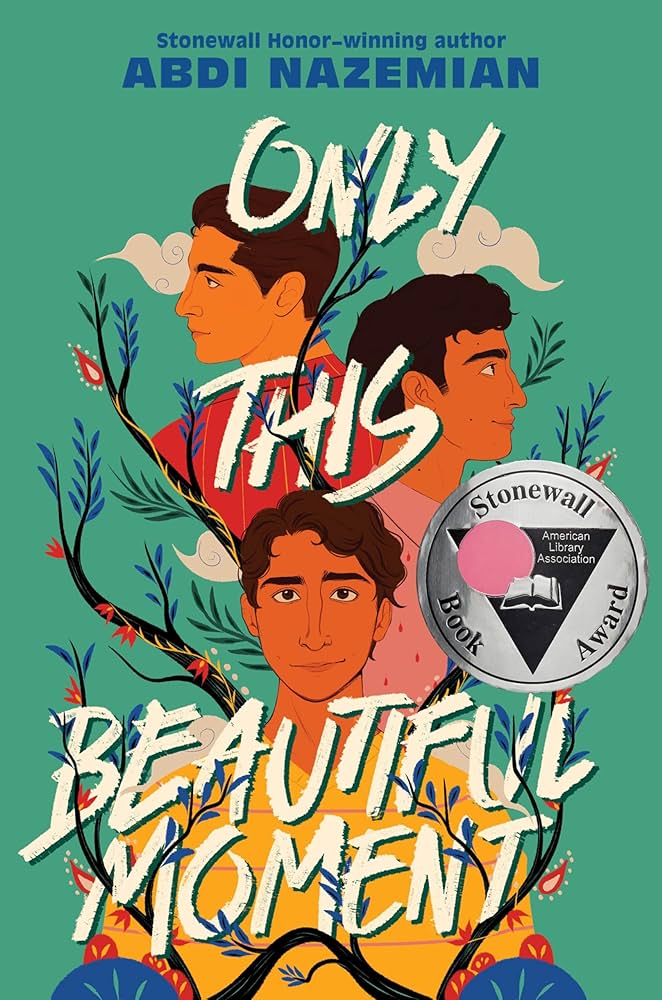
Only This Beautiful Moment – Abdi Nazemian – breaching generational lines to form an understanding of heritage, sexuality, and family.

“Drinking Song” – Haley Heynderickx

Contrary to the song title, Haley Heynderickx is (probably) not responsible for the kind of song that old men will sing in a pub while drunk for generations to come. I mean, that could be a possibility in some alternate universe. I’d like to see that. It’d make for an odd movie scene—nothing about this universe has changed, but instead of old Irish ballads, there’s a pub full of swaying people singing late-2010’s indie rock.

With a title like “Drinking Song,” I fully expected this song to be the prequel to “Oom Sha La La,” a telling of the period where “The milk [was] sour/I’ve barely been to college/And I’ve been doubtful/Of all that I have dreamed of.” Contrary to that, “Drinking Song” is a soft-spoken but resolute declaration of hope, delivered out a summer window while the crickets sing. Any darkness is the shroud of night, and all of the stars seem to bear witness to a constitution of better days to come: “And the edge of the world makes it seem/That everyone gone is still singing the same song/And I can believe in these things/That everyone’s singing along/The good and the bad and the gone.” There’s a kind of childlike optimism to the openness of Heynderickx’s declaration, but one with roots strong enough to hold it; with each repetition of “there’s a light at the end that I know,” that glow, like The Great Gatsby’s green light, pulses with more intensity with each incantation, until it becomes a portal to better times. It’s the opposite of negative overthinking; this song overflows with future vignettes of new cities to explore and new lovers to embrace, all held within the space of the back of your mind. “Drinking Song” is a snow globe containing every good future—all is too small to comprehend in the here and now, but with a little luck, you can hold them in your hands and watch them unfold before you.

…AND A BOOK TO GO WITH IT:

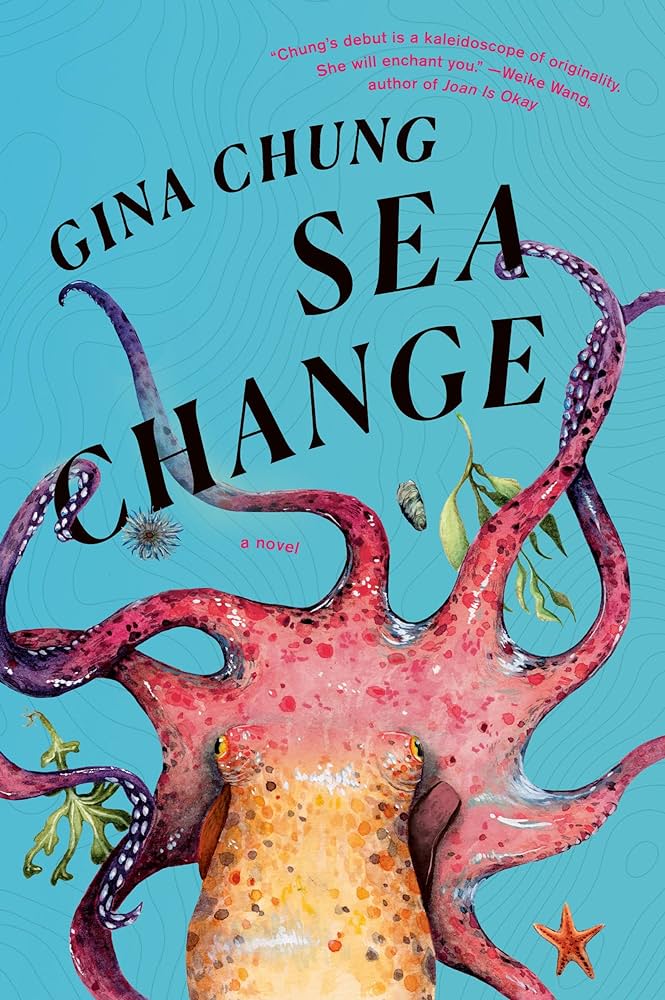
Sea Change – Gina Chung – holding onto hope in a time of lovelessness and isolation.

“Bad Form” – Ganser

I like plenty of bands and artists whose catalogue consists of one or two songs tops (see: Wet Leg, Suki Waterhouse, etc.). What distinguishes said bands, for me, is that they’ve made a career out of making those two songs worth your time—they may only be two songs, but they play them well. Sure, “I Just Threw Out the Love of My Dreams” may be one of Weezer’s one, maybe two songs (and even that’s generous), but it’s such a bright and shining piece of machinery that you can’t help but gaze at said one song and know that, yeah, it may be the same song they’ve been peddling since 1994, but it’s one fantastic song.

The more I listen to Ganser, the more I realize that they fall into that camp. I hate to say that every time, but like I said, it’s not always an insult. Although they do have a good amount of deviation here and there, most of Just Look At That Sky, as much as I enjoyed it, is the same three off-kilter, drawled post-punk songs about being numb, exhausted, and angry, or some combination of the three. They’ve got a brand. Ganser, for me, stands out in that their three songs sound different enough from any given song that you can excuse them for relative lack of variety. None of their chords ever align pleasantly—it’s abrasive, grating, and honestly? Fun. As with “People Watching” (which I reviewed at the beginning of the month), Ganser makes the kind of punk that’s aware of how punk it sounds, and they lean into every inch of theatricality with their bleary-eyed drawls and itchy, buzz-saw guitar riffs, fuzzy and stinging like staring straight at the sun—just as like the climax of “Bad Form.” Ganser is a band that’s not afraid to make music that scratches your skin like un-filed, bitten nails, and if that’s their three songs, then three cheers for making three songs that are bold enough to sound unappealing.

…AND A BOOK TO GO WITH IT:

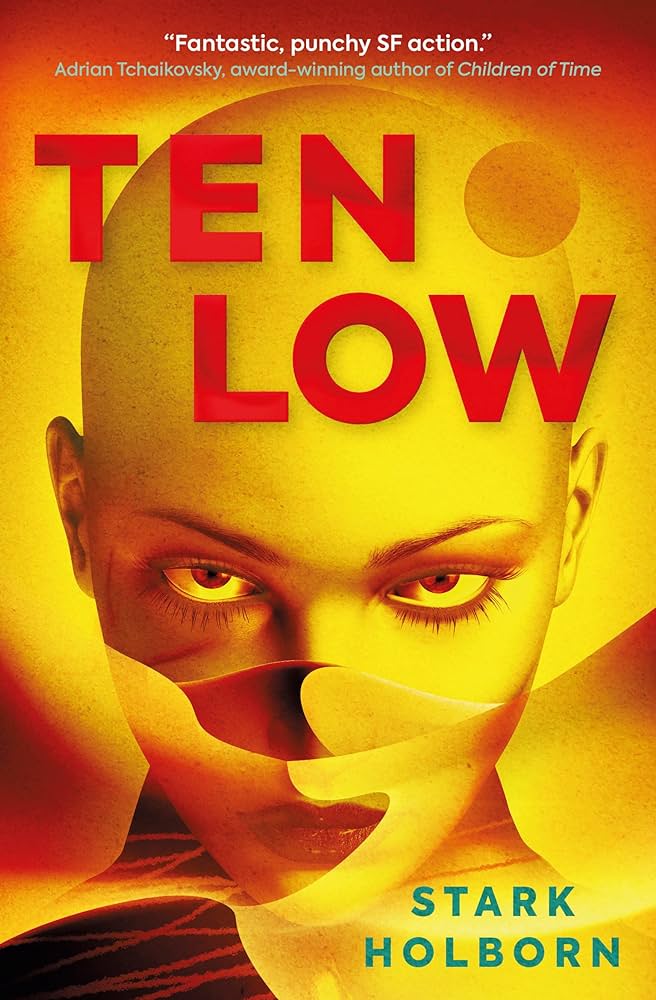
Ten Low (The Facts Sequence, #1) – Stark Holborn – “I’m the other man/I’ll take the medicine/The room spins like a feather/Folding over and over…”

“Transatlanticism” – Death Cab for Cutie

I was first introduced to “Transatlanticism” when I was about 12 or 13. A few months after the first listen (and being irreparably entranced), I had an internship at a local flower shop, where the owner had Sirius XMU playing. This song came on at some point, and I’ll never forget the deeply concerned look she gave me when I told her, in the most 13-year-old way possible, how much I “loooooooooooved” this song. She was entirely justified.

Another thing that music criticism does that I’ve never understood: categorizing Death Cab for Cutie as emo. If I suspend my disbelief enough, I can see the basis being in the whine in Ben Gibbard’s voice, especially when he performs live, and the dramatic emotion is there, but…in what world does Death Cab for Cutie belong in the same breath as My Chemical Romance? Really? I could almost see them being the middle ground between emo and indie, with some of the lingering whine and drama, but the key with selling drama is what has always lost me with most emo music: it actually feels authentic. Never once does Gibbard sound like a suburban teenage boy who’s just discovered heartbreak and black eyeliner in one fell swoop. The whine, although it can fit into some of said teenage boy sensibilities (see: “We Looked Like Giants”), just seems more of a product of Gibbard’s natural range than it does a forced vehicle for airbrushed angst.

In theory, “Transatlanticism” fails my test of withstanding a long song; most of the time, in order for a long song to hold enough water past around the six minute mark, there has to be at least some sort of shift, whether that’s tonal, lyrical, or instrumental; it’s why “Cop Shoot Cop” by Spiritualized really feels like it’s over 17 minutes long, with its largely extended sleepwalk of monotony, whereas Nina Simone’s ten minute epic “Sinnerman” has the fervor and gusto, as well as an act structure similar to classical pieces, is a nail-biting journey that never lets go of your shirt collar. (To be fair to J. Spaceman, my guess is that the tedium is the intended effect, seeing as it’s about how his heroin addiction all but made him into a dead man walking. Knowing him, it’s fully intentional.) However, there’s songs like Blur’s “Tender”—nearly eight minutes long and without much change—that have the pure, undiluted heart to keep its sails billowing. You feel everything—it’s an IV drip straight through to the sparest, most instinctual emotions, heart-wrenching in its delicately-crafted simplicity. “Transatlanticism” takes a trick out of that same book; until the last third, all that accompanies Gibbard’s thinning, tender lament is about four piano chords, played over and over with a purposeful negative space between them. Come to think of it, negative space is exactly why “Transatlanticism” works so well. Transatlanticism as a whole is a concept album about long-distance relationships, and even without the lyrics, crushing as they are, you can sense the abyssal gulf cutting down the middle of this song. At the four-minute mark, after Gibbard has finished with the first repetition of “I need you so much closer,” a full minute passes of a single, instrumental strain: those same four chords, a spare guitar lick, and tiny tendrils of synth that faintly moan and rattle like dying machinery, as if trying to conceal their death rattles without bothering anyone. Transatlancism was aided with Brian Eno’s Oblique Strategies cards, and I wouldn’t be surprised if they drew the same cards that produced Bowie’s “Sense of Doubt”—”emphasize difference” and “try to make everything as similar as possible.”

The difference, in this case, is a shift in lyrical style; It’s all but silent compared to the lyrics in the first half, but that silence conveys the feeling of separation, of having a strand of your soul stretched across an ocean and not being able to see who’s on the other shore, just as heartbreakingly as words do. After Gibbard’s lament (“The rhythm of my footsteps crossing flatlands to your door/Have been silenced forevermore/The distance is quite simply much too far for me to row/It seems farther than ever before”), the exhaustion of sorrow leaves you with no strength to do anything but stare into the canyon wrought by distance, too far to even touch fingertips over. Simplicity is what kills me about this song; after that instrumental break, Gibbard repeats the “I need you so much closer” refrain, only to transform it to “I need you so much closer…so come on.” When all of the poetry’s drained, sometimes the most sparing lyricism destroys me. The ocean has spread its impossible distance before you, and all you can do is stare as far as you can, towards the bottom, with only the most baseline instincts of longing to keep you company. It’s such an artful buildup and approach to portraying such deep yearning—you feel that negative space as a tangible barrier. See what I mean about Death Cab for Cutie making their angst authentic? “Transatlanticism” hits me like a goddamn steam train every time without fail. Ow, dude, who kidnapped me and abandoned me in the onion-cutting factory?

…AND A BOOK TO GO WITH IT:

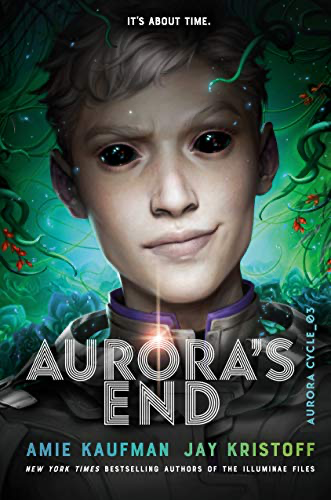
Aurora’s End (The Aurora Cycle, #3) – Amie Kaufman & Jay Kristoff – ow oof ow ouchie ow ow ow somebody hold me

“Country Sad Ballad Man” – Blur

And now, “Song 3.”

Blur’s self-titled album [slides Anthony Fantano glasses up bridge of nose] is an exercise in becoming the very thing you swore to destroy. After years of being right smack in the middle of the spotlight, participating in a manufactured battle of the bands, and pushing their mutual abuse of multiple substances to the edge, the band collectively decided that a change needed to be made. They packed their bags, temporarily relocated to Iceland, and hammered out a new album. The result was Blur, which had a much dingier, edgier, and altogether harder sound, with a lead single that famously parodied grunge, but then…circled around to being a smash success and an enduring stadium classic. That’s another story. (I’ll give you a hint: wooooooooohoo!) Yet, as much as they poked fun at American grunge, in all of its nihilistic, self-deprecating time in the sun, they slipped straight into the lifestyle, shedding their Britpop gloss for aggressive, alternative guitar, stubble, and, to the detriment of the whole band, excessive abuse of alcohol and heroin (see: “Beetlebum”).

Though the drug use is lamentable (to say the least), as all of the band members now agree, it was their mutual exhaustion and anger at being put through the British media meat grinder that allowed for such a hard—and delicious—left turn. On the verge of snapping, the band decided to put Parklife behind them and get grungy. It was bound to happen eventually, what with Graham Coxon’s adoration for the American alternative scene and the guitar sounds they were producing (should’ve listened to him earlier on that one…). Blur is all but absent of a bad track, crashing with the equivalent of a drum set tossed through a window one minute (“Chinese Bombs”) and slipping into acoustic melancholia in the next (“You’re So Great”). But “Country Sad Ballad Man,” for me, is a highlight I find myself sniffing out every six months or so. With one of the drier and more self-explanatory titles, this track feels like food left to rot out in a heatwave, festering and twangy. Every other lyric finds Damon Albarn stretching his voice into a creaky, scratching highs, as though mocking his own state of lying squarely at rock-bottom: “I haven’t felt my legs/Since the summer/And I don’t call my friends/Forgot their numbers.” The strings on Alex James’ upright bass come loose and unsteady, as though a few more takes of this song would’ve seen them snap off and collapse on the floor. Graham Coxon relishes in the alternative aggression that Britpop never fully allowed for, twisting riffs that seem to languish like drooping eyelids, dripping sweat and numbness. But the real freakout, one that must have been canned and compressed for ages, explodes in a vomit of wobbly distortion and screeching falsetto. It’s a vertigo-inducing outro that caves in like the mold-rotted roof of a wooden house, shattering in a hail of splinters and nails. In all of its spring-plucking chaos, there’s really no other lyric that fits it than Albarn’s self-aggrandizing, high-pitched screech of “I’ve done and fucked it!” yelled straight up from the well of rock bottom.

…AND A BOOK TO GO WITH IT:

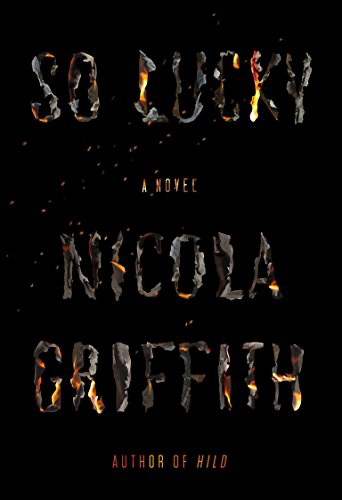
So Lucky – Nicola Griffith – “Yeah, I found nowhere/It got to know me…”

Since this post consists entirely of songs, consider all of them to be today’s song.

That’s it for this week’s Sunday Songs! Have a wonderful rest of your day, and take care of yourselves!
Posted in Sunday Songs

Sunday Songs: 6/2/24

Happy Sunday, bibliophiles!

Quick announcement before we begin: I’ll be going radio silent as far as posts go for the next week because I’ll be on vacation. See you next week!

This week: diversity win! The person who yelled “I WANNA HAVE YOUR BABIES!” at Joe Talbot during the IDLES show a few weeks back was a man! Happy pride, bibliophiles.

Enjoy this week’s songs!

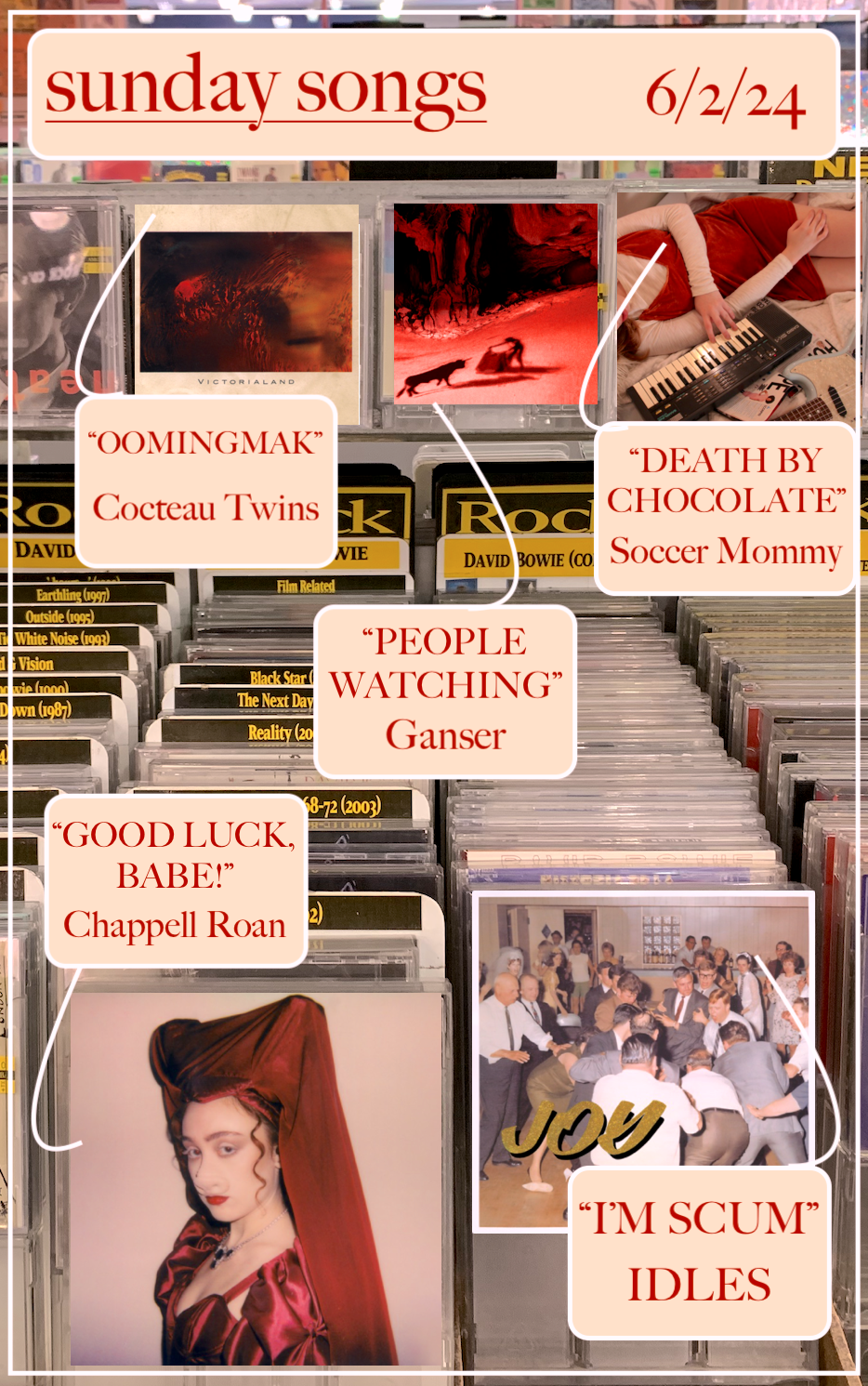
SUNDAY SONGS: 6/2/24

“Good Luck, Babe!” – Chappell Roan

I think I know what my process is with liking Chappell Roan songs now: inevitably, I hear a snippet on social media and think, “oh, that’s okay,” I hear it a few more times, and then I actually like it. Somehow, I wasn’t wowed by “Red Wine Supernova” until I’d listened to snippets of it three times over the course of several months, and then, boom. It’s my 10th most listened-to song of this year. Oops. “Good Luck, Babe!” hasn’t taken that title, but nonetheless, I’ve found another song to dramatically drape myself out of windows to, and to make matters better, it’s so gay. IT’S SO GAY! CAMPY QUEER POP STARS ARE SO BACK! I’m all for leaving the ’80s (mostly) in the dust, but we need some glittery, romantic ridiculousness to shake things up now and then, right? And if the last chorus of “Red Wine Supernova” wasn’t enough to convince you, then this one will convince you that Roan has, in my limited scope, some of the best pipes in pop music right now. And, whatever, the whole “graphic design is my passion” aesthetic was kind of tired for me even before this lyric video, but for a song as red-gowned and dramatic as “Good Luck, Babe!”…we need more. We need some more visual drama, something like The Kick Inside-era Kate Bush, minus the one-time fedora incident. The chances of Roan or any member of her team actually seeing this post are slim to none, but if they are: somebody needs to “Wuthering Heights” this shit up.

I’m choosing to believe that the combination of the glorious Grammys afterparty pig makeup for the single and the title had to be a reference to Babe, right? Some way or another? Maybe I’m reading too much into it. It’s fine. It’s cool, even…that’ll do, pig.

…AND A BOOK TO GO WITH IT:

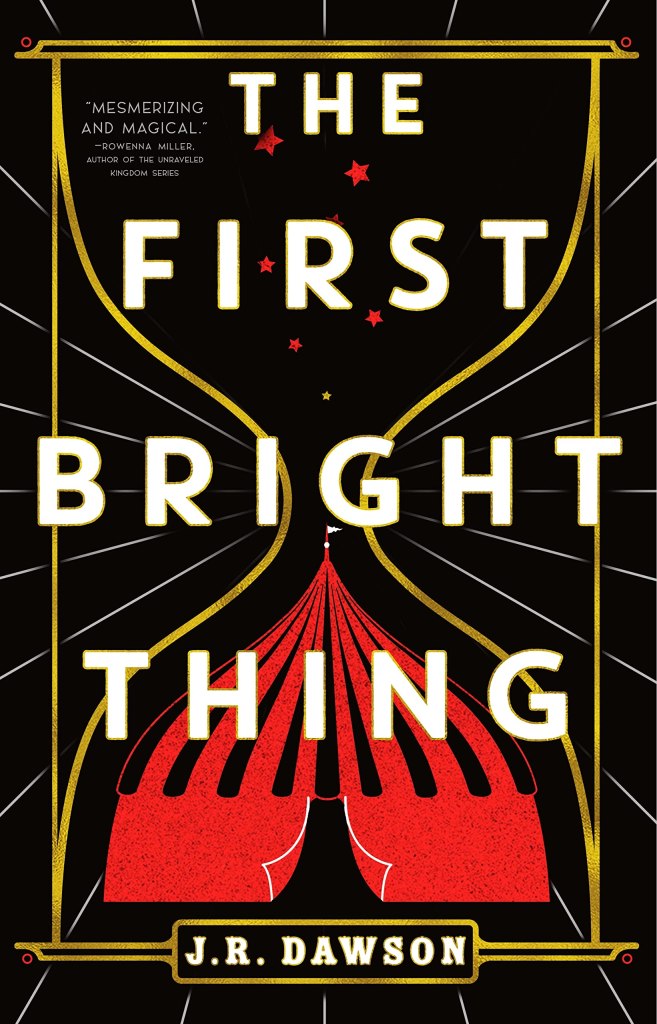
The First Bright Thing – J.R. Dawson – talk about stopping the world just to stop the feeling…

“I’m Scum” – IDLES

Something I learned a few Saturdays ago: I may be somewhat punk in spirit, but I am…not built for punk shows. Once IDLES actually came onstage, the music took me out of the grossness of the crowd, but we accidentally wandered too far into the Bro Zone™️, which was anxiety-inducing, to say the least. Love is the fing, but I’m not really feeling the love when I’m pressed up against excessively sweaty and inebriated people on almost all sides and getting conked on the shoulder with unknown objects. Ladies, gentlemen, and others: sensory issues. Also, alcohol.

But if you take anything away from that, it’s that the music took me out of the grossness. IDLES absolutely tore down the house with joyous screamers old and new alike. Even if Joe Talbot summoning the mosh vortex in the middle of the crowd made me want to go in the opposite direction (now I know how anchovies feel inside of those bait balls), he had such a command of the crowd, and not only that, but nothing but positivity to say: chants for Palestine, odes to love and connection between our fellow man, and just calls to get up on our feet and dance. And dance we did. Even just Talbot and Mark Bowen belting “All I Want For Christmas Is You” in mid-May got the crowd (myself included) going crazy. An IDLES show is, without a doubt, an experience of a lifetime. Not all of it was a good experience, per se, but none of the bad had anything to do with how loving and talented the band were all the way through.

That show made me come back to “I’m Scum,” a performance that had me jumping for joy the entire time. I’ve loved it since I discovered their 2019 Tiny Desk Concert, which is a sight to behold: here we are at said Tiny Desk, surrounded by small toys and trinkets and walled in by office decor, and Joe Talbot’s over here turning beet red and drenched with sweat while Mark Bowen, shirtless and wearing American flag leggings, is climbing onto the desk. It’s glorious. Barely contained chaos. “I’m Scum” is taken from Joy as an Act of Resistance., an album title which, before “Grace” and “love is the fing,” was the preeminent positivity slogan to sum up their aggressively kind ethos. As Talbot explained before the band launched into this song, “I’m Scum” was borne of the words of their critics—taking words like “scum” and “loser” and making them into badges of pride. More broadly, said words came from music critics who derided them, as Talbot recounted in Glastonbury in 2019, as “too fat, too old, too stupid, too ugly. Now we’ve been told we’re too good, too nice. Well this is for the critics: eat shit. This song is a celebration of just how ugly, stupid, old and ugly we are.” Never have I sung along to the lyrics “for a long, long while I’ve known I’m/dirty, rotten, filthy scum!” so loudly. Just like any given song of theirs, it’s undeniably joyous, a parade flag-waver as you skip through the streets, save for the fact that you’re yelling “SCUUUUUUUUUUUUUUUM” so loud that your throat goes raw. “This snowflake’s an avalanche” is one of the most hilarious but unifying rallying cries I can think of. The more I reflect on it, the more I can say that this is one of the IDLES songs that I’ve resonated with the most. I’ve grappled with being weird in a broader sense for most of my life, but late high school and college were when I most owned it—I wasn’t concerned with how people thought of me. Now that the former stage is over, I’ve turned that confidence into getting weirder still, especially with my makeup; a friend told me that I wasn’t afraid to camouflage, and there’s nothing that I could say that sums it up better. God, I LOVE being unpalatable. I love being weird. I love being the kind of person that gets stares from the suited-up business majors across the street. I love looking like I don’t belong on this planet. And that’s when I feel most myself, when I outwardly enhance how weird I am and how weird I’ve felt. I’m lefty, I’m soft. And I LOVE being dirty, rotten, filthy SCUM if I do say so myself. Embrace the scum!

…AND A BOOK TO GO WITH IT:

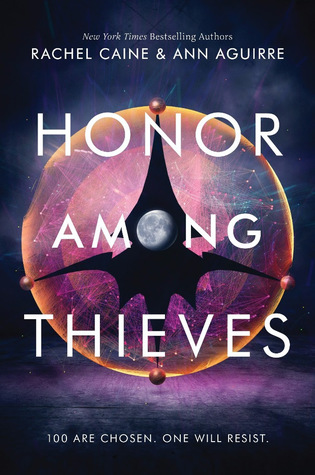
Honor Among Thieves (The Honors, #1) – Rachel Caine and Ann Aguirre – “I’m laughing at the tyrants/I’m sleeping under sirens/Whilst wondering where the time went/I’m scum…”

“Oomingmak” – Cocteau Twins

My introduction to the Cocteau Twins came right before I started making these Sunday Songs graphics, so I suppose that’s the only reason that I’ve never covered them here before. In my mind, there’s no band quite like them in the sense that the moods that they glean from me are rare in any other band. When an anonymous person put the iconic “Cherry-Coloured Funk” on the class playlist in art in my senior year of high school, I felt energized in a way that I hadn’t before—energized, but caught in the spacelike fabric of something beyond the world, like wading through cloth and stars. “Energized” isn’t the word I’d use to describe everything else I’ve heard of their catalogue—I’d lean more towards dreamlike and peaceful. The label “dream pop” is more fitting of them than any other band, save for maybe Beach House, who were no doubt influenced a great deal by them; they didn’t just pioneer the sound: they fully embody it. Every song sounds like a dream—Elizabeth Fraser’s method of lilting, nonsensical lyrics contribute to that feeling in no small part. But it’s more the atmosphere of it; somehow, they manage to replicate the feeling of waking up in the early hours of morning after waking from an unusually vivid dream, but not being able to remember it, save for how vivid it felt in the moment.

“Oomingmak” is a mist of peace that falls over your shoulders like a veil—or snow, more fittingly, a shawl woven from the crystalline fragments of snowflakes that melt the moment they make contact with your skin. There’s a simultaneous warmth and coldness to it, a watery swirl that coalesces around a glowing, amorphous radiance; this contact of warmth and chill creates the dewdrop-laden feel of the song. The effects on Robin Guthrie’s delicate lattice of guitar playing are so thin and misty that I thought they were synths—I’ve heard hardly anyone else that can make the guitar quite this delicate. You can play it delicate, sure, but this is the closest I think a guitar has ever gotten to being transparent, shiny as beads and thinner than a strand of hair. Hearing “Oomingmak” for the first time was like having a draught poured over my head, some kind of ambrosia that trickled into my eyes and mouth and induced a trancelike peace, a sense of calm that no other band I know has been able to replicate. Like dewdrops, you feel all of your earthly tethers dissolve.

And it seems the snowy, misty feel was intentional in every sense; much of Victorialand, named after the region in Antarctica, and its imagery owes to the Arctic and Antarctic regions, in no small part thanks to The Living Planet: A Portrait of the Earth, David Attenborough’s companion novel to the ’80s nature documentary of the same name. DAVID ATTENBOROUGH!! MY GUY!! Having watched The Living Planet as a kid, I love seeing that connection—and man, imagine if the ridiculous ’80s soundtrack made its way into Victorialand in any way…again, “Oomingmak” is the only track I’ve heard from this album, but I’m fully preparing myself for some Living Planet flute action. Many of the titles in particular were handpicked from passages of A Portrait of the Earth relating to the Arctic and Antarctic—I assume “Oomingmak” was one of such titles, as it’s the Inuit word for musk ox, literally translated as “the bearded one.”

…AND A BOOK TO GO WITH IT:

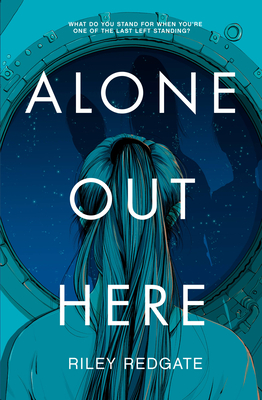
Alone Out Here – Riley Redgate – slower Cocteau Twins songs feel like the ideal soundtrack for being anxious and wandering aimlessly inside of a spaceship.

“People Watching” – Ganser

Apologies to everybody who I told that this band’s name was Gaster. Who knows how I got that into my head in the space between the IDLES opener being announced and the show itself. I guess I was only one letter off?

Either way, Ganser was a fantastic opener for IDLES—they had just the right amount of energy to pump up the crowd (although I suspect that none of the crowd needed any convincing to get pumped up) and retained the punk attitude that IDLES later blew through the roof. I later ended up searching through their catalogue for the songs in their setlist, and just ended up listening to their 2020 album Just Look At That Sky in its entirety. And I’m a fan! Not my newest obsession, or anything, but I’m so glad that IDLES exposed me to them. Although “People Watching” isn’t off of Just Look At That Sky, to me, it’s the best—or most fun, at least—representation of their sound today. Although both bassist Alicia Gaines and keyboardist Nadia Garofalo trade off on vocal duties (it’s usually a 50-50 split for lead, from what I’ve listened to), both of them have their place in the sun on “People Watching,” and both of them deliver disaffected vocals that conjure the title of their previous album, an exasperated, exhausted glance at the clouds as they inch through the blue. Gaines takes the backseat, save for a chant-like bridge, but Garofalo tends more towards a theatrical, gothic drawl as the chorus drones into a monotone lament: “Oh yeah, the world is big/And you could do better/You shake when you’re nervous/But it doesn’t matter.” It feels like what would happen if Raven from Teen Titans sat down to record a song in her bedroom, vocals and all. And yeah, nihilism is boring and silly, but at least Ganser shake that snowglobe around enough to make it gargle and glitter for three and a half minutes.

…AND A BOOK TO GO WITH IT:

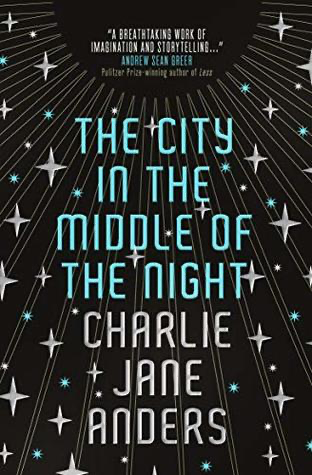
The City in the Middle of the Night – Charlie Jane Anders – “Oh yeah, the world is big/And you could do better/You shake when you’re nervous/But it doesn’t matter…”

“Death by Chocolate” – Soccer Mommy

As Sophie Allison has been teasing new music (!!!!!!!!!!!) and doing a select number of intimate U.S. dates to potentially demo some of it (!!!!!!!!!!!! but nowhere near me :/ ), I’ve been looking back at her old catalogue. “Death By Chocolate” appears on Collection, a re-recorded…collection of songs, many of which were originally self-released on Bandcamp; it originally appeared on the EP songs from my bedroom back in 2015. Like with the early Phoebe Bridgers track “Waiting Room” (which I reviewed last June), it’s a portrait of nascent talent, but still not quite out of the teenage woods just yet. Two years after initially recording “Death By Chocolate” at 18, the squirming larva of the original has been reformed into something with wings that can carry it, ready with star-shine guitar work and synths. Allison’s voice, which, at 20 and breaking free of the apparent shyness of recording demos in dorms, still has a few more hurdles to jump—this recording, even post-bedroom, feels like she’s either been mixed into submission or is just vocally holding back. But when her voice does break through, it’s as sweet and trickling as fudgy ice cream, the remnants dribbling down the corner of your lips as you dig through your sundae to find the stem of a maraschino cherry. But man…the lyrics? Thematically, it feels like the first iteration of “lucy,” with its bad boy love interest (that turns from human to, presumably, some manifestation of Lucifer or what he represents), but where “lucy” has more refinement, this has…[checks notes] “I wanna kill myself/I’m gonna go to hell/And he’s the way I’m gonna do it.” Hooooowhee… subtlety has left the building. Slow down, Juliet, just put the knife down…he can’t be all that. Lordy. Even so, it’s so teenage that it can’t not earn its place—all that angst is a part of growing up, and who am I to rag on a queen for letting it out? Gotta get it out of the system.

…AND A BOOK TO GO WITH IT:

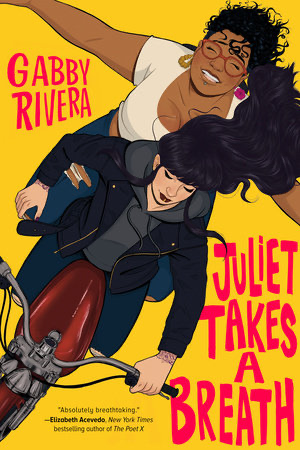
Juliet Takes a Breath – Gabby Rivera – a new town, and an all-consuming first queer love.

Since this post consists entirely of songs, consider all of them to be today’s song.

That’s it for this week’s Sunday Songs! Have a wonderful rest of your day, and take care of yourselves!

Posted in Sunday Songs

Sunday Songs: 6/4/23

Happy Sunday, bibliophiles! I hope this week has treated you well.

And more importantly, happy pride to each and every one of you! I’ll say a bit more about that in my annual pride recommendations post (working on it as we speak), but for now, here’s what I have to say: the past year has been incredibly difficult for the queer community, but it’s important to remember that amidst all of the anti-lgbtq+ legislation, that they can never take away our happiness—queer joy is an act of resistance. We’re still here, so get used to it. And please, buy your pride merch from somewhere other than…y’know, Walmart. Queer small businesses make better stuff, anyways.

On a lighter note, I really wish I’d found this clip earlier…I would’ve used it to come out to so many people, you have no idea…

Enjoy this week’s songs!

SUNDAY SONGS: 6/4/23

“Oom Sha La La” – Haley Heynderickx

There’s no whiplash quite like searching for this song on YouTube, and then seeing that one of the top results is “oom sha la la leafpool.” I kid you not. Glad to see that the Warrior Cats fandom is alive and kickin’ and making AMVs like it’s 2014. I did hear that the main series is still going (I stopped at the 5th series 🥴), and now there’s canonically…[checks notes] cats getting possessed? I’m not even gonna touch that. Call me an uptight old boomer, but everything was just fine back in the good old days, when it was just cats committing heinous war crimes against each other. Moving on…

I Need to Start a Garden has earned its place on my Sisyphean album bucket list ever since my brother turned me onto “The Bug Collector” by way of his girlfriend. I loved the latter, melancholy and full of creepy crawlies as it is, but this one immediately snagged me like a fish getting unceremoniously reeled up from the depths of a lake. There’s a comforting steadiness to this song; anchored by Heynderickx’s warm voice, it gently cups you into its hands like you’re a moth stuck in the house. Neat, glossy guitars buoy along a plethora of razor-sharp, wonderfully oddball lyrics—I doubt the words “arbitrary” and “sonogram” will ever be paired together again, unless Bon Iver or Ezra Koenig come along and steal it. (Obvious Bicycle 2?) But beyond that, “Oom Sha La La” is one of those songs that feels universally relatable. Judging from both my brother’s reaction and the YouTube comments, there’s a nugget of truth for everybody in this one—everybody’s had a moment in their life when they’ve come to the impetus that they need to get off of their butts, shake off the dust of the past, and get their lives together. For me, it reminds me of when I first started college—being so afraid to do anything and everything, but that saving voice telling me that “If you don’t go outside/well, nothing’s gonna happen.” And that impetus comes in the speeding catharsis train of Heynderickx’s cry of “I NEED TO START A GARDEN!”, which was apparently accompanied at one of her concerts with potting soil raining from the ceiling like confetti. There’s no use in waiting for the dirt to rain on you, in the end—you have the scream inside you, telling you that nobody but you can steer your life for the better. You have the power.

“Paprika” – Japanese Breakfast

I’m new-ish to Japanese Breakfast, but now that I’ve seen a video from a friend of mine who saw her a few weeks back, the best part of this song, by far, is that Michelle Zauner drags a whole gong onstage for this song. I really don’t think I need to justify that.

Every time I listen to “Paprika,” I get this voice in my head that slaps me upside the head, chiding me for not getting into more Japanese Breakfast right this second. Trust me, the only thing keeping me from it is my self-imposed need to get through a) some albums that are too hard to draw on a whiteboard (Here Come the Warm Jets) and b) get through all of the Blur and Peter Gabriel I have left to listen to before both of their new albums. This song, though, is absolutely enchanting—there’s no better word for it. Like so many of her other songs, it coats you in an intoxicating cloud of glitter, backed by faint steel drums and a bright horn ensemble. It really does feel like you’re “at the center of magic,” as Zauner chimes in at the chorus. It’s a shame that the famous gong is understated, but the sound mixing blends it perfectly with the rest of the instrumentals, paring it down to a clean crispness that seems to disappear into glittering sparks. I would’ve thought it was a cymbal, if it weren’t for said friend’s video footage. But that all works to uplift Zauner’s voice, bright and perfectly suited to the swirl of light surrounding her. Maybe she is the swirl of light.

“Breakadawn” – De La Soul

There’s something undeniably summery about this song. You can say that with certainty for the entirety of Three Feet High and Rising, with its carefree spirit and day-glo-colored album cover, but there’s a different kind of carefree slickness of “Breakadawn.” Smoothly collaged with samples from everybody from Michael Jackson (the backing track) to Smokey Robinson (the famous “breakadawn”), this song is proof of how seamlessly you can weave samples into a song—they all sound so natural together that they might as well have been borne together from the start. And what better soundtrack for watching Plug 1, Plug 2, Plug 3, and their many clones (?) walking along the beach and making camera moves that feel like proto-selfies? There’s no denying the shift in tone post-Three Feet High and Rising, but every song I’ve heard from Buhloone Mindstate is convincing me that this ethos never really left—in the end, this song is still filled with vibrant, summer colors that are impossible to deny. What better song to stick your head out a car window on a warm day to?

“Allison” – Soccer Mommy

We’ve got an Allison trifecta on this post, I guess? A song called “Allison,” made by my wife Sophie Allison, and an Al(l)ison Goldfrapp down below? Are we summoning Allisons here? (And can I summon the second one?)

Collection is Soccer Mommy’s first mini-album before her major label releases, and this was one of the few new songs amidst the other redone songs from when she self-released music on Bandcamp. Knowing this, it’s clear to see the sonic bridge between these periods of her career—the maturity of later albums like color theory comes through—this one reminds me of “night swimming”—but the young angst, painted with her tender, gentle touch, feels timeless. Allison’s guitar work has her signature, bedroom-pop touch of reverb and soul, and every bit of the song rings out like birdsong heard through the wind. It’s interesting that she likely named the song after herself—with that in mind, the song transforms from somebody else’s story to a mantra to her past self, a reminder of missed chances: “Allison, put down your sword/Give up what you’re fighting for.” There’s another layer of intimacy that manifests knowing that Allison crafted a lot of these earlier songs from pieces of her own diary entries—does it get more heart-laid-bare than that? It’s proof that from the beginning, Allison had no interest in being disingenuous—every song she writes is her, and nothing but—no airs put on, no glamorizing her life. I guess that almost comes with her bedroom pop, homemade roots, but I doubt that every single one of those musicians stay as true to themselves as she does.

“Monster Love” (Goldfrapp vs. Spiritualized) – Goldfrapp & Spiritualized

This is the only song that I’ve heard Spiritualized remix/reimagine, but it feels like he is to “Monster Love” what Denis Villeneuve was to Arrival: taking something that’s already beautiful, and artfully exceeding all of the qualities that made it so.

Goldfrapp and Spiritualized is a pairing that I never would’ve imagined, and yet, J. Spaceman has deconstructed her Seventh Tree album closer, already a beautifully introspective song, into…well, just pure J. Spaceman. All of the lyrics from the original have been stripped, save for this line: “Everything comes around/Bringing us back again/Here is where we start/And where we end.” Just from that, it already sounds like the words to a Spiritualized song, but it’s so fascinating to see the J. Spaceman Cosmic Touch™️ applied elsewhere. Alison Goldfrapp’s voice is cloaked in reverb, and the synths rise and fall like waves. Accompanying them is a series of chimes, harmonica, tambourine, which, if any other person was reimagining this song, would sound exceedingly out of place, but again—the J. Spaceman Cosmic Touch™️. His voice feels perfectly natural for the landscape he and Goldfrapp have created, his staticky harmonies melding smoothly into the music and drifting away just as quickly. It’s not surprising that Spiritualized would have such a Midas’ Touch on anything he lays a finger on, really.

Since this post consists entirely of songs, consider all of them to be today’s song.

That’s it for this week’s Sunday Songs! Have a wonderful rest of your day, and take care of yourselves!
Posted in Book Review Tuesday, Books

Book Review Tuesday (1/7/20)–Supernova (Renegades, #3)


Book review tuesday header.jpeg

Hey there, fellow bibliophiles!

I’ve mentioned this one several times before, as it was one of my most anticipated 2019 releases. And man, am I glad to say that this book was not only my first read of 2020, but an incredible conclusion to an unforgettable, action-packed series.

WARNING: This post may contain some spoilers for the previous two Renegades books. For my reviews/Goodreads reviews for books 1 and 2, click here:

Renegades (Renegades, #1)

Archenemies (Renegades, #2)


Enjoy this week’s review!


81+lEQiKzxL.jpg

Supernova (Renegades, #3)

Nova and Adrian. Both battling their forbidden romance and their inner demons. Both with double lives, days from being exposed and shattering each other’s relationships.

As an old enemy resurfaces in Gatlon City, the two Prodigies must reconcile their pasts and save their beloved city from the brink–even if it means exposing themselves and those who they love. And the further Nova and Adrian entrench themselves in their webs of lies, the more they realize…is the line between heroes and villains as clear as it is made out to be?


…


Marissa Meyer truly outdid herself in this final installment to the Renegades. With such a wide cast of characters, I’m still astounded by the way that they were all intertwined so seamlessly, without muddying or confusing the story. (Though, I suppose the very high body count thinned the cast out a bit, but mostly for character development. Mostly.) The theme of the moral gray area between good and evil was stronger than ever, and Meyer’s clever writing and world building truly shined in this novel. Clocking in at 548 pages, I was worried for the last 100 or so that the rest of the plot would be filler, but boy, we almost had not one, but two incredibly climactic battles that served the plot well and furthered the story in a satisfying way.

My only qualm, is, I’ll admit, pretty nit-picky. One thing that bothered me a little bit was the dialogue; some of the characters (Nova, etc.) seemed a bit…too eloquent in the way that they spoke. I get it, she and some of the others are intelligent characters, but their lines read like they were reading from a ghostwritten speech. It made for a bit of discordance in some of the more climactic scenes, but I’m glad to say that it didn’t take away too much of my enjoyment.

Overall, a simultaneously shocking and satisfying conclusion to a YA superhero series that may well become the benchmark for the sub-genre to come.

Solid 4.5 stars! ⭐️⭐️⭐️⭐️.5


Supernova is the end of the Renegades trilogy, but I’m almost certain that Marissa Meyer has another whopper up her sleeve, though nothing’s been confirmed yet. I just have a gut feeling. 😉

Image result for gut feeling gif"


Today’s song:

[heart eyes] SOOOOOPPPHHHHIIIIIIIEEEEE


That just about wraps up this week’s Book Review Tuesday! Stay tuned for more content later in the week! Have a great rest of your day, and take care of yourselves!
thank you for reading.jpg