
Happy Sunday, bibliophiles! I hope this week has treated you well.
This week: women getting weird with it is a common theme here, but the vibe you gravitate towards is your choice today. Plus, Tall Dwarfs get lost in the woods.
Enjoy this week’s songs!
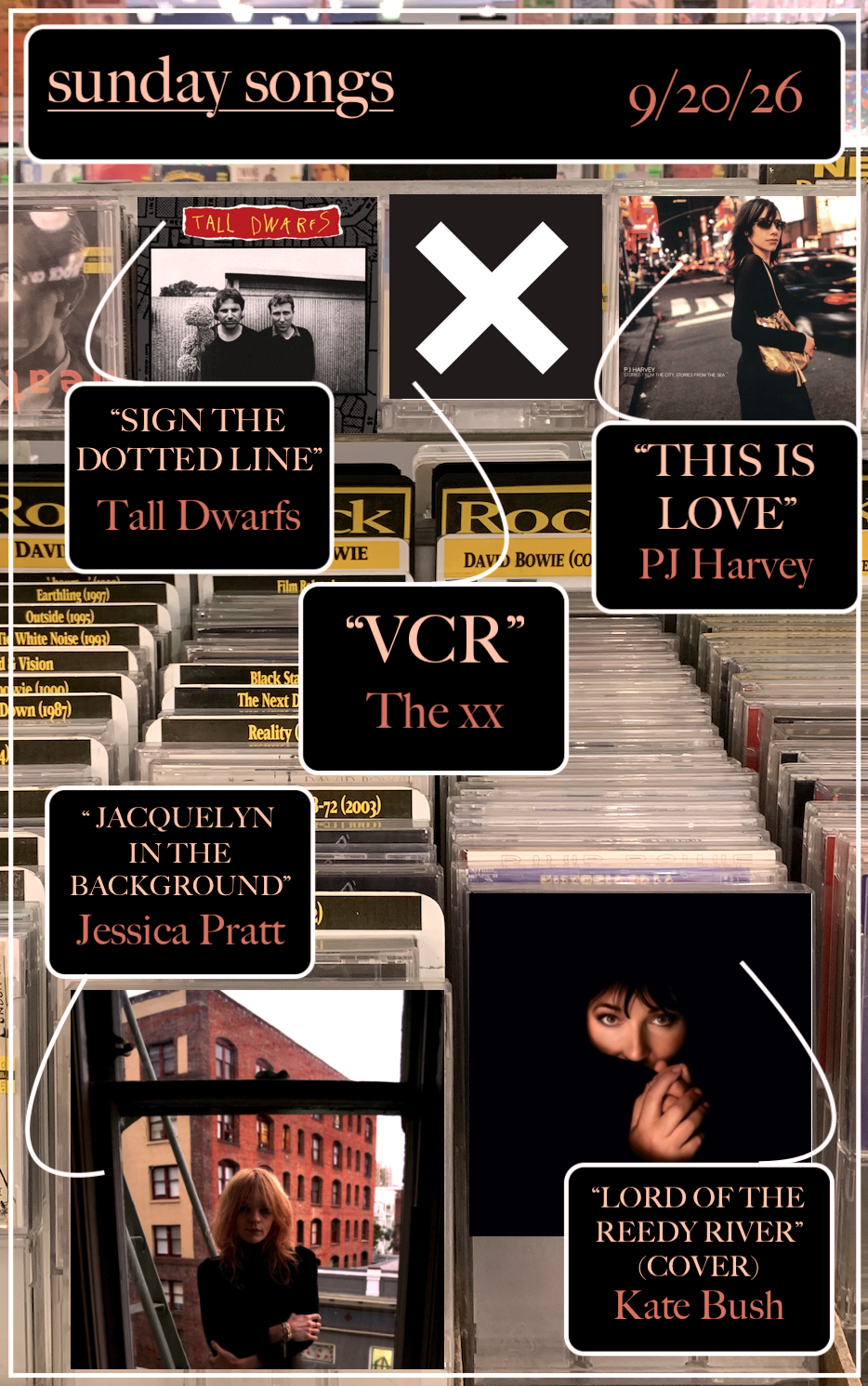
SUNDAY SONGS: 9/20/26
“Jacquelyn in the Background” – Jessica Pratt
Talking to Radio 6 Music for BBC, Clari Freeman-Taylor of mary in the junkyard described Jessica Pratt’s album On Your Own Love Again as “the kind of music that frogs would make on lily pads” and Pratt herself as “an alien.” And just like that, I was sold. Both of Freeman-Taylor’s descriptions are right on the money. There’s a charming, familiar yet alien quality to Pratt’s music. The first comparison that jumped out at me was early Cate Le Bon, before she’d gone full-throttle into sensory synth maximalism; St. Vincent circa Marry Me comes to mind as well. Their joint wavelengths of quirkiness manifest in similar ways, with folk skewed enough out of the ordinary to sound like something timeless but new.
I’ll always love a woman vocalist with an unabashedly unconventional voice. Pratt’s voice is nasally at the best of times, and that’s part of what makes Freeman-Taylor’s frog comparison genius: she totally sounds like she could be an extra on Over the Garden Wall, or something. Against the delicate pluckings of an acoustic guitar, “Jacquelyn in the Background” weaves a story that seems innocuous—just a folksy tale of mundane friendship—with flickers of uncertainty that belie some sort of imaginary friend narrative. Jacquelyn is in the background, but the image of her shifts colors, morphing as Pratt catches glimpses of her between shadows in her room. My favorite part of the song comes when the music catches up to the meaning: at 2:41, the pitch suddenly shifts and wobbles all over the place, dopplering in and out of the realm of the ordinary before tripping head over heels back into normalcy. Twitches of pitch-shifting fleck the rest of “Jacquelyn in the Background” until it ends. I was on board from the beginning, but that flourish of genius, connecting the narrative to the music itself, is what sold me on Jessica Pratt. If my never-ending album bucket list is anything to go by, it’ll be a long time coming, but something tells me that this isn’t the last time I’ll talk about her on here.
…AND A BOOK TO GO WITH IT:
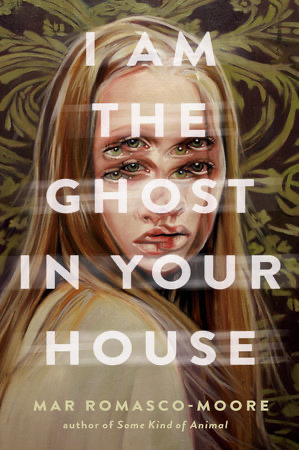
I Am the Ghost in Your House – Mar Romasco-Moore – “Ode to Jacquelyn, I see you coming through/See the changes in your smile/In the background, you’re coming in colors now/Leave your bad news for a while…”
“Lord of the Reedy River” (Donovan cover) – Kate Bush
I’m biased, since I listened to the Kate Bush version first and I really don’t know much of anything about Donovan. (To be fair, not all of her covers hit the mark—see her weirdly pseudo-reggae cover of Elton John’s “Rocket Man.” If that concept makes you go huh?, you’re not alone. To be fair, it’s not bad, it’s just a combination that doesn’t fully work.) But this cover elevates Donovan’s original song so much. Donovan’s version, a retelling of the Greek myth of Leda and the Swan, is eerie to begin with. It has that uneasiness that you find with a lot of ’60s folk songs, this kind of whispery discomfort that hints at unsaid things beneath the surface. But for a song about a myth about a mortal woman getting raped by Zeus in the form of a swan, the lyrics don’t suggest anything all that distressing, other than the waver in Donovan’s voice.
Kate Bush had to be keen on that undertone. Swapping Donovan’s acoustic guitar for flutes and a ghostly choir, her interpretation of “Lord of the Reedy River,” without changing the lyrics, makes it clear how inherently chilling the story is. There’s a quivering anxiety everything, shadows concealing feathers and uncertainty afoot. The male choir that Bush often used in her early years (to mixed results) hums discordantly, groaning and murmuring as though they’re spirits watching from the underworld itself. The only change is that Bush switches Donovan’s “she” to the more personal “I,” and that might be the most crucial change of all; closing the distance between Leda and the listener makes the mounting fear—and the implications of the myth itself—much more immediate.
…AND A BOOK TO GO WITH IT:
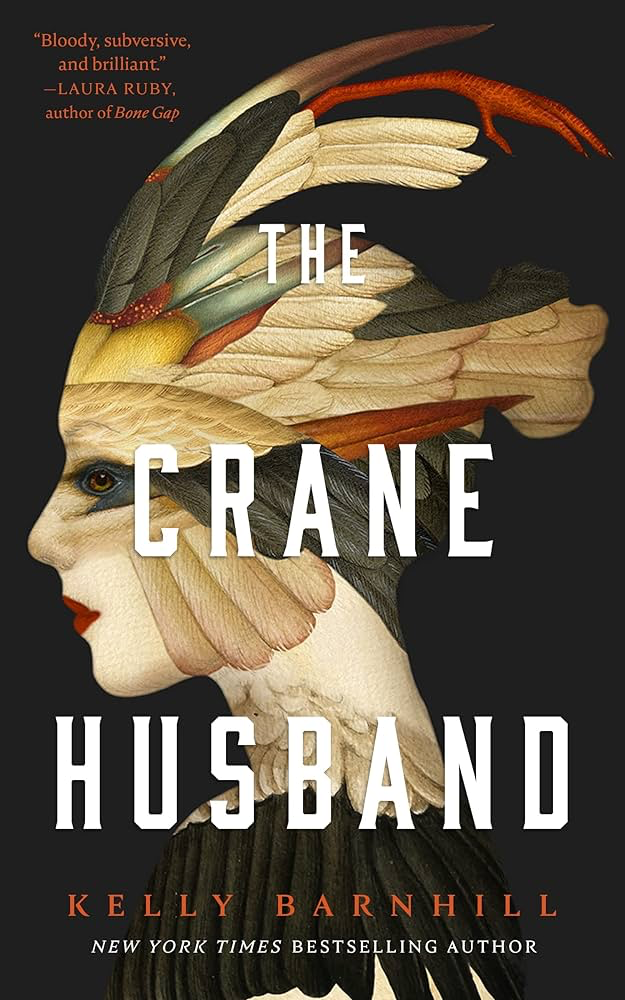
The Crane Husband – Kelly Barnhill – even with all of the Greek myth retellings I’ve read, I’ve never come across one of Leda and the Swan; and listen, fully admitting to double-dipping with this one, but it’s the first book that came to mind with eerie birds and uneven power dynamics (to put it lightly).
“Sign the Dotted Line” – Tall Dwarfs
“Sign the Dotted Line” has a strangely childlike quality to me, but it’s a very specific brand of childlike. Other than the grim territory that some of the lyrics verge into, it feels like it should be soundtracking the quest of a band of feral children with bindles wielding big sticks as swords with dirt smeared on their knees, like something out of Calvin and Hobbes. (I’m imagining at least one of them is wearing a colander as a helmet.) The looping background percussion—which reviewer Roger Shepherd derogatorily likened to a “burping mud pool” (ouch)—adds to that feeling; if there were any more instrumentation other than guitars and said loop, it ought to be a washboard or a shaker made out of an rusty can filled with gravel. The jangly rhythm has the measured march of gallivanting through the woods with some glorious purpose, which is where the enduring charm of it comes to me: “Let’s descend through fog and rain/And see if we can find the same way out/Of this whole mess/It’s not as if we’d lose our lives/Or be impaled by carving knives just yet.” Knox’s lyricism is undeniably pretty sarcastic, but it has the kind of glee that comes along with losing your way and embracing it. Of course, that’s my interpretation—Shepherd, writing for Flying Nun (the Tall Dwarfs’s label), posited that “[it] could equally be about a musician signing up to a record company” or, based on this illustration by Knox in Weeville‘s liner notes, “a commentary on the willingness of people to surrender their lives to religion.”
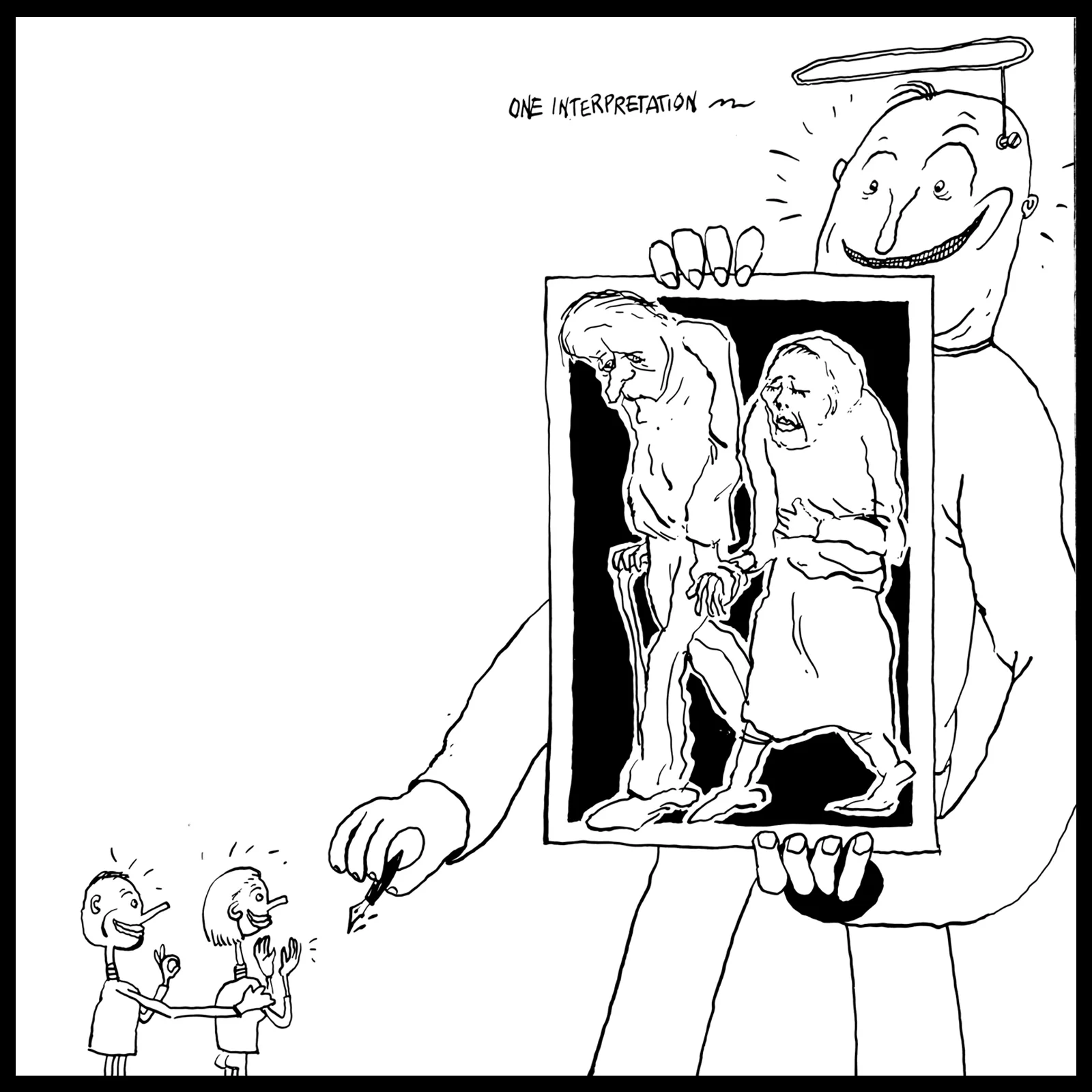
The screwed-on halo makes the whole drawing for me. (As do the dubious three arms.) Knox draws exactly how he writes songs—I love it when artists have that touch that’s so distinctly them that it translates across mediums. Either way, I’d take “Sign the Dotted Line” to be about willingness, earned or unearned—the “sign the dotted line” is undeniably sarcastic, but what awaits our heroes on the other side? That’s for you to decide.
…AND A BOOK TO GO WITH IT:
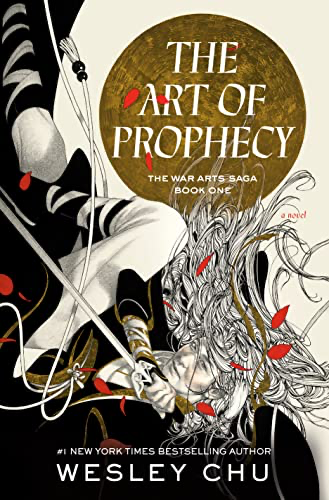
The Art of Prophecy – Wesley Chu – “Let’s descend through fog and rain/And see if we can find the same way out/Of this whole mess…”
“VCR” is inherently comforting. In the simplicity that The xx crafted out of some loops, guitars, and bass, they created a kind of nest where life is easy and romantic. Like the couple tearing off pieces of an abandoned building in the music video, it’s a song that’s for making you (and somebody else) feel like you’re the only people in the world. It’s a late-night blanket fort of a song, relishing in the quiet, cozy moments shared between two people: “And we, we live half in the day time/And we, we live half at night/Watch things on VCRs/With me and talk about big love/I think we’re superstars/You say you think we are the best thing/But you, you just know.” Falling asleep to this song on my beat-up, 13-year-old iPod feels like the best way to listen to “VCR”—it’s a song that nestles in those warm, half-asleep moments between dreaming and waking.
…AND A BOOK TO GO WITH IT:
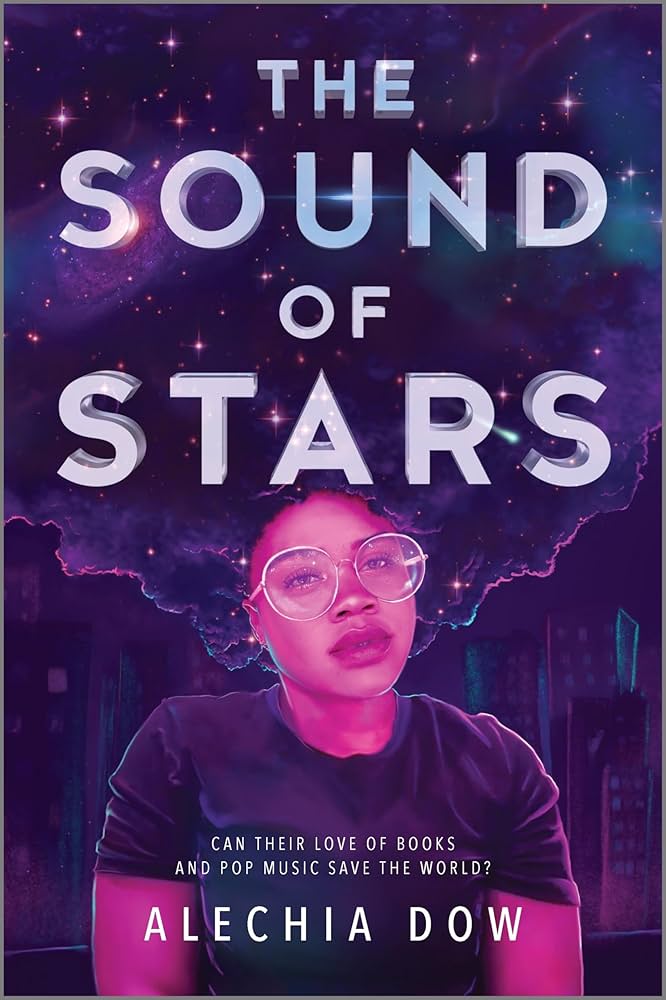
The Sound of Stars – Alechia Dow – “Watch things on VCRs, with me and talk about big love/I think we’re superstars, you say you think we are the best thing/But you, you just know, you just do…”
“This Is Love” rocks. Sometimes you don’t need so many paragraphs to describe how potent a song is, and this track is one of them. It’s just pure rock n’ roll, from the raw sensuality of the lyrics (very much giving meaning to the original meaning of rock n’ roll as a sexual slang term in the early 20th century) to the confidence she oozes with every shred of the guitar. Sure, I think women will never fully be free of the scrutiny that men don’t get when writing unabashedly sexy material, but PJ Harvey at least makes it feel like we’ve gotten somewhere, no matter what conservative panics may rise and fall. “This Is Love” is horny as fuck, and nothing but. And it rocks. The music video enhances that confident, sensual energy. It’s a simple setup, but every deliberate choice—PJ Harvey’s Dolly Parton-looking suit, that red lipstick, the bedazzled heels, the classic black and white tele she plays, the black and white background—exudes the confidence of somebody who already knew full well that she was an icon. It’s so gloriously in-your-face. Some songs scream “rock star” more than others—PJ Harvey, in this moment, was as emblematic of the term as you could possibly get.
…AND A BOOK TO GO WITH IT:
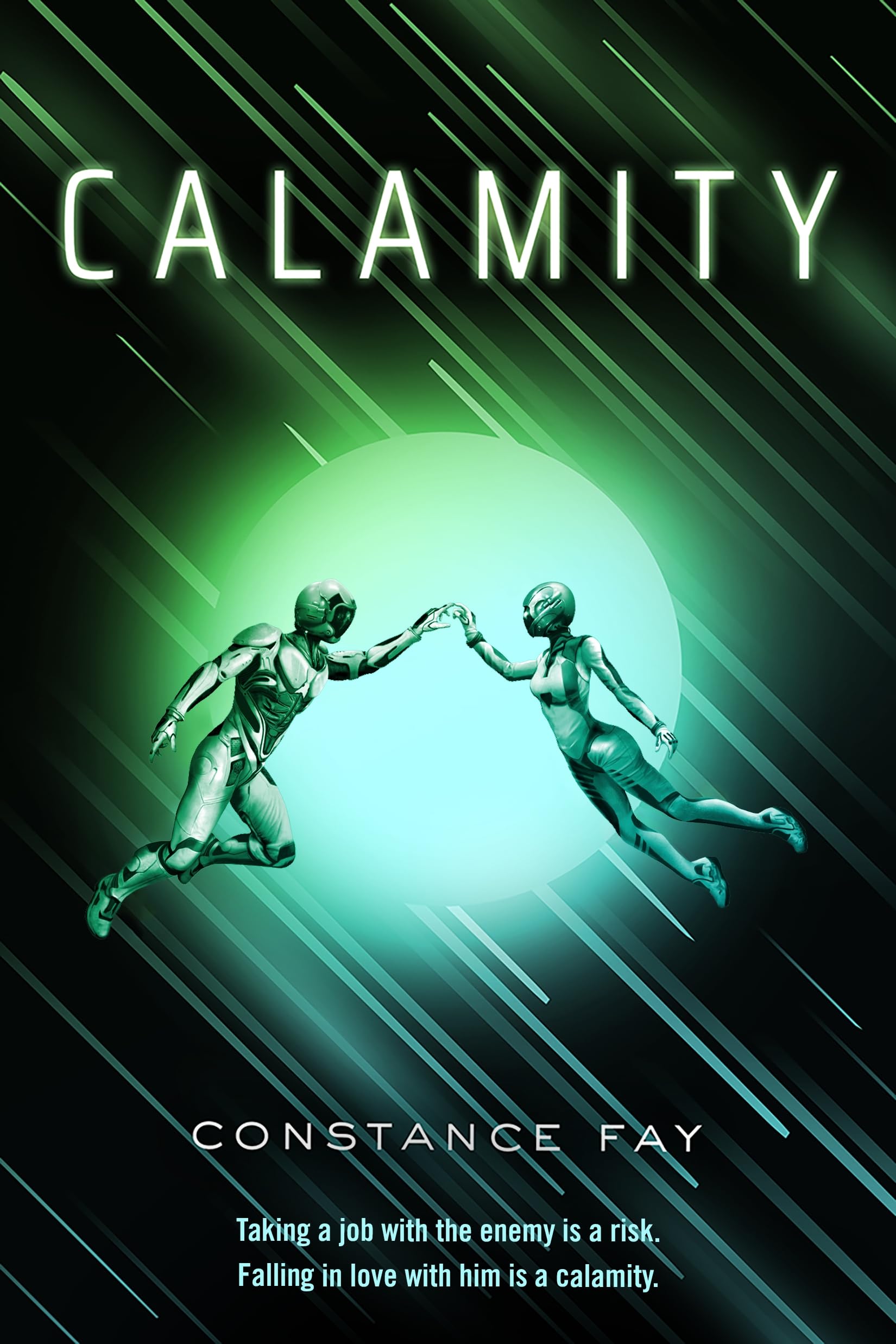
Calamity – Constance Fay – “I can’t believe life’s so complex/When I just want to sit here and watch you undress…”
Since this post consists entirely of songs, consider all of them to be today’s song.
That’s it for this week’s Sunday Songs! Have a wonderful rest of your day, and take care of yourselves!