Happy Sunday, bibliophiles! I hope this week has treated you well.
This week: at this rate, I could probably condense material from several previous posts to just have a whole album review of Pompeii. Plus, Bill Callahan gets existential, Lisa Germano gets sarcastic, and The Ladybug Transistor gets…very Elephant 6.
Enjoy this week’s songs!
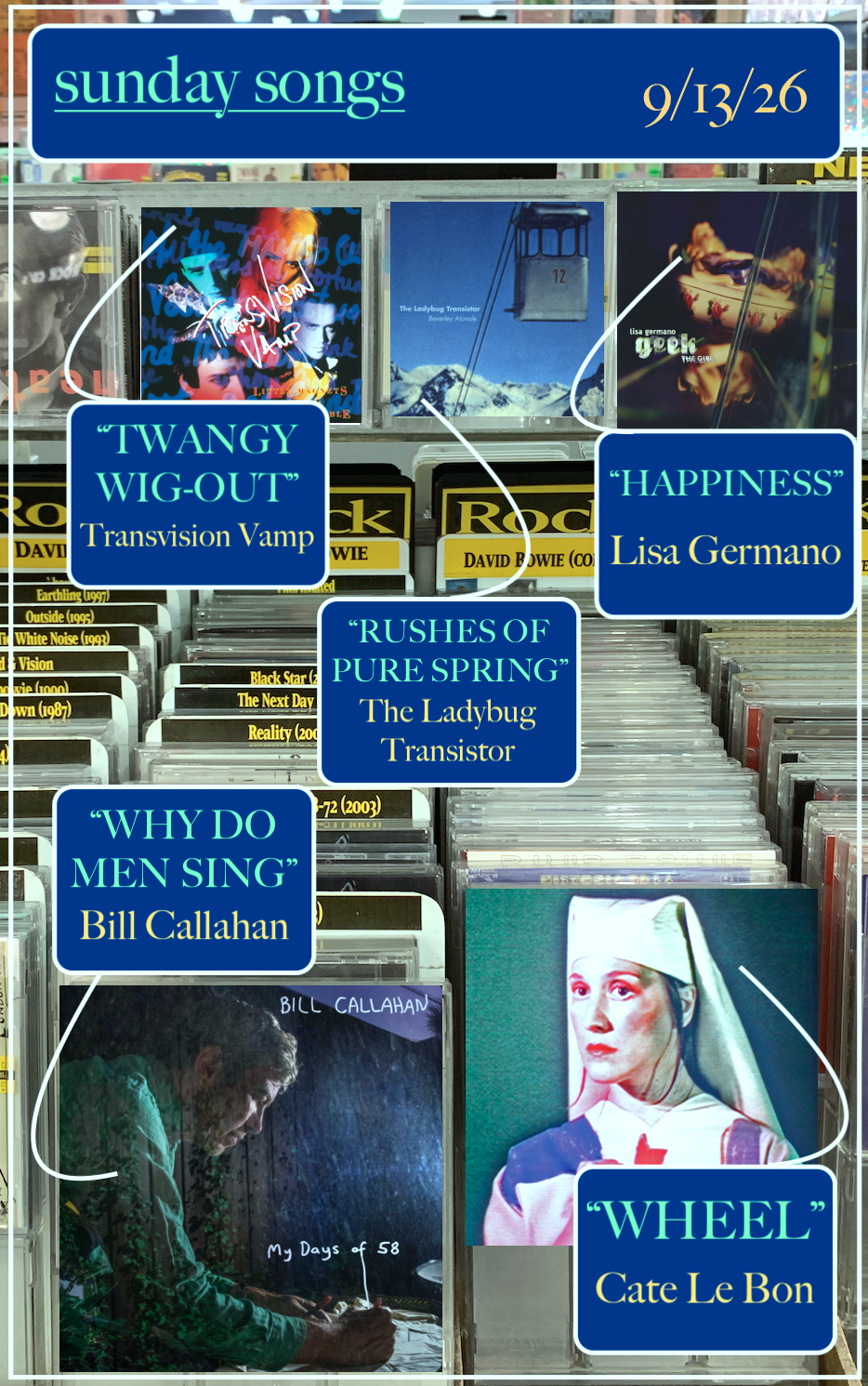
SUNDAY SONGS: 9/13/26
“Why Do Men Sing” – Bill Callahan
Last week, I was concerned about Bill Callahan going through it back during the era of Red Apple Falls. That sense of isolation thankfully seems to be behind him, but these days, it seems like he’s having a different kind of existential crisis. His newest album, My Days of 58, came out in February of this year, and it seems he had a mission to pick apart all of the questions that seem to emerge in the midst of a midlife crisis. “Why Do Men Sing,” the album’s opener, gets right to the meat of it: why is he still attached to this craft in the first place? I love the slowly-building meander of it, the acoustic strummings that are gradually strung with horns, harmonies, and electric guitars—it’s a song that languishes in all seven of its minutes, giving a weight to its stream-of-consciousness stylings. Callahan doesn’t necessarily answer his central question—it’s repeated over and over in the chorus, but he leaves the answer in the realm of ambiguity. But if there’s ever a sign that you’re artistically on the right track, it’s the visitation from Lou Reed beyond the veil that Callahan describes. (He even adopts a bit of Reed’s New York affect in several places in the song, which is a lot of fun.) His advice? “It’s cool, baby. Just got to let it ride.” First off, that sounds exactly like something he’d say, but I think that’s where the not-answer lies. There’s no one, concrete answer to the question Callahan poses. Creativity’s meaning is unique to you, but more importantly, the many meanings come from the winding journey you’re on. Let it ride, baby.
…AND A BOOK TO GO WITH IT:
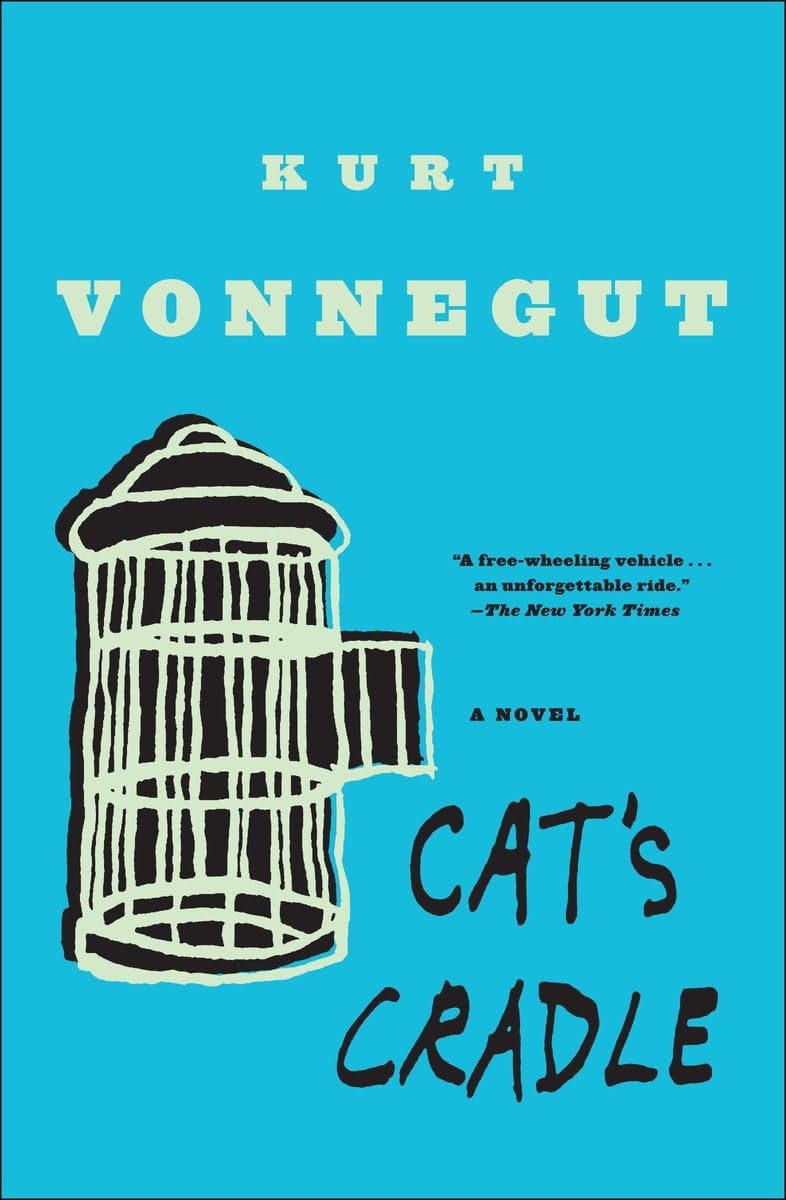
Cat’s Cradle – Kurt Vonnegut – the existential absurdity of this track feels very Vonnegut, in spirit if nothing else.
Shit, I’ve probably talked about at least half of Pompeii at this point. I’ve run the whole gamut of emotions about it; at first, it was more just “this is a great album, but the second half lags a bit” to “wait, that second half really doesn’t lag” to now, where I’m certain that it’s at least a top 10 album for me. The more I dissect everything about it—the origins, the lyrics, the aesthetic, the Cate Le Bon of it all—the more I adore it as an exercise in processing loneliness and isolation.
From the start, I loved “Wheel” as a closing track. Like its namesake, the blasts of distorted saxophone feel like the melody is eating itself, being born, dying, and being reborn in the space of a few beats. The synthy sway of it reminds me of St. Vincent at her weirdest. Its echoing lament made the track feel like it was ushering the end of the narrative into the fog, as ephemeral as the glow of a lighthouse. But it took me years to get why this album—and this song—got me. I think it was because I found it during a time when I was mired in some woefully self-imposed self-isolation, and something about that sensation planted a beacon in me, one that slowly but surely helped clear the fog. I loved the music, then I loved the aesthetic charm, and then wham: here comes “I do not think that you love yourself/I’d take you back to school/And teach you right/How to want a life/But it takes morе time than you’d tender.” FUCK.
Le Bon told Apple Music that this track was “more direct than the rest of the record. I was struggling to call people over the pandemic. What do you say?…I missed him, but couldn’t pick up the phone.” The circular feel of the melody now gives the image of somebody stumbling time after time over the same, self-imposed hurdle, like feeling your mouth clamming up before you can say what you desperately need to say. And it lodged itself in me deeply—even outside of said self-isolation, I relate painfully to that feeling of knowing that you want to connect more deeply with people, but agonizing so much over what to say, what to do, that it comes too late. Somehow, it feels more digital—especially given the pandemic context—it’s a feeling I experience way more when connecting with people over texts. I feel the urge spill over, desperate to say everything that you want to say, but then that mental barrier clogs your repository of words, anxiety freezing your hands. That previous lyric I referenced (beginning with “I do not think that you love yourself”) perfectly encapsulates that feeling of having an armful of things to say and do, but feeling inadequate when the time comes to condense them into something comprehensible, even if it’s just “hey man, do you want to hang out on Thursday?” Back to “I do not think that you love yourself”—I feel like it’s both Le Bon addressing these friends, but also herself, in a way: seeing yourself suspended in your current state, but frozen in the moment, you’re just observing yourself pacing in circles.
In this light, the outro of “no prisoner, no peace” feels like a call to arms. I’m still chewing on it. The prisoner is, to my understanding, herself, locked in these patterns: from there, “no peace” is the resulting state from being the prisoner of your own patterns. Le Bon repeats it like a storm warning, letting it crash against the waves: you’ll have no peace while you’re still a prisoner of these unsaid thoughts. And to end Pompeii, a study of being stir-crazy and vulnerably self-reflective in Le Bon’s childhood home during the pandemic, feels like the solution to claw through the dirt and see the light of day again. No prisoner, no peace indeed.
…AND A BOOK TO GO WITH IT:
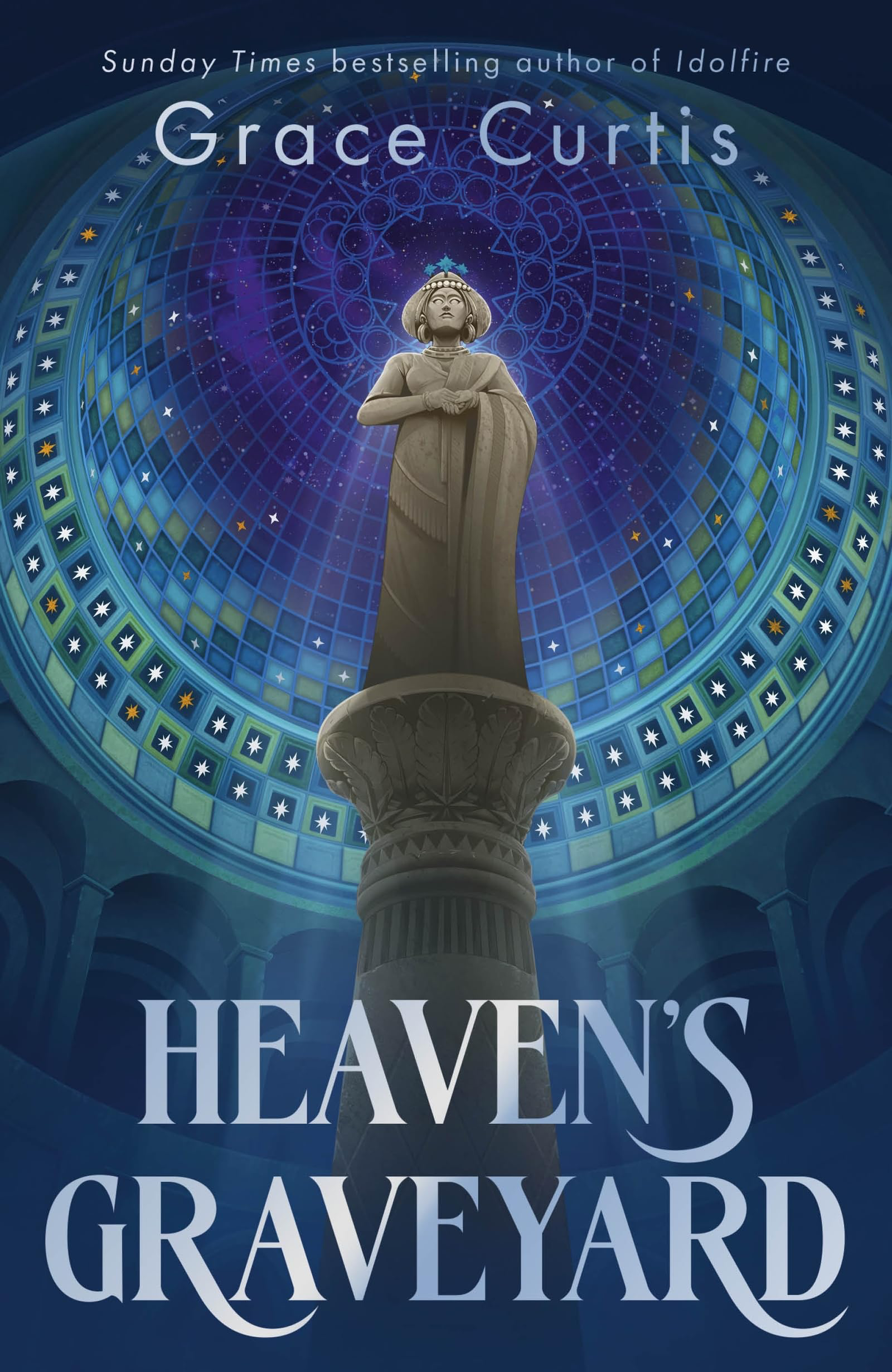
Heaven’s Graveyard – Grace Curtis – “It’s been a mild winter here/And I’ve buckled like a wheel/Sucked the life from god’s routine/Broke the royal we…”
“Twangy Wig-Out” – Transvision Vamp
I’d only heard of Transvision Vamp from songs off of their final album, Little Magnets Versus the Bubble of Babble, so it came as a surprise to discover that this album was their critically panned finale after several years of UK Number One singles in the ’80s. Of course, it’s reportedly pretty different from a lot of their earlier work, hence why it was initially barred from release in the UK by their record label. There’s nothing here that would suggest that Wendy James and co. were pop stars—I could see them being underground neo-psychedelia legends only going off of this. But it seems like that’s exactly what they wanted to do, after years of smearing by the UK music press (often at James’s expense, with many a misogynist insult hurled in her direction). “Twangy Wig-Out” has some pop genealogy, but it’s pure, British psychedelia—you can’t get much trippier than this. Its dreamlike prediction makes you feel like you’re stumbling through somebody else’s movie-montage drug trip, complete with lyrics that are the exact kind of thing you could only find deep if you got really, really stoned. (“‘Art is the mind set free’/She says, I don’t know any real artists?’ Shiiiiit, dude, that’s deep…[cough] pass the blunt…”) On its own, it’s a real fun track, but as a stylistic rebellion against a label (and a country) that wanted to kick them to the curb, it’s even more enjoyable.
…AND A BOOK TO GO WITH IT:

The Three Stigmata of Palmer Eldritch – Philip K. Dick – admittedly, I didn’t particularly like this novel, but you can’t get much druggier than this.
“Rushes of Pure Spring” – The Ladybug Transistor
Right off the bat: The Ladybug Transistor is an awesome band name. It also sounds like the kind of name you’d make up for a fake band to sound more pretentious than you are at a party. Oh, you haven’t heard of The Ladybug Transistor? Name three songs, poser. Their song and album titles only accentuate the vibe. Oh, you clearly haven’t heard of their critically acclaimed album Beverley Atonale and the lead single “Your Wagging Tail (Single Space).” Pitchfork gave it an 8.6, you know. Well, they actually didn’t, and that wasn’t the lead single, but you get what I mean. Apparently, they’re so niche that Beverley Atonale didn’t even get reviewed by Pitchfork. Who’s the poser now?
To me, that’s the mark of a fantastic band name/general aesthetic, because it’s a sign that they’re doing nothing but them. The Ladybug Transistor is another member of Elephant 6, and the influence is clear: like many of the other bands in their company, they were producing charming, ’60s-flavored indie pop. From my limited experience, they seem gentler and more slow-paced than some of their peers, but I love the atmosphere that “Rushes of Pure Spring” creates. Unlike a lot of other Elephant 6 bands, the ’60s comparison doesn’t jump out at me, but what does is another band from the ’90s—that being Luna. Aside from the fact that Gary Olson and Dean Wareham’s vocal styles are similar, it has that same gentle, observant quality to it; both the lyrics and the misty instrumentals sound like the results of a steady hour of journaling while staring out a window during a spring rain shower. My only complaint is that I found out about this song after I started taking the bus to school regularly, because this is prime bus commute music. There’s always tomorrow.
…AND A BOOK TO GO WITH IT:

Monk and Robot – Becky Chambers – “Beverly Road brings/Rushes of pure spring/I hear the day sing/It’s alright…”
If you’re coming into a Lisa Germano song called “Happiness” and expecting it to reflect any semblance of happiness…strap yourself in. Don’t say I told you so.
A lot of Lisa Germano’s songs have a childlike quality to them. It’s not in the sense of purity, but more in the sense of feeling like a nine-year-old hearing their parents fighting through the walls, learning some choice words, then misspelling them in their diary. There’s an almost-innocence to it, but it reflects a twisted mirror of childhood, a theme that recurs in a lot of her songs. (It’s especially evident in songs like “My Secret Reason,” whose plain lyrics paint images of rot through simplistic language: “But I know this/As dumb as I am/When I was young/And it was winter/In our yard/There used to be snow there.”) It’s a kind of reversion to lost childhood in adulthood, since that childhood wasn’t properly provided. A lot to unpack, to say the least.
“Happiness” has that same eerie simplicity to it. Germano intones the lyrics like she’s unenthusiastically regurgitating advice from a therapist: “Happiness/Is like TV/On or off/It’s up to me.” The subsequent ones are darkly childlike, with the sarcastic bent of a children’s songwriter with an acoustic guitar gathering everybody for a singalong: “Mom and dad/Are like my head/I won’t listen to them/Until they’re dead/Or I’m dead.” There’s a deliberate bit of gallows humor, a smirk evident when she sings “C’mon, everybody—sing!” and the next verse begins with “Pain and sadness/Are real to me.” (“Everybody!”) I wouldn’t go so far to say that “Happiness” is a funny song, but there’s a rotten sarcasm to it that only became more refined with time in Germano’s catalog. The chorus’s repetition of “Inconsiderate bitch, inconsiderate bitch,” sung in a similar singsong quality, is deeply wry and eerie, reflecting both the hollow platitudes people tend to give to suffering people (especially women) and the consequences of questioning them. Oh, you’re not just deciding to be happy? You’re not depressed! You’re just a selfish, inconsiderate bitch. Just turn on the happiness and be a docile, obedient woman, why don’tcha?
…AND A BOOK TO GO WITH IT:
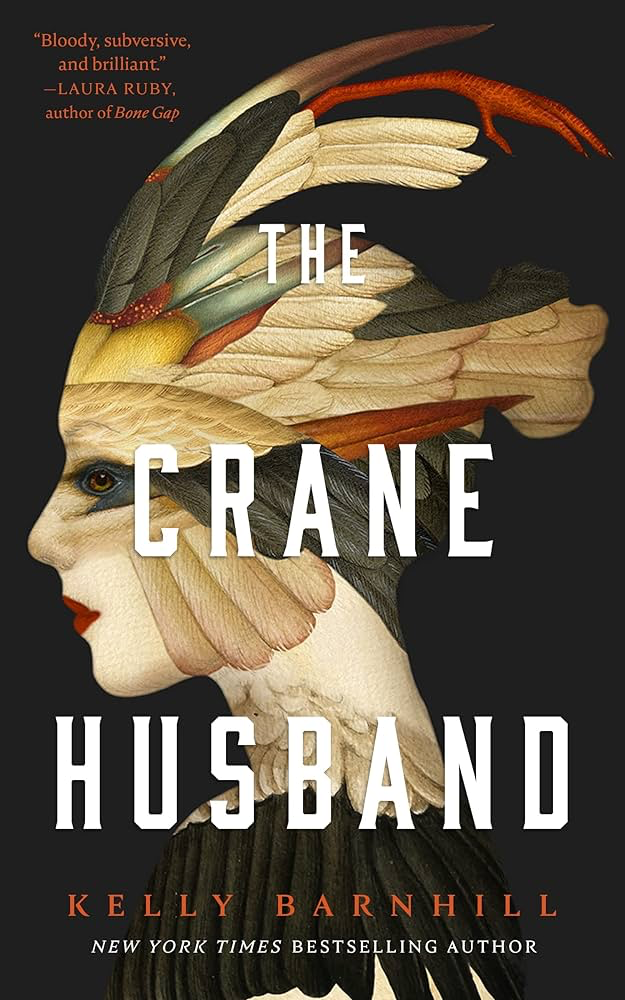
The Crane Husband – Kelly Barnhill – “Relationships
Are like a cow/Growing strong/Just for now/Poor little cow…”
Since this post consists entirely of songs, consider all of them to be today’s song.
That’s it for this week’s Sunday Songs! Have a wonderful rest of your day, and take care of yourselves!