

Happy Tuesday, bibliophiles!
After I finished Shadow Speaker back in December, I was eager to see what the newly published sequel, Like Thunder, had in store. It was finally available at the library recently, and it was one of my first reads of this year. And though it retained some of the issues that Shadow Speaker had, it was still a worthy sequel and end to the duology.
TREAD LIGHTLY! This review may contain spoilers for book one, Shadow Speaker. If you haven’t read it and intend to, read at your own risk.
For my review of Shadow Speaker, click here!
Enjoy this week’s review!
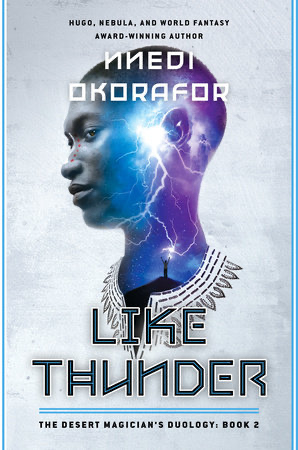
Like Thunder (The Desert Magician’s Duology, #2) – Nnedi Okorafor
2077. Three years after Ejii and Dikéogu saved Earth from the threat of Chief Ette and forced him to sign the truce to bring no harm to the Changed, Dikéogu has realized that the fight is not over. Estranged from his parents and living on his own, he knows that the truce is due to expire, and that the humans are growing more hostile to the Changed by the day. After disaster strikes and puts those that he love in danger, he sets off to find the one person he knows that can help save the day: Ejii. But when they reunite, saving the world—for the second time—is more difficult that either of them bargained for.
TW/CW: genocide, slavery, ableism, murder, death, loss of loved ones
In general, I was still a fan of this book, but strangely, even though a lot of my minor gripes with Shadow Speaker were resolved, they were often filled in with elements that ended up bringing down the narrative. That’s not to say that Like Thunder wasn’t a worthy sequel—it absolutely was, and it was a fitting way to finally end the Desert Magician’s Duology, all these years after Shadow Speaker was initially published.
The worldbuilding was, without a doubt, the strongest aspect of Shadow Speaker, and Like Thunder expanded on it in all the ways that it should have! Through Dikéogu’s eyes, we get to see parts of the Desert Magician world that Shadow Speaker left behind, and they greatly enhanced the ongoing narrative of change and prejudice. Not only do we get an expansion of the effect of what kind of powers possessed by the Changed, we also see the direct effects that being Changed has on people apart from the main characters that we saw in book one. Time was clearly on Nnedi Okorafor’s side here, since she presumably had so many years apart from Shadow Speaker to craft all of the world’s eccentricities, but even if there wasn’t such a large gap between now and then, I have faith that her worlds would have been fleshed out anyway—if there’s one thing that Okorafor has excelled at over the years, it’s crafting a detailed world.
A lot of this worldbuilding contributed to the themes that Like Thunder built up, and it serves as an incredibly powerful narrative about genocide. Now that the three-year treaty between Chief Ette and the Changed has expired, he doesn’t hide the hostility that he’s been waiting to unleash since then. No matter what perspective that it’s written from, genocide is always a difficult and delicate subject to write about, and Okorafor took great care in depicting it unapologetically—it’s brutal, authentic, and horrifying, just as it should have been. In general, I preferred Ejii’s perspective to Dikéogu’s (more on that later), but Dikéogu’s voice was well-suited to handling this kind of subject matter; he had the anger that the subject warrants, and his rage not only fueled his journey, but the emotion behind this depiction.
That being said, I wasn’t the biggest fan of Dikéogu being the main POV character in Like Thunder. Although seeing the effects of the treaty dissolving through his eyes was enlightening and his anger fueled much of the novel (and for good reason), in much of the down time of the novel, I found him to be borderline obnoxious. Most of it manifested in his treatment of a lot of the female characters in the novel—once he reunited with Ejii, he had this attitude that he was still owed her after all these years, and it got on my nerves to no end. I wouldn’t have minded a romantic subplot between the two of them, but Dikéogu’s insistence on being incredibly possessive of her soured the whole thing for me. His perspective was needed to a point, but I felt like he worked better as a side character.
Going off of that, there were a lot of cheap elements in Like Thunder that sullied the narrative for me. When I think of Nnedi Okorafor, I think a lot about subversion—subversion of genre conventions, subversion of tropes, etc. But throughout the novel, there were just so many elements that felt pointless and served no purpose—and were so common that it almost seemed beneath Okorafor to add them in the first place. We get the age-old “killing the main man’s girlfriend for the plot” trope; I think it was meant to convey some of the horrors of the genocide going on, but it was already pretty evident that Dikéogu’s life was significantly changed and he already knew the horrors of genocide firsthand, so there was no point in having that subplot at all, especially since it was blatantly shoved in there to try and advance Dikéogu’s narrative arc. And the love triangle…why? Why? Once we got to that part, combined with Dikéogu’s possessiveness of Ejii, it just felt like filler drama—it didn’t advance the plot at all, and it seemed like a cheap way to generate drama as well. It just seemed like a disservice to Okorafor’s inexhaustible creativity.
All in all, a satisfying conclusion to a solid sci-fi/fantasy duology that excelled in its worldbuilding, but suffered in its use of overused and stale tropes. 3.5 stars!
Like Thunder is the second and final installment in the Desert Magician’s Duology, preceded by Shadow Speaker. Nnedi Okorafor is also the author of Lagoon, the Binti series (Binti, Home, and The Night Masquerade), Noor, Remote Control, and several other books for teens and adults.
Today’s song:
That’s it for this week’s Book Review Tuesday! Have a wonderful rest of your day, and take care of yourselves!


 The Bookish Mutant
One thought on “Book Review Tuesday (1/9/24) – Like Thunder (The Desert Magician’s Duology, #2)”