

Happy Tuesday, bibliophiles, and happy fall equinox/bisexual visibility day eve!
Since this week is Bisexual Visibility Week, I figured I would read some books to supercharge my own bisexuality celebrate the occasion. I’m normally not a huge literary fiction reader, but I read SJ Sindu’s graphic novel Tall Water back in May and really enjoyed it, so I figured I’d give more of their works a try. Blue-Skinned Gods turned out to be quite an impactful novel!
Enjoy this week’s review!
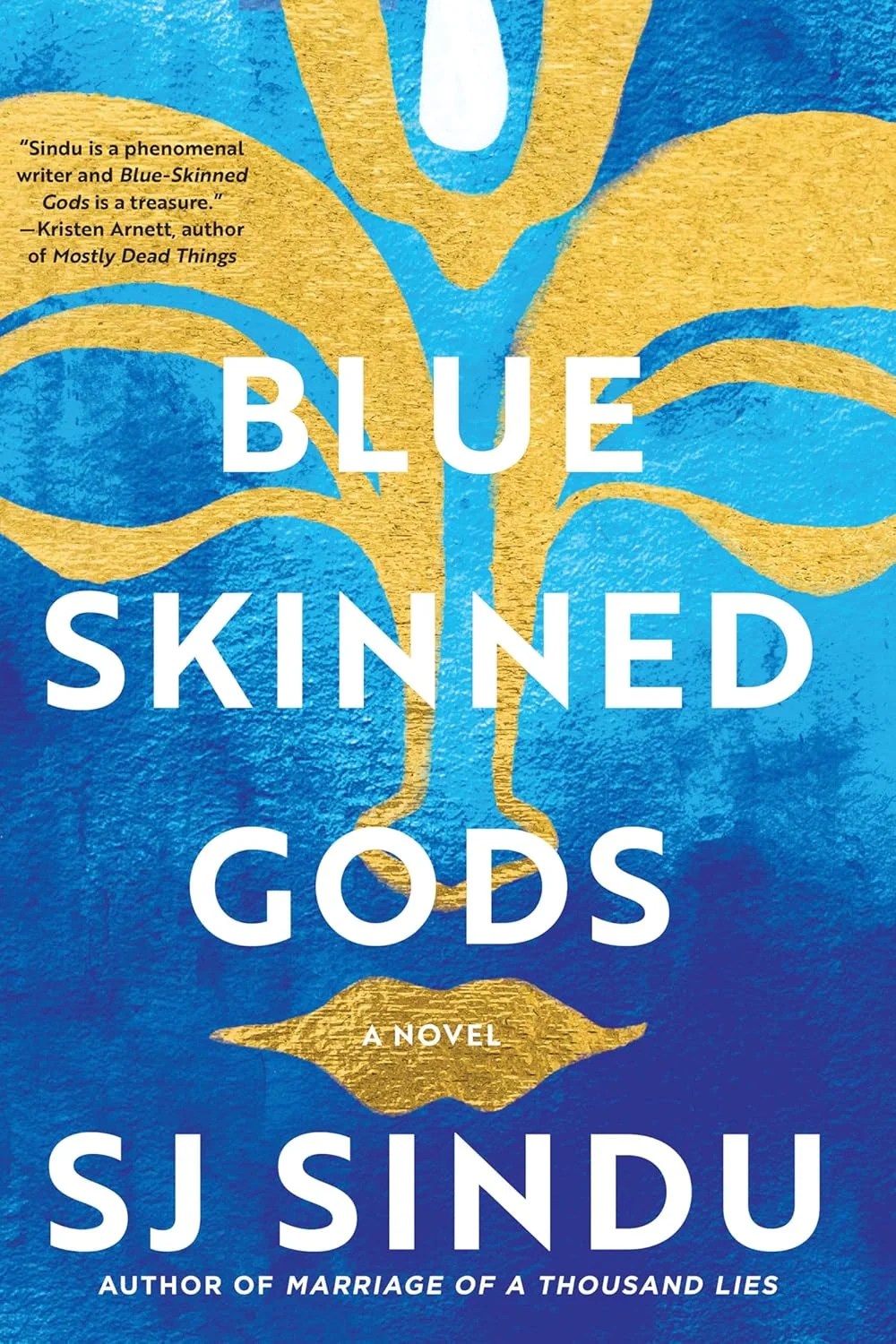
Kalki was born with sky-blue skin. His parents, believing he is the reincarnation of the god Vishnu, set up an ashram where they make a living off of Kalki’s supposed healing powers. As Kalki gets older, the cracks in his identity and his father’s manipulation of him begin to grow. But on a pilgrimage to New York City, Kalki discovers that the carefully-constructed narrative of his life may not live up to what his father made them out to be, and that the only way to discover his true nature—godly, human, or something else entirely—is to break free of his father’s grip.
TW/CW: child abuse, religious bigotry, cancer, loss of loved ones, emotional & physical abuse, sexual content, suicide, attempted murder
There’s a moment that I particularly liked in Blue-Skinned Gods that, to me, exemplifies the best qualities of SJ Sindu’s writing. When Kalki first arrives in New York City, he describes the traffic as rivaling that of India, with the rickshaws replaced by yellow cabs. It struck me, and it really made me laugh—I feel like a lot of the Orientalist rhetoric that we hear about India is about how crowded and unclean the streets are and how out of control the traffic is, and this passage felt like a slap upside the head to all of those tropes. But Sindu didn’t write it necessarily as such: it was just how Kalki processed his first experiences of the city. The impact of that observation was how a lot of the themes were delivered—everything had layers of satire, nuance, and emotion, and it just felt downright clever. Sindu’s writing engrossed me in the setting and delivered its messages all folded up into one: neither was separate from the other, and that’s what sets their writing apart to me.
Sindu’s buildup of Kalki’s character was one of the strongest aspects of this novel. His narrative voice, with his strong sense of justice and deep sensitivity to the corruption of the world around him, gave the novel a very tender aspect, especially considering the cruel hand that he and his family and friends were dealt. Kalki deals with his fair share of trauma, and Sindu did an excellent job of depicting it respectfully and not milking it into gratuitous trauma porn. (That being said, take heed of the trigger warnings. Blue-Skinned Gods is definitely a difficult novel to read.) There was a kind of innocence to him, but it was rooted in his belief of justice and his godly duty to right the wrongs of the world. Once he breaks away from his abusive father’s grip and comes into his own, his journey to true self-discovery was heartbreaking and heartwarming; on the one hand, Sindu’s portrayal of everything he’s built his life on come crumbling down almost instantaneously was just plain sad, but seeing Kalki’s rocky journey towards advocating for himself and not letting himself be manipulated by other people was so fulfilling. It’s clear that Sindu put so much love into Kalki, and every page was proof.
Strangely, I feel like Blue-Skinned Gods isn’t as much about religion in the end—it plays a part, but not the whole. It’s about people wanting to believe in something so desperately that they’re willing to do callous things to the people caught in the crossfire. Kalki’s childhood is stripped away just because his father knows the power of people who just want to see miracles—and because his father knows that it’s profitable to bring false miracles to people. When Kalki escapes to New York City and finds refuge in Lakshman and his band, he’s told that his father has been using him, but then gets manipulated by the band so that they can profit off of his identity as well, just in a different way. I think it’s also about how otherness is seen as profitable, and how when the othered person doesn’t want to be commodified, they become something to despise and fear in the eyes of the majority. Sindu had so much to say with Blue-Skinned Gods, but for the most part, she did an excellent job of addressing it without it coming off preachy—the narrative just lended itself to so many ethical and emotional questions, and Sindu navigated all of them with aplomb.
For the most part, Blue-Skinned Gods was such a strong book. Sindu was willing to let the reader absorb the weight of all the emotions in this novel, even though it spans around 20 years and there are a lot of events to dwell on. However, the same kindness was not shown to the ending. Without spoiling anything, it felt like such a climactic moment chock full of complicated and horrific emotions, like many of the events throughout Kalki’s life. There’s so much buildup, and then it’s over and done in about a page, as is the emotional fallout. It was an ending that made me think that there were at least 5-10 more pages, but it just ended—that was it? Why did this moment not get the same treatment as the rest of the traumatic events in this novel? It didn’t take away from my rating of this novel, but I feel like it needed more room to breathe, and much too abrupt for something so emotionally charged.
All in all, an affecting novel of religion, identity, and the lengths you’re willing to go to just to believe in something. 4 stars!
Blue-Skinned Gods is a standalone, but SJ Sindu is also the author of several other books for children, teens, and adults, including Marriage of a Thousand Lies, The Goth House Experiment, Tall Water (with Dion MBD), and Shakti. They also contributed to the anthology Be Gay, Do Crime.
Today’s song:
That’s it for this week’s Book Review Tuesday! Have a wonderful rest of your day, and take care of yourselves!


