Posted in Sunday Songs

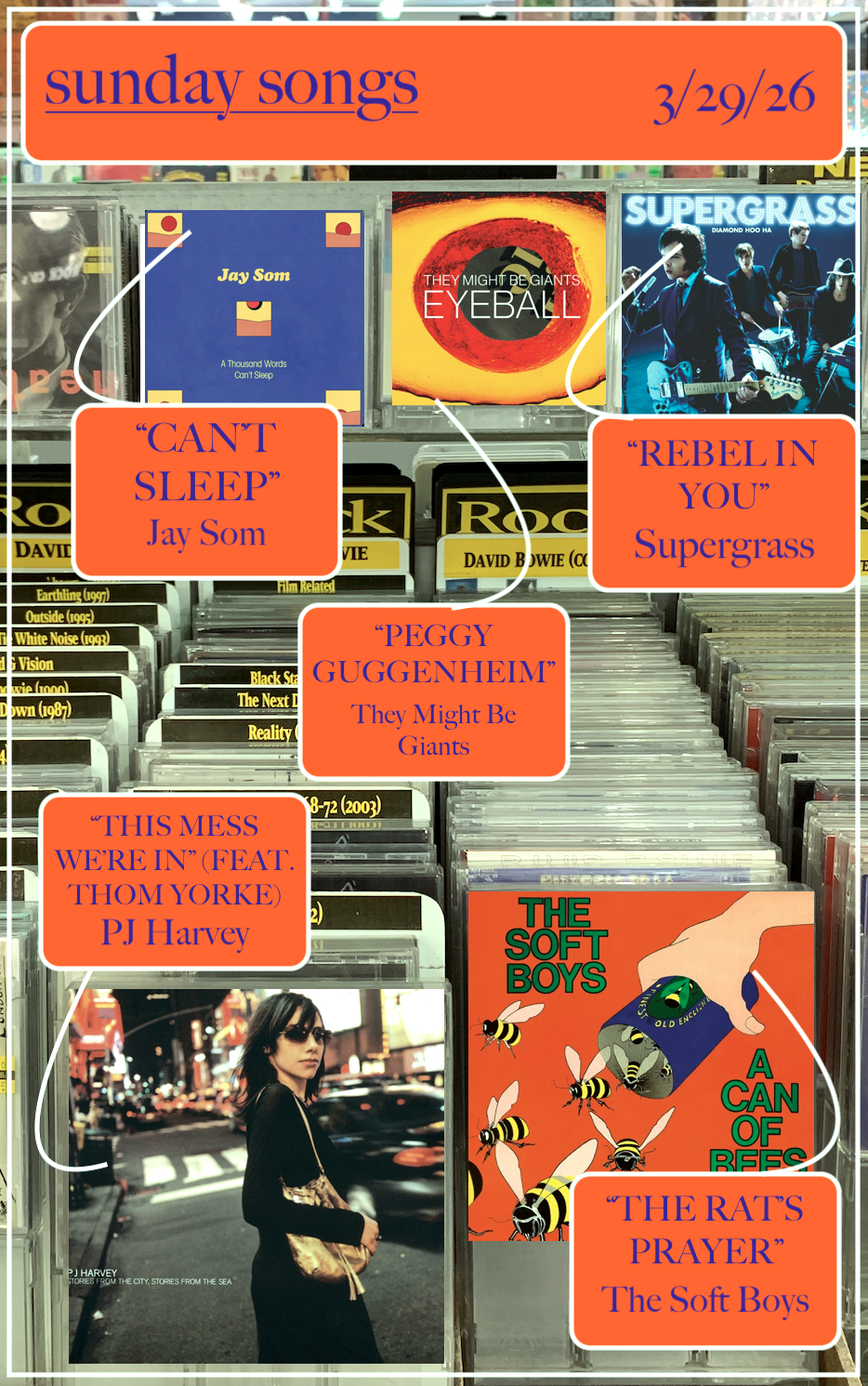
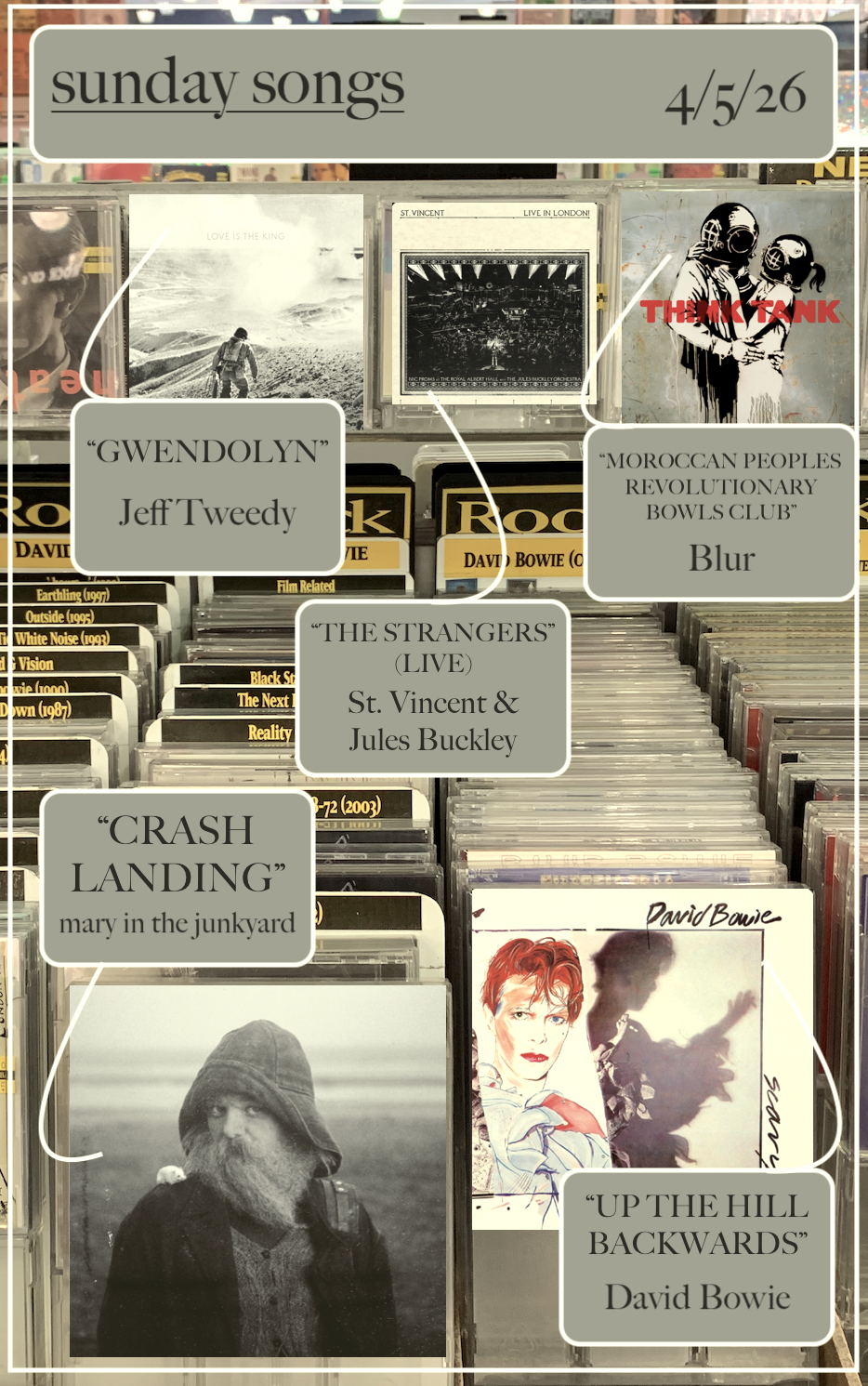
Sunday Songs: 8/3/25

Happy Sunday, bibliophiles! I hope this week has treated you well.

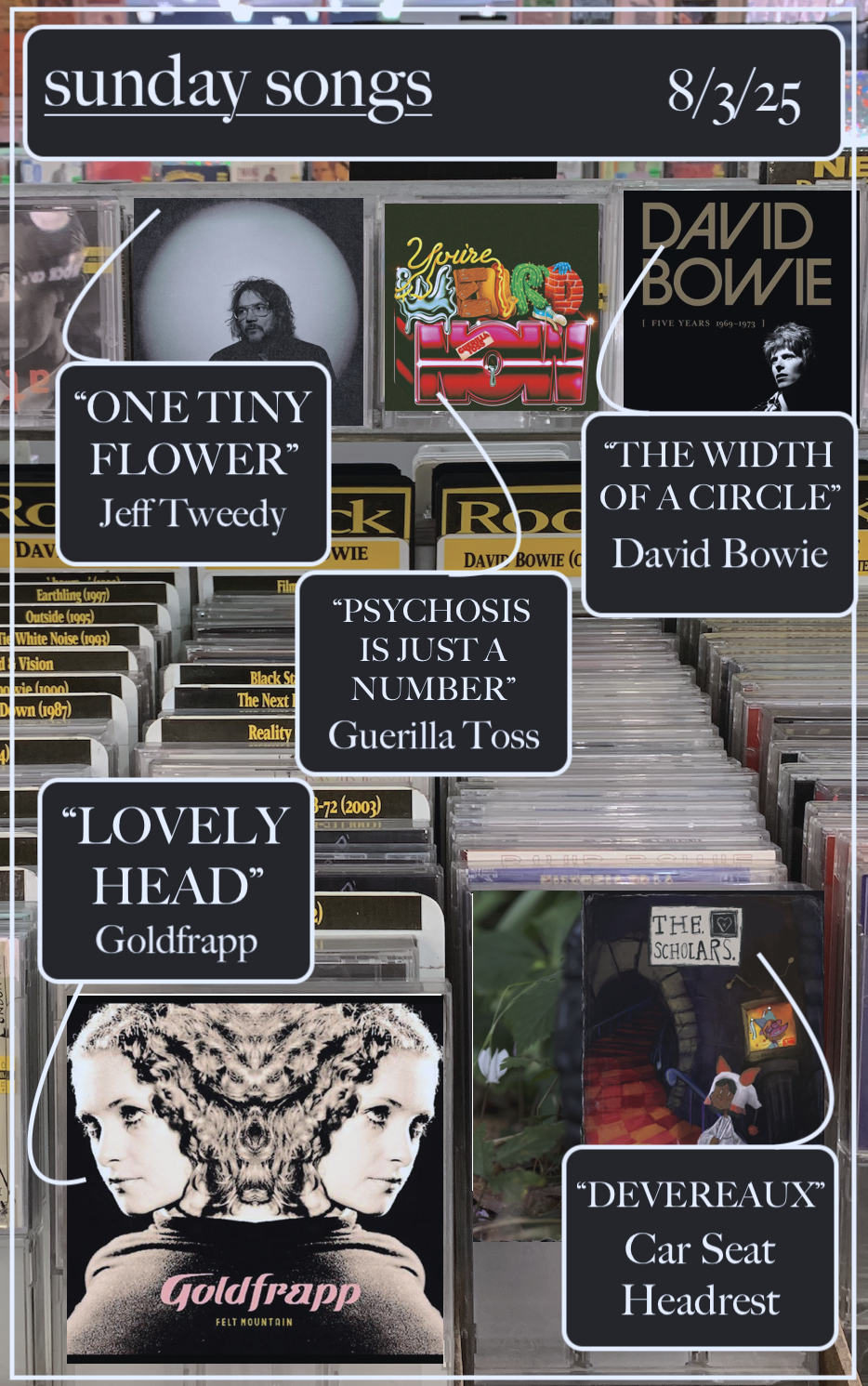
This week: even if Wilco wasn’t ever-present in The Bear, we’d have to physically restrain Jeff Tweedy just to stop him constantly cooking in that kitchen. Plus: lots of top tier album intros and some lyrics I probably should’ve reconsidered playing in the presence of my guitar teacher.

Enjoy this week’s songs!

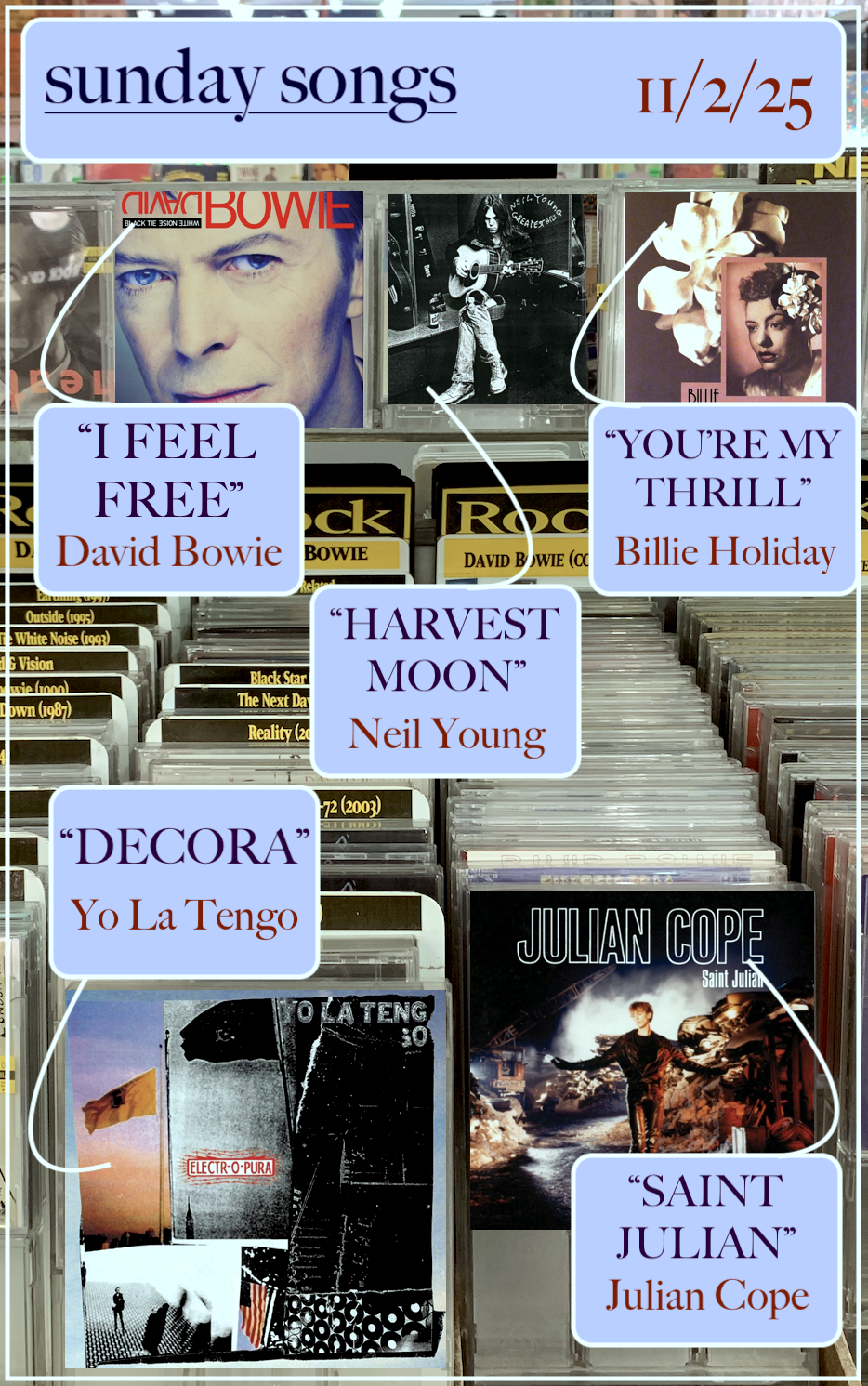
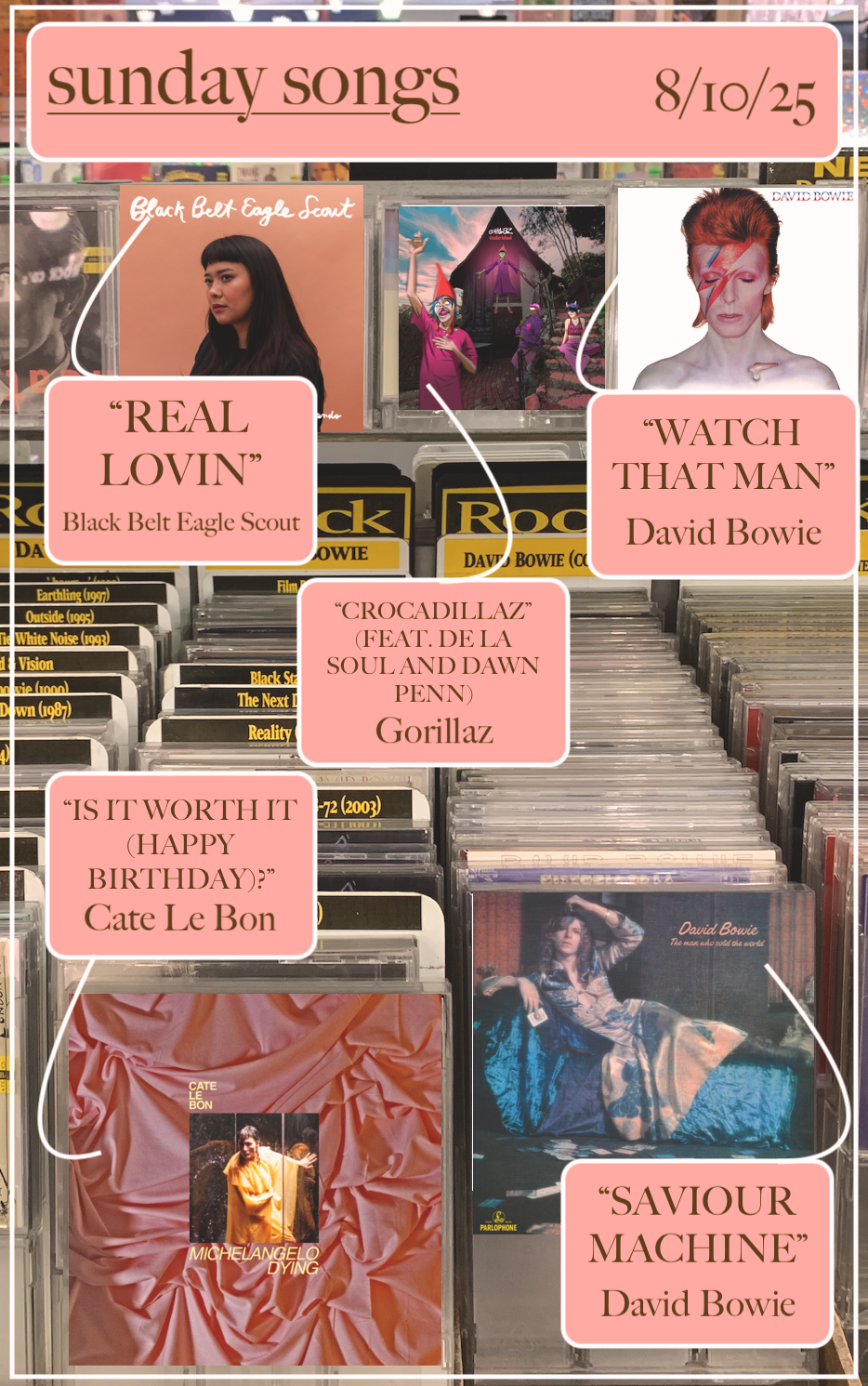
SUNDAY SONGS: 8/3/25

“Lovely Head” – Goldfrapp

Both Alison Goldfrapp and Will Gregory had been musically active before they joined forces, but even then, to come right out the gate with a single like this is so impressive for a band just getting its start. “Lovely Head” was the first single that Goldfrapp ever released and eventually became the opening track for their debut album, Felt Mountain. The U.S. didn’t seem to see the wave of popularity it eventually gained, but in the U.K., it was used liberally in film, TV, and commercials in the early 2000’s. But if there was ever a song that was meant for all of those things, it’s this one. Everything about it is cinematic, from the Ennio Morricone-like whistling intro to the soaring, theremin-like melodies, which wasn’t actually a theremin at all—just Alison Goldfrapp’s voice filtered through a synthesizer. It’s just so deliciously eerie, cool and distant, with lyrics that seem romantic only from the furthest distance, but disaffected and almost scientific once you examine them more closely. “Frankenstein would want your mind/Your lovely head” is probably only romantic for…y’know, a serial killer, or something, but it’s the precise effect that I think the song is going for—a love song penned by a cold-blooded killer.

…AND A BOOK TO GO WITH IT:

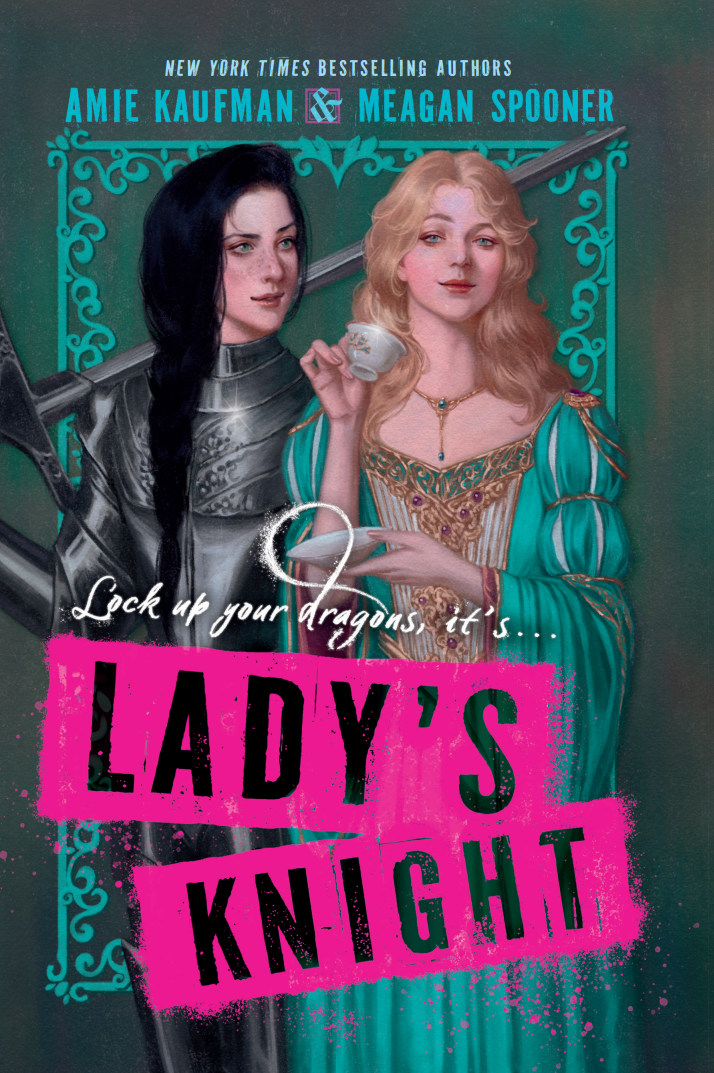
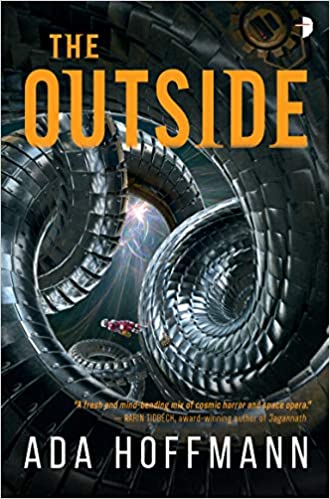
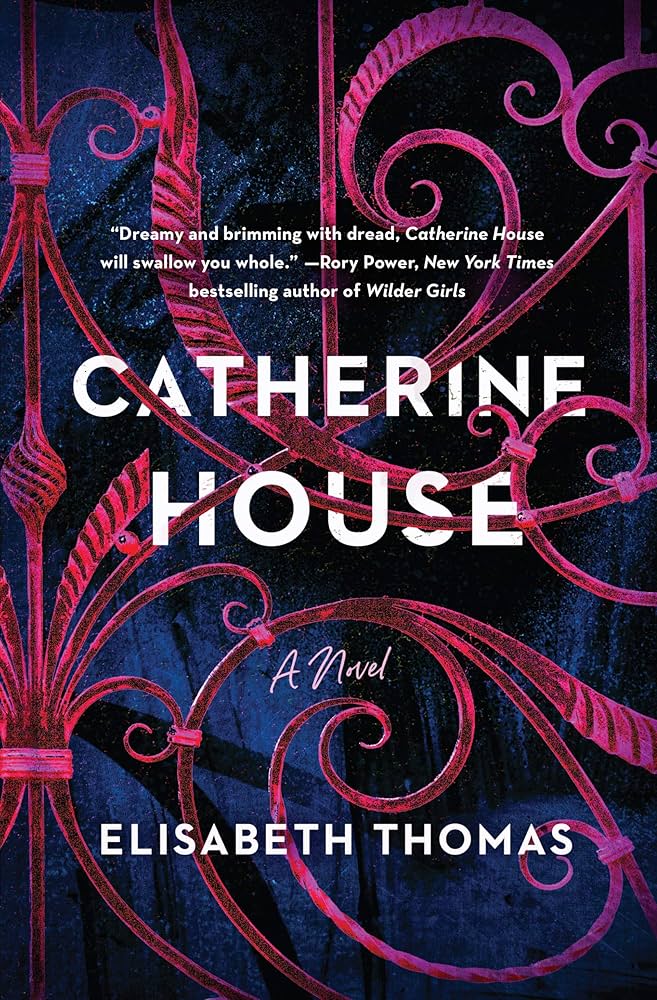
Catherine House – Elisabeth Thomasan eerie atmosphere, eerie interactions with eerie people, all in an eerie, secretive college.

“Devereaux” – Car Seat Headrest

I promise I’ll shut up about Car Seat Headrest for a few more months after this week. Well…I can’t make any promises.

Though I never got around to writing an album review for The Scholars (or any other of the amazing albums that have come out this year…oops. Phonetics On & On is the only album to come out in 2025, folks! Rejoice!), I feel like it’d be a crime for me to not talk about “Devereaux” at some point. After the back-to-back slew of excellent singles, “Devereaux,” along with “Equals,” is the song I’ve come back to the most from The Scholars. It’s what duped me into thinking that the album was going to be a re-hash of Teens of Denial, but even though it calls back to the song, the rest of the album proved me dead wrong…though I wouldn’t complain about Teens of Denial 2: Electric Boogaloo. Despite being from the perspective of one of Will Toledo’s many characters, a crocodile named Devereaux, the themes of living under the roof of religious bigotry and longing for escape could’ve been plucked straight out of his early discography. Anthemic and pleading, I see it becoming a future crowd-pleaser at shows—the kind I’d see the fans emphatically jumping up and down to. Hell, I saw them doing that on this tour, and it was only the second song in the setlist. Toledo’s soaring vocals meld the yearning, melancholic lyrics into a cry of longing: “I wasn’t born to be this, I was born to fight dragons/With a cowl on my face/With an auspicious birthday.” If there was ever a more air-punch worthy song, chock-full of lyrics meant to be yelled into the spacious walls of a sturdy venue, or simply into the darkness of a firefly-tinged summer night, “Devereaux” is it.

…AND A BOOK TO GO WITH IT:

Agnes at the End of the World – Kelly McWilliams“In the land beyond me and you/A bunch of kids who don’t know what to do/We all wait in the silence to hear…”

“One Tiny Flower” – Jeff Tweedy

BREAKING: water is wet, the sky is blue (sky blue sky, even? [gets dragged offstage by a comically large cane]), and Jeff Tweedy cannot stop cooking. Seriously! Even within a band, how is it possible that in the last five years, this man has put out one solo album, two albums (one of which is a double album) and an EP with Wilco, three reissues of past albums, and now a triple album out this September? It’s been a while since I’ve read Tweedy’s book, How to Write One Song, but if that kind of insane output—not only prolific, but consistently good to boot—doesn’t convince you that he can, in fact, teach you how to write one song, then I don’t know what will.

I had a feeling why he continues to be so prolific. In my experience, creativity blossoms most when you’ve got something impelling it: not necessarily spite, anger, or negative emotion, but any kind of passion that pushes you to put something new out into the world. Give yourself into it too much, you lose the outside world, and you lose the reality that must be grounded to; lose sight of it, and you forget that everything pushing against you in the world, positive and negative, can be a source to revive that creativity. Tweedy put it this way in a statement about the album: “When you choose to do creative things, you align yourself with something that other people call God…and when you align yourself with creation, you inherently take a side against destruction. You’re on the side of creation. And that does a lot to quell the impulse to destroy. Creativity eats darkness.” Tweedy saw the veritable tsunami of strife, fascism, genocide, and all the other ills plaguing the world, and put up arms against it by means of art. For me, and for so many people who feel helpless, it’s all we can do. My mom shared this wonderful Ted Talk by Amie McNee about how making any kind of art, political or not, is an act of resistance in this hellscape just by virtue of the fact that you’re putting your time and attention into creativity and not giving money to corporations by endlessly scrolling on social media or participating in other capitalist activities. It comes to mind when I think about the upcoming Twilight Override: now that’s an act of resistance. 30 songs! That monstrous length is also intentional to Tweedy: “Whatever it is out there (or in there) squeezing this ennui into my day, it’s fucking overwhelming. It’s difficult to ignore. Twilight Override is my effort to overwhelm it right back. Here are the songs and sounds and voices and guitars and words that are an effort to let go of some of the heaviness and up the wattage on my own light. My effort to engulf this encroaching nighttime (nightmare) of the soul.” 30 songs is hard to keep consistency with, but nevertheless, I welcome Jeff Tweedy as the musical champion of (twi)light in the overwhelming darkness.

Out of the four singles that have been released so far, “One Tiny Flower” seems most like Tweedy’s mission statement with Twilight Override. It’s not his most lyrically complex song, but it evokes the most classic imagery of resistance and resilience possible: a tiny flower sprouting out from the concrete. It’s an ember of joy, a labor of intensive hard work to make the roots hold onto concrete, and a fuck you to whoever poured the concrete over the space where they didn’t want more plants to grow. Even without the rest of Wilco, “One Tiny Flower” reeks of Cousin, shifting from understated, softly sung acoustic melodies to a jingling, entropic dissolution before straightening itself back up again. The other three songs veer between different sides of Tweedy’s range, but if there are any more songs like this one, then I’ll be satisfied with Twilight Override.

…AND A BOOK TO GO WITH IT:

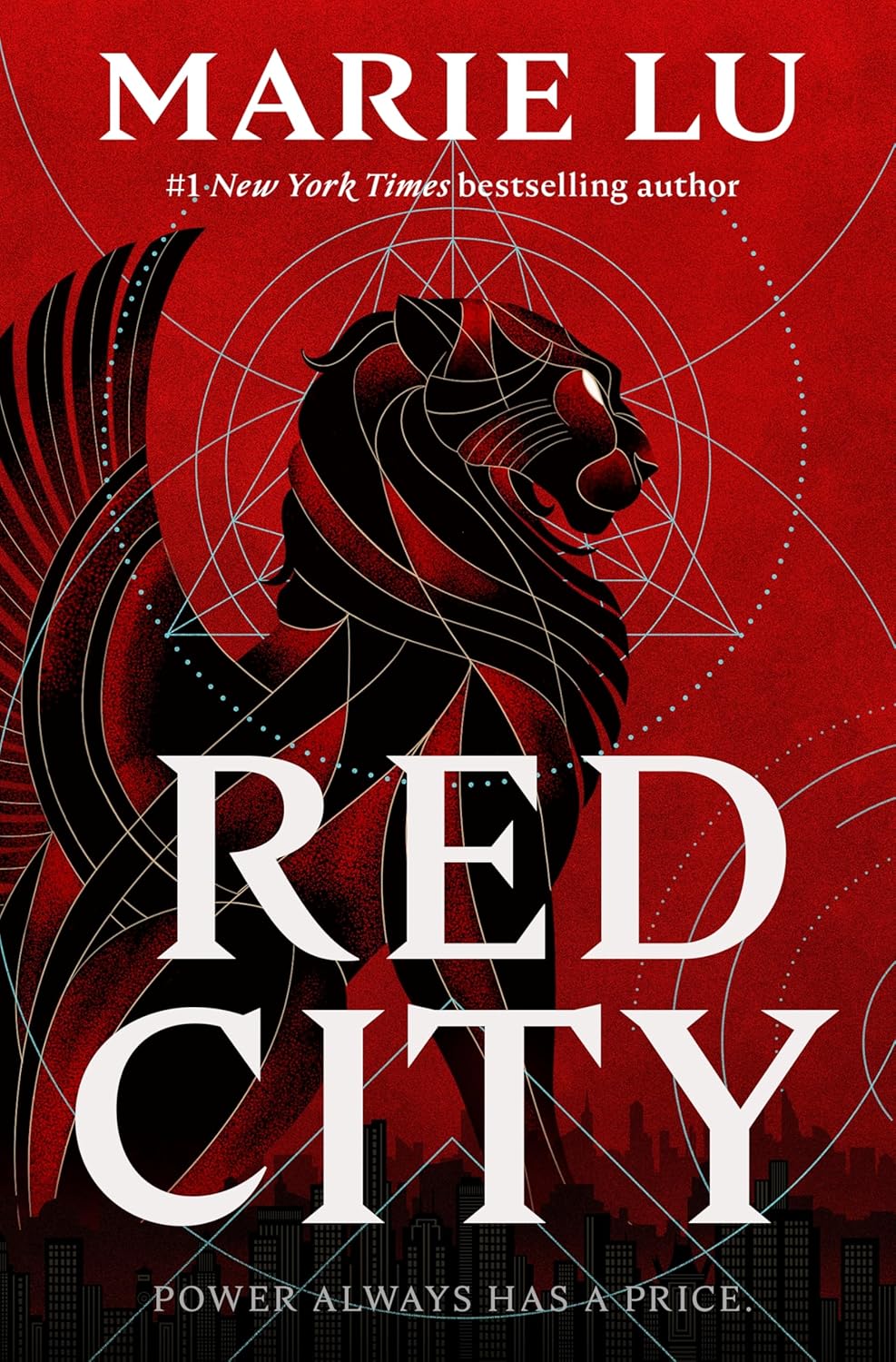
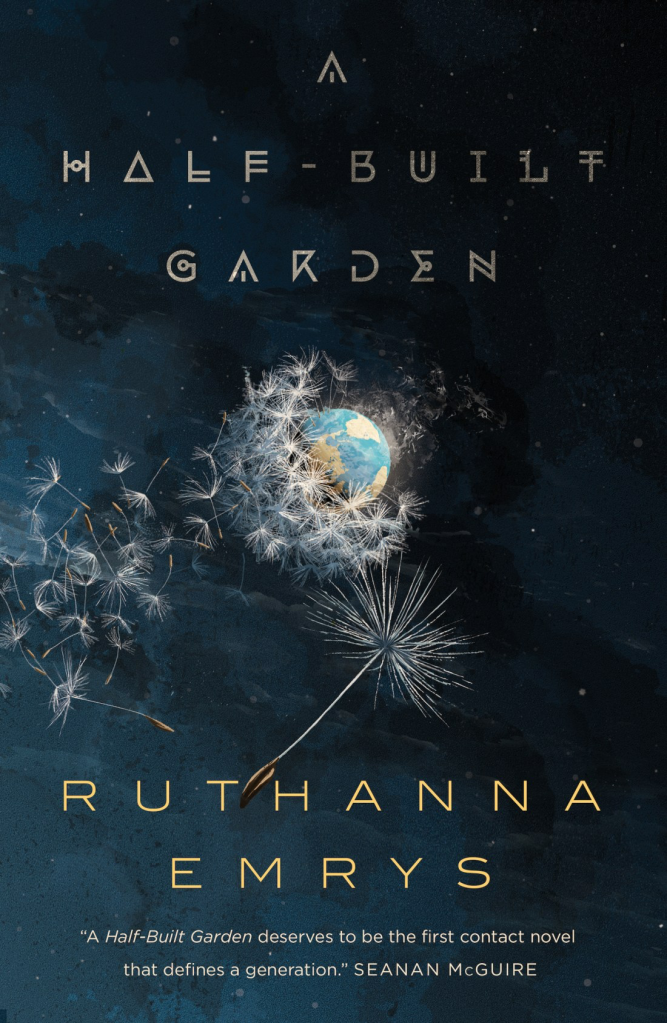
A Half-Built Garden – Ruthanna Emrysa quiet, hopeful tale of climate change and first contact.

“Psychosis is Just a Number” – Guerilla Toss

I’m surprised that I’ve never talked about Guerilla Toss on any of these posts, but I think it’s mainly because my main heyday listening to them ended right around the time when I started making these graphics, several months after their last album, Famously Alive, came out. I don’t tend to habitually revisit them, minus most of the tracks from Twisted Crystal (see: “Come Up With Me,” which I swear needs to be the theme song for a quirky Cartoon Network show with a plucky girl protagonist on a bicycle exploring a magical realm). But even though I’d never place them among my most-listened to bands, I’m always happy to hear something new from them. You’re Weird Now comes out this October, but the truth is, Guerilla Toss have been weird all along—and that’s what makes them special. They’re doing nothing but their own thing, pasting together surreal lyrics with electronic and rock beats frankensteined together. “Psychosis Is Just a Number” mashes together thrumming bass and a surprisingly smooth brass section—I’d never think to compare Oingo Boingo and Guerilla Toss musically, but the madcap, off-the-walls excitement of this track is so wonderfully reminiscent of them. They throw everything at you (the chorus is borderline overstimulating if you listen to it over and over) but that’s just how their unfiltered, raw excitement and creativity shines through.

…AND A BOOK TO GO WITH IT:

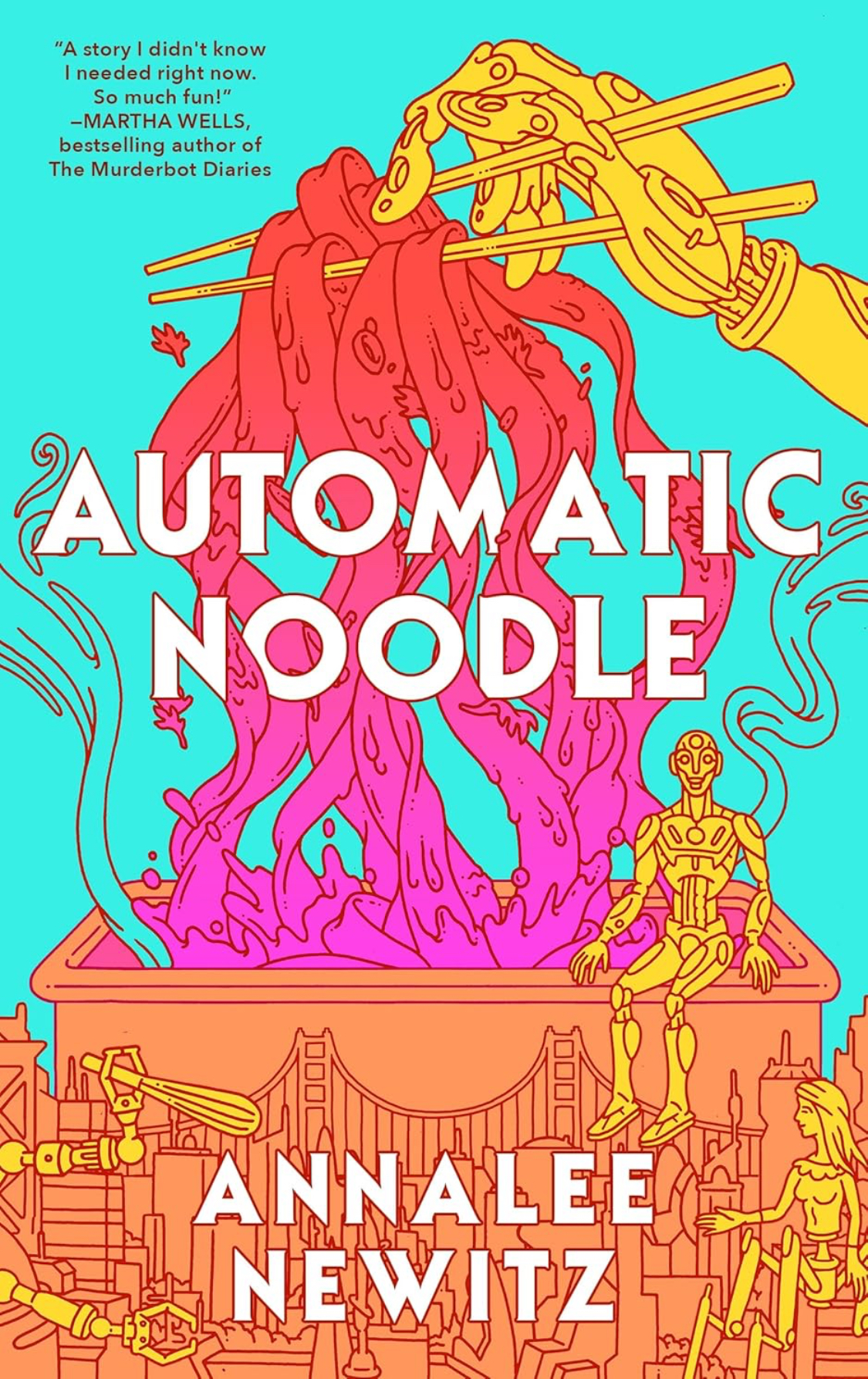
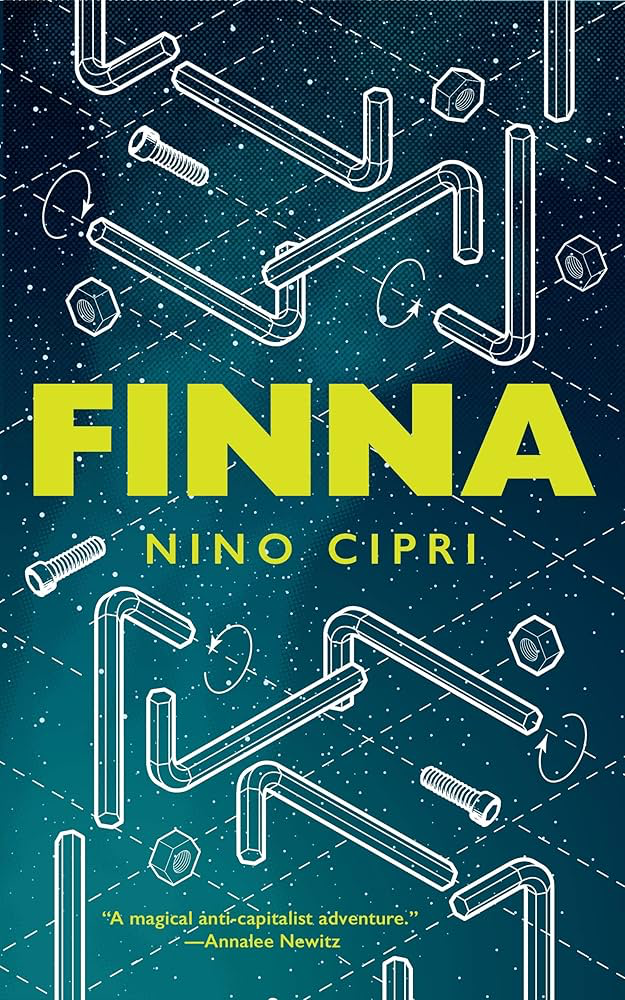
Finna – Nino Ciprithis is a highly specific situation, but strangely, Guerilla Toss seems like the ideal soundtrack to being trapped in an interdimensional, legally distinct IKEA full of monstrous furniture.

“The Width of a Circle” – David Bowie

I’ve loved “The Width of a Circle” for at least a few years, and I’ve been interested in learning how to play it on guitar. Unfortunately, though it has been a wonderful experience, I made a…uh, slight oversight, and didn’t realize how painfully awkward it would be to be in my guitar lesson and have my guitar teacher go through the whole “He swallowed his pride and puckered his lips/And showed me the leather bound ’round his hips” bit. Whoops.

As you probably gathered, “The Width of a Circle” is about as freaky as they come. Though the actual subject is somewhat ambiguous, it’s about Bowie encountering either God or Satan…and proceeding to have the most earth-shattering gay sex with him. (I’m more inclined to the Satan interpretation, as the figure fools the Bowie character into thinking he’s a humble, young God, then opens up the pits of Hell.) Even though The Man Who Sold the World didn’t get a ton of attention when it came out, it’s impressive that this got through any kind of censors and was released all the way back in 1970—just as impressive as the fact that Bowie was slaying in that dress on the front cover of the album. It’s honestly one of the queerest songs in his catalogue to me, and this was even before he made a whole album about a queer alien. The Man Who Sold the World didn’t gain much notoriety until Bowie’s career started picking up in earnest, but in retrospect, it’s the album where his storytelling really took a turn for the truly artful. Though the sound isn’t as cohesive, you can see the leap he took into going more daring places with his songwriting. “The Width of a Circle” truly is an epic in every sense of the word; originally two separate songs, it was tied together by the connective tissue of Mick Ronson’s jamming, expanding it into an eight minute long behemoth of a tale. The theatricality that would come to dominate Bowie’s work in only a few years blossoms here as he takes a journey through innocence and into shock and revelation. Even if it came to my disadvantage in that guitar lesson, this is the first time in Bowie’s career where his imagery takes on the quality of being so startlingly evocative—he’s a master of weaving worlds through song, and whether or not he’s selling them, each song is a Faberge egg of allusions and stunning songcraft.

…AND A BOOK TO GO WITH IT:

The Familiar – Leigh Bardugo“And I cried for all the others until the day was nearly through/For I realized that God’s a young man too…”

Since this post consists entirely of songs, consider all of them to be today’s song.

That’s it for this week’s Book Review Tuesday! Have a wonderful rest of your day, and take care of yourselves!

Posted in Sunday Songs

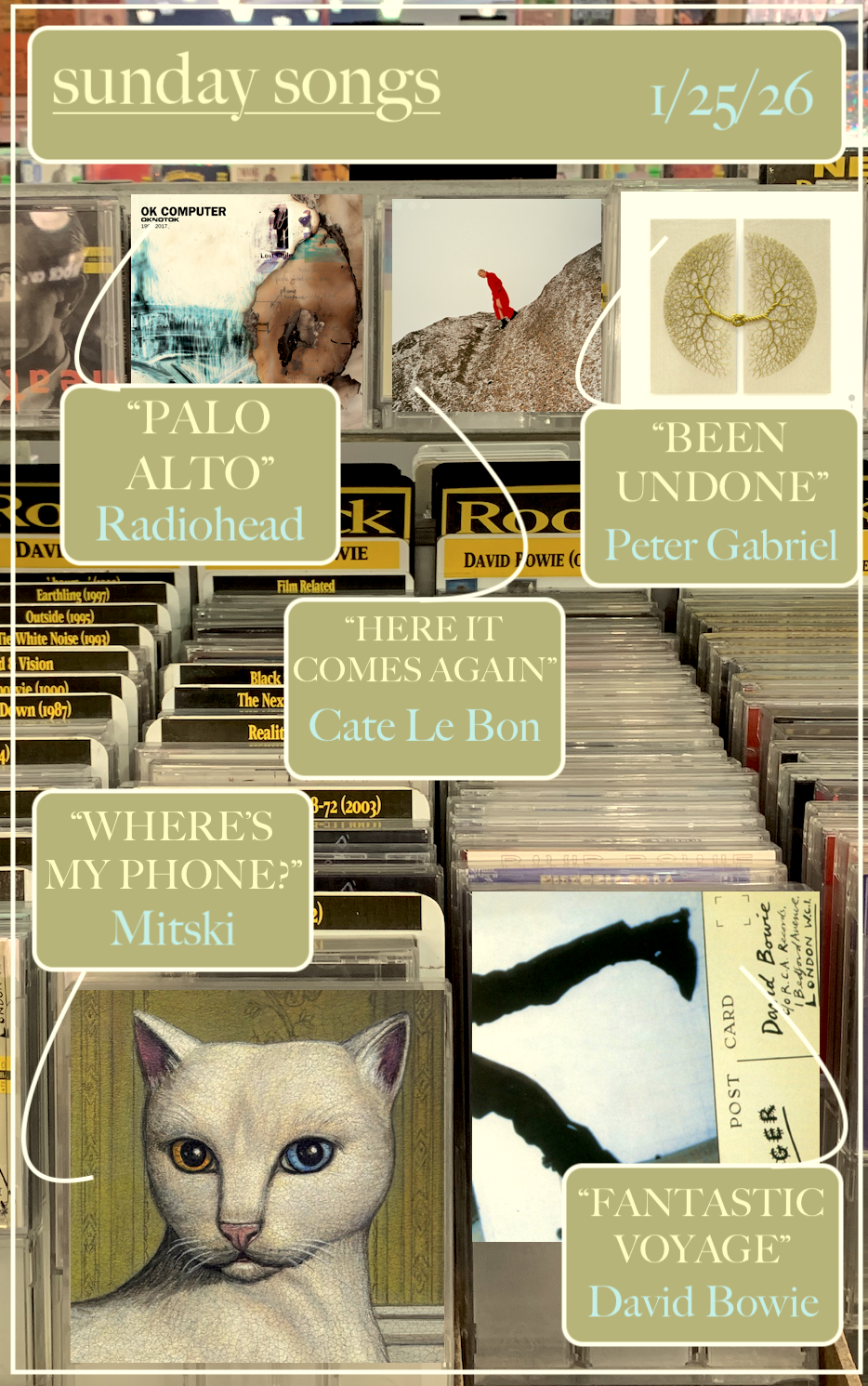
Sunday Songs: 5/25/25

Happy Sunday, bibliophiles! I hope this week has treated you well.

This week: it’s all a trick question. I saw St. Vincent last week, but did she play the song I’m writing about this week? No. Did she play the David Bowie song I’m writing about this week, though?

…yup.

Enjoy this week’s songs!

SUNDAY SONGS: 5/25/25

“Heartthrob” – Indigo De Souza

Two years on the heels of All of This Will End (I say that like I’ve listened to it…I’ve listened to about half? Good stuff, though), Indigo De Souza is back with a new album out this summer, Precipice. I don’t know if I’m committed enough to listen immediately (I might go for Any Shape You Take first). To be honest, after briefly hearing whatever the hell that disastrous, autotuned misfire that was WHOLESOME EVIL FANTASY, I was hesitant to see what De Souza had done next. Thankfully, it was far from that. The album cover’s gorgeous, too—the naked skull creature is having its beach episode!

As cheesy as the music video is, “Heartthrob” seems for all the world to be a moment of healing for De Souza, and I’m so happy for her. The chorus of “I really put my back into it” describes the throttle of this track, a more pop-rock offering with trembling vocals but no shortage of determination. The pre-chorus describing De Souza’s experiences of abuse are jarring against the otherwise sunny, bubbly feel of the track, and yet that’s the point; De Souza said that they wrote the song about “process[ing] something that is often hard to talk about—the harmful ways I’ve been taken advantage of in my physical memory. ‘Heartthrob’ is about harnessing anger, and turning it into something powerful and embodied. It’s about taking back my body and my experience. It’s a big fuck you to the abusers of the world.” That passion radiates through every inch of the track through wavering warble and cheerleader-like shout, which De Souza delivers in equal measure. More than anything, “Heartthrob” feels like a release, an outpouring of joy, anger, and passion, a bubbling bottle uncorked. I can’t help but love the rallying cry of “I really put my back into it”—maybe it’s not my favorite song in the world, but for all of the unoriginality plaguing our landscape, it’s refreshing to see people like them pouring it all into their art.

…AND A BOOK TO GO WITH IT:

The Luis Ortega Survival Club – Sonora ReyesA story of feminist resistance and reclaiming your body and identity in the face of abuse.

“Oh My God” – St. Vincent

I had the absolute privilege of seeing St. Vincent for a second time last week. I know I’m obsessed, but it was seriously breathtaking—the setlist was incredible, her stage presence was so captivating, and her guitar playing always knocks me off my feet. I was right near the third row, and I nearly had a heart attack when she started crowdsurfing during “New York”…never thought I’d find myself getting choked up by that song (it’s nowhere near my favorite), but to be so close to her and in the presence of so much love and togetherness began to heal a part of me, if only for a night. Sure, the loungy rendition of “Candy Darling” she did at the end was a bit of a misfire, but if that was the worst part of the night, then it was a concert I’ll never forget.

So without further ado, here’s a song that…she didn’t play, and I suspect that she probably won’t revive unless she willingly goes into her deep cuts. A bonus track from Actor that was also released along with the “Marrow” single (which she did play that night and absolutely annihilated), its deceptively quiet intro hides a suppressed, roiling storm. Like much of Actor, it hides dread and unpleasantness beneath a veneer of delicate woodwinds and finger-picking, but conceals a spreading rot beneath it. The dread veers into focus with Annie Clark’s chorus of “‘Cause when the drink goes in/The devil comes out” after detailing all of the dishes gone without washing and the bathwater gone cold while she’s still in it. A faintly “Via Chicago”-like drum fill patters as the chorus grows in intensity, a chanting of “Oh my god” that never loses its delicacy but turns more from an indifferent remark to a quietly horrified exclamation, as though she sees the landscape of dying houseplants and unmade beds before her. Given that this was a bonus track, it seems that even then, this was a time that Clark wasn’t keen on returning to, but I do find some comfort in the fact that presumably, given that there’s around 16 years behind it, this is something that Clark has deliberately put in the past; MASSEDUCTION saw her dealing with substance abuse and other issues more upfront, but even that’s an era that seems behind her, even if All Born Screaming found her in a darker but seemingly different headspace. I’m glad that she was able to exorcise “Oh My God”—sometimes, you have to extricate those things from your life, but hiding the track in plain sight seems a strategic way to not return to a time you’re not keen on revisiting.

…AND A BOOK TO GO WITH IT:

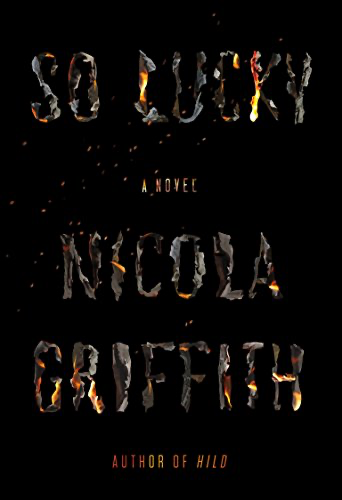
So Lucky – Nicola Griffith“Oh My God” matches the dread of the protagonist, Mara, picking the pieces of her life after losing everything, as well as the lingering feeling that her life is in danger—from herself and from outside forces.

“Cry for Me” – Magdalena Bay

Everything I’ve heard about Imaginal Disk has been nothing short of worship: album of the year (2024), modern classic, cult classic…the list goes on. Imaginal Disk feels inherently tied to hype for me, even though I’ve only heard this song. Again, outsider perspective, Magdalena Bay just seemed to spring up out of nowhere. Before this, I’d only heard a handful of reviews several years ago, a remix they did of Soccer Mommy’s “Shotgun” (not a huge fan, honestly) and this interview they did with Stereogum ahead of Imaginal Disk talking about how much they love the weird CGI in the music video for Peter Gabriel’s “Steam” (which, honestly, so based of them. They really just said “let’s dress Peter up like Jack Nicholson’s Joker and then put his face on as many objects as possible. I don’t care if they’re ungodly cursed.” I love it so much.). There’s also a concept and a narrative I’m missing here—something about a person rejecting some sort of disk put into their head by aliens?—but I’ll do my best.

I was floundering for comparisons for “Cry for Me” at first, but then it hit me. Imagine if the Cardigans had access to 21st century technology in the ’90s, and then imagine them taking that and making some kind of weird disco. They’ve got their uber-’70s violin piano flourishes and bass lines paired with the most modern-sounding, cinematic synths. What’s cooked up is bizarrely good—the at first disparate contrast of Mica Tennenbaum’s air-light voice and the oily chrome of the synths makes for something that works together in surprising harmony. The disco bit sometimes veers into too much for me, but I can’t deny how deliciously catchy “Cry for Me” is—the song’s title is uttered like a seductive plea to cross into a world where everything is glittering and perfect, but once you bite into the fruits, the venom starts pumping through your veins. The crunching, bubbling shift in synths at the 2:00 mark make you feel like you’ve turned a corner on some kind of theme park ride—into what, you’re not sure. For the rowers keep on rowing, and they’re certainly not showing any signs that they are slowing…

BONUS: who the fuck let a keytar in the—oh, okay. Just this once. I’ll allow it. Maaaaaaybe. Magdalena Bay recently covered “Ashes to Ashes” on Triple J, and even though it’s up there with my favorite Bowie tracks, they clearly get how weird of a song it is:

…AND A BOOK TO GO WITH IT:

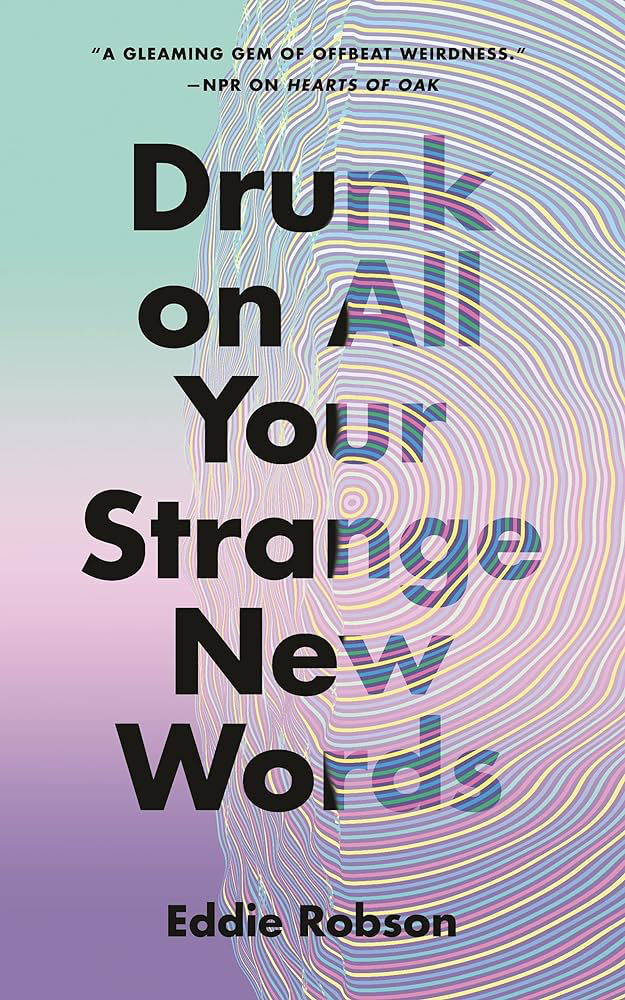
Drunk on All Your Strange New Words – Eddie Robsonagain, I’m not entirely clear on the concept, but if you want alien revelations with unintended side effects, look no further…

“Flowers on the Wall” – The Statler Brothers

Sometimes you remember certain songs at times that are too perfect for words.

“Last night, I dressed in tails pretending I was on the town/As long as I can dream, it’s hard to slow this swinger down/So please don’t give a thought to me, I’m really doing fine/You can always find me here and having quite a time…”

Depression, self-isolation, and making up scenarios transcends time, but getting this song absolutely hooked in my head while I was about a month into lockdown had to be divine intervention. Or something. Minus the more ’60s language, this could’ve been the contents of a long-distance FaceTime call right smack in the middle of 2020. I have a specific memory, give or take five years to the day (I’m just glad I can put some distance from it) of hearing nothing but this song in my head while I was supposed to be recalling something or other about U.S. History for the APUSH exam…a single essay question that I did on my laptop in my bedroom. (Don’t worry, I got a 4. I wasn’t really in dire straits.) Yes, feelings aren’t inherently attached to history, but “Flowers On the Wall” bottled something so succinctly and charmingly. Once it invited itself into my shuffle after years of not thinking about it, that feeling never went away—in a good way. Despite being so pandemic-feeling it never got sullied by it. I’ve never been one for this almost hokier country sound, but it fits the kind of exaggerated state that the narrator’s in—it’s exactly how I’d expect the inner voice of someone who spends their days playing solitaire and dressing up in a tux, never once leaving the house. It’s the catchiest song about extensively denying that you need to touch grass. Truly timeless.

…AND A BOOK TO GO WITH IT:

The Ministry of Time – Kailene Bradleywhat else is there to do when you’re [checks notes] a time-displaced polar explorer from the 1840’s who really shouldn’t leave the (21st century) house?

“DJ” – David Bowie

Diversity win! Bowie is breaking his and her heart!

“DJ” has been on the brain because, back to St. Vincent, they played this song not once but twice before she came onstage. Taste, especially from someone who has said that there’s no one she’d put above Bowie.

From Lodger, “DJ” retains some of the theatricality of his glam days, but well past the Ziggy Stardust days. He’s long shed that persona, as well as the abysmal leanings and drugs of the Thin White Duke, closing out the Berlin Trilogy with a slicker flourish that led into the ’80s (see: “Boys Keep Swinging”). It’s got a critical, sardonic eye that he retained from his earlier ’70s songwriting, magnifying the role of a DJ who becomes so swallowed in his career that he becomes it: “I am the DJ/I am what I play/I’ve got believers/Believing me.” According to Bowie, it was his take on the disco culture that had overtaken the ’70s: speaking to Melody Maker, he said, “The DJ is the one who is having ulcers now, not the executives, because if you do the unthinkable thing of putting a record on in a disco not in time, that’s it. If you have thirty seconds silence, your whole career is over.” Yet it’s so easy to see the through line back to himself—persona or not, you don’t have to chip away at much to find the one true Bowie within.

Even if “DJ” didn’t also spell out David Jones’ initials, this fear of becoming inextricable from his music and celebrity was a constant fear of his in the 1970s. 1979 saw Bowie recovering from his devastating cocaine addiction, and that almost-separation from it makes “DJ” feel like a less fatalistic version of “Cracked Actor,” in which he saw his future self as a washed-out, middle-aged actor relying on his past fame to pay the bills.”DJ” sees him inching away from “Forget that I’m 50/’Cause I just got paid” territory, but no less critical—and almost fearful—of being on the precipice of losing his career thanks to one less hit and being seen only as a vessel for the music. In the music video, he’s passed around by fans in the middle of the street; some hug him and seem to make genuine conversation, while others simply try to give him a kiss on the cheek (BRO?? not to get all gen z with it, but did he WANT that??). It’s all at once tenderly human and a little eery watching him weave through the crowd, some seeing a human, others seeing a celebrity. No matter the disaffected sarcasm in his words and lyricism, Bowie’s always there.

As for the music video…I don’t think there’s really any bad Bowie videos I can think of, and even the really bad ones are at least hilarious. But this one seems to fall on the wayside, and I don’t see why! The way that Bowie drapes himself down the blue shutters, the demolishing of the DJ equipment, the proto-Trait pink boiler suit/gas mask combination…he could work anything. Well…okay, definitely not this. Almost anything.

…AND A BOOK TO GO WITH IT:

Death of the Author – Nnedi Okoraforanother work about the line between the author, their work, and how the two are interconnected, no matter the perceived separations (and the complications that arise from it).

Since this post consists entirely of songs, consider all of them to be today’s song.

That’s it for this week’s Sunday Songs! Have a wonderful rest of your day, and take care of yourselves!
Posted in Sunday Songs

Sunday Songs: 5/18/25

Happy Sunday, bibliophiles! I hope this week has treated you well.

This week: do

you

SEEEEEEEEEEEEEEEEEEEE

THAT I’M SCARED

AND I’M LONELÆEEEEEEEEEEE

Enjoy this week’s songs!

SUNDAY SONGS: 5/18/25

“Innocence” – Björk

Saying that a certain Björk album feels bolder or more in-your-face than others feels redundant because most of them trend towards that direction. According to Sonic Symbolism, Volta was about being upfront, brightly-colored, and loud—in her personality, in her life, and in her political views (see: “Declare Independence”). Volta’s still in the weeds as far as my album bucket list goes, but I love the distinct flavor of it—flat neons and confidence. “Innocence” is a whole feast for me to pick apart in terms of sound. It stomps all over the place, leaving an asymmetrical trail in its wake, angular and herky jerky, but never more sure of itself. It’s the kind of song that makes me think that Björk’s suit on the album cover (designed by Bernard Willem) is about to turn into some kind of mech suit with flag-shooting cannons for hands. This is one of the songs on Volta that was produced by Timbaland, giving it a chrome-like sheen that could almost be pop, but could never deny the inherent weirdness that is Björk. At the beginning, the synths speed up as though winding up for a punch. The angular rhythm is an ouroboros, constantly made and remade again against Björk’s smoother vocals. There’s even a bit at 2:13 that I swear sounds like the Severance elevator noise. Every listen brings something new to the table—there’s all manner of Easter eggs lying around.

Lyrically, I can’t help but think of Debut. “Innocence” is a reckoning with the fearlessness of youth: “When I once was untouchable/Innocence roared, still amazes/When I once was innocent/It is still here, but in different places.” It’s hard not to think of the 1992 Björk that sang of “go[ing] down to the harbor/and jump[ing] between the boats” and ecstatically declaring that there was more to life than this. But the kind of confidence that she maintains at the time of “Innocence” is balancing that excitable youth with the fears that came as she matured: speaking to The Sun, she called the song “A handshake with fear.” For her, fear makes fearlessness even more tantalizing—now that she’s known the grips of it, she appreciates it even more. Even so, it’s still an extreme, but so is fear: “Fear of losing energy is draining/It locks up your chest, shuts down the heart/Miserly and stingy/Let’s open up: share!” Man. Did I need to hear that…for the millionth time. I feel like I’m the reverse, somehow. Of course, I’m not nearly at her maturity level, but I’ve been cautious my whole life. Still am. Fearlessness is freeing, and I only find that I can appreciate it when I have those fears right in front of me: I can see them, acknowledge them, and throw them to the wind, if only for a moment.

BONUS: The video above isn’t the official music video, but the 1st place winner of a fan contest that Björk held to make a music video, created by Fred & Annabelle. Here is the 2nd place winner for the video contest, made by Roland Matusek (Björk Kart?)

…as well as Björk talking about the inspiration behind the animation contest:

…AND A BOOK TO GO WITH IT:

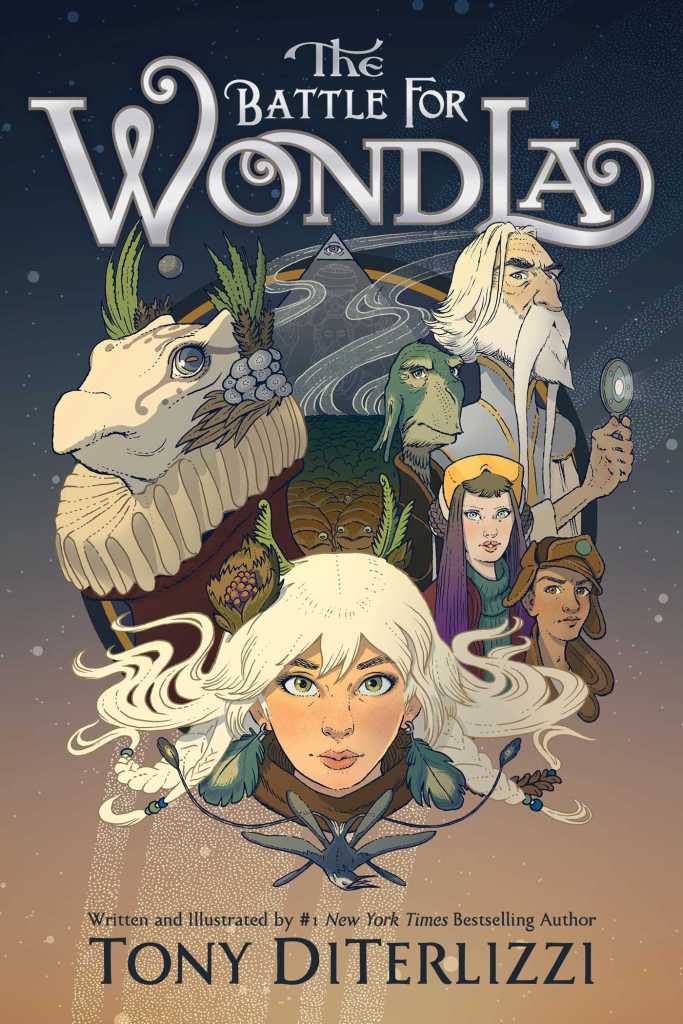
The Battle for WondLa (The Search for WondLa, #3) – Tony DiTerlizzi“When I once was fearless/Innocence roared, still amazes/Untouchable innocence/It is still here, but in different places…”

“Sweet Thing” – David Bowie

It’s been about a year since I finally listen to all of Diamond Dogs in full, and I’m still blown away by how much David Bowie’s storytelling had developed. Throughout his life, Bowie accumulated an extensive library, often bringing books along with him to read on tour. (If you’re interested, John O’Connell compiled a list of some of the books that impacted him the most in Bowie’s Bookshelf. It’s a great read.) The more I think about it, the more I realize that Bowie approached songwriting like an author—whether or not there was a linear narrative, like the story of Hunger City in Diamond Dogs, he had not just melody in mind, but the exact emotion to wring out of which characters and when, and which motifs and allusions to scatter throughout. Obviously, these elements can exist outside of the realm of literature, but it’s so distinct from any given Bowie lyric, much less “Sweet Thing,” that he was a literary-minded man. No wonder I connected with him instantly.

In terms of Diamond Dogs’ tracklist, often with songs that are directly chain-linked to the others, I’m partial to “Future Legend/Diamond Dogs” (my favorite album opening of all time…nothing will ever go harder than that), but “Sweet thing” is the emotional core of Bowie’s narrative, without a doubt. Take a look at the first verse: “It’s safe in the city/To love in a doorway/To wrangle some screams from the dawn/And isn’t it me, putting pain in a stranger?/Like a portrait in flesh, who trails on a leash?” MAN. Glam rock had roots in theatre and the dramatic from the start, but this is one excerpt from Diamond Dogs that would have felt right at home on stage. As one of the entries in Bowie’s failed 1984 musical adaptation, it’s a loose twist on the ill-fated romance between Winston and Julia in Orwell’s novel; Bowie had to make some changes after the musical was dead in the water, rendering the characters nameless and the woman, seemingly, into a prostitute. Under the watchful eye of the “knowing one,” a kind of panopticon surveillance a la Big Brother, the narrator and the prostitute share painful, ill-fated, but fleeting love: “I’m in your way/And I’ll steal every moment/If this trade is a curse, then I’ll bless you/And turn to the crossroads…” With the imagery aplenty of doors and doorways, it’s an affair steeped in transition, an air of impermanence and separation present in every bittersweet moment. Bowie sells it all with one of the album’s most heart-wrenching moments: he draws out “Will you see/That I’m scared and I’m lonely?” with a stabbed, bleeding heart, hand outstretched, with full on musical theater drama. Yet never once does it feel false—Bowie can’t help but let some sincerity slip through the metric ton of personas and fiction. Alan Parker’s guitar soars in true glam-rock fashion, and somehow, the saxophones never feel out of place; Bowie’s world is all brass, rust, and forbidden love—a world fully realized that burst from the shell of Orwell to become a myth all its own.

BONUS: for the full experience, here’s the full story, told in a joining of “Sweet Thing,” “Candidate,” and “Sweet Thing (Reprise)”:

…AND A BOOK TO GO WITH IT:

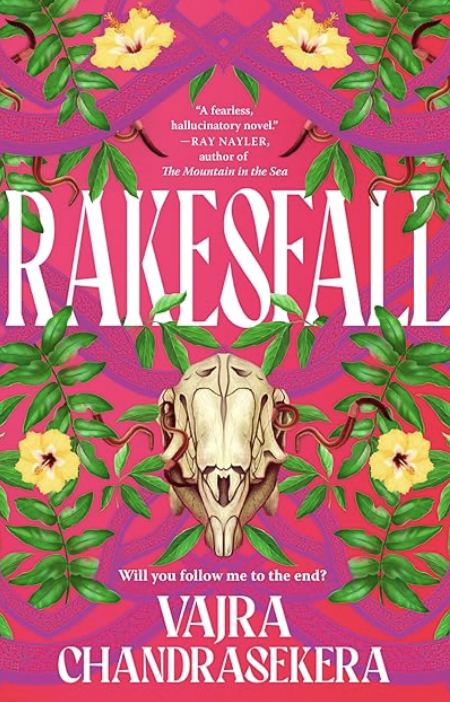
Rakesfall – Vajra Chandrasekerathe 1984 pairing has run its course at this point, so here’s a story of epic-like love spanning across space and time.


“Pet Rock” – L’Rain

Another amazing find from my dad, “Pet Rock” thrives on being propped up. The music video shows a variety of pet rocks being set up and placed around a miniature dollhouse fitted with all manner of retro furniture, tiny instruments, and mini versions of L’Rain’s album I Killed Your Dog. (Now that’s a title for you…what’d you have to do that for??) The music thrums with distortion, barely contained chaos with a bubbly, Crumb-like atmosphere, faintly on the verge of psychedelic collapse. Taja Cheek’s vocals, like Lila Ramani, flicker in and out of clarity—the only time a finger pokes through the haze is when the guitar, before the instrumentals start unraveling, almost tricks you into thinking that there’s a light at the end of the tunnel. Like the dollhouse, “Pet Rock” has the feeling of a neon-colored haunted house (new Meow Wolf concept?)—everything appears structurally sound, but there’s all sorts of weirdness drifting just out of earshot.

The lyrics take a similar turn: after speaking of being propped up like said rock “Why would you go without me?/And make me something else?”), the lyrics go from a faint dread to something outright sinister: “Like a dead girl with shades on/Propped up by captors/I’m fine/I’ve got no one to talk to.” HUH?? Cheek told Alternative Press that the story was inspired by “an old story I’d been told about a woman who was riding the train but looked strange, and the reader eventually figures out that she’s dead, with glasses on, being propped up by the people that seem to have harmed her.” There’s a solid manipulation metaphor for you—rock or human, you’re not alive, just a nice little dolly to be moved around the dollhouse in whatever way suits you.

It’s just a rock! Or not quite, this time? Rocco takes a stand?

…AND A BOOK TO GO WITH IT:

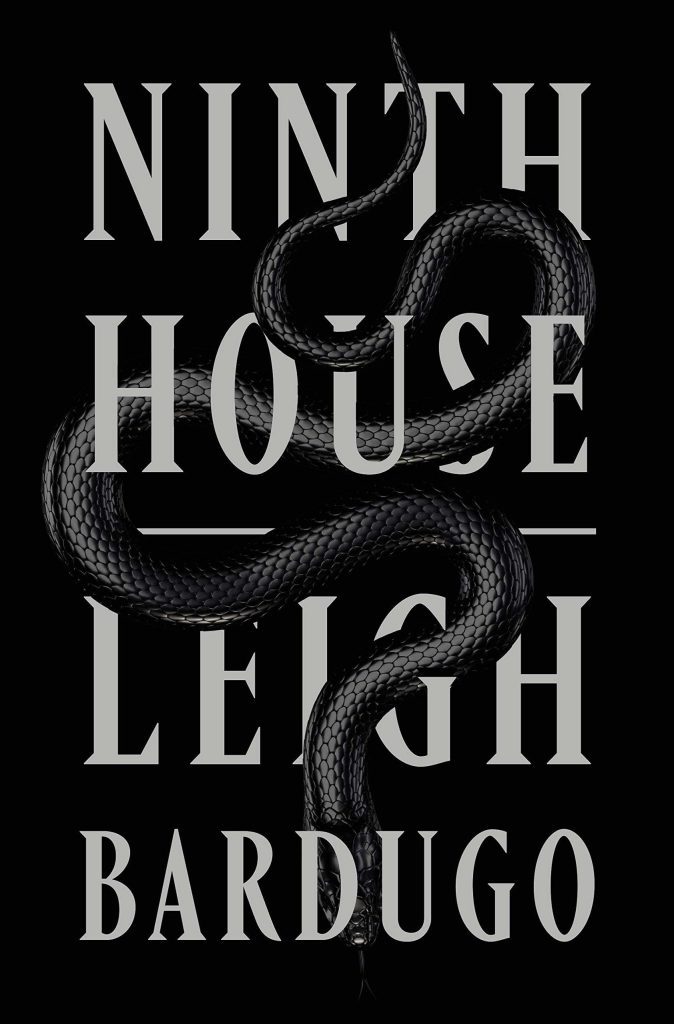
Ninth House – Leigh Bardugo“Like a dead girl with shades on/Propped up by captors/I’m fine/I’ve got no one to talk to/It’s all my fault, I know…”

“Blossom (Got To Get it Out)” – Komeda

I seem to gain a tolerance for more uptight songs once I get older, but in retrospect, “Blossom” gets less uptight the more I listen to it. Sure, it’s about as high-strung as The Feelies, but it’s got this ’60s girl group feel to it that makes it inherently more playful. Komeda seems to fall into a kind of indie, ’90s niche taking their cues from the bubblegum pop from the ’60s (see also: The Rondelles); it’s jangly as all get-out, and features an almost Fred Schneider-esque chorus of spelling out “B-L-O-S-S-O-M” like a cheerleader’s chant. I’d argue that Komeda’s voices aren’t quite as enthusiastic as their forebears (and the instrumentals), but it’s got that vibrant, candy-colored spirit of the ’60s with a distinctly ’90s production—it’s much more fun now that I’ve revisited it.

What makes this song infinitely better for me is the fact that, under the title “B.L.O.S.S.O.M.,” this song was on Heroes and Villains, an album of songs inspired by The Powerpuff Girls, alongside The Apples in Stereo, Devo, Dressy Bessy, and Frank Black…what a time to be alive. This version is re-recorded, sped-up, and drum-machine-ified, and doesn’t resemble a whole lot about the original. The more electronic version isn’t jangly at all, but the very early 2000’s, rapid-fire instrumentals mesh with the 2d, supersonic speed of the Powerpuff Girls. I’m partial to the original, but at least you’ve got this absolute banger from The Apples in Stereo, right?

…AND A BOOK TO GO WITH IT:

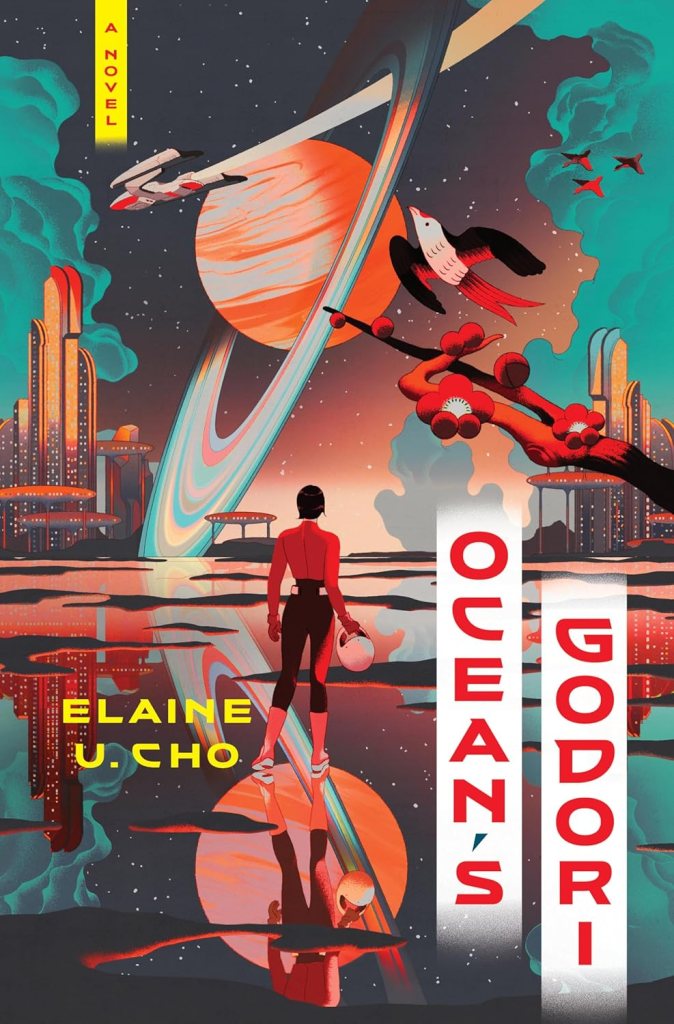
Ocean’s Godori – Elaine U. Chovibrant, fast-paced, and with the kind of spaceships I can imagine blasting Komeda through their speakers.

“High” – The Cure

I wasn’t here to witness it, but it must’ve been such a jarring shift in the ’90s when the Cure became more embraced by the mainstream. My parents talk about how maddening it was to have their special, alternative music be ignored or made fun of in the ’80s and then all the normies started singing along to “Friday I’m In Love.” Jeez. The Cure could always make an incredible pop song, but it never ceases to baffle me that they went from being relatively underground to selling out arenas in such a short period of time. Now that rock is less adjacent to the mainstream these days, I can’t say I’ve had an experience that mirrors it. The only thing I can think of is all of the members of boygenius getting huge, but they aren’t nearly as weird as the Cure were. The eternal battle: wanting people to appreciate your weird music, but wanting to gatekeep it at the same time…

I can’t fully grasp the kind of frustration my infinitely-cooler-than-me in their ’20s parents had when Wish came out back in 1992. I fully adore “Friday I’m In Love,” even though I can recognize that it’s leagues less weird than the more creative parts of their catalogue. But if the fact that I remember “High” to this day must prove that they weren’t all that resentful. “High” was a mainstay throughout my childhood in many a car trip—I distinctly remember mishearing “licky as trips” as “licky as chips” (those damn Brits) and Robert Smith meowing (can you really have a Cure song without it?). I’m charmed to this day about the way Smith makes adjectives into nouns with each lyric—”sky as a kite” or “kitten as a cat” makes perfect sense in his lingo. What strikes me now is that The Cure, even at their darkest, always kept true to having emotion at their core. They were dramatic and goth, but they were always in touch with whatever was at heart, and painted it in every complicated color. “High,” like “Friday I’m In Love,” is proof that they can be just as sugary and playful as they can be brooding and raw, but to an extent, all of it feels true to them. Like the subject, who’s “happy as a girl/limbs in a whirl,” “High” is The Cure in a dreamy, lovelorn state, adrift in the clouds in the throes of ecstatic love. It’s not their most emotional love song, but it’s got a similar purity as “The Perfect Girl” or “Just Like Heaven”—”High” feels like a spiritual successor of that emotion, even if it’s not fully on the level of the latter two to me. To this day, this track remains as warm as sand between my toes or afternoon sunlight heating up the glass of the back seat of a car.

…AND A BOOK TO GO WITH IT:

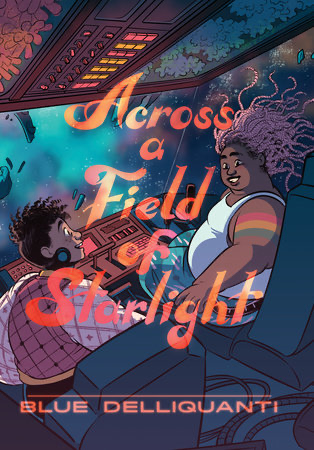
Across a Field of Starlight – Blue Delliquanti“And when I see you take the same sweet steps/You used to take, I say/’I’ll keep on holding you in my arms so tight/I’ll never let you slip away…'”

Since this post consists entirely of songs, consider all of them to be today’s song.

That’s it for this week’s Sunday Songs! Have a wonderful rest of your day, and take care of yourselves!
Posted in Sunday Songs

Sunday Songs: 10/13/24

Happy Sunday, bibliophiles! I hope this week has treated you well.

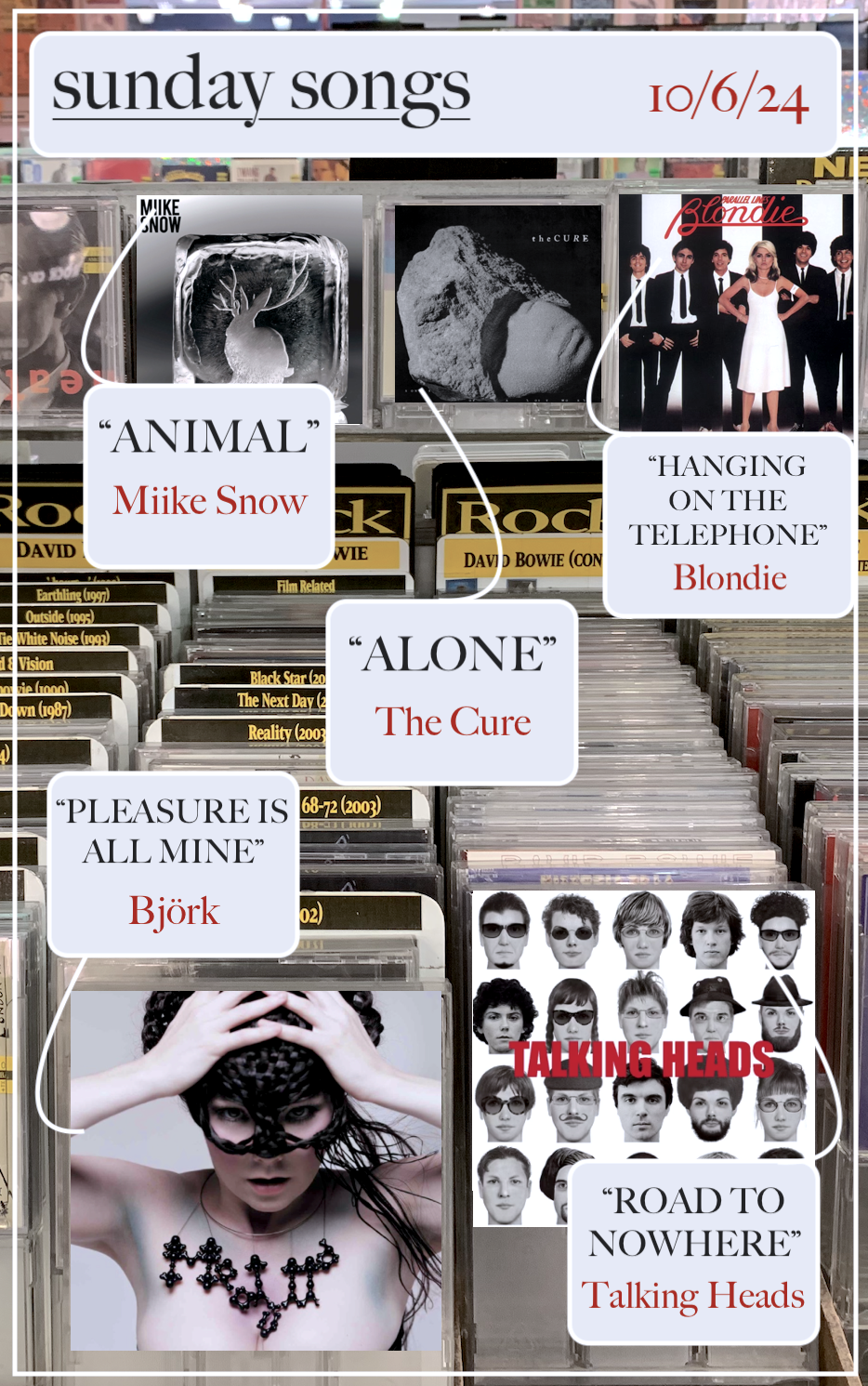
Apologies for the lack of a Sunday Songs last week and a Book Review last week—midterms are one helluva drug. Either way, I have been able to read some fantastic books, so expect a fun review next week. For now, here’s my graphic from last week:

10/6/24:

This week: MOM!!! MOM, MADELINE’S GOING AFTER THIN WHITE DUKE APOLOGISTS AGAIN!

Enjoy this week’s songs!

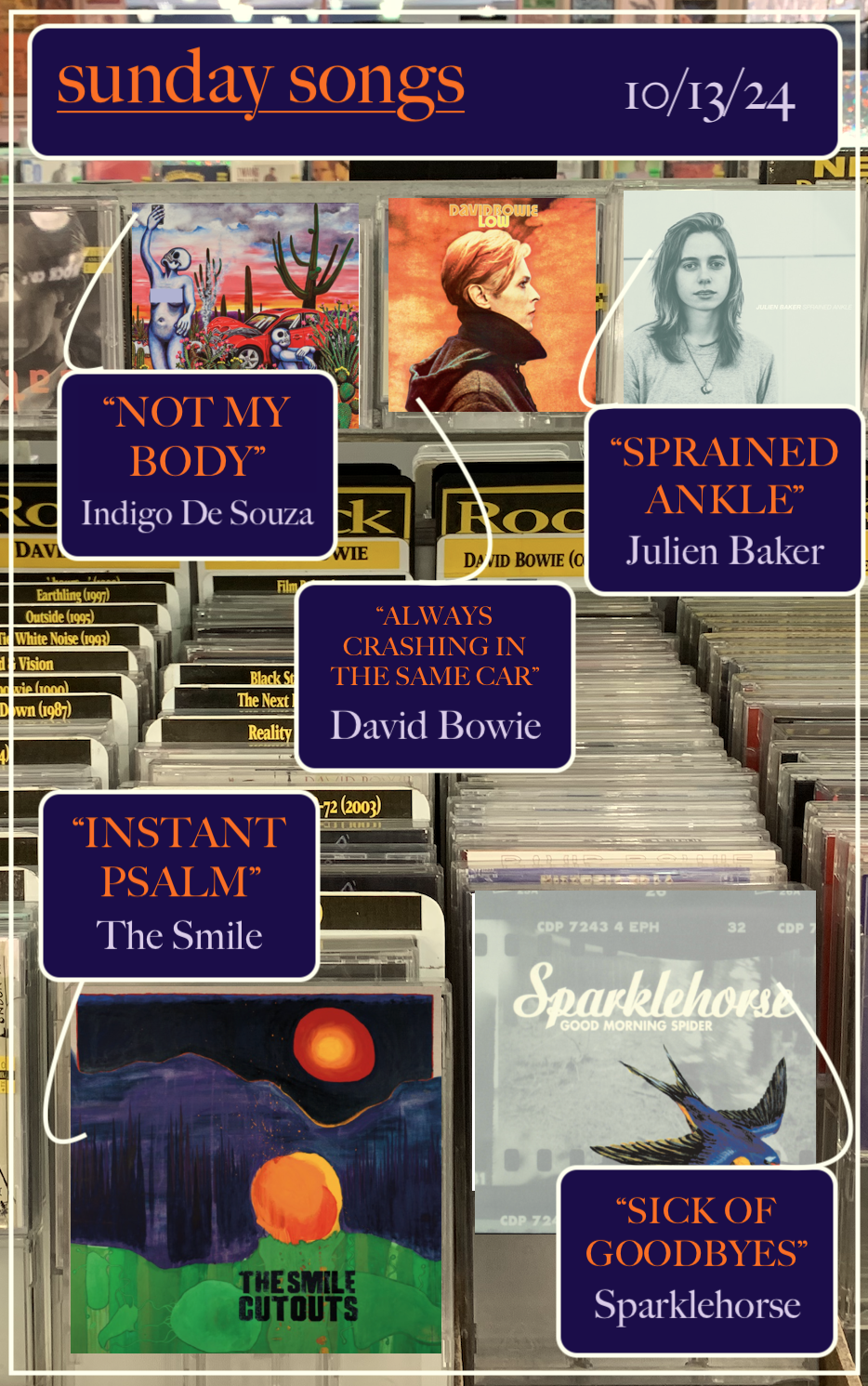
SUNDAY SONGS: 10/13/24

“Instant Psalm” – The Smile

Unprecedented opinion by me: Cutouts, the second album from The Smile in 2024, was…a slight disappointment. Are all of the songs good? Absolutely—this is The Smile we’re talking about, remember? And yet, even though the talent is all there, well-crafted songs don’t make up for an album lacking in cohesion. If they knowingly named the album Cutouts for this reason, it might make sense, but it really does live up to the name; these are the scraps, but for a band as artfully skilled as The Smile, the scraps will be treasures. Even if Cutouts meanders this way and that without the direction of A Light for Attracting Attention, the moving parts are spectacular.

Take “Instant Psalm.” I love when I just have the gut feeling of knowing that a song will rearrange my molecules after only listening to a 30-second snippet of it. From the minute the strings sunburst into existence, you feel that light blooming in the back of your mind. To say that this song only starts would do it a critical injustice: it awakens in the same way a flower does, the same way a cloud of spores puffs from a stomped mushroom, all of its glistening tendrils erupting in slow motion after the joyous moment of birth. “Instant Psalm” lyrically contains about the same existential dread as any other The Smile track, but I’d place it somewhere near “You Know Me!” in terms of siblings; these glistening tendrils have heralded the manipulation that the former track ushered in, and now, all is left is a kind of mental automation where your mind knows that what it’s doing is wrong, but cannot let go of what’s coiled around it: “yes is not a real yes.” It’s so calm in its submission, and that “Instant Psalm” feels like sparkling dust blown into the eyes, the kind that clogs them up enough that they no longer see reality. If there’s anything highly specific that The Smile has excelled in, it’s making songs about submitting to corrupted, outside forces sound so soothing and sleepy. Again: precisely the point.

…AND A BOOK TO GO WITH IT:

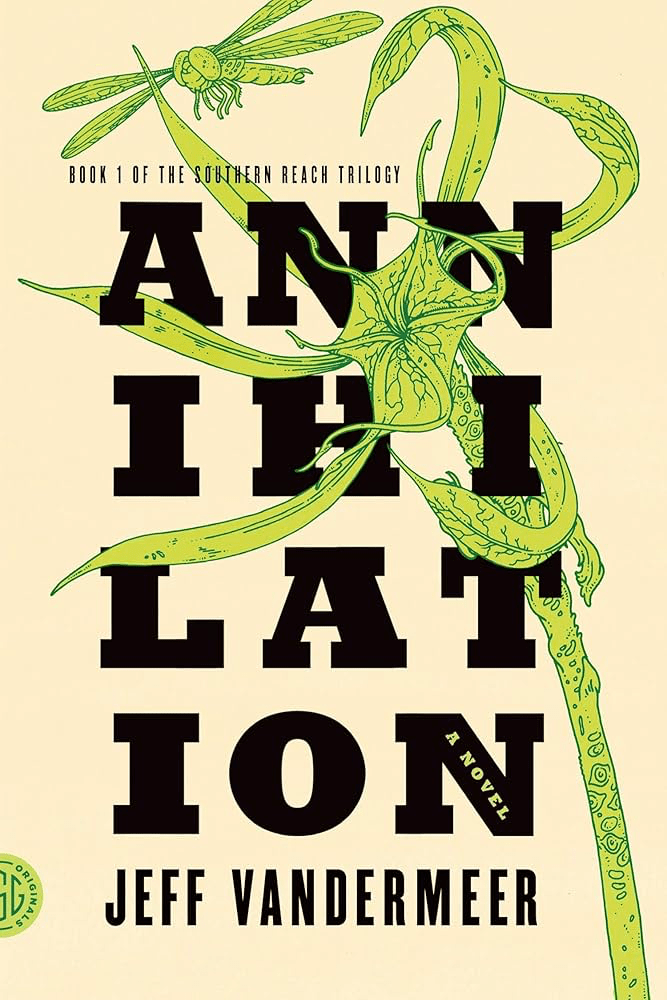
Annihilation (Southern Reach, #1) – Jeff VanderMeer“We can slide through this narrow gap/The narrow gap that you leave us in/And we feel you near/But so close that you disappear…”

“Sick of Goodbyes” – Sparklehorse

Listening to It’s a Wonderful Life prompted me to return to one of my many depressing high school lovers: Good Morning Spider, the album that preceded the former. I thought “Sick of Goodbyes” was okay back then, and given how much I suckled on that album like a baby bottle, “okay” is harsh. Compared to the irresistible draw of the melancholy of “Sunshine” and the adrenaline-blooded screech of “Pig,” this one stuck out like a sore thumb. Why is it so twangy? And my God, is it actually…upbeat?

To be fair, it really does stick out oddly in Sparklehorse’s catalogue, and for how odd Sparklehorse sounds, that really is saying something. It somehow lies at the crossroads of alt-country and punk, where scratchy guitars meet the place where Mark Linkous hefts his Southern twang into the spotlight. It’s got a vigor that few other songs on Good Morning Spider have (save for “Pig”), but the emotion behind it is no less of a punch to the face than the rest. Linkous’ specialty has always been stirring the surreal into his lyrics like a witch tossing strange objects into a cauldron, and “Sick of Goodbyes” has what I think may be one of his best weird one-liners: “no one sees you on a vampire planet.” No beating that, right?

But beating between lyrics like that is one of the sparer sentiments, but there’s no making it flowery: “I’m so sick of goodbyes.” It is sad in the way that a Sparklehorse song typically is, but the fury behind it makes it seem almost intent on healing. It’s a recognition of wanting to free yourself from the wallowing that you’ve been doing, and saving up all of the energy to declare as such. It’s not lost on me that the final belt of the chorus cuts off at “I’m so sick,” but I can’t not see the momentum. There may be no motion yet, but all of that energy has formed legs that are willing to stand, legs that are willing to rise from the muck and power forwards. “I’m so sick of goodbyes” feels like that spark of energy after you’ve gone through the first, ugly period of your grieving and realizing that you’ve spent so much energy on the dead that you have forgotten to go on living.

…AND A BOOK TO GO WITH IT:

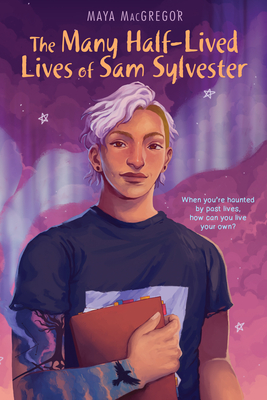
The Many Half-Lived Lives of Sam Sylvester Maya MacGregor“If I could just keep my stupid mind together/Then my thoughts would cross the land for you to see/No one sees you on a vampire planet/No one sees you like I do…”

“Not My Body” – Indigo De Souza

“Not My Body,” with De Souza’s intro, starts at 8:02.

While I ping-pong on whether or not I should listen to Any Shape You Take or All Of This Will End in my ongoing Indigo De Souza journey, I watched their Tiny Desk Concert, taken from the period of the latter. When introducing “Not My Body,” she said this about the song: “I think that when I die…what I want is to be composted and to become soil, and for that soil to be used to plant a tree, and I want that tree to be so big and strong. I don’t know what kind of tree yet—still thinking on it—A tree that people can visit and be like, ‘This is Indigo!'” Thus, she joins Peter Gabriel and his oak tree in what I imagine is a growing forest of reincarnation. It’s a soothing thought, to be reborn in the cells of something so sturdy.

Do you ever get those moments where you stop and have this realization that out of the billions of people on this Earth, that you are you, and by some roll of the dice, this is your life, this is your body, and this is who you are? It’s been a recurring thought lately. Those memes about gaining consciousness at age 4 in the middle of a Chuck-E-Cheese honestly hit the nail right on the head. For whatever reason, it’s been a recurring thought as of late. Not ideal for when I’m supposed to be listening to lectures, but it is a humbling reminder. As disembodying as those moments are, they remind me that yes, I do have the reins on this body. De Souza describes “Not My Body” as an ode to nature, and it taps into that feeling of being so conscious of your existence yet, for a moment, a spectator of it: “I’m not my body although you see me/Making moves and walking freely.” Nature, for me, is the missing key in this equation; the redwood tree that De Souza wants to be is the ultimate symbol of groundedness and connectivity—it is rooted in the earth, but its roots connect to all points in the wide world above and below it. There’s a happy medium between awareness and not feeling like you’re adrift in space, and nature has figured it out. And what better way to end such a sentiment than the last third of “Not My Body?” The way De Souza fashions their voice like a theremin, those echoing electronics that almost sound like dolphin calls, the gentle collapse of all the instruments into a single, coalescing being?

…AND A BOOK TO GO WITH IT:

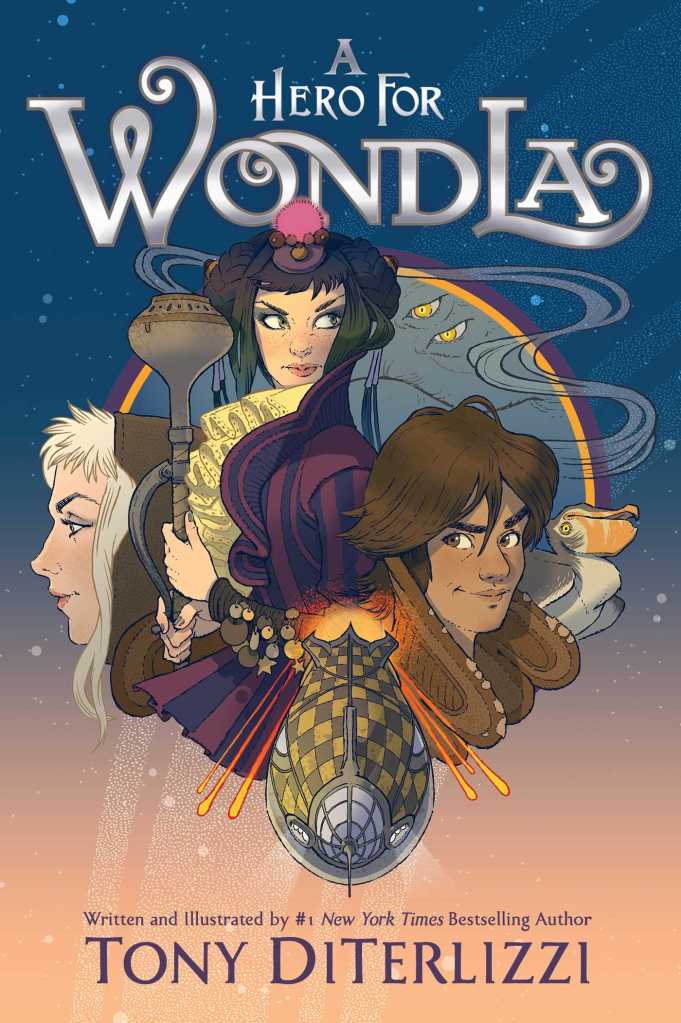
A Hero for WondLa (The Search for WondLa, #2) – Tony DiTerlizziwithout spoiling anything…Eva Eight arc, perhaps?

“Always Crashing in the Same Car” – David Bowie

If you mistook the title of this song for a commonplace idiom, I wouldn’t blame you. Frankly, it should be one. It’s memorable, it’s effective, and it’s a Bowie reference.

Low came at a deeply fraught time in David Bowie’s life. His Berlin trilogy of albums came on the heels of his darkest period, one where he committed actions that he disavowed until his dying day. Hence why I’m always suspicious and disdainful of Bowie fans who think that the Thin White Duke is somehow the “deepest” of his personas. Oh, okay, do you think you’re cool because you like the Bowie who was taking so much cocaine that it addled his brain enough to the point that he had a brush with Nazism? This is the period that Bowie spent the rest of his life thereafter vehemently swearing off (see: “Under the God“), and every clip from that era shows that he was clearly not of sound mind and body. Taking a critical look at the period is one thing, but being so uncritical about a period that Bowie so clearly wanted to forget takes a certain kind of thickheaded edgelord, in my humble opinion. It took him years to return to reality, and the Berlin trilogy chronicles his long and rocky journey towards healing, not to mention getting clean.

The circumstances surrounding “Always Crashing In the Same Car” are a fragment of Bowie’s period of addiction, an instance where, high out of his mind, he rammed his car into the car of his drug dealer. Yet there’s such a calm to this track, both warm and cold. It’s as though Bowie is watching his own life as a spectator, watching the car spiraling out of control from high above the clouds. His voice is placid, restrained, as he resigns himself to the song’s title, doomed to make the same mistakes. Apart from the crooning towards the conclusion, his voice never leaps—what does is the soaring guitar riff that seems to unfold Bowie’s ladder into the sky, from which he can watch his life from a safe distance.

Even if I haven’t gotten to such extreme lows in my life (please hold an intervention if I somehow do, good god), that kind of distance what makes the message of the song land. Breaking out of cycles and unhealthy habits is one of the hardest things a person can do, in my opinion. The effort it takes to change is outweighed by the ease of staying stagnant. You know you’re crashing in the same car, and yet your hands grip the wheel anyway. A few months, I made a commitment at the beginning of the month to stop being consumed by trivial thoughts, and I found myself trapped in an even worse cycle of anxiety just days later. The internal work I did that month was some of the most mentally strenuous that I’ve had in a while—it was far too easy to fall back on ineffective, harmful coping mechanisms than to put in the work to claw myself out of that pit of misery. I’m still working on it. But I’ve put in work. It’s taken a lot of clawing, but I’m growing the armor. Listening back to “Always Crashing in the Same Car” after all that mess gives it a whole new meaning—maybe the triumph I feel from that truly glorious guitar solo is symbolic of how it feels to climb through the sunroof, out of the wreckage, and into the light, knowing that the hard work of breaking these patterns is done.

…AND A BOOK TO GO WITH IT:

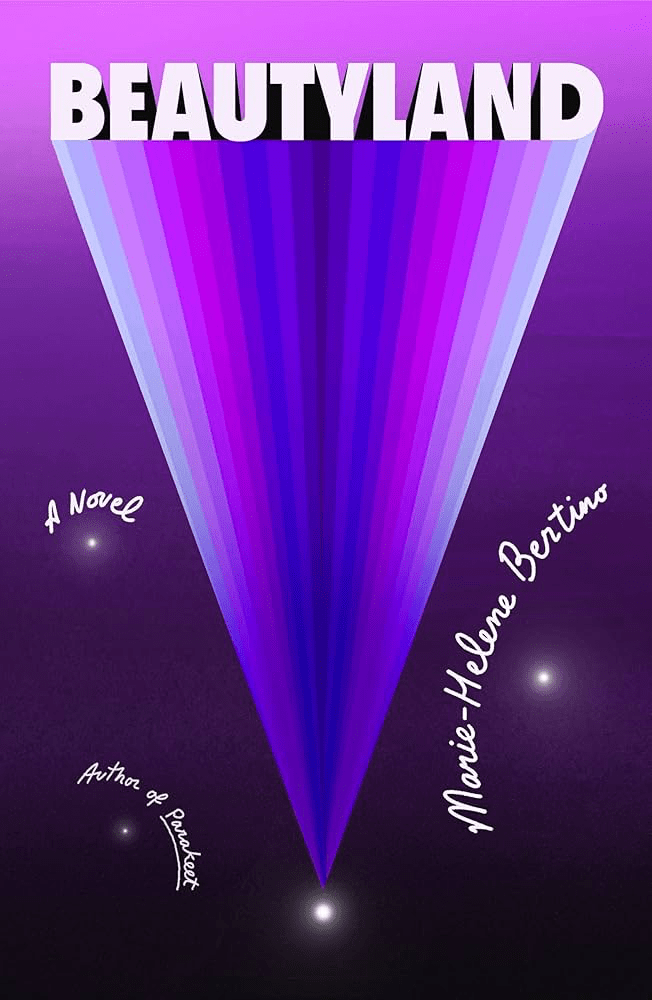
Beautyland – Marie-Helene Bertinothe narration of this novel feels the same as Bowie’s singing here: a kind of cool, matter-of-fact distance through which the world is observed, but not without some warmth.

“Sprained Ankle” – Julien Baker

From all accounts, it seems like Julien Baker has something new cooking up post-boygenius, and…hoo, boy. Am I ready? Nope. Nevertheless: I will listen. I will cry. (I already love “Middle Children” and “High in the Basement,” what can I say?) It seems simultaneously like ancient history and the blink of an eye away from when I first discovered Julien Baker, when, halfway through junior year during COVID, I listened to Sprained Ankle while I was a miserable puddle of grief and burnout. Whether or not that’s the only state you can properly listen to Julien Baker without curling up in a ball and crying is debatable, but…the only way out is through. Dramatic expression for weathering an album, I know, but there’s something gratifying in knowing that I’m a happier, stronger, and more healed person than the person I was when Little Oblivions came out in 2021. To my mom: consider this a formal apology for making you sit through almost a-capella Julien Baker depression while driving to school while it was barely even light out.

In the barest sense, Baker was working with what she had. She didn’t have any backup instrumentalists and recorded this in college at age 20, so there wouldn’t be any accompaniment other than what she played herself until Little Oblivions, alternating between guitar and piano. Yet there is no other way that “Sprained Ankle”—or any of the songs on Sprained Ankle—could have been made. It’s a lonely, self-deprecating, and wound-stingingly raw album, and outside of the lyrics, it sounds lonely. Like the bare, unadorned background of the album cover, many of the tracks feel like being in a cramped room with only the sound of your negative thoughts to keep you company. I realize how awful of an endorsement of Baker that is, but in that dreary state of 17, that was just what I needed. (To be fair, it can get to be too much—“Go Home” was exceedingly hard to listen to even back then, which is really saying something.) In the sparse, Baker creates a kind of confessional solace. Confessions are how “Sprained Ankle” starts off, after all: “I wish I could write songs about anything other than death.” There’s a self-awareness to the sadness, but like “Always Crashing In the Same Car,” the engine is running on borrowed fuel, and the marathon runner is sprinting on sprained ankles. Beyond the metaphor, Baker’s voice is meant to be the loudest thing on this record—like the cramped room, it echoes off the walls it’s given, an oral manifestation of the feeling of knowing that all you’ve got is your body. It would take a few years for it to reach the soaring heights of “Claws In Your Back,” but from the start, Baker always knew she had an anchor in her music—the instrument of her wobbling yet lighthouse-beacon piercing voice.

Now that I’ve mentioned “Claws In Your Back,” I can’t not link this dazzling performance from Baker with the National Symphony Orchestra…dare I say I haven’t felt goosebumps quite like this in years?

…AND A BOOK TO GO WITH IT:

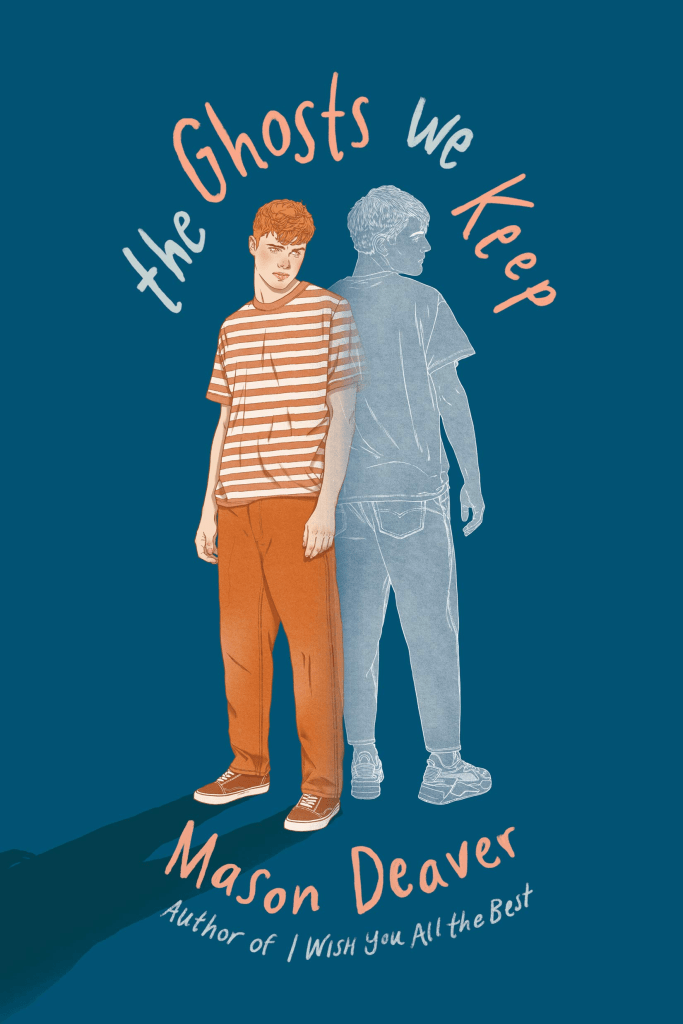
The Ghosts We Keep – Mason Deaver“I wish I could write songs about anything other than death…”

Since this post consists entirely of songs, consider all of them to be today’s song.

That’s it for this week’s Sunday Songs! Have a wonderful rest of your day, and take care of yourselves!
Posted in Book Review Tuesday

Book Review Tuesday (10/1/24) – Death’s Country

Happy Tuesday, bibliophiles, and happy October!

Since today is both in the middle of Latinx Heritage Month and the start of spooky season proper, I figured I would deliver on both fronts. I’d heard a lot of buzz about this one, especially the fact that it had polyamorous representation—something I rarely see in literature, much less in YA. Genre fiction written in verse is also uncommon, so I had to pick up this book since it combined both of them. The result was something that was inventive at every turn.

Enjoy this week’s review!

Death’s Country – R.M. Romero

Andres Santos is ready for a new start. After moving to Miami from São Paulo, he’s keen on leaving his past behind—especially his brush with mortality after nearly drowning and seeing the face of Death itself. He barely escaped by making a deal with Death for a second chance at life. Now, he’s a part of a happy, poly triad, deeply in love with spunky photographer Renee and joyous dancer Liora. But when a car crash puts Liora in a coma, Andres and Renee know that the only option is to confront Andres’ past—by returning to the Underworld where he once bargained for his very life.

TW/CW: car crash/coma, emotional abuse, suicide, self harm, eating disorders, fantasy violence

The minute that David Bowie was mentioned, I tried so hard not to go headfirst into liking this novel. My expectations were average, and I wanted to be surprised. And then “Space Oddity” became a recurring motif. You know me, I ate that up.

For the most part, I’ve rarely seen genre fiction and novels in verse mix. The latter is usually reserved for telling realistic fiction stories and occasional historical fiction, though I’ve only seen one or two examples of the latter. But using this method outside of fiction is something that, now that I’ve read Death’s Country, I feel should be utilized more often. Poetic language lends itself to describe the dark, fantastical setting of this novel and fantastical settings in general, and Romero’s is no exception; even if it doesn’t fill up the entire page, the flowing language renders the setting in luscious detail. Given that romance is also at the beating heart of this novel, Romero’s decision of putting it in verse made the romance feel all the more like the center of the narrative. Once more, her language didn’t just put the spotlight on it—the sparsity of the amount of words on the page truly made it feel like the center of the universe.

Even with the leaps and bounds that literature, mainly YA, has made in terms of queer representation, I’ve seen hardly any with polyamorous representation. (The only other one that I can remember is Iron Widow, which I also recommend!) What I liked about how Death’s Country handled it was that it was a polyamorous story, but that it wasn’t necessarily about polyamory; those stories have a place, but sometimes, the most powerful representation comes from seeing yourself in fantastical stories usually reserved for white, cishet, etc. protagonists. There are great discussions about the stigmas surrounding polyamory (cheating, slut-shaming, etc.), but they were only a part of the story, not the whole. The more that I think about it, a poly triad makes this story work in a way that it might not have with a couple; having two people, not just one, braving the Underworld for their girlfriend in a coma, presented a unique twist on a story that’s been retold countless times, and presented an opportunity to explore multiple perspectives of love under duress.

I went into Death’s Country expecting a meditation on death (obviously), but what I didn’t expect was such an insightful metaphor about how we idealize those we love in death. The Underworld in Death’s Country is almost a vehicle for reproducing what people deem most memorable about them: not just how they die, but how they were seen in death. Liora, who was adored unconditionally by both Andres and Renee, has been molded into a romanticized version of herself that, upon closer inspection, barely resembles the real Liora. Most of that is thanks to the manipulation of The Prince, but we later find out that even he is a reflection of the dark side of Andres’ love—that kind of unquestioning idealization that strips a real person into a glowing facsimile of who they once were. This provided an insight into these kinds of retellings (Death’s Country is a loose retelling of the myth of Orpheus and Eurydice) that they don’t normally touch on; death changes the people you love physically, but also mentally—in the perceptions of others that come to define them once their physical body is gone.

However, I feel like Death’s Country could have used a dual POV to execute the emotion to its absolute fullest. The only perspective we get is Andres, while we never get into the headspace of Renee, who is journeying with him through the underworld alongside him for the entire book. I wasn’t as big of a fan of Andres as a protagonist (I found him to be on the abrasive side at worst), but Romero’s writing of him was never sloppy or badly-executed in a technical sense. I just had the strongest sense that Renee had just as much of a story to tell as him! I get that Andres was specifically the one who made a deal with Death for another shot at life, but Liora isn’t just his girlfriend—she’s Renee’s girlfriend too. She needed more backstory, but I have a strong feeling that Death’s Country would have been enhanced if she’d also had more of a voice.

All in all, an inventive, fantastical novel-in-verse with plenty of fresh twists on otherwise well-trodden literary ground. 4 stars!

Death’s Country is a standalone, but R.M. Romero is also the author of The Dollmaker of Krakow, The Ghosts of Rose Hill, A Warning About Swans, and the forthcoming novel Tale of the Flying Forest.

Today’s song:

A NEW CURE ALBUM?? what a time to be alive

That’s it for this week’s Book Review Tuesday! Have a wonderful rest of your day, and take care of yourselves!
Posted in Monthly Wrap-Ups

June 2024 Wrap-Up 🐻

Happy Sunday, bibliophiles!

Halfway through 2024…no! No we aren’t 😀😀😀😀😀😀😀😀😀😀😀😀😀😀😀😀

Let’s begin, shall we?

GENERAL THOUGHTS:

After how busy and hectic my sophomore year of college was, June has been a time to recharge in more ways than one. I went on a quiet vacation at the beginning of the month (Ouray and Black Canyon of the Gunnison—the latter is a very underrated national park, I highly recommend it!), and I’ve taken the rest of the month to…well, rest. I’ve tried to be on social media less and focus on art, writing, and generally nourishing my creativity. In preparation for Camp NaNoWriMo (I only ever do the July camp these days because November and April are both abysmally busy times for me now that I’m in college), I’ve decided to round out my sci-fi trilogy and write the first draft of book three; at this point, I’ve beefed up the outline like a grizzly bear before hibernation, so at least I’ll have some sense of direction…wish me luck!

My reading month started out slower, and it’s had some dips, as always, but I ended up reading loads of fantastic queer books for pride month! Predictably, one of my vacation souvenirs wasn’t something related to where we went…no, I bought a copy of The Familiar at a local bookstore (support ’em!) knowing that it would take eons for my hold to arrive at the library. Worth it. I also figured it was as good a time as any to re-read my favorite series from when I was a kid—the WondLa trilogy. My verdict? It healed my soul and reinvigorated my creativity. Some kid’s books don’t age well, but WondLa never gets old.

Other than that, I’ve just been making art, playing guitar, going to pride (so much fun!), watching Hacks, Succession (nearly finished with season 1, and all it’s done is made me fear business majors even more than I already do), and…morbidly, Apple TV+’s new show that they decided to call WondLa. I’m three episodes in, and it’s like watching a train wreck. Expect a retrospective on the WondLa trilogy and possibly a review of…whatever that show is that definitely isn’t WondLa.

On a lighter note, photos from my vacation and pride:

(The bear on the title of the post is in honor of a bear we saw crossing the road in Black Canyon. Could also represent bears in general? Happy pride.)

READING AND BLOGGING:

I read 18 books this month! It’s been another relaxed reading month, and although I had a slump towards the end of the month, I read several incredible books for pride month!

1 – 1.75 stars:

Wild Massive

2 – 2.75 stars:

The Buried and the Bound

3 – 3.75 stars:

The Feeling of Falling in Love

4 – 4.75 stars:

The Spirit Bares Its Teeth

5 stars:

The Battle for WondLa

FAVORITE BOOK OF THE MONTH (NOT COUNTING RE-READS) – Freshwater – 4.5 stars

Freshwater

POSTS I’M PROUD OF:

POSTS FROM OTHER WONDERFUL PEOPLE THAT I ENJOYED:

SONGS/ALBUMS I’VE BEEN ENJOYING:

ADORE THIS ALBUM.
this song cracks me up…happy pride
forgot about this song for ages…thank you to my dad for resurrecting this one for me!
on a cocteau twins kick again…
LIVE LAUGH LISA GERMANO
great album!! with all the buzz it got when it came out, I’m surprised that I never heard anything about this one…
HOT WILCO SUMMER!!

Today’s song:

living for the Galaga noises at 0:26

That’s it for this month in blogging! Have a wonderful rest of your day, and take care of yourselves!
Posted in Sunday Songs

Sunday Songs: 6/30/24

Happy Sunday, bibliophiles! I hope this week has treated you well.

This week: this ain’t rock n’ roll…

Enjoy this week’s songs!

SUNDAY SONGS: 6/30/24

“Future Legend/Diamond Dogs” – David Bowie

Another victim of me trying stubbornly to fit this into a color scheme, and also a victim of me trying to align my albums with what I draw on the whiteboard of my dorm. Listen, if the original sleeve was banned in the U.S., that generally means it’s a cool album cover, but probably not a good idea to be displayed for the world and my RA to see. And I was not about to draw David Bowie’s anatomically accurate canine lower half. Nah.

A time-proven rule: nobody does it like Bowie. You can put on all of the theater and spooky voices that you like, but nobody will ever replicate the sheer goosebumps that the intro to this album induces. The same can be said for many songs on this album (see: “Sweet Thing/Candidate/Sweet Thing [reprise]”), but I put “Future Legend” and “Diamond Dogs” together because the most enriching way to experience them is to experience them as a single song, and that single song is one of my favorite album intros of all time. Diamond Dogs is glam rock covered in flies—the lovelorn hope of Ziggy Stardust remains, but stinking of a world left in tatters, a hunk of rotting meat left for the mutant vultures in the searing desert heat. Cobbled from shreds of William S. Burroughs and Bowie’s failed attempt at a musical adaption of 1984, this album is a dystopia full of lust and peril. As a prologue, “Future Legend” is the height of Bowie’s theatricality. On anybody else, a dog’s howl, distorted as though bellowed through a plastic tube would feel like a feeble attempt to set a scene. Bowie, of course, makes it into the most bone-chilling alarm bell signaling the beginning of the end. It’s not the kind of sound any normal dog makes— it immediately triggers a sense of uncanny valley, a hair’s breadth away from being distinctly, evolutionarily wrong. His staticky narration is accompanied by synthy moans and high-pitched, delirious singsong beasts echoing “love me, love me!” as he tells of an alien landscape where all that remains of the 20th century is the excess it produced, the last monoliths that the mutant survivors of some horrific extinction now cling to. Panting dogs and drooling bloodsuckers lick their lips in the distance as Bowie lifts the curtain to declare this an era beyond the collapsed remnants of our sense of time. No month, no four-digit number to designate this hellscape: it is the year of the Diamond Dogs.

And “Diamond Dogs?” Hearing it for the first time while freshly 13 rearranged my molecular structure. In that moment, nobody had ever done anything as cool as that. It’s still true.

Because there will never be another album intro like this:

And in the death, as the last few corpses lay rotting on the slimy thoroughfare,
The shutters lifted in inches in Temperance Building, high on Poacher’s Hill
And red, mutant eyes gaze down on Hunger City.
No more big wheels.

Fleas the size of rats sucked on rats the size of cats,
And ten thousand peoploids split into small tribes,
Coveting the highest of the sterile skyscrapers like packs of dogs assaulting the glass fronts of Love Me Avenue,
Ripping and rewrapping mink and shiny silver fox, now legwarmers.
Family badge of sapphire and cracked emerald.
Any day now…
The Year of the Diamond Dogs!

…AND A BOOK TO GO WITH IT:

1984 – George Orwellneed I really explain this?

“On Repeat” – International Teachers of Pop

In terms of Co-Pilot, I end up focusing. more on Jim Noir, which…well, he has played a very prominent part in my musical life, but Leonore Wheatley’s musical ventures rarely get the praise they deserve. Wheatley’s talents extend to The Soundcarriers (big thank you to my brother for introducing me to them!), Co-Pilot (who released their incredible album Rotate almost a year ago!! Make some noise!!), and International Teachers of Pop, where she provides vocals alongside Katie Mason.

I’ve heard far too many bands who desperately want to market themselves as a second-coming of a certain era of music (We haven’t recovered from what Stranger Things did to shove the ’80s in everybody’s faces…I want out), but only end up sounding like plastic imitations. The key, which this school board of musicians has figured out, is not to set out to imitate. This sounds like a product that emerged from a desire to have fun and make catchy dance-pop and not try and sound like somebody more famous. Fun should be the prime motivation to make music, especially in a side project like this, but the bar’s low in such a hit-churning industry. You can hear Erasure and the Pet Shop Boys in every synthy buzz and flourish, but not because they set out to sound like them—it’s an homage, never an imitation. Mason and Wheatley’s harmonies center this pulsating track, built for booming bass and bouncing feet. (It really was a shame to see how lukewarm the crowd was in the video above—why are they barely dancing??) With lyrics swimming between existential dread and a desire for oblivious joy, “On Repeat” is the product an extensive pop study. Maybe the name is a touch presumptuous, but they’ve got the talent to back up their assertion, tongue-in-cheek or not.

…AND A BOOK TO GO WITH IT:

Machinehood – S.B. Divyaooh! aah! capitalism! woo! woo! yeah! this economy cannot sustain human life! get funky!

“I Won’t Tell” – Conlon & The Crawlers

Listen, I am BEGGING the Hacks fandom to do their stuff, because I can’t keep looping this song over and over on YouTube, and I don’t have a record player and therefore have no reason to snag the copies lingering on eBay…PLEASE. WE NEED TO GET THIS ON STREAMING. WHATEVER IT TAKES. DO YOUR STUFF!!!!!

“I Won’t Tell” was one of two one-off singles (the other being “You’re Comin’ On”) by Conlon & The Crawlers, an offshoot of The Nightcrawlers (top 10 band names that I totally want to steal for reasons that are totally not X-Men-related). From the looks of it, neither song went anywhere, and now the only remnants are floating around on eBay, and, thanks to some digging, a few eagle-eyed people on YouTube. All of this begs the question: how were they able to get this on Hacks? Somebody’s got a great record collection…unfortunately, the scene isn’t on YouTube, but it appears in Season 3, Episode 6, and briefly soundtracks a hilarious slo-mo of Ava and Deborah on a golf course, with Ava confidently strutting beside Deborah with her caddy vest on backwards.

The minute I heard it, I knew I had to hunt it down—it encapsulates a very distinct sound of the late-’60s that I just adore. It’s just deliciously jangly, from the opening riff (a reworked and arguably improved version of the opening to The Nightcrawlers’ “Little Black Egg”) to the almost banjo-like strum that builds the track’s backbone. Chuck Conlon’s butter-and-sugar voice spins the strings of “Little Black Egg” into a precocious, peculiar masterpiece—who would forget a song that opens with “A teaspoon holds more than a fork does/A long snail eats more than a short one?” This vibrant, jangly oddball is practically asking to be used for a tightly-shot Wes Anderson montage. Surely it’s obscure enough for him…

…AND A BOOK TO GO WITH IT:

Floating Hotel – Grace Curtislighthearted, jaunty, and equally matched on the Wes Anderson vibes front.

“A Million Times” – Lisa Germano

I’m not sure which direction I should go for next in terms of Lisa Germano’s discography. She has nine studio albums, two of which I’ve already listened to (Excerpts from a Love Circus and Slide). I know I’ll feel like a kicked puppy lying on a dirt road in the middle of nowhere after I listen to any given album, so chances are, it probably doesn’t matter where I start. Either way, on a whim, I dipped my toes into a handful of songs from her 2009 album Magic Neighbor. Many of the reviews have categorized it as having a childlike innocence juxtaposing the veil of darkness that never lifts from her discography, and there’s tangible strings of it stretched throughout. Even if you’ve dictionary-definition Been Through It like Germano has, I feel like you’d still have to have at least the tiniest mote of innocent glee—or humor—left in your soul to name a song “Kitty Train,” even if it’s a short instrumental break.

“A Million Times” has a childish glint to it, but childish here translates to complacency and toxicity; it feels like the emotional progression of “Small Heads,” musically twelve years down the line, but personally, only a handful. (At least…I hope so. I can only hope that the abusive bastard who inspired her to write any of the songs from Love Circus is just one guy, and that he got his comeuppance.) “Small Heads” acknowledges how unhappy she is in said relationship, but wryly admits that it’s not all the other party’s fault: “How convenient to forget/All the lies that you say/When you’re really really drunk…like me.” It’s a mutual kind of tangling, with both people ouroboros-ing themselves into their own minds so deeply that they’ve ceased to think of each other (“Did I ever think of you?/Did you ever think of me?/Probably not, with our heads in the clouds”), or, as Bowie might put it, “making love to [their] egos.” It’s all just fun and games, right? Whee! “What a lonely life!” she sings to the cheer of the crowd and dainty recorders.

Such fun and games echo through “A Million Times.” Said recorder has made a comeback, and all of the egg shakers and brushes in the background sound like remnants of rusty toys being disassembled. Just as childlike, Germano tosses the relationship across the room like a discarded doll, letting its limbs crumple now that she’s had her fun: “We fell in love and we were caught/Inside this game we call together/And it felt good until we found/We had more fun when we were strangers.” Every motion they go through is described in the same way that Ken tells Barbie “we’re girlfriend boyfriend,” smashing doll heads together to simulate kissing. Such kisses and games are a distraction from the inevitable implosion of their excuse for love—they’re so caught up in performing love that both of them have retreated into their own heads, convincing themselves, over and over, that they’re not sick of playing. It’s self-aware in the way that an arsonist is self-aware: they know that they’ve just burned down a building, but they’ll continue to set as many fires as they like. Germano seems to regress as she drags out her cry of “You can’t leave me/No, not really/We are happy with this misery/So we’ll start it all again/A million times, a million times.” Never before have I heard an accordion that sounds so distinctly ominous—the bellow of it as Germano’s lyrics get progressively poisonous might as well be the siren in a bomb shelter, a low, distant warning of disaster to come. “You can’t leave me” is simultaneously the rug of innocence being pulled out and the dread of pulling apart from someone who you know will collapse without you to parasitically cling to. Platonically, I’ve been the host/discarded toy in such situations, so for my sake and hers, I hope Germano’s since quit playing with her dollies. I’m willing to give her some leeway, since if she’s played up the eerie overtones in this song, she recognizes these patterns for the toxic mess they are.

…AND A BOOK TO GO WITH IT:

The Emperor and the Endless Palace – Justinian Huang“We fell in love and we were caught/Inside this game we call together/And it felt good until we found/We had more fun when we were strangers…”

“Feet-like Fins” – Cocteau Twins

Rounding out the month with yet another Cocteau Twins song…sorry, everybody. Get Victorialand‘ed, I guess. The only thing keeping me from swallowing this album in one gulp like some kind of deep-sea abomination of god is knowing that this is the perfect album for winter, what with the Artic and Antarctic inspiration.

Situated near the end of the album, “Feet-like Fins” is a dewy spiderweb of reverb that glitters in waning sunlight through gray clouds. Crested by soft cymbal crescendos, you can never pick out a note from the track that isn’t vibrating like raindrops on a speaker. Even the bongos that gently steady the melody never truly feel percussive, nothing but droplets sending ripples out into the frigid water. Like “Aikea-Guinea,” “Feet-like Fins” is distinctly watery, but where the former feels like being tossed through the waters of time, this track is a gradual descent into the ocean, watching the last threads of silky light disappear into the shallows as you’re pulled downwards. Judging from the “Frozen World,” Living Planet-inspired patchwork of the album, the feet-like fins likely belonged to the various seals that appear throughout the episode: crab-eater seals, fur seals, and elephant seals; Indeed, the sleek movements of this track mirror their bubble-trailing paths through the water as they hunt for prey.

…AND A BOOK TO GO WITH IT:

Lagoon – Nnedi Okorafora mysterious, alien lifeform stretches its feelers and emerges from the ocean…

Since this post consists entirely of songs, consider all of them to be today’s song.

That’s it for this week’s Sunday Songs! Have a wonderful rest of your day, and take care of yourselves!
Posted in Sunday Songs

Sunday Songs: 6/23/24

Happy Sunday, bibliophiles! I hope this week has treated you well.

This week: I wouldn’t hold out hope for the tape deck…or the Creedence.

Enjoy this week’s songs!

SUNDAY SONGS: 6/23/24

“Soul Love” (Demo) – David Bowie

This week on me being incredibly predictable: needless to say, I’m a wreck again. The demos. The David Bowie demos. They got me…………..

As if I wasn’t already eviscerated by what I’ve heard of Divine Symmetry (see: “Quicksand” [Demo]), we’re already back at it again with Rock n’ Roll Star!, a collection of demos, rarities, and live recordings from The Rise and Fall of Ziggy Stardust and the Spiders from Mars. For me, an album is one of the few things that isn’t ruined by seeing all of the moving cogs inside of its stomach; seeing the nymphs of what would become rock classics makes the process even more admirable—and more human, knowing how many costumes each song had to try on before debuting. A piece of “Moonage Daydream” was once less than two minutes, much less spacey, and called “So Long 60’s”; “Lady Stardust” went through several vocal changes before coming out the other side. Most of these were changes that were necessary for the songs to shine.

And yet, the demo version of “Soul Love” feels like the proper way that the song should have been all along. On Ziggy Stardust, it serves to ground the grandiose, anguished lament of “Five Years,” calming the album in vignettes of grief and young lovers. This demo includes some of Bowie’s notes—you can hear him telling his producers that he envisions the final products with lots of saxophone, which it eventually gained. There was no way that “Soul Love” would have ever made it onto Ziggy Stardust in its sparse, acoustic form; there’s no room for that kind of true quiet on an album that’s not only so lofty in its story, but unabashedly theatrical and glam rock. “Soul Love” was always intimate, but in isolation, with only Bowie and his acoustic guitar, the intimacy feels exactly how it was intended. In such a soft, enclosed space, the secrecy of “A boy and girl are talking/New words/That only they can share” and the silent mourning of “She kneels before the grave/A brave son/Who gave his life to save the slogans.” In the landscape of the Ziggy Stardust narrative, “Soul Love” is the period after the announcement of Earth’s impending doom, where fleeting images of people are shown in private, emotional moments—lovers embracing in the darkness, and a mother grieving her fallen son, but thinking also of the future—was it for the best that he was slain before the calamitous end of the world? That privacy is what makes the acoustic version feel much more fitting to the true intent of the song; the performance itself is as secretive and soft of a moment as the very vignettes that Bowie describes; hunched over his guitar, for the first time, you understand the purpose with which he sings “all I have is my love of love,” solid against his beating heart like loose change in his breast pocket.

…AND A BOOK TO GO WITH IT:

Madman Yearbook ’95 – Mike Allredpure love and David Bowie references abound. Might just be my favorite comic of all time…

“Little Bird” – Lisa Hannigan

The more I listen to “Little Bird,” the more I’m tempted to just copy and paste the lyrics here in lieu of actually writing something, because how else could I do justice to this song? When you’ve got the talent to open a song like this, how do you describe it any better than her?

“Your heart sings like a kettle/And your words, they boil away like steam/And a lie burns long, while the truth bites quick/A heart is built for both, it seems/You are lonely as a church/Despite the queuing out your door/I am empty as a promise, no more.”

One verse. One verse, and I can already feel my chest caving in. Christ. You can dress your story with all the metaphors you like, but Hannigan places them so intentionally that they were never throwaways to make anything more purple or flowery; there’s a quiet tragedy to them, like the squeal of a tea kettle as its contents boil. And it’s not just tying objects like teakettles and churches—thinking to make words disappear in a flush of steam and making the pinnacle of isolation a church is what makes them dig so deeply; it’s Hannigan gives new eyes to these metaphors that turn them into such gut-wrenching poetry. It encapsulates a sensation I often felt as a child, and on occasion now that I’m older: that of being in such a large crowd of people, and everything seeming to collapse into silence and loneliness around you, even though you’re as surrounded and secure as can be. Loneliness, homesickness, lovesickness—the more company it has, the more it aches, I find. Whatever the opposite of claustrophobia is how “Little Bird” is—the feeling of being in an enclosed space, but such a large and unfurnished one that it makes your body instinctively crouch into a small shape. It’s the caldera of loneliness as you grapple with the space one filled by someone, but now occupied by the tug-of-war between whatever made you stay and what made you let them go: “When the time comes/And rights have been read/I think of you often/But for once, I meant what I said.” But the paper-thin, lead-heavy lyrics would not be the same without their messenger—nothing brings it sailing back home like Hannigan’s solemn, wavering warble, each tremble never failing to give me full-body tremors.

In case that wasn’t enough to elicit a good cry, here’s her performance of it on her Tiny Desk Concert (skip to 2:32):

…AND A BOOK TO GO WITH IT:

The Raven and the Reindeer – T. Kingfisher“I was salted by your hunger/Now you’ve gone and lost your appetite/And a little bird is every bit as handy in a fight….”

“We The People…” – A Tribe Called Quest

Of course I came back to this song in an election year. I distinctly remembering “We The People…” coloring the deep-rooted anxiety and turmoil of 2016, what with the hate machine that was Trump’s election campaign and eventual presidency. I really, really want to say that “We The People…” sounds dated, but nothing about it is. First off, A Tribe Called Quest are just that talented, but more importantly…nothing about this song’s politics is dated. Here we are in 2024, and Trump is back, and spewing the exact same rhetoric, now with callbacks to Hitler that aren’t even trying to hide it anymore. In his reelection campaign, the only change to his status are the impeachments (PLURAL, remember) and the 34 felony charges. Predictably, that’s done next to nothing to sway his rabid fanbase. I really wish I could say that this song was a product of its time. Maybe in 20 years, when all of this is behind us, it will be. But no, in eight years, nothing’s really changed. A Tribe Called Quest stripped the desires of Trump and his supporters down to the bone, and eight years later, it makes me ill to think that we’re trapped in this same cycle again.

But you know what else hasn’t changed? Our anger. Back in 2016, we knew the dangers of letting such a raging, narcissistic bigot with no political experience into the White House, and now we’ve survived it, and we’re bent on making sure it won’t happen again. The anger and determination of “We The People…” rings the same, but with more tenacity. It may be disheartening to be stuck in this hell time loop, but at least we have high-quality protest music whose wit (and infectious beat) hasn’t dulled in almost a decade. Thanks, Tribe.

…AND A BOOK TO GO WITH IT:

No Gods, No Monsters – Caldwell Turnbullpolitical unrest and injustice in modern America…now with more monsters.

“Aikea-Guinea” – Cocteau Twins

For the Cocteau Twins, the song’s title is often more important than the lyrics; it’s a placeholder for the abstract feeling that Elizabeth Fraser and company string together, an anchoring point for attempting to describe their lattice-like melodies. In Fraser’s own words, “aikea-guinea” is Scottish slang for “flat shells that have been bleached and smoothed out by the sea and the sand. I’ve just ruined it for you by telling you what it’s all about, haven’t I?”

I really don’t think it has, not at all. In fact, it only sharpens the image that “Aikea-Guinea” conjures as it fizzes like waves dissipating on a rocky shore. By 1985, gated reverb was king (and likely growing overused, at least in mainstream music…and remember, kids, we have “Intruder” to thank for it), but the Cocteau Twins knew just the way to use it to their advantage. By cloaking all of their percussion in it, “Aikea-Guinea” dissolves in your ears like fizzing candy, or more accurately, like crackling sea foam birthed from a freshly-broken wave. Like “Oomingmak,” it’s swathed in mist, but this mist comes from the aftermath of a storm out at sea, the air full of nostril-tingling salt and faint coldness making goosebumps prickle on your bare arms. With each punch of percussion, such seashells that Fraser described tumble through the water, colliding with each other as time and water erode them. Fraser’s voice, which bobs and balloons like frogs after nightfall, is as transient as plankton in the water, spiraling like the trails of bubbles that carry each shell through the currents of time.

…AND A BOOK TO GO WITH IT:

The Light at the Bottom of the World – London Shaha fitting soundtrack to an underwater England of the future.

“Lookin’ Out My Back Door” – Creedence Clearwater Revival

I’m not even that ardent of a Creedence Clearwater Revival fan—my knowledge doesn’t extend much past the hits—but I firmly believe that this is one of those songs, like David Bowie’s “Kooks,” that every kid should have in their life. The only crime about this song is that it wasn’t released in the same key as the music video, which, in my opinion, makes the lighthearted daydream of it feel all the more daydream-like. And speaking of daydreams…usually, I don’t get all up in arms when a given song gets interpreted as being about drugs, but oh my god. Please. “Oh, it’s about tripping, the spoon is an allusion to cocaine, the—” SHUT UP!! SHUT UP!!!!!!!!!!!!!! JOHN FOGERTY WROTE THIS SONG FOR HIS THREE-YEAR-OLD SON, YOU EDGELORDS!!! IT’S NOT AN ACID TRIP, THE LYRICS WERE INSPIRED BY DR. SEUSS!!! For fuck’s sake, man…of all the lyric interpretation cop-outs, this has to be one of the most offensive for me. Just because it was written in 1969 doesn’t mean that it’s about acid…

I guess what tweaks me so much, other than how much of a mainstay of my childhood that “Lookin’ Out My Back Door” was, is that people automatically see silly, nonsensical imagery and automatically attribute it to acid. Do none of you have any imagination? What, did you forget how you got bored in your childhood and started imagining happy creatures dancing on the lawn? Is that how out of touch you are with your inner child?? Okay, I’m getting far too worked up about that, but god. It genuinely gets under my skin that a song of such purity still gets misinterpreted like this. Just goes to show you how we treat childlike wonder and imagination.

Anyway. All that said, no amount of misinterpretation will ever sully this song to me; there’s a joyous warmth to it that really can only be the product of happy creatures dancing on the lawn. I remember imagining them somewhere along the lines of Mercer Mayer’s Little Critter books, and that’s the beauty of it. This song, like Dr. Seuss, was made to be a picture book: the language is simple enough for a child to understand, but there’s so much silliness and vibrance abound that, just like a peeling, well-loved board book, they’ll be asking to hear “doo, doo, doo, lookin’ out my back door” time and time again.

On another note: I’d planned on including “Lookin’ Out My Back Door” this week anyway, but putting it on the heels of rewatching The Big Lebowski recently was only fitting:

…AND A BOOK TO GO WITH IT:

And to Think That I Saw It on Mulberry Street – Dr. Seusssee above—this is the specific Dr. Seuss book that inspired the lyrics.

BONUS: an update to 6/2/24…they finally “Wuthering Heights”-‘d this shit up!!!!!

Since this post consists entirely of songs, consider all of them to be today’s song.

That’s it for this week’s Sunday Songs! Have a wonderful rest of your day, and take care of yourselves!

Posted in Book Tags

Read the Rainbow Book Tag 🏳️‍🌈🏳️‍⚧️

Happy Monday, bibliophiles!

I’m always up for a pride-themed book tag, so when I saw The Corner of Laura’s take on this one, I knew I had to give it a try! The tag was originally created by Isabelle @ Nine Tale Vixen.

RULES:

  • Link back to the person who tagged you
  • Credit & link back to the creator: Isabelle @ Nine Tale Vixen
  • Each book you pick should have an LGBTQIA+ main character and/or an LGBTQIA+ author. Try to include diverse books: different romantic/sexual/gender orientations, different ethnicities, etc.

Let’s begin, shall we?

🌈READ THE RAINBOW BOOK TAG🌈

RED: A book that gives you courage or is about courage

An Unkindness of Ghosts is a story of courage and resistance in circumstances that have all but walled you in—a generation ship that oppresses its lower-class passengers of color much like the antebellum South. Rivers Solomon never misses!

ORANGE: A book with a passionate/fierce protagonist

Jin-Lu from Road to Ruin is as tough as they come, but will do anything to protect the ones she loves. This novel was the perfect blend of post-apocalyptic sci-fi and fantasy!

YELLOW: A book that celebrates friendship

All of Alechia Dow’s books sparkle with themes of connection, but A Song of Salvation centers around the friendship (and eventual romance) between its three unlikely leads! Not her best, but still a sweet book.

GREEN: A Middle Grade book and/or a book featuring kids

It’s been ages since I’ve read (or even thought about) Star-Crossed, but I’m glad I remembered it—such a sweet coming-of-age story about a bisexual girl playing a genderbent Romeo in her class production of Romeo & Juliet!

BLUE: A book which includes a wedding or an already-established LGBTQIA+ couple

I seriously think that The Heartbreak Bakery has the most LGBTQ+ rep I’ve ever seen in a single book—several established queer couples, and characters spanning tons of sexualities, gender identities, and ethnicities!

PURPLE: A book featuring love at first sight

The Cybernetic Tea Shop is a sweet, cozy sci-fi novella about a robot who runs a tea shop and the romance that blooms between her and a technician!

BLACK: A book centered on an antihero or villain

Off With Their Heads centers around two cunning, bloodthirsty, and vengeful characters, in an equally bloodthirsty and vengeful world loosely based on Alice in Wonderland.

BROWN: A book that celebrates family, chosen or given

Don’t let the gritty-looking title and cover fool you—Activation Degradation is one of the most emotional celebrations of found family that I’ve read all year! Highly recommend it.

LIGHT BLUE: A book about star-crossed lovers

Across a Field of Starlight features a nonbinary romance that stretches across solar systems, war, and ideology.

PINK: A book as sweet as cotton candy

Just Your Local Bisexual Disaster is a lighthearted, sweet romance about a bisexual girl scrambling to find a date for her sister’s quinceañera—and sort out her messy romantic history.

WHITE: A book that isn’t focused on romance

Another piece of lovely cozy sci-fi (from the cozy sci-fi queen herself), A Psalm for the Wild-Built has no romance, and focuses on self-discovery and friendship!

PURPLE CIRCLE: A standalone book that is perfect and complete on its own

Only This Beautiful Moment is the story of three generations of men in an Iranian family, and the interwoven threads of sexuality, trauma, and love.

RAINBOW: Free choice! Recommend any LGBTQIA+ book that you love

A Half-Built Garden was one of the best pieces of sci-fi that I read last year—a wonderfully nuanced and human vision of first contact, featuring a whole host of cleverly designed aliens!

I TAG ANYONE WHO WANTS TO PARTICIPATE!

Today’s song:

:,,,,,,,,,,)

That’s it for this book tag! Have a wonderful rest of your day, and take care of yourselves!
Posted in Book Review Tuesday

Book Review Tuesday (6/11/24) – Junker Seven

Happy Tuesday, bibliophiles! I’m back from vacation, and I’m feeling rested—and ready to review one of the books I read on my trip.
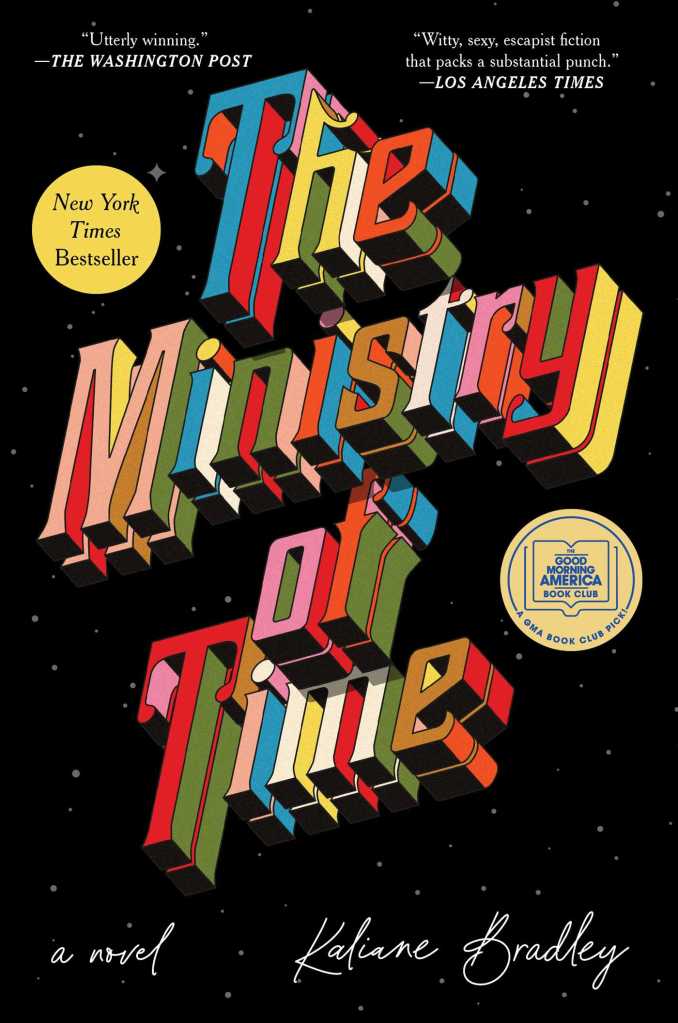
Junker Seven hung around on my TBR for about a year, and I ended up buying it on Kindle for my trip; as I’ve said ad nauseam, queer sci-fi is the stuff of life for me, so I’ll always lap it up when given the chance. Although I wish the worldbuilding (and the politics) were more creative, it was a solid tale of of love and the joy in reminding yourself that your existence is an act of resistance.

Enjoy this week’s review!

Junker Seven (Twin Suns duology, #1) – Olive J. Kelley

Castor Quasar makes a solitary but dangerous living as a junker, ferrying scrap—and fugitives—across the galaxy. They prefer to stay out of the business of others, whether that’s the widespread political unrest throughout the galaxy or simply making friends. But when Castor is offered a job with an exorbitant amount of money, they can’t help but be suspicious, even though the offer would mean valuable repairs for their ship—and an easier living. Their cargo is Juno Marcus, a trans activist with a target on her back and an urgent need to escape before the Intergalactic Peace Force finds her. Castor reluctantly agrees, but they soon find themself in over their head—and head over heels in love…

TW/CW: murder, loss of loved ones, transphobia, deadnaming, misgendering, ableism, police brutality

Junker Seven was by no means without its flaws, but if you’re looking for a love letter to trans love and identity, a slow-burn romance, and resistance in space, then you’ve come to the right place! Not my favorite, but this was a good book to start off pride month—unabashedly queer and political.

Structurally, there were a lot of odd worldbuilding choices (I’ll get to that later), but despite that, the world of Junker Seven felt wonderfully lived-in. The quiet moments where Castor was alone on their ship were what convinced me of this world being tangible; not everything is sleek, clean, and untouched. You never get the sense that the ship is cramped just because it was made so, but because of all of the choices that led Castor to the place they are today. It’s not just a plot device vehicle—it’s got special nooks and crannies that have been shifted over the years, and there’s a goldfish that’s been there through it all, Castor’s only constant companion. Details like this, as well as some of the pockets of resistance that Castor and Juno find throughout their journey, added a real human element to the story. Even with only two characters for most of the novel, Kelley did an excellent job of making the galaxy seem like a tangible place where humans have settled—and brought their unique ways into a new, far-future world.

If you’re looking for representation, especially trans representation, then you’re in the right place—Junker Seven has diversity in spades! Both the main character and the love interest are trans, as well as several side characters, and Castor is also disabled—they have burn scars, a prosthetic leg, and autism! The key part of said representation is that it never felt like a checklist; if the acknowledgements are any indication, Kelley’s goal was to create a resonant story of trans joy, love, and resistance, and though I’m not trans (disabled and queer, though), that love shone through; Junker Seven felt like a love letter to trans resistance all the way through, from Castor and Juno’s slowburn romance to Castor’s gradual radicalization. I love how the disability representation was handled as well! All of the details about Castor’s autism affects their job felt authentic as a neurodivergent person; no stone was left unturned, whether it was how wearing their prosthetic affected their sensory issues to how it affected their relationships. It’s clear from every page that the diversity in this novel wasn’t borne out of a need to tick off every possible marginalization—it was borne of a need to put authentic queer, trans, and disabled stories out into the world.
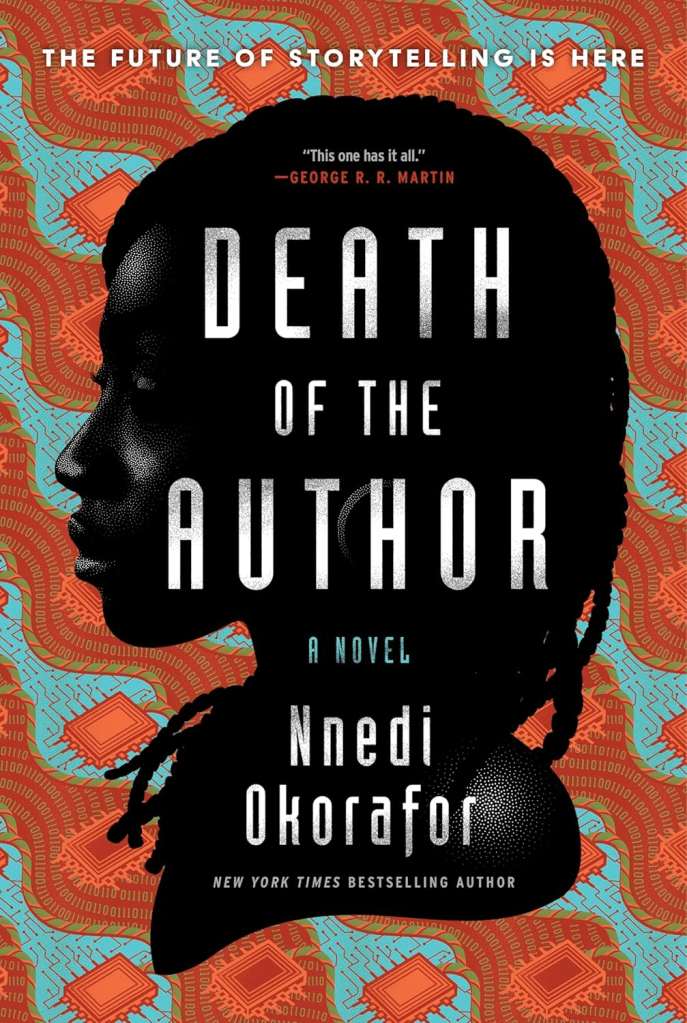
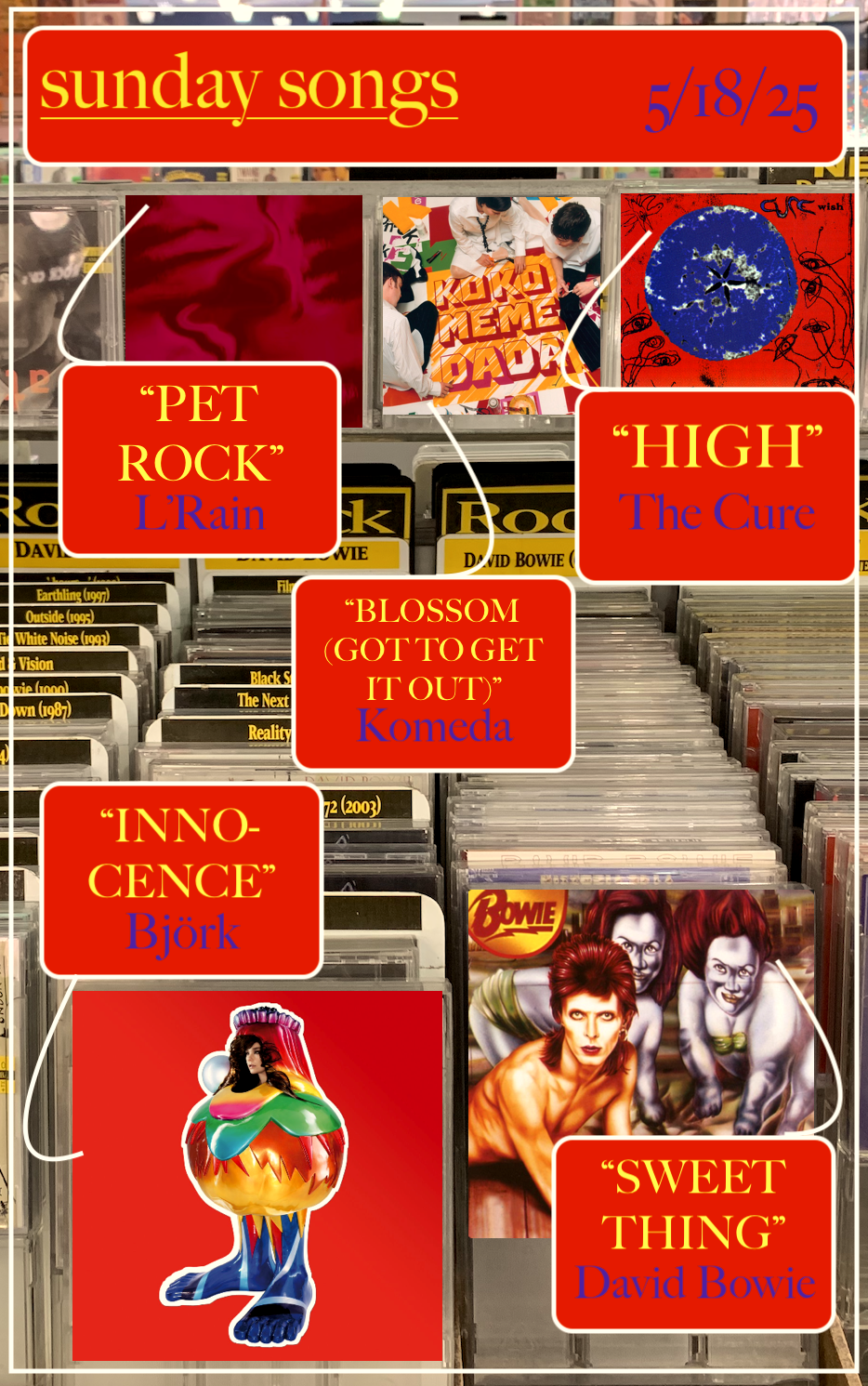
That being said, the worldbuilding of Junker Seven gets stranger the more I think about it. There are enough pockets that could convince you that, yes, this could be hard sci-fi that had some thought put into it, but the actual worldbuilding ends at the descriptions of the climates of the planets that Castor and Juno are hopping to and from. Other than that, the politics are the main focus, but given how political this book is, I was surprised at how unoriginal it was in terms of the evolution of politics and queer resistance. Junker Seven is set several hundred years from now, and yet the politics are all but copied and pasted from the U.S. politics of today—no changes whatsoever, save for being stricter when it comes to the treatment of trans people in particular. Yes, history does tend to repeat itself in terms of treatment of the marginalized, but it’s never in the exact same way twice; technology changes, rhetoric changes, leadership changes. None of that is reflected in Junker Seven; honestly, it was familiar to such a degree that it would have worked more if it were set in a less futuristic dystopia set on Earth. This story is set so far in the future that minimal changes in language and policy just makes no sense. It would have been so much more potent—and creative, frankly—to see how the adapted technology of the future actually factored into how trans people in this universe were being oppressed. There were a few throwaway mentions of more advanced technology that was being used to surveil trans people, but that was about the extent that anything changed. It all boiled down to unused potential—there were so many opportunities to explore how (possible) aspects like advancing technology, increased policing, and advancements in genetic modification could affect the status of trans people throughout the galaxy. And yet, Kelley chose to change almost nothing about our current political climate and paste it into space—to the detriment of my suspension of disbelief. Oppression of marginalized groups remains the same in its goals, but not necessarily in its methods—those change with the times.

What also suspended my disbelief was how little we knew about Marwood save for that he was horrible. Save for being a Trump stand-in, we knew almost nothing about him, save for that a) he’s evil (Trump), b) there’s a widespread news network that’s basically his mouthpiece that he uses to demonize trans people (Fox News), and c) did I mention? He’s evil. I will give Kelley some credit for at least establishing the Zephyr News aspect and the fact that his nepotistic predecessor both ended presidential term limits and instated Marwood in a corrupt, illegitimate election so that his fascist, ultra-conservative values would live on. That, at least, felt like a reasonable enough start for a villainous character, but that was it. The key word here is start. I wouldn’t say it completely falls into the dystopian trope of “we’re not going to say anything about the government, but you have to understand. They’re BAD, guys. BAD,” but it comes rather close. This circles back to my overarching issue of unoriginal worldbuilding, but I wanted to know what separated Marwood from any other run-of-the-mill fascist—did he come from a celebrity background and had no real political experience, like Reagan or Trump, or was he a more cold and calculating type with political prowess who knows exactly how to undo any kind of progress and twist the laws in order to abuse his power? A successful, frightening villain needs to be more than an evil cardboard standup that lurks in the shadows, and we never got more than fragments to show that Marwood was more than a stand-in fascist to move the plot along. (Also, did the entire galaxy, after blending into an almost universal accent after several hundred years, universally adopt a vaguely American two-party system and government? It’s…yeah, I have trouble believing that too.)

Although the disability representation is excellent, as I said before, I did find it odd that it wasn’t a part of Castor’s radicalization; being disabled in the 21st century is already a cyberpunk dystopia as it is, so I’m surprised that there wasn’t much discussion of not just Castor’s experience with being disabled, but how it affected their work or their perception of politics. Save for a throwaway line about an autistic person being driven to a life of crime because of how poorly said autism was treated and handled, there wasn’t much rumination on it other than that. I get that the main focus of Junker Seven was trans resistance specifically, I do wish we at least got more of it than what we got. Come to think of it…as diverse as Junker Seven was, there wasn’t a whole lot of intersectionality in terms of politics. I think there was…maybe one line about race and police brutality, and that was about it? I wouldn’t say that this is inherently a flaw of the book itself, but, once again, given how unabashedly political it was, I did find it odd that there wasn’t at least a small mention of the intersection of queer/trans issues with aspects like race, class, and disability.

All in all, a solid piece of queer sci-fi which suffered from unoriginal and nonsensical worldbuilding, but was nonetheless a shining ode to queer resistance. 3.5 stars!

Junker Seven is the first of the Twin Suns duology, followed by the forthcoming sequel Rebel Rising, which is slated for release in September. Kelley has also released D3F3CT: A Twin Suns Novella, set in the same universe as Junker Seven, as well as the novellas As the Light Goes Out and A Very Lighthouse Christmas. They have also contributed to Spectrum: An Autistic Horror Anthology and the forthcoming Dead Cowpokes Don’t Wrangle: A Weird West Anthology.

Today’s song:

why, why, WHY DID I PUT OFF LISTENING TO THIS ALBUM FOR SO LONG??

That’s it for this week’s Book Review Tuesday! Have a wonderful rest of your day, and take care of yourselves!