

Happy Tuesday, bibliophiles!
For the time being, I’m back! Safe to say I was swamped this semester, so I’m glad that I’ll have about a month of rest before I go back to school for the spring semester. When I wasn’t writing here or in my WIPs, I wrote around a combined 24 combined pages for various papers…and they say being an English major is easy…
Either way, I’ve had Can’t Take That Away on my radar since it came out in 2021. As with most other books on my TBR, there’s no real rationale for it languishing there for so long. I ended picking it up because of the premise; queer YA and MG books are bearing the brunt of bans and challenges here in the States, so I wanted to support them whenever I can (even if it’s already a good amount of what I read). (I can’t find anything definitive on whether or not this one was actually banned or challenged other than one Goodreads reviewer shelving it as such.) Either way, though it had its flaws, the storyline of Can’t Take That Away feels ripped right out of the headlines, and it’s a vital piece of literature for trans teens looking to find their voices.
Enjoy this week’s review!
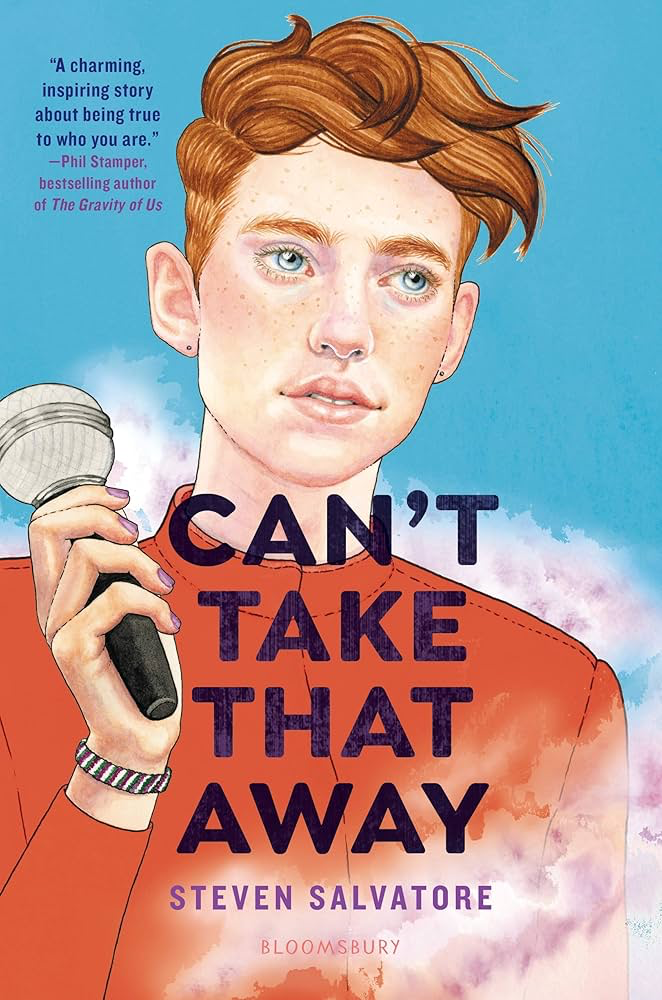
Can’t Take That Away – Steven Salvatore
Carey Parker was born to be a diva. With an unwavering love for Mariah Carey and aspirations of stardom, they have fought tooth and nail to express themself the way that they want. So when a friend convinces them to audition for Elphaba in their high school’s production of Wicked, they seize the opportunity—and land the leading role. Yet in spite of their apparent talent, parents and teachers cause an uproar about genderqueer Carey’s casting in the role of a leading lady. With mounting threats to kick them out of the play and dismantle the production all together, Carey must find their voice in order to prove that they deserve to be heard—and sing.
TW/CW: homophobia, transphobia, misogyny, misgendering, physical assault/violence, descriptions of injuries, bullying, gender dysphoria, suicidal ideation, cheating, loss of loved ones
I have nothing against Wicked, but reading this while being oversaturated with all things Wicked every time I opened up Instagram was an experience, for sure…I guess if Carey were a real person, they’d be over the moon at the prospect of the movie, so there’s that.
Without a doubt, Can’t Take That Away is a story that needed to be told. For the most part, I applaud Steven Salvatore for delivering this novel with unflinching realism (about 90% of it, at any rate. More on that later). The plot—parents and teachers cause an uproar when a genderqueer teen takes on the role of Elphaba in their high school’s production of Wicked—feels like a headline waiting to happen. I have no doubt that it’s already happened. My only minor complaint is that the main villains (Mr. Jackson and Max) felt cardboard, but they too, in a way, felt like the adults raving and ranting about “gender ideology” and the online trolls bent on tearing queer people down. They leaned on the side of exaggeration, yet…some people are just like that, unfortunately. That realism is what fueled the story; Carey’s manifold struggles, from grappling with gender dysphoria, bullies, and first love, was delivered both candidly and sensitively. Salvatore didn’t hold back from the ugly parts of some of these topics (be warned—happy ending aside, it’s a rough ride), but it made them all the more important to show that, like the plot, Carey is as real a person as your trans classmate. Carey could easily be someone in your life, and that was what made the story ring so resonantly.
That being said, I felt that the romance was incredibly messy, and not necessarily in a good way. Having Carey have their first love as they’re fighting to find themself was a good side plot in concept, but…it was just a dumpster fire for no reason. I don’t know if this is just me reading YA and no longer being a teenager, but half of the romantic drama felt unnecessary in contrast to the very timely, very upfront main plot. Why did Carey need to kiss some random guy in a basement while they were dating Cris? How are Carey and Cris just okay with everything that the other did? Maybe this is just me, but if my partner kissed somebody else in a basement while we were dating, I wouldn’t come running back…see? MESSY. Can’t Take That Away already had high drama aplenty, and I know that’s a hallmark of YA to some extent (that I appreciate), but this bordered on ridiculous.
I’m rather conflicted about the ending. It was wrapped up quite neatly, which isn’t inherently a crime, especially since it’s YA. There are bound to be some things that are tied up more nicely than they would be in real life. Can’t Take That Away is aimed at high schoolers, and unless it’s too neat, this quality isn’t always an instant flaw in YA books. That being said, Can’t Take That Away bordered on taking that to an extreme. After the protest, the cops are immediately on the side of the queer people and people of color, and have almost no hesitation about punishing the white male perpetrators of the hate crimes. Carey’s protest immediately goes viral, and they get so famous that they get free tickets to see Mariah Carey and go onstage and sing with her. The bad guys get their comeuppance almost instantly, and the good guys get the greatest rewards possible. I’m not saying that Carey and company didn’t deserve a happy ending—they absolutely did—but it felt unrealistic to a point where it almost felt like the fulfillment of a fantasy. Sure, that’s what writing’s for to some extent, but when dealing with a plot that felt ripped from the headlines, the resolution felt much less so. You can give characters a fulfilling, satisfying victory that feels earned and realistic!
Yet at the same time, queer kids deserve these kinds of stories. There are easily infinite examples of straight characters getting unrealistic endings that end in instant fame and wish fulfillment, so why shouldn’t Carey? Why shouldn’t all of the trans kids reading their story? Yes, it made me roll my eyes a little when this story, one that ended well enough, had to escalate everything to “and then Carey got everything that they ever wanted in life! Yippee!” But after the deluge of hatred and violence that Carey endured throughout Can’t Take That Away, why shouldn’t they get that ending? This novel is not escapist by any stretch of the imagination, but there’s a kind of necessary escapism in these stories—very real circumstances resolving with the absolute best possible outcome with no strings attached. Sure, it was a stretch, but Carey deserves it—and so do all of the queer teens reading this book.
All in all, a book with flaws here and there, but ultimately proved a timely story about finding your voice. 3.5 stars!
Can’t Take That Away is a standalone, but Steven Salvatore is also the author of And They Lived…, No Perfect Places, The Boyfriend Subscription, and the forthcoming novel When Love Gives You Lemons, which is slated for release in May of 2025.
Today’s song:
That’s it for this week’s Book Review Tuesday! Have a wonderful rest of your day, and take care of yourselves!













 The Bookish Mutant