

Happy Tuesday, bibliophiles, and a merry Christmas Eve (and Christmas, in advance) to those who celebrate! No matter your beliefs, I hope you’re staying warm and spending time with your loved ones this week. Happy holidays! ❄️⛄️🎄🍪
I discovered Meg Shaffer’s debut novel, The Wishing Game, about a month back and loved it. (Bottom line: if you’re an adult who wished they could’ve gotten Willy Wonka’s golden ticket as a kid, READ IT.) Naturally, I moved onto The Lost Story the minute it became available at the library. Although it wasn’t as strong as Shaffer’s debut, The Lost Story is a testament to the healing power of fantasy.
Enjoy this week’s review!
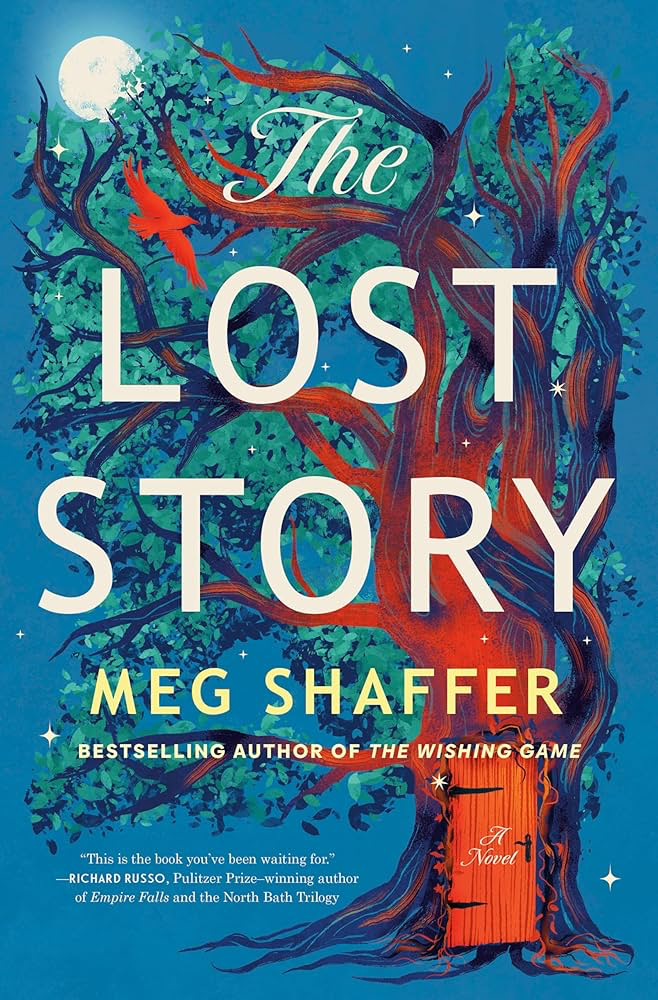
When they were 15, Rafe Howell and Jeremy Cox went missing in the West Virginia woods. Six months after their disappearance, they came back, seemingly unscathed. What the rest of the world doesn’t know is that they escaped to a fantasy world hidden deep in the Red Crow State Forest. But only Jeremy remembers their odyssey. Now, distanced for 15 years, Rafe remembers nothing about what happened that day, and Jeremy has a magical knack for discovering missing persons.
Emilie Wendell has gotten wind of Jeremy’s talent for locating the missing, and enlists his help to find her older sister, who vanished in the same stretch of woods where he and Rafe went missing all those years ago. With Rafe and Jeremy in tow, Emilie discovers a magical world that could have only sprung from the mind of a child, only visible to those who look hard enough. But confronting this world and its secrets may lead to the very reason that Jeremy and Rafe never spoke of their time together—and the reason why Emilie’s sister never returned.
TW/CW: near death situations, discussions of child endangerment/kidnapping (past), abuse (physical and emotional), homophobia, loss of loved ones (past), fantasy violence, mentions of suicide (past)
I never got around to reviewing The Wishing Game (which I liked better than The Lost Story) here, but it’s safe to say that Meg Shaffer is out here doing the good work, and by the good work I mean writing books about reclaiming childhood innocence and joy via the stories we loved as children. Having read both books, Shaffer really gets the power of stories—and the power of rediscovering them in adulthood. The balance between childlike wonder and whimsy and the harrowing realities that come with adulthood are a difficult balance to strike, but The Lost Story lives in the reality between them and never denies either aspect. Rafe and Jeremy’s journey of healing, rescuing people who may not need to be rescued, and realizing their love for each other was a rickety, emotional ride, but one that, once the plot got going, paid off in spades. Plus, I love that Shaffer made this story a distinctly queer one—I always love queer books, but the fantasy escapism plot with their queer identities made so much sense when you consider how fiction can be a sanctuary for queer people.
Part of what made that aspect of The Lost Story land so well was that Shanandoah truly felt like a child’s wonderland. There was a charm to the misplaced names (the Valkyries being only what a young girl would think of the real Valkyries of Norse myth, for instance) and the over-the-top magical ones, and each fantasy element had the nonsensical aspect of a child’s mind. This world is full of magical horses, impossibly sweet fruit, vengeful spirits, and everything a child could possibly populate a fantasy world with—and all of it is delightful. The Narnia influence was clear (it’s wonderful! Imagine C.S. Lewis without the proselytizing), but there was a whimsy to it that Shaffer excelled in—even if it was separate from the real world, she fully succeeding in making a world feel like it was ripped from the pages of a 13-year-old girl’s notebook.
However, I really didn’t see the point of Emilie being a part of the story. In contrast to Jeremy and Rafe’s complicated relationship, the only thread connecting her to the narrative was the fact that it was her sister who happened to have gone missing. Her personality bordered on grating—there wasn’t much to her other than a determination to find her sister and having her “teehee! so quirky”-isms when the plot called for it. (But did it really call for it?) My main issue with her is that she didn’t have the development that the other characters did. She witnesses the wonders and horrors of Shanandoah and comes out of it having barely changed, save for the fact that she’s reunited with Shannon. In contrast with Rafe and Jeremy, it just seemed increasingly obvious that she didn’t have as much business being there, even though she was purportedly the main character. The Lost Story might have been stronger if she had been nixed entirely—she was placed as the protagonist, but at its heart, it was the story of Rafe, Jeremy, and Shannon, not her.
Additionally, The Lost Story had some issues with its pacing. It took nearly halfway through the book for the characters to reach Shanandoah, the whole premise of the book. The first third or so, although Shaffer’s establishment of the exposition was spread out evenly, tended to drag. Instead of more development that could have lead more to the (excellent) arcs of the characters later on, we get drawn-out scenes of banter between the main characters once they reunite, as well as some tired training montages that could have been flattened out into a much shorter scene. As a result, the first half of the events in Shanandoah were rushed together—our heroes reach this famed fantasy land, and almost immediately, they’re separated and thrown on wildly different adventures that only converge in the last quarter or so. For such a grounded story, there needed to be more even allocation of events that truly mattered, which is why I couldn’t give it the full 4 stars.
That being said, I loved how the duality of the themes were tied together in the end. For all of the characters, the land of Shanandoah was escapism, but they had different ways of handling reality while in it. For Rafe and Jeremy, they couldn’t stay because there were real monsters they had to confront; Shanandoah worked both as a place for them to rekindle their relationship, but also to confront the very real demons back in the real West Virginia. For them, they had to return to the real world to heal. But for Shannon, Shanandoah was the realest part of her life. She had gotten into a situation that no child should ever be placed in, and for that, her childhood wish for another world came true, and it became her sanctuary. If The Lost Story had gone with either interpretation, I would’ve been happy, but I loved Shaffer’s approach in depicting both sides of fantasy and escapism. Fantasy can be a place to ignore all of your troubles, but also a place you return to when you need healing. Even if it’s fictional, it can be the truest, realest part of you. Both can be true.
All in all, a heartfelt and heartstring-tugging fantasy for all of the kids who wanted to return to Narnia. 3.75 stars, rounded up to 4!
The Lost Story is a standalone, but Meg Shaffer is also the author of The Wishing Game.
Today’s song:
That’s it for this week’s Book Review Tuesday! Have a wonderful rest of your day, and take care of yourselves!


 The Bookish Mutant
One thought on “Book Review Tuesday (12/24/24) – The Lost Story”