
Happy Tuesday, bibliophiles, and happy Disability Pride Month! I’ll have something up for the occasion later this week, but for now, here’s the first book review of the month.
I’ve had this novel on my TBR for a few years. I read Alaya Dawn Johnson’s Trouble the Saints several years ago and remembered it being on the denser side, so I was hesitant going into this novel, especially with the low ratings on both Goodreads and Storygraph. I understand those ratings now—this book is not for the faint of heart, but it was also victim to some serious mismarketing, in my opinion. It’s a sprawling novel that hops between worlds and genres, and despite its flaws, it’s one of the most ambitious novels I’ve read in a while.
Enjoy this week’s review!
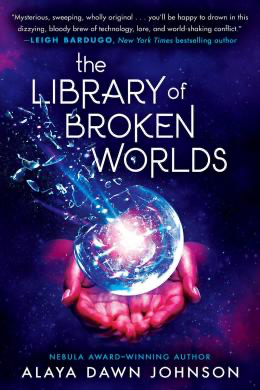
The Library of Broken Worlds – Alaya Dawn Johnson
Centuries ago, tesseract technology made travel and connection across the stars. Now, in the Library, where all of the tesseracts are held and all of the political machinations go on, Freida spends her childhood wandering amongst all kinds of strange magic and technology. She was artificially created by the Library, and has access to all of its texts. But as she grows older, she begins to understand the corruption deep within the Library. Her friends face persecution from all sides, both from mortal people and the gods beyond their reach. To save them, she must dig deeper than she’s ever ventured into the Library—and what she finds there could change her life.
TW/CW: genocide, loss of loved ones, sexual assault, colonialism/imperialism, violence
Right off the bat, let me just say: this is truly a weird book. For the most part, I mean that affectionately. It’s weirder than most YA I’ve read, and even weirder than some adult books. It’s also one of the more ambitious books I’ve read in quite some time. Straddling the line between hard sci-fi and full-blown fantasy, The Library of Broken Worlds is an ambitious—if not incredibly messy—novel.
I’ll start off by saying this: The Library of Broken Worlds really shouldn’t have been YA. Even though Freida is about 17 here, all of the concepts jammed in here really don’t feel like they should be for the 12-18 crowd. That might just be another consequence of 12-18 being a ridiculous jump in maturity for a single age range, but I digress. There are a lot of aspects that feel more well-suited for the more adult crowd. You sit in on a lot of court hearings, the politics get both deeply philosophical and intricate, and you’re dunked into the worldbuilding like one might be dunked face-first into a bucket of ice water. I think you can still work with a teenage character in an adult story (see: The Fifth Season), so I feel like it wouldn’t be much of an adjustment. As voracious of a reader as I was when I was in the peak market for YA books, I feel like I would’ve DNF’d this book in my teens. But that’s not to say that I didn’t love The Library of Broken Worlds. Had it been adjusted for an older audience, I think it might have been more successful—if not in marketing than anything else.
The case of the worldbuilding in The Library of Broken Worlds is a complicated one. It’s both the biggest strength and the biggest weakness of the novel. The worldbuilding itself is marvelous—what I could get of it. This novel is such a unique blend of sci-fi and fantasy. You have a Library as the central hub to travel to other parts of the galaxy, and the main characters is an artificially-created being created by the will of the Library itself. There’s lots of intergalactic folktales, extinct alien civilizations, a triad of nature gods that preside over the universe and form the basic divisions between its people, and a ton of worms and grubs. Gotta love the grubs. There’s a lot of ’em. The world is also refreshingly queernormative, with a variety of characters with different neopronouns and a young sapphic couple at the forefront of the story. In the acknowledgements, Johnson said that Studio Ghibli and Hayao Miyazaki were the biggest inspirations for the book. The comparison didn’t fully make sense to me, but in a way, I can see that the blend of sci-fi and fantasy, along with some of the more imagery, could feel like a darker, more convoluted version of Miyazaki. It’s such a lovingly created and multilayered world—I just wish we could’ve explored more of it.
Now, let’s go back to that word, convoluted, because it applies to…well, everything. I often talk about how writers often have the issue of vomiting all of their worldbuilding in chunks that distract from the story. This book has the exact opposite problem. From the start, you’re thrown headfirst into an exceedingly complex and convoluted world, expecting to know all of the terms and political divisions as they’re thrown about every which way. It felt like the scene from The Big Lebowski where The Dude is repeatedly getting his head dunked into the toilet (“WHERE’S THE MONEY, LEBOWSKI?”), but each time, you get a face full of completely wild fantasy terms that only get the most barebones explanations. By the time you’re sort of acclimated to the world and you think you’re getting a break, somebody’s pissing on your rug that really pulled the room together (more unexplained worldbuilding out of nowhere that overcomplicates things further). I still don’t fully know what a “broonie” is, and at this point I’m too afraid to ask. This book was in desperate need of a glossary, Jesus Christ. And a lot more exposition, as well as less convoluted and all-over-the-place explanations for what little was explained beyond the basics.
The characters in The Library of Broken Worlds were also a treat to explore! I wish we got more of some of the side characters, since there were so many, but it was Frieda’s story first and foremost. Though some parts of her were underdeveloped, Frieda was a solid protagonist; although she almost falls into a very typical mold of the YA protagonist whose life is out of her control and is different from the others (and is understandably angsty about it), these things are for reasons that are fully fleshed-out—the weight on her shoulder never feels manufactured, and the way that Johnson writes her trauma, from various sources, was very sensitive. I don’t think we got enough of Joshua (he’s almost forgotten about halfway through and only comes back in the last few bits of the climax), but I did like Nergüi’s coldness and eventual insightfulness as a counter to Frieda’s passion and hunger for knowledge.
There are some fascinating themes, political and otherwise, at play in The Library of Broken Worlds. In an attempt to be more utopian, the main government has built its government and legal system on the basis of freedom from and freedom to, and the discussion surrounding that, especially where those definitions get dangerously misused (justifying planetwide colonialism and genocide). Johnson didn’t shy away from getting into a ton of moral dilemmas. However, aside from that theme, I loved how The Library of Broken Worlds handles cycles. Simply by existing counter to her original purpose, Freida is breaking a cycle of her sisters being created for a specific purpose, and embracing empathy and love. But by doing that, she is also breaking a multitude of other cycles—the personal cycles of being traumatized and taking it out on others, and the vast, historical cycles of injustice and mass cruelty. The tesseracts also felt a bit like the interconnectedness of actions as well as events throughout history, and Freida exists at the confluence of it, making her able to fully see how she is able to reshape both her destiny and the unjust system that she lives under. As rocky and convoluted of a road Johnson takes us to get there, I appreciate that it was taken in the first place, because the payoff was mostly worth it in the end.
For most of what I just detailed, I nearly gave The Library of Broken Worlds the full 4 stars. But given the state of the book, I just…couldn’t. For all of its boundless creativity, timely themes, and observant insights, this novel was just a mess. I think this could’ve been the second-to-last draft before sending it off to the publisher, because as good as it was, the writing was all over the place. You’re unceremoniously thrust into the worldbuilding, and the only reason that I ended up acclimating (and even that’s a stretch) to everything was that this novel is nearly 450 pages long. It desperately needed more exposition, as well as clearer explanations of the key terms that come into play throughout the novel. The pacing was off—though I enjoyed the explorations of politics that Johnson employed throughout, I think we could’ve spent more time getting to know the world and less time sitting in space congressional hearings. There were a multitude of loose ends that didn’t fully get tied up. I guess that’s a consequence of such an expansive world, but The Library of Broken Worlds needed some serious refinement. I don’t normally find myself saying this, but give this book 50 more pages and a glossary, and I think some of these issues could be fixed.
All in all, an expansive piece of sci-fi/fantasy with highly commendable worldbuilding and themes, but which needed more page time and another round of edits to fully achieve its purpose. 3.75 stars!
The Library of Broken Worlds is a standalone novel, but Alaya Dawn Johnson is also the author of several novels for teens and adults, including Trouble the Saints, Love is the Drug, Moonshine, Racing the Dark, and The Summer Prince.
Today’s song:
That’s it for this week’s Book Review Tuesday! Have a wonderful rest of your day, and take care of yourselves!


 The Bookish Mutant
One thought on “Book Review Tuesday (7/1/25) – The Library of Broken Worlds”