

Happy Tuesday, bibliophiles! Merry Christmas Eve (Eve)—in advance, I hope you all have a lovely, safe, and restful remainder of the year.
This book was recommended to me around two years ago by a good friend of mine, and I’ve been trying to find it ever since. Last Wednesday, we had a power outage (it lasted four days 😵💫) because of some scarily high winds. Without anything to read on my Kindle, which was rapidly losing battery, my mom and I decided to make a Barnes & Noble run on day 2, where I finally happened on a copy. Lo and behold, Embassytown blew me away with its experiments in language, alienness, and communication—thanks, said friend!
Enjoy this week’s review!
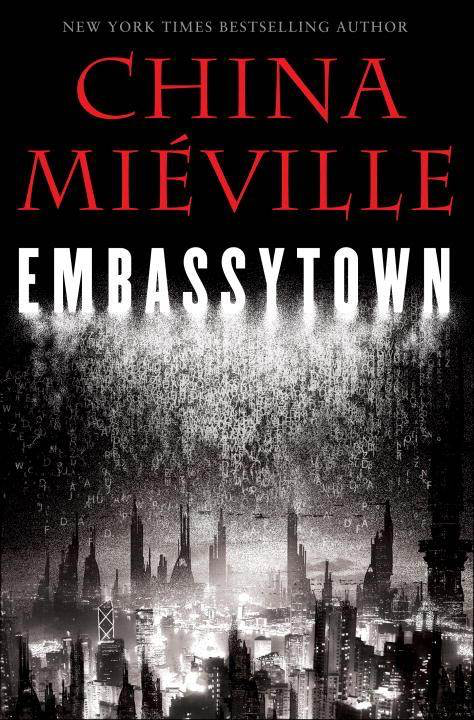
Avice Benner Cho is many things: an interplanetary traveler, a politician, a former resident of a colony filled with all manner of alien species. But the most important of these distinctions is that she is a living simile in the language of the Ariekei, an alien race with a language that is impossible for humans to speak. The only way of communicating with them is through genetically modified ambassadors. Having left the alien-populated Embassytown as a child, Avice has returned just as tensions between the humans and Ariekei. Developments in language and communication have made leaps and bounds, but their consequences could spell war between the two species.
TW/CW: substance abuse, violence, gore, blood, war themes, suicide, infidelity, sexual content
One of my first thoughts after finishing Embassytown was “man, no wonder Ursula K. Le Guin blurbed this.” Even having only read a handful of her books, I could see how faithfully this follows in Le Guin’s footsteps. Embassytown is an experiment in language, but more than that, it’s a meditation on individuality and autonomy that blew me away with its creativity.
While I was helping teach another science fiction course in the fall, my students inadvertently got into a discussion about the hypothetical consequences of a society that couldn’t lie. I couldn’t help but think about it when I reflected on Embassytown. Of course, the reverse happens here: an alien species who evolutionary cannot lie suddenly breaks down the constructs of their language, and once they are able to lie, all hell breaks loose. (I’m not exaggerating. It’s very grim. The hopeful ending was an exceptional relief.) Some novels just have the inherent feel that they came from a series of thought experiments (say, what if you made first contact with an alien species that you can’t speak the language of without changing yourself, and they also can’t lie?), and Embassytown is one of them. But Miéville used this opportunity to really break down the effects of language and turned it into a meditation on religious fanaticism, autonomy, but most of all, communication. More often than not, this novel’s a dense mouthful, and I still don’t think I’ve processed and/or comprehended 100% of it, but what I have been able to chew on was breathtaking.
Since this is The Bookish Mutant…it’s once again the Creature Design Hour! And my god, this is some top-tier creature design here! The Ariekei were such a well-thought-out species, and the amount of detail that went into everything from their language to their culture knocked me off my feet. My mental image of them was plain fun, first off: I’m a huge fan of these spider-horse-coral-beetle creatures. Now that’s what I call a critter. One of my minor pet peeves about the novel was that most of the other aliens (or “exots,” as they’re called), are only scarcely described, but I think that’s a consequence of everything being an afterthought in the face of how detailed the Ariekei culture was. (Please, China, give me all the creatures!!) Case in point: they have several stages to their lifespan, and one of them, evolutionarily, was that when they grow old, their bodies break down in such a way that’s meant to feed their young, like many insects and arachnids do in real life; nowadays the Ariekei consider it barbaric, but their society adapts to accommodate their aging population instead of eating them. Even with the amount of real-world, familiar descriptors that were used to describe them, I think Miéville was so successful at creating them because they felt alien.
What also blew me away was how thoroughly Miéville examined how First Contact affects humanity—and not just that, it fundamentally changes it. Humans physically can’t speak the language of the Ariekei because the Ariekei have two mouths, and beyond that, a language constructed entirely differently than ours, completely absent of metaphor and the ability to lie. Our solution is to create genetically modified Ambassadors, doppelgängers raised in labs just so that they can speak the language—even their names are just halved versions of normal names (EzRa, CalVin, MagDa, etc.). The ripple effects that creates, from the Ambassadors’ fractured sense of identity to their interactions with unmodified humans, was so thoroughly examined that I could imagine the Charlie Kelly-esque, intricate corkboard filled to the brim with every possible ramification for first contact. (On reflection, I feel like Eddie Robson’s Drunk on All Your Strange New Words feels like a toned-down version of some of the stuff in this novel.) One of the reasons that kept me from rating Embassytown the full 4.75-5 stars was that I didn’t particularly care for Avice, or any of the other characters (even though Scile was an insufferable—and later downright horrible—mansplainer, the weird cheating love triangle with CalVin icked me out); yet in this case, their individual reactions to interacting with aliens made it worthwhile, especially when it came to picking apart their personalities.
That alienness that I mentioned earlier accentuated what, for me, was the primary experiment of the novel. For me, Embassytown was all about the consequences of losing oneself—autonomy, individuality, the like, but also what it takes to empathize with somebody wildly different than yourself. Both the humans and the Ariekei fundamentally have to change themselves in order to communicate with the other species, be it through genetic modification or the dissolution of the structure of their language. Taken too far, and war breaks out, nearly decimating both species. But what saves them from the brink is maintaining individuality while still being peacefully working around those cultural hiccups in order to unify and solve problems. Neither of them lose their cultural identity, but they find ways around them that benefit both parties. That’s how true cooperation comes about: communication that serves both sides, but also does not deny the individuality and humanity of the other.
I never thought I’d get emotional at a sentence like “I don’t want to be a simile anymore…I want to be a metaphor,” but man, here we are. I am nothing if not an overly sensitive English major. The leap from being like something to being is a leap into autonomy and self-determination, which, after all the bloodshed and bigotry at the climax of Embassytown, is what saves the day. When both species are left to pick up the pieces, they do so through mutual recognition of autonomy without tearing themselves in two just to please the other party. Nothing short of beautiful.
All in all, a multilayered and multifaceted exploration of the rocky road of communication—unexpectedly emotional and utterly alien. 4.5 stars!
Embassytown is a standalone, but China Miéville is the author of several other novels, including the New Crobuzon trilogy (Perdido Street Station, The Scar, and Iron Council), The City & The City, Railsea, King Rat, Kraken, and many others.
Today’s song:
That’s it for this week’s Book Review Tuesday! Have a wonderful rest of your day, and take care of yourselves!


 The Bookish Mutant
2 thoughts on “Book Review Tuesday (12/23/25) – Embassytown”