Posted in Book Review Tuesday

Book Review Tuesday (2/1/22) – Beyond the End of the World (The Other Side of the Sky, #2)

Happy Tuesday, bibliophiles, Happy beginning of Black History Month, and happy Lunar New Year! 🐅 My, today’s a momentous occasion…

I’ve been a fan of Amie Kaufman’s for years, and at this point, I’ll read almost anything that she writes. I discovered The Other Side of the Sky during a really tough time in my life, and reading it and immersing myself in her and Spooner’s world made the pain just that much more bearable. I preordered book 2 last year, and it came in the mail recently! Although it was a bit of a slow start, Beyond the End of the World was a jaw-dropping conclusion to a creative duology!

Now, tread lightly! This review may contain spoilers for book 1, The Other Side of the Sky! If you haven’t read book 1 and intend on doing so, I’d suggest that you skip this review just in case.

For my review of The Other Side of the Sky, click here!

Enjoy this week’s review!
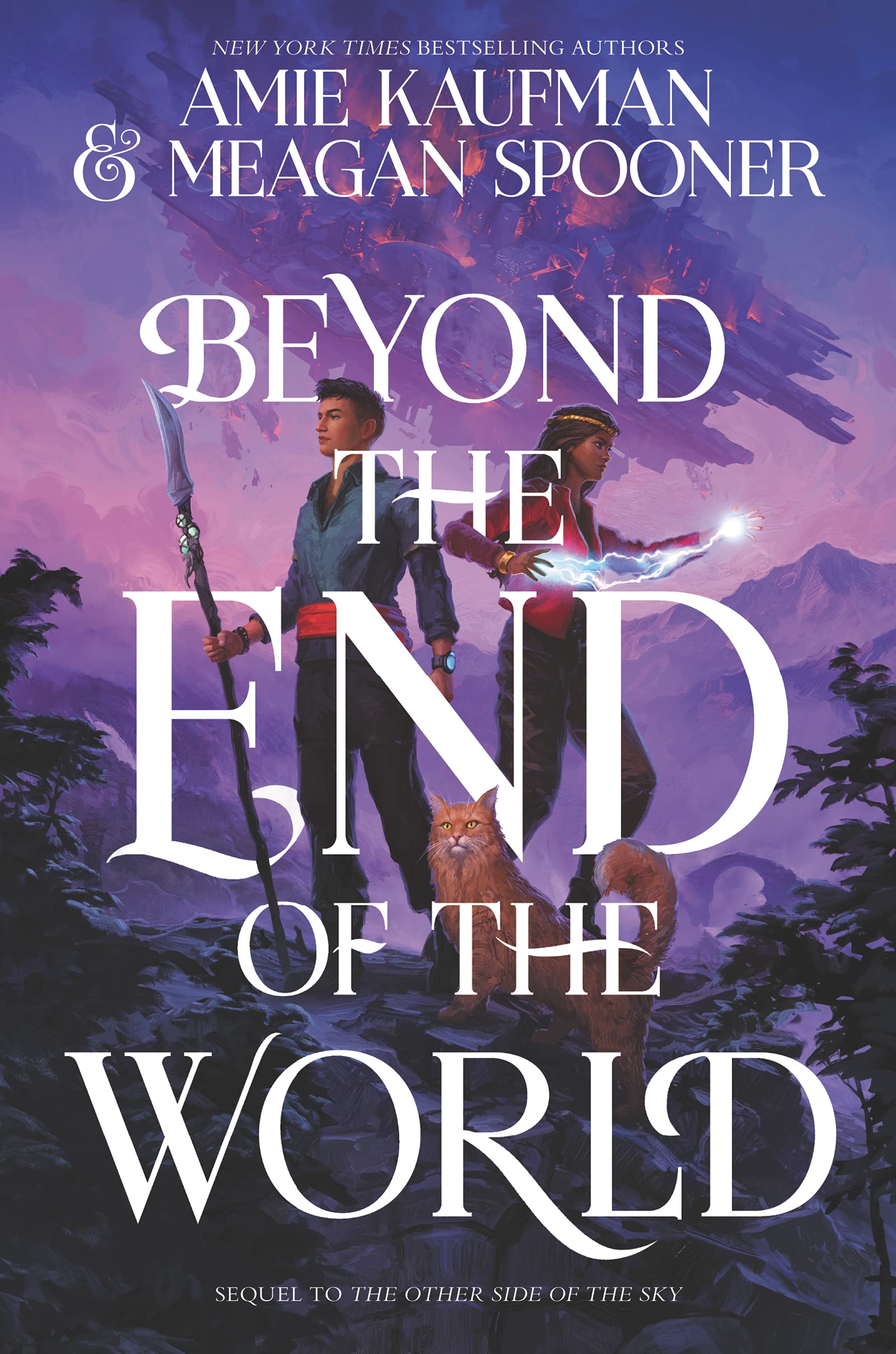
Amazon.com: Beyond the End of the World: 9780062893369: Kaufman, Amie,  Spooner, Meagan: Books

Beyond the End of the World (The Other Side of the Sky, #2) – Amie Kaufman & Meagan Spooner
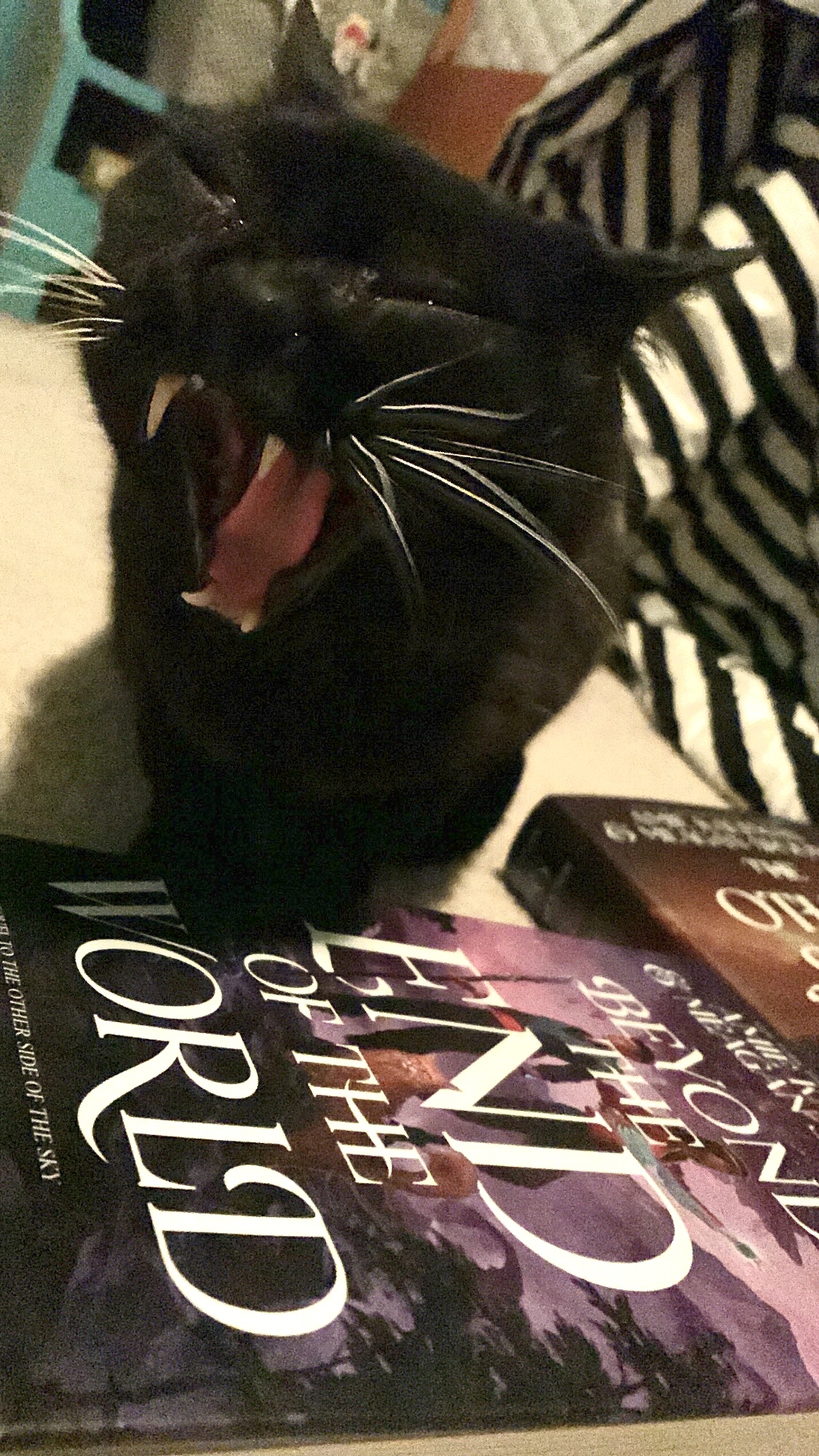
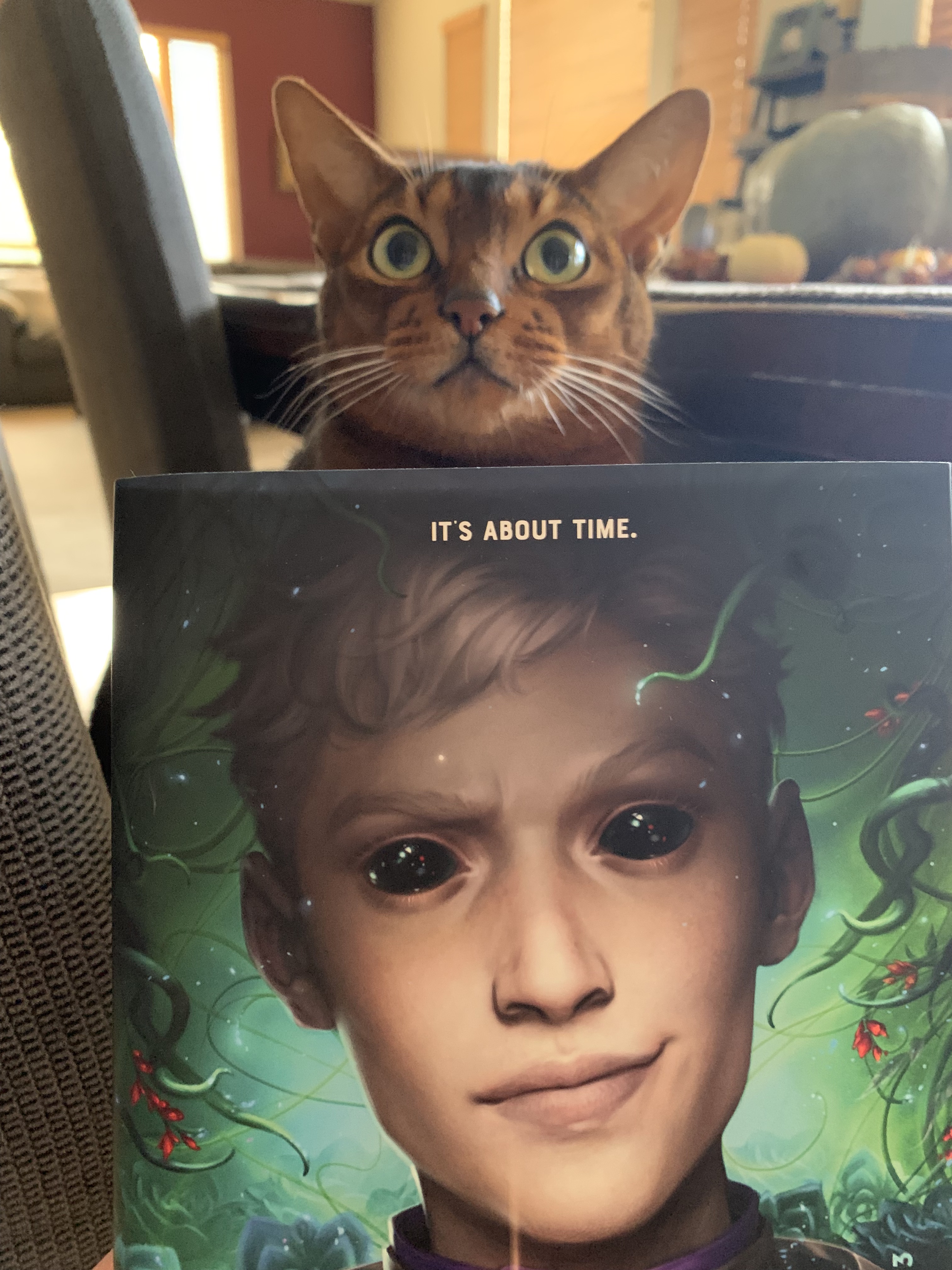
my copy ft. Anakin the cat being very tired of me

Nimh and North have switched places, and only a miracle can get them back where they each belong—and solve the conflict brewing Below.

Nimh and Inshara, the cultist bent on usurping her, are stranded in Alciel, Prince North’s domain in the clouds. But when Nimh wakes up, she realizes that Inshara has contacted the Queen and convinced her that she is Nimh. Below, Prince North is on the brink of discovering a secret that may upend all that Nimh and her people stand for. With the odds stacked against them both, their only chance is to reunite, but the hidden secrets Below may mean chaos for both North and Nimh.

Sky GIF - Sky - Discover & Share GIFs

TW/CW: train crash, frightening situations, descriptions of blood, murder

Every sequel that has a recap of what happened in the previous book is already great by my standards. But in all seriousness, Beyond the End of the World was a sequel that delivered a satisfying end to a uniquely inventive duology!

My only problem with Beyond is the first 100 or so pages; it moves a little slowly for the first quarter, and even though I love Amie Kaufman’s (and I guess Meagan Spooner’s, by proxy, even though I haven’t read any of her solo books) writing, I found myself losing interested. But once the inciting incident—Nimh’s in particular—is set into motion, Beyond’s pace accelerates to the perfect speed.

I loved the prospect of North and Nimh being trapped in worlds completely alien to them, but what made it so tense and well-executed was the introduction of conflict. Once the aftermath of book 1 fades off, Kaufman and Spooner did a fantastic job of setting up obstacles for each of them to overcome. Not only that, but these obstacles had fascinating ramifications that had such a jaw-dropping impact on the last quarter of the book.

I’m not usually one for twists thrown into the last book in the series not long before it ends, but the revelation at the end of Beyond was enough to put a giddy, baffled grin on my face. DANG. Without spoiling anything, I’m still reeling from it just thinking about it. Part of what made it so great was its implications on the worldbuilding—once this domino is set in motion, it tears down everything about Nimh’s world that you thought you knew. So well done, and so well-built-up over the course of two books!

I have one slight problem with said twist. One of the aspects of this duology that I loved so much was the fact that it’s the only “magic vs. technology” book that I’ve read that actually works. The twist, however well-executed that it was, did kind of throw a wrench in the whole concept. Again, no spoilers, but the fact that this is the direction that the twist meant that the “magic vs. technology” part was almost rendered moot. I still hold that this twist was incredibly well-written, but it’s a bit of a disappointment on the themes front.

Of course, it was wonderful to be back in Kaufman and Spooner’s shiny world of goddesses and floating cities. Although I’m more partial to Nimh than North, it was great to see them both again, and it was even sweeter to see them reunite. I didn’t feel a whole lot for the side characters, but given how wonderfully written most everything else, I could let that slide. Plus, cats. I would do anything to pet the Bindle cat.

Overall, a stunning and tense conclusion to one of the most creative series that I’ve come across in the past few years. 4 stars!

Medieval | Gif Hunt | Aesthetic gif, Gif, The witcher

Beyond the End of the World is the conclusion to the Other Side of the Sky duology, preceded by The Other Side of the Sky. Amie Kaufman and Meagan Spooner have also written the Starbound trilogy (These Broken Stars, This Shattered World, and This Fractured Light) and the Unearthed duology (Unearthed and Undying) together.

Today’s song:

besides being on of my favorite TV on the Radio songs, this music video just cracks me up every time

That’s it for this week’s Book Review Tuesday! Have a wonderful rest of your day, and take care of yourselves!

Posted in Book Review Tuesday

Book Review Tuesday (1/25/22) – Railhead

Happy Tuesday, bibliophiles!

As of last week, it had been ages since I’ve read anything by Philip Reeve. I’d gotten through the whole Larklight trilogy in middle school and loved it, and I read Fever Crumb as well and wasn’t as much of a fan. I forgot about him for a while, until I got a recommendation from Sabrina (thank you!) about another series of his—the Railhead series. I decided to pick it up, and I ended up liking it—after reading this, I definitely want to see how the rest of the story goes!

Enjoy this week’s review!

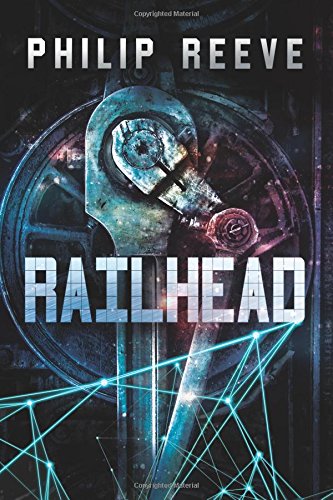
Amazon.com: Railhead: 9781630790486: Reeve, Philip: Books

Railhead (Railhead, #1) – Philip Reeve

In the distant future, it isn’t spaceships that transport humanity across the stars—it’s a massive network of trains. The Great Network spans across the entire galaxy, and one line can take you anywhere that you so choose. It’s the perfect place for Zen Starling, a young thief who makes a living from the goods he steals from passenger cars. But when he attracts the attention of the mysterious Raven, Zen finds himself entrenched in a royal conspiracy. Soon, his own identity as a nobody from the streets is called into question, and his success on Raven’s mission may determine the rest of his career.

Star Wars Prequel - Planet Coruscant | Star wars, Film inspiration, Gif

TW/CW: violence (fairly mild), descriptions of killing animals/dead animals, fire, fear

It’s been about 5 years since I’ve read anything by Philip Reeve; I loved the Larklight trilogy but didn’t have the same luck with Fever Crumb, so he was generally hit-or-miss for me. But ultimately, I’m glad I picked Railhead up! It was the perfect antidote after reading something as heavy as Anthem; fun, light-hearted, and fast-paced. (Thanks again for the rec, Sabrina!)

The worldbuilding of Railhead made the whole book. It’s the kind of intricate worldbuilding that I aspire to have in my own writing; no stone is left unturned in terms of the little details that make the Great Network so genuine-feeling and fleshed out. Best of all, none of it is delivered in info-dumps; pieces of information are spaced out and don’t distract from the overall story. There was so much love put into every little nook and cranny of Reeve’s world, from the trains to the android history to the graffiti on the walls. I especially loved the Hive Monks—the concept behind them was so inventive! I wished we’d seen more of Uncle Bugs and the others.

As far as characters go, I didn’t get attached to many of them, but they were at least decently flushed out. Zen himself didn’t have many traits that would distinguish him from the average middle grade/YA protagonist, and having him get saddled with this trilogy’s equivalent of the chosen one trope didn’t exactly help his case. He was simply…alright for me. I felt the same way towards most of the other characters; they were distinct enough to not be trope-y, but not distinct enough to be rememberable. I did like Nova, though. She was my favorite out of the main cast—I liked her backstory a lot, and her being an android (or a “moto,” as is the lingo in Zen Starling’s world) added a unique layer to her story.

The plot itself was a little lacking for me, but its fast pace saved it. At its worst, the plot seemed to [Robert Plant voice] ramble on without any clear direction, but at its best, it was loads of fun. You do get the sense that you’re clinging to the top of a speeding train, the way the events move—it’s very fast-paced, and given both the setting and the premise, it’s perfect!

I wasn’t as invested in the main plot, but I tended to gravitate more towards the side plots, the short anecdotes that fleshed out Railhead’s world even more. The fact that I got more excited about seeing giant manta ray creatures and looking at the insides of futuristic trains than the actual should probably say something about the book itself, but those parts gave me joy, and that’s that. Again—it’s the tiny details that made Railhead as entertaining as it was.

All in all, a romp through a futuristic world at breakneck speed that shone in its detailed worldbuilding. I’m on board with continuing the rest of the series! 3.75 stars, rounded up to 4!

Padawanlost — ✩ star wars gif meme ✩ [¾] planets: Coruscant...

Railhead is the first book in the Railhead trilogy, and it is followed by Black Light Express (#2) and Station Zero (#3). Philip Reeve is also the author of the Larklight trilogy (Larklight, Starcross, and Mothstorm), the Mortal Engines quartet (Mortal Engines, Predator’s Gold, Infernal Devices, and A Darkling Plain), the Fever Crumb series (Fever Crumb, A Web of Air, and Scrivener’s Moon), and several other series for young adults and children.

Today’s song:

That’s it for this week’s Book Review Tuesday! Have a wonderful rest of your day, and take care of yourselves!

Posted in Book Review Tuesday

Book Review Tuesday (1/18/22) – Anthem

Happy Tuesday, bibliophiles!

I went on a kick of Noah Hawley’s books in the first half of 2021, and I managed to read all of them. I’d already been exposed to his writing through Fargo and Legion (my two favorite shows), and my experience of his books ranged from just good to masterful. So naturally, I was excited to hear that he had a new book coming our way in 2022! I preordered it and read it last week, and…well, it was hard to read. Great writing, as always, but god, it was heavy.

Enjoy this week’s review!

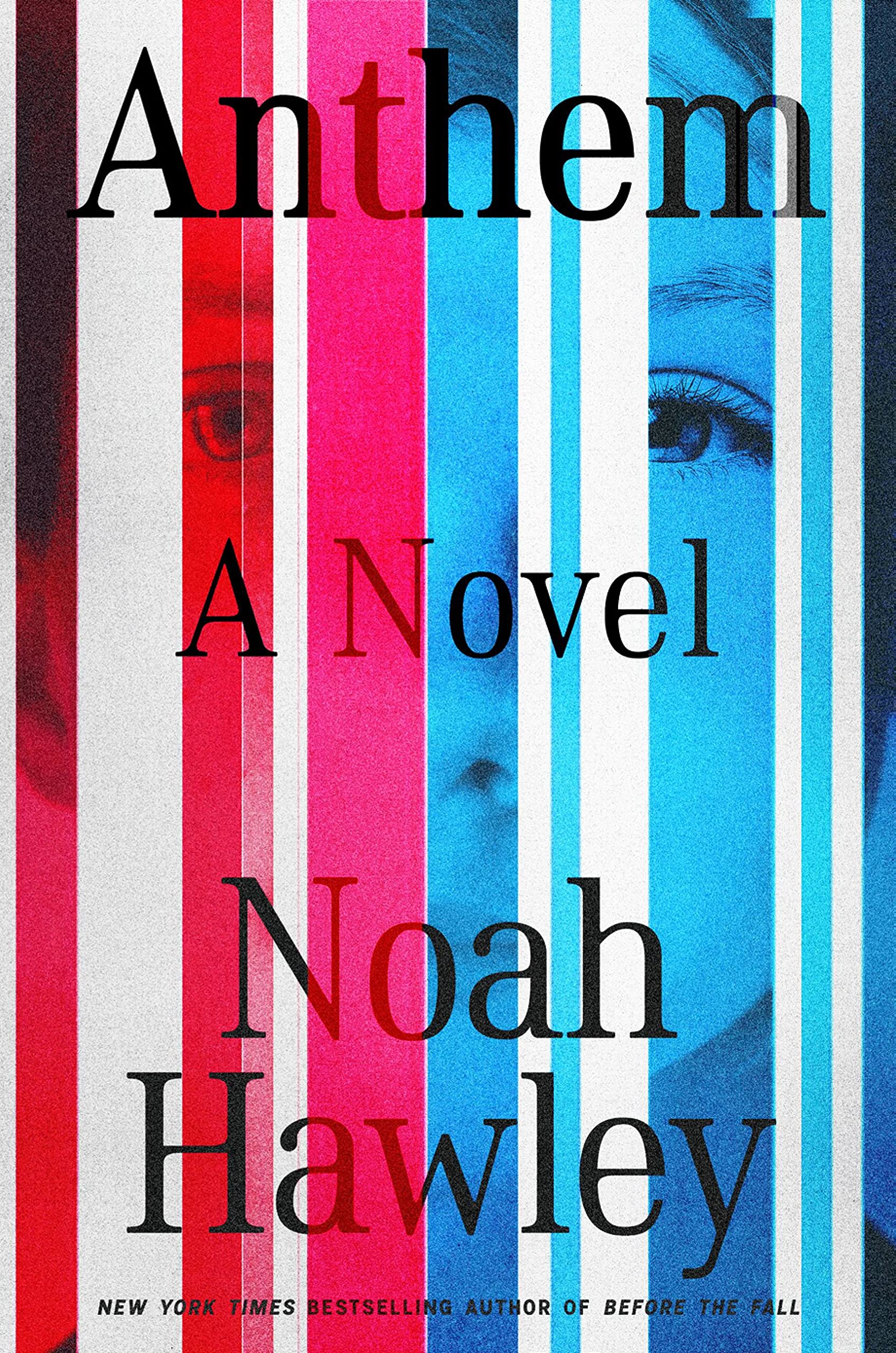
Anthem: Hawley, Noah: 9781538711514: Amazon.com: Books

Anthem – Noah Hawley

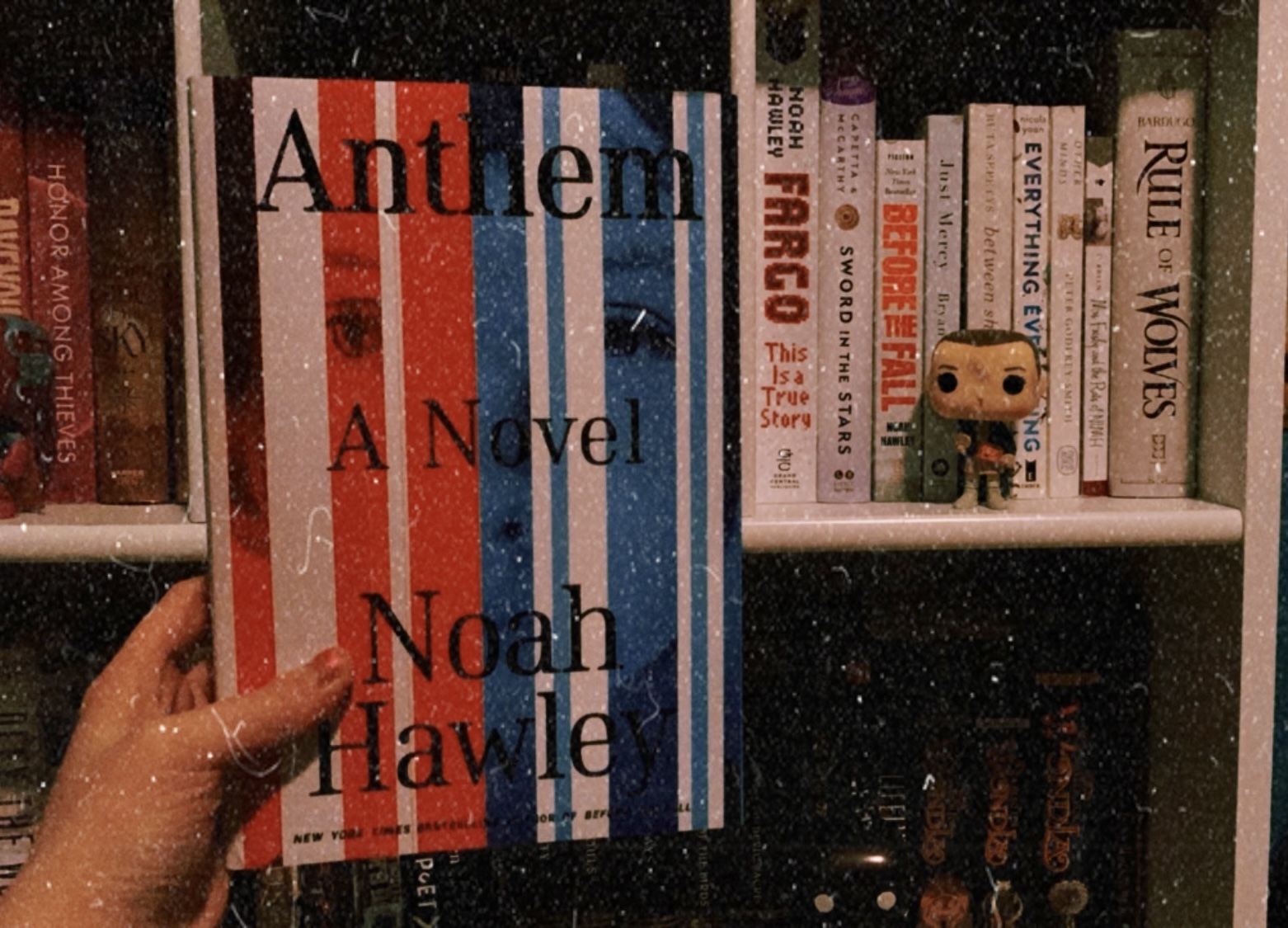
my copy ft. my bookshelf (including the other two Noah Hawley books I own) & a cool filter

Our world is in shambles. The political chasm between the American people is widening more with each day, the oceans are rising, and now, teenagers are committing suicide by the thousands each day.

One such teenager was Claire Oliver, the daughter of a reviled pharmaceutical mogul. After her death by an overdose, her parents send Simon, her younger brother, to a rehab center in Chicago to make sense of her passing. There, he meets a strange figure who only goes by The Prophet. The Prophet’s enigmatic visions lead Simon and his fellow patients out of the rehab center and on the road to a shadowy man known only as the Wizard, whose downfall may be their only means of salvation.

satchel cannon | Explore Tumblr Posts and Blogs | Tumgir

TW/CW: suicide (overdosing, hanging, jumping from bridges, etc.), racism, descriptions of rape/sexual assault, graphic violence, anti-semitism, climate change, brief descriptions of genitalia, blood

Anthem, in its essence, is Noah Hawley’s megaphone for existential dread. But given the times, it’s understandable.

Let me be crystal-clear about this: it’s a bad idea to read this book if you’re not in a good headspace. A lot of what Anthem deals with is a worst-case scenario of the future: near anarchy, the political divisions of the U.S. with the volume turned up even more so, mass suicide, climate change, and every other bit of dystopia you can possibly imagine. This is Hawley’s vision of the worst that could possibly be, and he does it well. What’s really scary about it, though, is that some parts were almost plausible. I’m not cynical enough to call it realistic, but I’m scared enough to call it partially feasible. It’s scary. enough that Noah Hawley flat out apologizes for the world he created—like the horrific worst case parenting scenario of The Good Father, it’s the most pessimistic outcome on the spectrum, but it’s well-written.

As always, Noah Hawley has a unique way with words that paints the near-future in a number of ways. There’s the main plot, in which a band of disillusioned, teenage rehab patients go on a cross-country road trip based solely on a 14-year-old who claims to have visions from God and encounter everything from gangs of gun-toting clowns to lions. But interspersed within are anecdotes from a wide cast of characters—most of which are unlikeable, as per Noah Hawley standards—that add to the genuinely disturbing feel of the world he’s created.

However, Hawley’s vivid descriptions often gave way to portions of flat-out rambling—about the state of the world, the nature of the darkest parts of the human species, the possibilities of a world like the one of Anthem. This part was what bogged me down the most; as a young person who would theoretically be maturing into this dystopia, it…well, it freaked me out, to put it plainly. I’d been on a stint of finishing books in a day, but this one took me almost four just because I couldn’t swallow all of the statistics and existential doom at once. Even so, at least it was well-written; Hawley’s talent for spinning words and stories, combined with all manner of allusions, made it slightly easier to palate.

Through it all, Hawley presents a strange, pseudo-fantasy quest throughout a changed America, and every bit of it hooked me. Every little detail made for a landscape that felt tangible enough to touch. I’ll have to go back and read some of his other books to see if this is really a hallmark of his, but in Anthem, at least, all of the sensory details were what made the world seem so frighteningly real: the paintings on the side of the van, the music on the car radio, the interior decor of the Wizard’s sadistic mansion. Without them, a book like Anthem might not have succeeded for me—if you’re going to make commentary on what the future might turn out to be, tell us what this future looks like.

Most of my other problems were more nitpicky; some of the dialogue, especially with the teenaged characters, felt at times very unrealistic. (sir, I’m aware that you have gen z kids but I, also a gen z kid, can assure you that nobody, nobody, says “LOL” out loud.) That part was inexcusable. There were some minor threads that weren’t resolved all the way (ex. the whole “these memes are driving our children to suicide” subplot—the meme is explained, but given that it was the first line of the synopsis, I expected it to play a bigger role), and the ending, although it also was explained, felt rushed. There’s hope in the resolution, but the resolution was so glossed over that it couldn’t be felt all the way.

But through it all, one thing was clear to me—this felt like a pandemic book. I don’t mean that in a derogatory way. Anthem just seems like one of the first in a new wave of dystopian novels, books that speak to the fear, chaos, and violence of the past six years. Anthem feels like the kind of book that will be remembered as distinctly “21st century”: post-Trump, amidst the COVID-19 pandemic, and appropriately frightened for what the future might hold not just for America, but for us as a species.

All in all, a frightening vision of the future from one of my favorite literary masterminds, but not quite coherent enough to his best work. 3.75 stars, rounded up to 4!

fargo fx | Explore Tumblr Posts and Blogs | Tumgir

Anthem is a standalone novel, but Noah Hawley is also the author of Before the Fall, The Punch, The Good Father, Other People’s Weddings, and A Conspiracy of Tall Men. Hawley has also adapted the Coen Brothers’ Fargo and Marvel Comics’ Legion for TV on FX and Marvel Television.

Today’s song:

That’s it for this week’s Book Review Tuesday! Have a wonderful rest of your day, and take care of yourselves!

Posted in Book Review Tuesday

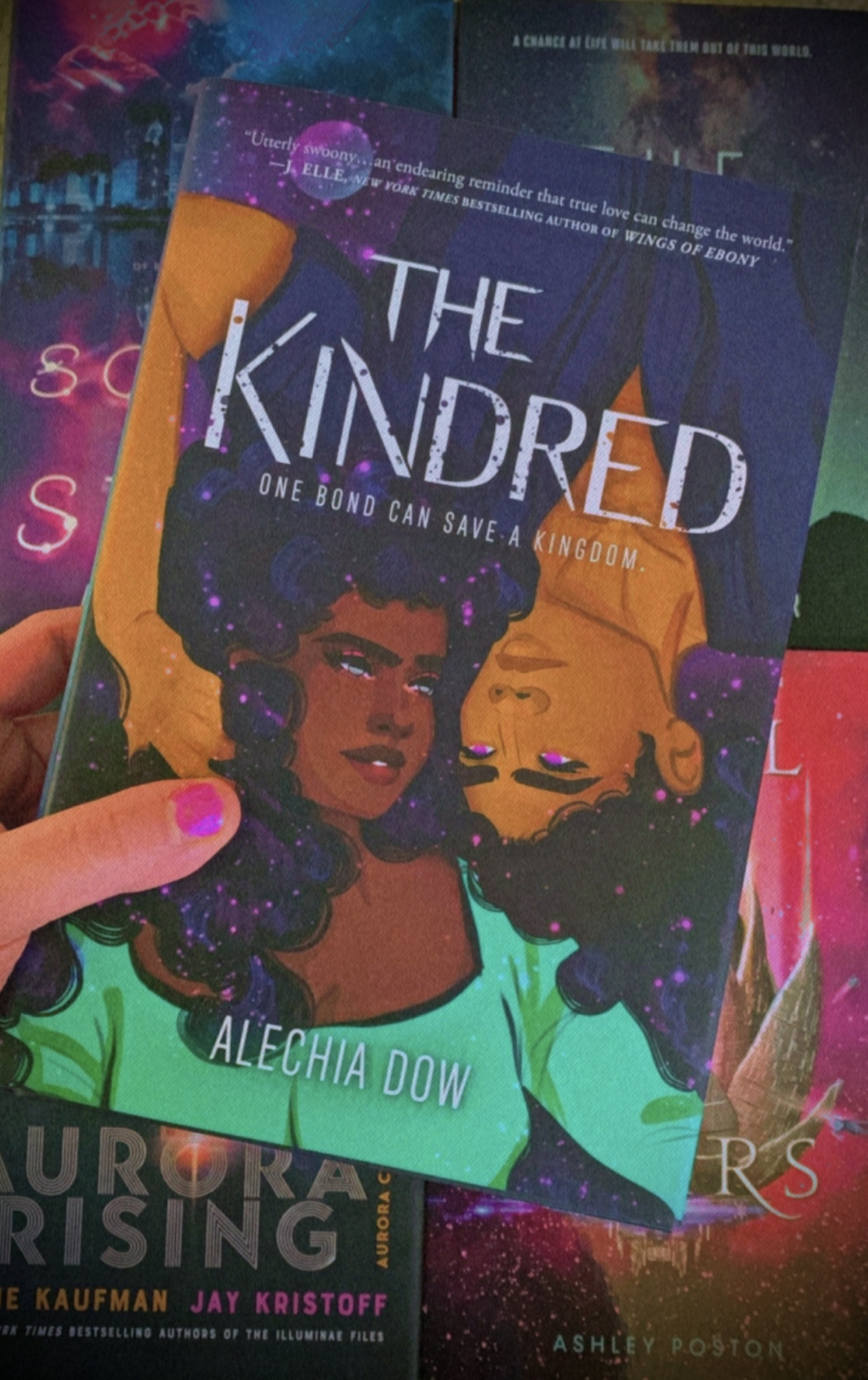
Book Review Tuesday (1/11/22) – The Kindred

Happy Tuesday, bibliophiles!

Ever since I read The Sound of Stars back in 2020, I’ve been eagerly anticipating Alechia Dow’s next book. I preordered The Kindred last year knowing that I’d love it, and although I didn’t enjoy it as much as The Sound of Stars, it was a wonderfully sweet and rollicking novel.

Enjoy this week’s review!

The Kindred by Alechia Dow

The Kindred – Alechia Dow

my copy ft. some more purplish sci-fi books & a cool filter

After a violent, class-based revolution ravaged the Monchuri system, the Kindred program is introduced to quell the chaos; in order to ensure equal representation within the kingdom, mind pairings between citizens from all over the system.

Felix and Joy are paired by the Kindred, but their backgrounds couldn’t be more different; Felix is the Duke of the Monchuri system, while Joy is a commoner in the poorest planet in the system. But when the rest of the royal family is assassinated and Felix is put under suspicion, they escape together—only to crash-land on Earth. With the galaxy hunting for them and targets on their backs on Earth, the two must find a way to return home and prove Felix’s innocence.

Download this awesome wallpaper - Wallpaper Cave

TW/CW: violence, racism, fatphobia/bodyshaming, murder, kidnapping

The Kindred wasn’t quite as potent as The Sound of Stars was for me, but in no way does that mean that I didn’t enjoy it. In fact, it’s solid proof that if I see Alechia Dow’s name on a book, I’ll probably read it.

Despite the trigger warnings I listed, The Kindred is fairly light-hearted; even with all of these topics discussed (all with aplomb), it still manages to be a feel-good, tender read throughout. The themes of racism and fatphobia (mostly with regards to Joy) are handled in a sensitive way that doesn’t dull their importance, but the book is consistently light-hearted and warm. It hits the perfect balance of not diminishing these themes and keeping levity within the book, and it’s the perfect book if you want sci-fi that will cheer you up!

Everything I loved about The Sound of Stars was in The Kindred in spades! Felix and Joy were such endearing characters, and their chemistry together was perfect. They had conflicting personalities on the surface level (with Felix being the more reckless one and Joy being more sensible and reserved), but as they bonded, their relationship became the textbook example of “opposites attract” done well! Plus, it’s always wonderful to have queer couples like them front and center. Joy is demisexual/asexual, and I believe Felix is pansexual or queer? (Felix’s sexuality wasn’t specified, but it’s mentioned that he’s been in romantic relationships regardless of gender so I’ll say queer for now.) Alechia Dow never fails to give us the diverse stories we need.

As far as the plot goes, I wasn’t invested in it as much as I was the characters. Most of it was a bit predictable—not much subtext, surface-level political intrigue, a neat and tidy end to the conflict, and all that. But I didn’t mind this time; the focus was supposed to be on Felix and Joy’s romance, after all. The Earth part of the story was funny most of the time; I didn’t get as many of the music references this time, unlike with The Sound of Stars (definitely not a Swiftie here haha), but the fact that there’s a black cat named Chadwick sold me. BEYOND CUTE.

My other main problem with The Kindred was the aliens themselves. It’s one of my main pet peeves in sci-fi in general: aliens that look like humans, but with a few very minor differences. Although there were some side aliens that were described as non-human, Joy and Felix and their species were just…humans with better technology? Eh…I will say though, at least they’re not white this time. In particular, Joy is plus-size and Black-coded, which was a vast improvement from the white-coded aliens that usually end up in the aforementioned trope. I’m willing to let it slide this time (sort of) because a) Alechia Dow is a great writer and b) diversity.

All in all, a romantic, diverse, and all-around feel-good sci-fi from an author that I’ll be sure to watch in the future. 4 stars!

Thor 3 Ragnarok : Le film de tous les changements pour Thor ? | melty
The Kindred summed up in a single gif

The Kindred is a standalone, but it is set in the same universe as The Sound of Stars, Alechia Dow’s debut novel. You don’t have to read one to understand the other, but there are nods to The Sound of Stars throughout The Kindred. Alechia Dow is also the author of the forthcoming Sweet Stakes (expected to be released in 2023), and contributed to the anthology Out There: Into the Queer New Yonder.

Today’s song:

That’s it for this week’s Book Review Tuesday! Have a wonderful rest of your day, and take care of yourselves!

Posted in Book Review Tuesday

Book Review Tuesday (1/4/22) – Rise of the Red Hand

Happy Tuesday, bibliophiles!

Since I haven’t been able to go to the library lately, I’ve been going through some books on my wish list at the Kindle library. I found this in the sci-fi section, and despite a lot of mediocre to bad reviews, I figured that I would give it a try. And yes, it was a little messy at times, but it presented a unique addition to the YA dystopia genre.

Enjoy this week’s review!

Rise of the Red Hand (The Mechanists, #1) by Olivia Chadha

Rise of the Red Hand (The Mechanists, #1) – Olivia Chadha

25 years after a devastating nuclear war, Ashiva ekes out a living in the slums of the South Asian province. While the rich gorge on new technology, the poor barely get by on secondhand tech and scarce food and water.

Ashiva works for the Red Hand, a revolutionary organization with the goal of dismantling the oppressive government of the South Asian province. As a new sickness ravages the province, Ashiva is forced to ally with Riz-Ali, a rich uplander who may hold the key to exposing a dark conspiracy within the government.

ohapplejuice.tumblr.com - Tumbex

TW/CW: human experimentation, pandemic, graphic violence, emergency medical procedures, death, blood, faked disability, attempted murder

Rise of the Red Hand was more than a little messy, but it had enough unique takes on the average dystopia to pull it through.

What sets Rise of the Red Hand apart from most everything else in the YA dystopian genre is its setting; it’s set in a futuristic South Asia, which is really cool to see, especially since 90% of the dystopias I’ve read are set somewhere in the U.S.! That, along with the atmosphere of the future world that Chadha created and the interspersed South Asian culture and slang, was a breath of fresh air.

Along with that, the highlight of Rise of the Red Hand is that it made dystopia feel…human. There were slices of life that the reader witnesses amidst the horror and destruction—the last real-food vendor in the market, a group of children putting a “kick me” sign on a government robot—that made the setting feel genuine. Dystopias are supposed to be bleak and horrible, of course—that’s the definition of a dystopia in the first place—but elements like these are what make it believable. No matter the circumstances, little pockets of life always thrive. Or, in the words of Jeff Goldblum, “Life finds a way.”

I have mixed feelings about the worldbuilding. On the one hand, Chadha did a good job of making a thorough buildup to the current state of her world, and I didn’t feel as though I were missing anything as I read it. On the other hand, this information was delivered in chunks that were often hefty and distracted from the present dialogue. Good worldbuilding, but ruined by getting dropped on the reader’s head like cinderblocks. Also, on the subject of the provinces…if Asia was divided into the South Asian province and the Asian province, why were North America, South America, and Africa just provinces on their own? It made sense for Europe and Australia, since they’re both fairly small as far as continents go, but…North and South America and Africa are huge. How could that be one province?

The plot itself wasn’t terribly unique; Chadha’s writing made it compelling enough, but underneath all its trappings, it was your garden-variety “take down the oppressive government (that is oppressive for very vague and unspecified reasons) kind of dystopian plot. It’s not to say that it isn’t bad, just overdone. Take away the thorough worldbuilding and unique setting, and this could have been something from 10 years ago, post-Hunger Games. However, I will say that at least it was specified why the government was so oppressive—and a lot of it’s horribly sinister. But again, the setting was the saving grace here—not much else.

Other than that, the characters were decent—not terribly interesting, but not cardboard either. The romance between Ashiva and Riz-Ali felt very rushed and insta-love-y, and was ultimately very unnecessary. Taru’s chapters didn’t feel very necessary, and her voice bothered me. And on the subject of Taru—why exactly did they fake her having brittle-bone disease? Not only are we supposed to be rooting for Ashiva, who conspired to do this, how is that even a solution? That part just felt…weird.

Overall, a dystopia that boasts a unique setting, humanity and atmosphere—but not a lot else. 3 stars.

Dystopia GIFs - Get the best GIF on GIPHY

Rise of the Red Hand is the first book in the Mechanists duology, and it is followed by an untitled sequel set for release this year. Olivia Chadha is also the author of Balance of Fragile Things.

Today’s song:

the harmony at the very end is so pretty 🥺

That’s it for this week’s Book Review Tuesday! Have a wonderful rest of your day, and take care of yourselves!

Posted in Book Review Tuesday

Book Review Tuesday (12/28/21) – Squad

Happy Tuesday, bibliophiles!

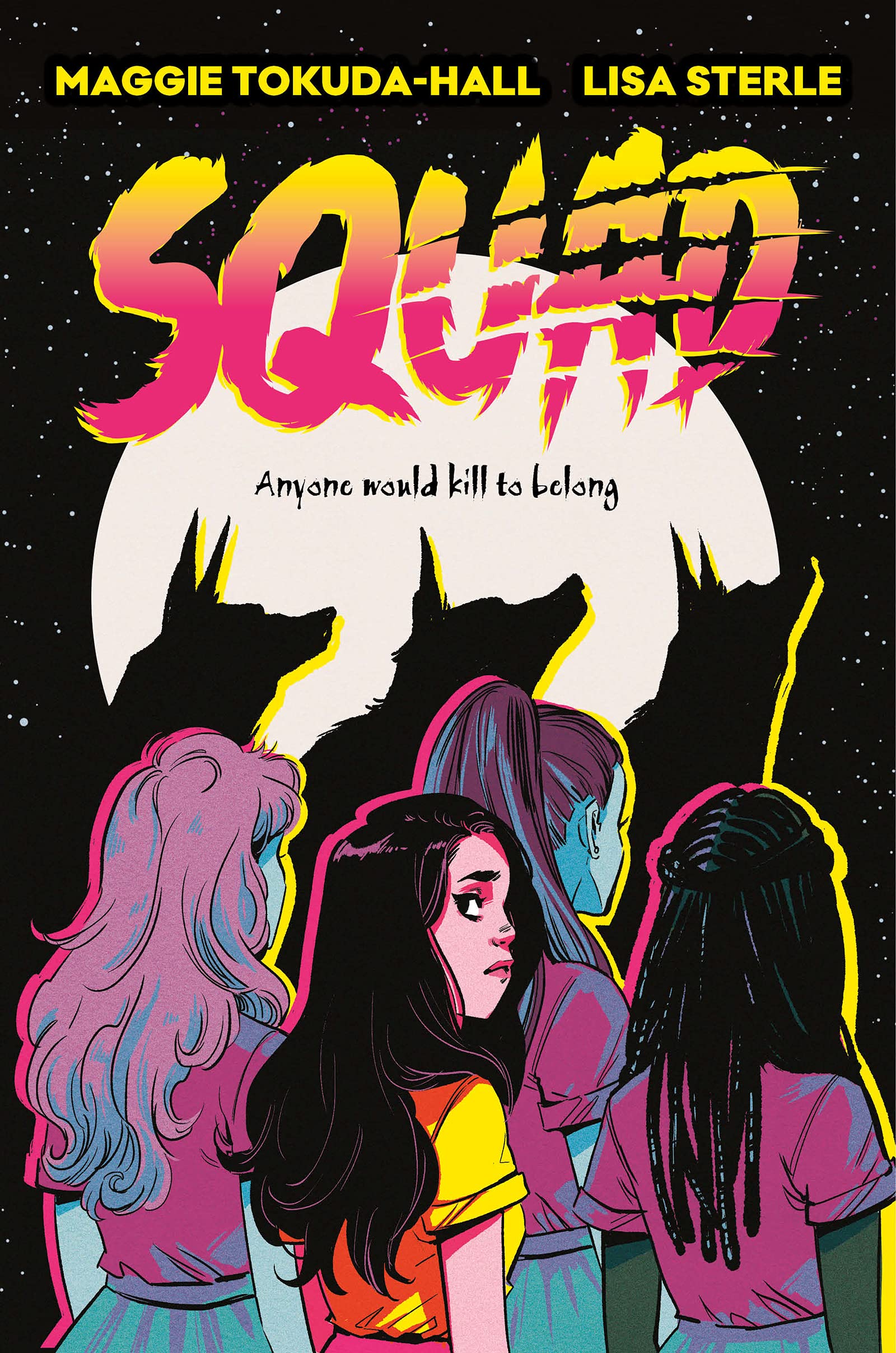
After finishing and loving The Mermaid, the Witch, and the Sea, Squad immediately came on my radar—with the details of the Mermaid sequel being hazy at best, I needed more of Maggie Tokuda-Hall’s writing in my life. I found it in Squad, a punchy and timely graphic novel with bright colors and inner darkness.

Enjoy this week’s review!

Amazon.com: Squad: 9780062943149: Tokuda-Hall, Maggie, Sterle, Lisa: Books

Squad – Maggie Tokuda-Hall and Lisa Sterle

In her junior year, Becca moves to a new high school, thinking that she’ll have to settle with not fitting in. To her surprise, she’s taken under the wings of the three most popular girls in school, and soon, she is swept up into a world of new clothes and rowdy parties. But these three girls have a secret—they’re werewolves, and their prey are the predatory boys they find at their parties. But as the police investigate their most recent killing, Becca must decide if she still wants to be a part of their werewolf Squad.

Squad : Tokuda-Hall, Maggie, Sterle, Lisa: Amazon.ca: Books
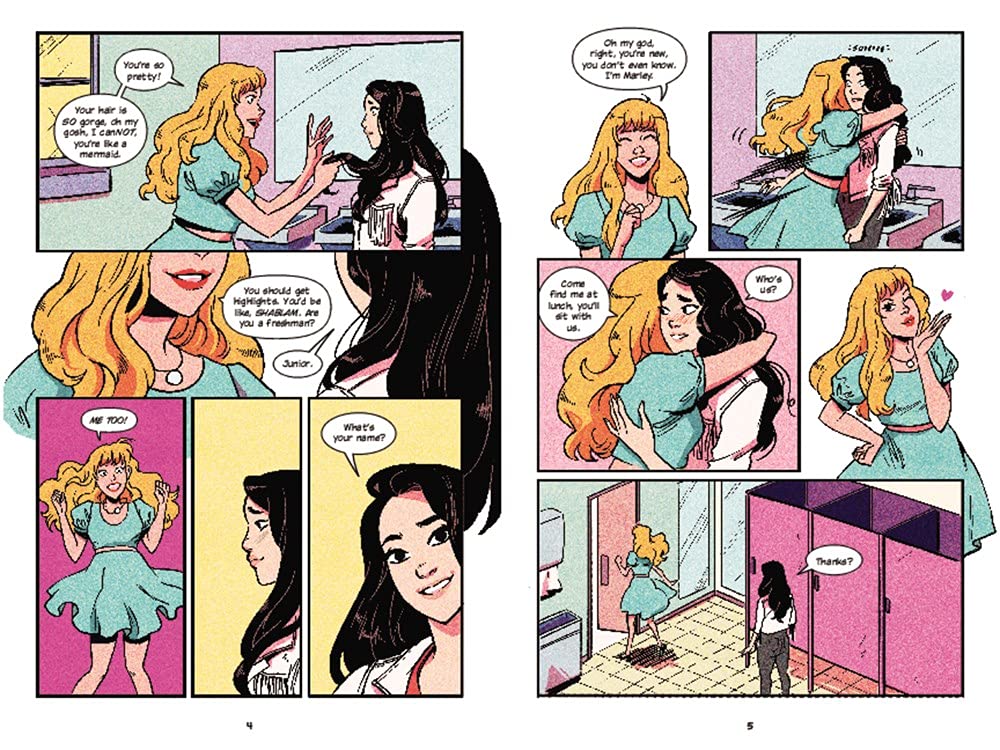
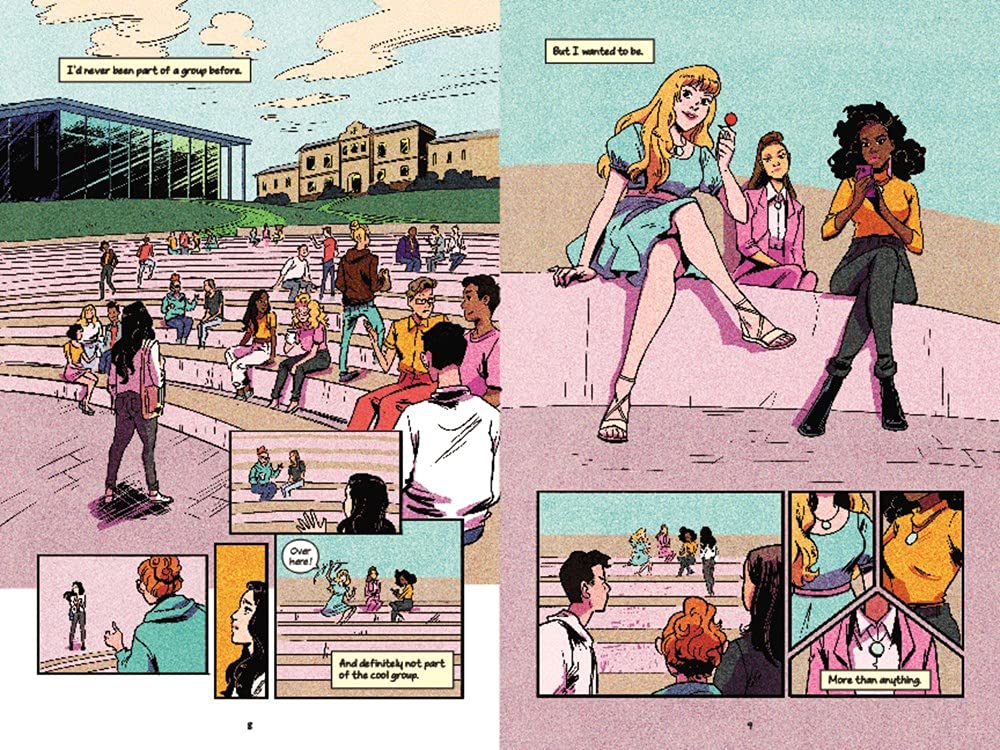
art by Lisa Sterle

TW/CW: attempted rape, misogyny, racism, graphic violence, gore/blood

With its juxtaposition of a bright color palette and the darkness of werewolves out for blood, Squad is the perfect graphic novel for this day and age, and presents a timely theme—when does justice become purely revenge?

I’ve been a fan of Tokuda-Hall’s since The Mermaid, the Witch, and the Sea, but I hadn’t seen anything of Lisa Sterle’s before this. Now, I can definitively say that they make a fantastic graphic novel team! The combination of Tokuda-Hall’s dark and witty writing and Sterle’s bright colors and distinctive faces (both human and wolf) meshed so well together, making the storytelling all the more cohesive. Sterle’s art style is one that I really liked, and it’s the perfect style for this story. I’d like to see something else from this team—their respective writing and art styles were perfect for the aesthetic of Squad!

Right off the bat, I loved the concept of this novel and the implications it had. The idea of a clique of werewolves preying on rapists at parties already had my attention, and this part was executed so well! But beyond this, Squad asks us the question that’s become so prevalent with #MeToo and the growing movement to hold rapists accountable: when does getting back at the perpetrator become pure revenge and not accountability? Seeing all of this through the eyes of Becca—the newest in what we find out is a long line of werewolves—is a perfect way to show these themes from the perspective of a newcomer.

Becca’s perspective also serves as a wonderful way to show how dangerous trying to fit in can be. Over the course of Squad, a rift begins to form between these four girls, especially with Arianna, who has begun to break all the rules set by their previous “alpha,” and Amanda, who seems to be the only one willing to stick to their original plans. All of this threatens to tear Becca apart, even when her own mother pushes her to continue climbing the social ladder. It presents a great dilemma for Becca—is it worth it to go against what she feels is right for a chance at power?

However, there were a few things that I didn’t quite like about Squad. First off, the ending felt very abrupt and unresolved. It went from point A to point B with no real correlation, and it simply…ended. From reading two of her works now, I’d say that endings aren’t Tokuda-Hall’s strong suit; I didn’t mind the ending of The Mermaid, the Witch, and the Sea as much as I did this one (although my friends in book club would probably say otherwise lol), but it still felt rushed. Squad’s ending was still sweet, but it lacked a cohesive resolution.

In addition, while I loved the idea of a sapphic werewolf romance, the relationship between Becca and Marley was very rushed. Like the ending, I loved what little I saw of it (especially that last scene!), but it felt crammed into the last third of the story and bordered on insta-love. Plus, I have mixed feelings about Becca being paired with Marley; it made sense in concept, since they were both caught up in the conflict of the rest of the squad, but given some of the offhand comments that Marley makes about Becca in the beginning, it didn’t make sense that Becca would immediately tolerate all that and fall in love. Maybe if we’d seen if Marley had a change of heart or at least apologized about some of those comments, it might have made sense. But the romance ended up being sweet, but sloppily done. Almost an afterthought.

All in all, a biting (no pun intended) and important tale of the line between accountability and revenge. 4.25 stars!

Squad : Tokuda-Hall, Maggie, Sterle, Lisa: Amazon.ca: Books

Squad is a standalone, but Maggie Tokuda-Hall is also the author of The Mermaid, the Witch, and the Sea. Lisa Sterle is also the illustrator of Witchblood and the creator of the Modern Witch Tarot Deck.

Today’s song:

That’s it for this week’s Book Review Tuesday, and the last Book Review Tuesday of 2021! Have a wonderful rest of your day, and take care of yourselves!

Posted in Book Review Tuesday

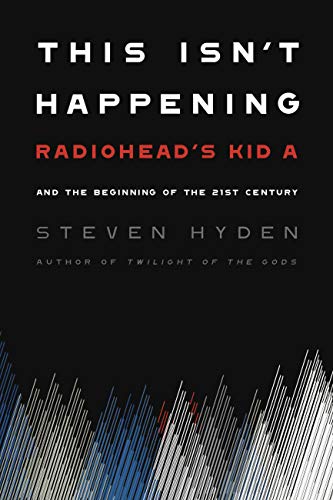
Book Review Tuesday (12/7/21) – This Isn’t Happening: Radiohead’s “Kid A” and the Beginning of the 21st Century

Happy Tuesday, bibliophiles!

For the past two years, I’ve started to read more nonfiction (though still not much, admittedly), but it’s rare that I ever review any of them. But I figured I would review this book since a) I’m a major Radiohead fan, and b) I have Some Thoughts™️ on it, so here goes nothing…

Enjoy this week’s review!

This Isn't Happening: Radiohead's "Kid A" and the Beginning of the 21st  Century - Kindle edition by Hyden, Steven. Arts & Photography Kindle eBooks  @ Amazon.com.

This Isn’t Happening: Radiohead’s “Kid A” and the Beginning of the 21st Century – Steven Hyden

From its tumultuous inception to its profound impact on release, Radiohead’s 2000 album “Kid A” is seen as a landmark of modern music. Though critics and fans alike were divided on it when it first hit stores, its impact stretches far beyond the world of music—for many, it was an unintentionally prophetic vision of the future. 20 years later, music critic Steven Hyden dives deeper into the mythology around this iconic album, from its creation in the studio to the cultural impact it had in the years after its release.

TW/CW: this is nonfiction and it’s mostly just music history, but be aware that there are some (mostly brief) mentions of mental breakdowns, suicide, 9/11, and substance abuse.

This Isn’t Happening reads like a 244 page Pitchfork review, but I wouldn’t say that’s necessarily a bad thing. What’s clear, though, is that it’s by Radiohead fans and for Radiohead fans, which is exactly what it should be.

It’s clear from every page of This Isn’t Happening that, like many Radiohead fans, that listening to “Kid A” was a life-changing experience for Steven Hyden. Hyden’s love for the album bleeds for the page, and every bit of analysis was so clearly crafted out of love and admiration. This isn’t simply bare analysis: it’s imbued with a well-deserved appreciation for a band that may well have changed the fabric of modern rock music forever. Every track—even “Untitled“—gets some degree of attention (although I’m stunned that more praise wasn’t given to “Motion Picture Soundtrack”—come on, now), and the most minute details are reported on with simultaneous tact and love, from Thom Yorke’s inner conflict while creating the album to the many bands whose influences shine through on the album.

However, the price of This Isn’t Happening clearly being from the heart of a Radiohead fan is that it tends to ramble. Smaller, more unimportant points during the course of the book were often extended to a near-ridiculous degree, digressing from the subject matter of that particular section. This resulted in passages like “yeah, I just mentioned post-rock here. You know what my favorite post-rock band is? It’s this obscure band that you’ve never heard of, beat that!” or “Many wonder what ‘Kid A’ would have been like had it been a double album with ‘Amnesiac.’ You know what? Screw it, here’s how I would organize it if it was a double album. Ooooh, look at me, I’m putting in all the singles that got cut from the album…”, etc., etc., etc. With how short This Isn’t Happening is (only around 244 pages on the hardcover edition), a lot it felt like nothing more than stream-of-consciousness digressions that only served to plump up the page count.

What was also fascinating to me was some of the more cultural aspects of This Isn’t Happening and the aftermath of “Kid A.” All of this happened just before I was born, and from a younger perspective, it was so interesting to see Hyden’s picture of the cultural landscape. It’s not from the perspective of a historian—it’s from the perspective of a music critic, and something about this view, from somebody who knows everything just from living through it, made it all the more engrossing to read.

Through it all, there’s a profound appreciation—not worship, but still immense admiration—for music as a whole. Hyden’s writing is full of dry humor and clever references, and it makes for a read that wholly appeals to the music nerd in all of us. Hyden treats listening to “Kid A” as an almost cinematic experience, encouraging the reader to sit back, relax, and start playing “Everything In Its Right Place” as he dives into the creation of the album. This is the kind of book that only a music critic could write—otherwise, it would sound disingenuous.

All in all, a loving but flawed exploration into the most groundbreaking albums of the 21st century. But before I go:

That’s all.

3 stars!

submitted by invisible-rainbow) | Radiohead kid a, Album art, Radiohead  albums

(since this is a book dealing with an album, click here if you’d like to listen to “Kid A” for yourself. I highly recommend it!)

Stephen Hyden is an author and music critic; besides This Isn’t Happening, he is also the author of the nonfiction books Your Favorite Band is Killing Me and Twilight of the Gods.

Today’s song:

That’s it for this week’s Book Review Tuesday! Have a wonderful rest of your day, and take care of yourselves!

Posted in Book Review Tuesday

Book Review Tuesday (11/30/21) – Six Wakes

Happy Tuesday, bibliophiles!

Six Wakes is one of those books that’s been on the first shelf of my Goodreads TBR since the dawn of time. (Read: early 2017) I forget exactly when I fished it back out of the depths, but the premise looked interesting, so I figured I’d put it on hold at the library. Sadly, Six Wakes befell the same fate as most of the books that sit and wither in my TBR for too long: it didn’t live up to my expectations—average as they were—and ended up just being mediocre.

Enjoy this week’s review!

Six Wakes by Mur Lafferty

Six Wakes – Mur Lafferty

The spaceship Dormire is home to six clones. Each of them were convicted of crimes in their past lives, and by steering the Dormire to a new planet, they will be pardoned of all their past misdeeds. But when they wake up to find the corpses of their previous clones strewn around the spaceship, all six suspect foul play. But with their memories wiped and the Dormire’s AI malfunctioning, will they be able to find the perpetrator of the crime before they strike again?

Deshi Basara | 4orror: In space no one can hear you scream. ...

TW/CW: murder, blood, gore, poisoning, descriptions of death/corpses

From the premise of Six Wakes, I expected a sci-fi thriller. The sci-fi box was ticked off, without question, but the further I progressed in the novel, I was more convinced that all I was reading was 50% fictional cloning history, 48% backstory, and 2% plot.

I’ll give Six Wakes one thing, though; the worldbuilding, at its best, was incredibly thorough and well thought-out. Mur Lafferty clearly spent so much time on creating a rich, century-spanning history of cloning and its ethics, as well as the effects it had on world governments and the criminal underworld. It’s the kind of worldbuilding that made me think, “wow, I doubt I could ever have the patience to create something that detailed.” It was fantastic, really. However, it ended up being a bit of a curse to the rest of the book.

This worldbuilding, extensive and detailed as it was, ended up being delivered in such long chunks that I found myself forgetting what the novel was supposed to be about in the first place. There was so much content shoved in that it distracted from the plot as a whole, leaving it suspended in time for so long that I had to go back and re-read just to remember where we left off before the clone rambling started.

Along with the blessing/curse of the worldbuilding, the other 48% (excluding the plot) that bogged down Six Wakes was the excessive backstory. I may not be a frequent mystery reader, but I’ve read enough to know that the whole point of figuring out the mystery is to very slowly realize key details of the characters. And yet, Six Wakes went and did the EXACT opposite. Almost half of the book consisted of multi-chapter sections of backstories for the characters. Not only were they the most inorganic way possible to learn about the characters, they dragged away from what was supposed to be the main plot, and contributed to my lack of enjoyment for the book.

Even with all that backstories, none of the characters really had much of a personality. At all. We got their stories, sure, but save for maybe Hiro (whose personality seemed to be solely for comic relief), I got no sense for what made any of them tick, or what any of them were like as people. I will say in Lafferty’s favor that at least the cast was diverse—two of the main characters were Latinx (Mexican and Cuban-American) and one character was Japanese, so that was a plus.

All of those lacking plot aspects ultimately numbed me to what could have been an inventive and chilling mystery. By the time I’d trudged through all of the backstory and clone history, the plot twists made me feel nothing. And I still don’t have a clear picture of how the book was even resolved. Maybe that’s because by then, I was just skimming, but it still felt so weak and lacking as a whole.

All in all, a sci-fi thriller that had the potential for greatness but got bogged down by excessive backstory and info-dumping. 2 stars.

space aesthetic gifs | WiffleGif

Six Wakes is a standalone, but Mur Lafferty is also the author of the Afterlife series (Heaven, Hell, Earth, Wasteland, War, and Stones), the Shambling Guides series (The Shambling Guide to New York City and The Ghost Train to New Orleans), the novelization of Solo: A Star Wars Story, and several novels.

Today’s song:

That’s it for this week’s Book Review Tuesday! Have a wonderful rest of your day, and take care of yourselves!

Posted in Book Review Tuesday

Book Review Tuesday (11/23/21) – The 7 1/2 Deaths of Evelyn Hardcastle

Happy Tuesday, bibliophiles!

I’ll admit to being not much of a mystery reader; I’m terrible at predicting who perpetrated (x) crime, so I just end up going along for the ride like a dog sticking its head out of a car window. But I thoroughly enjoyed Evelyn Hardcastle, from its consistent suspense to its creative takes on the genre.

Enjoy this week’s review!

The 7½ Deaths of Evelyn Hardcastle by Stuart Turton

The 7 1/2 Deaths of Evelyn Hardcastle – Stuart Turton

Aiden Bishop has no memory of who he is, or who he was before. All he knows is this: he is currently attending a masquerade ball at Blackheath Manor, and that at the end of the night, a famous socialite by the name of Evelyn Hardcastle will die. Every day, time starts over, and Bishop wakes up in the body of a different party guest. The only way for him to break out of Blackheath Manor is to answer this question: who killed Evelyn Hardcastle?

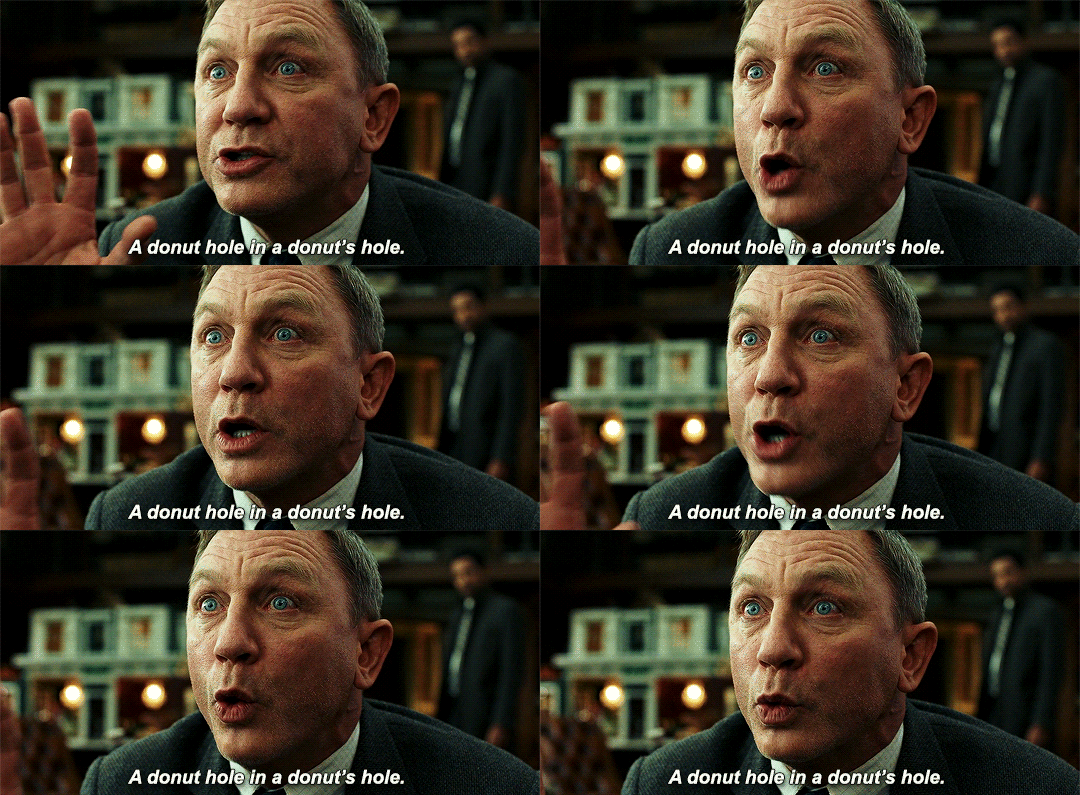
𝔧𝔲𝔰𝔱 𝔶𝔬𝔲 — chewbacca: KNIVES OUT dir. Rian Johnson
god, I need to watch this movie again

TW/CW: murder, suicide, gunshot wounds, near-death situations, forced marriage, poisoning, drinking

Listen. I don’t often read mysteries, but even with a limited body of work to base my thoughts off of, I can say with certainty that this is one of the most creative mysteries that I’ve ever read.

The 7 1/2 Deaths of Evelyn Hardcastle has drawn comparisons to the likes of everything from Agatha Christie to Groundhog Day, and I can see the threads of both in this novel! It certainly had the feel of a classic mystery, and the cyclical, time-twisting element reminded me a lot of Groundhog Day with very different stakes. In fact, Turton’s playing with time is what made Evelyn Hardcastle such an enjoyable book; with each day that Aiden experiences, the stakes are raised even higher, building a very unique brand of suspense. I’m not usually one for back-and-forth time jumps, but Evelyn Hardcastle had a precise and clear reason for doing so, and the chapter layout worked just as well to increase the tension.

Going into Evelyn Hardcastle, the concept of switching between the bodies of guests was what intrigued me most. This aspect was easily the most well-executed element of them all, bringing in a twisty and creative factor to a mystery that would otherwise seem like any other period piece murder. The fact that all of the guests were, on some level, deplorable people made this facet of the book all the better; each one of them had any number of nasty skeletons in their closets, which made the question of Evelyn’s murder all the more intriguing—it could have been anyone.

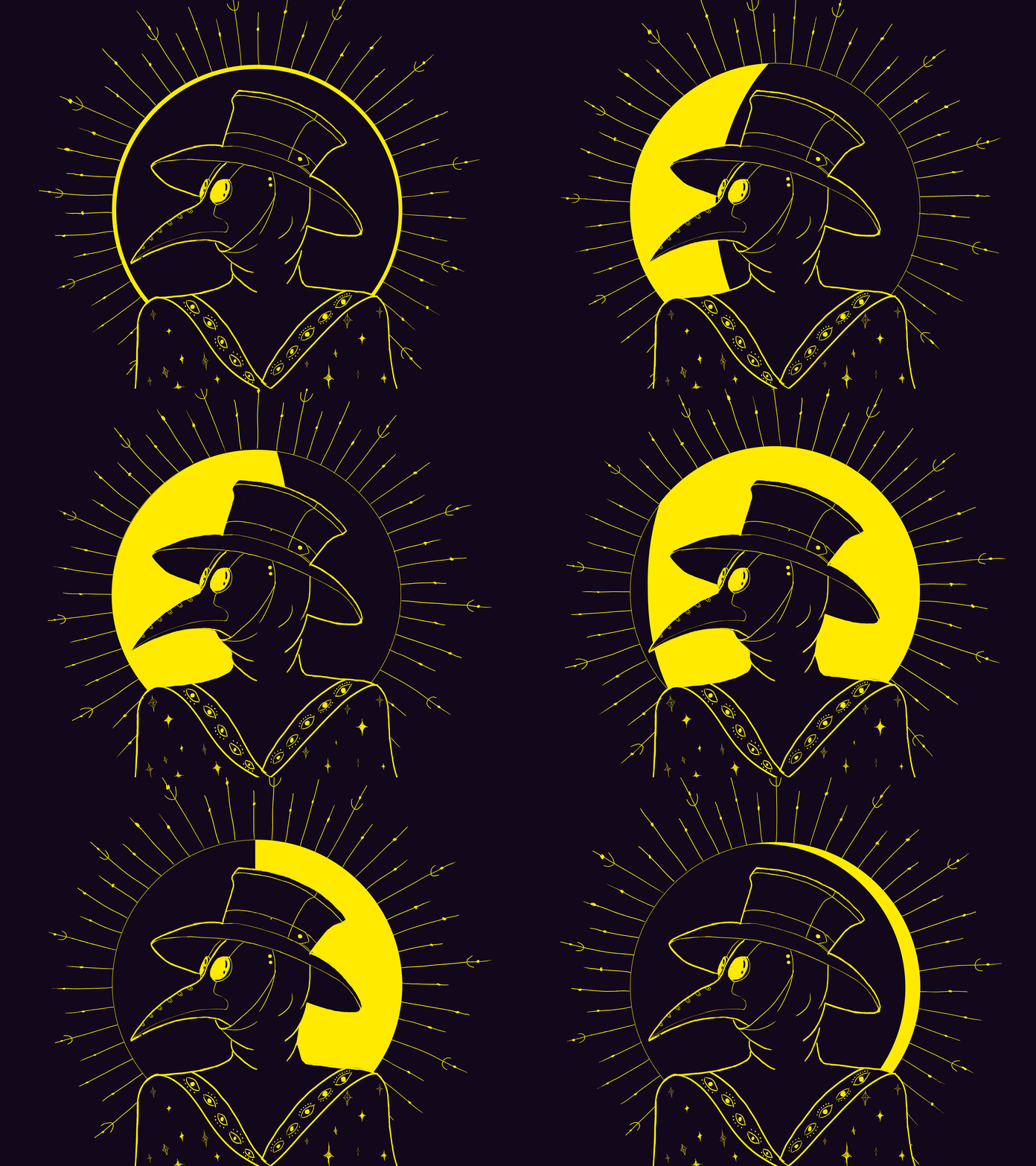
I didn’t expect for the mystery to be an orchestrated test as well; the added element of multiple body-switching guests and the enigmatic Plague Doctor character created a new layer of suspense, which not only made the stakes higher, but also stranger. The idea that the key to Aiden’s freedom was solving Evelyn Hardcastle’s murder was all the more interesting given that this twisted “game” of sorts was orchestrated by any number of cryptic agents was such an inventive way of creating tension, so hats off to Turton for finding all sorts of ways to craft a suspenseful mystery!

Plus, the amount of red herrings that got thrown around…I’m notoriously bad at a) figuring out mysteries, and b) falling for false bait, so I tend to give up on trying to solve the mystery itself and just go along for the ride. That being so, I loved all the ways that Turton threw us off the trail as readers; in multiple instances, there were times that Evelyn Hardcastle’s murder seemed deceptively simple, but there were ruses on top of ruses (or: a donut hole in a donut’s hole) that slowly unfolded to uncover the real cause of her death. I’m sure that it’s just the kind of thing that mystery readers eat up—and I certainly ate it up, even as someone who rarely reads in the genre.

Also, without spoiling anything—the fact that Evelyn Hardcastle could technically count as sci-fi (according to the interview with Stuart Turton) makes it so much more fascination, not just because I love sci-fi so much, but because of the implications that has for the origin of Blackheath Manor in the first place. FASCINATING stuff.

All in all, a crafty mystery that employed all manner of creative twists to hook the reader in. 4 stars!

The Plague Doctor by MaxChe on Dribbble

The 7 1/2 Deaths of Evelyn Hardcastle is a standalone, and it was Stuart Turton’s debut novel. Turton is also the author of The Devil and the Dark Water, and contributed to the anthology You Are Not Alone.

Today’s song:

That’s it for this week’s Book Review Tuesday! Have a wonderful rest of your day, and take care of yourselves!

Posted in Book Review Tuesday

Book Review Tuesday (11/16/21) – Aurora’s End (Aurora Cycle, #3)

Happy Tuesday, bibliophiles!

Wow. The day has finally come, folks. 1 and a half years of waiting, and now I have answers. My favorite series has come to a close, and yet it doesn’t feel like the end. It’s surreal to think that this may be it—the series that changed the course of my life, finally capping off. But if this really is the end, then Aurora’s End is the best conclusion that I could have ever asked for, and a book that I will no doubt cherish just as fervently as the first two books.

Now, TREAD LIGHTLY! If you haven’t read Aurora Rising or Aurora Burning and intend to, beware of spoilers! If you want to read my previous reviews, look no further:

Enjoy this week’s review!

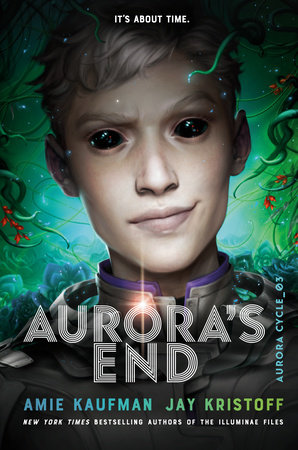
Aurora's End by Amie Kaufman and Jay Kristoff | Penguin Random House Canada
F I N

Aurora’s End (Aurora Cycle, #3) – Amie Kaufman & Jay Kristoff

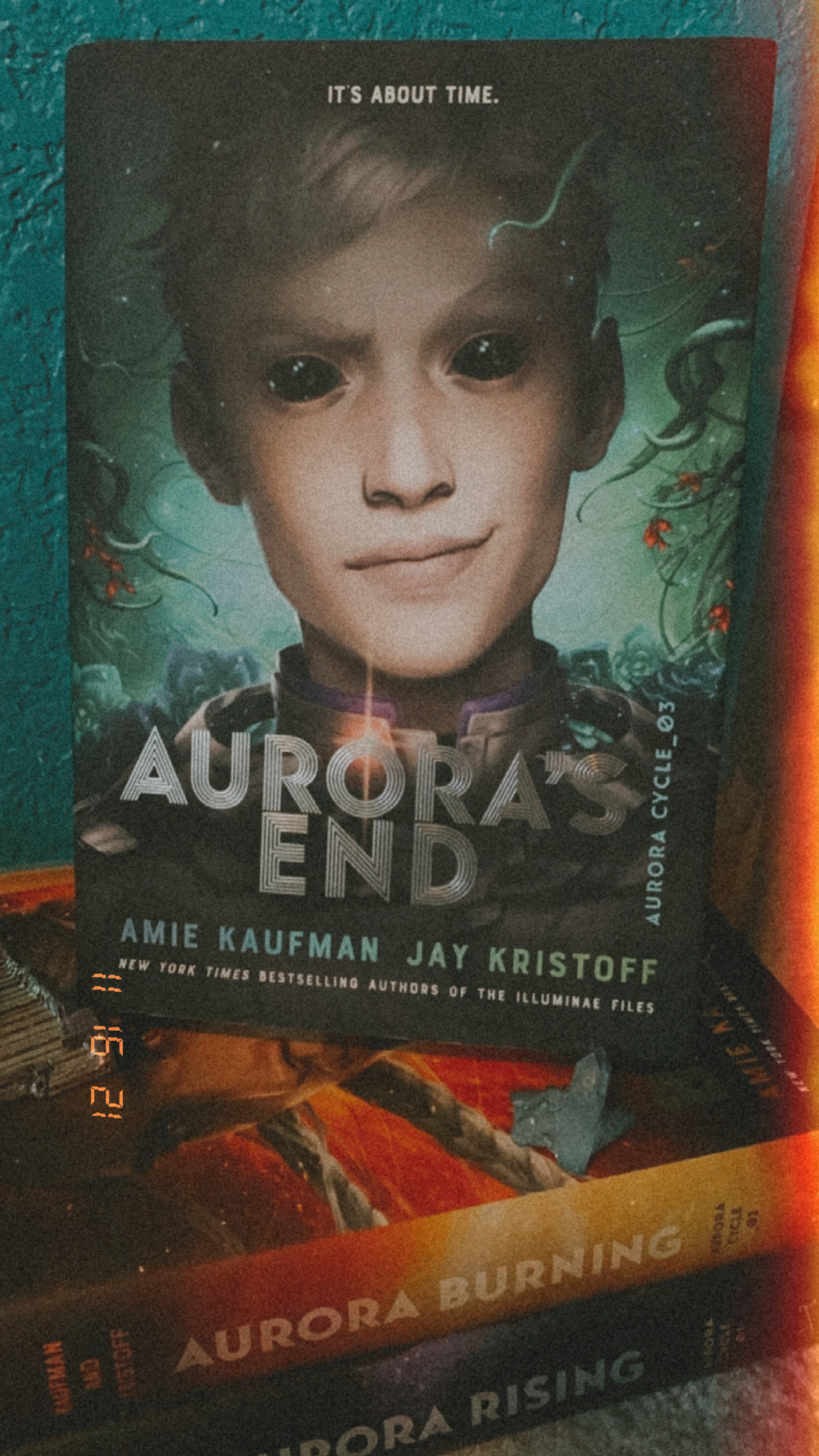
my copy ft. Aurora Burning and Aurora Rising, plus a cool filter and some crystals (not Eshvaren crystals oop)
last picture, I promise—here’s Finny boy with Hobbes, one of my cats

For all intents and purposes, the Battle of Terra was the end for Squad 312. They failed to stop the Starslayer from harnessing the Eshvaren’s Weapon, and intergalactic war is imminent. Meanwhile, the Ra’Haam slips in through the chaos, threatening to cover the entire universe in its spores.

But by a cosmic twist of fate, Tyler, Auri, Kal, Zila, Scarlett, and Finian are unscathed. They’ve been separated by time, and the only chance they have at thwarting the Ra’Haam is turning history itself inside out. Time is not on their side, though, and it may not be enough to save civilization itself from being wiped out.

karlmordo - This is how things are now! You and me. Trapped in...
Aurora’s End without context

TW/CW: graphic violence, mild sexual content, blood, near-death situations, severe allergic reaction, emergency medical procedures, loss of loved ones, death, descriptions of injury, body horror

[WARNING: this review may contain spoilers for Aurora Rising and Aurora Burning!]

I still haven’t come to grips with the fact that this is really the end of the Aurora Cycle. But as someone whose life was permanently altered for the better by this trilogy, I can say with certainty that this is the best end to the series that I could have ever asked for. My heart is so, so, so full of love.

There were so many factors that went into the separate situations that Squad 312 got themselves into, but Kaufman and Kristoff have once again proved that nothing is impossible. Time is distorted, there are future selves to be dealt with, technology and ancient aliens races are as complicated as ever, and of course, Past Pete is here to kill Future Pete. Lucky for us, Kaufman & Kristoff have been rapid-firing Chekhov’s gun, and every detail from the past two books comes full circle. After how mind-boggling the plot and cliffhanger of Aurora Burning were, Aurora’s End brings everything back in superbly clever and surprising ways, making for a trilogy that’s more cohesive than ever before.

And my emotions…MY EMOTIONS! After so long apart, reuniting with Squad 312 felt like reuniting with long-lost friends. Despite this being the last book, the development that many characters got was such a beautiful way to bring them all the way back and display the enormous growth many of them have had over the course of the series. Out of all of them, though, I thoroughly enjoyed getting to see Finian and Scarlett’s relationship develop; they’re such an unlikely couple, but the love they have for each other is so consistently tender and heartwarming. Plus, a) NORMALIZE BI PEOPLE IN STRAIGHT PASSING RELATIONSHIPS! STRAIGHT-PASSING RELATIONSHIPS ARE SO VERY VALID!, and b) DISABLED PEOPLE!! IN LOVING RELATIONSHIPS!! WE NEED MORE OF THOSE!! Nothing can top Kalauri, but Fin and Scar come very, very close. I LOVE those two. Power couple. Finian is the once and future disaster bisexual.

Also, Tyler trying to be all “space pirate”-y after an entire lifetime of being Captain America was a train wreck…comedy gold

One aspect of Kaufman and Kristoff’s writing that I haven’t often touched on is how they build tension. Their skill at developing heart-pounding tension is especially evident in Aurora’s End; they did such a masterful job of raising the stakes over the course of these three books, and bringing it all to a nail-biting cataclysm towards the end. The last 100 pages of Aurora’s End had me stressed out to no end, but…in a good way? It made me genuinely worried for everybody involved. Look, I’ve gotten way to attached to my space misfits over the past two years. Let me off the hook this once.

Along with all that, Kaufman and Kristoff once again more than delivered with everything that made the first two books so strong. The universe was expanded upon in surprising ways, the characters were more fleshed out and lovable than ever, the chemistry was impeccable, the action sequences had me clutching the book in a vice grip, and the dialogue hit the perfect balance of levity, tenderness, and solemnity. The found family of Squad 312 is stronger than ever, and my heart is still bursting with love for all of them.

It’s hard to end this review. It isn’t every day that a series changes my life, but the Aurora Cycle truly did. These books taught me so much about moving through this world as an outsider; Auri taught me that I didn’t have to be brave or strong to be a hero, and that people with the fate of the world on their shoulders can have their big feels too. She was the first time I’d really seen a mixed-race hero, and having a character like her means the world to me. I’ve come to see myself in Finian, and he’s taught me that I deserve love just as I am. And Squad 312 has taught me that no matter who you are, there will always be a home for the outsiders. It cemented, more than ever, that even if you think that you are alone in the world, somebody out there loves you, and will give you a home.

All in all, the perfect ending for a series that changed my life for the better. 5 stars for the sake of Goodreads, but realistically, however many stars there are in the known universe.

Squad 312 forever. 💗

never again shall we submit

Aurora’s End is the final book in the Aurora Cycle, preceded by Aurora Rising (#1) and Aurora Burning (#2). Amie Kaufman and Jay Kristoff have also written the Illuminae Files together; Amie Kaufman is also the author of the Starbound trilogy (co-written with Meagan Spooner) and the Elementals series, and Jay Kristoff is also the author of the LIFEL1K3 trilogy and Empire of the Vampire.

Today’s song:

That’s it for this week’s Book Review Tuesday! Have a wonderful rest of your day, and take care of yourselves!