

Happy Tuesday, everyone!
…so. Elephant in the room here, quite literally. I’ll venture to say that last Tuesday was one of the worst Tuesdays in American history. Hence, no activity. (Also, I had a whole cocktail of midterms to study for and papers and annotated bibliographies to write.) I needed the time to grieve. Let me tell you the truth: I’m so scared. I’m betrayed. Being in my formative years under a president who systematically mocked the identities of everyone who isn’t him—not just the ones that comprise my family—forced me to confront the fact that America had no regard for me. If there was change to be made, I had to do it myself, and with the help of the communities around me. So I started writing. I started educating myself. The process is never over, and will continue until my dying day; even with the sort of beef that I have with Sara Ahmed (yeah, killjoy etc. etc. etc., I’m on board with 50% of it, but can’t feminism be gleeful sometimes?), I look back to her words: “To become a feminist is to stay a student.” I am always learning. I am far from perfect, but I am trying. The key here is motion: we can’t afford to stay static, not in our ideas or in our actions. Resistance comes in many forms (and don’t let anybody tell you that there’s one right way to fight), but the key is that we must always keep moving. Donate. Protest. Pay someone a compliment. Make art. Write with hope in your heart. Trump and his ilk win when we’re too far into the quicksand of hopelessness.
Never lose hope and never lose love, because that is what the Trump administration lacks. Grieve, and grieve on your terms. I certainly did. The last thing I wanted was a repeat of that November morning when, at the age of 13, I woke up to my dad hanging his head over the kitchen counter as he made lunches for my brother and I. I remember clinging to him tighter than I ever had, frightened of every horrid possibility. Some of them came true. Some of them didn’t. I called both of my parents. I cried the same tears to them that I cried when I was young. Cry the same tears, but remember that they are the same tears. I’m frightened. But if we can resist Trump once, we can do it again. We can fight the same good fight. I love you.
…
All this is to say that, even though my output has been lessened lately (college!), this won’t change a thing. I’ll still be reviewing queer books aplenty, and no election will change that. Gather ’round.
After a solid two weeks of reading nothing but fluff to keep my mind off of everything, I remembered that Meru, one of the more innovative new sci-fi novels I read last year, had a sequel that was finally out! I was eager to re-immerse myself into S.B. Divya’s endlessly creative futuristic landscape, and Loka found itself on my Kindle in no time. Loka turned out to be contrary to my expectations and a very different book to Meru—it was a mixed bag at first, but by the final third, I’m happy to say that it stuck the landing in a deeply moving way.
Now, TREAD LIGHTLY! This review contains spoilers for Meru, book one in The Alloy Era series. If you haven’t read Meru and intend to do so, read at your own risk!
For my review of book one, Meru, click here!
Enjoy this week’s review!
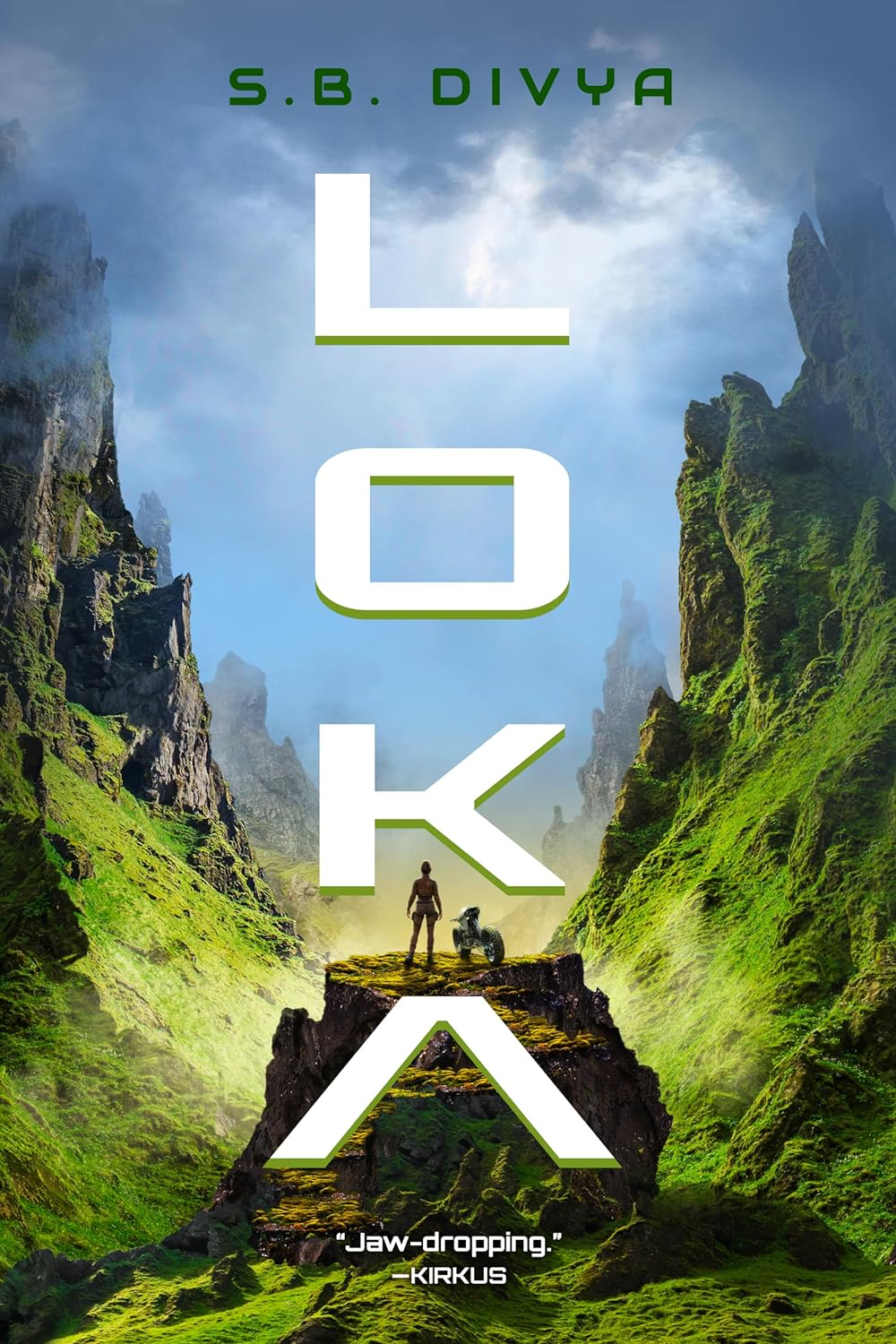
Loka (The Alloy Era, #2) – S.B. Divya
Akshana is a child that defies all existence. Her mother is human, and her maker is an Alloy—a post-human being with godlike powers. The ruling Alloy government condemns her very existence. For years, she has lived a sheltered existence on the planet Meru, raised by her human mother. But once Akshana turns 16, she heeds the call of Earth, the ancient homeworld of humankind. With the help of her friends, she takes up the rigorous Anthro Challenge: a trek to circumnavigate the habitable zone of Earth. As she navigates foreign terrain, Akshana comes to terms with how she was born and created—and where her destiny lies.
TW/CW: near-death situations, medical emergencies (related to sickle-cell anemia), xenophobia/discrimination (fictional), life-threatening storms
I thought that Meru had scared off all of the people who thought that S.B. Divya invented neopronouns, but apparently people are still complaining about it in the reviews for Loka? Did you just…miss book one in its entirety, or what?
I’ll get my main gripe about Loka out of the way first. The more I think about it, the more that I realize that my issue with Loka is that to some extent, it has the exact same stakes as Meru: a young girl/woman has to take a daring trek onto a foreign landscape, all the while facing prejudice from the outside world and alien, terrestrial dangers from the ground beneath her feet. S.B. Divya remains an excellent writer and crafter of worlds, but in terms of plot, in this case, lightning couldn’t strike twice. Aside from Akshana’s differing personality and the novelty of Earth 1,000 years in the future, there wasn’t as much to distinguish the two plots once I broke them down.
I wasn’t crazy about the main plot of the Anthro Challenge. In the future landscape of Loka, this challenge is designed for humans and Alloys to circumnavigate the landscape of Earth as humans did millennia ago. Only a few strips of Earth remain habitable (forming ringed borders around the world), but the brave adventurer must cross swaths of the Southern hemisphere and the Atlantic and Pacific Oceans in order to complete the challenge. In concept, it’s a great bit of worldbuilding, but it didn’t make for a very compelling of a plot. For the first half of the novel, it felt like the same regurgitation of 1) reach new landscape, 2) inter or intra-personal conflict within the friend group, and 3) make a harrowing trek to the next stop on the Challenge. This was rinsed and repeated with less change than I wanted; even with the new landscapes, none of the side characters had much time to develop, and they seemed to encounter almost the exact same problems for a solid 100 pages. It bordered on feeling cheap, given how innovative Meru was.
That being said, even though the plot faltered, Divya’s writing never did. You’ve just got to trust in her abilities at this point, because she can write some fantastic sci-fi, even if the foundation of the plot is flimsy. Her voice for Akshana perfectly captured that teenage urge to explore beyond your parents’ backyard and prove everyone wrong. Divya’s descriptions of future Earth, from the raging seas to the lush greenery to the plains of a futuristic America, immersed me instantly in a vibrantly crafted vision of the future. I’ll get to the specifics of the emotional core of Loka later, but that was perhaps the best part of the novel—S.B. Divya’s brand of space opera borders on hard sci-fi for me, but it keeps the emotional center that so many other hard sci-fi novels forget to consider.
The subject of disability was one of the more compelling aspects of Meru; in a genre rife with eugenic practices that get dismissed as signs of a “progressive” society, Divya changed the game by creating Jayanthi, who, in a future when most disabilities were edited out of the gene pool, was specifically engineered to have sickle-cell anemia. More than that, her sickle-cell anemia was advantageous for surviving the landscape of Meru. Fast-forward 16 years, and Akshana is experiencing, as I said before, the same plot, but her sickle-cell anemia presents unique challenges on Earth, leading to many a close scrape when she exhausts herself to near-fatal levels. She has thoughts of resentment towards her mother, who made a conscious decision to pass this gene down to her. S.B. Divya said that Loka was inspired by their experience being a disabled parent, and that shone through in Loka; eugenicists would have you believe that this would constitute cruelty on the highest level, but Akshana comes to reconcile with—and understand—her mother’s logic. By erasing this gene and others from the gene pool, the Alloys past erased entire cultures, as well as the ways in which they moved about in the world. Being disabled is challenging, to say the least, and in my experience, bothersome and at times taxing to deal with on a daily basis. Yet it has shaped my life in ways that I will never regret. Akshana comes to realize that her mother, even though the road to this decision was rocky, merely wanted her to know that individuality, adversity, and culture cannot be erased by a purging of the gene pool.
Which brings me to the ending. The buildup of Loka concerns the mounting pressure and prejudice surrounding daring Akshana and her friends as they complete the challenge and return to a world that wants to erase their bravery and ban the Anthro Challenge altogether. Not only has she come to terms with her disability, she has come to reckon with her status as a half-human, half-Alloy being in a galaxy where neither party wants her to exist. Yes, there was the physical challenge, but the real Anthro Challenge is the identity crisis you have along the way, amirite? All jokes aside, that was the real hurdle to overcome. I know how corny I sound, but the real journey was Akshana’s journey to self-acceptance in all of the facets of her identity. At the end of the treacherous paved with prejudice and hatred, Akshana learns that the only way to survive is to be yourself, unapologetically so. As she says, in Loka’s stunning final lines:
“Our bodies don’t have a true end. Subatomic particles bounced between skin and air continually. So what did that make me, or any person? If I coexisted with everything and everyone, then part of me was also part of them, and vice versa. To some people, I would never be human enough. To others, I would always be too human. In the end, I had no choice by to be myself.”
And if anything could save Loka from being a letdown, it would be this, and the character arc it coincides with. Excuse me for a moment…no, I’m not crying, it’s just raining on my face.
All in all, a sequel with a plot that nearly dragged the novel down, but just like Akshana completing the Anthro Challenge, beautifully stuck the landing after a rocky journey. 4 stars!
Loka is the second book in The Alloy Era series, preceded by Meru. S.B. Divya is also the author of Machinehood, Runtime, and several other science fiction short stories.
Today’s song:
That’s it for this week’s Book Review Tuesday! Have a wonderful rest of your day, and take care of yourselves!


 The Bookish Mutant
One thought on “Book Review Tuesday (11/19/24) – Loka (The Alloy Era, #2)”