
Happy Tuesday, bibliophiles!
Finna has been on my radar since it came out back in 2020; it had a funny and clever concept, but it just kept being pushed back on my TBR for whatever reason. I ended up picking it up after hearing praise from one of my creative writing classmates, and although it wasn’t perfect, it delivered on its inventive premise.
Now, tread lightly! This week’s book review contains spoilers for the novella, so if you intend to read Finna, skim at your own risk.
Enjoy this week’s review!
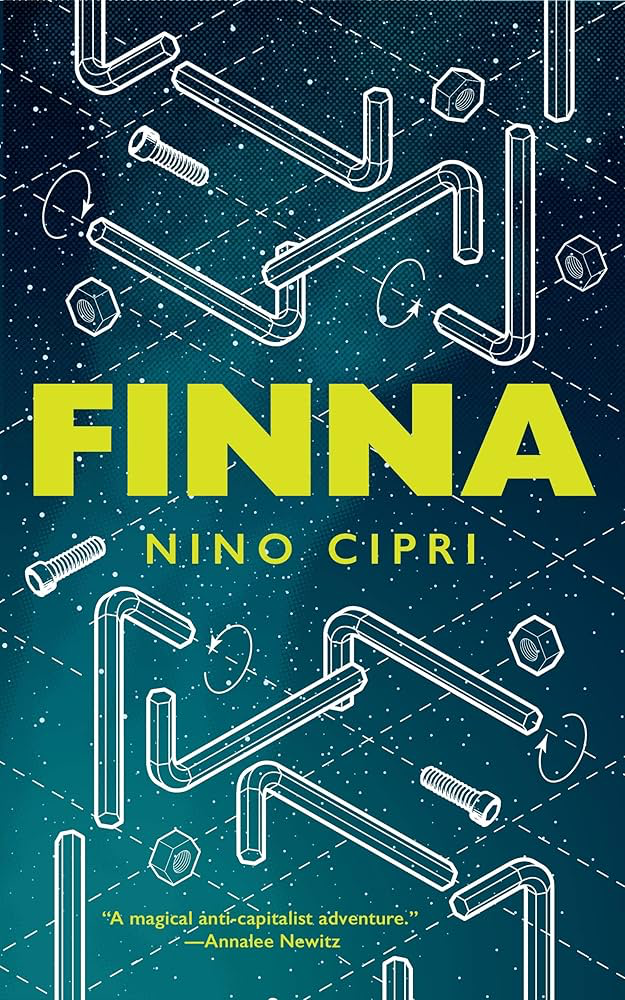
Finna (LitenVerse, #1) – Nino Cipri
Ava and Jules barely make a living working minimum wage at LitenVarld, a Swedish furniture supply giant. Ever since they broke up, they’ve been trying to avoid each other, and with the labyrinthine structure of the store, it’s easy. But the two are thrown together when an old woman goes missing and the manager tells them that LitenVarld is no ordinary store—it’s prone to opening wormholes that lead to alternate dimensions. Ava and Jules must search across the universes to return the old woman to safety at any cost, but their superiors appear less and less like they have their needs in mind…
TW/CW: blood, violence, grief, mental health themes (anxiety and depression), misgendering
My main concern with Finna was that it would only have the premise to hold it up. It’s a fantastic premise! And although it wasn’t a perfect novella, it went far beyond the expectations for its ideas, delivering an anti-capitalist spin on the monstrous multiverse.
Making Finna a novella was, without a doubt, a wise move. It’s got an inviting premise—a not-IKEA store that’s home to a multitude of portals to strange and hellish dimensions—but it’s one that could have easily been stretched out. It partly works because…well, if you’ve ever been inside IKEA, that’s where your mind naturally goes, but Finna mainly succeeded because Cipri knew the limits of the idea. If it had been a full-length novel, I’m sure it would have been interesting to see the other dimensions hidden within the interdimensional labyrinth of LitenVarld, but the plot couldn’t have sustained itself beyond 100 pages. I’ve seen too many novels where the story has been stretched far too thin, so to have an author know the limits of their story—and have an inventive novella to show for it—was incredibly refreshing.
Finna is the perfect story for right now not just because it has a fun concept, but because it truly nails the kind of corporate neglect that runs rampant in workplaces in this day and age. Even against the threat of a multiverse full of monstrous obstacles (including but not limited to man-eating furniture), Ava and Jules are having to tackle threats leagues beyond their pay grade, and their only compensation is gift cards for a pasta restaurant. Their managers openly tell them that they don’t actually care about the old woman who’s gotten lost in the multiverse—they just want Ava and Jules to find an alternate universe replacement for her so that they can keep up appearances. It’s all so blatantly uncaring and corporate—and it’s all realistic. If some massive chain of stores discovered a wormhole in one of their locations, they would absolutely cover it up until it was no longer possible to do so, especially at the expense of the minimum wage employees. I will say that, although you got hit over the head with this even though the commentary was right there already, Finna’s setup made it perfect for the anticapitalist commentary that Cipri explored—corporations only make it look like they care about you when it looks good for them, and even then, the worker is always dispensable. The execution of this corporate setting was, in the end, what made Finna so successful in that regard—it seems like a real, capitalist response to a fictional problem.
That being said, even though Finna works best as a novella, it did fall victim to some of the pitfalls of novella writing. It’s difficult to develop characters in just over 100 pages, and this worked to the detriment of its protagonists, Ava and Jules. We only knew them from the lens of their situations and their breakup; after finishing the novella, all I knew about Ava was that she a) had a failed relationship with Jules, b) had anxiety and depression, and c) hated her job—nothing much about her personality. This is about as deep as we get with her, and for Jules, we get even less, other than the fact that they’re more reckless and cocky, and for that reason, Ava doesn’t like working with them. The plot was compelling and well-executed enough for me to continue reading the story, but it was so plot and theme-driven that the characters were left in the dust.
Such underdeveloped first drafts of characters meant that the emotional impact of Finna was all but deadened. I got the feeling that I was supposed to feel something when Jules sacrificed themself so that Ava could return to her home dimension, but since I knew so little about them, I never felt much. What Jules needed, perhaps more than a handful of base personality traits, was some kind of motivation; it could also be down to how quickly the second half moves, but their quest through the other dimensions gave us no indication of why they would go from reckless to selfless. It could just be the constraints of the novella format, but I’ve read plenty of novellas longer and shorter than Finna that have been able to establish well-rounded characters with believable motivations, so I’m not sure if there’s much of an excuse for this.
All in all, a novella with a funny, inventive premise and sharp anti-capitalist commentary that was dragged down by its underdeveloped characters. 3.5 stars!
Finna is the first novella in the LitenVerse series, followed by Defekt. Nino Cipri is also the author of the short story collection Homesick: Stories and the forthcoming YA novel Dead Girls Don’t Dream. They have also contributed stories to Nonbinary: Memoirs of Gender and Identity, Transcendent: The Year’s Best Transgender Speculative Fiction, and several other anthologies.
Today’s song:
That’s it for this week’s Book Review Tuesday! Have a wonderful rest of your day, and take care of yourselves!


 The Bookish Mutant
One thought on “Book Review Tuesday (7/23/24) – Finna”